
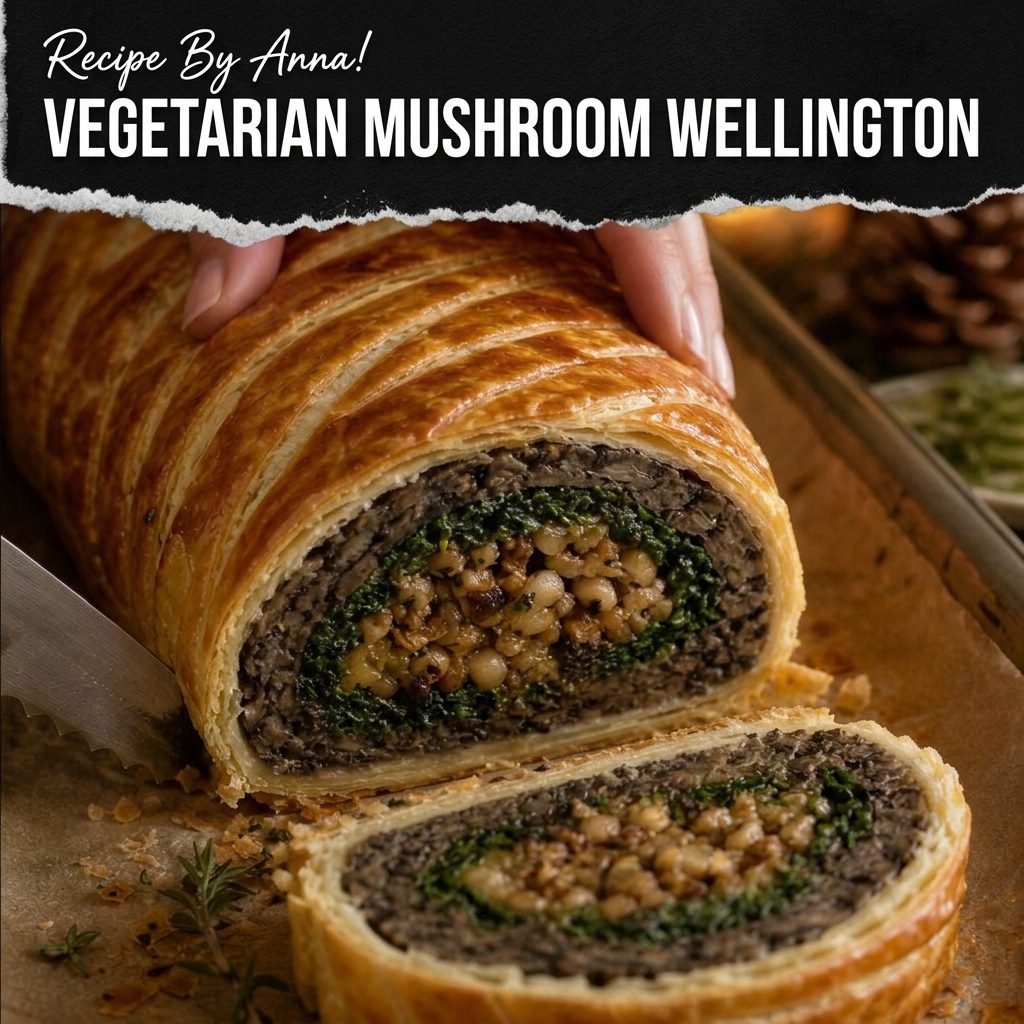
Vegetarian Mushroom Wellington for Thanksgiving
Some dishes get passed around the table. A Wellington gets carried in. That’s the whole reason this recipe exists on a vegetarian table: Thanksgiving already has twenty bowls that travel hand to hand, and what it’s short on, when nobody is roasting a turkey, is the one dish that arrives with ceremony, gets set down at the center, and gets carved. This is that dish — a log of puff pastry wrapped around a mushroom filling, baked to a deep gold, and cut at the table in thick slices that show rings of dark, concentrated mushroom, a stripe of green spinach, and a sweet, crunchy core of chestnuts and walnuts. The turkey has held the job for a century or so. This is my candidate to share the shift.
The inside is built like a proper centerpiece, not like vegetables hiding in a coat. The mushroom layer is a duxelles — mushrooms cooked down with shallots and thyme until they’ve given up their water on purpose — which is the most mushroom flavor that has ever fit in a spoon. The spinach is wrung until it’s barely damp, so it seasons instead of steaming. And down the middle runs the crunch: crumbled chestnuts and toasted walnuts, which bring exactly the dense, sweet bite a plate of vegetables is usually missing on a holiday. Wrap all three in all-butter puff pastry, bake until the shell is gold and shatteringly layered, and the table does the thing you want it to do: a hush lands, and then somebody asks for the knife.
Site disclosure, as always, because the shelf here is organized: this isn’t the only vegetarian centerpiece in the house. The vegan Thanksgiving pot pie covers the table’s plant-only end, and the no-noodle butternut and carrot lasagna is the other candidate for the middle of the table. This wellington is the formal one — the dish for the year you want a carve instead of a scoop, and the year somebody at the table deserves a little pageantry with their gratitude.
The Duxelles Doctrine
Here is the entire recipe in one sentence: pastry forgives almost everything except water. Puff pastry rises because it’s built from thin sheets of butter trapped between thin sheets of dough, and when it hits a hot oven, the water in the butter flashes to steam and lifts every layer apart. That steam is a limited resource. Surround those layers with wet filling and the moisture soaks inward while the pastry bakes, the layers never fully separate, and you end up with something brown and dense and quietly disappointing — a souvenir, not a centerpiece. Every rule in this recipe exists to keep water out of the pastry’s way, and there are exactly three rules.
Rule one is the duxelles itself. Mushrooms are around ninety percent water, which is their reputation problem and also the opportunity: cook them long enough in a dry-hot pan and they surrender that water into the air, leaving behind a dark, spreadable paste that tastes like the idea of mushrooms, concentrated about tenfold. Two pounds of mushrooms walk into the pan; a little over two cups of duxelles walk out. That’s not loss — that’s the recipe. A filling that gave up its water in the skillet has none left to give up in the oven, which is the difference between a pastry that shatters and one that sighs.
Rule two is the wring. Spinach arrives — thawed from frozen, usually — carrying a shocking amount of liquid, and the only fix is physical: pack it in a clean kitchen towel and twist, hard, twice. What comes out through the cloth is dark green water, and it is water you would otherwise have baked into your pastry. The spinach that survives the towel is dense, almost rubbery, and exactly right. If you skip this step, no other step in the recipe can save the bottom crust, and I mean that literally.
Rule three is the two chills. The filling goes into the roll cold, and the finished log goes into the oven cold. Warm filling starts melting the pastry’s butter layers on contact, before the oven has a chance to set them; a twenty-minute rest in the refrigerator firms the butter back up so the pastry hits the heat all at once and rises all at once. Cold in, gold out. The chills are the cheapest ingredient in the recipe — they cost nothing but patience — and they’re the ones most often skipped by people who then write to me about their flat wellingtons.
⏱️ 50 MINUTES HANDS-ON | 🍄 FEEDS 8 | 🦃 THE VEGETARIAN CENTERPIECE
- Duxelles: 25 minutes, plus cooling — the filling must be cold before rolling
- Assembly: 15 minutes of spreading, rolling, and scoring
- Chill: 20 minutes, while the oven and the sheet pan heat
- Bake: 35-40 minutes at 400°F, to deep gold top and bottom
- Rest: 10 minutes before the first slice — non-negotiable
- Yield: one log, eight thick slices
The Pastry Pact
The pact is this: the freezer aisle does the laminating, and you buy the all-butter kind. Homemade puff pastry is a legitimate two-day project involving letter folds and rest periods, and I have deep respect for anyone who does it — from a respectful distance, on a week that isn’t Thanksgiving. Store-bought all-butter puff bakes up into hundreds of distinct, shattering layers and no one at the table can tell it wasn’t yours. The standard box holds two sheets; that’s the recipe. Read the label once, because the cheaper rolls are made with shortening, and shortening pastry tastes like the box it came from.
Everything else is ordinary equipment doing honest work:
- Large, wide skillet — the duxelles needs surface area, so the mushrooms brown instead of boiling; a Dutch oven can stand in if you cook longer
- Food processor or a good knife — the mushrooms want a fine, even mince, and the processor does it in five pulses
- Clean kitchen towel — the spinach’s only way out; paper towels tear, a towel wrings
- Sheet pan and parchment — with the pan preheated in the oven while the log chills, so the bottom starts the moment it lands
- Pastry brush — for the egg wash; a spoon paints, a brush polishes
- Sharp or serrated knife — for scoring before the bake and carving after the rest
One note on the pan preheat, because it sounds fussy and isn’t: a cold sheet pan goes into the oven with the log on it and spends the first ten minutes heating up, during which the pastry’s butter melts sideways into the pan instead of flashing to steam upward. A preheated pan starts the bottom crust the instant the wellington lands, and it’s the single most reliable fix for the pale, soft underside that sinks otherwise-good versions. The oven should be fully hot too — 400°F, no compromise, because pastry this buttery wants a violent start.
Ingredients (With Labels)
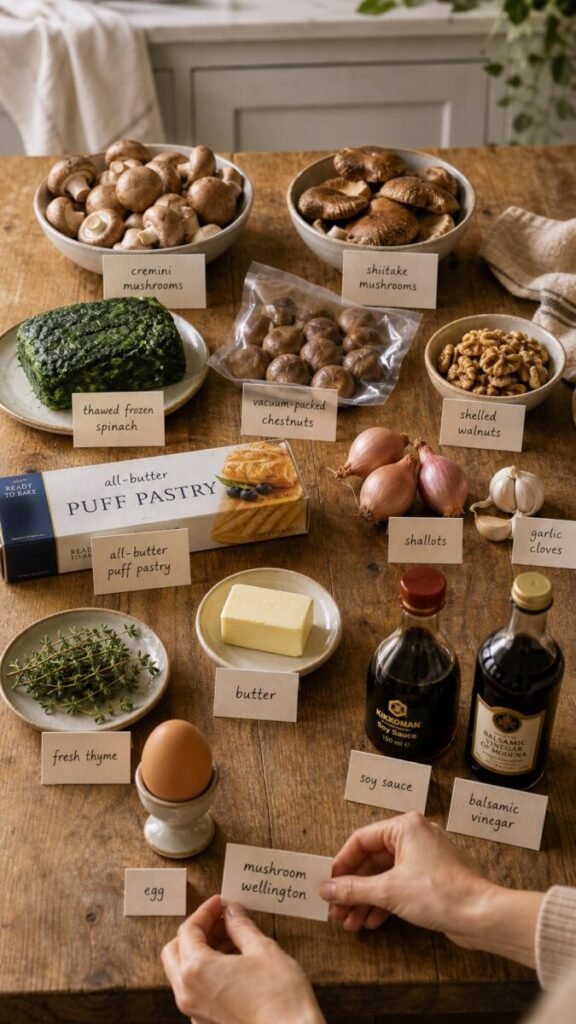
🍄 The Duxelles
- Cremini mushrooms: 1½ lb — the workhorse body of the filling
- Shiitake mushrooms: 4 oz, stems discarded — the depth note; swap more cremini if needed
- Shallots: 2 medium, minced
- Garlic: 3 cloves, minced
- Butter: 3 tablespoons
- Thyme: 2 teaspoons fresh (or ¾ teaspoon dried)
- Soy sauce: 1 tablespoon — the umami anchor; mushroom-friendly even on a holiday table
- Balsamic vinegar: 1 tablespoon
- Salt and black pepper: ½ teaspoon salt, ¼ teaspoon pepper
🌿 The Green Layer
- Frozen spinach: 10 oz, thawed — and then wrung within an inch of its life
- Nutmeg: one small pinch — the classic spinach partner, and yes, the pinch matters
- Black pepper: ⅛ teaspoon
🌰 The Crunch
- Vacuum-packed chestnuts: 1 cup, crumbled — the holiday signature
- Walnuts: ¾ cup, toasted and roughly chopped
- Fresh sage: 6 leaves, torn
🥐 The Wrap
- All-butter puff pastry: 2 sheets, thawed in the refrigerator overnight
- Egg: 1, beaten with a splash of milk — the wash
- Flour: a small handful, for the rolling surface
Step by Step How to Make
- Step 1 — The duxelles. Brush the mushrooms clean with a damp cloth — never rinse them, they soak water like little sponges and this recipe has a strict water policy — then mince them fine in the processor, in batches, or with a patient knife. Melt the butter in the wide skillet over medium-high heat, add the mushrooms, and leave them alone for the first three minutes: they will hiss, then flood, then, as that liquid cooks off, begin to brown. Keep cooking and stirring for 20 to 25 minutes total, until the pan goes quiet and the mushrooms have gone from a crowded pan of raw caps to a dark, glossy, nearly dry paste — two pounds walking in, two cups walking out. Add the shallots and garlic for the last 5 minutes, then the thyme, soy sauce, balsamic, salt, and pepper for the last 2. Scrape it into a bowl and let it cool to room temperature, then refrigerate until genuinely cold. This is the make-or-break step, and it cannot be rushed at the end: an impatient duxelles is a wet duxelles.
- Step 2 — The green layer. While the duxelles cools, take hold of the thawed spinach. Pile it into the center of the clean kitchen towel, gather the corners into a bundle, and twist, hard, over the sink — then open, re-pack, and twist again. You’re looking for a dense, compressed brick of greens; a full cup of dark liquid will have left through the cloth, and every drop of it is a drop your pastry won’t have to survive. Unwrap the brick into a bowl, break it up, and mix in the nutmeg and pepper with your fingers.
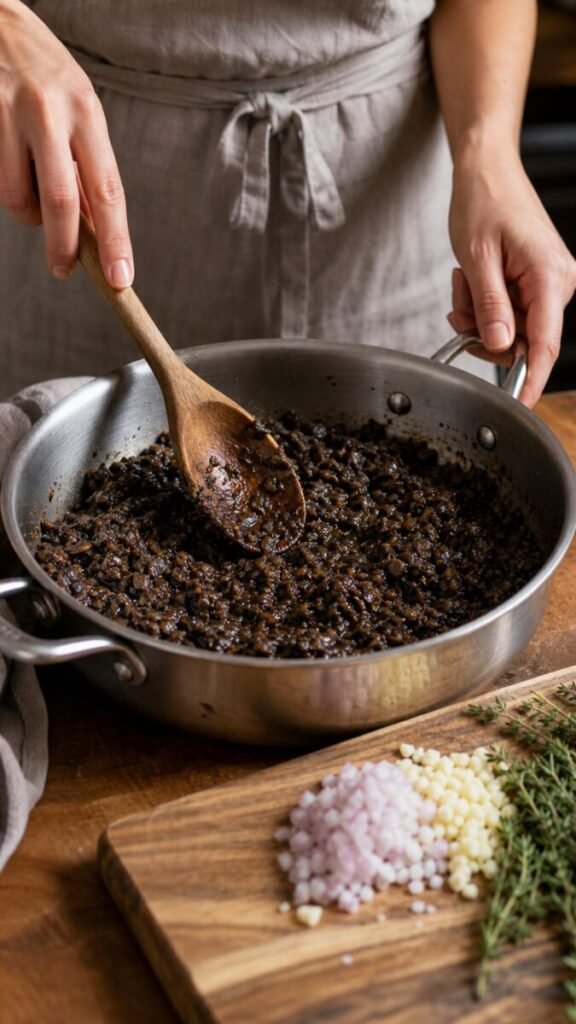
- Step 3 — The crunch. Toast the walnuts in the dry skillet for 6 to 8 minutes over medium heat, shaking twice, until they smell like a bakery instead of a bag — the oils wake up and they hold their snap through the bake. Crumble the chestnuts into rough pieces with your fingers, roughly chop the walnuts, and toss them together with the torn sage. Keep the pieces coarse: this layer is the wellington’s texture argument, and texture needs corners.
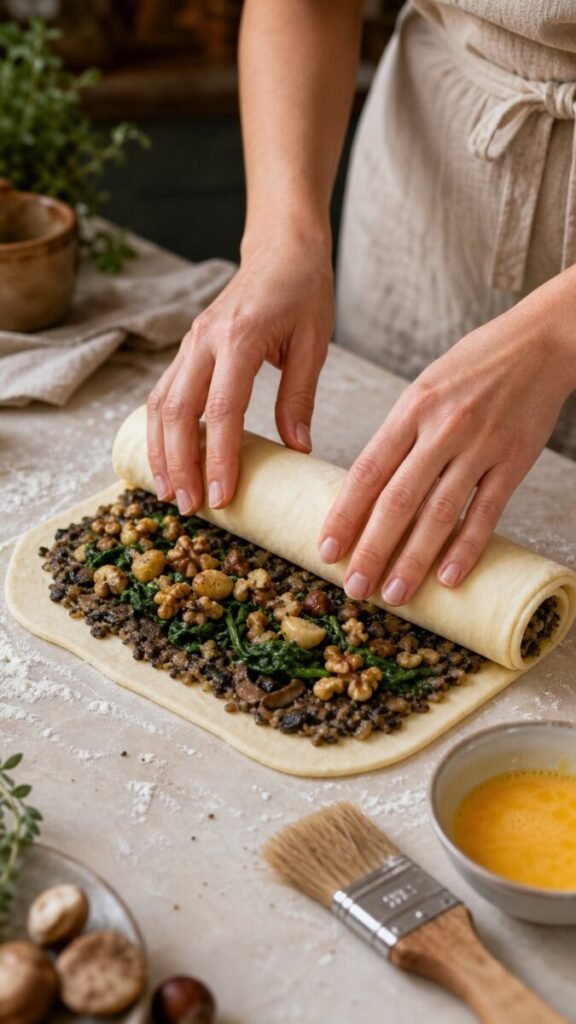
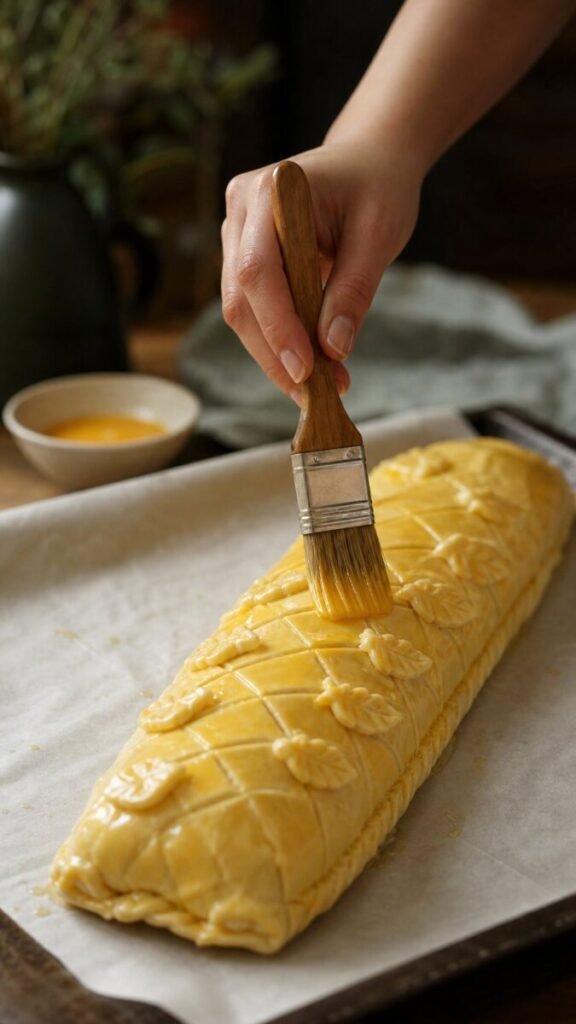
- Step 4 — The roll. Flour the counter lightly and roll one pastry sheet into a rectangle roughly 12 by 14 inches, keeping the second sheet cold until its moment. Spread the duxelles down the center of the pastry in a thick runway, leaving a 2-inch border on every side — it should look like too much, and it isn’t. Lay the spinach over it in a slightly narrower blanket, then run the chestnut-walnut mixture down the middle in a fat stripe. Brush the exposed border with egg wash, fold the short ends over the filling first, then roll the long side over and over until the seam lands underneath, tucking and pressing as you go. Roll the log seam-side down, brush the whole thing with egg wash, and give it three shallow diagonal scores with the sharp knife — you’re marking the pastry, not sawing through it. Cut leaves from the second pastry sheet if the mood strikes, press them on around the scores, and wash them too.
- Step 5 — The chill and the bake. Slide the log onto parchment, still seam-side down, and refrigerate it — uncovered — for 20 minutes. Put the empty sheet pan on the middle rack and heat the oven to a full 400°F while the log firms up; the cold and the heat are working as a team, and the twenty minutes costs you nothing since the oven needed the time anyway. When both are ready, transfer the log on its parchment onto the hot pan and bake 35 to 40 minutes, until the pastry is puffed and deeply golden on the ridges and bronze on the underside, and the scores have cracked open to show the layers. If the top is browning faster than the bottom, slide the pan one rack down for the last 10 minutes — but don’t pull it early; pale pastry is soft pastry.
- Step 6 — The rest and the carve. Rest the wellington 10 minutes on the pan before cutting — the filling sets in those minutes, and set filling is the difference between carved rings and smeared ones. Then, with the serrated knife and a gentle sawing motion, cut straight down into thick slices, about an inch each, wiping the blade between cuts. Plate the first slice facing up, so the table sees the cross-section before anyone tastes it: dark mushroom rings, the green stripe, the golden crunch down the center, all inside a shattering shell. This is the moment the dish was invented for. Take it slowly, and let people watch.
The mini mushroom and gruyere pot pies are the same mushrooms with the ceremony removed — individual ramekins, no carve, no audience. Make the wellington for the day that deserves a carry-in, and the pot pies for every other week of the year.
Anna’s Kitchen Notes
Brush the mushrooms, don’t drown them. Mushrooms are little sponges, and a rinse under the tap loads them with exactly the water the whole recipe is built to expel — it adds ten minutes of cooking and dilutes the browning. A damp cloth over each cap takes off every speck of field dirt I’ve ever encountered. If your mushrooms arrive genuinely gritty from a farmers market, a fast rinse and a thorough towel-dry is the honest compromise; just never soak.
Chestnut sourcing, honestly rated. Vacuum-packed or jarred whole chestnuts are the sane buy — they’re peeled, cooked, and ready to crumble, usually shelved near the holiday baking display. Fresh chestnuts roasted and peeled at home are wonderful and completely unreasonable on a day when the oven is already spoken for; that’s a Sunday-in-November project, not a Thanksgiving-morning one. And if chestnuts fail you entirely, the all-walnut version below is not a consolation prize — several people in my family actively prefer it.
The shiitake is a small cost with a big job. Cremini alone makes a fine duxelles, but four ounces of shiitake — stems gone, caps in the processor — adds a dark, almost smoky depth that reads as more than the sum of its price. If you want to push further, a half-ounce of dried porcini, soaked and minced in, turns the volume all the way up; that’s the version I make when the wellington is the only main on the table and I’m cooking for skeptics.
Make the duxelles on Tuesday. It keeps three days refrigerated in a covered bowl, and it improves overnight as the flavors settle into each other — the shallots mellow, the thyme spreads out. Wednesday becomes a fifteen-minute assembly and a chill; Thursday is oven management you’d be doing anyway. On the one cooking day of the year with a schedule attached to it, splitting the recipe across the week is not laziness. It’s logistics, and logistics is what Thanksgiving actually runs on.
Two logs, one oven. For a table past ten, bake two wellingtons rather than one giant one — a double-width log bakes unevenly, with a pale middle and overdone ends, while two standard logs swap racks at the halfway point and finish together. The second log is also your insurance policy: baked or unbaked, it freezes, and a spare centerpiece in the freezer is the kind of preparedness that makes hosting feel casual instead of heroic.
The Head of the Table
The wellington is the main, so the rest of the table can relax. Around it, I want one soup poured small as a starter, one long-cooked side, and one green thing — the pumpkin soups handle the first in coffee cups, and the maple roasted Thanksgiving vegetables are the side that shares the wellington’s thyme-and-toasted-nut accent without repeating itself. For the hour before dinner, cheesy thumbprint appetizers make a sly preamble — little warm, salty bites that take the edge off the crowd without taking any of the wellington’s thunder.
For the wider table: the vegan pot pie stands in for any plant-only guests, and the two centerpieces make a handsome pair on the sideboard, if you’re the kind of host who says sideboard out loud. The day after, thick slices of leftover wellington beside a scoop of the cranberry apple quinoa salad is the best lunch of the whole holiday weekend, and I will fight quietly for that title. And if the table is fully vegetarian this year, the butternut and carrot lasagna as a second main turns the meal from a carve into a small buffet, which nobody has ever complained about.
Same Pastry, Other Centers
The all-walnut version. Skip the chestnuts and double down on toasted walnuts — a cup and a half total. More tannic, more crunch, slightly less sweet, and honestly a little more everyday. This is the Tuesday version that eventually becomes the version you make without checking the recipe.
The squash-centered school. A peeled, cubed, and roasted butternut squash layer between the spinach and the duxelles makes the filling taller, sweeter, and more carving-stable — the squash sets firm and the slices come out architectural. Add 25 minutes to the schedule for the roasting, and press the cubes dry with a towel before rolling, because roasted squash keeps opinions about moisture.
The lentil-walnut loaf. One can of lentils, cooked down dry with the duxelles aromatics and a spoon of tomato paste, folded with the walnuts — the vegan school’s answer to a Wellington center, dense and sliceable and honest. With plant butter in the pan and a plant-milk wash, the whole log goes plant-based; the carve survives, the layers survive, and what you’ll miss is the butter’s roundness at the edges. It is still the best-looking vegan main most tables have ever seen.
The goat cheese core. A log of fresh goat cheese laid down the middle where the crunch goes — it melts into a warm, tangy ribbon that plays beautifully against the sweet chestnuts. Half goat cheese, half chestnut-walnut mix is the version that converted my brother-in-law, a man who described vegetarian food, before this, as “the appetizer that never grew up.”
Individual wellingtons. Cut the pastry into quarters, portion the filling into four logs, and bake 22 to 25 minutes. Everyone gets their own sealed, steaming parcel with a carved initial scored on top — the extra ten minutes of assembly buys the kind of table reaction that caterers charge for.
The mustard inheritance. A thin schmear of whole-grain mustard on the pastry under the duxelles, which is the beef Wellington habit carried over. Sharp, faintly vinegary, and surprisingly good with the mushrooms — but start with a tablespoon, because mustard does not know how to whisper.
The Wellington Math
| Nutrient | Per Serving (1 slice of 8) |
|---|---|
| Calories | 340 kcal |
| Protein | 7 g |
| Carbohydrates | 30 g |
| Fats | 24 g |
Estimates as written — all-butter pastry fully counted, chestnuts and walnuts included, no apologies offered for either. Seven grams of protein is what a nut-and-mushroom centerpiece delivers; pair the slice with the quinoa salad from the pairings and the plate covers itself. The friendlier math is financial: two pounds of cremini, four ounces of shiitake, a pack of chestnuts, walnuts, and two sheets of good pastry run about twenty-four dollars, which puts eight centerpiece slices on the table at three dollars apiece — roast presence, soup money. On a holiday whose grocery receipt arrives with its own weather system, that math deserves a seat at the table too.
The Week Before
The schedule, in the order a calm Thanksgiving actually unfolds. Duxelles: Tuesday or Wednesday, three days ahead at most, and better on its second day. Full assembly: Wednesday night, log wrapped airtight and refrigerated, ready to bake Thursday with the chill already done. The freezer takes an assembled, unbaked log for a month — bake from frozen, adding roughly 15 minutes and tenting it with foil at the 30-minute mark so the outside doesn’t outrun the middle. On the day itself, the only decisions left are the oven and the resting, which is exactly the right amount of decisions for a Thursday.
Leftovers keep three days, and they reheat best uncovered in a 325°F oven for 12 to 15 minutes, which re-crisps the pastry that the fridge softened. The microwave works on the filling and ruins the shell — it turns the bottom to cardboard and the middle to steam — so I use it only when the audience is me alone at a counter, and I make no notes about it afterward.
Cold from the fridge, the wellington is nearly as good as hot, in the way of dishes with a firm, set filling: the rings hold, the duxelles firms to almost a pâté, and a thick slice on bread with mustard becomes the sandwich my household now requests by name. A holiday recipe that feeds you twice is doing double work in the best sense, and this one never seems to make it past Saturday.
Where It Goes Wrong
The soggy bottom. The genre’s classic failure, and it’s almost always one of three leaks: duxelles pulled off the heat while still weeping, spinach that skipped the towel, or a sheet pan that went into the oven cold. The recipe’s three water rules cover all three, and the underside of the pastry is where they all show up at once. If your wellingtons keep sinking, wring harder — the towel has more to give than you think.
Mushrooms that boiled instead of browned. A pan too crowded or stirred too eagerly traps the mushrooms’ own liquid around them, and they simmer to gray instead of frying to bronze — the result tastes like the idea of mushrooms, with none of the conviction. Two fixes: a wider pan, and patience for the first three minutes, when the pan seems too dry and every instinct tells you to fiddle. Don’t.
The split seam. A log overfilled or rolled with the seam on top opens along its belly in the oven, every time, and spills its chestnut stripe onto the parchment. Keep the filling inside the 2-inch border, roll until the seam sits underneath, and press it closed with conviction before the egg wash. Pastry forgives a lot, but it keeps no secrets about strain.
Flat, dense pastry. Warm assembly is the usual cause — filling straight off the stove, or a log that went from counter to oven — with shortening pastry running a close second. The butter layers need to hit 400°F cold and all at once; give them the two chills and the real oven temperature, and the rise takes care of itself with room to spare.
Slices that smear instead of ring. The rest got skipped. Ten minutes off the heat is when the duxelles and the spinach set into carveable layers, and a log cut at minute two is a delicious smear. Also mind the knife: a gentle saw, straight down, blade wiped between slices. The cross-section is the whole presentation — treat it like one.
A pale, soft underside despite everything. If the water rules were followed and the bottom still lands pale, the pan wasn’t hot enough or the parchment bunched and steamed a corner flat. Preheat the empty pan a full twenty minutes, smooth the parchment flat under the log, and slide the pan one rack lower for the final stretch if the top browns first. The underside is the part nobody photographs, which is exactly why it has to be right.
Wellington Questions
Can I assemble it the night before?
Yes — that’s the intended schedule, not a workaround. Build the log Wednesday, wrap it airtight, and refrigerate; on Thursday it goes straight from the fridge onto the preheated pan, with five extra minutes on the bake for starting cold. The overnight chill is genuinely better for the pastry, and the morning-of workload drops to oven-watching, which on Thanksgiving is the correct amount.
Can I make it vegan?
Largely, yes: plant butter in the duxelles, a plant-milk wash on the pastry, and the filling was already plants — mushrooms, spinach, chestnuts, walnuts, shallots, thyme. The lentil-walnut variation below is the fully plant-based build. What you’ll notice is the butter’s roundness missing at the edges of the pastry, which is a real loss and a small one; the carve, the layers, and the presentation all survive intact. For a mixed table, bake one of each and let the labels stay vague.
Do I really need the chestnuts?
No — the all-walnut version is a first-class wellington in its own right, and it’s what I make most weekends. Chestnuts bring a sweet, starchy, faintly holiday-specific note that walnuts alone don’t quite cover, which is why they’re in the Thanksgiving version. If your table has a walnut skeptic, swap in pecans and call it done.
Can I use one large piece of pastry instead of two sheets?
You can, if your store sells puff in a single roll — roll it into the same 12-by-14 rectangle and proceed. The second sheet in the standard box is officially for patching and decorating, and unofficially your insurance; keep it cold until the log is sealed so you can mend any tear with a wet-edged patch. Extra pastry also makes the leaves, if you’ve decided this is the year for leaves.
Why does everything have to be cold?
Because puff pastry rises on steam trapped between its butter layers, and only cold butter traps anything. Warm filling migrates heat into the pastry during assembly, the butter softens and blends into the dough, and by the time the oven arrives there are no distinct layers left to lift — just a solid, honest sheet of something closer to shortbread. The two chills cost forty total minutes, most of it unattended, and they are the entire difference between a pastry that shatters and one that merely browns.
What do I serve with it?
Treat it as the main and keep the rest of the table modest: a soup poured small, the maple roasted vegetables, something green and sharp, and bread only if the table demands it. A vegetarian pan gravy — the duxelles skillet deglazed with mushroom stock, a spoon of flour, and a splash of soy, simmered to spoon-coating — takes eight minutes and makes the carve feel complete for anyone who misses the turkey’s accessory. The classic move is a port reduction, which is lovely, and which my Thursdays have never once had room for.
How do I know when it’s done?
Color, and then a tap. The pastry should be deeply golden across the ridges with the scores cracked open, the underside bronze when you lift a corner of the parchment, and the tallest ridges firm — not crisp-crackling — under a fingertip. Thirty-five to forty minutes covers it at a true 400°F; ovens that run cool will stretch toward forty-five. Pull it when the color persuades you, not when the timer does, and then let it rest the full ten minutes before the first cut.
Vegetarian Mushroom Wellington for Thanksgiving
Ingredients
As an Amazon Associate I earn from qualifying purchases.
Mushroom duxelles
- 1½ lb (680 g) cremini mushrooms, finely minced
- 4 oz (113 g) shiitake mushrooms, tough stems removed and caps finely minced
- 2 medium shallots, minced
- 3 cloves garlic, minced
- 3 tablespoons unsalted butter
- 2 teaspoons fresh thyme leaves, or ¾ teaspoon dried thyme
- 1 tablespoon soy sauce
- 1 tablespoon balsamic vinegar
- Up to ½ teaspoon fine salt, to taste
- ¼ teaspoon black pepper
Spinach layer
- 10 oz (283 g) frozen spinach, prepared according to its package, cooled, and thoroughly squeezed dry
- 1 small pinch nutmeg
- ⅛ teaspoon black pepper
Chestnut-walnut center
- 1 cup (about 150 g) peeled, fully cooked chestnuts, crumbled
- ¾ cup (about 85 g) walnuts, toasted, cooled, and roughly chopped
- 6 fresh sage leaves, torn or thinly sliced
Pastry & finish
- 2 sheets all-butter puff pastry, about 17–17.3 oz (480–490 g) total, thawed in the refrigerator; use enough for the wrapper, with surplus for optional decorations
- 1 large egg
- 1 teaspoon milk
- A little all-purpose flour, for rolling
Kitchen Tools
- Large, wide skillet
- Food processor or chef’s knife
- Cutting board and wooden spoon
- Clean kitchen towel, for wringing the cooled spinach
- Shallow food-storage container, for cooling the duxelles
- Mixing bowls and measuring cups and spoons
- Rolling pin and pastry brush
- Heavy metal baking sheet, suitable for empty preheating
- Baking parchment rated for at least 400°F
- Flat transfer tray
- Paring knife and serrated knife
- Instant-read food thermometer
- Oven mitts and heat-resistant trivet
- Wide serving spatula
Directions
- Make a concentrated mushroom filling. Wipe the mushrooms clean, or rinse briefly if gritty and dry thoroughly. Mince finely with a knife or pulse in small batches without turning them into a purée. Melt the butter in a wide skillet over medium heat. Cook the shallots for 4–5 minutes, then add the garlic for 1 minute. Add the mushrooms and increase the heat to medium-high. Cook, stirring regularly, for about 20–30 minutes or longer as needed, until the released liquid has evaporated and the mixture is concentrated and spreadable. Add the thyme, soy sauce, balsamic, and pepper. Cook another 2–3 minutes until no liquid pools, then taste before adding the salt.
- Chill the duxelles and dry the spinach. Spread the mushroom filling in a shallow container and refrigerate promptly until completely cold, allowing about 45–90 minutes or longer as needed. Do not leave it at room temperature for hours. Prepare the spinach according to its package instructions, then cool enough to handle. Gather it in a clean towel and squeeze firmly until very little moisture comes out. Break up the spinach and season with the nutmeg and pepper. Refrigerate until ready to assemble.
- Prepare the chestnut-walnut center. Toast the walnuts in a dry skillet over medium-low heat for about 4–6 minutes, stirring frequently until fragrant. Cool and chop, then combine with the crumbled cooked chestnuts and sage. Mash some of the chestnuts with a fork to help the center hold together while leaving the walnuts chunky. Keep all filling components cool before assembly.
- Prepare the wrapper and arrange the filling. Beat the egg with the milk. On a lightly floured surface, prepare a pastry rectangle about 12×16 inches and approximately ⅛ inch thick. Because sheet sizes vary, join pieces from both sheets if necessary: overlap the edges by about ½ inch, brush the join lightly with egg wash, and press together gently. Do not stretch one small sheet paper-thin. Transfer to parchment on a flat tray. Spread the cold duxelles in a centered rectangle, leaving a generous clear border. Layer the spinach more narrowly over it, then place the chestnut-walnut mixture in a compact stripe down the middle.
- Seal, vent, and chill the Wellington. Lightly brush the sealing borders with egg wash. Bring the long sides over the filling to overlap, then fold and seal the ends. Trim excessive dough rather than building thick folds. If the wrapper will not close without stretching, remove some filling or enlarge it. Turn carefully so the seam is underneath. Add optional pastry decorations using egg wash to attach them. Make shallow decorative scores and cut 2–3 small vents fully through the top pastry for steam to escape. Refrigerate for 20–30 minutes. Meanwhile, preheat the oven to 400°F with a suitable heavy metal baking sheet on the lower-middle rack.
- Bake until the pastry and center are ready. Brush the chilled Wellington with a thin coat of egg wash, leaving the vents open. Wearing oven mitts, place the hot baking sheet on a heat-resistant surface. Slide the log onto it using the parchment and transfer tray; do not lift the heavy log by unsupported parchment alone. Bake for about 35–50 minutes, until the pastry is deeply golden, the underside is cooked, and the center reaches 165°F. If the top browns before the middle is hot, tent loosely with foil and continue baking. Check temperature rather than relying on pastry color alone.
- Rest and carve. Let stand for 10–15 minutes before slicing. Use a serrated knife with a gentle sawing motion to cut eight equal portions, wiping the blade between cuts. Support each slice with a wide spatula; some loose filling is normal because the center has no egg binder. Allow roughly 2½–3½ hours overall, including cooling and chilling, but excluding pastry thawing. Refrigerate leftovers within 2 hours, or within 1 hour above 90°F. Use within 3–4 days of cooking the filling, counting any advance refrigeration toward that window, or freeze. Reheat to 165°F.
Nutrition
| Nutrient | Approximate amount per serving |
|---|---|
| Serving size | 1 of 8 slices |
| Calories | 440–530 kcal |
| Protein | 10–12 g |
| Carbohydrates | 36–44 g |
| Total fat | 30–36 g |
Broad estimates assume the full mushroom, spinach, chestnut, and walnut filling, with approximately 350–490 g pastry used for the wrapper and decorations. Includes butter and a portion of the egg wash. Excludes unused pastry, surplus filling, gravy, and side dishes. Actual values vary considerably with pastry brand and quantity. Contains wheat, milk, egg, soy, and walnuts; also contains chestnuts. This version is vegetarian, not vegan or gluten-free. Check pastry ingredients for animal-derived fats other than butter.