


Vegetarian Pot Pie Soup Recipe
Chicken pot pie is a magnificent idea wrapped in an inconvenient format: the filling is the whole point, and getting to it involves forty minutes of pastry architecture plus a serving knife and a certain amount of ceremony. This vegetarian pot pie soup keeps the magnificent idea and drops the inconvenience. All the pot pie filling you love — the creamy sauce, the tender potatoes and carrots, the peas, the thyme and sage — simmered in one pot as a soup, with squares of puff pastry baked separately until golden and floated on top of each bowl. Same dinner, same comfort, none of the crust surgery. Forty-five minutes, one pot, six bowls.
The soup answers a question I get a lot: what makes something taste like pot pie if there’s no chicken in it? The honest answer is the seasoning. What most people remember as “pot pie flavor” is actually thyme, sage, and a creamy roux base — the poultry seasoning profile, which contains no poultry and never has. Build a vegetable stew on butter, flour, milk, and those two herbs, and the brain files it squarely under pot pie, chicken or no chicken. Add the flaky pastry lid and the case is closed entirely.
A few honest notes before you start. The puff pastry toppers are the soul of the presentation, and they take almost no effort — a thawed sheet, a knife, fifteen minutes in the oven while the soup simmers — but they must be baked separately, never floated raw and never skipped. Frozen peas and corn go in at the very end, because the whole recipe’s texture depends on them staying bright. And this soup is thick by design; it’s a stew wearing a soup’s name, and the leftovers will need a splash of milk to loosen. That’s not a flaw. That’s tomorrow’s lunch having a head start.
The Crust, Liberated
Let me make the case for the separated crust, because it’s the whole concept. A pot pie’s filling is essentially a cream stew — and stew is a better weeknight format than pie in every way. It’s faster (no blind baking, no crimping, no resting), it’s more forgiving (no soggy-bottom anxiety), it serves flexibly (one bowl or six, no portion math), and it reheats like a dream. What the stew format loses is the pastry, so this recipe simply serves the pastry on its own terms: squares of all-butter puff pastry, baked on a sheet pan until they rise into golden, flaky rafters, then set afloat on each bowl where they crack and soften into the broth exactly the way the top of a pot pie does. You get the flaky layer that matters and skip the bottom crust nobody was going to praise anyway.
The soup itself is built on a proper roux, and the roux is why it tastes like pot pie instead of like vegetables in milk. Butter and flour cooked together for two minutes form the thickener, and whisking the milk and broth in gradually — cold liquid into hot roux, a splash at a time at first — is what keeps it smooth. The roux also cooks out the raw flour taste and gives the soup its satin weight. Rush it and you’ll taste the flour; skip it and you’ve made a different, thinner soup that will still get eaten but won’t be called pot pie by anyone.
The vegetable cast is the classic one, plus corn. Onion, carrot, and celery open the pot; potatoes (Yukon Gold, held to a half-inch dice so they cook in the simmer time) give it body; peas and corn land in the last five minutes, bright and sweet and just cooked. The peas-and-corn finale is the texture conscience of the whole recipe — everything before it is soft and creamy, so those two minutes of freshness at the end are what keep each spoonful awake. The sage matters more than people expect: one small teaspoon, but it’s the herb that makes the filling read as pot pie rather than as creamy vegetable soup. Trust the sage.
⏱️ 45 MIN | 🥧 ALL THE POT PIE, ONE POT | 🌿 THYME-SAGE, NO CHICKEN
- Prep Time: 15 minutes
- Cook Time: 30 minutes
- Total Time: 45 minutes
- Yield: 6 bowls
The Soup Pot Setup
One pot, one sheet pan, basics:
- Dutch oven or large soup pot — the soup never leaves it, from butter to bowls.
- Whisk — the roux’s best friend; a spoon leaves lumps, a whisk files them out.
- Wooden spoon — for the vegetables and the simmer.
- Sheet pan and parchment — for the pastry squares.
- Chef’s knife and cutting board — the dice is the whole prep.
- Ladle and wide, shallow bowls — shallow bowls give each pastry raft room to float with drama.
Ingredients (With Labels)
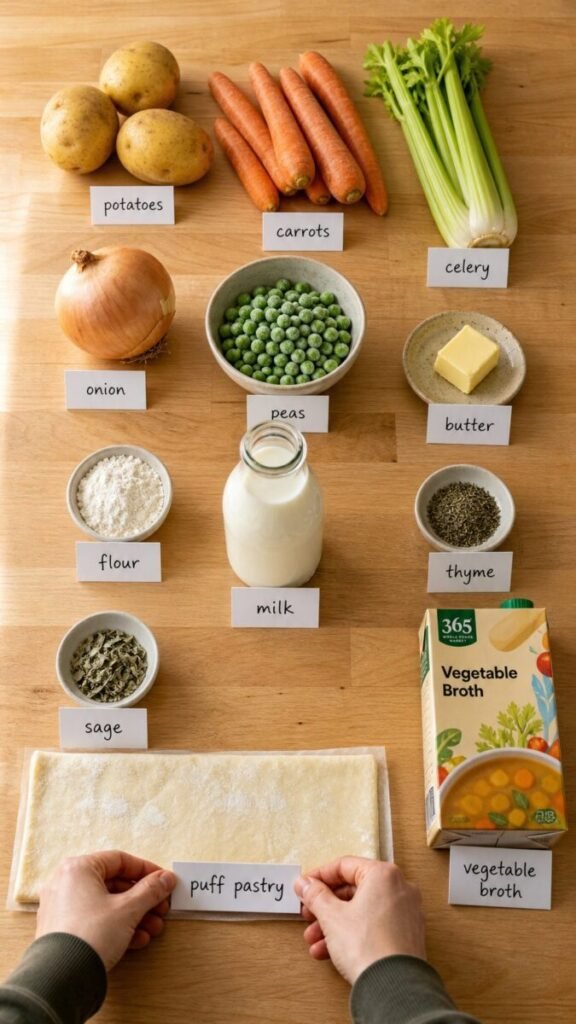
🧈 The Cream Base
- Butter: 4 tablespoons
- Flour: ⅓ cup
- Milk: 2 cups, whole if you have it
- Vegetable broth: 2 cups
- Heavy cream: ½ cup, at the end
🥕 The Pot Pie Vegetables
- Onion: 1 medium, diced
- Carrots: 3, sliced into thin coins
- Celery: 2 ribs, diced
- Garlic: 3 cloves, minced
- Yukon Gold potatoes: 1 lb, cut into ½-inch cubes
- Frozen peas: 1 cup
- Frozen corn: ½ cup
🌿 The Pot Pie Seasoning
- Dried thyme: 1 teaspoon
- Dried sage: 1 teaspoon, rubbed between your fingers as it goes in
- Salt: 1 teaspoon, plus more to taste
- Black pepper: ½ teaspoon
- Nutmeg: one small pinch — the quiet note that makes cream taste rounder
🥐 The Crust
- Puff pastry: 1 sheet, thawed but cold — from the freezer aisle, one sheet of the standard two-sheet box
- Egg: 1 beaten, for the wash — or a splash of milk
- Flaky salt: for the pastry tops
Step by Step How to Make
- Step 1 — Start the pastry clock. Take the soup’s allies first: unfold the thawed puff pastry, cut it into six squares, and park them in the fridge on a parchment-lined sheet pan, egg wash and flaky salt going on right before they bake. Cold pastry into a hot oven is the rise rule — warm pastry bakes flat and greasy, and the rafters need to rise. The soup takes about 30 minutes from here, which is exactly one pastry bake with room to spare.
- Step 2 — Build the roux. Melt the butter in the pot over medium heat until it foams. Add the onion, carrots, and celery and cook 5 minutes, until the onion is translucent and the vegetables have taken on some warmth. Sprinkle the flour over everything and stir constantly for 2 minutes — it will look pasty and clumpy and wrong, and then it will smooth out and smell faintly of toast. That toast smell is the raw flour taste leaving, and it’s the two most important minutes in the pot.
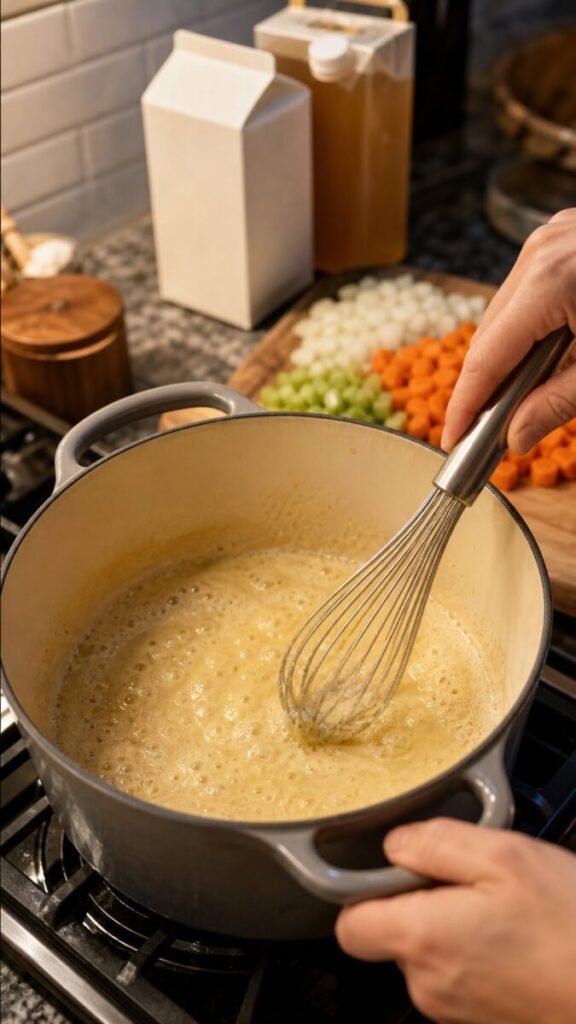
- Step 3 — Whisk in the liquids. Pour the milk and broth in slowly, whisking the whole time — a splash, a whisk, a splash, a whisk, until the whole pot is smooth. Add the potatoes, garlic, thyme, sage, salt, pepper, and the pinch of nutmeg. Bring to a simmer and let it bubble gently for 15 minutes, stirring now and then, until the potatoes are tender and the soup has thickened into something that coats the spoon with intent.
- Step 4 — Bake the rafts. While the soup simmers, brush the pastry squares with egg wash, sprinkle with flaky salt, and bake at 400°F for 12 to 15 minutes, until they’ve puffed into tall, golden layers. Pull them out and resist handling them — they crisp as they cool, and the first crack across the top of a bowl is a sound worth arranging.

- Step 5 — The finale five. Drop the peas and corn into the simmering soup and give them exactly 5 minutes — enough to cook through, not enough to go dull. Stir in the cream, turn the heat to low, and taste. This is the seasoning moment: salt first if it tastes shy, a grind of pepper, a drop more sage if it hasn’t quite said “pot pie” yet. The soup should be thick enough that a spoon stands at a slight angle and feels optimistic about it.
- Step 6 — Float and crack. Ladle into wide, shallow bowls and lay one pastry square on each, whole — not broken, not dunked. At the table, the eater cracks the lid with the back of a spoon, watches the steam escape, and pushes the flaky pieces down into the broth where they soften into pot-pie-topper perfection. Extra squares go on a plate in the middle of the table, because there is always someone who treats the raft as a first course.

If the pastry aisle is out of stock, the crust has a backup plan: our Buttermilk Biscuits, split and floated, do the pot pie top proud with a weeknight’s notice.
Anna’s Kitchen Notes
Cold pastry, hot oven — the rise rule. Puff pastry is laminated layers of butter and dough, and the layers only separate if the butter hits the oven still cold, flashing to steam and lifting the dough as it goes. Pastry that sat on the counter too long bakes into something flat and greasy that never forgave you. Thaw it in the fridge, cut it cold, and it goes from fridge to oven with the door barely closing behind it.
Whisk the liquids in slowly. The classic lump moment in any cream soup is liquid meeting roux too fast. Start with just a splash of milk and whisk it completely smooth before the next splash — the first two additions set the texture for everything after. Once half the liquid is in, you can relax and pour steadily. Two minutes of patience at the top saves ten minutes of fishing lumps out at the bottom.
Sage is what makes it pot pie. Thyme alone gives you a nice creamy vegetable soup — good, but not pot pie. Sage is the herb that pulls the whole flavor memory into place, and one teaspoon of the dried kind, rubbed between your fingers as it goes in, is plenty. Fresh sage works too: 4 or 5 leaves, thinly sliced. The nutmeg is the other quiet note; one small pinch, no more, and the cream tastes rounder without anyone knowing why.
Thawed but cold is a real window. Puff pastry wants roughly 30 to 40 minutes of fridge thawing before you can unfold it without cracking — and then it wants to stay chilled until the oven. If your sheet tears at the fold lines, it needed ten more minutes. If it feels soft and floppy, it needed ten fewer. This is the only fussy thing in the recipe, and the freezer aisle does all the actual pastry work.
Thicken with intention. The soup thickens as the potatoes cook and again when the cream goes in, so judge the body at the end of the simmer, not before. Too thin? Mash a few potato cubes against the side of the pot and stir them back in — instant body, no extra flour. Too thick? A splash of milk. This soup swings both ways gracefully, which is more than I can say for most things I make.
Around the Bowl
The pastry raft is the main event, so the sides can be simple. A sharp green salad with a vinegary dressing cuts the cream exactly the way you want it to after the second bowl. And if the table wants more than one soup night out of the week, this one trades shifts with the Best Broccoli Cheese Soup and the Creamy Parmesan Tomato and Cannellini Bean Soup — the creamy trio that runs my colder months.
For the holiday table, the soup has a natural sibling in our Vegan Thanksgiving Pot Pie — same soul, different format, and together they cover both the meatless crowd and the comfort-food crowd at once. Milder weeks, it sits next to the Slow Cooker Vegetable Curry in the rotation: two vegetable dinners, one stove’s worth of attention, and nobody asking where the chicken went.
Pot Pie, Many Ways
The chicken version. Two cups of shredded rotisserie chicken stirred in with the potatoes is the direct route to classic chicken pot pie soup — the recipe barely notices the addition. The vegetarian version is the default in my house, but this is the variation that converts the skeptics, and I make it for them gladly.
Cheddar-topped. A handful of sharp cheddar stirred into the finished soup, off the heat, until it melts in. Richer, oranger, dangerously close to broccoli-cheese territory — see the rotation above for why that’s not a problem in this kitchen.
The Thanksgiving leftover version. Leftover cooked turkey or extra roasted vegetables from the holiday pan, folded in with the peas and corn. The soup was practically designed for the week after Thanksgiving, and I’ve stopped pretending I don’t plan it that way.
Biscuit-topped. Skip the pastry and bake the soup’s bowls under biscuits, dumpling-style: drop spoonfuls of biscuit dough onto the simmering surface, cover, and steam 12 minutes. Different ceremony, same comfort, and the biscuits drink the broth as they cook.
Lighter build. Half milk, half cream, and an extra potato mashed in for body — the soup stays convincing and the bowl gets gentler. The full version is a comfort food and I treat it like one; this is just the Tuesday-through-Thursday variant for the weeks that need it.
Corn chowder crossover. Extra corn, a diced poblano with the aromatics, and a dash of paprika, and the soup drifts happily toward chowder — which puts it in the same family as our Slow Cooker Corn Chowder, another member of the creamy-vegetable comfort league.
The Bowl Count
| Nutrient | Per Bowl (1 of 6, with one pastry raft) |
|---|---|
| Calories | 420 kcal |
| Protein | 11 g |
| Carbohydrates | 44 g |
| Fats | 21 g |
Estimates for the soup and one pastry square, salad and seconds excluded. The protein is the honest weak spot of a meatless cream soup — the milk, cream, and flour contribute what they can — so I sometimes stir in a can of drained white beans with the peas, which nudges it toward 15 grams and changes the texture barely at all. The vegetable count, on the other hand, is the quiet flex: six different vegetables in one bowl, and not one of them announced itself as a duty.
The Week Ahead
The soup keeps four days in the fridge and is genuinely better on day two, once the thyme and sage have had a night to settle into the cream. It thickens in the cold — reheat gently with a splash of milk, stirring, and it comes right back to pouring consistency. Low heat only; a hard boil is where cream soups go grainy, and this one has done nothing to deserve it.
The soup base (everything through Step 3, before peas and cream) also freezes well for up to two months — thaw overnight, reheat, and finish with the peas, corn, and cream fresh. What doesn’t freeze is the pastry: baked puff pastry squares go soft in the freezer and never fully re-crisp, so bake those fresh each time. The good news is that a fresh batch takes fifteen unattended minutes, and the freezer keeps a spare box of pastry for exactly this reason.
Party logic: make the soup a day ahead, reheat as guests arrive, bake the pastry squares while the soup warms, and assemble bowls in the kitchen with the full crack-and-steam ceremony. Six people, one pot, one sheet pan, and the sound of six pastry lids giving way in a row — it’s the best dinner-party trick I know that costs under fifteen dollars.
Where It Goes Wrong
Lumpy, gluey soup. The liquids went into the roux too fast, or the flour didn’t get its two minutes of cooking. Whisk the milk in a splash at a time at first, and keep the whisk moving. A soup that’s already lumpy can usually be saved with two minutes of vigorous whisking — the lumps are almost always just impatient flour.
Thin, watery soup. The simmer ran short (potatoes release starch as they cook, and that starch is half the thickening), or the vegetables were too wet going in. Give it the full 15 minutes, and if it’s still shy, mash a few potato cubes into the broth — the fix is already in the pot.
Raw flour taste. The roux was rushed. Those two minutes of stirring after the flour goes in are when the starches cook and the pasty smell turns toasty — cutting them short leaves the whole pot tasting like paper. It’s two minutes. Set a timer and let the pot have them.
Flat, greasy pastry. It went into the oven warm. Cold pastry, hot oven — the rise lives on that temperature gap. If the squares are soft and floppy when you cut them, give the sheet ten minutes back in the fridge before baking, and next time thaw in the fridge rather than on the counter.
Dull, olive-green peas. They boiled too long. Five minutes is the whole contract — peas should stay bright and sweet, the one crisp-ish note in a creamy bowl. The same goes for the corn, though it’s slightly more forgiving; it will tell on the peas instead.
Soup broke or curdled on reheating. Too much heat, too fast. Reheat leftovers low and slow with a splash of milk, stirring — cream soups are patient-food, and the microwave at full power is where they plot their revenge. A soup that’s just barely grainy usually smooths out again with gentle heat and stirring.
Pot Pie Questions
Can I make this without the puff pastry?
The soup stands on its own as a creamy vegetable stew — it just stops being quite so pot-pie about it. Crackers, croutons, torn toast, or the biscuit route in the variations all make fine rafts. But the puff pastry square cracked under a spoon is the ceremony that makes the dinner, and it costs you one sheet of freezer-aisle dough and fifteen unattended minutes. I’d make the effort, and then I’d make it again.
Can I use rotisserie chicken to make it a chicken pot pie soup?
Yes — two cups of shredded cooked chicken stirred in with the potatoes is the whole change, and it turns this into the classic. The vegetarian version is my default, but the soup doesn’t mind either way; the seasoning is what carries the pot pie identity, and it works for both congregations.
What if I don’t eat dairy?
Olive oil for the butter, and equal parts oat milk and coconut milk (or a plant cream) for the dairy — the roux works the same with oil. The flavor tilts slightly sweet with coconut, which suits the corn and peas nicely. Full vegan? Use a plant-based puff pastry, which most freezer brands are, and check the egg wash — a splash of any plant milk browns almost as well.
Can I make it in the slow cooker?
Partly. Vegetables and broth go in the pot on low for 6 hours, but the roux still wants a stove — melt the butter and flour in a skillet, whisk in a ladle of the hot broth until smooth, then stir that back into the cooker and add the milk for the last 30 minutes. The pastry still bakes in the oven. It works well, and it’s the same split logic our Slow Cooker Vegetable Curry uses for its coconut finish.
How do I keep the pastry crispy on top of the soup?
You don’t, entirely — and that’s the point. The raft stays crisp for the first few minutes, then slowly softens into the broth exactly like the top of a baked pot pie does. The first few bites give you both textures at once. If you want longer-lasting crunch, serve the squares alongside and dunk to order; if you want the full pot pie experience, float them whole and let the soup do what it was always going to do.
Can I use other vegetables?
Anything that suits a cream stew: broccoli florets and cauliflower with the potatoes, chopped green beans with the peas, a handful of kale in the last two minutes, mushrooms sautéed with the aromatics. The two rules: hard vegetables go in early, green and delicate things go in at the end, and the pot pie seasoning holds it all together no matter which way the crisper drawer leans.
Why is my soup thicker the next day?
Because the potatoes and flour keep absorbing liquid overnight — it’s normal and, honestly, a feature. Day-two pot pie soup eats like a stew, and a splash of milk over gentle heat returns it to bowl form. Some people in my house prefer it thick enough to stand a spoon in, and I’ve stopped asking who.
Vegetarian Pot Pie • Pot Pie Soup • Creamy Vegetable Soup • Comfort Food • Puff Pastry Recipes • One Pot Dinners • Easy Vegetarian Recipes • Cozy Fall Dinners • Thyme and Sage • 45-Minute Meals
Golden pastry · Creamy vegetables · Thyme & sage
Vegetarian Pot Pie Soup
A thick, creamy soup with tender potatoes, carrots, celery, peas, and corn, seasoned with thyme and sage. Each bowl gets its own golden puff pastry topper for all the comfort of pot pie without assembling a whole pie.
As an Amazon Associate I earn from qualifying purchases. Ingredient and equipment links below are affiliate links.
Equipment
Ingredients
The creamy base
- 4 tablespoons butter
- ⅓ cup all-purpose flour
- 2 cups whole milk, plus a little more if needed to thin
- 2 cups vegetable broth
- ½ cup heavy cream
The vegetables
- 1 medium onion, diced
- 3 carrots, sliced into thin coins
- 2 ribs celery, diced
- 3 cloves garlic, minced
- 1 lb (454 g) Yukon Gold potatoes, cut into ½-inch cubes
- 1 cup frozen peas
- ½ cup frozen corn
The thyme-sage seasoning
- 1 teaspoon dried thyme
- 1 teaspoon dried rubbed sage
- 1 teaspoon salt, or less initially if the broth is salty; adjust to taste
- ½ teaspoon black pepper
- 1 small pinch nutmeg
The golden pastry toppers
- 1 sheet puff pastry, thawed according to its package but kept cold
- 1 egg, beaten, or a splash of milk, for brushing
- Flaky salt, for the pastry tops
Pastry check: Sheet sizes and baking times vary by brand. Choose pastry made without animal fat such as lard for a vegetarian meal. Standard puff pastry and the roux contain wheat; this version also contains dairy and contains egg if using egg wash.
Instructions
-
Prepare the pastry and preheat
Heat the oven to 400°F (200°C), or the temperature recommended on your puff pastry package. Line a baking sheet with parchment rated for that temperature. Unfold the thawed, cold pastry and cut into 6 equal squares or rectangles. Arrange with space between them and refrigerate while you start the soup.
-
Soften the vegetables and cook the flour
Melt the butter in a large soup pot over medium heat. Add the onion, carrots, and celery and cook for about 5 minutes, stirring, until the onion begins to soften. Add the garlic and cook for 30 seconds. Sprinkle in the flour and stir continuously for 2 minutes, coating the vegetables and cooking the flour without scorching it.
-
Add liquids and simmer the potatoes
Gradually add the milk and broth, whisking between additions to disperse the flour. Add the potatoes, thyme, sage, salt, black pepper, and nutmeg. Bring to a gentle simmer, then reduce the heat as needed. Cook for about 15–20 minutes, stirring regularly along the bottom, until the potatoes and carrots are tender. Add a small splash of milk if the soup becomes too thick before the vegetables finish cooking.
-
Bake the pastry separately
While the soup simmers, brush the tops of the cold pastry pieces lightly with beaten egg or milk, avoiding drips down the cut edges. Sprinkle with flaky salt. Bake according to the package guidance, beginning to check around 15 minutes. Depending on thickness and brand, the pieces may need 15–25 minutes or longer. They should be well risen, golden on top and underneath, and baked through—not pale or doughy in the middle. Transfer to a rack.
-
Finish with peas, corn, and cream
Add the frozen peas and corn once the potatoes are tender. Simmer until cooked through, following their package directions, usually about 3–5 minutes. Reduce the heat to low, stir in the heavy cream, and heat gently until the soup is thoroughly hot. Taste and adjust the seasoning. Thin with a little milk if needed, or mash a few potato cubes into the soup for a thicker consistency.
-
Top each bowl just before eating
Ladle the hot soup into 6 bowls. Place one fully baked pastry piece on each bowl immediately before serving, or offer it alongside for longer-lasting crunch. Let the soup cool slightly, then break the flaky topper with a spoon and enjoy it with the creamy vegetables.
Timing clarified: The 45–50 minute estimate assumes the pastry is already thawed and bakes while the soup cooks. Follow the package thawing instructions; refrigerator thawing may take several hours or overnight, not just 30–40 minutes. Larger potato pieces or longer-baking pastry can extend the total.



Where is the actual recipe??
Hi there, card recipe was added