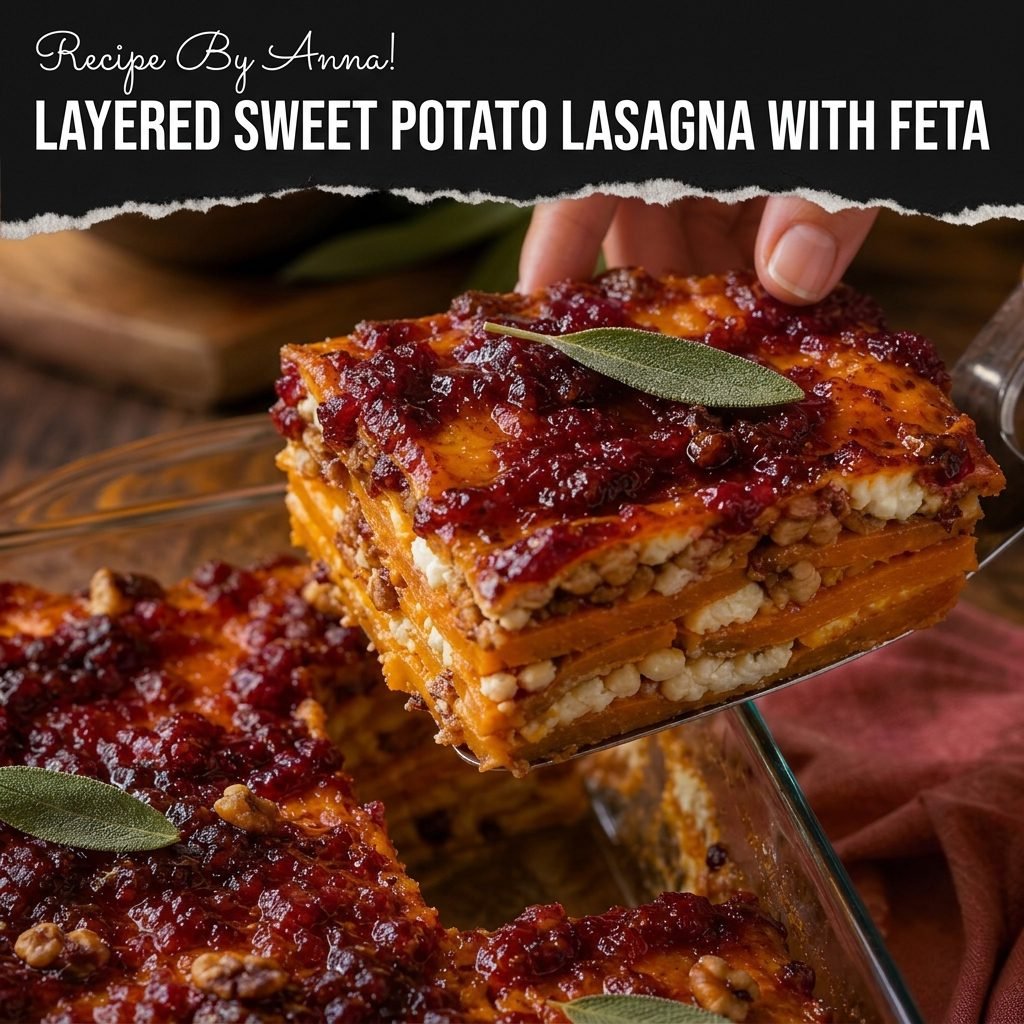
Layered Sweet Potato Lasagna with Feta and Cranberry Glaze
Every vegetarian knows the Thanksgiving problem: the table is a meat parade with side dishes, and the polite smile over a plate of sides is not the same as dinner. This lasagna is my answer, and it’s become the dish my vegetarian guests photograph before they touch. Sweet potatoes are cut into thin, even slices and used as the noodles — no pasta anywhere — and between the layers go crumbled feta, toasted walnuts, and fresh sage, with a cranberry-balsamic glaze that gets drizzled inside the build and then brushed on top, where the last minutes of baking turn it into a glossy, tart lacquer. It carves like lasagna, plates like lasagna, and tastes like the best thing that ever happened to a sweet potato that wasn’t a fry.
The flavor math is the oldest one in the book: sweet wants salty, and it wants tart, and it wants something crunchy to push against. The sweet potato brings the first part on its own. Feta, crumbled in big pieces, brings a salt-and-tang that keeps all that sweetness honest instead of dessert-adjacent. The cranberry glaze — cranberry juice, honey, and balsamic, reduced in one small pan — brings the tart, and the walnuts bring the crunch. Sage is the bridge that makes it read as lasagna and not as a sweet potato casserole wearing a costume. Four flavors in deliberate tension, every layer seasoned on purpose, and the whole thing lands somewhere between Italy in its ingredients and November in its soul.
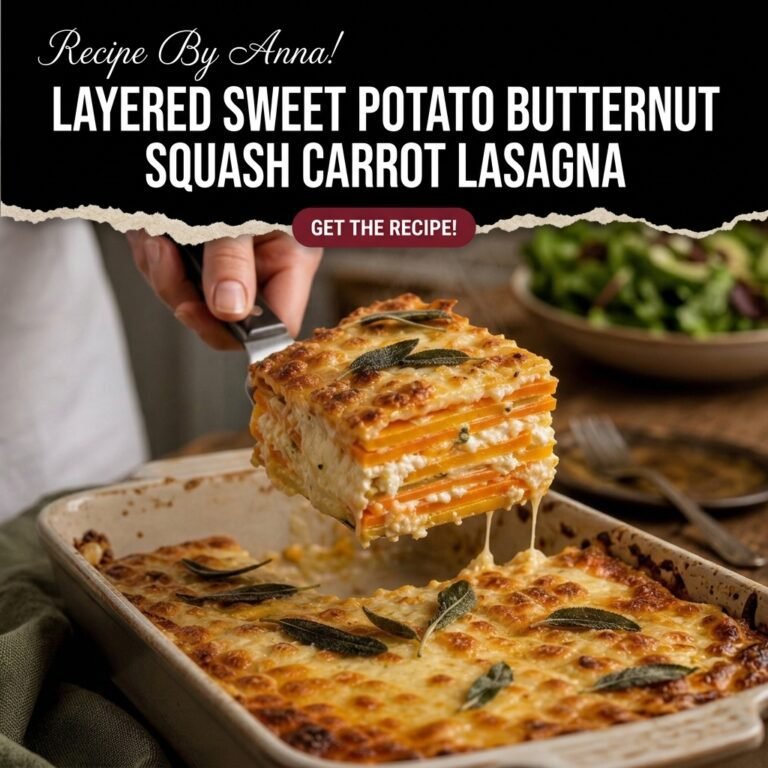
Full disclosure on the family tree, because this site keeps its shelf organized: there’s already a no-noodle lasagna living here — a mixed sweet potato, butternut, and carrot build with a sage cheese sauce, and it’s the reason I didn’t reinvent that wheel. This one is the other branch of the same idea: sweet potatoes only, so the flavor is deeper and more singular; feta instead of a sauce, so it’s lighter and sharper; and the glaze, which turns the whole dish distinctly toward the holidays. They’re different recipes sharing one technique, and my table has decided they’re both staying. The cranberry-and-feta chord, for the record, already runs through this site’s honey cranberry chicken bake — this is that flavor pairing in its full vegetarian formalwear.
The Slice Mandate
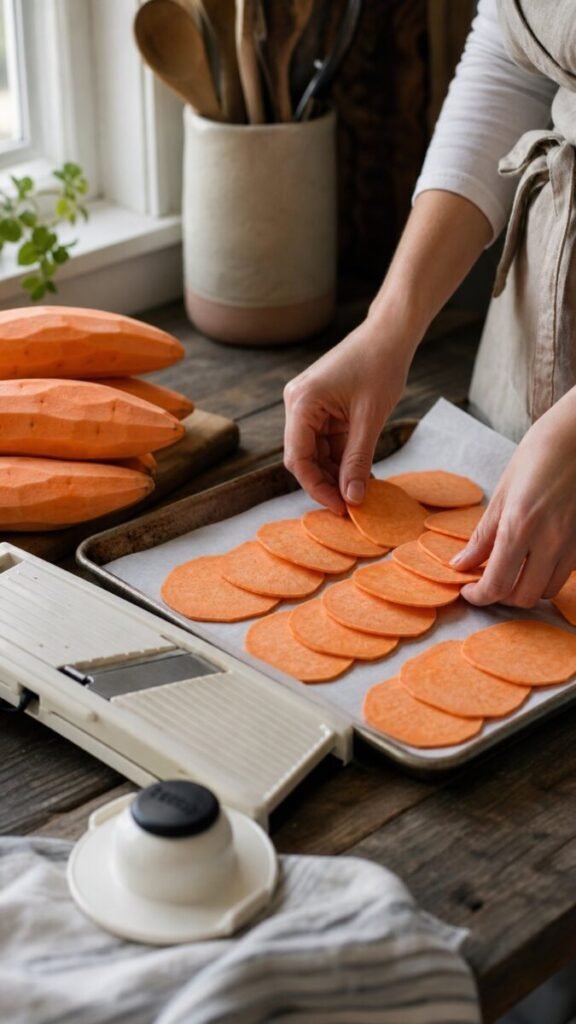
The first rule is geometric: a sweet potato lasagna is exactly as good as its most uneven slice. The sweet potato IS the noodle here, and noodles are uniform for a reason — a dish built from slices of different thicknesses bakes into a museum of doneness, with some layers dissolving to mush while their thicker neighbors are still working on being tender. The fix is a mandoline set to a quarter inch, which turns the produce aisle into the pasta aisle in about four minutes of pushing. Four even slices side by side also mean even layer heights, and even layer heights mean a lasagna that carves into squares instead of avalanching at the first spatula. If you own a mandoline and its little guard and you use both, you’ve done the hardest part of this recipe before the oven is warm.
The second rule is the par-roast, and it’s the quiet decision that separates this version from the watery ones. Sweet potatoes hold a lot of water, and a raw-slice lasagna spends its bake steaming that water out of every layer and into the dish — which is how a beautiful idea becomes a puddle with aspirations of architecture. So the slices take a short, hot roast first: fifteen minutes at 425°F on two sheet pans, just until they’re pliable and matte, with their surfaces dried and their sugars a step closer to caramel. Then the final bake is shorter, drier, and focused on marrying the layers and lacquering the top instead of evaporating a swamp. The par-roast costs fifteen minutes of passive oven time and buys back the entire structural integrity of the dish.
The third rule is the two-dose glaze. The glaze itself is three ingredients — pure cranberry juice, honey, balsamic — reduced in a small saucepan while the slices roast, until it coats a spoon and holds a clean line through the middle; cooks call that stage nappe, and it’s the only fancy word in this recipe. But the application is the part most versions get lazy about: one dose goes between the layers during assembly, where it soaks into the sweet potato and seasons from inside, and the second, final dose goes on top after the foil comes off, where the dry heat of the uncovered bake reduces it further into a sticky, garnet lacquer. Glaze applied all at once either floods the interior or never caramelizes on top. Split the dose and both jobs get done.
⏱️ 30 MINUTES HANDS-ON | 🍠 FEEDS 8 | 🦃 VEGETARIAN, GLUTEN-FREE, HOLIDAY-READY
- Prep Time: 20 minutes — slicing, glaze, crumbles
- Par-Roast: 15 minutes at 425°F, two sheet pans
- Bake: 25 minutes covered + 12-15 uncovered at 375°F
- Rest: 15 minutes, which the dish insists on
- Yield: a 9×13 dish — eight squares, or six generous ones
The Glaze Rule
Nothing exotic, and one tool that matters more than the rest:
- Mandoline with its guard — the quarter-inch law; the guard is the difference between a recipe and an incident report
- Two sheet pans and parchment — for the par-roast; the slices come off clean and nothing welds to the pan
- 9×13 baking dish — glass or ceramic, and shallow beats deep for a layered dish
- Small saucepan — the glaze’s whole world, eight minutes of it
- Pastry brush — for the top dose of glaze; a spoon drizzles, a brush lacquers
- Foil — the covered phase’s lid
The rule of the section is the nappe test, so let’s be exact about it. The glaze is done when you dip a spoon and it comes up coated in translucent ruby, and a finger drawn across the back of the spoon leaves a line that stays. Too thin, and the inside dose waters the layers and the top dose never sets; too thick, and it goes to tar in the last bake — balsamic burns faster than anything else in this dish, and a glaze past nappe is a smoke alarm with a schedule. Pull it the moment it passes the test, because it thickens further as it cools in the pan, and that carryover is real. Eight to ten minutes of simmering is the usual window, and unlike most of cooking, you can watch it happen.
And the feta handling, because it’s a two-sentence doctrine: buy the block, crumble it by hand, and make the crumbs generous. Pre-crumbled feta arrives shaken in cellulose dust that keeps it from ever softening properly, and the whole point of feta in this build is the way big crumbles turn creamy-edged and just faintly melty between hot sweet potato layers while keeping their salt. Fist over the bowl, press, let the pieces fall where they fall — that’s the entire technique, and no two crumbles should be the same size, because texture between layers is the dish’s second architecture.
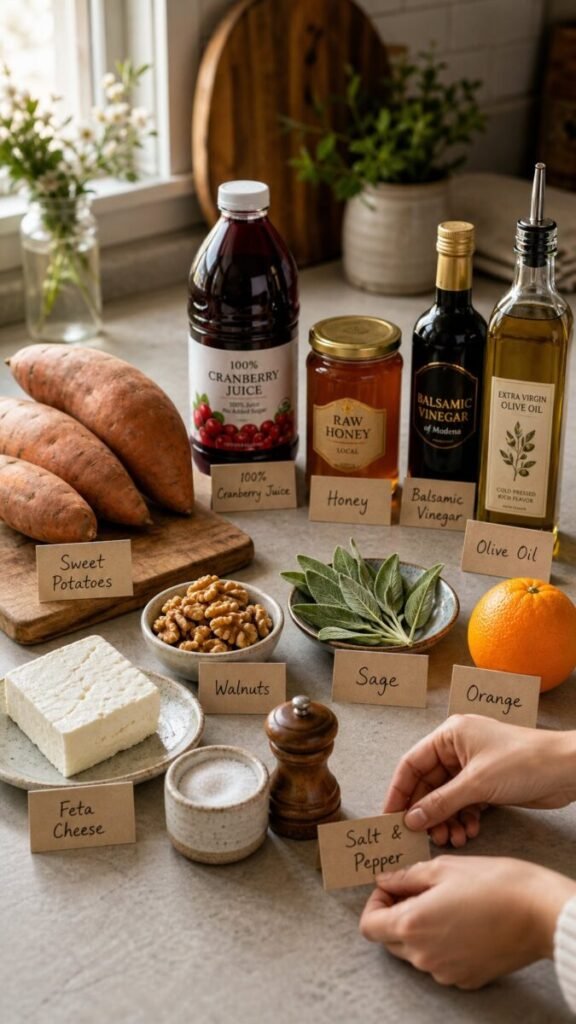
Ingredients (With Labels)
🍠 The Sheets
- Sweet potatoes: 3 lb — long, even ones, sliced ¼ inch thick
- Olive oil: 3 tablespoons, for the slices
- Salt: 1 teaspoon, on the slices — this is not optional seasoning
🧀 The Layers
- Feta: 8 oz block, hand-crumbled into big pieces
- Walnuts: ¾ cup, toasted and roughly chopped
- Fresh sage: 10 leaves, torn
- Black pepper: ½ teaspoon, coarsely ground
🍒 The Glaze
- 100% cranberry juice: 1 cup — not cranberry juice cocktail, which is apple juice that met a cranberry once
- Honey: ¼ cup
- Balsamic vinegar: 2 tablespoons
- Orange: one wide strip of zest, for the simmer
- Salt: one small pinch
Step by Step How to Make
- Step 1 — The slices. Heat the oven to 425°F and line both sheet pans with parchment. Peel the sweet potatoes and square off the thinnest sliver of the long side so they sit flat on the mandoline — steadier potato, safer fingers — then slice everything a quarter inch thick, guard on, letting the rounds and ovals fall into a bowl. Toss the slices with the olive oil and the teaspoon of salt right in the bowl, with your hands, so both sides of every slice get their coat. The salt here is doing more than seasoning: it starts pulling surface moisture out before the oven even gets involved.
- Step 2 — The par-roast. Spread the slices across the two pans in a single layer, not touching where you can help it, and roast 15 minutes, swapping the pans’ racks at the halfway mark. You’re looking for pliable and matte, with the edges just barely turning gold — cooked enough to bend without snapping, not so far that they brown. Pull them and lower the oven to 375°F for the bake to come. While the oven resets, start the glaze, because the timing stacks perfectly.
- Step 3 — The glaze. Combine the cranberry juice, honey, balsamic, orange strip, and pinch of salt in the small saucepan and bring it to a steady simmer over medium heat. Let it bubble 8 to 10 minutes, stirring now and then, watching it darken and thicken — and start testing early, because the window between nappe and tar is short. The spoon test is the arbiter: dip, coat, draw a line through the ruby on the back, and when the line holds, pull the pan off the heat, fish out the orange strip, and pour a third of the glaze into a small bowl. The pan’s two-thirds are the inside dose; the bowl’s third is the top lacquer, reserved for the finish.
- Step 4 — The build. Grease or glaze-sweep the bottom of the 9×13 with a thin spoonful of the inside dose, then lay down the first layer of sweet potato slices, the biggest and most uniform ones, slightly overlapped like shingles. Scatter a third of the feta over them, a third of the walnuts, a third of the sage, a grinding of pepper, and a thin drizzle of the inside glaze — thin, because this dose is a seasoning, not a sauce. Repeat twice more with the remaining slices and fillings, pressing each layer gently down as you finish it, and crown the dish with a final layer of the best-looking slices laid flat and tidy.
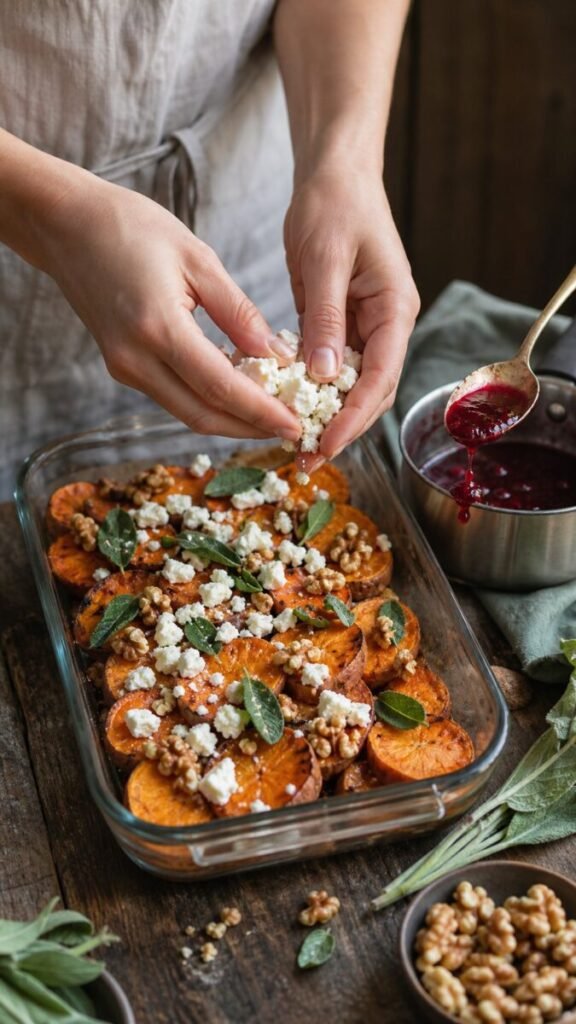
- Step 5 — The bake. Cover the dish tightly with foil and bake at 375°F for 25 minutes, until the layers have sunk and settled into each other and the edges are bubbling faintly at the rim. Pull the foil — admire briefly; it looks unfinished, and it is — and brush the reserved third of the glaze across the entire top with the pastry brush, edge to edge, using it all. Return the dish uncovered for 12 to 15 minutes, until the glaze has gone glossy and just barely sticky and the top slices show bronzed, caramelized edges. Watch the last five minutes honestly: balsamic moves from lacquered to scorched with very little warning, and the dish you’re guarding is worth the vigilance.
- Step 6 — The rest and the carve. Rest the dish 15 minutes on a rack before the first cut — the longest-feeling wait in the recipe and the least optional one, because those minutes are when the feta firms back up, the layers finish welding, and the glaze sets into its shine. Cut a 3×4 grid, lift the first square with a flat spatula and a little conviction, and look at the face of it: bands of deep orange, white drifts of creamy feta, walnut speckles, and a dark ruby seam where the inside glaze settled. Serve with the last of the walnuts scattered over for anyone whose square lost its crunch, and watch the meat eaters at the table take a piece out of curiosity and stay for the flavor.
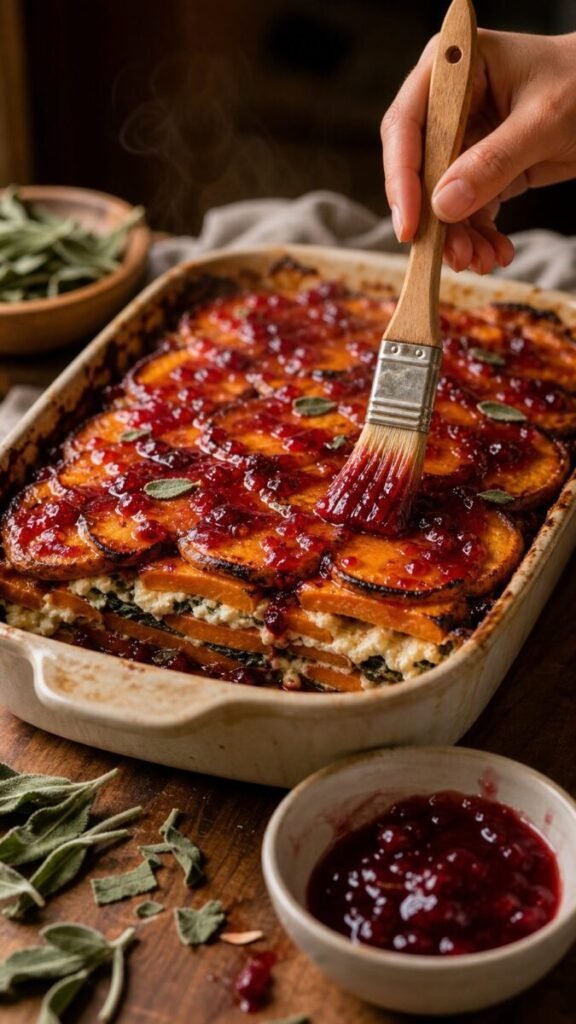
The no-noodle butternut and carrot lasagna is this recipe’s other branch — the same slices-for-noodles idea taken toward ricotta and sage sauce instead of feta and glaze. One technique, two entirely different dinners.
Anna’s Kitchen Notes
Buy sweet potatoes that look like each other. Long, evenly wide ones slice into the uniform planks this dish is built from; knobby, acrobat-shaped ones produce a puzzle box of sizes and a lasagna with soft spots and stubborn spots. And buy a touch more than three pounds — one odd slice-length sweet potato is a small price for a full dish of even coverage. The garnet and jewel varieties are both right; their orange is what photographs like November.
The mandoline guard is not a suggestion. I say this as someone who learned it the unpleasant way, in a kitchen, mid-recipe, with a heroic amount of paper towel: the guard exists because the blade is genuinely sharp at exactly the height of your knuckles, and the final slices of a sweet potato are exactly when concentration is lowest. If you’d rather skip the mandoline entirely, a sharp chef’s knife and patience make honest ⅜-inch slices — add five minutes to the par-roast and the bake, and the dish forgives the extra thickness.
Toast the walnuts, and do it while the glaze simmers. Eight minutes in the dry skillet, shaken twice, and they go from polite to fragrant — the oils wake up, the flavor sharpens, and they hold their snap through the bake instead of fading into the layers. The timing slots into the glaze’s simmer and the oven’s reset without adding a minute to the recipe’s clock, which is the kind of scheduling this dish does well everywhere.
The make-ahead split. The glaze keeps five days in the fridge — re-warm it gently, because cold glaze is thick as jam and refuses to drizzle. The slices can be par-roasted a full day ahead and held covered in the fridge. And the whole dish can be assembled in the morning and baked at dinner, straight from the fridge, with five extra minutes on the covered phase. On a hosting day, when the oven and your attention are both contested, that split is the difference between a dish you serve and a dish you get to enjoy serving.
Double it into two dishes, not one deeper one. A doubled batch in a single deep dish is a different, sadder recipe — the center of a thick vegetable lasagna steams while the outside overbakes, and the layers lose their carve. Two 9×13s side by side, racks swapped halfway, bake identically to one, and the second dish is Sunday’s lunch or the freezer’s tenant. Around the holidays, I make both and consider it one act of cooking.
The Autumn Table
This dish is a vegetarian main that behaves like the centerpiece of a table, and it wants company that plays second lead well. For the mixed crowd — some meat eaters, some not — the honey cranberry chicken bake is the same flavor family in its meat form, and the two dishes share a shopping list so gracefully that hosting both barely registers as extra work. The vegan end of the table gets its own anchor with the vegan Thanksgiving pot pie, and a pot of one of the pumpkin soups poured small as a starter ties the whole table to the season.
For the rest of the sweet potato rotation: the sweet potato black bean enchiladas are the weeknight branch of the same vegetable, and the sweet potato and chickpea curry is its spice-rack branch. A simple bitter-green salad with a sharp dressing belongs beside this lasagna — the glaze’s sweetness wants something to push against — and the cranberry apple quinoa salad doubles down on the cranberry for a lunch the day after, when you’ll still be thinking about this dish.
Same Layers, Other Cheeses
Goat cheese, the creamy cousin. Same weight, dolloped and smeared rather than crumbled — the layers go softer and tangier, and the dish drifts toward the elegant end of its range. A little extra black pepper, and it’s the version I make for a dinner party that I want to sound fancy without being fussy.
Blue cheese and walnuts, the bold table. Half feta, half a mild blue, crumbled together — the sweet-glaze-and-blue combination is a steakhouse classic for a reason, and it turns this into the version for people who think they don’t like sweet potato anything.
The ricotta bridge. Ricotta with an egg and plenty of pepper in place of the feta, no glaze, extra sage — this walks the recipe back toward its Italian heritage and lands it next door to the butternut-and-carrot lasagna already on this site. Make this version when the table wants comfort and the glaze feels like too much personality for a Tuesday.
Greens in the middle. Two big handfuls of baby spinach or torn chard scattered with the feta in each layer — they steam down to almost nothing and the dish gains a color and a conscience. This is the weeknight default in my house during the long stretch between holidays.
Dried cranberries, the chewy pockets. A half cup tossed with the walnuts between the layers — they rehydrate in the steam and become little bursts of extra tart right where the glaze already lives. Use sparingly; this is an accent, not a theme.
The vegan conversion, honestly rated. Almond-based feta or a cashew lemon cheese carries the salty-tangy corner respectably, maple swaps into the glaze for the honey, and everything else in the dish was already plants. The result lands at about eighty-five percent of the original’s personality — the carve, the glaze, the crunch all survive; what softens is that feta edge — and eighty-five percent of this dish is still well ahead of most center-of-table options.
The Lasagna Math
| Nutrient | Per Serving (1 square of 8) |
|---|---|
| Calories | 330 kcal |
| Protein | 8 g |
| Carbohydrates | 41 g |
| Fats | 15 g |
Estimates as written — full feta, full walnuts, the double dose of glaze all counted, and the salad beside the dish left to its own accounting. Eight grams of protein is honest for a vegetable main; serve it with the quinoa salad from the pairings and a square of this covers what a vegetarian plate is usually missing. The money math is the friendlier column: three pounds of sweet potatoes, one block of feta, a bag of walnuts, and a bottle of cranberry juice put eight holiday-scale servings on the table for about eleven dollars — a centerpiece price that embarrasses most centerpieces, vegetarian or otherwise.
The Next-Day Pan
Storage, in the order the leftovers deserve. The baked dish keeps four days covered in the fridge, and the squares reheat best covered in foil in a 350°F oven for fifteen to twenty minutes — the glaze re-softens, the feta re-creams, and the walnuts, softer now, still do their job. A single square in the microwave takes ninety seconds and comes out softer all over, which is fine; a lunch eaten at a desk forgives what a dinner table wouldn’t.
Cold from the fridge, this lasagna is a genuinely excellent lunch, in the way that good pizza is — the glaze firms to a jammy layer, the sweet potato reads almost like a firm terrine, and the flavors settle overnight into something rounder than the hot version. I’ve cut a cold square for breakfast with coffee and regretted nothing but the missing piece at lunch.
The freezer takes the assembled, unbaked dish for a month — wrap it tight, glaze and all, and bake from frozen with the covered phase extended by twenty minutes and the uncovered phase watched closely. What the freezer does not take well is the baked and glazed top, which thaws dull; the unbaked route protects the lacquer. Two dishes in the freezer by mid-November is my standing insurance policy against the season’s chaos, and every year it gets cashed.
Where It Goes Wrong
The watery dish. The most common failure of the whole no-noodle genre, and it means the water management lost: slices that skipped the par-roast, a glaze that stopped short of nappe, or thick, uneven slices holding their reservoirs. The recipe’s spine — quarter-inch slices, fifteen hot minutes, a properly reduced glaze — is three walls against the flood, and skipping any one of them shows up as a puddle at the edges and layers that slide apart.
Firm slices, mushy ones, both at once. The mandoline wandered, or a knife improvised — a dish of mixed thicknesses bakes unevenly no matter how patient the oven is. There’s no rescuing it at the table, only preventing it at the board: measure the first slice against a quarter-inch reference if you need to, because every slice after it follows the set one.
A bland first bite. Sweet potato is a quiet vegetable until salt speaks up, and the most common note I hear from first-timers is that their version tasted flat. The causes, in order: the salt never went on the slices, the feta was mild to the point of anonymity, or the pepper got skipped. Salt the slices at the bowl like the recipe says — it is the difference between a dish that tastes like autumn and one that tastes like healthy.
Scorched glaze on top. The uncovered bake ran long, the glaze was reduced past nappe to begin with, or the oven runs hot at its top element. Balsamic is the fastest-burning ingredient in this recipe, and the final phase is its most exposed moment — pull the dish when the glaze is glossy and the edges bronze, and if your oven browns eagerly, drop the last phase to 350°F and add three minutes instead of risking the shine.
Squares that won’t hold. The rest got shortened, or the layers went in without their gentle press. Fifteen minutes of resting is when the feta resets and the layers fuse; a dish cut at minute two is a delicious landslide, and the same dish cut at minute fifteen comes out in clean, striated squares. The press at each layer — one light pass with your palm — does the same work vertically that the rest does at the end.
Gritty, dry crumbs between the layers. Pre-crumbled feta happened. The cellulose that keeps bagged crumbles free-flowing also keeps them from ever softening, so they bake as salty gravel instead of turning creamy-edged. The block costs less per ounce anyway; crumble it over the bowl with your own hands and the texture problem never starts.
Sweet Potato Questions
Can I make this without a mandoline?
Yes — a sharp chef’s knife, a steady hand, and honest ⅜-inch slices, with five extra minutes on both the par-roast and the bake. The dish is slightly more rustic and every bit as good. What you can’t do is freehand a quarter inch with a dull knife and hope: uneven slices are the one failure no oven fixes, and the mandoline is simply the tool that makes evenness automatic.
Why par-roast instead of just baking longer covered?
Water. A raw slice releases its moisture into the dish during the bake, and a covered dish holds that steam against the layers — the vegetable steams in its own liquid and the lasagna comes out wet. The par-roast moves that water removal to a separate, hot, dry step on sheet pans, so the final bake is free to do its actual jobs: welding layers, melting feta, lacquering glaze. It’s fifteen minutes that redecorates the whole recipe’s outcome.
Can I use other vegetables in the layers too?
You can, and there’s already a version of that on this site — the butternut and carrot build is the mixed-vegetable branch of this same technique, with a cheese sauce instead of the glaze. In this recipe I keep it sweet potato only, because the feta-and-cranberry pairing wants one deep, singular sweetness underneath it rather than a chorus. Two recipes, one mandoline.
Is this really gluten-free?
As written, yes — sweet potato, feta, walnuts, juice, honey, vinegar, and herbs, with nothing wheat anywhere in the build. The two labels worth a glance are the feta (occasional facility notes) and the balsamic, which is naturally gluten-free in the traditional process but worth a check if your household is strict. No substitutions, no compromises, and nobody at the table will be performing sympathy.
Can I make the glaze with fresh cranberries instead of juice?
You can — a cup of fresh or frozen cranberries with a quarter cup of water, cooked until they burst and then strained, gives you a sharper, fresher-faced juice to reduce. It’s an extra step and a brighter result; the bottled juice version is rounder and calmer. On a holiday week, I take the calm one, and nobody has ever asked which I used.
How far ahead can I build it?
Glaze: five days, refrigerated. Slices: par-roast a day ahead and hold covered. Assembled dish: build it in the morning, refrigerate, and bake at dinner with five extra minutes on the covered phase. Fully baked ahead is the one route I’d avoid — the lacquered top is the dish’s signature, and it’s earned in the last fifteen minutes of a fresh bake, in front of the people about to eat it.
What do I serve it with for a holiday table?
One green thing with a sharp dressing, one soft thing, and bread if the table wants it — the pumpkin soup poured small for a starter, the vegan pot pie if the table’s wider than one main can cover, and the honey cranberry chicken bake alongside for the mixed crowd, since it shares this dish’s entire flavor outlook. The lasagna carves like a centerpiece and eats like the main event; everything else is supporting cast, and simple supporting cast at that.
Sweet Potato Lasagna with Feta, Walnuts & Cranberry Glaze
Ingredients
As an Amazon Associate I earn from qualifying purchases.
Sweet potato layers
- 3 lb (1.36 kg) orange-fleshed sweet potatoes, peeled and evenly sliced ¼ inch thick
- 3 tablespoons olive oil, plus a little for greasing the dish
- 1 teaspoon fine salt, or slightly less if your feta is very salty
Feta, walnuts & sage
- 8 oz (227 g) block feta made with vegetarian enzymes, drained and crumbled
- ¾ cup (about 85 g) walnuts, lightly toasted, cooled, and roughly chopped
- 10 fresh sage leaves, torn or thinly sliced
- ½ teaspoon coarsely ground black pepper
Cranberry-balsamic glaze
- 1 cup pure unsweetened cranberry juice, not a sweetened cocktail or apple-grape juice blend
- ¼ cup honey
- 2 tablespoons balsamic vinegar
- 1 wide strip of zest from an orange, avoiding the white pith
- 1 small pinch fine salt
Kitchen Tools
- Mandoline with a hand guard, or a sharp chef’s knife
- Vegetable peeler and cutting board
- Two large rimmed sheet pans; roast in batches if the slices do not fit in a single layer
- Baking parchment rated for at least 425°F
- 9×13-inch baking dish
- Large mixing bowl
- Small saucepan and heat-resistant spatula
- Small skillet, if toasting the walnuts yourself
- Measuring cups and spoons
- Pastry brush and aluminum foil
- Oven mitts and heat-resistant trivet
- Wide serving spatula
Directions
- Slice and season the sweet potatoes. Preheat the oven to 425°F. Line the sheet pans with parchment rated for that temperature. Peel the sweet potatoes and slice evenly into ¼-inch rounds or ovals. Use the mandoline’s hand guard throughout and stop before the remaining piece becomes too small to hold safely. Toss the slices with 3 tablespoons olive oil and the teaspoon of salt.
- Par-roast and prepare the walnuts. Arrange the slices in a single layer without stacking. Use additional batches if needed. Roast for about 15–20 minutes, rotating the pans halfway through, until the slices are pliable and beginning to soften but still hold their shape. Lower the oven to 375°F. If the walnuts are not already toasted, toast them in a dry skillet over medium-low heat for about 4–6 minutes, stirring frequently, until fragrant. Cool, then chop.
- Reduce and divide the cranberry glaze. While the potatoes roast, combine the cranberry juice, honey, balsamic vinegar, orange zest strip, and pinch of salt in the saucepan. Bring to a simmer and cook, stirring occasionally, until reduced to roughly ½–⅔ cup and lightly syrupy. This may take 12–20 minutes or longer depending on the pan and heat. Test a small amount on a cool plate: it should coat a spoon once cooled but still drizzle, not set like candy. Do not touch hot syrup with your finger. Remove the orange strip. Reserve one-third of the glaze for the top and use the remaining two-thirds between the layers.
- Build three sweet potato layers. Lightly oil the baking dish. Divide the roasted sweet potato slices into three portions, reserving the neatest pieces for the top. Arrange the first portion in a mostly single layer, overlapping only enough to close gaps. Scatter with half the feta, half the walnuts, half the sage, and half the pepper. Drizzle with half the interior glaze. Repeat with a second layer of sweet potatoes and the remaining filling and interior glaze. Finish with the final sweet potato layer, gently pressing with a spatula. Three potato layers with two filling layers give more reliable coverage in a 9×13-inch dish with this quantity.
- Bake covered, then glaze the top. Cover tightly with foil and bake at 375°F for about 25 minutes. Test the center with a thin knife: it should pass through the layers easily. If the potatoes are still firm, continue baking covered and check every 5–10 minutes before glazing. Remove the foil and brush the reserved glaze thinly over the top. Bake uncovered for another 10–15 minutes, until glossy and lightly browned at the edges. Watch closely and loosely cover if the glaze begins to darken too quickly. Do not broil.
- Rest and cut into eight portions. Rest on a heat-resistant trivet for 15 minutes. Cut into a two-by-four grid for eight portions and lift with a wide spatula. This is a layered vegetable bake without an egg or starch binder, so some shifting is normal even after resting. Allow about 1 hour 30 minutes to 1 hour 50 minutes overall, with extra time if roasting in batches. Refrigerate leftovers in shallow containers within 2 hours, or within 1 hour above 90°F, and use within 3–4 days. Reheat to 165°F. If assembling ahead, follow the baking dish manufacturer’s guidance on temperature changes; do not place refrigerated glass or ceramic directly into a hot oven unless explicitly permitted.
Nutrition
| Nutrient | Approximate amount per serving |
|---|---|
| Serving size | 1 of 8 portions |
| Calories | 385 kcal |
| Protein | 9 g |
| Carbohydrates | 50 g |
| Total fat | 18 g |
| Fiber | 6 g |
Estimates assume 1.36 kg sweet potatoes, 227 g feta, 85 g walnuts, 3 tablespoons olive oil, and the entire cranberry-honey glaze, divided into eight servings. Excludes extra oil used to grease the dish and any side dishes. Values vary with peeling losses, brands, juice type, and portions. Contains milk and walnuts. Choose feta made with vegetarian enzymes for a vegetarian dish. For gluten-free needs, verify packaged ingredients and avoid cross-contact.