

Creamy Polenta with Poached Eggs Recipe | Cozy Meal
There is a specific kind of morning that calls for this bowl: slow, gray at the edges, and worth treating properly. Creamy polenta — cornmeal simmered in salted liquid until it turns to soft gold silk — with a poached egg settled into the middle of it, black pepper cracked over everything, and chives scattered like confetti for a party of one. When the fork breaks the yolk, it runs down through the polenta and the whole bowl becomes its own sauce. It’s breakfast, it’s brunch, and honestly it’s been dinner at my table more than once, because a bowl this warm doesn’t check the clock.
Two humble techniques, each with a reputation for difficulty that it hasn’t earned. Polenta scares people because somewhere along the way we all agreed it demands forty minutes of constant stirring, and that’s simply not true — a heavy pot, a low simmer, and a good stir every few minutes produce the same silk with a fraction of the custody. Poached eggs scare people because the first attempt usually happens in a rush, in plain boiling water, with an egg straight from the back of the fridge. Give the egg two small courtesies — a splash of vinegar and a gentle simmer instead of a boil — and it behaves. The whirlpool you’ve seen in videos is real and useful, but it’s the third most important thing, and I’ll rank all three below.
Housekeeping, as this site keeps its shelves tidy: the breakfast department is well staffed — the cottage cheese pancakes and the banana pancakes run the sweet side of the menu — but the savory, egg-forward corner has been waiting for its anchor. This is that anchor: one pot of cornmeal, one pan of water, four eggs, and thirty minutes between you and the best-behaved breakfast in the house.
The Corn Ratio
Polenta is a ratio before it’s a recipe: one cup of coarse cornmeal to four cups of liquid, and everything else is technique. The four cups can be all water, or three water and one milk for a rounder, faintly sweeter bowl — the version written here. Salt the liquid before the cornmeal goes in, the same way you’d salt pasta water, because cornmeal seasoned at the end tastes like cornmeal with salt on it, and cornmeal seasoned from the start tastes like itself. This is the cheapest lesson in the whole cuisine: a one-dollar bag of cornmeal becomes, with salt and patience, something restaurants charge eighteen dollars for and call rustic.
The stir question deserves a straight answer. The old doctrine of standing at the pot for the better part of an hour comes from wood stoves and thin pots, where scorching was a live threat every second. In a heavy-bottomed pot on a modern burner at a genuine low simmer, polenta needs a firm stir every four to five minutes — and it needs you to scrape the bottom when you do, because that’s where the sticking starts. The goal is a slow bubble, the occasional lazy ploop, not a rolling boil. Your arm is on call, not on duty, and the twenty-five minutes in between stirs are yours to spend on the eggs.
The finish is where cheap polenta turns expensive-tasting: off the heat entirely, a few tablespoons of cold butter and a fistful of parmesan stirred in until they vanish. The cold butter does more than taste good — it adds gloss and keeps the polenta loose, the same trick a pat of butter plays on a bowl of grits or a plate of pasta. And polenta tightens fast as it sits, so make it slightly looser than you want it in the bowl; by the time it travels from pot to table, it will have made up its mind.
⏱️ 30 MINUTES | 🌽 SERVES 4 | 🥚 ONE RUNNY YOLK PER BOWL
- Prep Time: 5 minutes — measuring, grating, eggs out of the fridge
- Polenta: 25 minutes at a low simmer, stirred every 4-5 minutes
- Eggs: 3 minutes each, timed, during the polenta’s last stretch
- Yield: 4 generous bowls
The Whirlpool Method
The egg side of the recipe needs almost no equipment — but the small pieces matter more than usual:
- Heavy-bottomed pot — for the polenta; thin pots scorch where the cornmeal sits
- Wide, shallow saucepan — for the eggs; two inches of water, more surface than depth
- Fine-mesh strainer — the egg world’s best-kept secret, explained below
- Small bowls or ramekins — one egg per cup, cracked ahead, no exceptions
- Slotted spoon — for lifting; a flat spatula works in a pinch, poorly
- Paper towel — the thirty-second drain that keeps water out of your bowl
- Microplane or box grater — for the parmesan finish
Now the ranking, because poached-egg advice usually arrives as one undifferentiated pile of rules. First: the water should be at a bare simmer — bubbles the size of peppercorns, not a rolling boil. Second: a tablespoon of white vinegar in the water, which firms the whites as they cook and which nobody has ever been able to taste in the finished egg. Third — genuinely third — the whirlpool: stirring the water into a slow spin before sliding the egg into the center, so the whites wrap around the yolk instead of wandering. It helps, it looks impressive, and if you’re poaching four eggs one after another, the whirlpool is only really available for the first. Fresh eggs matter more than all of it: an egg a few days old holds a tidy package, while an older egg sheds wisps no whirlpool can save. Buy the freshest eggs in the fridge case and the method becomes almost boring, which is the goal.
And the strainer trick, the one that separates diner eggs from restaurant eggs: crack the egg into the fine-mesh strainer over a bowl and let the loose, watery white drain off for ten seconds before tipping the egg into its ramekin. That watery white is the stuff that becomes the wispy flags and ragged skirts on a poached egg — straining it away leaves only the thick white that sets into a clean, round parcel. Ten seconds per egg, and the improvement is out of all proportion to the effort.
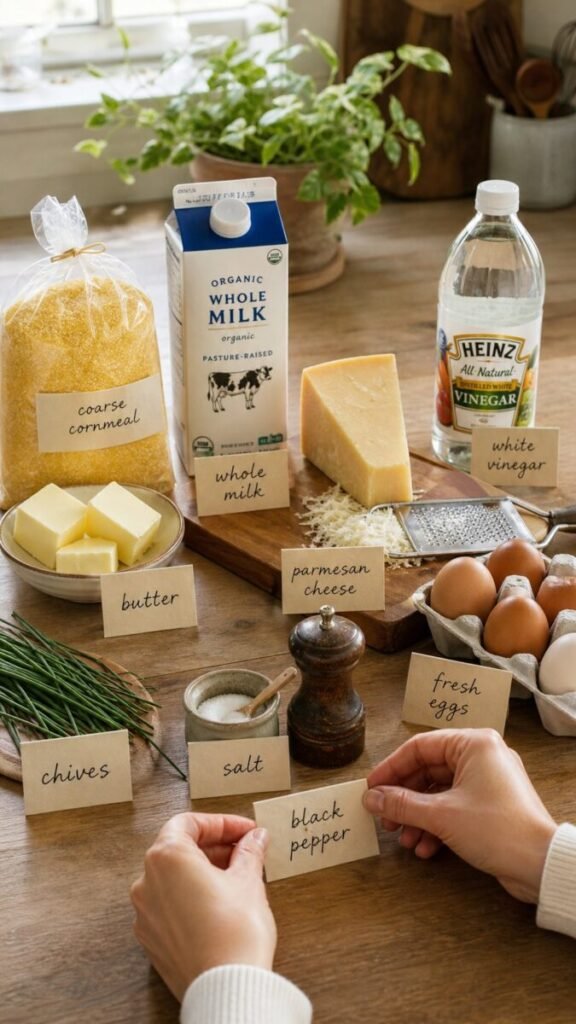
Ingredients (With Labels)
🌽 The Simmer
- Coarse cornmeal (polenta): 1 cup — stone-ground if you can get it; instant works in a pinch and tastes like it
- Water: 3 cups
- Whole milk: 1 cup — or a fourth cup of water, for the dairy-free lane
- Salt: 1½ teaspoons, in the liquid from the start
🥚 The Poach
- Fresh eggs: 4 large, the freshest you can find
- White vinegar: 1 tablespoon, in the egg water
🧈 The Finish
- Butter: 3 tablespoons, cold, off the heat
- Parmesan: ¾ cup, finely grated, plus more for the bowls
- Chives: a small handful, snipped
- Black pepper: coarsely ground, more than seems reasonable
Step by Step How to Make
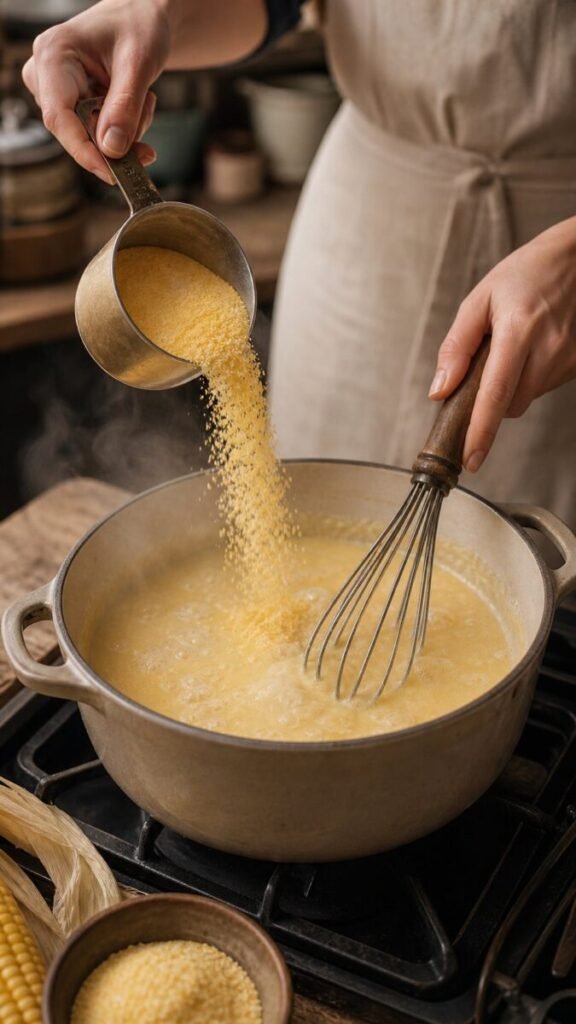
- Step 1 — The rain. Bring the water, milk, and salt to a boil in the heavy pot, then drop the heat to low. Pour the cornmeal in slowly — a thin, steady rain from a height of a few inches, whisking the whole time — so the grains disperse into the liquid instead of landing in clumps that cook into little dumplings. Cornmeal dumped in a flood seizes into balls that never fully dissolve; cornmeal rained in while whisked has nothing to grab onto. Once it’s all in, switch to a wooden spoon and settle into the rhythm: a firm stir, bottom scraped, every four to five minutes.
- Step 2 — The twenty-five minutes. Keep the pot at the laziest possible bubble and stir on schedule, and watch the transformation: at ten minutes it’s loose grit, at eighteen it’s thickening porridge, and around twenty-five it pulls away from the sides of the pot in a slow, heavy sheet when you drag the spoon through. It should be glossy and just barely pourable — remember, it firms up off the heat. Somewhere around minute fifteen, fill the egg pan with two inches of water, add the vinegar, and set it over medium-low heat to come up to its bare simmer while you keep one eye on the corn.
- Step 3 — The straining. Crack each egg into the fine-mesh strainer over a small bowl, ten seconds of draining, then tip it gently into its ramekin. The loose, watery white slides through the mesh and gets left behind, and that’s the part you’re losing on purpose — it’s the stuff that would have become ragged flags in the pan. Four ramekins lined up on the counter, each holding one tidy, strained egg. This is also the moment to taste the polenta’s liquid progress and adjust salt if needed.
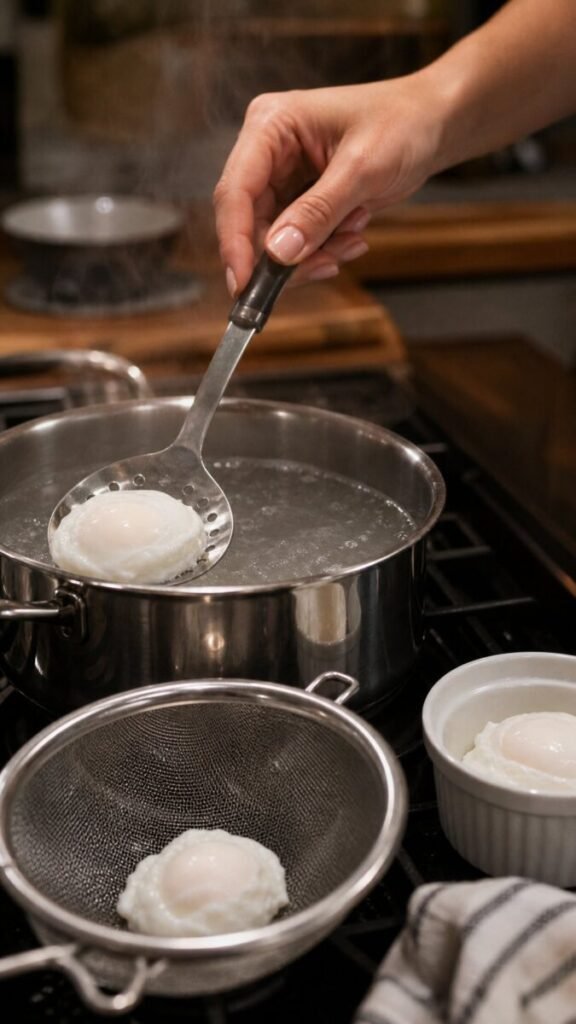
- Step 4 — The poach. Check the egg water: it should be trembling, with bubbles the size of peppercorns, and nothing more. Stir it once into a slow spin, then slide the first egg into the center of the whirlpool and count three minutes on a timer — not from memory, a timer. The second egg goes in when the first comes out, or with a friend if your pan fits them without crowding. Each egg is done when the white is fully set and opaque and the yolk still shivers under its surface when you nudge it. Lift with the slotted spoon, rest the spoon briefly on a folded paper towel, and keep the finished eggs on a warm plate while their siblings take their turns.
- Step 5 — The finish. Pull the polenta off the heat and beat in the cold butter, then the parmesan, stirring until both disappear and the pot goes glossy. Taste it — properly taste it — for salt, because cornmeal drinks salt all through its twenty-five minutes and can always use a final opinion. If it has tightened past pourable, loosen it with a splash of milk; it should mound softly in the bowl, not stand at attention.
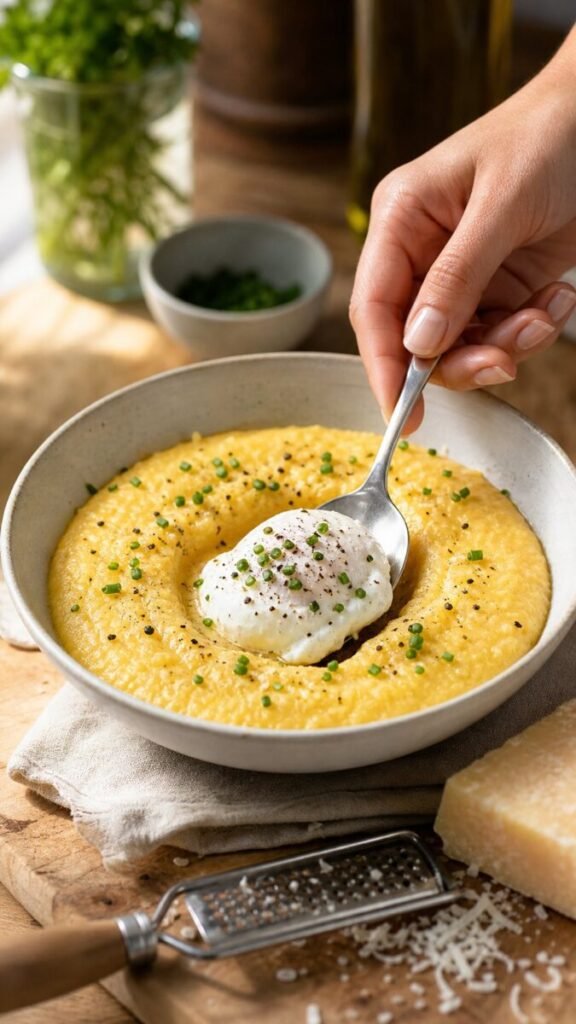
- Step 6 — The assembly. Spoon the polenta into warm bowls and make a shallow hollow in each with the back of the spoon — a small crater, so the egg sits down into the polenta instead of perching on top of it. Set an egg in each hollow, crack the pepper over everything with a generous wrist, snipe the chives across, and shave or grate a final snowfall of parmesan over the bowls. Serve immediately, and give the first guest the honor of breaking their yolk where everyone can watch it run gold into the corn. That moment is the entire point of the recipe, and it’s free.
The eggs benedict casserole is this bowl’s make-ahead cousin — the same egg-and-ceremony instinct, baked for a crowd instead of simmered for four. One is for the slow morning; the other is for the brunch you’re hosting.
Anna’s Kitchen Notes
Buy the freshest eggs in the case, and mean it. Egg age matters more than any trick in this recipe. A fresh egg has a thick, tightly wrapped white that poaches into a clean round; an egg two weeks past has a watery white that scatters into streamers the moment it meets water, and no vinegar or whirlpool will collect it. Check the date, or float-test at home: a fresh egg lies flat on the bottom of a bowl of water, an old one stands on end or floats. Save the floaters for scrambling.
Instant polenta is a different recipe wearing the same name. It cooks in five minutes, which is a genuine virtue on a weekday, and it tastes like a polite imitation of the real thing, which is a genuine limitation. If you use it, cut the liquid to three cups and stir the butter and parmesan in exactly the same way — the finish carries more of the flavor than the base does. But coarse, stone-ground cornmeal has a texture and a corn sweetness the instant tube can’t touch, and the extra twenty minutes are mostly unattended. On a morning like the one this recipe is for, that’s not a cost. That’s the point.
The double boiler insurance policy. If the eggs are running behind or the table isn’t ready, polenta holds beautifully over a pan of barely simmering water — the gentle steam keeps it loose and glossy where direct heat would slowly concrete it. Restaurant kitchens hold polenta this way for hours. A heatproof bowl set over a saucepan works if you don’t own a true double boiler, and a lid on top keeps a skin from forming.
Poach ahead for a crowd, the restaurant way. Poach the eggs a few minutes shy of done — around two and a half minutes — then slide them straight into a bowl of ice water and refrigerate. They hold for hours, and to serve, lower them into barely simmering water for sixty seconds, just to warm through and finish setting. Every brunch kitchen in the country does this, and it turns four-at-a-time poaching into an assembly line. The yolks come out exactly as runny as if you’d done everything in a panic at the end, only without the panic.
Loosen before you serve, always. Polenta is the most predictable thickener in the kitchen: give it five minutes off the heat and it firms, give it a night in the fridge and it becomes a building material. The fix is always liquid — milk for richness, water for neutrality — stirred in vigorously until the gloss returns. Never add more butter to loosen; butter adds shine and weight, but it can’t rehydrate what the cornmeal has absorbed. That’s milk’s job, and it does it perfectly.
The Morning Table
This bowl anchors the savory end of a brunch spread, and it wants company that doesn’t need minding. The breakfast bake handles the sweet-savory crowd from the oven while you stir; the pancake sausage casserole covers the syrup faction; and the cottage cheese pancakes bring the high-protein contingent. All three go in the oven and leave you alone, which is exactly what a stovetop breakfast needs from its neighbors.
On the side, keep it sharp and green: a small salad with the house Greek dressing cuts the richness of the polenta between bites, the same way it does beside anything creamy. And if the brunch runs long and the polenta runs out, a warm wedge of focaccia with the last of the butter ends the meal properly. Leftover polenta never goes to waste in a house that plans its brunches this way — see the next section for what it becomes instead.
Same Bowl, Other Toppings
The tomato relish version. While the polenta simmers, cook down a chopped onion, a garlic clove, and a can of chopped tomatoes with a spoon of brown sugar and a splash of vinegar until jammy — then spoon it around the egg instead of under it. Sweet, sharp, and the single best argument I know for making polenta in August, when the tomatoes are worth eating raw and you’re cooking them anyway.
The mushroom ragu version. Browned mushrooms with garlic, thyme, and a splash of cream, spooned over the polenta with the egg on top of the pile. This is the dinner version, unapologetically — some evenings deserve a runny yolk too, and the polenta never checks the clock.
The sausage-and-maple version. Breakfast sausage browned in the egg pan before the water goes in, crumbled over the bowl, with the faintest drizzle of maple syrup across the top. Sweet, salty, meaty, creamy — all four corners of the breakfast map in one bowl, and the syrup-polenta combination is far better mannered than it has any right to be.
The gorgonzola-and-walnut version. Swap the parmesan finish for crumbled gorgonzola and scatter toasted walnuts over the bowl. The blue cheese melts into the hot polenta and turns the whole thing faintly elegant — this is the version for a dinner party that starts at breakfast, or a breakfast that decides it’s a dinner party.
The greens stirred in. Two big handfuls of spinach or chopped chard wilted into the pot in the last two minutes, so the polenta comes out flecked green and slightly virtuous. The egg stays exactly where it is. This is the weeknight-dinner version that keeps all the comfort and adds a vegetable without anybody noticing a thing.
The honey-and-black-pepper version. Skip the parmesan, finish with butter and a thin thread of honey, and grind the pepper twice as hard. Sweet polenta with a runny yolk is a harder sell on paper than on the plate — the yolk and honey meet somewhere near custard — and it’s the version a braver household than mine orders at restaurants.
The Polenta Math
| Nutrient | Per Serving (1 bowl of 4) |
|---|---|
| Calories | 430 kcal |
| Protein | 15 g |
| Carbohydrates | 38 g |
| Fats | 25 g |
Estimates as written — whole milk, real butter, a serious hand with the parmesan, and one egg apiece, all counted. Fifteen grams of protein is respectable for a meatless breakfast; stir in the greens version and the vitamins arrive without changing the number that matters at breakfast. The money math is the showpiece: cornmeal is reliably the cheapest item in its aisle, and the entire recipe — even buying good eggs and real parmesan — lands around seven dollars for four bowls. That’s under two dollars a bowl for something that reads on the plate like a hotel brunch, and the hotel is welcome to keep the room-service prices and the tiny orange juice.
The Set and the Sizzle
Storage, and the reason leftovers of this dish are secretly a second recipe. In the fridge, polenta does what polenta does: it sets. Pour the extra warm into a loaf pan or a small rectangular dish, smooth the top, and refrigerate it uncovered until it’s cold — a few hours — and it becomes a firm, sliceable slab that keeps four days like this. Covered, once the surface has chilled.
Then the sizzle: cut the set polenta into thick slices or triangles, fry them in butter in a nonstick pan over medium-high heat for about three minutes a side, until a deep gold crust forms and the middle goes back to soft, and top each piece with a freshly poached egg. Crisp bottom, creamy middle, runny yolk — the leftover version is, and I say this as the person who wrote the original, better than the original. Fried polenta is one of the great transformations in a home kitchen, and it costs a spoonful of butter.
The poached eggs themselves don’t store well once they’re done — the yolks keep setting as they sit, and a reheated over-done yolk is a small tragedy. Poach fresh for the fried version, using the strainer and the timer exactly as before; the eggs take three minutes, the polenta slices take six, and the second morning is every bit as slow and golden as the first.
Where It Goes Wrong
The dumplings. Little clumps of half-cooked cornmeal through an otherwise smooth pot mean the corn went in too fast — a flood instead of a rain, or a pour that outpaced the whisk. There’s no rescuing them once they’ve cooked; there’s only fishing them out and stirring the rest smooth. Next time, pour from a measuring cup in a thin stream, whisking like you mean it, and the clumps never form.
The scorch. A brown, stuck layer on the pot’s floor means the heat was too high or the stirs too far apart — polenta forgives a lot, but it keeps a perfect record of neglect. Lower and slower is the whole doctrine, and a heavy pot is half of it. If you catch it early, transfer the unstuck polenta to a clean pot with a splash of milk and carry on; the faintly toasty flavor even suits it.
The concrete. Polenta that stands in the bowl instead of flowing has simply been allowed to finish tightening — off the heat, in a slow pot, on the counter. It isn’t ruined; it’s thirsty. Vigorous stirring with splashes of milk brings the gloss back in seconds. Loosen at the pot, not at the bowl, so every serving gets the same consistency instead of the last one getting soup.
The flags. Wispy streamers off the egg whites mean one of two things, in order of likelihood: old eggs, or skipped straining. The watery white is the culprit in both cases — it’s loose in old eggs and abundant in unstrained ones — and the fix is the ten-second strainer pass plus the freshest eggs you can get. Vinegar and a gentle simmer reduce the flags; they can’t eliminate them once the white is determined to travel.
The hockey puck yolk. A yolk that’s set solid means the three minutes drifted to five, or the water crept from simmer to boil. The timer is the only defense, because the pan looks nearly identical at both temperatures — this is the one step in the recipe where I’ll never tell you to eyeball it. If the eggs are done before the polenta, lift them out and let them wait; an egg resting on a towel loses almost nothing in five minutes, but an egg in hot water loses its whole personality.
The skin. A film across the top of the polenta pot means it sat uncovered off the heat, and the surface dried where the steam left it. A lid, a laying piece of parchment, or a good stir every few minutes prevents it entirely; if it’s already formed, stir vigorously — the skin reincorporates with enough determination and a splash of milk. Leftovers, as covered above, are the one place polenta is supposed to set, so let the loaf pan be the loaf pan and the pot be the pot.
Polenta Questions
Do I really need the vinegar in the poaching water?
You need one of the two helpers, and vinegar is the cheaper one. Its acid makes the whites set a beat faster, so they wrap the yolk before they can wander, and it’s completely undetectable in the finished egg. If you’re out, a squeeze of lemon does the same job. Skip both and you’re relying entirely on egg freshness and gentle heat — doable with truly fresh eggs, but you’re cooking without the net.
Can I use instant polenta instead?
Yes, with expectations set honestly. Instant cooks in about five minutes; use three cups of liquid instead of four and finish with the same butter-and-parmesan treatment. The texture is smoother and softer and the corn flavor is quieter — a weekday stand-in rather than a substitute. The poached eggs, the strainer, and the timing don’t change at all, and honestly the eggs are half the reason you’re here.
Why did my eggs spread all over the pan?
Almost always the water was too hot, the eggs too old, or both. Boiling water churns the eggs before the whites can set; a bare simmer lets them sit still and firm up in place. Old eggs carry watery whites that no temperature can gather. Drop the heat until the water is trembling rather than bubbling, strain each egg for ten seconds, and if the eggs are a week past their date, plan a frittata instead — the pan will tell you within seconds.
Can I make this for a crowd?
Yes, and the scheduling is friendlier than it looks. Scale the polenta in the same pot up to one and a half recipes — beyond that, cook two pots, because a too-deep pot scorches before it simmers. Poach the eggs ahead by a minute, chill them in ice water, and rewarm each for sixty seconds in simmering water as the bowls go out — the restaurant method, and it works exactly as well in a home kitchen. Your last guest’s egg is as good as your first’s, which is the entire secret of hosting brunch.
Is polenta the same as grits?
They’re cousins — both cornmeal porridge, both finished with butter, both better with a runny yolk. The traditional difference is the corn: polenta is usually yellow and medium-to-coarse, grits are traditionally white and often finer. In a modern grocery store the bags are sometimes interchangeable and sometimes labeled by mood. Buy coarse-ground yellow cornmeal with one ingredient on the list, and call it whatever makes your morning better.
Can I make the polenta ahead and reheat it?
You can, with a whisk and some milk. Day-old polenta sets firm in the fridge, and reheating is a reconstruction: cut it into chunks, add a generous splash of milk, and stir over medium-low heat until it comes back to glossy and pourable, which takes about five minutes. It returns to roughly ninety percent of its fresh-made self — the gloss comes back, the texture goes slightly smoother — and with a poached egg on top, nobody’s ever cross-examined the polenta’s yesterday.
What do I do with leftover polenta?
You fry it — this is not a consolation, it’s a promotion. Pour the extra warm into a loaf pan, chill until set, cut into slices, and pan-fry in butter until crusted gold on both sides, then crown with a fresh egg. The full method, with times and the small details that make it work, is in The Set and the Sizzle above. Several people I’ve cooked for — quietly, at my own table — make the extra polenta on purpose now, just to get to the fried version faster.
Creamy Polenta with Poached Eggs
Ingredients
As an Amazon Associate I earn from qualifying purchases.
Polenta
- 1 cup (about 160 g; check your brand’s cup weight) coarse cornmeal or traditional dry polenta, not a precooked tube
- 3 cups water, plus more hot water as needed
- 1 cup whole milk, plus a little more if needed to loosen
- Up to 1½ teaspoons fine salt, added gradually to taste
Poached eggs
- 4 large eggs; choose pasteurized shell eggs for a runny-yolk preparation
- 1 tablespoon distilled white vinegar
- Enough water to fill the poaching pan about 2–3 inches deep
Butter, cheese & finish
- 3 tablespoons cold unsalted butter, cut into pieces
- ¾ cup (about 60 g) finely grated Parmesan-style hard cheese made with vegetarian enzymes, plus extra for serving if desired
- A small handful of fresh chives, snipped
- Coarsely ground black pepper, to taste
Kitchen Tools
- Heavy-bottomed saucepan with a lid, for the polenta
- Wide saucepan, deep enough for 2–3 inches of poaching water
- Whisk and wooden spoon
- Fine-mesh strainer
- Four small ramekins and a bowl for straining
- Slotted spoon
- Paper towels, for draining the eggs
- Fine cheese grater
- Measuring cups and spoons
- Kitchen timer
Directions
- Whisk the cornmeal into the liquid. Bring the 3 cups water, 1 cup milk, and ¾ teaspoon of the salt to a gentle boil in the heavy saucepan, watching so the milk does not boil over. Reduce the heat and slowly sprinkle in the cornmeal in a thin stream while whisking continuously. Once evenly incorporated, switch to a wooden spoon.
- Simmer until the grains are tender. Cook at a very gentle simmer, stirring thoroughly and scraping the bottom every 3–5 minutes, or more often if it begins to stick. Keep the lid partly on to contain splatters. Begin checking around 25 minutes, but follow your cornmeal’s package guidance: coarse or stone-ground polenta may need 40–50 minutes or longer. The grains should taste tender, not gritty. Add hot water in small splashes if it thickens before the grains finish cooking. Aim for soft, spoonable polenta, not a firm mass.
- Prepare the poaching pan and eggs. When the polenta is nearly tender, bring 2–3 inches of water and the vinegar to a bare simmer in the wide saucepan. Crack each egg into the fine-mesh strainer over a bowl, let the loose white drain for about 10 seconds, then transfer gently to its own ramekin. Keep the water gently trembling rather than boiling. Egg freshness affects shape, but it does not establish safety; a float test cannot tell whether an egg is safe to eat.
- Finish the polenta and poach the eggs. Once the polenta is tender, remove it from the heat and stir in the butter, then the grated cheese. Taste before adding more of the remaining salt. Loosen with hot water or milk until slightly softer than your desired serving consistency, then cover while poaching. Gently lower the eggs from their ramekins into the water, working in pairs if necessary and leaving space between them. Do not create a whirlpool when cooking multiple eggs; a gentle swirl is optional for a single egg.
- Check the eggs and drain carefully. For pasteurized shell eggs with runny yolks, begin checking after about 3 minutes; 3–4 minutes is common, but size and water temperature affect timing. The whites should be fully opaque and set. Lift each egg with the slotted spoon and briefly rest the underside of the spoon on paper towel to drain. For the lowest foodborne-illness risk, cook both whites and yolks until firm. Runny eggs carry additional risk, especially for pregnant people, young children, older adults, and people with weakened immune systems; serve those guests fully cooked eggs.
- Assemble and serve immediately. Stir the polenta and add another splash of hot liquid if needed. Divide among four warm bowls and make a shallow hollow in each. Add one drained egg, then finish with chives, black pepper, and optional extra cheese. Serve at once. Allow roughly 35–60 minutes overall, depending on the cornmeal, rather than relying on a fixed 25-minute simmer. Refrigerate leftover polenta in shallow containers within 2 hours, or within 1 hour above 90°F, and use within 3–4 days. Reheat to 165°F with added liquid and prepare fresh eggs for serving.
Nutrition
| Nutrient | Approximate amount per bowl |
|---|---|
| Serving size | ¼ of the polenta with 1 egg |
| Calories | 395 kcal |
| Protein | 17 g |
| Carbohydrates | 35 g |
| Total fat | 21 g |
Estimates assume 160 g dry cornmeal, 1 cup whole milk, 3 tablespoons butter, 60 g Parmesan-style cheese, and 4 large eggs. Excludes extra finishing cheese and any additional milk used to loosen. Values vary with cornmeal cup weight, brands, and portions. Contains egg and milk. Traditional Parmigiano-Reggiano uses animal rennet; choose a vegetarian-labeled hard cheese for a vegetarian dish. For gluten-free needs, use labeled gluten-free cornmeal and verify the remaining packaged ingredients.