
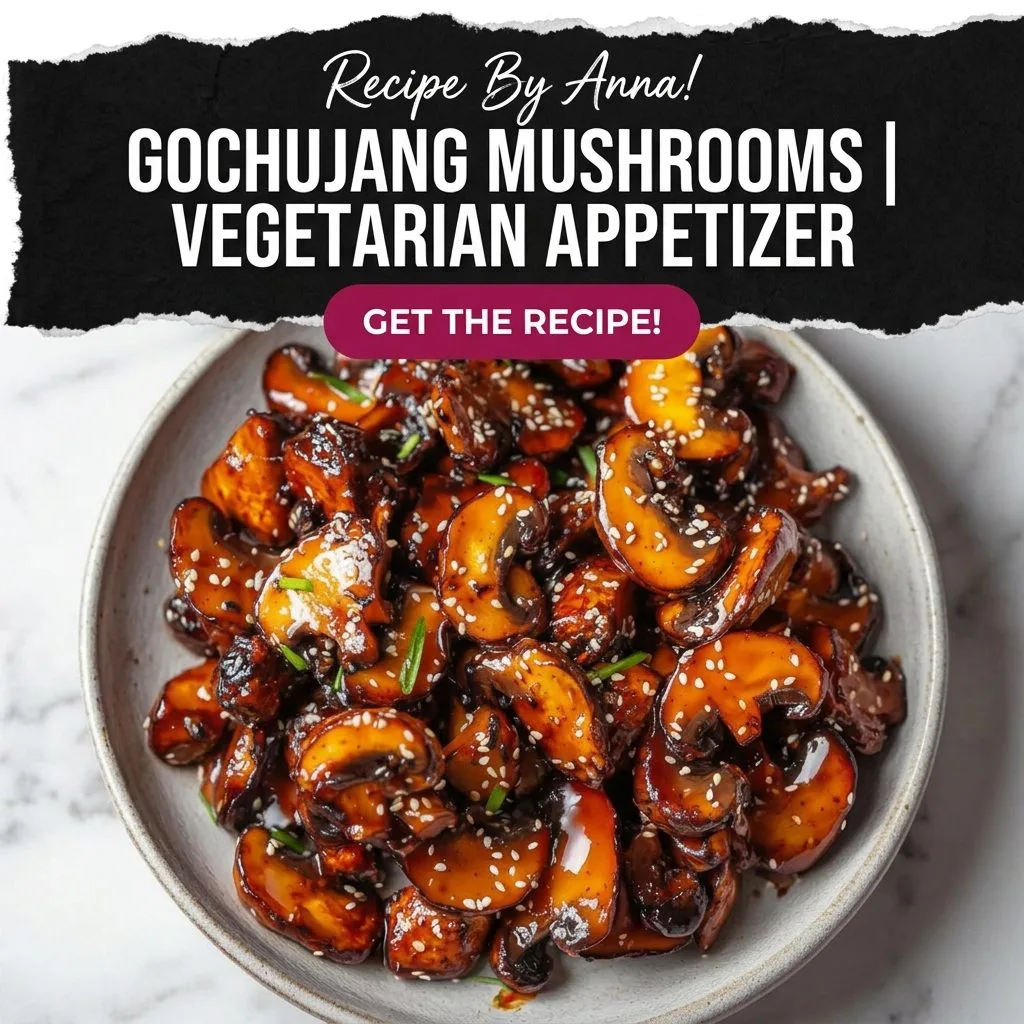
Gochujang Mushrooms — The Vegetarian Appetizer That Steals the Whole Show
Gochujang is the Korean fermented chilli paste that makes everything it touches more interesting — deeply savoury from the fermentation, sweet from the rice powder in the paste, spicy with a building heat that arrives after the first bite rather than immediately, and so specifically complex in flavour that it cannot be replicated by adding heat plus sweetness plus umami in separate components. It just tastes like itself. And mushrooms glazed in it, in a screaming-hot cast iron pan until caramelised and sticky and smelling aggressively of garlic and sesame and fermented chilli, are one of the best vegetarian appetisers that exists.
This is also the recipe most likely to convert someone to the position that mushrooms can be the most satisfying thing on the table regardless of what else is present. The combination of proper high-heat browning, the gochujang glaze cooking against the already-caramelised mushroom surface, and the finishing elements of sesame oil and green onion produces something that tastes meaty in the best possible sense — deeply savoury, slightly chewy at the edges, with a crust that has a little of the sweetness and char that makes Korean barbecue so compelling. That is a lot of work being done by a bowl of mushrooms and a tablespoon of chilli paste.
Twenty minutes. One pan. A dish that disappears from the appetiser table before anything else does.
What Gochujang Is and Why It Cannot Be Substituted
Gochujang (goh-choo-JANG) is a Korean fermented chilli paste made from red chilli powder, glutinous rice, fermented soybeans, salt, and sometimes sugar. It has been fermented for months or years, which is what produces the deep, complex umami flavour underneath the heat that distinguishes it from any non-fermented chilli paste. The fermentation breaks down the proteins in the soybean component into free glutamates — the same compounds responsible for the umami in soy sauce and miso — which is why gochujang tastes so intensely savoury despite containing no meat or fish.
Substituting sriracha or sambal oelek produces a dish that is spicy and flavourful but not gochujang mushrooms — those substitutes lack the fermented depth, the sweet rice complexity, and the specific Korean flavour that makes this recipe specifically worth making rather than just another spicy mushroom stir-fry. Gochujang is available in most supermarkets in the Asian foods aisle, in any Korean or Asian grocery store, and online. A tube or tub lasts for months in the fridge. It is worth having.
- Prep Time: 8 minutes
- Cook Time: 12 minutes
- Total Time: 20 minutes
- Yield: 4 servings as an appetiser, 2 as a main over rice
What You Need
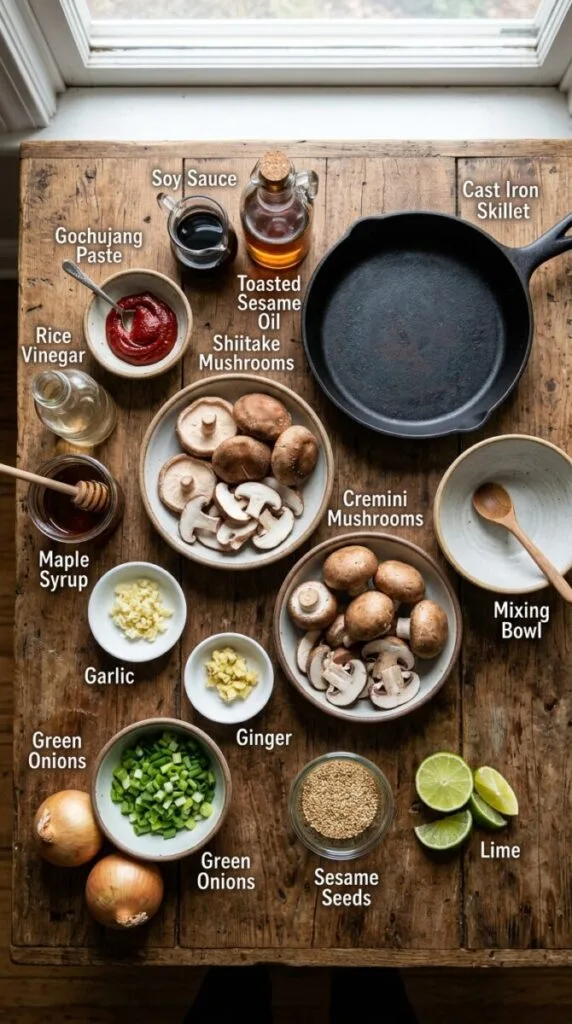
For the mushrooms:
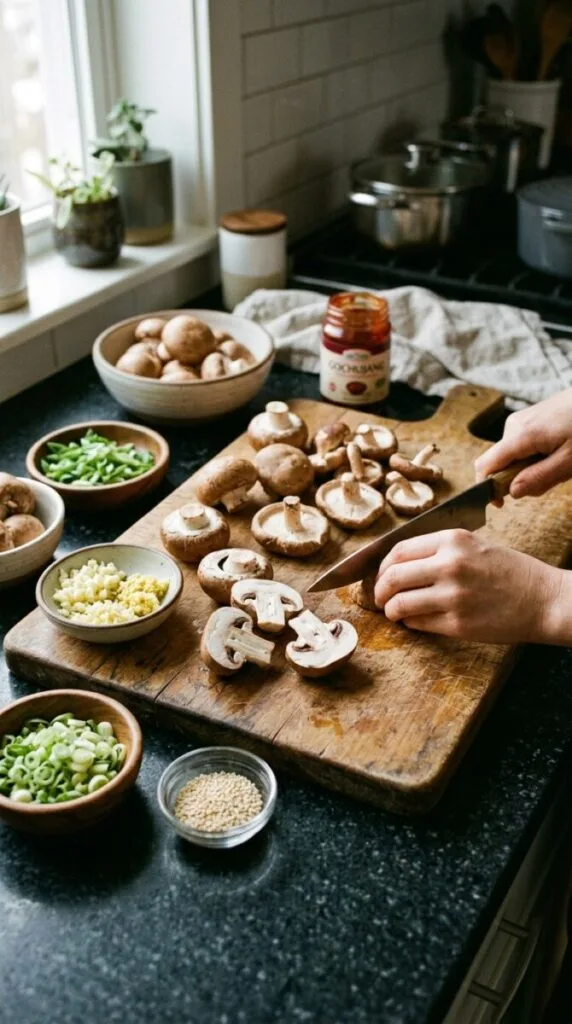
- Mixed mushrooms — cremini, oyster, shiitake, or king oyster: 1.5 lbs (680g) — larger mushrooms (king oyster, whole cremini) provide the most satisfying bite and develop the best caramelised crust; tear rather than cut oyster mushrooms to preserve their natural frilled texture; halve cremini
- Neutral oil with high smoke point (avocado or vegetable): 2 tablespoons — not olive oil, which smokes and turns bitter at the temperatures needed for proper mushroom browning
- Fine sea salt: added after browning, not before
For the gochujang glaze:
- Gochujang: 2 tablespoons — this is moderately spicy; reduce to 1 tablespoon for mild heat or increase to 3 tablespoons for significant heat
- Soy sauce: 2 tablespoons
- Honey or brown sugar: 1 tablespoon — balances the fermented intensity of the gochujang and helps the glaze caramelise against the mushroom surface
- Rice wine vinegar: 1 tablespoon — the acid that prevents the sweet glaze from being one-dimensional
- Toasted sesame oil: 1 tablespoon — stirred in after cooking; high heat destroys the aromatic compounds that give sesame oil its flavour
- Garlic cloves, finely grated: 4
- Fresh ginger, finely grated: 1 teaspoon
- Water: 2 tablespoons — thins the glaze slightly so it can coat the mushrooms evenly before reducing and concentrating during the final cook
For finishing:
- Green onions, thinly sliced: 3
- Toasted sesame seeds: 1 tablespoon
- Fresh cilantro or shiso leaves: a small handful
- Lime wedge: one per serving — the squeeze of fresh lime over the finished mushrooms is the acid that brightens the fermented, caramelised glaze and makes it taste complete rather than just intensely flavoured
Gear You Need
Nothing fancy — your oven does the heavy lifting:
- Rimmed baking sheet — rimmed, because that glaze bubbles, and you want it on the mushrooms, not on the oven floor.
- Parchment or foil — gochujang sugar bakes onto pans like it’s paying rent. Line it, thank yourself later.
- Medium bowl — for the glaze and the tossing.
- Fine grater — for garlic and ginger, so they melt into the sauce instead of hiding in spicy little ambushes.
- Heatproof spatula — for the mid-bake toss.
- Toothpicks — the official utensil of appetizer night.
How to Make Them
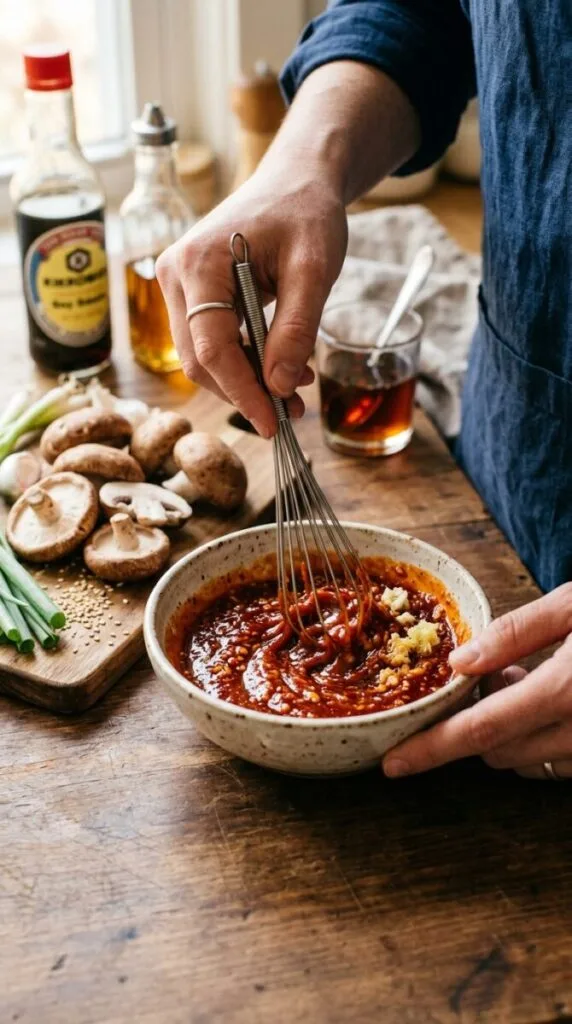
- Mix all the glaze ingredients together — gochujang, soy sauce, honey, rice wine vinegar, grated garlic, grated ginger, and water — in a small bowl until smooth. Do not add the sesame oil yet. Set aside.
- Heat a large cast iron skillet or wide, heavy-bottomed pan over high heat for 2 full minutes until very hot. Add the neutral oil and heat until shimmering and just beginning to smoke.
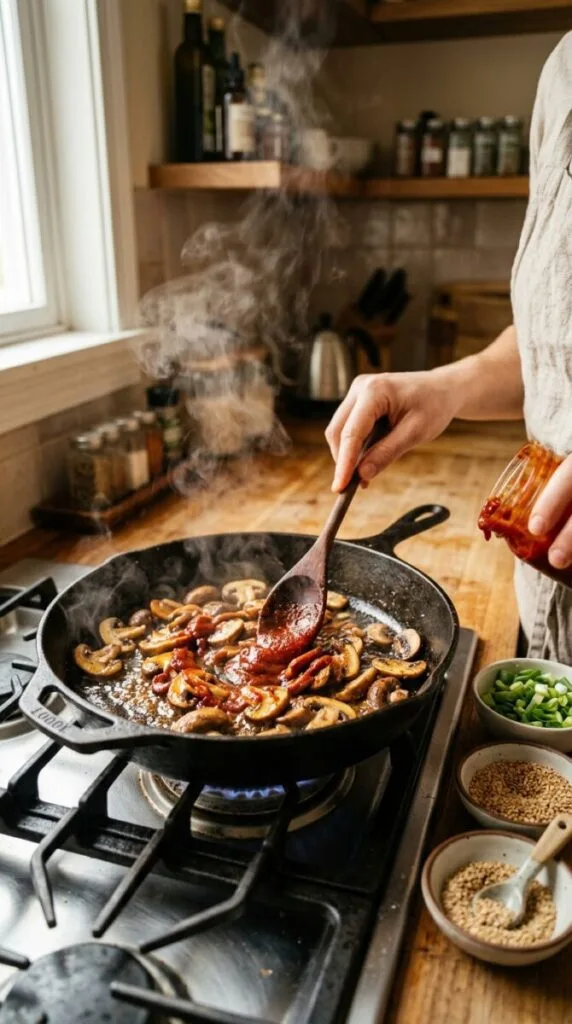
- Add the mushrooms in a single layer — in batches if needed; crowding produces steaming, not browning. Place cut-side or flat-side down and do not move them for 3 to 4 minutes. The mushrooms will release moisture, that moisture will evaporate, and then the surface in contact with the pan will begin to brown. Wait for the browning. Wait for the moment when the mushroom releases cleanly from the pan rather than sticking. That is the signal.
- Toss the mushrooms and cook for another 2 minutes until golden on the second side. Season with a pinch of salt now — after browning, not before. This is the salt-timing principle that applies to every mushroom preparation in the collection.
- Reduce the heat to medium. Pour the gochujang glaze over the mushrooms. Toss to coat every piece. The glaze will sizzle, steam, and reduce rapidly — cook for 2 to 3 minutes, tossing frequently, until the glaze has thickened to a sticky, glossy coating on each mushroom. The mushrooms should look lacquered — deeply glazed, slightly charred at the edges, and clinging together in the pan.
- Remove from heat. Drizzle the toasted sesame oil over the top and toss once more. The sesame oil goes in off the heat to preserve its aromatic compounds.
- Transfer to a serving plate or serve directly from the pan. Scatter green onions, sesame seeds, and cilantro or shiso over the top. Serve immediately with lime wedges alongside.
Gochujang mushrooms served alongside our Tofu Fried Rice and our Chickpea Edamame Salad with Sesame Ginger Vinaigrette is the three-dish plant-based Asian-inspired spread that requires no meat and produces no sense of anything missing — the mushrooms as the appetiser or side dish, the fried rice as the substantial base, the bright sesame-ginger salad as the contrast. Every flavour, every texture, every temperature covered from three recipes that share a broadly Korean and Japanese flavour language without duplicating each other anywhere on the plate.
High Heat, Salt Timing, and Sesame Oil Last
The mushroom browning requires specifically high heat — higher than most home cooks use for vegetables, high enough that the oil is shimmering and beginning to smoke before the mushrooms go in. At lower heat, mushrooms release their moisture faster than it can evaporate and begin to steam rather than sear, producing pale, rubbery, moisture-releasing mushrooms that cannot caramelise. At high heat, the moisture evaporates quickly and the direct pan contact produces the Maillard browning that transforms the surface of each mushroom from pale and soft to golden and slightly chewy. The gochujang glaze applied to a properly browned mushroom caramelises against an already-flavourful, already-textured surface — which is a completely different result from the same glaze applied to a pale, steamed mushroom.
Salt added before browning draws osmotic moisture from the mushroom cells and produces a pan full of liquid that prevents browning. Salt added after browning seasons into already-concentrated mushroom flesh. The sequence — brown first, salt after — appears in the White Bean Mushroom Skillet, the Garlic Butter Orzo, and the Garlic Mushroom Rice Casserole in this collection. The principle is always the same. So is the result.
Sesame oil added off the heat is the rule that preserves the specific toasted aroma that makes sesame oil worth using in the first place. Toasted sesame oil’s aromatic compounds — the pyrazines and furanones produced during the toasting of the sesame seeds — are volatile and evaporate quickly at high heat. Added over a high-heat pan, these compounds are gone within seconds. Added off the heat, into the residual warmth of the finished dish, they perfume the surrounding food without evaporating. The sesame flavour in the finished mushrooms should be unmistakable and present in every bite. That requires the oil to be added at the end.
What to Serve These With
As an appetiser, gochujang mushrooms need only a lime wedge and a clean serving plate — they are complete and specifically interesting enough to stand alone. If the occasion calls for something to scoop them with, lettuce cups (butter lettuce or Little Gem) with a bowl of steamed rice alongside make them into a hand-held appetiser that is more interactive and slightly more substantial.
As a main over rice, double the recipe and serve over a generous bowl of steamed jasmine or short-grain rice with the sauce from the pan spooned over. A soft-boiled egg halved over the top of the rice bowl adds protein and the egg yolk mixing into the gochujang sauce makes each bite richer than the mushrooms alone.
For a dinner party vegetarian course, these mushrooms plated over a smear of white bean purée (cannellini beans puréed with olive oil, garlic, and lemon) with a drizzle of extra sesame oil and some microgreens is the most elegant presentation of this recipe — the contrast between the smooth, mild white bean purée and the intense, sticky, caramelised mushrooms produces a composed plate that tastes like a restaurant thought about every element.
Variations That Take This in Different Directions
Milder Version: Reduce the gochujang to 1 tablespoon and add 1 tablespoon of doenjang (Korean fermented soybean paste) alongside it. The doenjang is less spicy but equally fermented and deeply savoury — the combination produces the fermented umami character of gochujang without the heat level. Increase the honey to 1.5 tablespoons to compensate for the reduced sweetness from the gochujang.
Crispy Pan-Fried Tofu Version: Add 8 oz of firm tofu, pressed dry and cubed, to the pan with the mushrooms for the initial high-heat browning — the same oil and the same high temperature. Brown the tofu alongside the mushrooms, add the glaze, toss together. The tofu absorbs the gochujang glaze beautifully and produces a more protein-complete dish that functions as a complete main course over rice rather than an appetiser.
Gochujang Mushroom Tacos: Serve the finished mushrooms in warm flour or corn tortillas with quick-pickled daikon (julienned daikon + rice wine vinegar + salt + sugar, left for 20 minutes), a drizzle of sriracha mayo (mayonnaise + sriracha + lime juice), and fresh cilantro. The Korean-Mexican fusion direction is one of the most naturally complementary in the global flavour combination space — the fermented heat of gochujang against the fresh, acidic taco components is as good as it sounds.
With Noodles: Toss the finished gochujang mushrooms with 6 oz of cooked ramen noodles or udon, adding 2 tablespoons of the pasta cooking water to loosen the sauce. Add a soft-boiled egg, sliced. Top with additional sesame seeds and green onion. The noodle version is the most substantial format — a complete meal in a bowl that takes 25 minutes total and tastes like something a Korean restaurant would serve as a special.
Nutritional Information
| Nutrient | Amount Per Serving (appetiser, based on 4 servings) |
|---|---|
| Calories | 145 kcal |
| Protein | 5 g |
| Carbohydrates | 14 g |
| Fats | 9 g |
145 calories per appetiser serving is genuinely one of the lowest-calorie dishes in the collection at this level of flavour intensity and satisfaction — the mushrooms are low in calories by nature, and the glaze ingredients together add minimal calories beyond the honey and sesame oil. As a main over rice (double portion), each serving reaches approximately 290 calories before the rice. Adding the rice bowl (1 cup cooked jasmine rice at approximately 200 calories) produces a 490-calorie complete dinner that includes 11 grams of protein and is vegan as written. The tofu version adds approximately 90 calories and 9 additional grams of protein per serving.
Storing and Reheating
Store leftover gochujang mushrooms in an airtight container in the fridge for up to 3 days. The glaze deepens and the mushrooms absorb more of the gochujang flavour during storage — day-two gochujang mushrooms are more intensely flavoured than day-one, which makes them excellent for meal prep purposes despite the loss of the just-browned texture.
Reheat in a hot dry skillet for 2 to 3 minutes until warmed through and the glaze has slightly re-caramelised on the mushroom surface — the dry pan reheat is specifically what restores some of the browning that softens during storage. The microwave reheats faster but produces mushrooms that are warm and soft rather than warm and slightly caramelised. For the appetiser context where appearance matters, the skillet. For the weekday lunch over rice where appearance is secondary to speed, the microwave is fine.
The Only Mistakes Worth Knowing
Not using a hot enough pan is the most common error and the one that most consistently produces disappointing mushrooms — a warm pan produces steaming; a hot pan produces browning. The 2-minute preheating of the empty pan over high heat before the oil goes in is not a suggestion. The oil should shimmer and just begin to smoke when the mushrooms go in. If it does not, wait. The heat is worth waiting for.
Crowding the pan is the mistake that compounds with insufficient heat — even a hot pan crowded with mushrooms produces steam from the accumulated moisture, which reduces the pan temperature and prevents browning. The mushrooms need space. Cook in two batches in a home-sized skillet and the result is worth it. The second batch cooks in the pan fat and residual heat from the first batch and browns even faster.
Adding sesame oil before removing from heat is the mistake that produces a dish where the sesame flavour is present but muted — the aromatic compounds that make toasted sesame oil specifically taste of sesame evaporate at high heat within seconds. The oil goes in last. After the heat is off. Every time. The same instruction applies to sesame oil in every recipe in the collection that includes it.
15-Minute Prep · Meal-Prep Friendly
Chickpea Edamame Salad with Sesame Ginger Vinaigrette
Chickpeas, edamame, crunchy purple cabbage and fresh vegetables tossed in a nutty sesame ginger vinaigrette with lime and fresh herbs. A colorful, satisfying lunch or dinner side with an easy vegan option.
*Times assume cooked, cooled edamame or a product labeled ready-to-eat. If your frozen edamame requires cooking, follow the package directions and allow additional time to cool.
Ingredients
As an Amazon Associate, we earn from qualifying purchases. Ingredient links below are affiliate links.
For the Salad
- Canned chickpeas — 1 can (15 oz / 425 g), drained, rinsed and patted dry
- Shelled edamame — 1½ cups (225 g), prepared according to package directions, cooled and drained
- Purple cabbage — 1½ cups, finely shredded
- Carrots — 2 medium, julienned or coarsely grated
- English cucumber — ½ large, diced or thinly sliced
- Red bell pepper — ½, thinly sliced
- Green onions — 3, thinly sliced
- Fresh cilantro — ¼ cup, roughly chopped
- Fresh mint leaves — 2 tablespoons, torn
- Toasted sesame seeds — 2 tablespoons, white or a mix of white and black
For the Sesame Ginger Vinaigrette
- Toasted sesame oil — 2 tablespoons
- Rice wine vinegar — 3 tablespoons
- Soy sauce or tamari — 2 tablespoons
- Fresh ginger — 1 tablespoon, finely grated
- Garlic — 1 clove, finely grated
- Honey or maple syrup — 1 tablespoon
- Lime juice — 1 tablespoon
- Neutral oil — 1 tablespoon
- Sriracha or chili garlic sauce — ½–1 teaspoon, to taste
How to Make It
-
Whisk the vinaigrette
Whisk all dressing ingredients in a small bowl or shake vigorously in a tightly closed jar until combined. Taste and adjust the saltiness, acidity, sweetness and heat. Set aside.
-
Prepare the edamame
Check the package: cook frozen edamame as directed unless explicitly labeled ready-to-eat. Cool promptly, drain thoroughly and pat dry. For ready-to-eat edamame, thaw according to package instructions.
-
Drain and dry the chickpeas
Drain and rinse the chickpeas, then pat dry with a clean towel. Removing excess water keeps the vinaigrette from becoming diluted.
-
Combine the salad
Add the chickpeas, cooled edamame, shredded cabbage, carrots, cucumber, red bell pepper and green onions to a large bowl.
-
Dress and toss
Whisk or shake the vinaigrette again, then pour it over the salad. Toss thoroughly so the cabbage shreds and chickpeas are evenly coated.
-
Fold in the herbs
Add the cilantro and mint, then fold gently three or four times. If preparing several days ahead, keep the herbs separate and add them just before serving.
-
Finish with sesame seeds
Scatter the toasted sesame seeds over the salad. Taste and add a little more soy sauce or lime juice if needed.
-
Serve or briefly rest
Serve immediately for maximum crunch, or let stand for an optional 10 minutes to allow the flavors to mingle. Toss again before serving.
Tips & Variations
- Choose toasted sesame oil: Look for “toasted” or “roasted” on the label for the dressing’s distinctive nutty flavor.
- Vegan option: Choose maple syrup instead of honey and check the sauce labels.
- Gluten-free option: Use certified gluten-free tamari and check all condiment labels. Not every tamari is gluten-free.
- Crispy tofu: Press and cube 14 oz firm tofu. Toss with 1 tablespoon each of soy sauce, cornstarch and sesame oil. Pan-fry in 2 tablespoons neutral oil until golden, turning to brown several sides. Cool slightly before adding. Allow extra cooking time.
- Mango version: Add 1 cup diced ripe mango. Reduce the dressing’s honey or maple syrup to ½ tablespoon.
- Noodle bowl: Cook 6 oz soba noodles according to the package, rinse cold and drain. Add to the salad and double the vinaigrette. For gluten-free needs, choose certified gluten-free soba; many varieties contain wheat.
- Winter version: Replace the cucumber and bell pepper with 1 cup roasted, cooled butternut squash. Add ¼ cup dried cranberries and replace the cilantro and mint with fresh basil to taste.
Meal Prep & Serving
- Storage: Refrigerate promptly in an airtight container at 40°F (4°C) or below and use within 3–4 days. Follow any shorter storage instructions on your ingredients. Do not leave at room temperature for more than 2 hours.
- Maximum crunch: Store the vinaigrette separately and dress individual portions before eating. Keep the herbs and sesame seeds separate until serving. Dressed vegetables will gradually soften.
- Plant-based pairing: Serve alongside Tofu Fried Rice for a more substantial dinner.
- Salmon pairing: The tangy dressing also complements Brown Sugar Salmon.
- Allergens: Contains soy and sesame. Standard soy sauce usually contains wheat.
Nutrition Per Serving
| Nutrient | Amount |
|---|---|
| Calories | 395 kcal |
| Protein | 21 g |
| Carbohydrates | 45 g |
| Fat | 16 g |
Estimates supplied with the original recipe, not independently calculated. Actual values vary by brand, drained weight and serving size. Optional additions are excluded.