
Fast Nova Scotia Seafood Chowder | Cozy Dinner
Some dishes have a place, and this one has a province. Nova Scotia seafood chowder is what the Atlantic coast of Canada eats when the fog comes in — a milk-and-cream broth loaded with the fish that landed that morning, potatoes from the Annapolis Valley, and a finish of dill that no one south of the border ever thinks to add and everyone who tries never forgets. Drive the coast and you’ll find it everywhere from church basements to the province’s famous chowder trail, where dozens of seaside kitchens compete over the same humble brief: potato, salt pork, cream, and whatever the boats brought in. The recipe I make in my own kitchen is the honest home version of that — haddock as the backbone, shrimp and scallops as the supporting crew, bacon standing in for the traditional salt pork, and a broth built on clam juice that tastes like it took all day and takes eleven minutes.
What separates a great chowder from a bowl of creamy fish soup is discipline, not difficulty, and the discipline comes down to three rules. The dairy never boils — milk and cream curdle at a hard boil, and a curdled chowder is grainy in a way no amount of hoping fixes, so the pot lives at a bare simmer from the moment the dairy goes in. The seafood goes in staged — haddock first, then the fast-cooking shrimp and scallops in the final minutes — because two pounds of seafood thrown in together means rubbery shrimp and falling-apart fish in the same spoonful. And the thickening comes from the potatoes themselves — a scoop mashed against the side of the pot releases their starch into the broth, which is how the old fishing families did it, and it means no flour, no roux, and a chowder that happens to be gluten-free without trying. Three rules, one pot, and a pot that means it.
Honest notes before we start. This is a flexible recipe by birth — a chowder on the coast is whatever the boats brought, and the variations section has the full roster of sanctioned swaps. Haddock is the traditional white fish and worth finding if you can (frozen works beautifully); cod, halibut, or any firm white fish steps in without ceremony. The clam juice is the one ingredient I’ll argue for hard: it’s the difference between a broth that tastes like the ocean and a broth that tastes like milk and optimism. And make it for people you like, because this is a bowl that gets ladled slowly and eaten quietly, and both of those things are better with company. The fog is optional.
The Tide Pot
Start with the word itself, because chowder is one of the few dishes named after its cookware. It comes down from the French chaudière — a cauldron, the big pot — and the story attached to it is the Grand Banks fishermen’s version of a potluck: crews out on the banks would each contribute part of their catch to a kettle kept simmering on deck, and everyone ate from the communal pot at the end of the day. That origin explains almost everything about the dish’s personality. A chowder is built to feed a crew from one pot. It’s forgiving about exactly what goes in, because the catch changed daily. It’s thick enough to eat with a spoon and a piece of bread rather than a ladle and a bowl of broth. And it’s humble in its technique — no straining, no puréeing, no refinement — because it was made by tired people with cold hands and good fish. Four centuries later, the recipe still rewards exactly those values: simple handling, generous seafood, a pot patient enough not to boil its own cream.
The broth is where Nova Scotia’s version earns its identity, and it’s a two-part trick. Part one is the clam juice: fish stock is the old-fashioned base, made by simmering bones and shrimp shells for the better part of an hour, and it’s wonderful — but bottled clam juice delivers eighty percent of that depth for two percent of the effort, and its briny glutamates make the broth taste like the ocean without a single extra fish in the pot. Part two is the potato mash: when you crush a scoop of cooked potato against the wall of the pot, the ruptured cells release their starch, and that starch swells and thickens the surrounding liquid — the same physics as a cornstarch slurry, except it comes packaged in the soup’s own ingredient. The result is a broth that coats the spoon and clings to the fish without a trace of floury pastiness. A light sprinkle of black pepper at the end, and the old Maritime formula — salt pork, allium, potato, cream, seafood — is complete and intact.
Then the dairy science, because this is the rule that ruins more chowders than any other. Milk and cream are emulsions — butterfat globules suspended in water with proteins keeping the peace — and a hard boil breaks the peace: the proteins tighten, the fat clusters, and the liquid separates into grainy curds and a thin, watery whey. It’s the same process that makes ricotta, which is lovely on purpose and heartbreaking in a chowder. A bare simmer keeps the emulsion intact, and warming the milk and cream before they join the pot removes the temperature shock that encourages splitting in the first place. This is why the recipe says never let it boil after the dairy goes in — not a preference, a boundary condition. The pot can do anything it likes before the cream; after the cream, it whispers.
And the seafood staging deserves its own paragraph, because it’s where texture is won. Everything in the pot is already cooked the moment it turns opaque — haddock at around 140°F, shrimp and scallops a shade higher — and every degree past that trades tender for tough, since fish proteins squeeze out their moisture fast when overcooked. The fix is sequence and restraint: the haddock goes into the barely-simmering broth first and gets four gentle minutes to turn from translucent to just-opaque; the shrimp and scallops follow for the final three; lobster meat, already cooked, needs only to be warmed through, so it goes in at the very end with the heat off. Total active seafood time: under eight minutes. The pot does the rest with residual heat, and every piece comes out the way the ocean intended it.
⏱️ 50 MIN | 🌊 6 BOWLS | 🥣 NEVER LET IT BOIL
- Prep Time: 20 minutes — the seafood cutting is most of it
- Cook Time: 30 minutes, gentle throughout
- Total Time: about 50 minutes, plus a 10-minute rest
- Yield: 6 generous bowls
The Salt Pork Question
Every traditional chowder starts with fat from cured pork, and there’s a genuine fork in the road worth understanding. The original Nova Scotia pots used salt pork — plain salt-cured pork belly, no smoke — diced and rendered slowly until the fat runs and the little cubes turn golden and chewy. Its contribution is clean, savory salt-fat with no other agenda, which is why the old recipes lean on it: it seasons the vegetables and the broth without announcing itself. Bacon, by contrast, renders smoke along with its fat — and that smoke is doing something the old pots didn’t have, standing in pleasantly for the smoked haddock that the most traditional Maritime versions use to deepen the broth. So this is one of the rare cases where the modern substitute isn’t a compromise so much as a remix: salt pork gives you history, bacon gives you smoke, and both give you the salt-fat foundation that makes the vegetables sweeter and the broth rounder than butter alone ever could.
My house version uses bacon, three slices, because it’s in every fridge and the smoke plays well with haddock. If you find salt pork — any good butcher carries it, and it keeps for months in the fridge — dice it small, render it low and slow, and know that you’re cooking the version the fishing crews would recognize. Either way, the technique is the same: render the pork first, and cook the vegetables in that fat with a spoon of butter for richness. This is the flavor foundation of the entire pot, the step that makes the leeks taste deeper than leeks and the potatoes taste like more than potatoes, and it costs about eight unhurried minutes.
The Chowder Kit
One pot, a few supporting pieces, nothing fussy:
- Dutch oven or heavy pot, 5 to 6 quarts — wide and heavy, which holds the gentle heat steady and gives the seafood room to poach instead of stack.
- Wooden spoon — for the render, the sweat, and the potato mashing against the wall.
- Fork — the official potato-mashing instrument. A potato masher works; the fork mashes a scoop without over-working the rest.
- Cutting board and a sharp knife — seafood cutting is the main prep event.
- Measuring jug — for warming the milk and cream together in the microwave or a saucepan, so they join the pot without a temperature shock.
- Ladle and deep bowls — chowder is a bowl food with a bread alongside, and the deep bowl keeps it hot to the last spoonful.
Ingredients (With Labels)
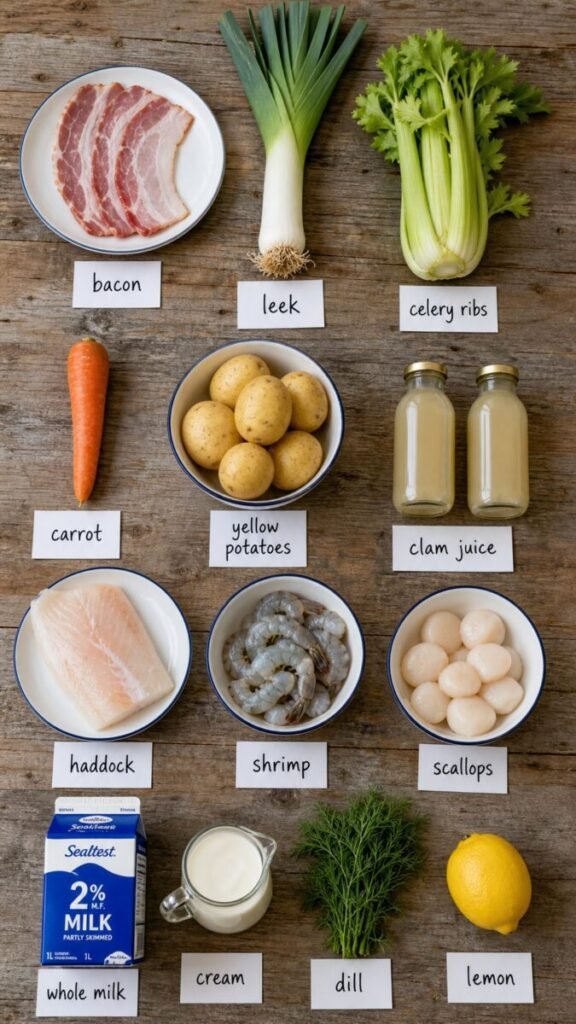
🥓 The Base
- Bacon: 3 slices, diced small — or 2 oz salt pork, the traditional route
- Butter: 1 tablespoon
- Leek: 1 large, washed well and sliced — or 1 onion, diced
- Celery: 2 ribs, diced
- Carrot: 1 small, diced fine
🥔 The Broth
- Yellow potatoes: 1¼ lb, half-inch dice
- Clam juice: 16 oz — two 8-oz bottles
- Water: 1 cup
- Bay leaf: 1
- Dried thyme: ½ teaspoon
- Salt and black pepper: ½ teaspoon pepper; salt at the end, to taste
🌊 The Seafood
- Haddock: 1 lb, cut into bite-size chunks — cod or halibut welcome
- Shrimp: ½ lb, peeled and deveined
- Scallops: ½ lb — halved if large
- Lobster meat: optional 4 oz, chopped — the celebration upgrade
🥛 The Dairy and the Finish
- Whole milk: 2 cups
- Heavy cream: ¾ cup
- Fresh dill: 1 tablespoon, chopped, plus more for the bowls
- Lemon: 1 — the zest at the end, wedges at the table
- Chives: 1 tablespoon, snipped
Step by Step How to Make
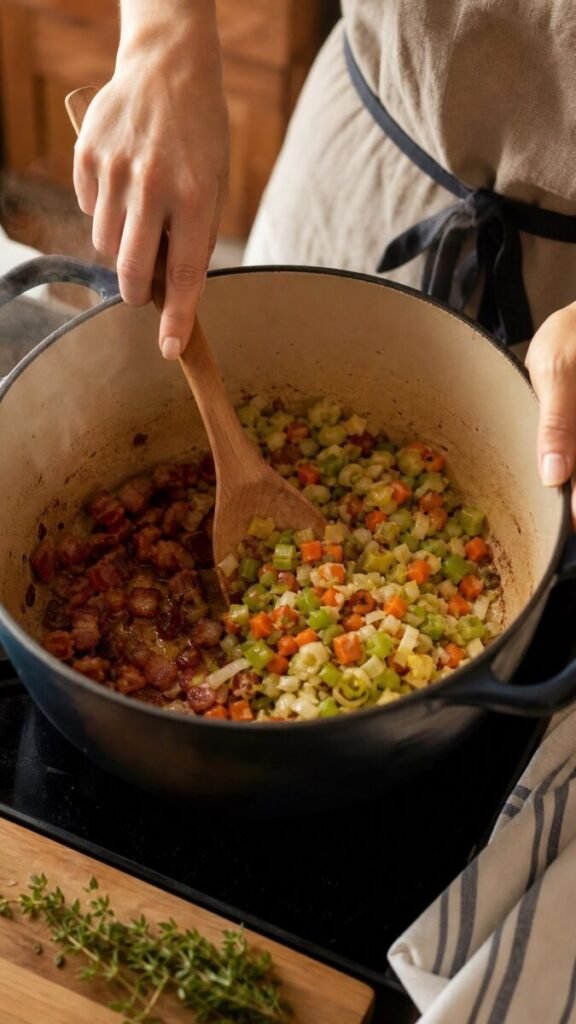
- Step 1 — Render and sweat. In the Dutch oven over medium-low heat, cook the diced bacon slowly until it’s crisp and the fat has rendered out, 6 to 8 minutes — low and slow gives you clean fat and chewy bits rather than scorched ones. Spoon out half the bacon and set it aside for garnish; leave the rest in the pot. Add the butter, then the leek, celery, and carrot with a small pinch of salt, and sweat them in the pork fat for 6 to 7 minutes, stirring now and then, until the leek is soft and translucent and the whole kitchen smells like the beginning of something. No browning — you’re sweetening them, not coloring them.
- Step 2 — The clam bath. Add the potatoes, clam juice, water, bay leaf, and thyme, and bring the pot up to a gentle simmer. Let it go, uncovered, 12 to 14 minutes, until the potatoes are tender to the fork and the broth smells like a tidepool in the best way. This is the chowder’s stock phase — the clam juice and the potato starch are becoming one thing — and there’s nothing to do but stir occasionally and appreciate the smell, which is a legitimate step in Maritime cooking as far as I’m concerned.
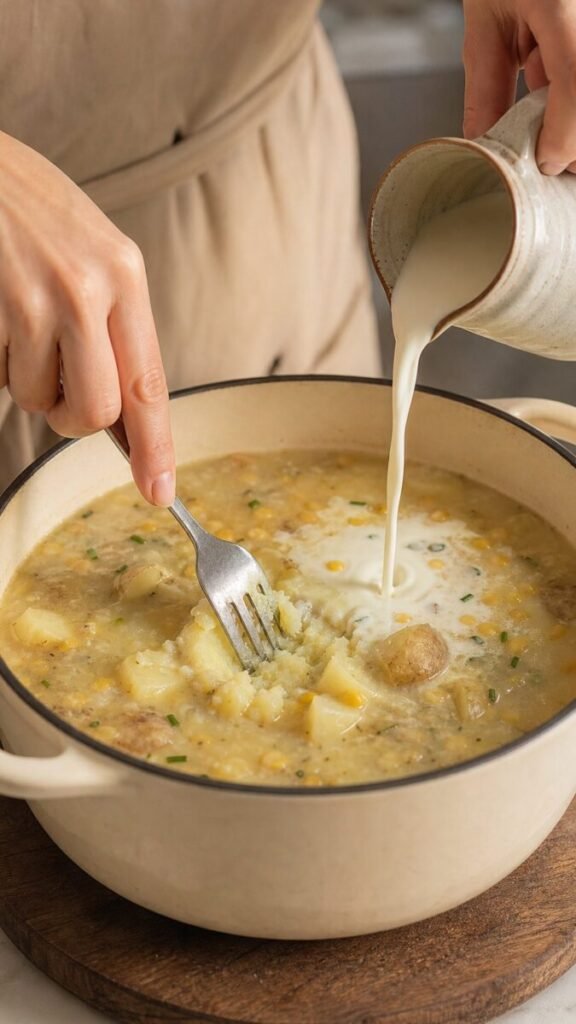
- Step 3 — Mash a scoop, warm the dairy. Fish out about a cup of the potato chunks — the fork makes this easy — and mash them right against the inside wall of the pot until they’re a rough purée, then stir that purée back into the broth. This is the entire thickening operation: the ruptured potato releases its starch, the broth turns from watery to chowder, and the body of the soup is done without a speck of flour. Meanwhile, warm the milk and cream together in the jug — a minute in the microwave, or a few in a small pan — so they’re tepid rather than fridge-cold when they meet the pot.
- Step 4 — Dairy in, and the whisper begins. Pour the warmed milk and cream into the pot, stir, and bring it back to the barest simmer — the surface should shiver, not bubble. From this moment forward, the pot never boils; a boil curdles the dairy, and curdled chowder is a texture failure no garnish can hide. Taste the broth now — it should be pleasantly seasoned from the bacon, clams, and salt so far — and add salt as needed, keeping in mind that the clam juice brands vary and the seafood adds its own brine. Let the pot hold that gentle shiver for 5 minutes so the flavors settle in before the seafood arrives.
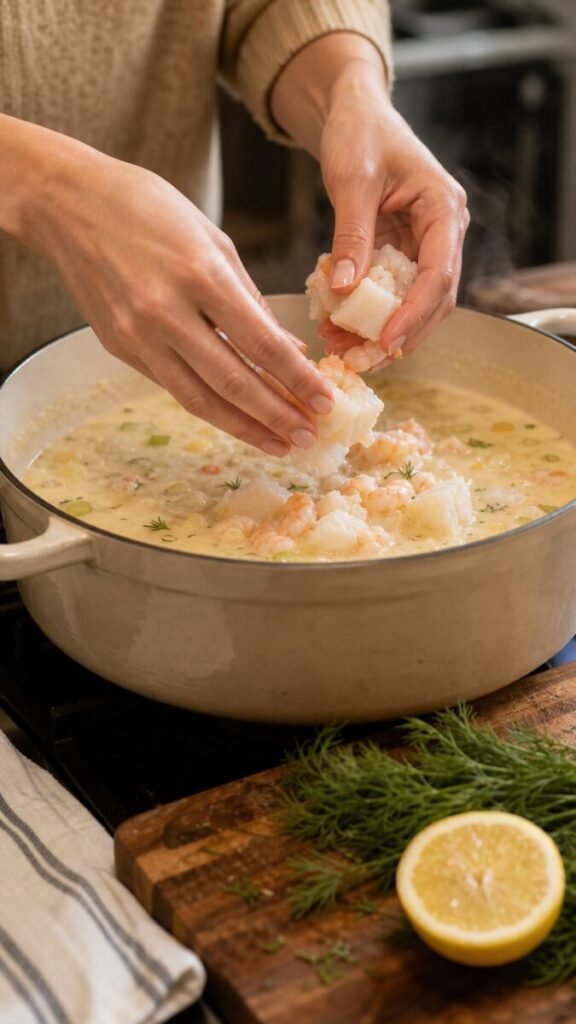
- Step 5 — The seafood staging. The order matters, and here it is: haddock first. Slide the chunks into the barely-simmering broth and give them 4 gentle minutes to turn from translucent to just-opaque — stir once, softly, mid-way. Then the shrimp and scallops, for 3 final minutes, and the lobster if you’re running the celebration build. Watch the shrimp: the moment they curl into a loose C and turn pink-opaque, everything in the pot is done, and thirty seconds past that moment is where tenderness starts becoming rubber. If you’re unsure, pull a piece of haddock and break it — it should flake, not shred.
- Step 6 — The East Coast finish. Heat off. Stir in the dill, chives, and the lemon zest — the zest is doing quiet, important work, lifting the whole pot the way it does in every good Maritime kitchen — and a generous grind of black pepper. Then the rest: ten minutes with the lid on, no heat, while the chowder settles and the flavors finish introducing themselves. Ladle into deep bowls, scatter the reserved bacon over each, a pinch more dill, and lemon wedges on the table alongside warm buttermilk biscuits or oyster crackers. Eat it while it’s hot enough to fog the window. That fog is part of the recipe, and I’ll defend that position.
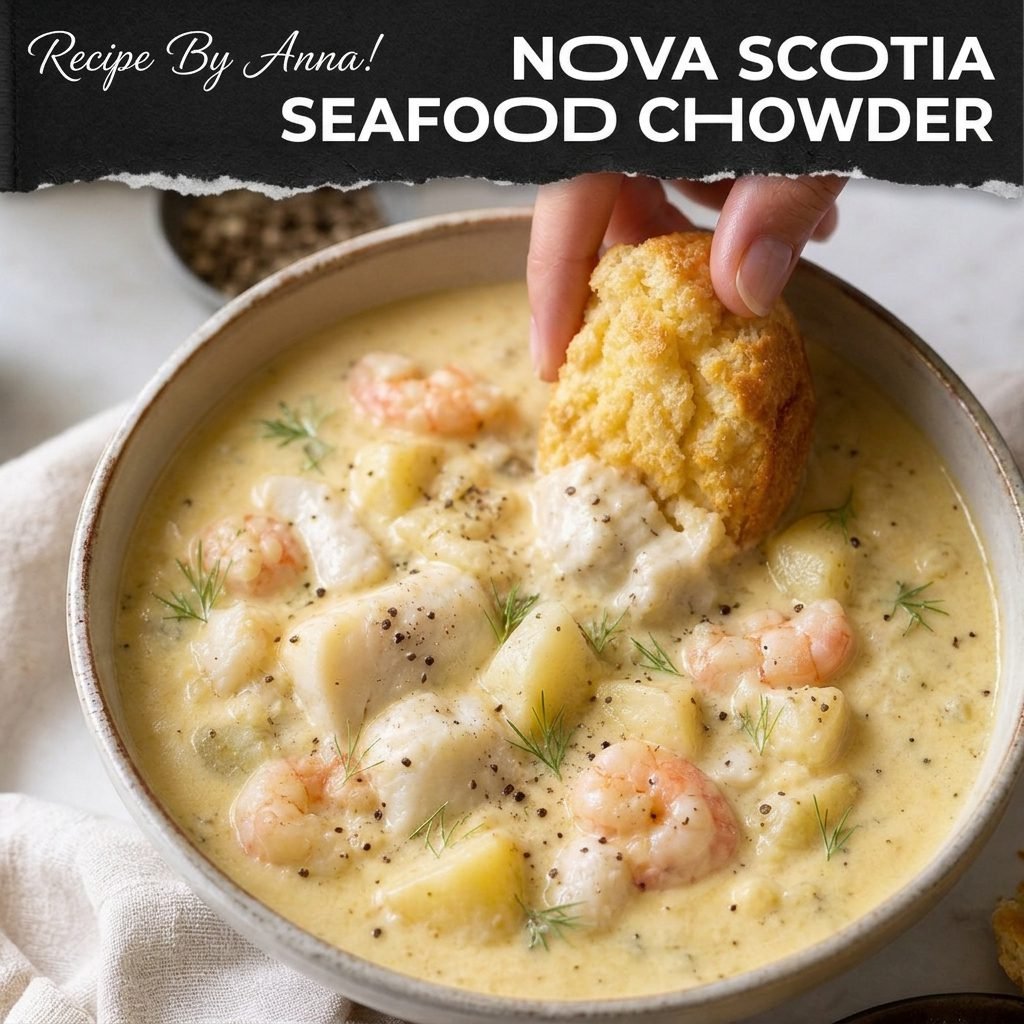
A chowder this creamy was born to sit beside bread — pull the buttermilk biscuits out of the oven when the pot goes quiet, and let the dunking begin.
Anna’s Kitchen Notes
Find the haddock, or don’t. Haddock is the heart of a Maritime chowder — sweeter and flakier than cod, with a tenderness that poaches beautifully — and the frozen version thaws into this recipe so well that I buy it frozen on purpose. Cod, halibut, hake, or any firm white fish works when haddock’s not around; the chowder is bigger than any one fillet, and the coast has always cooked it that way. The one thing I’d skip is a delicate fish like sole, which dissolves into nothing and leaves you with a chowder that’s all rumor.
The clam juice is not optional. I’ll bend on almost everything else in this recipe — the fish, the herbs, the pork — but the broth is the chowder, and bottled clam juice is what makes a thirty-minute broth taste like a four-hour one. Two eight-ounce bottles, next to the tuna in most grocery stores, for about three dollars. If you want to go the full traditional route, save the shrimp shells and simmer them in the clam juice and water for fifteen minutes before straining into the pot — a homemade fumé, and genuinely better. But the bottles alone already get you the ocean.
Warm dairy, cold pot, no curds. The three-part insurance policy against grainy chowder: warm the milk and cream before they go in, let the pot come back to a simmer slowly, and never let it boil afterward. Every curdling disaster traces back to a broken link in that chain, usually the last one during a distracted moment of “it’s just barely bubbling.” If you see the surface doing more than shivering, lift the pot off the burner for a minute. The cream will thank you by staying cream.
The rest is a real step. Those ten minutes with the lid on are when a good chowder becomes a great one — the potato starch finishes thickening, the seafood’s juices finish meeting the broth, and the temperature drops to the point where the dairy sits smooth and settled instead of restless. It also happens to be exactly enough time to split and butter the biscuits, which I mention as a matter of scheduling and not at all as a coincidence.
Tomorrow’s bowl is the better bowl. Like every stew and chowder in maritime history, this one improves overnight in the fridge as the flavors marry — reheat it gently, at that same shivering simmer, and stir it once or twice, and the second-day bowl will taste deeper and rounder than the first. The one honest note: the potato absorbs broth as it sits, so loosen day-two chowder with a splash of milk or clam juice on the reheat. It comes back to itself in a minute.
The East Coast Table
A chowder bowl wants bread beside it and something bright across from it, and the table builds itself from there. The buttermilk biscuits are the official vehicle — split, buttered, and used as both dipper and lid — and the slow cooker corn chowder is this pot’s sweeter, easier cousin for the week you want the same comfort with no seafood in sight.
For the rest of the spread: the pork sausage and potato soup is the same hearty-cozy energy in a meat-eater’s key, the warming Italian broccoli soup keeps a green bowl on the table, and the black bean and lentil soup rounds out a soup night for a crowd. And when the table leans international, the tom kha gai is this chowder’s coconut-milk twin from the other side of the world — same creamy comfort, entirely different ocean. Two pots, one very well-fed couch.
Same Pot, Other Coasts
The New England detour. Swap half the seafood for chopped fresh clams in their juice — the classic Boston move — and drop the dill for a thyme-forward finish. It’s the same pot with a different accent, and the clams’ juice replaces one bottle of the clam juice called for above.
Manhattan-style, honestly noted. The tomato-based chowder that New England considers a feud: sweated vegetables, diced tomatoes in place of the dairy, and the same seafood staging. It’s lighter and tangier, it’s not traditional anywhere in Nova Scotia, and it’s genuinely delicious — I make it in late summer when the tomatoes are taunting me. About eighty percent of the comfort, none of the cream.
The lobster-forward celebration. Double the lobster to a full half-pound of knuckle and claw meat, cut the shrimp, and finish each bowl with a claw on top. This is the wedding-and-anniversary build, the one that turns a fog-day chowder into an occasion, and it needs no other changes — the pot was already built for it.
Corn and bacon summer. A cup of fresh or frozen corn kernels added with the potatoes, extra bacon, chives doubled — the sweet-corn version that bridges this recipe and its corn chowder cousin. Late August, patio, bowl in one hand: this is the one.
Smoked haddock, the old soul. Replace a third of the haddock with the same weight of smoked haddock (finnan haddie, when you can find it) — the traditional depth that Nova Scotia kitchens have leaned on forever, and the reason bacon’s smoke works so well in the modern version. The broth goes quietly magnificent, and nobody will be able to name why. Now they can.
The weeknight minimal build. One fish, one pound, done: skip the shrimp and scallops, use a full pound and a half of haddock, and the chowder comes together in thirty-five minutes flat. It’s less of a production and still entirely itself — the bacon, potatoes, clam juice, and cream carry the identity, and a single-fish chowder is a proud Maritime tradition in its own right.
The Ladle Tally
| Nutrient | Per Bowl (1 of 6) |
|---|---|
| Calories | 375 kcal |
| Protein | 27 g |
| Carbohydrates | 22 g |
| Fats | 13 g |
Estimates as written, seafood, bacon, and the full dairy pour included — and look at that protein line for a second, because it’s the quiet headline: twenty-seven grams a bowl puts this chowder in territory usually reserved for a chicken dinner, and it comes from two pounds of seafood doing what seafood does. The fat sits modestly for a cream soup because the body comes from potato starch rather than a flour-and-butter roux — the old fishing-family trick paying off on the label as well as the palate. The potatoes account for most of the carbohydrates, the cream for the richness, and a biscuit alongside adds whatever you decide it adds. In my accounting, the biscuit is worth it.
The Freezer Pot
The fridge keeps the chowder three days, and day two is the better bowl — full stop, no caveats, the flavors married and the broth settled. Reheat gently on the stove over low heat with the occasional stir, adding a splash of milk or clam juice to loosen it back to ladling consistency, and never letting it reach a boil, because the curdling rule outlives the cooking day. The microwave works in bursts for a single bowl, stirred at the halfway mark; the stovetop is better, and you already know why.
The freezer is a partial yes, honestly rated: the broth, potatoes, and bacon freeze beautifully for two months, but the seafood is never quite as tender after thawing — haddock tightens, shrimp firm a shade — so the frozen bowl lands at about eighty-five percent of the fresh one. The workaround that beats the problem: freeze the chowder base before the seafood goes in, and stage fresh seafood into the reheated base on the day you serve it. Base in the freezer, fish from the market on the day, and a weeknight chowder that tastes like a Saturday.
Leftover careers, for the rare surviving bowls: reheat and serve over toast points with an egg on top for the breakfast the coast never told anyone about; stretch a cup with a little extra milk and a handful of sweet corn for a lighter lunch; or reduce it slightly, stir in a spoon of the lobster butter logic and toss with hot pasta for a chowder-adjacent pasta night. And the heels of bread left on the board after biscuit night exist to be dragged around the empty pot, which in my kitchen is considered a course.
Where It Goes Wrong
Grainy, curdled broth. The pot boiled after the dairy went in — the one unforgivable sin in chowder country. The proteins in the milk tighten and the fat separates, and what was silk becomes grain and whey. It’s prevented entirely by the shiver-not-simmer rule and mostly prevented by warming the dairy first; it cannot be fully reversed once it happens, though a gentle whisk off the heat pulls a mild case back toward smooth. Guard the simmer like the whole recipe depends on it, because it does.
Rubbery shrimp and scallops. They overcooked, full stop — either the pot was too hot or they stayed too long. Shrimp and scallops need exactly three minutes at a bare simmer, and they’re done the moment they turn opaque; the loose C-shape curl on a shrimp is the universal doneness flag. If the pot is at a proper simmer, set a timer and trust it. And remember the residual heat keeps working after the burner’s off — pull the pot at done, not at “almost done plus a minute for luck.”
Fish that shreds to nothing. The haddock was stirred hard, cooked long, or cut too small. Haddock wants big, confident chunks — bite-size, not dice — four gentle minutes, and a single soft stir. It finishes breaking into flakes on the spoon naturally, which is the texture you want, but the break-up should happen in the bowl, not in the pot. Also check the fish: a soft-frozen-and-refrozen fillet falls apart no matter how gently it’s treated, which is why firm, properly thawed fish is worth the label-reading.
A thin, watery chowder. The potato mash got skipped, or the spuds were waxy rather than starchy. The thickener here is potato starch, and it only thickens if the starch is released — mash the full scoop against the wall, stir it in, and give it two minutes to swell. If it’s still thin, pull a second scoop and repeat. Yellow russets and Yukons are the starchy team players; red potatoes hold their shape beautifully and thicken like they’re being paid not to.
A bland bowl despite good seafood. Under-salt and missing zest, usually — clam juice varies wildly in saltiness between brands, so the pot must be tasted after the dairy goes in, not before. The lemon zest at the end is the other half: it lifts the cream and brightens the fish, and its absence is the most common note in my “something’s missing” mail about this recipe. Salt to taste, zest the lemon, and taste again before the lid goes on.
A fishy-tasting chowder. The seafood was past its prime, or the shrimp weren’t deveined, or the fish had been thawed and refrozen — chowder concentrates rather than hides, and a borderline fillet becomes a borderline pot. Shop a busy counter, trust your nose over the date on the package, and cook what smells like clean ocean the day you buy it. The beauty of this recipe is that it’s fast enough to make the same day you shop, which is exactly what the coast would tell you to do.
Chowder Questions
Can I use frozen seafood?
Yes, and for the haddock I’d actually recommend it — fillets frozen at sea thaw into firmer, sweeter chunks than many “fresh” fillets that have been sitting on ice for days. Thaw everything overnight in the fridge, pat the fish dry, and proceed. Frozen shrimp are the industry standard even at good fish counters, and frozen scallops work fine as long as they haven’t been soaked in a phosphate solution — check the label for a single-ingredient list that reads “scallops.”
What’s the best fish if I can’t find haddock?
Cod is the closest stand-in — same flake, same sweetness, a slightly firmer chew. Halibut makes a luxurious version, hake and pollock are the quiet bargains of the white-fish case, and any firm, lean, flaky fish that smells clean will do the job. The Maritime rule of thumb is whatever the boats brought in, which historically meant the fish that was abundant and affordable — a tradition your grocery store can absolutely honor.
Can I make it with milk only, no cream?
You can, with two adjustments: use a quarter cup more potato for the mash-thickening, since the body will need the help, and accept a leaner, more old-fashioned bowl — the fishing families used what the cow gave them, and plenty of pots were all-milk. Half-and-half is the middle path that most closely matches the written texture. What I wouldn’t do is swap in low-fat milk and expect the same chowder; the fat carries flavor, and this is a bowl that runs on it.
Can I make chowder ahead for a party?
Beautifully — this is a make-ahead dish by nature. Build the pot through step four, dairy in and seasoned, then stop: refrigerate the base for up to two days, and stage the seafood into the gently reheated base twenty minutes before serving. The seafood needs those final minutes anyway, and the base genuinely improves overnight. For a party of twelve, double the base and split it into two pots so the seafood staging stays gentle — a crowded pot boils when you’re not watching, and you know the rule about boiling.
Is this chowder gluten-free?
Yes, as written — the thickening is potato starch, the seafood is plain, and clam juice carries no gluten. Two labels to check: the bacon (a few brands add flavorings with gluten, most don’t) and whatever you serve alongside, since oyster crackers are wheat and the biscuits are too. With a gluten-free roll or crackers beside the bowl, the whole table eats the same dinner, which is the Maritimes’ kind of hospitality and mine.
Why clam juice instead of fish stock?
Speed and reliability, mostly. A proper fish stock means bones, shells, forty-five minutes, and a strainer — worth it on a weekend, and the upgrade is real if you want it. But bottled clam juice is shelf-stable, cheap, consistently good, and briny in exactly the direction this broth wants; it’s the single ingredient doing the most work per dollar in the recipe. Water alone is the version I’ll argue against every time — without the clam juice, the broth tastes like milk that met a potato, and the chowder deserves the ocean.
What do I serve with it?
The classic pairings are warm bread and something sharp: buttermilk biscuits or oyster crackers for the dunking, and a bright, vinegar-y slaw or a simple green salad with a lemony dressing to cut the cream between spoons. A bowl of pickles or giardiniera does the same job casually. And the beverage matters more than usual — something crisp and cold, a pale ale or a dry white, stands up to the cream and keeps the bowl from getting heavy. The coast drinks what the coast drinks, and the chowder is why.
Atlantic-inspired · Three kinds of seafood · Potato-thickened broth
Nova Scotia Seafood Chowder
A creamy, Maritime-inspired chowder with tender haddock, shrimp, scallops, potatoes, and smoky bacon. Clam juice builds the savory broth, mashed potatoes add body, and fresh dill, chives, and lemon zest brighten every bowl.
As an Amazon Associate I earn from qualifying purchases.
Ingredients
The savory base
- 3 slices bacon, finely diced, or 2 oz salt pork
- 1 tablespoon butter
- 1 large leek, white and light-green parts washed well and sliced, or 1 diced onion
- 2 ribs celery, diced
- 1 small carrot, finely diced
Potatoes & broth
- 1¼ lb yellow potatoes, cut into ½-inch dice
- 16 fl oz clam juice, two 8-fl-oz bottles
- 1 cup water, plus a little more if needed
- 1 bay leaf
- ½ teaspoon dried thyme
- ½ teaspoon black pepper
- Salt, to taste
The seafood
- 1 lb raw haddock, boneless and skinless, cut into roughly 1-inch chunks; cod or halibut also works
- ½ lb raw shrimp, peeled, deveined, and tails removed
- ½ lb raw scallops, tough side muscles removed and large ones cut into similar-size pieces
- 4 oz fully cooked lobster meat, chopped, optional
Dairy & fresh finish
- 2 cups whole milk
- ¾ cup heavy cream
- 1 tablespoon chopped fresh dill, plus more for garnish
- 1 lemon, finely zested, then cut into wedges
- 1 tablespoon snipped fresh chives
The chowder kit
- 5–6-quart Dutch oven or heavy pot with lid
- Wooden spoon
- Slotted spoon and fork, for lifting and mashing potatoes
- Small bowl
- Cutting board and sharp knife
- Large microwave-safe measuring jug
- Measuring spoons and fine zester
- Instant-read food thermometer
- Ladle and deep soup bowls
Timing includes the whole pot: rendering bacon, softening vegetables, cooking potatoes, warming dairy, poaching seafood, and resting take longer than 30 minutes combined. Allow about 70–75 minutes from the start of prep, excluding seafood thawing.
Thaw first: thaw frozen seafood in the refrigerator, following package directions. Keep it refrigerated until needed, and wash hands, utensils, and work surfaces after handling raw seafood.
Gentle heat, not a rolling boil: dairy does not inevitably curdle the instant it bubbles, but prolonged high heat can scorch or split the chowder and toughen the seafood. Maintain a gentle simmer and stir along the bottom as needed.
How to make it
-
Render the bacon and soften the vegetables
Cook the diced bacon in the Dutch oven over medium-low heat for about 6–8 minutes, stirring occasionally, until cooked and the fat has rendered. Remove half the bacon for garnish. Leave the remaining bacon and about 1 tablespoon rendered fat in the pot, spooning off excess. Add the butter, leek, celery, and carrot. Cook for 6–7 minutes, stirring, until softened without significant browning.
-
Simmer the potatoes in the clam broth
Add the potatoes, clam juice, water, bay leaf, and thyme. Bring to a gentle simmer and cook for about 12–15 minutes, or until the potatoes are fully fork-tender. Stir occasionally. If the liquid reduces too much before the potatoes soften, add a little water and partially cover the pot.
-
Mash some potatoes and warm the dairy
Lift about 1 cup of cooked potatoes into a small bowl with a slotted spoon. Mash with a fork and return to the pot, stirring to give the broth body. Meanwhile, combine the milk and cream in a microwave-safe jug and warm in short intervals, stirring between them, until warm but not boiling. Remove and discard the bay leaf.
-
Add the dairy and gently heat the broth
Stir the warmed milk and cream into the pot. Heat gently for about 3–5 minutes, until the broth is steaming with occasional small bubbles. Avoid a rolling boil and stir along the bottom to prevent scorching. Taste and add salt sparingly; bacon and clam juice vary considerably in saltiness.
-
Poach the seafood in stages
Add the haddock and cook gently for about 3–4 minutes. Add the shrimp and scallops, folding them into the broth without breaking up the fish. Continue cooking gently, usually another 3–5 minutes or longer for larger pieces, until the raw seafood reaches 145°F in its thickest parts. The fish should flake easily, shrimp should be pearly and opaque, and scallops should be opaque throughout. Timing and shrimp curl alone are not reliable doneness tests. If adding cooked lobster, fold it in near the end and follow its package reheating instructions; previously cooked refrigerated leftovers should reach 165°F.
-
Finish with herbs, rest, and ladle
Once the seafood is fully cooked, remove the pot from the heat. Gently stir in the dill, chives, lemon zest, and black pepper. Taste and adjust salt if needed. Cover and rest for 5–10 minutes; the seafood will continue cooking in the hot broth, so avoid extending the rest unnecessarily. Ladle into bowls and top with the reserved bacon and extra dill. Offer lemon wedges alongside, adding juice to individual bowls rather than boiling it into the dairy.
Seafood safety: cook the seafood fully before taking the pot off the heat; do not rely on the covered rest to finish undercooked pieces. Refrigerate leftovers promptly in shallow containers within 2 hours, or 1 hour above 90°F. Reheat to 165°F, stirring gently and checking the temperature rather than relying on visible boiling.
Allergen check: contains fish, crustacean shellfish, mollusks, and milk. The chowder uses no flour, but gluten-free suitability depends on the bacon, clam juice, seasonings, and any bread or crackers served alongside. Check all relevant labels.