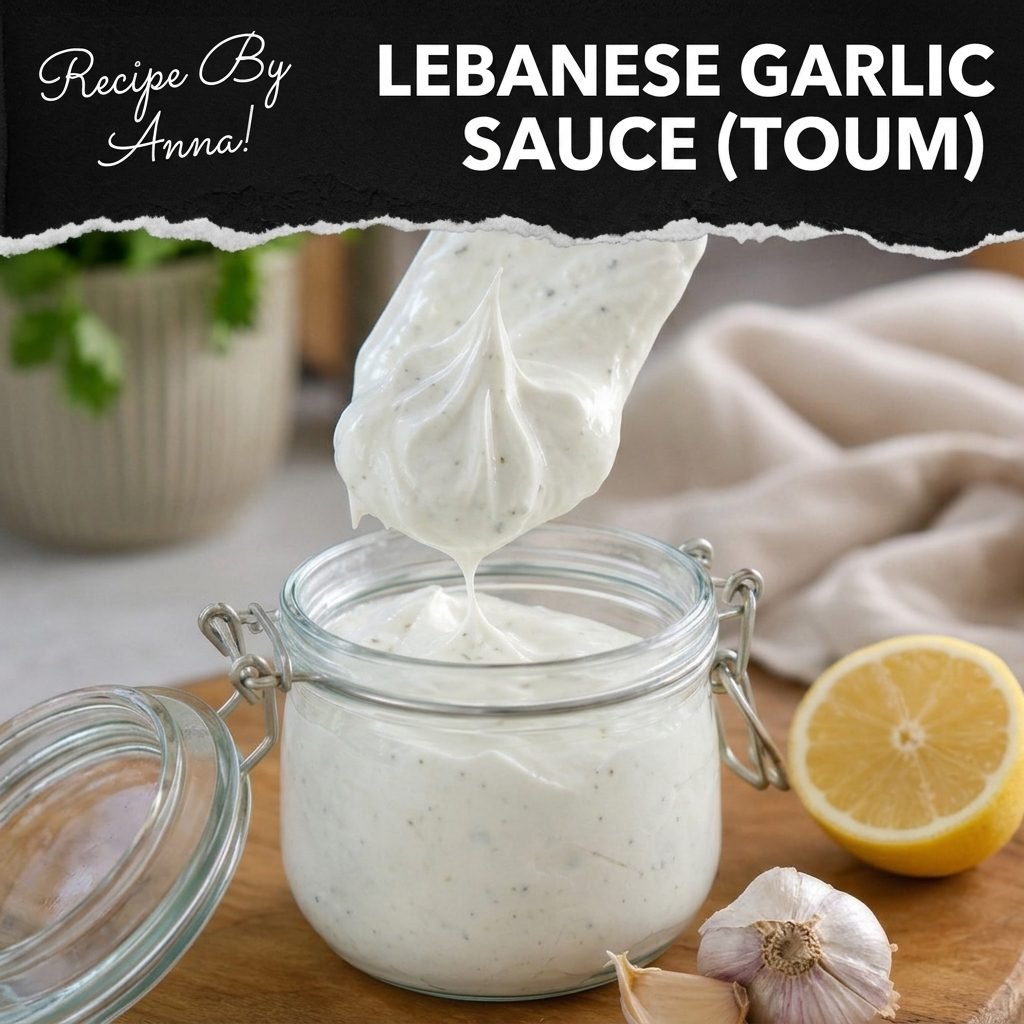
Easy Lebanese Garlic Sauce (Toum) Recipe
Toum is the sauce on the shawarma plate that you asked about. It’s the fluffy, bright-white, aggressively garlicky whip that Lebanese restaurants scoop next to grilled meat and fries, the one that makes people say “what IS this?” and then eat it with a spoon when they think no one’s looking. It has four ingredients — garlic, neutral oil, lemon juice, salt — plus a splash of ice water, and no egg, no dairy, no anything else. Half a cup of garlic cloves gets puréed with salt, and then two cups of oil is streamed into it so slowly that the garlic’s own soluble compounds wrap around every microscopic droplet and hold them apart, which is the entire secret of the sauce: the garlic is not just the flavor, it is the machinery. Ten minutes of work, one food processor, and a jar of something that no store sells properly and no one who tastes it forgets.
Here’s the honest framing, because this is a technique post wearing a recipe’s clothes. Toum is a member of the emulsion family — mayonnaise’s cousin — and emulsions are the one corner of cooking where the physics is visible. Oil and water refuse to mix; force them together with a blade and you get droplets that want nothing more than to re-merge into a puddle. Something has to stand between them. In mayonnaise, that’s lecithin from the egg yolk. In toum, there’s no egg, so the garlic does the job itself — its pulp and soluble compounds, sheared fine enough and given enough patience, coat each droplet and keep the sauce white, thick, and stable for weeks. That’s why the technique has rules that look like superstition until you know what they’re protecting: the paste must be smooth before any oil goes in (the emulsifier has to exist before the emulsion starts), the oil must go in a thread-thin stream (droplets can only be made small if they’re introduced small), and everything stays cold (warm emulsions break). Every one of those rules has a reason, and I’ll give you all of them.
And then there’s the part nobody tells you, which is that toum has a future. On the day you make it, it’s ferocious — raw garlic at full volume, the kind of sauce that announces itself from across the plate. By day three, the same jar has mellowed into something balanced and almost sweet, the garlic rounding off as it rests in the acid and oil. By week two, it’s gentle enough for people who claim they don’t like garlic. Few sauces improve for two weeks in your fridge; this one does, and knowing that changes how you use it — you make it on Sunday for the shawarma you’re having on Thursday. The recipe below is the traditional formulation, the same one running through every Lebanese kitchen and restaurant, and my job is to make the technique unbreakable, including the famous rescue for the batch that breaks anyway. Let’s start with the rules, because they’re shorter than you fear and more interesting than you’d guess.
The Emulsion Rules
Rule one: the paste comes first. Before a single drop of oil enters the bowl, the garlic and salt must be run to a smooth, wet paste — thirty to sixty seconds with a couple of scrape-downs. This isn’t about texture preference; it’s about physics sequencing. The emulsifier — the garlic’s pulp and soluble compounds — only works from inside the mixture, and it has to be evenly distributed before the droplets arrive. Coarse garlic chunks in oil just give the oil garlic-flavored places to hide, and the sauce that comes out of that arrangement is thin, runny, and quick to separate. When the paste is smooth, every drop of oil that enters the spinning bowl meets garlic that’s ready for it, and the emulsion forms the way it’s supposed to. If you remember one rule from this whole post, it’s this one, because it single-handedly prevents most failed toum.
Rule two: the oil goes in slow — slower than feels necessary, and then slower than that. The stream should be thin enough that you can see individual threads of oil hitting the vortex, especially for the first quarter cup, which is where the emulsion is born and where it’s most fragile. Here’s what’s happening: the blade is breaking the incoming oil into droplets, and the smaller a droplet is, the more total surface area the emulsifier has to cover. Flood the bowl and the garlic can’t keep up — big droplets merge, the mixture goes oily and curdled, and you’re in the broken-sauce chapter of this post. Dribble the same oil in a thread over three or four minutes and the garlic coats everything as it arrives, and the sauce thickens steadily toward white. Patience is not a virtue garnish here; it is the active ingredient.
Rule three: cold, always. Emulsions are stabilized by cold and wrecked by heat — a warm garlic paste, a bowl that’s been running hot, or oil that’s been sitting next to the stove all weakens the structure you’re building. The classic fix and the classic ingredient are the same thing: ice water. A couple of tablespoons during the long oil stage keeps the mixture cold, thins the sauce to the consistency you actually want (pure toum with no water is thick enough to stand a spoon in and a little solemn about it), and adds the water phase that the emulsion needs — remember the oil needs something to be emulsified into. If your kitchen is hot or your processor warms up, chill the bowl and blade in the freezer for ten minutes before you start. The Lebanese grandmother with the mortar and pestle didn’t need this rule, because thirty minutes of grinding by hand never overheated anything; the food processor saves you twenty-five minutes and charges you a little vigilance.
And the ratio, which is less a rule than a law: half a cup of garlic holds about two cups of oil, and not more. This is the capacity of the emulsifier — past two cups per half cup of garlic, there simply isn’t enough garlic surface to coat the droplets, and the sauce goes oily no matter how slow your pour. If you want a bigger batch, scale both together: a full cup of garlic for four cups of oil, made in a bigger bowl. The recipe’s proportions aren’t a suggestion; they’re the load-bearing arithmetic of the sauce.
⏱️ 10 MIN, 4 INGREDIENTS | 🧄 MAKES 2½ CUPS | 🌙 BETTER ON DAY THREE
- Prep Time: 10 minutes — most of it peeling garlic and pouring oil slowly
- Active Machine Time: 6 to 8 minutes of running and streaming
- Total Time: 10 minutes, plus an overnight rest that does the mellowing
- Yield: about 2½ cups — a pint jar and a bit more
The Blender Verdict
The equipment list is one machine and a few supporting players:
- Food processor with a blade and a feed tube — the correct tool, full stop. The feed tube is what makes the slow stream possible while the blade spins; a machine you have to stop and start to pour into will test both the emulsion and your temperament.
- Small bowl, or a double batch — a small amount in a wide bowl fails, because the blade can’t catch and whip a shallow puddle. If your processor has a mini bowl, this is its moment; if not, make the double batch (a full cup of garlic, four cups of oil) so the machine has something to work with.
- A liquid measuring cup — for the oil; the spout makes the thin stream controllable
- A rubber spatula — for the scrape-downs, and later for scraping the jar clean, which you will want to do
- A clean glass jar with a lid — the storage vessel and, honestly, the serving vessel
Now the blender question, because everyone asks. A high-speed blender can make toum — the blades are faster than the processor’s and the emulsion can come together in the narrow jar — but it has two genuine strikes against it. First, the vortex problem: a blender needs enough liquid to catch and circulate, and the garlic paste at the start is thick and prone to cavitating, spinning uselessly with an air pocket around the blade while the garlic sits above it in smug refusal. Second, the pour: most blender lids don’t have a stream-friendly opening, so you’re pouring into a stopped machine in stages, which is the stop-start rhythm emulsions dislike. If the blender is all you have, use the full half-cup of garlic (a big enough batch to vortex), start it with the lemon juice and two tablespoons of ice water already in, and pour the oil through the lid opening in the slowest stream your patience permits. It works. The food processor just works better, and this is the rare recipe where the tool matters as much as the ingredients.
And the mortar and pestle, for the record, because it’s the tradition and it deserves its sentence: the original toum was thirty minutes of grinding garlic and salt with a pestle until the paste went glossy, then the oil beaten in drop by drop. The result is marginally silkier and no better flavored than the food processor’s, and the forearm it costs is your own. I own a mortar and I love it and I use the processor. The grandmothers would too, if they’d had one — of this I am completely certain.
Ingredients (With Labels)
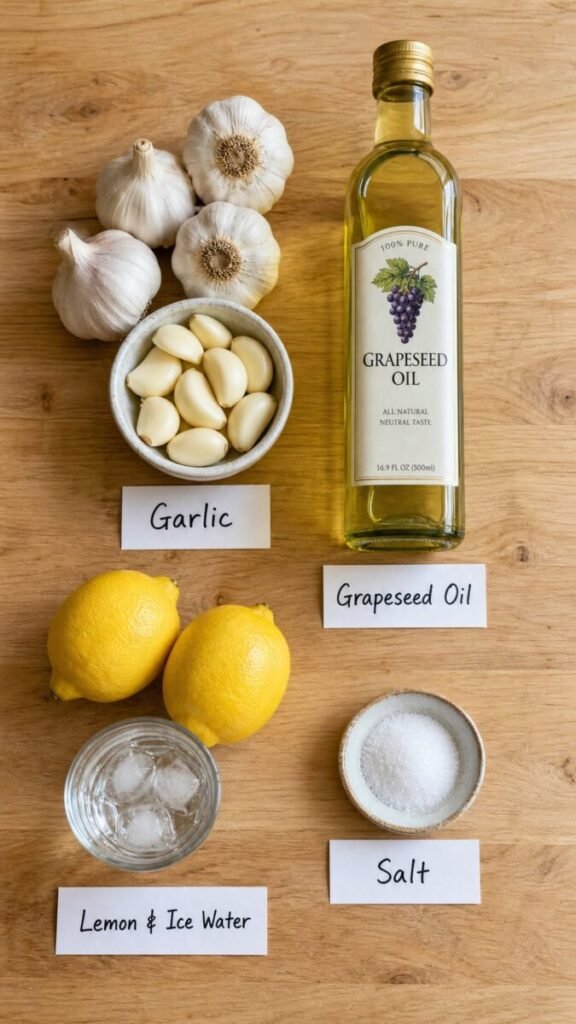
🧄 The Foundation
- Garlic: ½ cup peeled cloves — one large head, about 10 to 12 cloves
- Kosher salt: 1 teaspoon
🫒 The Emulsion
- Neutral oil: 2 cups — grapeseed, avocado, or canola
- Lemon juice: ¼ cup, fresh-squeezed
- Ice water: 3 to 5 tablespoons, as needed
Step by Step How to Make
- Step 1 — Peel and de-germ. Peel the garlic, and while you’re at it, check every clove for the green germ — the tiny sprout in the center. Halve any clove that shows one and flick it out. The germ is the bitterest part of the garlic, and in a sauce where garlic is half the volume and nothing is cooked, its bitterness comes through loud and clear. This is the peeling stage where a bench scraper and five minutes of podcast pay off, and the firmness test is worth a mention: the cloves should be tight and dry, not soft or sprouting, because old garlic makes bitter toum and fresh garlic makes the good kind.
- Step 2 — The paste. Garlic, salt, and one tablespoon of the lemon juice go into the processor bowl. Run it for 30 seconds, stop, scrape the sides down thoroughly, and run it again until you’re looking at a smooth, wet, sticky paste — another 30 seconds — with no visible chunks anywhere. This is the foundation of the whole sauce, and it’s the step that cannot be rushed or skipped: a smooth paste means the emulsifier is fully distributed and ready, and everything after this is just feeding oil into a system that works. If the paste seems dry and clumpy rather than glossy, add the second tablespoon of lemon juice and run again. Touch the machine’s bowl; if it’s warm to the touch, wait five minutes before proceeding — cold, always.
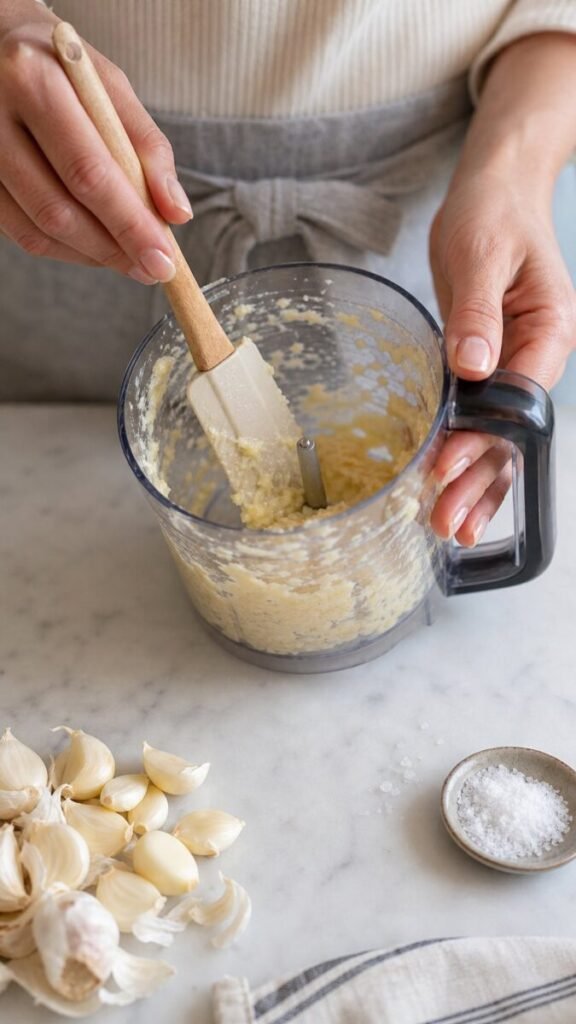
- Step 3 — The critical first quarter cup. With the machine running, pour a quarter cup of the oil in the slowest stream you can manage — thin enough to see the individual threads hitting the bowl. This is the stretch where the emulsion is born, and it takes a full two to three minutes to do properly. You’ll hear the change before you see it: the machine’s tone drops as the mixture thickens, and the paste lightens from translucent ivory toward white. When the first quarter cup is fully in and the mixture looks like a thick, whipping garlic cream, stop, scrape the bowl down once, and add a tablespoon of lemon juice and a tablespoon of ice water. Run ten seconds. You’ve just built the mother emulsion — everything from here is expansion.
- Step 4 — The long middle. Machine running, stream in the remaining oil — still slowly, though the sauce is sturdier now and you can loosen the stream to a steady thin pour. Alternate as you go: after every half cup of oil, a tablespoon of lemon juice or ice water, switching between them, letting each incorporate for a few seconds before the oil resumes. Somewhere in this stretch the transformation happens — the mixture brightens to stark white, thickens to the texture of softly whipped cream, and starts holding a ribbon when you lift the blade. If it gets so thick the machine labors or the sauce looks solemn and heavy, that’s the ice water’s cue: a tablespoon, run it in, and watch it lighten. All two cups of oil take about four to five minutes of pouring at the correct pace. This is the part where you stand there pouring and feel like you’re not cooking — you are, you’re doing the most important cooking in the recipe.
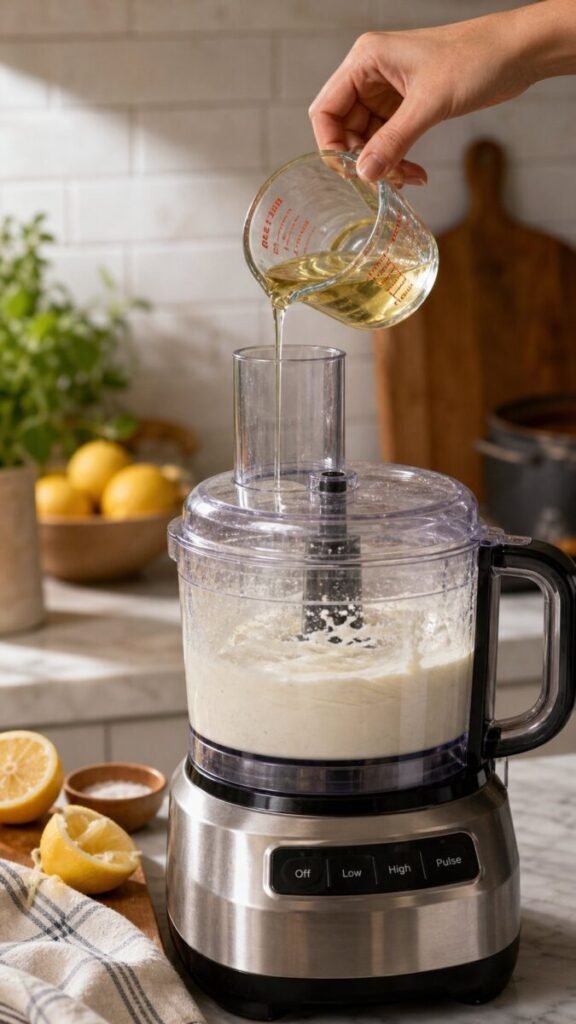
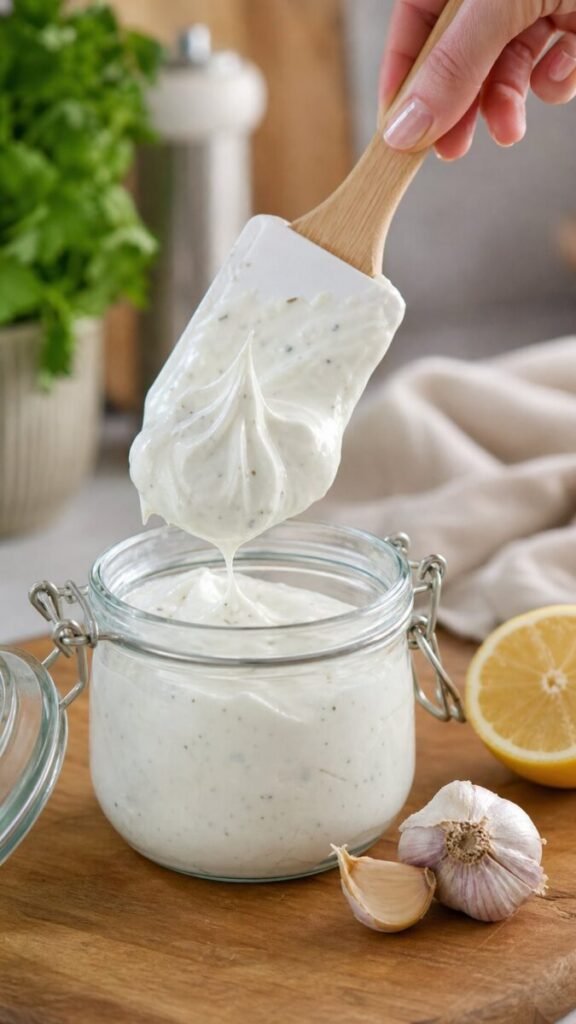
- Step 5 — The finish. When all the oil is in, run the machine a final fifteen seconds to tighten, then stop and assess. The texture test: lift the spatula and turn it sideways — the sauce should hold a slow, reluctant ribbon that sits on the surface before sinking back. Too thick? Ice water, a tablespoon at a time, machine running, until it’s glossy and spoonable. Too thin? It needed slower oil, and next time it’ll get it — this batch will still set up somewhat in the fridge overnight. Now taste, and taste bravely: on day one it should be aggressive, lemony, and saltier than seems polite — the salt and lemon both read louder in a cold white sauce than they do in soup, and the fridge will mellow everything by tomorrow. Adjust, run five seconds, and taste again.
- Step 6 — The rest and the jar. Scrape the toum into the clean glass jar, press a piece of plastic wrap onto the surface if you’re fussy about the top layer, lid on, and into the fridge for an overnight rest before the first real serving — 24 hours is the minimum, and three days is when it becomes itself. The day-one fire gives way to something rounder and more complex, and from there the jar just keeps getting friendlier. When you serve it, stir first — a thin layer of oil rising to the top of the jar after a few days is normal separation, not failure, and a quick stir reincorporates it. Then put it on the table with everything: fries, roasted vegetables, grilled chicken, the shawarma you presumably made this for. The sauce that took ten minutes will outlast and outshine most of the plate.
Creamy, punchy garlic on juicy chicken — toum and the garlic butter chicken thighs are the same idea at two volumes, and they share a plate beautifully.
Anna’s Kitchen Notes
The overnight rest is not optional-ish. It’s the difference between a sauce that’s all volume and one that’s all balance. Day-one toum is raw garlic at full blast — impressive, but harsh, and it can actually overpower the shawarma it was made for. By day three, the same jar tastes rounded, almost sweet, with the garlic flavor still front and center but the sharp edge sanded off by the acid and the cold. When I’m serving toum to people, I make it two or three days ahead on purpose. When I’m making it for myself, I eat it on day one with toast, standing at the counter, like a dragon.
Neutral oil means neutral. Grapeseed, avocado, and canola are the three that work — light-flavored and stable under shear. Extra-virgin olive oil is the famous mistake: its polyphenols, which are lovely at a drizzle, turn distinctly bitter under minutes of high-speed blending, and its flavor walks all over the garlic. If you love the olive note, the compromise is the half-and-half build in the variations below, added at the very end so it barely gets blended. But the classic is neutral, and the classic is neutral for a reason.
The jar’s life is a mellowing arc, so plan around it. Week one: sharp, punchy, the fries sauce. Week two: gentle, almost sweet, the sandwich spread that converts people who “don’t do raw garlic.” The jar I make for a Friday dinner is a different sauce by the following Wednesday, and both of them are correct. Write the date on the jar with a marker, give it two to three weeks, and stir before every use. The thin oil layer on top of an older jar is normal — the emulsion relaxing slightly overnight, not breaking — and it stirs back in with ten seconds of spoon work.
Always a clean, dry spoon. The jar’s long life depends on nothing foreign going in: no double-dipping, no crumbs, no water from a wet spoon. Introduce anything with moisture or food bits and you introduce both bacteria and an emulsion-breaking agent, and the jar’s remaining weeks get shorter. I keep a small dedicated spoon next to the jar in the fridge door like the Lebanese restaurants do, and it has saved more batches than I can count.
The freezer verdict, honestly. Toum freezes at about eighty percent of itself — the emulsion survives, with some graininess on the thaw and a texture that’s slightly looser than fresh. Thaw it overnight in the fridge, stir well, and it’s fine on fries and roasted vegetables; for the pristine white scoop next to shawarma, make it fresh. Given that the fridge gives you two to three weeks anyway, the freezer is only worth it for a double batch you made for a crowd that canceled. Ask me how I know.
The Shawarma Table
Toum’s natural habitat is anything grilled, fried, or roasted, and the site has the partners ready. The roasted Mediterranean Greek vegetables with a scoop of toum is the weeknight version of the whole genre — char and cream, no meat required. And the garlic bok choy stir-fry plus this jar is the double-garlic dinner, for days when garlic is the entire plan.
To finish the spread: the Turkish ezme is the tomato-chili brightness every mezze table wants beside the white whip, the creamy cashew cheese sauce is this jar’s dairy-free cousin from the other shelf, and the garlic butter orzo with mushrooms and spinach is the bowl that turns toum into dinner — a spoonful stirred in at the end melts into the orzo like a garlic cloud. Which, now that I’ve written it down, is my favorite sentence of the week.
Same Whip, Other Sauces
The half-EVOO build. A quarter of the oil swapped for good extra-virgin, added in the last minute of blending — you get a peppery, grassy toum with an olive edge, without the bitterness that five minutes of hard shear would pull out of it. This is the version for people who find neutral-oil sauces a little anonymous.
The yogurt fold. Stir toum into an equal amount of Greek yogurt and you get the creamy garlic sauce that shawarma shops sell as the “mild” option — softer, tangier, and about half the intensity. This is also the move for garlic-shy tables, and it keeps three days of its own. Honest label: it’s no longer toum proper, it’s toum’s friendly cousin, and both belong at the table.
The potato training wheels. Boil one medium potato, and blend it in with the garlic paste before the oil goes in. The potato’s starch is a powerful emulsion stabilizer — this is the Greek skordalia trick — and the sauce becomes nearly unbreakable, softer in texture, and milder in garlic heat. It’s the version to make the first time, or with kids, or when your garlic is a little tired, and there is zero shame in it.
The preserved-lemon route. Replace a third of the lemon juice with the finely chopped pulp of half a preserved lemon — the sauce goes briny and complex, the color of late afternoon, and it becomes the sauce for roasted cauliflower and grilled fish. If you keep a jar of preserved lemons going, this is the reason to keep this sauce going too.
The chili whip. Half a jalapeño or a small pinch of cayenne run with the garlic at the paste stage — a warm background hum rather than actual heat, and suddenly the sauce wants lamb kebabs specifically. This is also the fastest way to make the fries sit up and pay attention.
The roasted-garlic blend. Half the cloves roasted until soft and sweet, half raw, same technique after that. The sauce loses about a third of its fire and gains a caramel depth, and the color goes ivory-gold. Purists will note that raw garlic’s punch is the point of toum, and the purists are right — but this blend is the one that wins over the spouse who flinched at the classic, and marriage is also a cuisine.
The Clove Count
| Nutrient | Per Tablespoon (1 of 40) |
|---|---|
| Calories | 110 kcal |
| Protein | 0 g |
| Carbohydrates | 0 g |
| Fats | 12 g |
Let’s be honest about what this is: a condiment that is mostly oil wearing garlic’s clothes. Two cups of oil across the batch means each tablespoon carries about a tablespoon of it, and there’s no fiber, protein, or sugar to speak of — the allicin and the flavor ride along free. The serving size in real life is one to two tablespoons per plate, as the creamy edge on otherwise lean food: roasted vegetables, grilled chicken, a pile of fries that were going to need something anyway. That’s the job toum was invented for — it’s the reason a plate of vegetables and plain grilled meat feels like a restaurant meal — and a jar of it in the fridge quietly upgrades about twenty of them. If the numbers matter to you, the yogurt fold variation halves the fat per spoon and doubles the protein, and the potato version spreads the same flavor across more tablespoons.
The Two-Week Jar
Storage is simple and non-negotiable: the fridge, always, from the moment the sauce is made. Garlic in oil at room temperature is the one genuinely unsafe corner of this recipe — it’s a known botulism risk, because garlic can carry the spores and oil creates the airless environment they like, and the lemon’s acid helps but does not solve it. Cold does. So: into the fridge within the hour, stay there for its whole two-to-three-week life, and serve by the spoon rather than leaving the jar out on the table through a long dinner. This isn’t cautionary fine print; it’s the actual rule that Lebanese restaurants run on, and it’s easy to keep because cold is also where toum tastes best.
Within that cold life, the timeline is generous. Two weeks is the confident window, and many jars are fine at three — the sauce’s own salt, acid, and garlic intensity are all mild preservatives, which is part of why the recipe contains them at full strength. The signs of a jar that’s finished its run are off smells, fizzing, or anything growing at the surface — all rare, all obvious, and none subtle. When in doubt, the batch cost a dollar and ten minutes. Throw it out and make the next one; this is a sauce with no sunk costs.
Second careers, because a jar this size is bigger than one dinner: the stir-into-soup move (a spoon of toum swirled into lentil soup at the end is a legitimate Lebanese move), the sandwich spread (better than mayo on anything involving roasted vegetables), the marinade shortcut (smear on chicken thighs thirty minutes before roasting), and the potato dressing (hot roasted potatoes tossed with a spoonful each of toum and lemon juice — the side dish that gets requested by name). The jar always empties before it spoils. In my kitchen, the problem has never once been the other way around.
Where It Goes Wrong
The sauce broke — oily, curdled, separated. The classic toum failure, and it has exactly two doors: the oil went in too fast, or something was too warm. A broken batch looks like a greasy, grainy soup and feels like a personal insult, but it is fixable, and the fix is the restaurant trick: clean the bowl, start a fresh paste with a quarter cup of new garlic, a pinch of salt, and a tablespoon of lemon juice, and then feed the broken sauce slowly into the running machine as if it were the oil — which, structurally, it now is. The new garlic’s emulsifier picks up the old droplets, and the batch comes back thicker and slightly more garlicky than the original plan. Some kitchens use an egg white to rescue instead, which works the same way, but it costs you the egg-free claim that makes toum toum — the fresh-garlic rescue keeps the recipe what it is.
Bitter sauce. Three usual suspects: green germs left in the cloves (the fix is Step 1’s flick — always do it), old or sprouting garlic (the fix is fresher heads, tight and firm), or extra-virgin olive oil put through the full blend (the fix is in the notes above — neutral oil, or the late-add compromise). Bitterness doesn’t mellow out over the jar’s life; it only becomes bitter and old. If the batch has gone bitter, eat it with something starchy and learn the lesson for next time, which is one of the cheaper lessons in cooking.
Never thickened — stayed a loose, watery suspension. The oil went in before the paste was truly smooth, or the batch was too small for the bowl, or the ratio drifted past garlic’s capacity. Check the arithmetic: half a cup of garlic, two cups of oil, and no more. A sauce that’s merely loose but emulsified will tighten some overnight in the fridge; a sauce that never emulsified needs the rescue above or a fresh start. The consolation prize: garlic-flavored oil is lovely for roasting vegetables, so a failed batch is really a successful ingredient.
Day one, and it’s TOO much. That’s not a defect; that’s the sauce on its first day of a two-week mellowing arc. Give it 24 hours minimum before you judge it, and three days before you serve it to company. If it’s still more than the table can handle after the rest, the yogurt fold cuts the intensity in half, and the potato route on the next batch starts it gentler. Toum is supposed to be strong — the trick is scheduling, not diluting.
The jar grew an oily cap. A thin layer of oil on top after several days in the fridge is the emulsion relaxing slightly, not breaking — the difference is that it stirs back in smoothly and stays in. Ten seconds with the spoon and the jar is white and uniform again. Actual breaking looks curdled and grainy all the way through, smells off, and doesn’t come back with stirring. One is Tuesday; the other is the trash.
The blender betrayed you. The paste cavitated — an air pocket formed around the blade and the garlic sat above it, spinning untouched while the machine roared. That’s the vortex problem, and the fixes are in the blender verdict above: a bigger batch so the jar has depth, the liquid added up front so there’s something to circulate, and patience with the tamper if your blender has one. Or, you know — the food processor, which was the verdict all along.
Toum Questions
What exactly is toum?
A Lebanese emulsified garlic sauce — garlic, neutral oil, lemon juice, and salt, whipped into a thick white spread with no egg and no dairy. It’s mayonnaise’s cousin with the egg replaced by garlic itself, which acts as both the flavor and the emulsifier. It’s the traditional condiment for shawarma and grilled meats in Lebanon, it keeps for weeks in the fridge, and it’s the reason a whole category of restaurant food tastes the way it does.
Why did my toum break or separate?
Oil added too fast, or a warm mixture — those are the two doors, and both mean the garlic couldn’t coat the oil droplets as they arrived. The rescue is the restaurant trick in the mistakes section: start a small fresh garlic paste and stream the broken sauce into it as if it were oil. It comes back thicker and a little more garlicky, which nobody has ever filed a complaint about.
Can I make it without a food processor?
Traditionally it was made in a large mortar and pestle, and it still can be — thirty minutes of grinding the garlic and salt to a glossy paste, then beating the oil in drop by drop. It’s a workout and the result is marginally silkier. A high-speed blender works with the adjustments in the blender verdict. But the food processor with a feed tube is the tool this recipe was written for, and it’s the one that makes the slow stream easy.
How long does toum keep?
Two to three weeks, refrigerated, with the flavor mellowing and improving through the whole run — day one is fierce, day three is balanced, week two is gentle. Keep it cold, use a clean dry spoon, and stir the harmless oil layer back in before serving. Any jar that smells off, fizzes, or grows anything at the surface is done, and at a dollar’s worth of ingredients, it retires without ceremony.
Is raw garlic in oil safe?
Refrigerated, yes, for the two-to-three-week life of the sauce — that’s the standard this recipe and the restaurants run on. The danger case is garlic-in-oil left at room temperature, where botulism spores (which garlic can carry) find the airless environment they need. The lemon’s acid helps, but cold is the actual rule: the sauce goes into the fridge within an hour of making it and lives there. Serve it by the spoon onto plates rather than letting the jar sit out through a long dinner, and the whole question stays settled.
Can I make it less intense?
Yes, in order of effort: make it three days ahead instead of one (the mellowing arc is free), remove every green germ (a bitterness and sharpness cut), fold it into Greek yogurt (half the intensity, still tastes like toum’s side of the family), or blanch the cloves for thirty seconds in boiling water before processing (a gentler, rounder sauce — though you start losing the point). The potato variation in the same section is the training-wheels version, and it’s delicious enough that no one will call it a compromise.
What do I serve it with?
Everything grilled, fried, or roasted. The classics: chicken shawarma, fries, grilled chicken, kofta, roasted potatoes. From this site’s shelves: the roasted Mediterranean vegetables, the garlic bok choy stir-fry for the double-garlic dinner, and the lemon chickpea patties, whose yogurt sauce it replaces when you want the punchy version. The general rule is that toum belongs wherever you’d want a creamy, garlicky edge on food that has char or crunch of its own — which is most of dinner.
Lebanese garlic sauce · Four ingredients plus water · No cooking
Lebanese Garlic Sauce (Toum)
A fluffy, intensely garlicky Lebanese sauce made by slowly emulsifying neutral oil into fresh garlic, lemon juice, and salt. Naturally egg-free and dairy-free, with a bright, creamy texture for shawarma, grilled vegetables, and fries.
As an Amazon Associate I earn from qualifying purchases.
Important food-safety correction: this homemade garlic-and-oil recipe has no validated acidification process. Do not assume the lemon juice makes it safe for 2–3 weeks. Refrigerate promptly at 40°F or below and use within 4 days of preparation, or freeze promptly in small portions. Botulinum toxin cannot be reliably detected by appearance, smell, or taste.
Ingredients
Garlic & salt
- ½ cup peeled garlic cloves, measured after peeling
- 1 teaspoon kosher salt, adjusted to taste because crystal sizes vary
The emulsion
- 2 cups neutral canola oil, grapeseed oil, or mild refined avocado oil
- ¼ cup freshly squeezed lemon juice, divided
- 3–5 tablespoons ice-cold water, added gradually as needed
Measure the garlic, not the heads: ½ cup peeled cloves may require more than one head, depending on their size. Choose firm cloves, discard spoiled ones, and remove any green shoots for a cleaner flavor.
Keep track of the lemon: ¼ cup is 4 tablespoons total. Use 1 tablespoon for the initial paste, then add the remaining 3 tablespoons gradually during emulsification.
The toum kit
- Food processor with a feed tube, sized so its blade can catch a small amount of garlic
- Spouted liquid measuring cup, for controlled oil pouring
- Measuring cups and spoons
- Silicone spatula
- Paring knife and cutting board
- Lemon juicer
- Clean food-storage jars with lids, totaling at least 3 cups capacity
- Small freezer-safe containers, for portions not needed within 4 days
Bowl size matters: a very wide processor may scatter this quantity above the blade rather than purée it. Use a suitable smaller bowl if available. Do not exceed the appliance’s capacity or recommended continuous running time.
Slow additions, cool equipment: keep the oil and lemon away from stove heat. If the bowl becomes noticeably warm, stop and chill the mixture before continuing. Temperature control helps, but oil rate, water balance, and a sufficiently fine garlic paste also determine whether the emulsion holds.
How to make it
-
Prepare the garlic and ingredients
Peel enough garlic to measure ½ cup. Trim tough ends and remove green shoots if present. Measure the oil, lemon juice, and ice-cold water separately. Begin with a clean processor bowl and blade and ingredients that are cool, not warm.
-
Process the garlic into a fine paste
Add the garlic, salt, and 1 tablespoon lemon juice to the processor. Process in short runs, stopping the machine completely before scraping down the sides. Continue until the garlic is as smooth and evenly minced as the machine can make it, with no large pieces. If the blade cannot reach the mixture, use a better-sized bowl rather than flooding it with oil.
-
Establish the emulsion slowly
With the processor running, add the first ¼ cup oil very slowly through the feed tube, beginning with drops and progressing to a thread-thin stream. Allow roughly 2–3 minutes for this first addition. The mixture should become paler and thicker, without a visible pool of oil. Pause the pour if oil stops incorporating.
-
Alternate the remaining oil with lemon and water
Continue adding the remaining oil in a thin stream. Between roughly ¼-cup additions of oil, slowly add small amounts of the remaining lemon juice or ice-cold water, letting each incorporate before continuing. Use no more than the measured ¼ cup lemon juice in total. Start with 3 tablespoons water across this stage and reserve the rest for adjusting the texture. Stop for scrape-downs or cooling breaks as needed, following your processor’s operating limits.
-
Check the texture and seasoning
Once all the oil is incorporated, the toum should be opaque, fluffy, and spoonable. If too stiff, blend in the reserved ice water a teaspoon at a time, stopping when the texture suits you. Taste with a clean spoon and adjust salt sparingly. Fresh toum is pungent; do not over-salt in an attempt to balance the garlic. A separated, oily mixture is a broken emulsion, not something that chilling alone will reliably repair.
-
Jar and refrigerate promptly
Transfer to clean containers, cover, label with the preparation date, and refrigerate immediately at 40°F or below. It can be served the same day, though an overnight refrigerated rest may soften its sharpness. Use within 4 days of making it. Freeze promptly in small portions any amount you will not use within that window; thaw in the refrigerator and expect possible texture changes. Spoon out only what you need for serving.
Texture is not a safety test: an emulsion can separate without spoiling, and an unsafe garlic-in-oil mixture can look and smell normal. Do not use an oil layer, a smooth appearance, or the absence of an off smell to extend the refrigerated holding time. Fresh lemon juice in this recipe is not a validated preservation treatment.
Keep it cold: do not leave the jar on the table throughout a long meal. Limit cumulative time out of refrigeration to 2 hours, or 1 hour above 90°F. Use a clean utensil each time. This formulation contains no egg or dairy and is vegan; check packaged ingredients for relevant allergen information.