
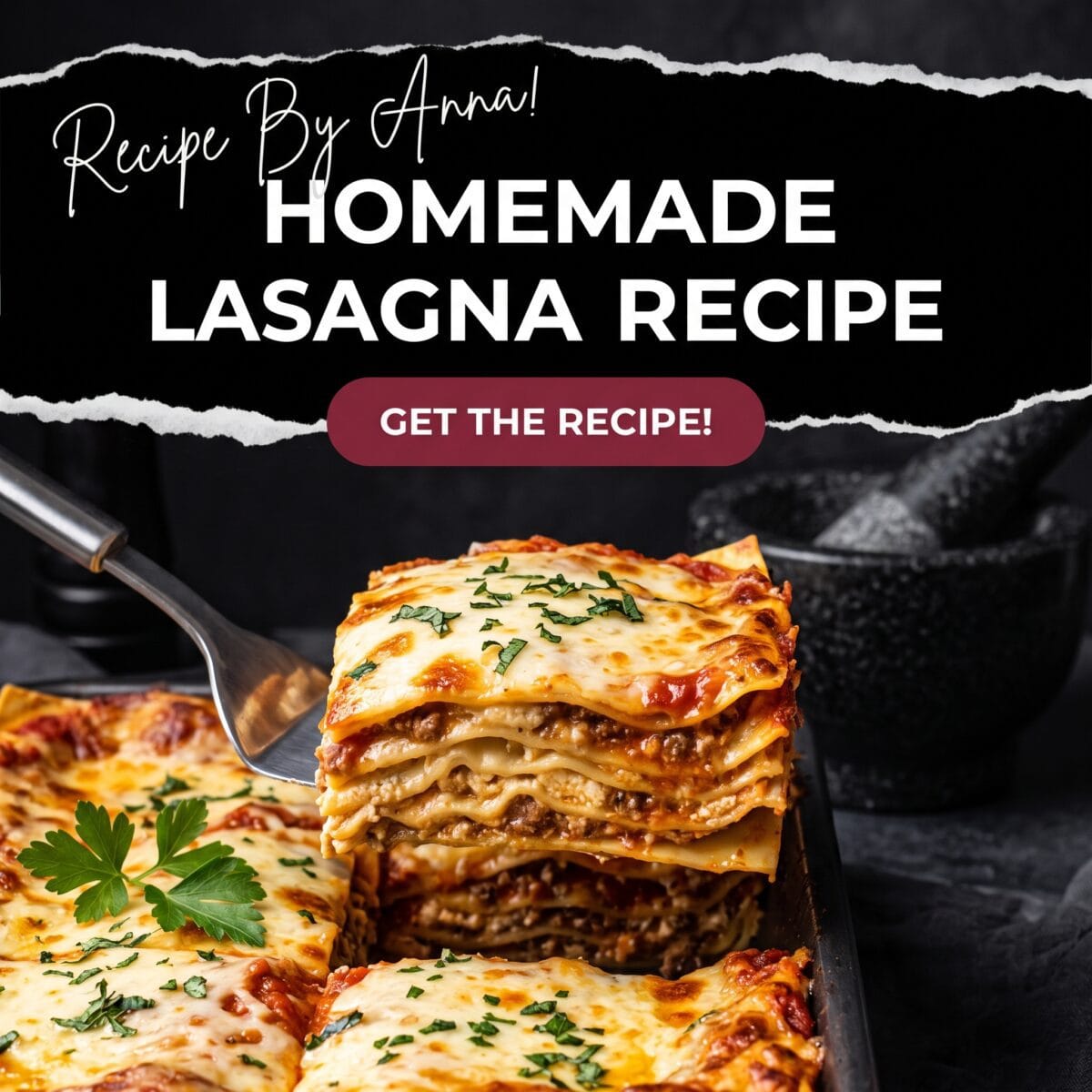
Homemade Lasagna Recipe
This Homemade Lasagna Recipe is the version that gives you the proper Italian-American lasagna that everyone has been hoping for when they pull a pan out of the oven — clearly defined layers of pasta, a deeply flavoured meat sauce that has been simmered long enough to lose the tinned-tomato edge, a thick ricotta filling that sets into a creamy, lightly seasoned layer, and enough mozzarella on top to blister and caramelise into the golden, pull-apart cheese top that is the whole visual reason lasagna exists.
It is not a quick weeknight dinner — building and assembling a proper lasagna takes about an hour of active work and another hour of oven time — but it is the kind of recipe that produces enough to feed eight people generously, reheats perfectly, freezes beautifully, and improves on day two in the specific way that slow-cooked tomato and meat dishes always do. Make it on a Sunday afternoon and eat well through Wednesday without any additional cooking.
This is the recipe worth making correctly once rather than making a shortcut version repeatedly. The difference between a properly made homemade lasagna and any shortcut version is exactly large enough to justify the effort.
Why This Lasagna Is Worth the Full Process
The meat sauce cooked long and low is what separates a lasagna that tastes like made-from-scratch from one that tastes like canned tomato with beef through it — the thirty minutes of simmering after the tomatoes go in concentrates the sauce, deepens the flavour, and removes the sharp, tinny edge of uncooked tomato that makes quick pasta sauces taste clearly rushed.
The ricotta layer seasoned with egg, Parmesan, and herbs sets during baking into a creamy, cohesive layer rather than the watery, grainy pocket that unseasoned ricotta sometimes becomes in a lasagna when the liquid hasn’t been properly managed.
- Prep Time: 45 minutes
- Cook Time: 1 hour (sauce) plus 45 to 50 minutes (baking)
- Total Time: 2 hours 30 minutes
- Yield: one 9×13 inch lasagna, 8 to 10 servings
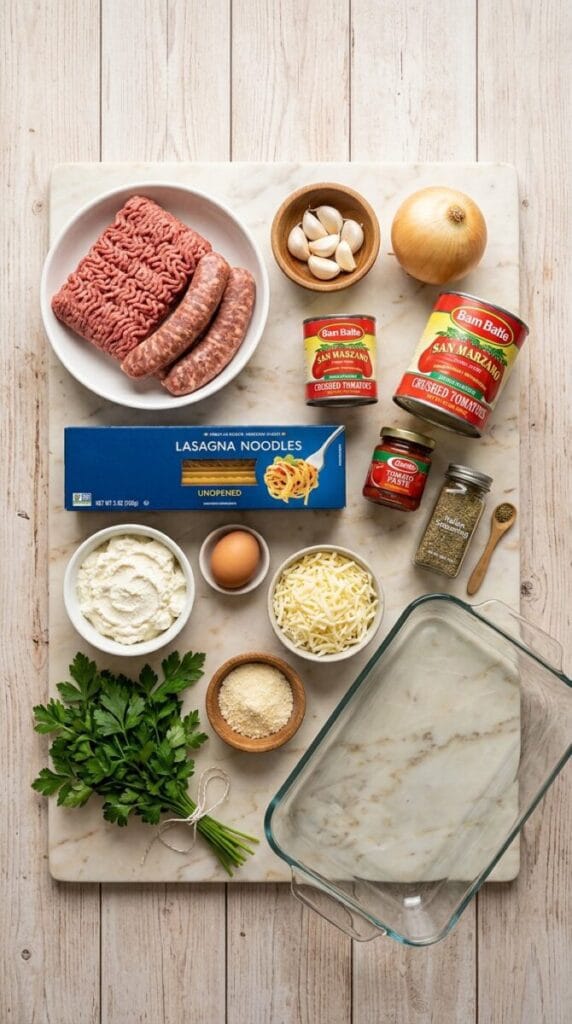
What You Need
For the meat sauce:
- Ground beef (80/20) or a mix of beef and Italian sausage: 1 lb (453g)
- Yellow onion, finely diced: 1 large
- Garlic cloves, minced: 5
- Olive oil: 2 tablespoons
- Crushed tomatoes: 1 can (28 oz / 794g)
- Tomato paste: 2 tablespoons
- Diced tomatoes: 1 can (14.5 oz / 411g)
- Dry red wine or beef broth: 1/2 cup (120ml)
- Dried Italian seasoning: 2 teaspoons
- Dried basil: 1 teaspoon
- Dried oregano: 1/2 teaspoon
- Sugar: 1 teaspoon (balances the tomato acidity)
- Fine sea salt: 1 teaspoon, plus to taste
- Black pepper: 1/2 teaspoon
- Red pepper flakes: 1/4 teaspoon (optional)
For the ricotta filling:
- Whole-milk ricotta: 15 oz (425g)
- Large egg: 1
- Parmesan cheese, finely grated: 1/2 cup (50g)
- Fresh flat-leaf parsley, finely chopped: 1/4 cup
- Dried basil: 1/2 teaspoon
- Fine sea salt: 1/2 teaspoon
- Black pepper: 1/4 teaspoon
- Garlic powder: 1/4 teaspoon
For the layers and topping:
- No-boil lasagna noodles: 12 sheets (or regular lasagna noodles, boiled al dente and laid flat on oiled parchment)
- Low-moisture mozzarella, shredded: 3 cups (300g)
- Parmesan cheese, finely grated: 1/2 cup (50g), for the topping
- Fresh basil leaves: for garnish after baking
How to Make It
Making the meat sauce:
- Heat the olive oil in a large, heavy-bottomed pan or Dutch oven over medium-high heat. Add the ground beef and cook, breaking it up, until browned with no pink remaining — about 8 minutes. Drain excess fat if the beef is very fatty, leaving about 1 tablespoon behind.
- Add the diced onion and cook in the beef fat for 5 minutes until softened and translucent. Add the garlic and cook for another 60 seconds until fragrant.
- Add the tomato paste and cook, stirring constantly, for 2 minutes until it darkens slightly and smells less raw — this blooming of the tomato paste is the step that removes its tinny, concentrated flavour and replaces it with a rich, sweet tomato depth.
- Pour in the red wine or beef broth and stir to deglaze the pan, scraping up any browned bits from the bottom.
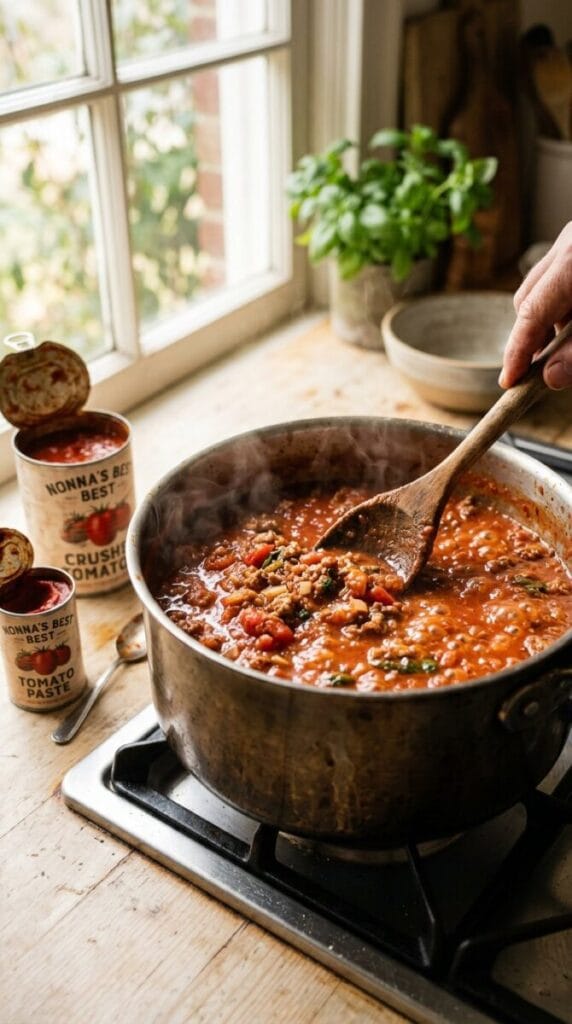
- Add the crushed tomatoes, diced tomatoes with their liquid, Italian seasoning, basil, oregano, sugar, salt, pepper, and red pepper flakes if using. Stir to combine.
- Bring to a simmer, then reduce to medium-low and cook uncovered for 30 to 40 minutes, stirring occasionally, until the sauce has thickened, darkened slightly, and tastes deeply flavoured rather than sharp and fresh. This is the most important step in the recipe — an under-simmered sauce produces an under-flavoured lasagna regardless of how well everything else is executed.
- Taste and adjust seasoning. Set aside.
Making the ricotta filling:
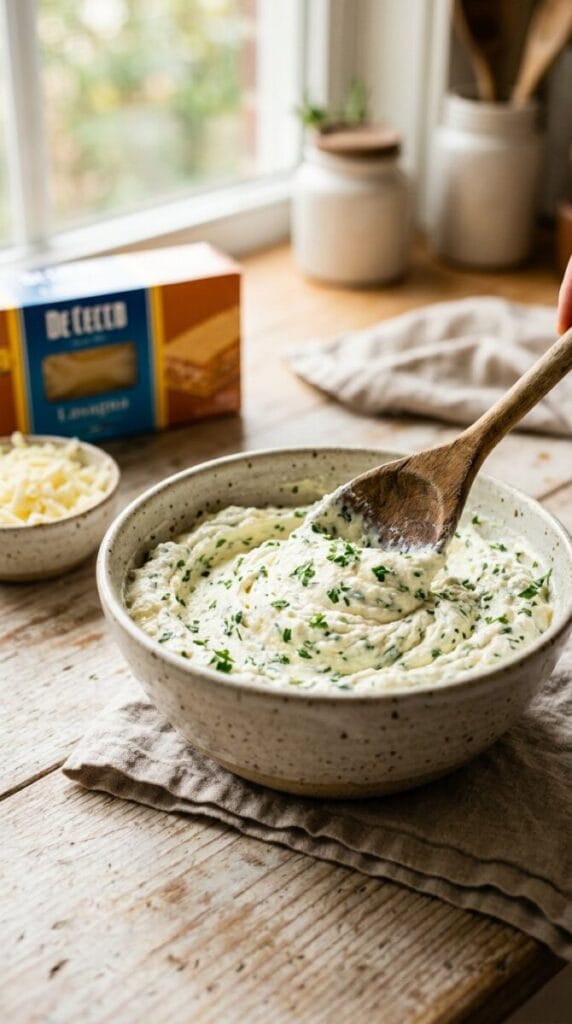
- Combine the ricotta, egg, Parmesan, parsley, basil, salt, pepper, and garlic powder in a bowl and stir until completely combined. The egg is the binder that prevents the ricotta from becoming watery and separating during baking — it sets the ricotta filling into a creamy, cohesive layer rather than a puddle of liquid whey.
- Taste and adjust the seasoning — the ricotta filling should taste distinctly seasoned on its own since it will be surrounded by unseasoned pasta noodles.
Assembling and baking the lasagna:
- Preheat the oven to 375°F (190°C).
- Spread 1 cup of the meat sauce across the bottom of a 9×13 inch baking dish — this prevents the bottom noodles from sticking and drying out.
- Layer 3 to 4 lasagna noodles over the sauce to cover the bottom, overlapping slightly if needed.
- Spread half of the ricotta filling in an even layer over the noodles.
- Sprinkle 3/4 cup of shredded mozzarella over the ricotta.
- Spoon one third of the remaining sauce over the mozzarella.
- Repeat: another layer of noodles, the remaining ricotta, 3/4 cup of mozzarella, another third of the sauce.
- Top with the final layer of noodles, the remaining sauce, the rest of the shredded mozzarella, and the Parmesan.
- Cover tightly with foil — spray the underside of the foil with cooking spray first to prevent the cheese from sticking to it as it melts.
- Bake covered for 25 minutes, then remove the foil and bake uncovered for a further 20 to 25 minutes until the top is deeply golden and bubbling aggressively at the edges.
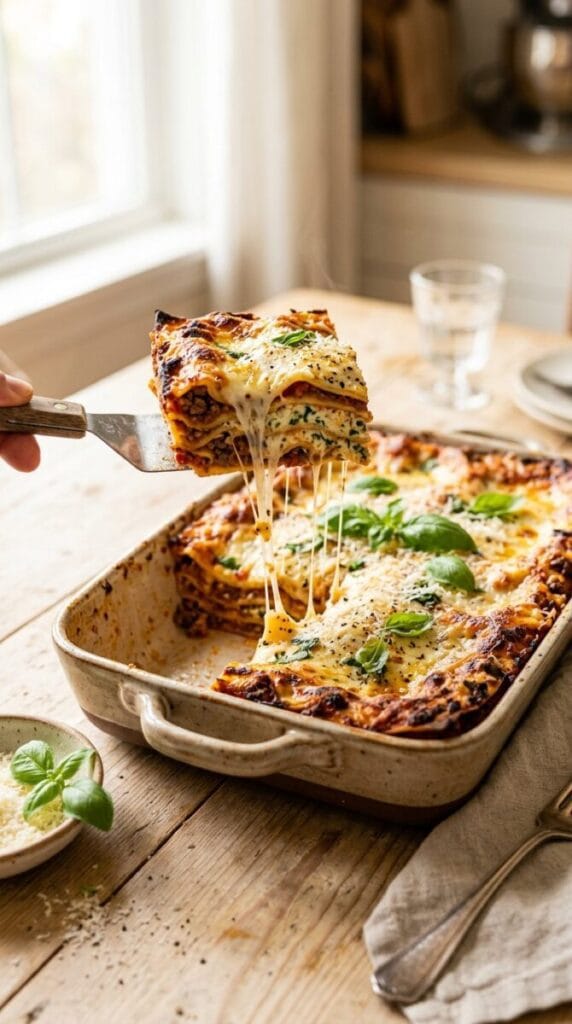
- Remove from the oven and rest for 15 minutes before cutting — this is the most important serving step. Cutting a hot lasagna produces collapsed layers and a pool of sauce on the plate. After 15 minutes, the layers will hold their shape when sliced and lifted onto a serving plate.
- Garnish with fresh basil leaves and serve.
Lasagna is the dinner that earns a proper bread service — and our Focaccia Bread is the best possible companion for the sauce that will inevitably be left in the dish. Make the focaccia the same afternoon while the lasagna sauce is simmering and serve both at the same table.
The Three Technique Details That Elevate This
Blooming the tomato paste before adding the liquid tomatoes is the step most recipes list as an afterthought and most home cooks skip — cooking the concentrated paste in the hot fat for 2 minutes before the liquid goes in caramelises its sugars and removes the sharp, slightly artificial flavour of uncooked concentrate. A sauce made with bloomed tomato paste tastes richer and deeper than one where the paste was added with everything else.
Low-moisture mozzarella rather than fresh mozzarella is the correct choice for a baked lasagna — fresh mozzarella contains significantly more water and releases it during baking, which creates a watery pool at the top of the lasagna and prevents the cheese from properly browning and blistering. Low-moisture shredded mozzarella melts evenly and browns to the golden, bubbly top that makes lasagna look like lasagna.
The 15-minute rest after baking is the step that makes lasagna serveable — the layers are held in place partially by the heat of the dish maintaining the gelatin from the meat sauce in a semi-solid state, and cutting too quickly while everything is still at baking temperature produces a liquid that runs across the plate rather than cohesive, stackable layers. According to Serious Eats, the resting period for layered pasta dishes like lasagna serves the same function as resting meat — the internal temperature drops enough that the collagen gelatin from the meat sauce re-solidifies slightly, holding the layers in place and allowing a clean cut to pass through without the filling collapsing out of the edges.
What to Serve Alongside
A simple dressed green salad is the most natural accompaniment — the acid from a vinaigrette cuts through the richness of the cheese and meat sauce and makes the whole meal feel more balanced than lasagna alone.
Our Greek Salad — Fresh, Tangy and Easy is a ten-minute acidic salad that contrasts beautifully with the richness of the lasagna — the feta, Kalamata olives, and vinegary dressing give the table a fresh, bright counterpoint that makes the lasagna taste less heavy for having something light alongside.
Variations That Use the Same Assembly
Make a vegetarian lasagna by replacing the meat with 1 lb of finely diced mixed vegetables — zucchini, bell pepper, and mushrooms browned in olive oil until deeply caramelised — and using the same sauce base with vegetable broth instead of the meat rendering. The long simmer is equally important for a vegetable sauce and produces a result that is genuinely satisfying rather than obviously meatless.
Add a béchamel layer — a simple white sauce of butter, flour, and warm milk — between the ricotta and the mozzarella layers for a version closer to a classic Italian lasagne al forno. The béchamel adds another layer of creamy richness and produces a more uniformly luxurious texture throughout each bite.
Use Italian sausage exclusively rather than ground beef for a more robustly spiced meat sauce — remove the sausage from its casing and crumble it in the pan. The fennel and herb seasoning already in good Italian sausage means you need less additional seasoning in the sauce and the finished lasagna has a more complex, spiced meat character.
Nutritional Information
| Nutrient | Amount Per Serving (based on 10 servings) |
|---|---|
| Calories | 510 kcal |
| Protein | 30 g |
| Carbohydrates | 42 g |
| Fats | 22 g |
These values are estimates based on 80/20 ground beef, whole-milk ricotta, and full mozzarella quantities, divided by 10 servings. Lasagna is a complete protein-and-carbohydrate meal — the protein count of 30 grams per serving reflects the meat, ricotta, and cheese combined.
Storing, Freezing and Reheating
Store covered in the fridge for up to 4 days — the lasagna improves significantly overnight as the sauce, pasta, and cheese layers meld together into a more cohesive, unified dish. Day-two lasagna is consistently better than day-one in a way that justifies making it well ahead of when you plan to serve it.
Freeze either the fully assembled and baked lasagna or the assembled-but-unbaked lasagna — both approaches work. For unbaked frozen lasagna, thaw overnight in the fridge then bake as directed, adding 15 to 20 extra minutes to account for residual cold. For baked frozen lasagna, reheat portions covered in foil at 350°F for 25 to 30 minutes until heated through.
Reheat individual portions in the microwave at 60 percent power in 90-second intervals until heated through, or in a 350°F oven covered with foil for 20 minutes. The oven produces a better result for the cheese layer but the microwave is faster and acceptable for a weekday lunch.
Where Lasagna Goes Wrong
Not simmering the sauce long enough is the most impactful mistake — a sauce simmered for only 15 minutes tastes sharp, bright, and slightly raw. A sauce simmered for 40 minutes tastes deep, rich, and complex. The difference defines the character of the entire lasagna. If time is limited, at least give the sauce 25 minutes of simmering before the assembly begins.
Cutting too soon produces a plate full of collapsed layers and sauce — the 15-minute rest is not a suggestion and cannot be shortened without accepting a result that looks nothing like the layered photo on the recipe. Set a timer immediately when the lasagna comes out of the oven and resist lifting the foil or cutting until it goes off.
Using too much sauce between the layers makes the finished lasagna soupy rather than cohesive — spread each sauce layer as an even coat that just covers the noodles rather than a thick, generous pour. The sauce concentrates and thickens further during baking, and a heavy hand at assembly produces a dish that weeps liquid when cut and doesn’t hold its layers on the plate.
Classic
Homemade Lasagna
Rich, slow-simmered meat sauce, creamy herb ricotta, tender pasta layers, and a deeply golden mozzarella top make this the baked lasagna everyone hopes for when dinner comes out of the oven.
Ingredients
Instructions
Heat olive oil in a large heavy-bottomed pot over medium-high heat. Add beef and cook for about 8 minutes, breaking it apart, until browned with no pink remaining. Drain excess fat if needed.
Add diced onion and cook for 5 minutes, until soft and translucent. Add garlic and cook for 60 seconds until fragrant.
Stir in tomato paste and cook for 2 minutes, stirring continuously, until it darkens slightly and develops a deeper, sweeter aroma.
Pour in wine or broth and scrape the browned bits from the pan. Add crushed tomatoes, diced tomatoes, Italian seasoning, basil, oregano, sugar, salt, pepper, and optional red pepper flakes.
Bring to a simmer, reduce heat to medium-low, and cook uncovered for 30–40 minutes. Stir occasionally until the sauce is thick, darkened, and rich tasting. Adjust seasoning and set aside.
Combine ricotta, egg, Parmesan, parsley, basil, salt, pepper, and garlic powder in a bowl. Stir until fully combined and well seasoned.
Preheat oven to 375°F (190°C). Spread 1 cup of meat sauce across the bottom of a 9×13-inch baking dish.
Arrange 3–4 noodles over the sauce. Spread half the ricotta mixture over noodles, then add ¾ cup shredded mozzarella and one-third of the remaining meat sauce.
Repeat with noodles, the remaining ricotta, another ¾ cup mozzarella, and another one-third of the sauce.
Add the final noodles, remaining sauce, remaining mozzarella, and Parmesan. Cover tightly with foil sprayed underneath with non-stick spray.
Bake covered for 25 minutes. Remove foil and bake for another 20–25 minutes, until deeply golden and bubbling at the edges.
Kitchen Notes
Cooking tomato paste in the hot pan before adding liquid removes the raw, tinny flavor and creates a deeper, sweeter sauce.
Low-moisture mozzarella melts and browns beautifully without releasing the excess water that can make lasagna soupy.
This is what creates tidy, defined slices. Cutting immediately causes the sauce and cheese layers to collapse.
Use enough sauce to cover each layer, but not so much that the finished lasagna becomes loose and watery when cut.
Easy Variations
Replace the meat with caramelized zucchini, mushrooms, and bell peppers, then use vegetable broth in the sauce.
Use Italian sausage in place of beef for a bolder, more herb-forward sauce with fennel and warm spice notes.
Add a layer of creamy béchamel between the ricotta and mozzarella for a richer, more classic lasagne al forno style.
Increase red pepper flakes and use hot Italian sausage for a gently spicy lasagna with a bolder tomato sauce.
Store covered in the refrigerator for up to 4 days. Lasagna is often even better on day two after the flavors meld.
Freeze fully baked or assembled unbaked lasagna for up to 3 months. Thaw overnight before reheating or baking.
Reheat covered portions at 350°F for about 20 minutes, or reheat a larger frozen baked lasagna covered for 25–30 minutes.
Heat individual slices at 60 percent power in 90-second intervals until warmed through for an easy weekday lunch.