Focaccia Bread — Crispy Olive Oil Recipe
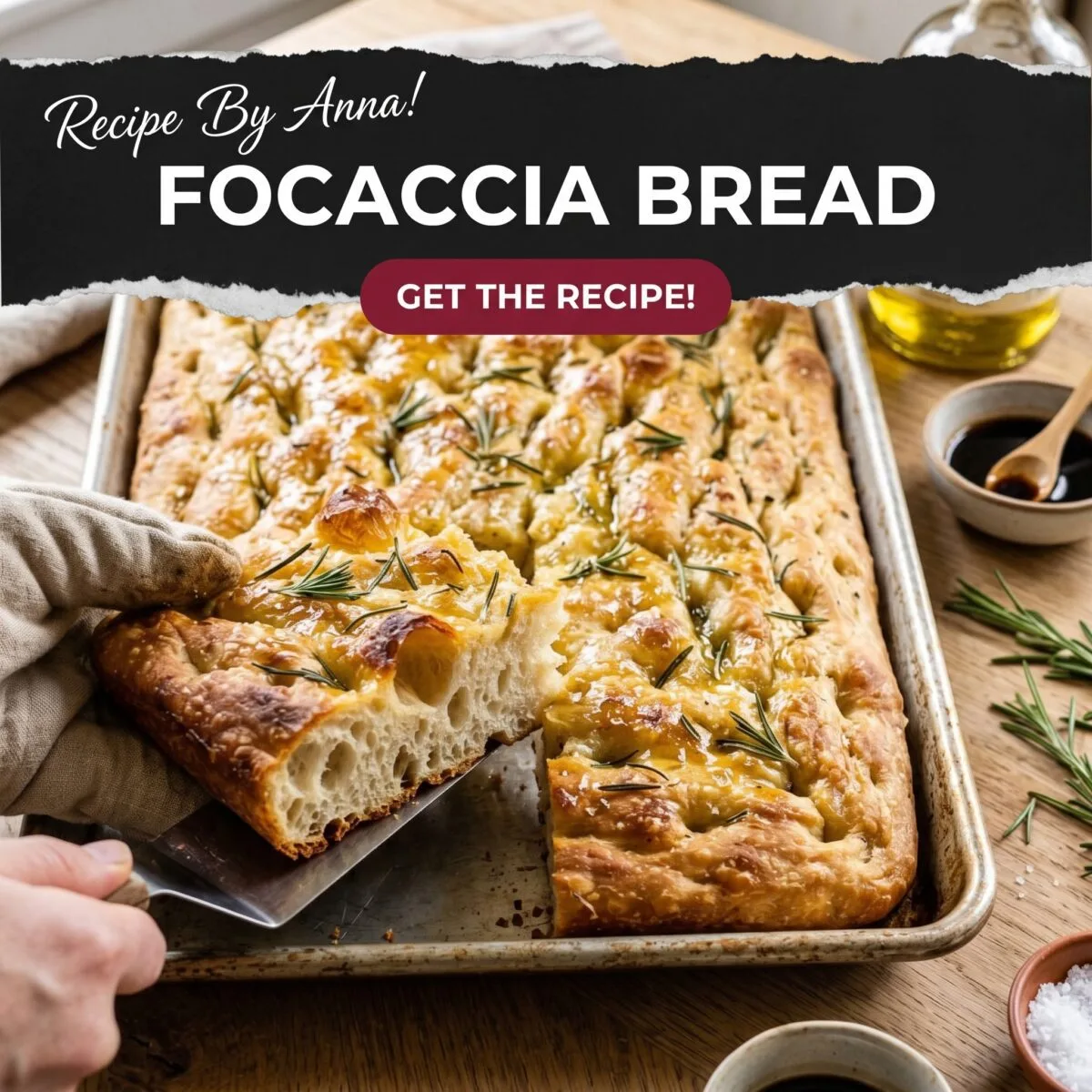
This Focaccia Bread is the olive oil recipe that produces the Ligurian classic every time — a thick, pillowy interior with an open, airy crumb and a golden, crispy, olive-oil-soaked bottom and top crust that is genuinely better than most bakery versions because you can get it into the oven within 30 minutes of buying the flour and have it on the table that same afternoon.
Focaccia is the most forgiving bread in the serious baker’s repertoire — it requires no shaping skill, no scoring, no perfect windowpane test, and no tension-building technique. The dough is too wet to knead conventionally, which means the entire process is accomplished with a series of stretch-and-fold movements done in the bowl rather than on a counter, and then the dough goes into a generously oiled pan to rise before baking. The result rewards the olive oil generously — the bottom crust absorbs it and fries gently against the hot pan, and the surface crust soaks it up and blisters into a golden, salted, deeply savoury thing that is one of the most satisfying single products of home bread baking.
This is the recipe that converts people who think bread is too complicated into people who make bread every weekend.
Why Focaccia Is the Best Starting Point for Home Bread Baking
The dough is a no-knead style with a high hydration (approximately 75 percent) — a wet, sticky dough that relies on time and gluten development through a series of gentle folds rather than the physical work of kneading. This means there is no risk of under-kneading or over-kneading, no bench flour to get wrong, and no shaping anxiety.
It also produces results that scale very obviously with ingredient quality — a focaccia made with genuinely good extra virgin olive oil is dramatically better than one made with basic cooking olive oil, which makes this the recipe that most directly rewards the decision to spend more on a good bottle.
- Prep Time: 20 minutes active
- Rise Time: 1 hour 45 minutes (two rises)
- Cook Time: 20 to 25 minutes
- Total Time: 2 hours 30 minutes
- Yield: one 9×13 inch focaccia, serves 8 to 10
What You Need
For the dough:
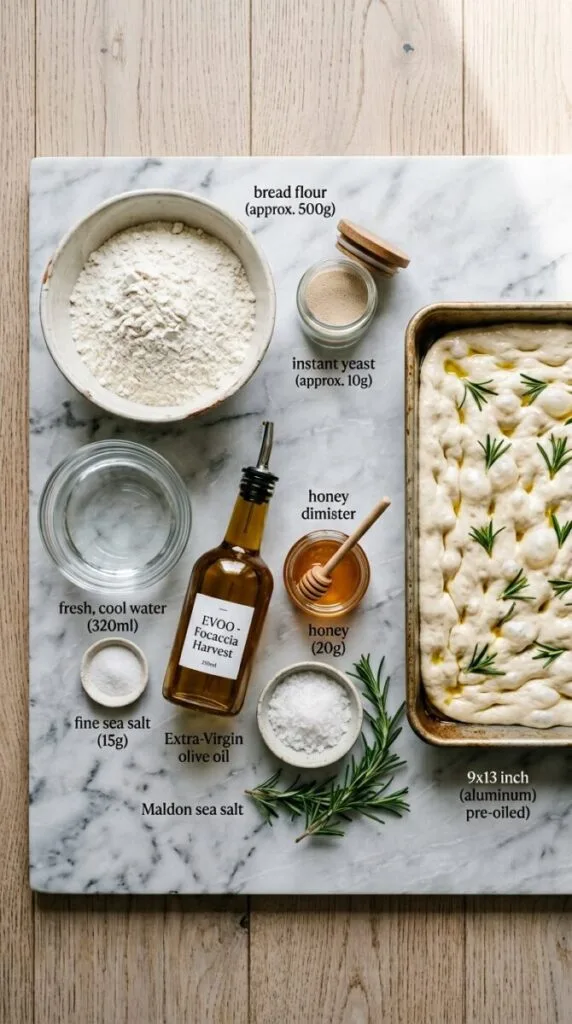
- Bread flour or all-purpose flour: 3 cups (375g) — bread flour produces a slightly chewier crumb with more structure; all-purpose produces a slightly softer, more tender result
- Instant yeast: 2 1/4 teaspoons (1 standard packet)
- Fine sea salt: 1 1/2 teaspoons
- Warm water (105 to 110°F): 1 1/4 cups (300ml)
- Extra virgin olive oil for the dough: 2 tablespoons
For the pan and surface:
- Extra virgin olive oil for the pan: 1/4 cup (60ml) — this is generous and intentional; the oil creates the characteristic crispy bottom crust
- Extra virgin olive oil for the surface: 2 tablespoons
- Flaky sea salt: 1 tablespoon, for the surface
Classic toppings (choose one or combine):
- Fresh rosemary sprigs: 3 to 4 sprigs, leaves stripped
- Pitted olives, halved: 1/2 cup
- Cherry tomatoes, halved: 1 cup
- Thinly sliced red onion: 1/2 cup
- Sliced garlic cloves: 4, thinly sliced
- Flaked red chilli: 1/2 teaspoon
How to Make It
Making and developing the dough:
- Combine the flour, instant yeast, and salt in a large bowl and whisk to distribute them evenly — do not add the salt directly on top of the yeast without mixing, as direct contact can inhibit yeast activity.
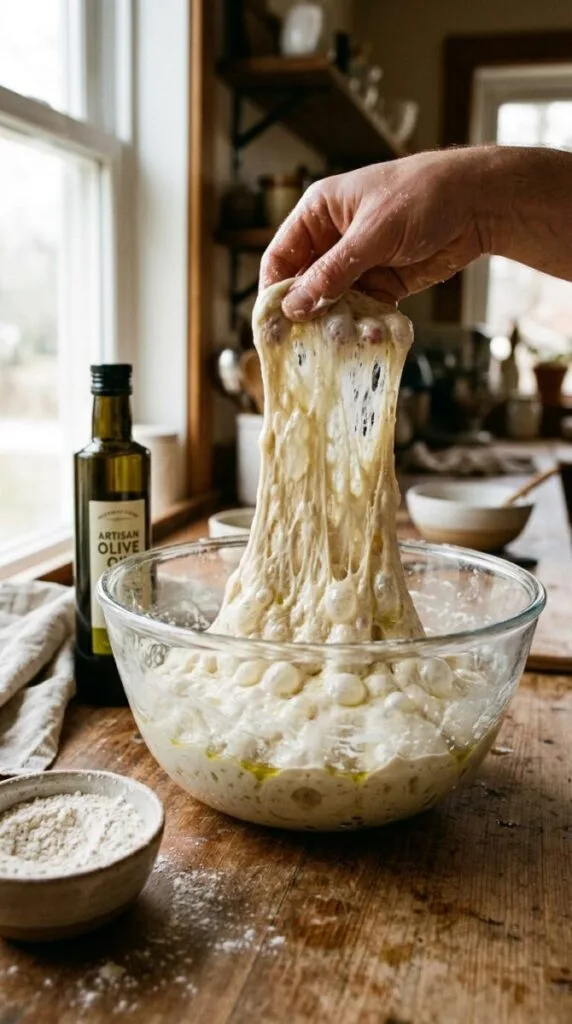
- Add the warm water and 2 tablespoons of olive oil and mix with a spatula or your hand until the flour is completely hydrated and no dry spots remain — the dough will be very shaggy, sticky, and wet, which is correct for a high-hydration focaccia dough.
- Cover the bowl with plastic wrap and let rest for 10 minutes — this autolyse period allows the flour to fully hydrate before the gluten development begins, which makes the subsequent folds easier.
- Perform the first set of stretch and folds: wet your hand, reach under the dough and stretch it upward as far as it will go without tearing, then fold it over itself. Rotate the bowl 90 degrees and repeat — 4 stretches and folds complete one set. The dough will initially feel very slack and sticky; this is correct.
- Cover and rest for 15 minutes, then perform a second set of stretch and folds.
- Cover and rest for 15 minutes, then perform a third and final set of stretch and folds — by this third set, the dough should feel noticeably more elastic and cohesive than when you started, with more resistance as you stretch it.
- Cover and let the dough rise at room temperature for 45 to 60 minutes until visibly puffed and approximately 50 percent larger in volume.
Panning and the second rise:
- Pour the 1/4 cup of olive oil into a 9×13 inch metal baking pan and tilt to coat the bottom and sides generously — this amount looks excessive and is exactly the right amount. The oil will pool slightly at the bottom and this is what creates the crispy, almost fried bottom crust.
- Gently transfer the risen dough to the oiled pan using an oiled spatula or your oiled hands — do not punch it down or degas it before transferring.
- Gently stretch and press the dough toward the edges of the pan, flipping it once to coat both sides in the oil. If it springs back and won’t reach the edges, let it rest for 5 minutes and try again — the gluten needs to relax before it will stretch to fill the pan.
- Drizzle the additional 2 tablespoons of olive oil over the surface of the dough.
- Cover loosely with plastic wrap and let rise for a further 30 to 45 minutes until puffed and slightly domed above the rim of the pan.
Dimpling, topping, and baking:
- Preheat the oven to 450°F (230°C) — the high heat is what produces the crispy crust and the blistered, golden surface.
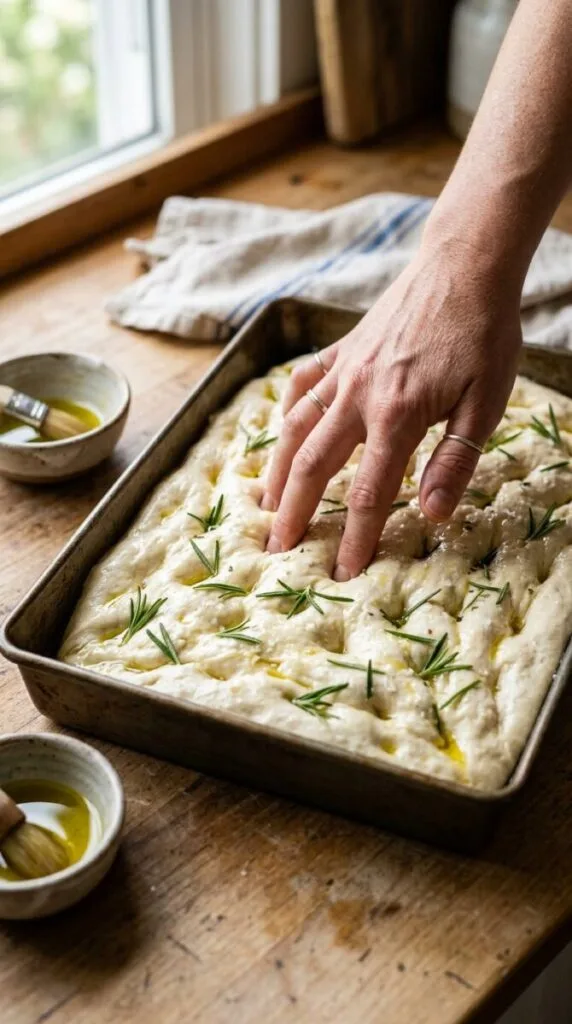
- Uncover the risen dough and use all 10 oiled fingertips to press deep, dramatic dimples across the entire surface of the dough — the dimples should go almost to the bottom of the pan and the dough should not spring back. These are not decorative; they prevent the dough from forming large air bubbles during baking and also create the pools of olive oil on the surface that baste the bread as it bakes.
- Scatter the rosemary leaves, olive halves, cherry tomatoes, or your chosen toppings over the dimpled surface, pressing them in gently so they anchor into the dough rather than sitting on the surface.
- Sprinkle the flaky sea salt generously over the entire surface — generously means more than feels comfortable, as focaccia needs substantial salt on the exterior to balance the richness of the olive oil.
- Bake at 450°F for 20 to 25 minutes until the surface is deep golden brown with some darker spots around the toppings and the edges.
- Remove from the oven and let cool in the pan for 5 minutes, then run a spatula around the edges and slide the focaccia onto a wire rack — cooling on the rack rather than in the pan prevents the bottom from continuing to steam and going soft.
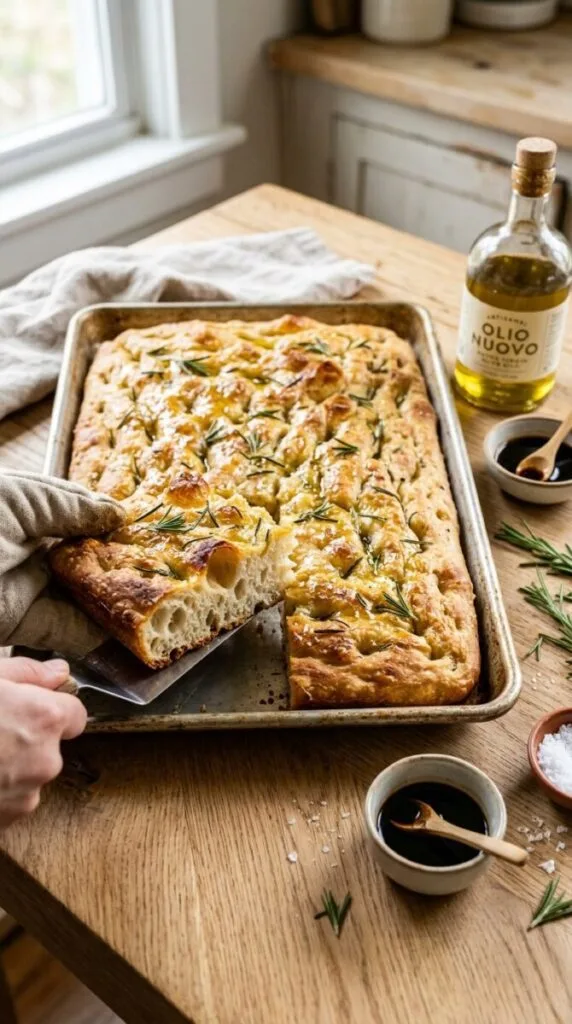
Focaccia is the bread that belongs alongside everything — and alongside our Classic Butter Chicken specifically, it is the best possible vehicle for the sauce that would otherwise be left in the bowl. Tear it into pieces, drag it through the curry, and you have the best use of both recipes simultaneously.
Why the Olive Oil Amounts Are Not a Typo
The 1/4 cup of olive oil in the pan looks like too much. It is exactly the right amount. Focaccia’s defining quality is the crispy, almost fried bottom crust that comes from the dough sitting in a pool of olive oil in a hot oven — the same technique that makes pizza in a deep pan different from pizza on a stone. Reducing the oil produces a plain baked bread bottom rather than the golden, slightly shattering crust that makes focaccia worth making over any other flatbread.
The same logic applies to the surface oil and the salt — focaccia is not a health food and attempting to reduce its olive oil content produces something that is less focaccia and more “bread in a pan.” The olive oil is the point.
Using genuinely good extra virgin olive oil for focaccia matters more than in most cooking applications because the oil is in the bread, on the bread, and surrounding the bread during baking — its flavour is present in every bite rather than being a background element. According to Serious Eats, focaccia’s flavour is fundamentally an expression of its olive oil — the bread structure exists to hold and carry the oil’s flavour rather than the oil existing to lubricate the bread, which is the opposite priority of most baked goods that include fat and is why the quality of the olive oil directly determines the quality of the finished loaf.
What to Serve Alongside Focaccia
Focaccia with a bowl of good olive oil and aged balsamic for dipping needs nothing else to justify its presence at a dinner table. As part of a larger spread, it anchors a mezze or appetiser table better than any other bread because it is substantial enough to be genuinely filling and flavourful enough to be interesting without any accompaniment.
For a complete dinner where the focaccia serves as bread service, our Tuscan Butter Beans with Spinach and Sun-Dried Tomato is the most natural companion — the Italian herb profile connects directly to the rosemary and olive oil focaccia, and the warm beans make a complete vegetarian dinner when the focaccia is generous enough to serve as the carbohydrate.
Our Greek Salad — Fresh, Tangy and Easy is the ten-minute acidic counterpart that gives a focaccia-centered lunch something fresh and bright to balance the richness — the vinegary dressing and the cold vegetables against the warm, oily bread is one of the most satisfying simple lunch combinations in Mediterranean food.
Recommended Kitchen Tools for the Best Focaccia Bread
6 essential tools for a golden crust, airy interior, and classic bakery-style focaccia.This crispy olive oil focaccia is all about a golden crust, airy interior, and plenty of flavorful olive oil. These 6 essential tools make the dough easier to prepare and help you get that classic bakery-style texture.

9×13-Inch Baking Pan
A sturdy baking pan gives the focaccia enough room to rise and spread while creating crispy, golden edges and a soft, airy center.

Large Mixing Bowl
A spacious bowl gives the dough plenty of room to rise during fermentation without overflowing.

Digital Kitchen Scale
Accurate measurements help maintain proper dough hydration and produce consistent bread results every time.

Bench Scraper
A bench scraper makes sticky focaccia dough easier to handle, transfer, and divide without adding too much extra flour.

Silicone Pastry Brush
A pastry brush spreads olive oil evenly across the pan and over the dough for a crispy, flavorful crust.

Large Measuring Cup
A large measuring cup makes it easy to measure and pour water and olive oil accurately when preparing the dough and coating the pan.
As an Amazon Associate we earn from qualifying purchases.
Variations That Keep the Essential Technique
Make a garlic herb focaccia by combining 4 minced garlic cloves, 2 tablespoons of fresh rosemary, and 1 tablespoon of fresh thyme with the surface olive oil before dimpling and drizzling — the garlic caramelises against the bread surface during baking and creates a deeply savoury, fragrant version that is the best thing to serve alongside a bowl of pasta.
Top with thin slices of potato, fresh rosemary, and a generous pinch of chilli flakes for a Roman-style potato focaccia that is deliberately understated and genuinely excellent — the potato slices soften and caramelise on the surface and the combination of starch on starch is more satisfying than it sounds.
Make an overnight focaccia by mixing the dough before bed, skipping all the folds, and refrigerating the covered bowl overnight. The cold, slow fermentation develops more flavour than the 2-hour room-temperature rise without any additional work — transfer to the oiled pan in the morning, let it warm and rise for 45 to 60 minutes at room temperature, then dimple, top, and bake as directed. This is the version with the best flavour and the lowest stress.
Nutritional Information
| Nutrient | Amount Per Serving (based on 10 servings) |
|---|---|
| Calories | 265 kcal |
| Protein | 5 g |
| Carbohydrates | 34 g |
| Fats | 12 g |
These values are estimates for the plain focaccia with the full olive oil quantities and flaky salt, divided by 10 servings. The olive oil contributes most of the fat content — this is accurate and expected for a recipe where the olive oil is the defining flavour ingredient. Toppings like olives and cherry tomatoes add minimal additional calories.
Storing and Refreshing Focaccia
Focaccia is at its absolute best on the day it is baked — the crispy bottom crust begins softening from the residual moisture in the bread within a few hours of coming out of the oven, and it cannot be fully restored to its fresh-baked state. This is the nature of focaccia rather than a failure of the recipe.
Store at room temperature wrapped loosely in a kitchen towel (not plastic, which traps moisture and makes the crust soggy faster) for up to 2 days. To refresh, place slices or the whole focaccia directly on the oven rack or on a baking sheet at 375°F for 5 to 8 minutes — the direct heat re-crisps the surface and bottom crust significantly and produces something very close to fresh-baked.
Focaccia freezes well — cool completely, slice or leave whole, wrap tightly in plastic wrap and then foil, and freeze for up to 2 months. Refresh from frozen at 375°F for 10 to 12 minutes without thawing. The freeze-and-refresh approach produces better results than day-two room-temperature storage in most cases.
Where Focaccia Goes Wrong
Not enough oil in the pan produces a bread bottom that bakes rather than fries — the characteristic shattering, golden, slightly crispy bottom crust of a proper focaccia requires the dough to sit in oil rather than on an oiled surface. The 1/4 cup is the minimum for a 9×13 pan; more is better and has never made a worse focaccia.
Shallow dimples that don’t reach close to the bottom of the pan leave air bubbles underneath the surface that create uneven, ballooned areas on the focaccia surface during baking. The dimples should be deep and dramatic — fingertip-to-almost-bottom-of-pan deep — and the dough should not spring back at all after they are made. If it does, it needs more resting time before dimpling.
Underbaking to a pale golden top produces a focaccia with a soft, doughy bottom rather than a crispy one — the bottom crust requires the same level of heat and time as the top to fully fry in the olive oil, and pulling the bread before the top is genuinely deeply golden means the bottom hasn’t had long enough either. Bake until it looks dark gold, not pale gold.
Crispy Olive Oil
Focaccia Bread
A golden, olive-oil-soaked focaccia with a crisp, almost fried bottom crust, a pillowy open crumb, deep dimples, flaky sea salt, and your favorite savory toppings.
Ingredients
Instructions
Whisk flour, instant yeast, and fine sea salt together in a large bowl. Add warm water and 2 tablespoons olive oil. Mix with a spatula or wet hand until fully hydrated with no dry flour remaining.
Cover the bowl and let the dough rest for 10 minutes. This short rest gives the flour time to hydrate and makes the dough easier to stretch and fold.
Wet your hand, reach beneath the dough, stretch it upward without tearing, then fold it over itself. Rotate the bowl and repeat until you have completed 4 folds.
Cover and rest for 15 minutes. Perform a second set of 4 stretch-and-folds. Rest another 15 minutes, then perform one final set. The dough should feel more elastic and cohesive by the final round.
Cover and let dough rise at room temperature for 45–60 minutes, until visibly puffed and about 50 percent larger in volume.
Pour ¼ cup olive oil into a 9×13-inch metal baking pan. Tilt the pan to generously coat the bottom and sides. The oil should pool slightly—this creates focaccia’s crisp bottom crust.
Transfer risen dough to the pan using oiled hands or an oiled spatula. Flip once to coat both sides in oil, then gently stretch toward the edges. Let it rest 5 minutes if it springs back.
Drizzle the remaining 2 tablespoons of olive oil over the dough. Cover loosely and let rise for 30–45 minutes, until puffy and lightly domed.
Preheat oven to 450°F (230°C). With all 10 oiled fingertips, press deep dimples across the dough, nearly reaching the pan bottom. Add rosemary, olives, tomatoes, onions, garlic, or other toppings, pressing them in gently.
Sprinkle generously with flaky sea salt. Bake for 20–25 minutes, until the top is deep golden brown with darker spots around the edges and toppings.
Kitchen Notes
The generous oil in the pan is what gives focaccia its signature golden, lightly fried bottom. Do not reduce it.
Focaccia dough should be sticky and soft. Resist adding extra flour; the high hydration is what creates its airy crumb.
Use all your fingertips and press firmly. Deep dimples prevent oversized air bubbles and create delicious pools of olive oil.
A pale focaccia will have a soft base. Let it bake until deeply golden so the bottom crust has time to crisp in the olive oil.
Easy Variations
Mix minced garlic, fresh rosemary, and thyme into the surface oil before dimpling for a deeply fragrant pasta-night focaccia.
Top with very thin potato slices, rosemary, flaky salt, and a pinch of chili flakes for a simple Roman-inspired version.
Use halved cherry tomatoes, pitted olives, red onion, and rosemary for a colorful, savory Mediterranean-style bread.
Mix dough the night before and refrigerate without folding. Pan it in the morning, let rise 45–60 minutes, then dimple and bake.
Focaccia has its crispiest crust on the day it is baked, so serve it fresh whenever possible.
Wrap loosely in a clean kitchen towel for up to 2 days. Avoid plastic wrap, which traps moisture and softens the crust.
Reheat slices directly on an oven rack or baking sheet at 375°F for 5–8 minutes to restore the crisp edges and bottom.
Wrap completely cooled focaccia in plastic wrap and foil. Freeze for up to 2 months, then bake from frozen at 375°F for 10–12 minutes.