Easy Loaded Veggie White Lasagna Recipe
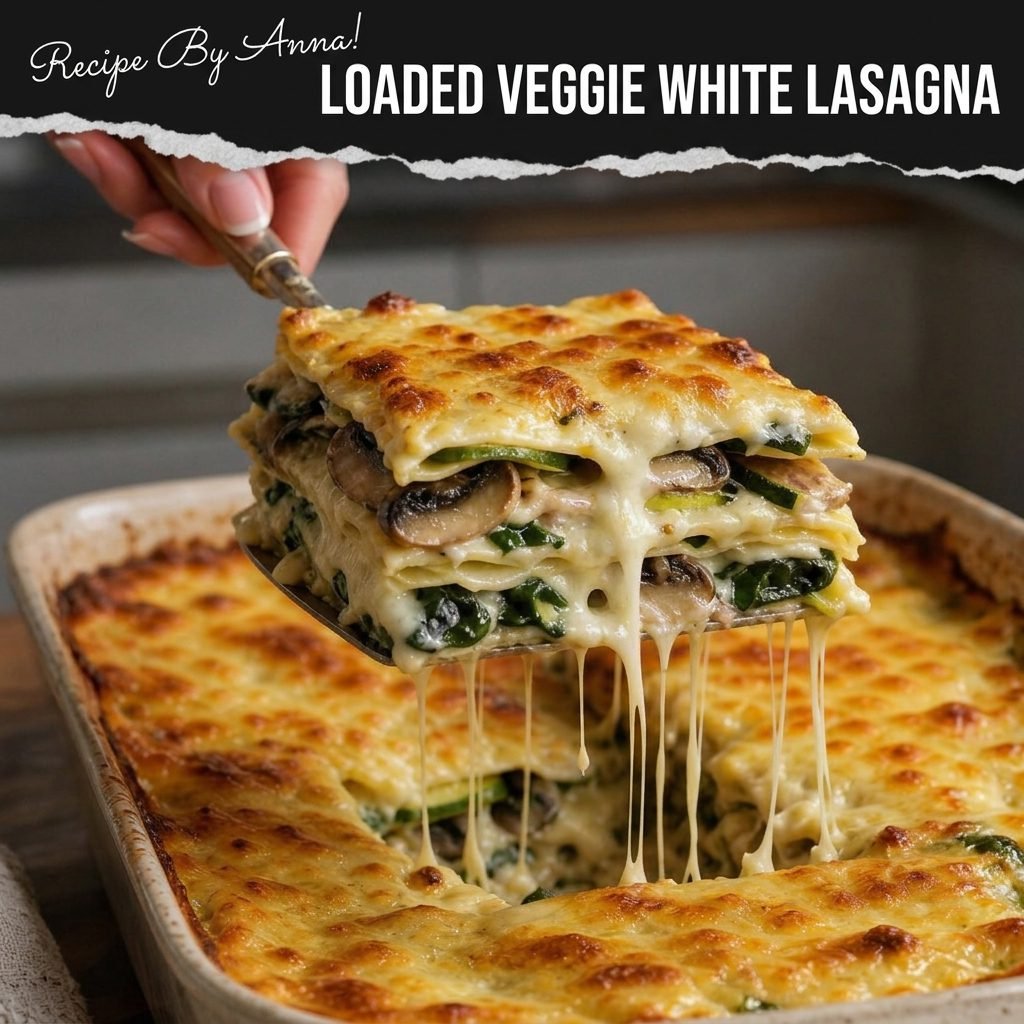
White lasagna is the version nobody expects and everybody remembers. There’s no red sauce anywhere in the dish — the liquid is a nutmeg-scented béchamel, the vegetables are the point rather than the garnish, and the whole pan bakes into something creamier and quieter than the lasagna you grew up with, with a golden cheese top that needs no introduction. This one is loaded in the honest sense of the word: three pounds of vegetables — cremini mushrooms, zucchini, red and yellow peppers, spinach, onion — browned and squeezed and folded between layers of ricotta, mozzarella, and parmesan, all of it swimming in the silkiest white sauce a home cook can make in ten minutes.
Here’s the reputation problem this recipe fixes. Vegetable lasagna has a well-earned fame for arriving at the table as soup with aspirations — you cut a square, the plate floods, and the noodle layers slide apart like continental drift. That happens for one reason: vegetables are mostly water, and a 375-degree oven does nothing but invite that water out. Most recipes sauté the vegetables for five minutes, cross their fingers, and hope. This recipe doesn’t hope — it budget. The mushrooms get browned until they’ve given up their water to the skillet, the spinach gets wilted and squeezed like laundry, the zucchini gets salted and blotted. Every vegetable enters the pan already wrung out, and the béchamel — which is nothing more than milk held in suspension by cooked flour and butter — does the opposite of leaking: it sets as it cools, gluing the layers into sliceable architecture.
The result is a lasagna that cuts clean, eats creamy, and reheats even better than it started. It’s a Sunday-afternoon project in shape but a friendly one — about forty-five minutes of actual work, most of it vegetable wrangling, and the oven handles the rest. It feeds nine generously, it’s vegetarian without apologizing about it, and it makes two pans’ worth of sense, because the recipe was written with the freezer in mind. Let me show you the plumbing first — the sauce and the water budget — because once those two ideas are in place, the layering is just stacking.
The Béchamel Brief
Béchamel has a reputation as restaurant territory, which is a shame, because it’s four ingredients and ten minutes and it runs on chemistry a ten-year-old could love. Butter and flour cooked together make a roux — the flour’s starch granules get coated in fat so they disperse without lumping — and when milk goes in and the mix hits a simmer, those granules swell and burst, thickening the milk into a sauce that coats a spoon. That’s the whole trick. What matters for lasagna is what the sauce does later: as it cools, the gelatinized starch sets into a soft gel, and the sauce stops being a liquid at all. Hot out of the oven it flows; fifteen minutes on the counter and it’s the mortar holding every layer to its neighbor. Red sauce can’t do this — it’s water-thin by nature — which is exactly why a well-built white lasagna slices cleaner than a red one.
The water budget is the second half of the doctrine, and it deserves its own arithmetic. Mushrooms run about ninety-two percent water; zucchini, ninety-five; spinach, ninety-one. That’s more than two pounds of water riding along inside three pounds of vegetables, and the oven will happily pull it out into your lasagna’s basement. So we pull it out in advance, on our terms: mushrooms browned in a hot skillet until they squeak and the pan goes dry, spinach wilted and squeezed in a fist (ten ounces of raw spinach becomes one dense, dark ball the size of a baseball — always a startling magic trick), zucchini salted twenty minutes and pressed with paper towels. The flavor argument matches the physics — a browned mushroom is concentrated and meaty where a steamed one is slippery and quiet — so the same step solves both problems at once. A vegetable that has nothing left to give up can spend the whole bake absorbing flavor instead of leaking structure.
The nutmeg, by the way, is not optional, and it’s not there to taste like nutmeg. A quarter teaspoon in four cups of milk reads as warmth — the reason restaurant cream sauces taste rounder than yours is usually this exact spice. White lasagna without nutmeg is a fine dish; white lasagna with it is the one people ask about. Same story with the white pepper if you’ve got it, though black pepper tells the same joke in a louder shirt.
⏱️ 45 MIN ACTIVE | 🍽️ SERVES 9 | 🥬 THREE POUNDS OF VEGETABLES
- Prep Time: 45 minutes — the vegetables are most of it
- Assembly: 15 minutes of layering
- Bake Time: 45 minutes, foil then no foil
- Rest Time: 15 to 20 minutes, and it counts as work the pan does
- Total Time: about 2 hours start to golden slice
The Noodle Ruling
The kit is ordinary on purpose:
- 9×13 baking dish — glass or ceramic, and the straighter the sides the squarer the slices
- Large skillet — the biggest one you own; three pounds of vegetables start bulky
- Medium saucepan and a whisk — the béchamel’s entire payroll
- Clean kitchen towel or paper towels — for pressing the zucchini and squeezing the spinach
- Mixing bowl — for the ricotta layer
- Offset spatula or the back of a spoon — for spreading the ricotta without tearing noodles
- Foil — the lasagna bakes covered first, uncovered after; the foil is the crust controller
Now the ruling on noodles, because it’s the one decision the recipe actually asks of you: use no-boil sheets. Not because they’re fancy — because they’re the correct tool. No-boil noodles arrive dry and thirsty, and they spend the bake drinking the béchamel that surrounds them, which means the sauce thickens and the noodles hydrate in the same transaction, and the whole pan self-balances. Regular noodles must be boiled first (in water you then pour down the drain, flavor and all), they tear, they stick to each other, and they bring extra surface moisture to the pan. If regular sheets are what’s in the pantry, boil them two minutes shy of the box time and lay them out singly on towels — but bought on purpose, no-boil wins this contest, and I say that as someone who has umpired it more than once.
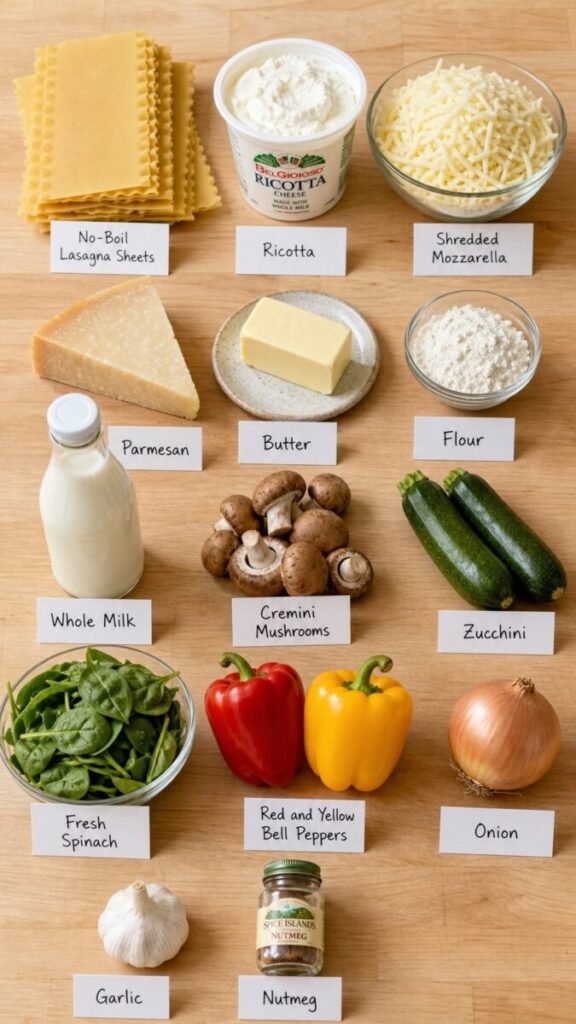
Ingredients (With Labels)
🥬 The Vegetables
- Cremini mushrooms: 16 oz, sliced
- Zucchini: 2 medium, diced
- Red and yellow bell peppers: 1 each, diced
- Spinach: 10 oz, fresh
- Onion: 1 medium, diced
- Garlic: 4 cloves, minced
🥛 The Béchamel
- Butter: 5 tablespoons
- Flour: ¼ cup
- Whole milk: 4 cups, warmed if you think of it
- Nutmeg: ¼ teaspoon, freshly grated
- Salt and white pepper: ½ teaspoon and ¼ teaspoon
🧀 The Cheeses
- Ricotta: 15 oz, whole-milk
- Mozzarella: 3 cups, shredded, low-moisture
- Parmesan: ¾ cup, grated — half in the ricotta bowl, half on top
- Egg: 1, for the ricotta bowl
✨ The Flavor Crew
- Olive oil: 2 tablespoons
- Italian herbs: 1 teaspoon dried, or a fistful of fresh basil at the end
Step by Step How to Make
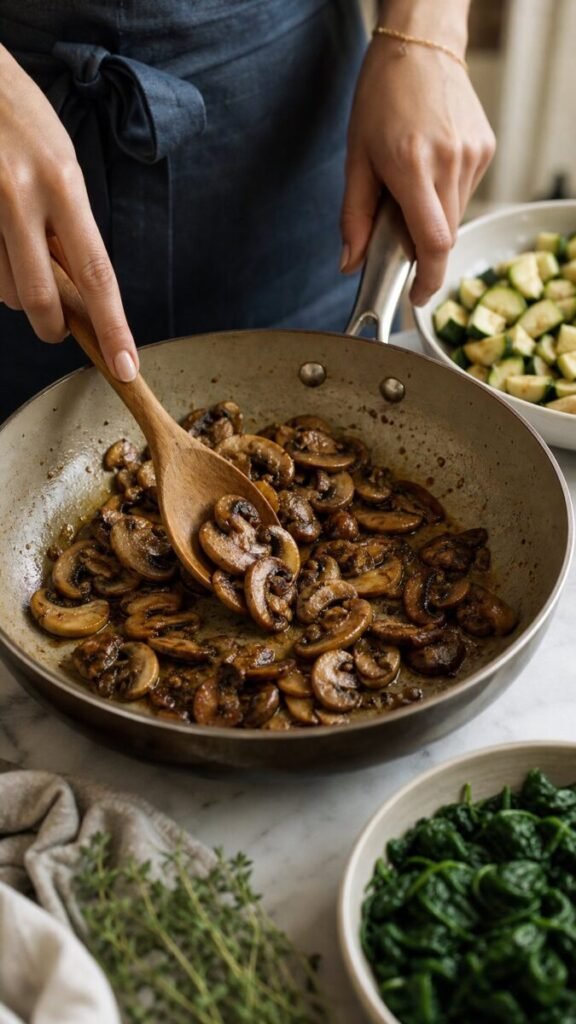
- Step 1 — The vegetable work. This is the recipe’s real labor, and it’s where the pan gets won or lost. Heat a tablespoon of olive oil in the big skillet over medium-high and add the mushrooms in a single layer — crowd them and they steam instead of brown, so if your skillet is modest, do two batches and accept your fate with dignity. Let them sit, undisturbed, until the underside is brown, then stir and let them sit again; they’ll release their water, the pan will briefly look like a mistake, and then the water will boil off and the mushrooms will start to squeak and brown. That’s the sound of structure being saved. When they’re browned, scoop them into a bowl. Add the second tablespoon of oil, then the onion and peppers, and cook five minutes until soft; add the zucchini and cook five more, until the pieces gild at the edges. Salt the zucchini lightly as it cooks — better to draw its water now than in the oven. Add the garlic and cook one minute. Finally, pile the spinach on top, wilt it for two minutes, then take everything off the heat. When it’s cool enough to handle, grab the spinach by the fistful and squeeze — hard — over the sink, then chop it roughly and add it back to the vegetables. The bowl should look like a vegetable confetti, not a stew: glistening, but with no pooled liquid anywhere.
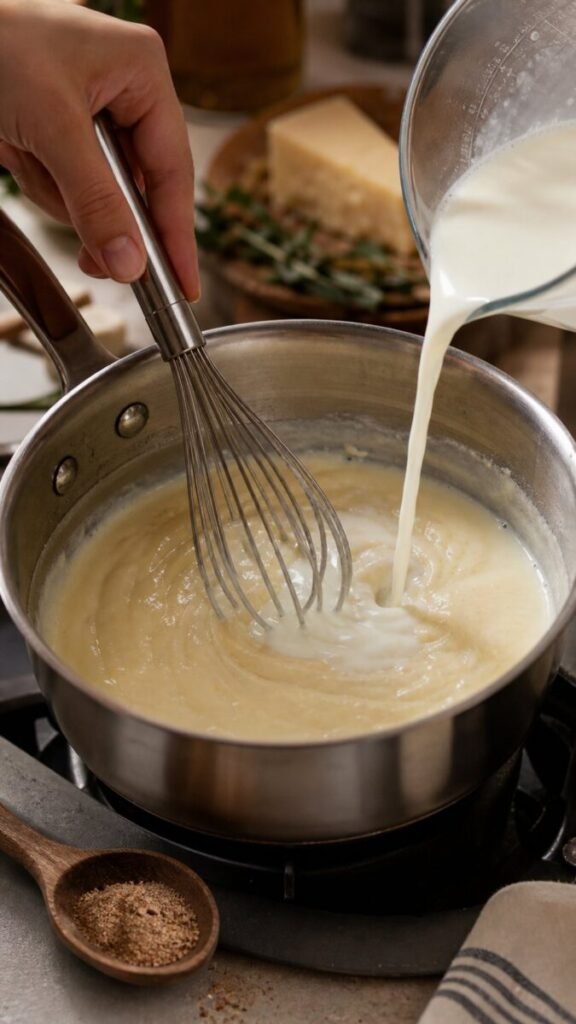
- Step 2 — The béchamel. In the saucepan, melt the butter over medium heat, whisk in the flour, and let it cook one full minute — you’re cooking the raw-starch taste out, and a blond roux should smell faintly of toasted cookies rather than flour. Pour in the milk in three additions, whisking each completely smooth before the next — small additions are the entire secret to a lumpless sauce; the first half-cup turns the roux into a paste, and everything after that is just thinning. Bring it to a bare simmer, whisking, and watch it thicken in the space of about three minutes into something that slowly slides off the whisk. Season with the salt, white pepper, and nutmeg, and pull it off the heat. It should taste gently savory and warm — taste it now, because a bland béchamel is a bland lasagna, and fixing it later is impossible.
- Step 3 — The ricotta bowl. Stir the ricotta with the egg, half the parmesan, the Italian herbs, and a grind of pepper. The egg is doing quiet structural work — it sets in the oven and turns the ricotta from a spread into a soft custard layer that holds its place in the slice. Thirty seconds of stirring; there’s no technique beyond evenness.
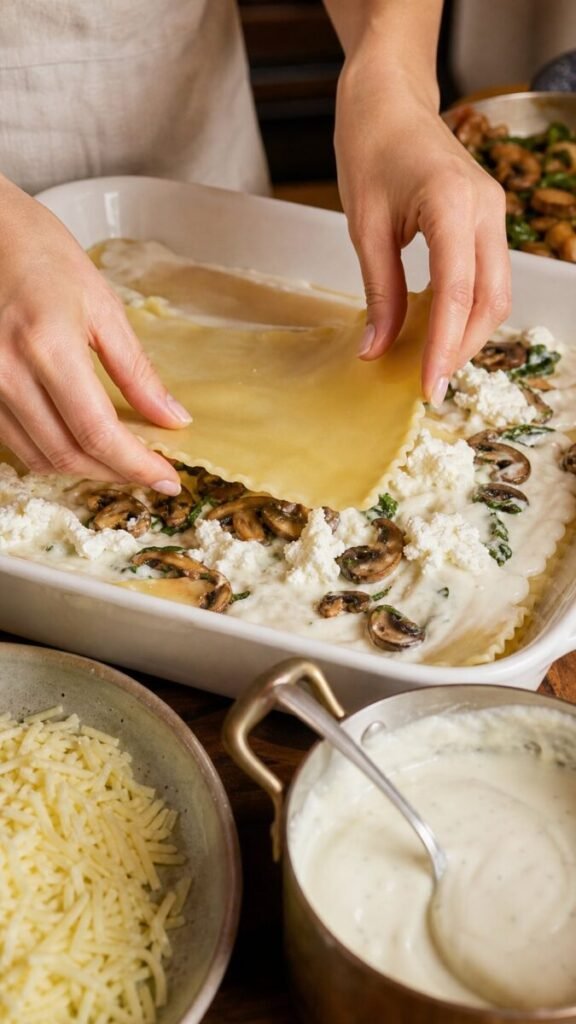
- Step 4 — The layering. Heat the oven to 375°F. Spread half a cup of béchamel thinly across the bottom of the dish — it looks like too little and it is exactly right; its whole job is to glue the first noodle layer down. Lay four noodle sheets over it, then spread half the ricotta mixture across the noodles in dollops, nudged gently flat with the spatula’s back. Spoon half the vegetables over the ricotta, pour a third of the remaining béchamel over the vegetables, and scatter a cup of mozzarella. Noodles again, and repeat: ricotta, vegetables, béchamel, mozzarella. Finish with a last noodle layer, the rest of the béchamel poured and spread to the corners, the last mozzarella, and the remaining parmesan. Two rules worth repeating: every noodle should touch sauce on both sides — a dry noodle is the crunchy edge’s origin story — and the top layer gets béchamel under its cheese, never cheese straight onto naked pasta.
- Step 5 — The bake. Tent the dish loosely with foil — keep it off the cheese, which will marry any foil it touches — and bake 25 minutes. The foil traps steam so the noodles hydrate through; then the last act needs dry heat. Pull the foil and bake 20 minutes more, until the sauce bubbles at the edges and the top has gone deep gold in spots. If the top is still pale and you want the bakery-window finish, two minutes under the broiler, door open, eyes on it the entire time. Broiler time is measured in regret, so stay put.
- Step 6 — The rest and the first slice. Take the pan out and let it sit 15 to 20 minutes. This is not a suggestion — it’s the moment the chemistry finishes the job: the starch in the béchamel gels as it cools, the ricotta custard sets, and the pan converts from lava to lasagna. Cut too early and you’ll eat a delicious soup with a spatula. Rest the full quarter hour, then cut a nine-square grid and lift the first piece with confidence — it should come up intact, layers visible, sauce moving slowly. Scatter basil over the top if you have it, and bring the whole dish to the table. A white lasagna earns its applause at the first slice, and this one has been preparing for it since Step 1.
Mushrooms, spinach, and cheese in a baked layer — the mushroom spinach enchiladas are this lasagna’s weeknight cousin, the same filling wearing a tortilla instead of a noodle.
Anna’s Kitchen Notes
Squeeze the spinach. Really squeeze it. Ten ounces of raw spinach wilts down to what looks like a side dish for a mouse, and it holds its weight in water anyway. A fistful at a time, over the sink, twist and squeeze until it stops dripping, then chop it. The first time I made this recipe I skipped a proper squeeze for speed, and the pan served lasagna-flavored water to nine polite people. The squeeze takes ninety seconds. Take the ninety seconds.
The béchamel is a sauce, not a soup — until it’s a gel. Two facts that matter at different moments: hot, it should coat a spoon thickly (if it runs off like milk, keep it on the heat another minute); and cold, it sets firm enough to slice. Both facts are the same starch doing the same job. If your sauce feels thick when you spread it — thicker than pancake batter — you did it right, because the noodles will drink some of it in the oven and the cheese will melt into more of it. The pan’s final texture is always firmer than anything you see at assembly.
Whole milk, full-fat ricotta, low-moisture mozzarella. The dairy trilogy is not snobbery — it’s water accounting again. Whole milk makes a béchamel that tastes like something and breaks nowhere near as easily; whole-milk ricotta is creamier and holds less water than the part-skim tub; low-moisture mozzarella melts into stretch instead of flooding the pan the way fresh mozzarella’s whey will. Every substitution in the dairy case trades a little structure for a little virtue, and lasagna is not the dish to go virtuous on. Save the penance for January.
Nutmeg, the invisible ingredient. A quarter teaspoon in the whole pan, and it will never identify itself — it just makes the cream taste rounder and the vegetables taste sweeter, and guests will ask what the secret is. Grate it fresh if you can; pre-ground nutmeg is a fading photograph of the real spice. And while you have the grater out, the parmesan tastes noticeably better freshly grated than pre-bagged, and this pan has enough going on that it can afford to skip the cellulose-powdered stuff.
Make it tomorrow’s dinner. Assembled but unbaked, the pan holds three days in the fridge and improves overnight — the noodles keep sipping sauce, the flavors keep merging — then bakes from cold with ten extra minutes on the foil stage. And the recipe doubles cleanly into a second pan for the freezer: assemble, wrap a layer of foil, then a layer of plastic, and freeze up to three months. Bake from frozen at 375°F, covered, for about an hour and fifteen, then uncover for the last twenty-five. A lasagna in the freezer is a dinner party insurance policy, and I have cashed that policy more than once.
The Family Table
White lasagna wants company with acid and crunch. The roasted Mediterranean vegetables are the easy side — same oven, same temperature, and their char plays perfectly against all that cream. For a green alternative, a sharp little salad of cucumber and celery cuts the richness the way a squeeze of lemon does.
Elsewhere on the table: this pan and the sweet potato butternut squash lasagna are the site’s two lasagna doctrines — one creamy and savory, one sweet and noodle-free — and together they cover every season of the year. The garlic butter orzo with mushrooms and spinach is the same flavor family in weeknight form, and the vegetarian zucchini slice is the lunchbox cousin that uses up the rest of the zucchini bunch. For the dairy-free guest, the creamy cashew cheese sauce steps in for the béchamel with surprising grace — soak the cashews while you chop.
Same Pan, Other Vegetables
The winter pan. Butternut squash, kale, and caramelized onion instead of the peppers and zucchini — roast the squash cubes while the béchamel cooks, and massage the kale with a pinch of salt until it relaxes. Deeper, sweeter, and it eats like November.
The spring pan. Asparagus, peas, leeks, and a handful of lemon zest in the ricotta bowl. Faster vegetables — three minutes in the skillet, no squeezing required — and the whole pan turns bright enough to serve in April with the windows open.
The protein addendum. Shredded rotisserie chicken or browned Italian sausage folded into the vegetable bowl settles the meat wing of the family with no extra pans. Layer it exactly where the vegetables go; nothing else changes, and no one will call it a compromise.
The gluten-free swap. Gluten-free no-boil lasagna sheets exist and work well — the béchamel was already gluten’s only job in the recipe, so swap the flour for a gluten-free all-purpose blend in the same quarter-cup measure. The sauce thickens a shade faster, so keep the whisk moving.
The vegan conversion, honestly rated. The cashew cheese sauce linked above for the béchamel, dairy-free ricotta or extra-firm tofu crumbled with lemon and salt for the ricotta bowl, and a mozzarella-style shreds for the top. The structure holds — the starch physics don’t care about the dairy — and the flavor lands at about eighty-five percent of the original. For a table that needs it, eighty-five percent of this pan is still the best thing on it.
The Layer Ledger
| Nutrient | Per Serving (1 of 9) |
|---|---|
| Calories | 470 kcal |
| Protein | 24 g |
| Carbohydrates | 36 g |
| Fats | 26 g |
Estimates as written, sauce, cheeses, and all three pounds of vegetables included. The number worth sitting with is the protein: twenty-four grams per slice from ricotta, mozzarella, parmesan, and the egg — a vegetarian main that out-proteins a lot of the meat page — with a full serving of vegetables riding along inside the count. The fats run high because the cream story is the dish’s whole identity; this is Sunday food, and the ledger forgives it. For lighter plates, the spring pan variation trims the calorie line meaningfully while keeping the architecture, and a green salad beside the square does the rest of the balancing without anyone feeling rationed.
The Second Pan
Storage is where lasagna quietly becomes the best recipe in your rotation. Baked leftovers keep four days in the fridge, covered, and reheat beautifully — a square in a 350°F oven for fifteen minutes beats the microwave’s version the way a replay beats a summary, though the microwave’s two-minute version is fine for lunch and I have never once pretended otherwise. The texture argument goes to the oven: the béchamel re-gels, the edges re-crisp, and day-three lasagna has fans who will fight about it.
Make-ahead is the format’s superpower. Assembled and unbaked, the pan holds three days refrigerated — bake it straight from the fridge with ten extra covered minutes — and three months in the freezer, double-wrapped. A frozen pan goes into a cold oven, not a preheated one, so the dish warms up gently; glass in particular will crack if it meets a hot oven cold, and no lasagna is worth a dish. Bake covered about an hour and fifteen from frozen, then uncovered twenty-five, and dinner arrives with no thawing chore attached. The second pan is the whole reason I make this recipe in twos: one for tonight, one for the version of you that didn’t have time.
Where It Goes Wrong
A flooded plate. The classic, and it always comes back to the water budget: vegetables that were steamed instead of browned, spinach that wasn’t squeezed, zucchini that skipped its salt. The oven can only add heat, not remove water — everything that floods the plate went into the dish carrying it. If you’re mid-recipe and the vegetable bowl has pooled liquid in the bottom, pour it off; the pan will thank you. And if a baked pan still runs loose, rest it another ten minutes — the béchamel keeps gelling as it cools, and time is free.
A lumpy or broken béchamel. Lumps mean the milk went in too fast — the fix is whisking the first half-cup into the roux until it’s a smooth paste before adding more, and a whisk, not a spoon, the whole way. A broken sauce, one that looks grainy or oily, got too hot or boiled too hard: pull it off the heat and whisk vigorously with a splash of cold milk, which usually pulls it back together. Remember the pan gets baked anyway — a slightly imperfect sauce still finishes perfectly inside the lasagna, which makes béchamel one of the most forgiving sauces in the repertoire.
Bland white mush. White lasagna has no tomatoes to do the flavor work, so the seasoning carries everything: salt the béchamel until it tastes good on a spoon, salt the vegetables as they cook, and get real browning on the mushrooms — brown is flavor, pale is filler. The nutmeg, the garlic, and the parmesan are all doing heavy lifting; if the assembled pan tastes mild, the fix is at the table, with flaky salt and a lot of black pepper.
Crunchy noodle edges. A dry corner noodle sticking up out of the sauce is the culprit, and it means either the béchamel didn’t reach the pan’s edges or the foil came off too early. Press every noodle flat into sauce at assembly, sauce the top to the very corners, and keep the foil on for the full first twenty-five minutes. Edges that went crunchy anyway are not a failure — some people fight over them — but the pan should be able to produce a tender slice from any square.
Cheese sliding off in a sheet. Cheese straight onto a naked noodle top layer melts, then slides — it has nothing to grip. The rule from Step 4 is the fix: béchamel on the top noodles first, then mozzarella into the sauce, then parmesan. The parmesan on the very top is there to brown and grip; the mozzarella under it stretches. Both, in that order, and the top slice comes up with the rest of the square instead of peeling away like a label.
First slice collapses anyway. It rested five minutes and hit the pan with a spatula. Fifteen to twenty is the honest window — the internal temperature drops, the starch gel sets, the ricotta custard firms — and a sharp knife, straight down, does less damage than a spatula’s lever action. Even perfectly built lasagna gives a ragged first piece sometimes; cover it with basil and call it the cook’s bonus. It still tastes exactly like the rest.
White Lasagna Questions
Can I make it ahead of time?
Yes, and it’s better for it. Assemble the whole pan up to three days ahead and refrigerate unbaked — the noodles keep absorbing sauce and the flavor keeps deepening — then bake from cold with ten extra minutes under the foil. Or bake it fully, refrigerate, and reheat squares in a 350°F oven for fifteen minutes. The freezer route is in the storage section above, and the frozen pan has rescued more of my Tuesdays than I can count.
Do I have to use no-boil noodles?
No, but they’re the better tool, and the reasoning is in the noodle ruling above: they arrive dry and drink the béchamel during the bake, which thickens the pan and hydrates the pasta in one self-balancing move. Regular noodles work — boil them two minutes shy of the package time, drain, and lay them out in a single layer on towels so they don’t weld themselves into a noodle brick while you work. Expect the finished pan to be a touch softer with boiled noodles, and expect no complaints.
Can I use frozen spinach instead of fresh?
Yes — a one-pound bag of frozen spinach equals roughly the ten ounces of fresh once wilted. Thaw it completely, then squeeze it harder than feels polite; frozen spinach releases more water than fresh, and this recipe’s entire foundation is spinach with no water left. The same fistful-over-the-sink technique applies, and one box yields about one dense cup once wrung dry.
Why is my vegetable lasagna watery?
Because water went into the pan, and physics is honest. The three usual carriers: vegetables that were steamed rather than browned (mushrooms especially will dump their water in the oven if they kept it on the stovetop), spinach that skipped the squeeze, and fresh mozzarella, which is half whey. This recipe front-loads the drying — browned, squeezed, salted, blotted — so the pan bakes dry and the plate stays clean. The rest at the end is the second line of defense: the béchamel sets as it cools, so a restful pan slices firm where a rushed one floods.
Can I make it gluten-free?
Easily. Swap the noodle sheets for gluten-free no-boil sheets and the béchamel’s quarter-cup of flour for a gluten-free all-purpose blend — same amount, same technique, and it thickens a little faster so whisk attentively. Everything else in the recipe was already gluten-free. Check the sauce and noodles’ labels as always, and the rest of the pan needs no announcements.
What protein can I add for meat eaters?
Browned Italian sausage, removed from its casings and crumbled, is the classic add — cook it in the skillet before the vegetables and leave a tablespoon of its fat behind for the mushrooms. Shredded rotisserie chicken folds straight into the vegetable bowl with no cooking at all. Either way, the meat joins the vegetable layer, and the layering order doesn’t change. The mushroom browning matters even more with sausage in the pan, because everything’s competing for the same browning real estate.
How do I reheat it without ruining it?
Covered in a 350°F oven for fifteen minutes is the gold standard — the béchamel re-gels, the cheese re-melts, and the square arrives close to its first-night self. A covered skillet on the lowest flame with a spoonful of water works well for single squares, and the microwave at half power, while it won’t win any beauty pageants, makes a perfectly respectable lunch in three minutes. Add a fresh grind of pepper at the table either way; reheated lasagna leans on the fresh stuff.
Vegetable-packed · Three cheeses · Nutmeg béchamel
Loaded Veggie White Lasagna
Layers of browned mushrooms, zucchini, peppers, and spinach with herbed ricotta, mozzarella, Parmesan, and a creamy nutmeg-scented béchamel. A golden-topped, tomato-free lasagna that rests into generous, sliceable portions.
As an Amazon Associate I earn from qualifying purchases.
Ingredients
The vegetables
- 16 oz cremini mushrooms, sliced
- 2 medium zucchini, diced
- 1 red bell pepper and 1 yellow bell pepper, diced
- 10 oz fresh spinach
- 1 medium onion, diced
- 4 cloves garlic, minced
- 2 tablespoons olive oil, divided
The béchamel
- 5 tablespoons unsalted butter
- ¼ cup all-purpose flour
- 4 cups whole milk, plus extra only if required by the noodle package
- ¼ teaspoon freshly grated nutmeg
- ½ teaspoon salt, plus a little for the vegetables as needed
- ¼ teaspoon white pepper, plus a little for the ricotta if desired
Pasta & cheeses
- About 12 no-boil lasagna sheets, or enough for 3 layers in a 9×13-inch dish; sheet sizes vary
- 15 oz whole-milk ricotta, drained if watery
- 3 cups shredded low-moisture mozzarella, divided
- ¾ cup grated Parmesan-style cheese made with vegetarian enzymes, divided equally
- 1 large egg
- 1 teaspoon dried Italian herbs
- Fresh basil, for finishing, optional
Check the noodle directions before starting: no-boil sheets need sufficient liquid and covered baking time. Four cups of milk in this sauce is not a universal hydration guarantee for every brand or sheet size. Follow the package’s white-lasagna guidance for sauce quantity, added liquid, spacing, and bake time. Do not compensate for dry pasta by leaving excess water in the vegetables.
The lasagna kit
- Deep 9×13-inch baking dish, oven-safe at 375°F
- Large skillet
- Medium saucepan and whisk
- Mixing bowls
- Clean kitchen towel or paper towels, for squeezing cooled spinach
- Cutting board and knife
- Offset spatula or spoon
- Measuring cups and spoons
- Aluminum foil
- Instant-read food thermometer
- Oven mitts and heat-resistant trivet
Cook the spinach separately: it is much easier to drain and squeeze before mixing it with the diced vegetables. Let it cool before handling; freshly wilted spinach and its trapped liquid can burn.
Batch browning takes time: a crowded skillet traps steam. Cook mushrooms and zucchini in batches if needed, and allow extra prep time if your pan is small. The finished vegetables should have no pooled liquid.
Vegetarian cheese matters: traditional Parmigiano-Reggiano uses animal rennet. Choose a vegetarian Parmesan-style alternative and check the mozzarella and ricotta labels when cooking for vegetarians.
How to make it
-
Wilt, cool, and squeeze the spinach
Wilt the spinach in the large skillet in batches, using only the moisture clinging to the washed leaves or a small splash of water if needed. Transfer to a bowl and let it cool until safe to handle. Squeeze thoroughly in a clean towel, then chop. Set aside and wipe the skillet dry. Heat the oven to 375°F.
-
Brown the mushrooms and cook the remaining vegetables
Heat 1 tablespoon olive oil in the skillet over medium-high heat. Cook the mushrooms in batches as needed, allowing released moisture to evaporate and the slices to brown, about 8–12 minutes per batch. Transfer to a large bowl. Add the remaining oil, onion, and peppers; cook for about 5–7 minutes. Add the zucchini and a small pinch of salt, then cook until tender and the pan is no longer watery, about 5–10 minutes. Add the garlic for the final minute. Combine with the mushrooms and squeezed spinach. Drain any pooled liquid and let cool slightly.
-
Whisk the béchamel
Melt the butter in the saucepan over medium heat. Whisk in the flour and cook for 1–2 minutes without browning. Gradually whisk in the milk, starting with small additions and whisking smooth each time. Bring to a gentle simmer and cook, whisking frequently, until smooth and lightly thickened, about 5–8 minutes after adding the milk. Stir in the nutmeg, ½ teaspoon salt, and ¼ teaspoon white pepper. Taste and adjust. Keep the sauce pourable rather than reducing it to a stiff paste; adjust liquid as directed by your no-boil noodle package.
-
Prepare the ricotta filling
Mix the ricotta with half the grated Parmesan-style cheese, the Italian herbs, and a little pepper if desired. Taste and adjust seasoning before adding the egg. Stir in the egg until evenly combined; do not taste the filling after the raw egg is added.
-
Build three pasta layers
Spread about ½ cup béchamel across the bottom of the baking dish. Add one layer of noodles, fitting or breaking sheets as needed and following the package guidance on overlap. Spread a thin coating of sauce over the pasta, then add half the ricotta mixture, half the vegetables, more sauce, and 1 cup mozzarella. Repeat with a second pasta layer and the remaining ricotta and vegetables, more sauce, and another cup of mozzarella. Finish with the third pasta layer, reserving enough béchamel to cover it completely to every edge. Top with the final cup of mozzarella and remaining Parmesan-style cheese. Distribute sauce throughout so no noodle surface is left dry.
-
Bake covered, then uncover to brown
Tent foil above the cheese and seal it around the dish’s rim to retain steam. Bake for 25–30 minutes, or for the covered time specified by the noodle manufacturer. Uncover and bake for another 20–25 minutes, until the center is hot, the noodles are tender when pierced, and the cheese is golden. Check that the center reaches at least 160°F for the egg-containing filling. If the top browns before the pasta is tender, cover again and continue baking. Edge bubbling alone does not confirm doneness.
-
Rest before slicing
Place the dish on a heat-resistant trivet and rest for 15–20 minutes. This lets the layers settle and makes portioning easier, though the first slice may still be softer than the others. Cut into 9 squares, lift carefully, and finish with fresh basil if using.
Bakeware safety: do not broil glass or ceramic unless the manufacturer explicitly approves it. A cold oven does not make freezer-to-oven glass safe; follow your dish’s thermal-shock instructions. The timings above are for a freshly assembled pan, not a chilled or frozen lasagna.
Food safety & allergens: refrigerate leftovers in shallow containers within 2 hours, or 1 hour above 90°F, and reheat to 165°F. Contains milk, egg, and wheat. Gluten-free noodles and flour require their own package-specific hydration and thickening guidance; they are not automatically interchangeable with the quantities and timings here.