
Mediterranean Lemon Chickpea Patties with Yogurt Sauce
These are the patties I make when I want something warm and golden in the middle of the day without turning the afternoon into a project. Two cans of chickpeas, mashed by hand with a potato masher — never the food processor, and I’ll tell you exactly why in a minute — folded with feta, scallions, a full cup of lemon-scented herbs, and just enough chickpea flour to hold everything together. They chill for half an hour while you whisk the yogurt sauce, then they pan-fry in olive oil to a deep gold crust with a tender, crumbly middle. On pita, on greens, or straight off the rack while nobody’s looking, they taste like a Greek island café figured out your lunch plans.
Every chickpea patty recipe on the internet makes the same three moves, and this recipe politely declines all of them. First, the food processor — a few pulses and the chickpeas turn to paste, and paste fries into dense, leaden discs that taste like hummus’s homework. Hand-mashing leaves you a coarse, rubble-textured mash with whole chickpea pieces scattered through it, and that texture is the entire difference between a patty that eats tender and one that eats like a hockey puck with herbs. Second, breadcrumbs as the binder — they dilute the chickpea flavor and add nothing back. Chickpea flour binds the mash with more chickpea, which means the patties taste more like themselves, and as a side effect the whole recipe is gluten-free without anyone trying. Third, the paper-towel drain, which is how you trade a hard-won crispy bottom for a damp one — the towels trap the steam coming off the hot patty and steam is the enemy of everything we just built. A wire rack lets the steam leave. Small detail, loud result.
The sauce is not an afterthought; it’s the second half of the recipe’s name and half the reason it works. Greek yogurt, lemon juice, garlic grated to a paste, and both dill and mint — cool and creamy against the patties’ warm, salty crust, the way tzatziki plays off a fried croquette anywhere in the eastern Mediterranean. And the lemon itself gets split duties: the zest goes into the mash, where its aromatic oils perfume the whole patty, and the juice goes mostly into the sauce, where acid belongs. That division is the difference between patties that taste “lemon-ish” and patties that taste like lemon had intentions. Thirty minutes of chilling, ten minutes of frying, and lunch is not just handled — it’s the thing people remember about the day.
The Mash Mandate
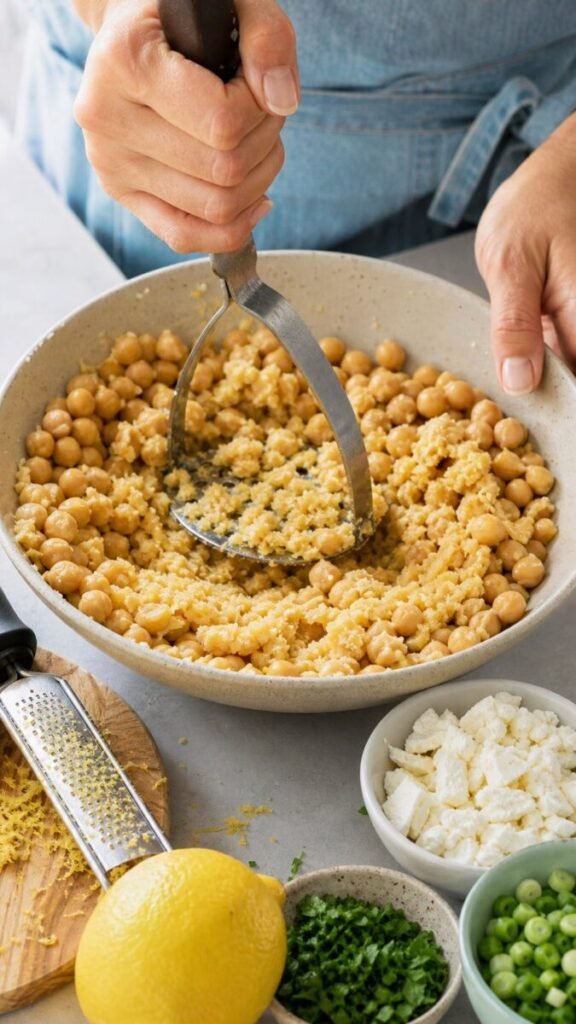
The mandate is simple: mash, never purée, and stop while you can still see what things used to be. A chickpea patty’s interior should be a coarse crumb — think rolled oats and rubble, with a third of the chickpeas left whole — because those intact pieces are what make the patty tender and interesting to bite. The food processor’s blade works so fast and so evenly that it obliterates the structure before you can stop it; even “just a few pulses” over-processes the bottom of the bowl while the top is still chunky. A potato masher takes ninety seconds, gives you perfect control, and leaves a texture you can actually see and steer. You’re not making hummus. You’re making rubble with intentions, and a masher is the right tool for rubble.
Now the binder logic, because this is where this recipe earns its keep. Breadcrumbs are the standard internet binder, and they work — but they work by adding wheat and softness, diluting the very flavor you built the patty around. Chickpea flour is the same legume ground fine, so it binds the mash while making it taste more like chickpeas, not less; it drinks up the lemon juice and egg and turns them into a soft, savory custard as the patties cook; and it toasts nutty in the pan, which is a flavor breadcrumb never contributes. Half a cup binds two cans; a light extra dusting on the outside of each patty gives the crust something to grab. The whole recipe ends up gluten-free by accident, which I mention not as a health claim but as a free bonus, like finding money in a jacket.
The lemon split and the herb trio are the Mediterranean signature. Lemon zest is where the fruit keeps its aromatic oils — the part of lemon that smells like lemon — and those oils live in the mash, infusing the crumb from the inside while the patties fry. Juice in the mash would mostly add water and a sour edge; juice in the sauce, against the yogurt’s fat, reads as bright and clean. Same fruit, two jobs, no waste. And the herbs are a trio on purpose: parsley for green freshness, dill for the anise-y note that loves both chickpeas and yogurt, mint for the cool lift that makes the whole thing taste like it has a sea view. Two of three will do if that’s what the market had — but all three is the version people ask about.
⏱️ 15 MIN + A 30-MIN CHILL | 🍋 10 PATTIES, SERVES 4 | 🥣 SAUCE INCLUDED
- Prep Time: 15 minutes — mash, fold, shape
- Chill Time: 30 minutes, during which you make the sauce
- Cook Time: 10 to 12 minutes, two batches
- Total Time: about 1 hour, half of it the fridge’s problem
- Yield: 10 patties — dinner or lunch for 4, starter for 6
The Sizzle Check
The kit is short, and one piece of it is non-negotiable:
- Large bowl and a potato masher — the mash’s entire workshop. No food processor anywhere in this recipe; the masher is the tool with the mandate.
- Wide skillet, preferably cast iron or heavy nonstick — ten patties fry in two batches, and wide means more patties per batch and more crust per patty
- Thin-edged spatula — for flipping without sawing at the crust
- Wire rack set over a baking sheet — the drain station. This replaces the paper towels, and the reasons are a whole doctrine below.
- ¼-cup measuring cup or ice cream scoop — for patties of identical size, which means identical cooking
- Small whisk and bowl — the sauce’s studio
- Box grater or microplane — one for the zest and garlic; grating garlic to a paste is what makes the sauce smooth instead of sketchy
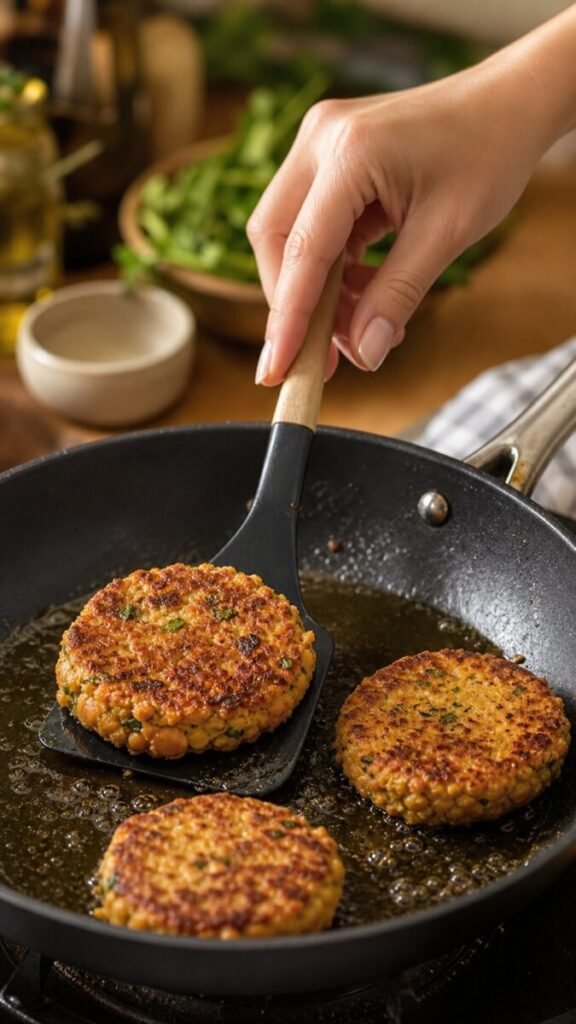
And the sizzle check itself — the thirty-second ritual that decides the whole cook. Heat the pan over medium for a good two minutes, add the olive oil, and give it a minute more until it thins out and shimmers, with the first faint wisp of smoke meaning you’ve gone far enough (olive oil is fine here; “medium” keeps it well under its trouble zone). Then the scout patty goes in alone. It should sizzle immediately — a steady, energetic hiss, not a lazy crackle and not an angry roar. A quiet pan means the oil’s too cool and the patties will drink oil instead of searing; smoking, spitting oil means too hot, and chickpea flour burns faster than breadcrumbs do. Adjust, and only when the scout sizzles right does the rest of the first batch go in. One patty, thirty seconds, and the entire fry is calibrated. That’s the cheapest insurance in cooking.
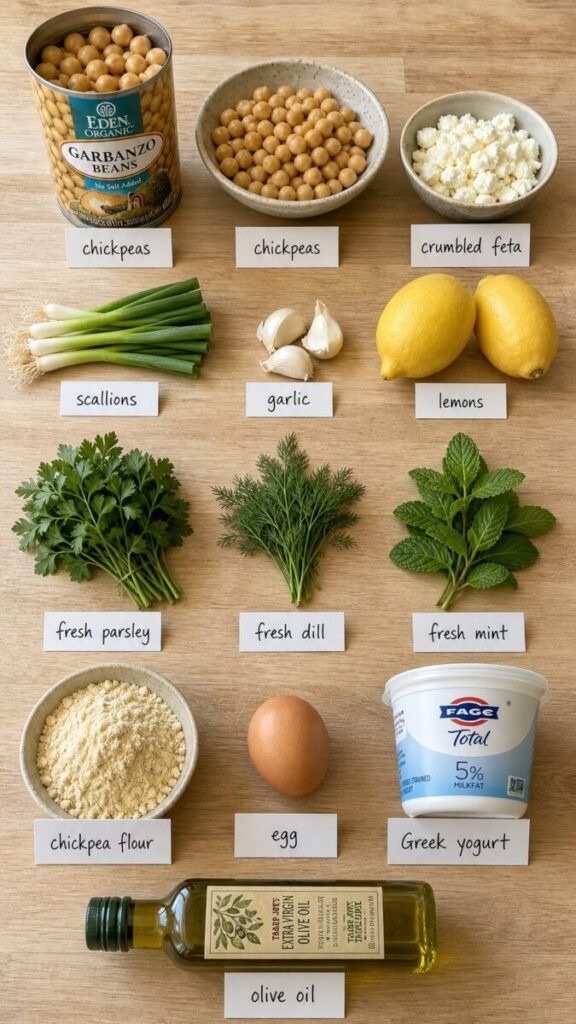
Ingredients (With Labels)
🍋 The Mash
- Chickpeas: 2 cans (15 oz each), drained, rinsed, and towel-dried
- Lemon: 1 large — the zest and 1 tablespoon juice
- Scallions: 2, thinly sliced
- Garlic: 2 cloves, grated
🌿 The Herbs and Cheese
- Fresh parsley: ¼ cup, chopped
- Fresh dill: 2 tablespoons, chopped
- Fresh mint: 1 tablespoon, chopped
- Feta: ½ cup, crumbled
🥣 The Binder
- Chickpea flour: ½ cup, plus a small bowl for dusting
- Egg: 1 large
- Ground coriander: 1 teaspoon
- Ground cumin: ¾ teaspoon
- Salt: ½ teaspoon — the feta brings plenty
- Black pepper: ¼ teaspoon
- Olive oil: about 3 tablespoons, for frying
🥛 The Yogurt Sauce
- Greek yogurt: 1 cup, whole milk
- Lemon juice: 1 tablespoon, from the same lemon if it’s generous
- Garlic: 1 small clove, grated to a paste
- Fresh dill and mint: 1 tablespoon each, chopped
- Olive oil: 1 teaspoon
- Salt: ¼ teaspoon
Step by Step How to Make
- Step 1 — Dry and mash. Drain the chickpeas, rinse them well, and roll them in a clean towel until the towel comes away dry — wet chickpeas make wet mash, and wet mash makes patties that fight you in the pan. Pour them into the big bowl and mash with the potato masher, pressing and turning, until you’re looking at coarse rubble with whole chickpeas scattered through it — stop well before it looks smooth. The target texture is rolled oats with pebbles, not paste with regrets. If a few chickpeas escape the masher entirely, that’s not a flaw; that’s the interior architecture.
- Step 2 — Season the mash. Everything goes into the bowl now: the lemon zest first — rub it in with your fingers for five seconds, which smears the aromatic oils through the mash and is a step I learned from a Greek neighbor and have never skipped since — then the lemon juice, scallions, grated garlic, all the herbs, the crumbled feta, the coriander, cumin, salt, and pepper. Toss with a fork, then add the chickpea flour and the egg and mix with your hands, squeezing the mash through your fingers until it’s one even, willing mixture. The squeeze test: grab a fistful and press it into a ball — it should hold together as a packed lump without cracking apart or weeping liquid. Too crumbly? One more tablespoon of chickpea flour. Too wet? That towel-drying step is what was supposed to prevent this, but a tablespoon of flour walks it back.
- Step 3 — Shape and chill. Scoop the mash in level ¼-cup portions and press each one into a patty about half an inch thick, smoothing the edges with a quick turn of the wrist — cracked edges now become crumbled edges in the pan. Lay them on a plate, dust both sides lightly with the extra chickpea flour, and into the fridge, uncovered, for 30 minutes. This is the chill doctrine, and it’s doing three jobs at once: the flour hydrates and firms, the egg sets the structure, and the flavors — dill, feta, lemon zest — get acquainted. A cold, firm patty hits hot oil and sears; a warm, soft one hits hot oil and panics. The chill is what separates patties that flip in one piece from patties you serve as evidence.
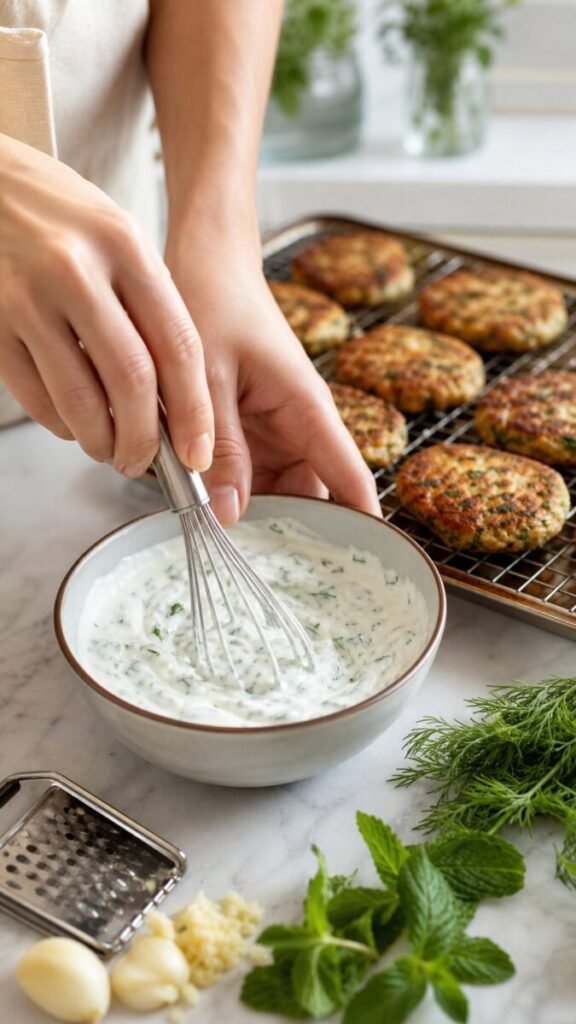
- Step 4 — The sauce, while they chill. In the small bowl, whisk the yogurt with the lemon juice, the garlic grated to an actual paste on the fine side of the grater, the dill, the mint, the teaspoon of olive oil, and the salt. Taste it. It should be tangy, faintly sweet from the mint, and just slightly too salty on its own — it’s about to meet mild patties, and a sauce that tastes perfect alone will disappear on them. Then walk away and let it rest in the fridge for the remaining chill time; grated garlic needs ten minutes to mellow from “sharp” to “present,” and the herbs need time to bleed into the yogurt. The sauce, like the patties, is improved by not being rushed.
- Step 5 — The sizzle. Heat the skillet over medium for two minutes, add two tablespoons of the olive oil, and when it shimmers, run the sizzle check with one scout patty. When the hiss is steady and enthusiastic, add four more patties — five per batch, spaced with an inch between them, because a crowded pan is a steamed pan. Now leave them alone for four full minutes. The crust has to form and set before the flip, and poking at them early is how crusts die. Peek underneath one at the four-minute mark: deep gold means flip, pale means another minute. Flip once, gently, with the thin spatula, and cook three to four minutes on the second side. Move the finished batch to the wire rack, add the last tablespoon of oil to the pan, let it come back to temperature, and fry the second batch the same way. The patties should be handsomely crusted outside and just warm through the middle — there’s nothing raw in them, so you’re frying for crust and heat, not for doneness.
- Step 6 — The plate. The best-case plate is a warm pita brushed with olive oil, a handful of greens or shredded cucumber, two or three patties on top, and the sauce drizzled over everything from a height, with extra on the table because it runs out — it always runs out. Scatter a few extra dill sprigs and a pinch of flaky salt, wedge a lemon on the side, and serve the patties while they’re still crisp, which gives you roughly a ten-minute window of perfect texture. The honest alternative plating is the grain-bowl route — couscous or farro underneath, patties, sauce, herbs — which keeps the crisp longer on a drier base. Either way, eat them warm. A chickpea patty at room temperature is still a good citizen, but a hot one with cold sauce is the whole idea.
Crispy chickpea patties run in the family — the protein-packed crispy chickpea fritters are this recipe’s smoky-spiced cousin, and the two halves of the pair belong on one table.
Anna’s Kitchen Notes
Whole-milk Greek yogurt, and check the thickness. The sauce is three ingredients wearing yogurt as a suit, so the yogurt has to carry it. Greek yogurt should be thick enough to hold a spoon upright for a slow count of three; the thinner, cheaper tubs will give you a sauce that runs off the patty and pools in defeat. If your yogurt runs thin anyway, strain it through a coffee filter or cheesecloth for fifteen minutes and watch it become what the recipe wanted. Whole milk over nonfat here — the fat is what carries the lemon and the garlic, and a fat-free sauce tastes like the idea of sauce.
The feta is doing two jobs. It brings a salty, briny tang to the mash — the same flavor note the yogurt sauce plays from the other side — and its fat keeps the interior tender while the crust crisps. Buy feta in brine if you can and crumble it yourself; the pre-crumbled tubs are coated in anti-caking powder that melts into the mash invisibly but flavorlessly. And if the feta’s a dealbreaker for anyone at the table, leave it out, add a quarter teaspoon of salt, and know that the patties go from Greek-island to merely Mediterranean-market. Still excellent. Just quieter.
Grate the garlic, don’t chop it. A chopped clove in raw yogurt is a series of tiny garlic ambushes — hot one bite, absent the next. Grated on a microplane, the clove becomes a wet paste that dissolves completely into the sauce, distributing evenly and mellowing as it rests. Same rule for the patties themselves. This is a two-minute detail with an all-day payoff, and it is the difference between a sauce people compliment and a sauce people avoid.
The chill is flexible. Thirty minutes is the working minimum, but the shaped patties can sit in the fridge for up to 24 hours, and they’re arguably better for it — the flavors deepen and the structure sets like the mash meant it. This is the make-ahead move for company: shape on Saturday afternoon, whisk the sauce into a jar, and fry on Saturday night in twelve minutes flat. The mash can also be mixed and held a full day before shaping, if your fridge is better at scheduling than your evening is.
Leftovers are lunch, twice over. Cooked patties keep four days in the fridge and reheat beautifully in a dry skillet over medium — three minutes a side, no oil, and the crust comes back to about ninety percent of its first self. The microwave is admitted but not celebrated; it warms the patty and surrenders the crust in the same thirty seconds. Cold leftovers also make an excellent pita sandwich, sauce smeared inside, cucumbers and extra dill, no reheating required — honestly, the day-two pita is my favorite format of the whole recipe, and I plan extras specifically to guarantee it exists.
The Yogurt Counterpart
The sauce is the built-in counterpart, but the plate wants company, and the site has a whole Mediterranean shelf to build from. The Turkish ezme is the raw, chili-bright counterpoint — a spoonful beside these patties is the closest a lunch gets to a full mezze table. And the chickpea feta avocado salad shares the exact flavor genes and adds cool, creamy crunch for days when you don’t want to stand at a stove at all.
To build the full spread: warm pita and the roasted Mediterranean Greek vegetables make it dinner, the lentil quinoa patties are the other half of the patty family for a mixed platter, and the veggie Mediterranean roasted chickpea bowl is this recipe’s grain-bowl sibling — same shelf, different night.
Same Mash, Other Patties
The baked build. Bake at 400°F on an oiled sheet, 12 minutes a side, and you get a patty with about eighty percent of the crust and none of the splatter — a fair trade on a Tuesday. Brush or spray the tops lightly with olive oil before each side, and give the sheet a minute to reheat between batches. Honestly rated: the pan-fried version is the recipe’s best self, and the baked version is its most convenient self, and both get eaten.
The falafel-adjacent route. Swap the scallion for a small grated onion, the parsley-heavy herb mix for cilantro-heavy, double the cumin and coriander, and skip the feta — now the patty leans Middle Eastern, and it wants tahini sauce or a slick of hummus instead of yogurt. Same mash, same chill, same sizzle; a completely different address.
The za’atar crust. Dust the shaped patties in za’atar instead of plain chickpea flour before frying — the sumac in the blend adds a tangy, rusty edge that plays beautifully with the lemon, and the sesame toasts into the crust. This is my favorite one-ingredient upgrade on the whole site, and I include it here because it was practically invented for these patties.
The vegan conversion. Omit the feta and the egg — the chickpea flour binder is strong enough to carry the structure alone with an extra tablespoon or two — and swap the yogurt sauce for the creamy cashew cheese sauce, thinned with lemon juice until it drizzles. The patties lose a little of the feta’s brine, so add a quarter teaspoon of salt to the mash and an extra pinch of coriander. The result is a fully plant-based patty that keeps the crisp, the lemon, and the herbs — which is to say, it keeps the point.
The breakfast amendment. A reheated patty under a soft poached egg, extra sauce thinned with lemon as the “hollandaise,” a few flakes of salt — this is the Saturday-morning second life, and it requires no extra ingredients beyond the egg. I maintain that a chickpea patty is a more reliable hollandaise vehicle than an English muffin, and I will accept correspondence on the matter.
The Patty Math
| Nutrient | Per Serving (2-3 patties + sauce, 1 of 4) |
|---|---|
| Calories | 430 kcal |
| Protein | 19 g |
| Carbohydrates | 34 g |
| Fats | 22 g |
Estimates as written, feta, frying oil, and the full sauce ration included. The protein line is the honest headline — chickpeas, chickpea flour, egg, feta, and Greek yogurt stack up to nineteen grams per serving, which is territory most meat lunches don’t reach, and the fiber rides along at a number usually reserved for cereals that taste like cardboard. The fats come from olive oil, feta, and whole-milk yogurt — the flavorful column of the ledger, every gram pulling its weight. And because the binder is chickpea flour rather than breadcrumbs, the whole plate is gluten-free without a single substitution, which costs nothing and counts double for anyone at the table counting. As a pita sandwich with greens, call it closer to 500 calories — still the best deal at the lunch counter.
The Chilled Patty
Storage runs in two lanes, raw and cooked, and both are worth knowing. Cooked patties keep four days covered in the fridge — reheat in a dry skillet to bring the crust back, or eat them cold in a pita, which is a fully sanctioned format. The sauce keeps a day longer than the patties in its own jar; re-whisk it with a fork before serving, because yogurt sauces settle into stubbornness overnight and want thirty seconds of encouragement.
The raw lane is the freezer’s business. Shape the patties, dust them, freeze them solid on the plate, then stack them between squares of parchment in a freezer bag for up to three months. Fry them straight from frozen — medium heat, an extra minute per side, and the sizzle check matters even more with a cold patty, because a frozen center slows the whole pan down. The chill doctrine, extended indefinitely: a freezer full of these patties is a lunch insurance policy, and the sauce takes ninety seconds to whisk fresh whenever a claim needs filing.
Second careers, briefly: crumble a cold patty over a Greek salad and it becomes a warm-crouton-cold-chickpea situation that shouldn’t work and does; tuck halves into a wrap with the sauce and pickled onion; and any sauce left over after the patties are gone is tomorrow’s best raw-vegetable dip or baked-potato topper, which is less a second career than an encore.
Where It Goes Wrong
Patties fall apart in the pan. Three suspects, in order of frequency: the chill got skipped (warm, soft patties are fragile ones — give them the full thirty minutes), the mash was too wet (the squeeze test in Step 2 exists to catch this before it costs anything), or the flip came before the crust set (four untouched minutes, then check for deep gold). A patty that breaks anyway isn’t ruined — press the pieces back together with the spatula, and the crust will weld them shut in a minute. The patties are forgiving; they just ask for patience in the first four minutes.
Dense, heavy interior. The food processor got invited after all. Puréed chickpea paste fries into a patty with the crumb of a doorstop, and no amount of herbs fixes the texture. The mandate is the mandate: potato masher, coarse rubble, a third of the chickpeas whole. If your mash has gone too far and looks smooth, fold in a handful of whole reserved chickpeas to buy the texture back — but the masher makes this a non-issue in the first place.
Soggy bottoms on the drain. The patties came out crisp and were laid on paper towels, which is a nice soft bed that traps the exiting steam and steams the crust right back off them. The wire rack lets the steam leave from both sides, and it costs nothing. If the rack is genuinely unavailable, paper towels work only if you move the patties to a fresh, dry spot after the first minute — the soaked patch under a resting patty is the exact bath you’re trying to avoid.
Bland patties despite good ingredients. Usually the zest got skipped. Lemon juice alone reads as sour; the zest is the fruit’s actual perfume, and rubbing it into the mash with your fingers is the five-second step that makes the difference between lemon flavor and lemon rumor. The other usual suspect is a shy hand with the salt — the feta carries some, but not all. And taste the mash before shaping: it should be pleasantly seasoned raw (egg and all, a tiny pinch is tradition and safe enough), because it won’t get any more seasoned than it is right now.
Dark crust, cold middle. The heat ran high and the outside finished before the inside warmed. Chickpea flour browns faster than breadcrumbs, so medium — not medium-high — is the setting, and the sizzle check’s steady hiss is the calibration. Scorched anyway? The pan and the oil were too hot from the start; pull the batch, wipe the pan, let the oil cool a minute, and start the next batch at a gentler temperature. Burnt chickpea flour is bitter, and bitterness doesn’t cook out.
Sauce too thin, or garlic too loud. Thin sauce was thin yogurt — strain it next time, or whisk in a spoonful of Greek yogurt now to pull it back. Loud garlic was chopped garlic — grated to a paste and given ten minutes to rest, the clove mellows into the sauce instead of ambushing it. Both fixes are retroactive and both lessons are permanent, and the sauce will be perfect by the second batch you ever make.
Chickpea Questions
Can I use dried chickpeas instead of canned?
Yes, and they’re arguably better — a cup of dried chickpeas, soaked overnight and simmered until tender, yields about three cups, and the texture mashes into a slightly sturdier crumb than canned. Let them cool and dry them thoroughly before mashing. But canned is what the recipe was tested on and what the timeline assumes, and there’s no shame in a can: rinsed well and towel-dried, they make an excellent patty, and the pantry is where they live anyway.
Why chickpea flour instead of breadcrumbs?
Because it binds while making the patties taste more like themselves — the same legume, ground fine, reinforcing the chickpea instead of diluting it with wheat. It also drinks the egg and lemon juice into a soft custard as the patties cook, it toasts nutty in the pan, and it keeps the entire recipe gluten-free for free. Breadcrumbs work in a pinch, but they’re the binder of a lesser patty, and now you know why.
Can I bake these instead of frying?
Yes — 400°F, oiled sheet, twelve minutes a side, and a light brush of olive oil on each side before it goes in. The crust lands at about eighty percent of the pan-fried version, with zero splatter and zero supervision, which is exactly the trade a weeknight wants. The full comparison is in the baked build variation, honestly rated.
Can I make the mash ahead of time?
Up to 24 hours, and it improves — the dill and lemon zest deepen, the flour fully hydrates, and the patties shape and fry better for the rest. Keep the mash covered in the fridge and shape straight from cold. The sauce also keeps three days in its jar and wants a thirty-second re-whisk before serving. This is a recipe that likes being made ahead, which is my favorite kind of recipe.
Why did my patties fall apart?
Almost always one of the three: no chill, wet mash, or an early flip — the full diagnosis is in the mistakes section, with fixes for each. The short version: the thirty-minute chill sets the structure, the squeeze test catches a wet mash before it costs anything, and the crust needs four undisturbed minutes before it can hold the patty together through the flip. Do those three things and falling apart stops being a thing that happens.
Is the sauce basically tzatziki?
Close cousin, no cucumber. Tzatziki’s soul is the grated, salted, squeezed cucumber; this sauce spends the same budget on dill and mint instead, which makes it more herbaceous and better matched to the feta in the patties. If you want the tzatziki version, grate half a cucumber, salt it, squeeze it dry after ten minutes, and fold it in — you’ll get a cooler, crunchier sauce, and the patties will not object.
Can I freeze the patties?
Both raw and cooked, and raw is the better lane. Shape and dust them, freeze solid on the plate, then stack between parchment squares in a bag for three months; fry from frozen at medium with an extra minute per side. Cooked patties freeze well too but lose a little more crust on the reheat. Either way, whisk the sauce fresh — it’s ninety seconds, and yogurt sauces freeze about as well as jokes.
Hand-mashed chickpeas · Lemon & feta · Cool herb sauce
Mediterranean Lemon Chickpea Patties with Yogurt Sauce
Golden pan-fried chickpea patties with fresh lemon zest, crumbled feta, parsley, dill, and mint. Chickpea flour and egg bind the coarse mash, while a cool lemon-garlic yogurt sauce completes the plate.
As an Amazon Associate I earn from qualifying purchases.
Ingredients
The chickpea mash
- 2 cans (15 oz each) chickpeas, drained, rinsed, and thoroughly towel-dried
- Finely grated zest of 1 large lemon, plus 1 tablespoon juice
- 2 scallions, thinly sliced
- 2 cloves garlic, finely grated
Herbs & feta
- ¼ cup chopped fresh parsley
- 2 tablespoons chopped fresh dill
- 1 tablespoon chopped fresh mint
- ½ cup crumbled feta, drained if packed in brine
Binder, seasoning & frying
- ½ cup chickpea flour, plus a little extra for light dusting
- 1 large egg
- 1 teaspoon ground coriander
- ¾ teaspoon ground cumin
- ½ teaspoon fine salt, or less if the feta is very salty
- ¼ teaspoon black pepper
- About 3 tablespoons olive oil, for frying, divided
The dill-mint yogurt sauce
- 1 cup plain whole-milk Greek yogurt
- 1 tablespoon fresh lemon juice
- 1 small garlic clove, finely grated
- 1 tablespoon chopped fresh dill
- 1 tablespoon chopped fresh mint
- 1 teaspoon olive oil
- Up to ¼ teaspoon fine salt, to taste
The patty kit
- Large mixing bowl and potato masher
- Wide, heavy skillet
- Thin-edged spatula, suitable for your pan’s surface
- Wire rack set over a baking sheet
- Small bowl and whisk
- Fine grater, for lemon zest and garlic
- Measuring cups and spoons
- Clean kitchen towel, for drying chickpeas
- Cutting board and knife
- Covered tray, for chilling the shaped patties
- Instant-read food thermometer
Two batches take longer than one: at about 7–9 minutes per batch, allow 16–20 minutes including turning and bringing the pan back to temperature. A smaller skillet may require three batches.
Divide the full mixture into 10: a fixed ¼-cup scoop may produce more than 10 patties with these quantities. Portion the mixture evenly, then flatten each portion to about ½ inch thick.
Raw ingredients need cooking: the canned chickpeas are cooked, but the egg and chickpea flour are not. Do not taste the raw mixture or serve patties that are merely warm in the middle.
How to make them
-
Dry and coarsely mash the chickpeas
Drain and rinse the chickpeas, then dry them thoroughly in a clean towel. Transfer to the mixing bowl and mash by hand until most are crushed but small pieces remain. Aim for a cohesive, coarse mash rather than a smooth purée or a bowl with many whole chickpeas.
-
Mix in the flavorings and binder
Add the lemon zest, 1 tablespoon lemon juice, scallions, garlic, parsley, dill, mint, feta, coriander, cumin, salt, and pepper. Mix evenly. Taste for seasoning now, before adding the egg or flour. Stir in the chickpea flour and egg, then let the mixture stand for about 5 minutes so the flour begins to hydrate. It should hold together when firmly pressed.
-
Adjust, shape, and chill
If the mixture is wet and sticky, mix in a little extra chickpea flour, 1 tablespoon at a time. If it is dry and crumbly, mash a little more of the chickpea mixture and, if necessary, add water 1 teaspoon at a time rather than more dry flour. Divide into 10 equal portions and press into patties about ½ inch thick, smoothing the edges. Dust lightly with flour and arrange on a tray. Cover and refrigerate for 30 minutes. Chilling firms the mixture; the egg sets during cooking, not in the refrigerator.
-
Whisk and chill the yogurt sauce
While the patties chill, whisk together the Greek yogurt, 1 tablespoon lemon juice, grated garlic, dill, mint, and 1 teaspoon olive oil. Add salt gradually to taste. Cover and refrigerate until serving so the sauce stays cool while the patties cook.
-
Pan-fry in uncrowded batches
Heat a wide skillet over medium heat, following the pan manufacturer’s guidance, and add 2 tablespoons olive oil. The oil should shimmer but not smoke. Add one patty to check for a steady sizzle, then add enough patties to leave space between them. Cook undisturbed for about 4 minutes, until the underside is golden and releases readily. Flip gently and cook for another 3–4 minutes, or longer as needed, until the center reaches at least 160°F and the interior is set. Insert the thermometer from the side into the center. Reduce the heat if the crust browns before the middle cooks.
-
Drain on a rack and serve with sauce
Transfer the cooked patties to the wire rack without stacking. Add the remaining tablespoon of oil to the skillet as needed, let it return to cooking temperature, and cook the second batch the same way. Keep uncooked patties refrigerated while they wait. Serve the patties warm with the chilled yogurt sauce alongside or spooned over them just before eating.
Cook safely, even from cold: golden crust does not guarantee a cooked center. These timings are for chilled, not frozen, patties. For frozen uncooked patties, thaw in the refrigerator before following this method rather than relying on an extra minute per side.
Allergens & dietary checks: contains egg and milk. For gluten-free needs, use chickpea flour and other packaged ingredients labeled appropriately and avoid wheat-based accompaniments. For vegetarian guests, choose feta made with vegetarian enzymes. Refrigerate patties and sauce within 2 hours, or 1 hour above 90°F, and reheat cooked leftover patties to 165°F.