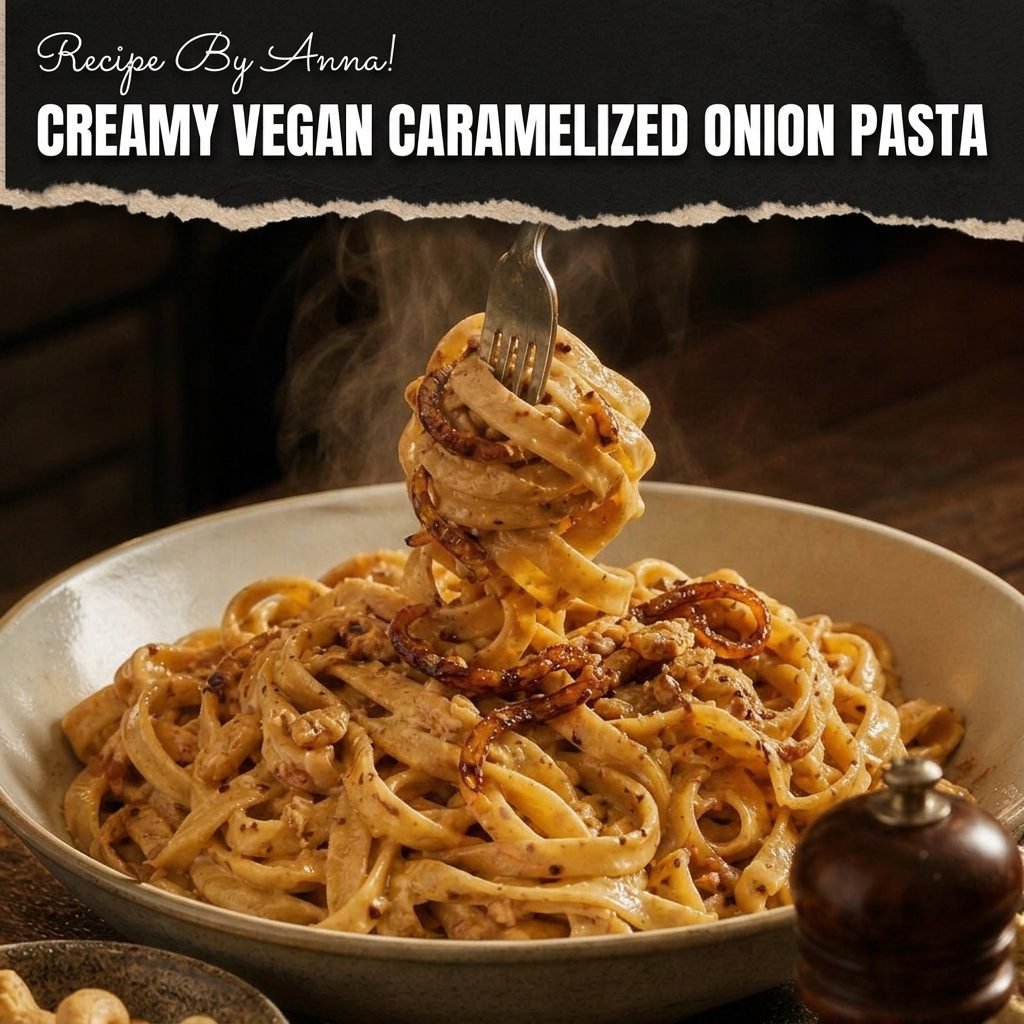
Easy Creamy Vegan Caramelized Onion Pasta Recipe
This is the pasta I make when I want comfort food that happens to be vegan, instead of vegan food that’s trying to be comfort. Four large onions go into a wide pan with olive oil and nothing else but time, and over the better part of an hour they collapse into a jammy, mahogany-sweet mass that tastes like someone explained the concept of deliciousness to a vegetable. That jam gets folded through a sauce of blended raw cashews — the cream that isn’t cream — with a spoonful of nutritional yeast, a shot of balsamic, and a ladle of the cloudy, starchy water the pasta cooked in. The noodles finish cooking in the sauce itself, drinking it up through their ridges, and the bowl you sit down to is glossy, savory, faintly sweet, and entirely plant-based without ever once mentioning it.
Let’s clear up the onion business first, because it’s the heart of the recipe and the internet is lying to you about it. You will find caramelized onion pasta recipes that say “caramelize the onions in 20 to 25 minutes.” Those onions are not caramelized — they’re sautéed, browned at the edges, and pleasant, the way a sunburn is a tan’s ambitious cousin. True caramelization is a transformation, not a color: the onion’s own sugars — and two and a half pounds of onions carry more sugar than a can of cola, a fact I find delightful — need low, patient heat and repeated chances to concentrate, while the cell walls soften and the water leaves a tablespoon at a time. That takes fifty minutes to an hour, and there is no honest shortcut, only faster imitations. The good news is that the time is almost entirely unattended: five minutes of stirring every little while, and in between you’re free to make the cream, cook the pasta when the moment comes, and enjoy the fact that your house smells like the inside of a bistro.
The cream, meanwhile, deserves its own introduction, because “creamy vegan pasta” is a phrase that has disappointed a lot of people. Cashew cream is the answer that actually works, and the reason is chemistry: a raw cashew is roughly forty-four percent fat, with starch and protein alongside, and once it’s soaked soft and blended at speed, it shears into a stable emulsion that behaves like dairy cream — thick, smooth, clingy — with one genuine advantage, which is that it cannot curdle. Dairy cream, hit with acid and heat, can break into grains; cashew cream has no casein to curdle, so you can boil it, lime it, simmer it overnight, and it stays silk. In this sauce it meets the pasta water — which is not an afterthought but the sauce’s skeleton, its dissolved starch knitting the cream and the oil into something that coats noodles instead of pooling beneath them — plus the nutritional yeast’s glutamates for the savory depth cheese would normally bring, and a spoonful of white miso if you keep it around, for the same reason. One hour, one pan plus one pot, and a dinner that makes nobody at the table feel like they settled.
The Onion Arithmetic
The arithmetic first, because it explains the whole recipe: two and a half pounds of onions — four large ones — cook down to about a cup and a third of jam, and the loss is all water. An onion is close to ninety percent water by weight; what remains after the pan has had its hour is concentrated sugar, softened fiber, and the browned compounds that carry all the flavor. That concentration is why the recipe insists on four onions for a single pound of pasta, a ratio that looks absurd at the cutting board, when the pan is so full of raw slices you can barely find the bottom. Trust the arithmetic. The pan that looks overfull at minute zero looks half-empty at minute twenty and exactly right at minute fifty, and the finished sauce needs that full cup and a third of jam to taste like caramelized onion rather than pasta with a rumor of it.
The mechanism deserves its own paragraph, because it’s the difference between the color roadmap and the flavor roadmap, and they’re not the same map. Onions brown through two separate reactions running side by side: caramelization proper — the sugars themselves browning, which needs the water mostly gone first — and the Maillard reaction, where sugars and proteins team up into hundreds of new flavor compounds, the same reaction that browns bread crust and sears steak. Both want heat, but only in doses a thick mass of watery slices can absorb slowly. Crank the heat to rush it and the sugars at the pan’s bottom pass straight through brown into black, and burnt onion is not a strong flavor, it’s a bitter one, and it poisons the whole pan. So the doctrine is low heat, a heavy pan, patience, and the deglaze: every time a brown film builds on the bottom — that film is fond, concentrated flavor — you splash in a quarter cup of water and scrape it up, returning the brown to the onions where it belongs. Five or six deglazes over the hour, and the onions carry all their own browned flavor instead of donating it to the pan.
The cream side of the recipe has its own three-piece science, and none of it is optional. The cashew cream is the body: soaked raw cashews blended with fresh water until genuinely smooth, which takes longer than you expect and matters more than any other texture decision in the dish. The pasta water is the skeleton: noodles boiled in aggressively salted water shed surface starch into it, and that starch is what lets a fat-based cream emulsify with the water-based everything else and cling — it’s the same physics that makes cacio e pepe work, and the same reason a splash of plain tap water does nothing. And the nutritional yeast is the umami bridge: its free glutamates hit the same savory receptors that aged cheese does, which is why a vegan sauce without it tastes like it’s missing something it can’t name. Add the miso for the same reason, doubled: salt plus glutamate plus a fermented depth that makes the finished bowl taste like it simmered longer than it did.
⏱️ 1 HR, MOSTLY THE ONIONS | 🧅 SERVES 4 | 🌱 FULLY VEGAN, FULLY CREAMY
- Prep Time: 15 minutes — slicing onions, measuring, soaking cashews
- Cook Time: 45 to 55 minutes for the onions, 10 more for everything else
- Total Time: about 1 hour, most of it hands-off
- Yield: 4 generous dinner bowls
The Slow Pan
The kit list is short, and the pan is the whole headline:
- A wide, heavy pan — 12 inches, cast iron or clad stainless — the single most important piece. Wide gives the water somewhere to leave; heavy holds heat evenly so no hotspot scorches a corner while the middle sulks. A thin pan makes this recipe harder in every direction.
- Large pot for the pasta — generously salted water is half the seasoning of the finished dish
- Blender — high-speed if you have it, regular if you don’t — the cream’s smoothness is worth the soak-time adjustments in the notes
- Wooden spatula with a flat edge — for the stirring and the deglaze scraping; a rounded spoon just polishes the fond instead of lifting it
- Liquid measuring cup or a mug — for the deglaze water, kept beside the stove so a splash takes three seconds
- A 2-cup measure or heatproof cup — to reserve the pasta water before draining; this is the step the colander has ruined for generations
- Tongs — for marrying the pasta into the sauce, which is a motion more than a stir
And the pasta ruling, since the pot is here too: rigatoni is the shape this sauce was built for. The ridges grip cream the way corduroy grips dust, the tubes fill with jam and hold it like tiny edible filing cabinets, and the thick walls stand up to finishing in the sauce without going soft. Linguine is the runner-up — a flat noodle for a slick sauce, and it twirls beautifully — and any short tubular shape works on the rigatoni principle. What I’d skip is delicate pasta: thin angel hair cooks out its structure before the sauce can cling, and the bowl goes from elegant to mush in the time it takes to notice.
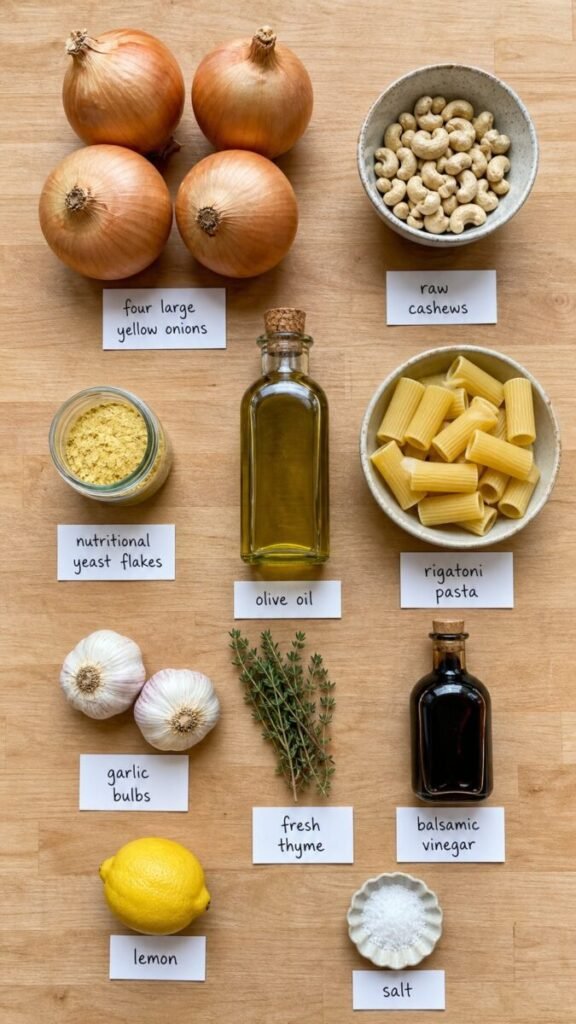
Ingredients (With Labels)
🧅 The Jam
- Yellow onions: 4 large, about 2½ lbs
- Olive oil: 3 tablespoons
- Salt: ¾ teaspoon, plus more for the pasta water
🥛 The Cream
- Raw cashews: ¾ cup, soaked
- Fresh water: ¾ cup, for blending
- Nutritional yeast: 2 tablespoons
- White miso: 1 teaspoon, optional but excellent
- Lemon juice: 1 tablespoon
🍝 The Pasta and the Finish
- Rigatoni: 1 lb — or linguine
- Garlic: 4 cloves, minced
- Fresh thyme: 1 teaspoon, chopped — plus leaves for the bowls
- Balsamic vinegar: 1 tablespoon
- Black pepper: freshly and generously ground
- Pasta water: 1½ cups reserved — see the colander warning above
Step by Step How to Make
- Step 1 — Soak and slice. Cover the cashews with boiling water and set them aside — thirty minutes of soaking is the minimum, and they’ll sit happily while the onions do their hour. Halve the onions pole to pole and slice them into thin half-moons, following the onion’s own longitude so the slices hold together as arcs instead of dissolving into dice. Uniformity matters more than thinness here: a mixed pan of thick and thin slices means the thin ones are jam while the thick ones are still straw. Four onions will overfill the pan; that’s correct and temporary. Add the oil to the wide pan over medium heat, then the onions and the salt — the salt early, because it draws water out fast, and water leaving early is the whole agenda.
- Step 2 — The hour. Stir the onions every five minutes or so — set a timer if you’re the wandering kind, and no shame, I am too. For the first ten minutes, over medium heat, they’ll hiss and soften and shed a shocking amount of liquid. When the bubbling slows and the pan starts to go quiet, drop the heat to low: from here on, the roadmap is pale → translucent → straw → amber → deep brown, and you’re driving slowly on purpose. Each time a brown film builds on the pan’s floor, splash in a quarter cup of water and scrape it up with the flat spatula — the film is concentrated flavor trying to escape, and the deglaze is you refusing to let it. Somewhere around minute forty-five you’ll have a pan of glossy, mahogany jam, deeply sweet, no burnt smell, about a cup and a third of it. If it smells sharp or bitter at any point, the heat is too high — lower it immediately and add a splash of water; you’ll lose a little depth but save the batch.
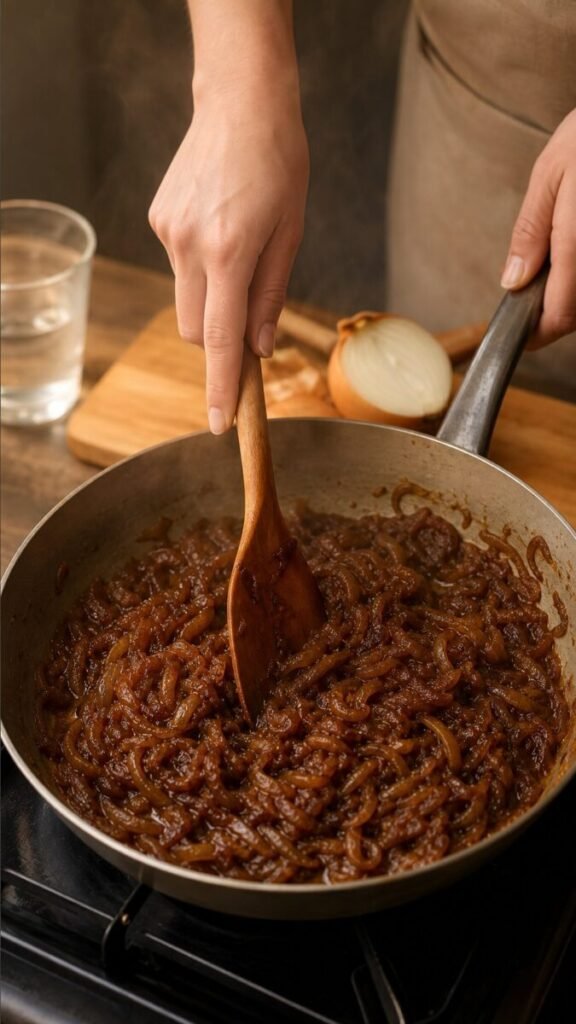
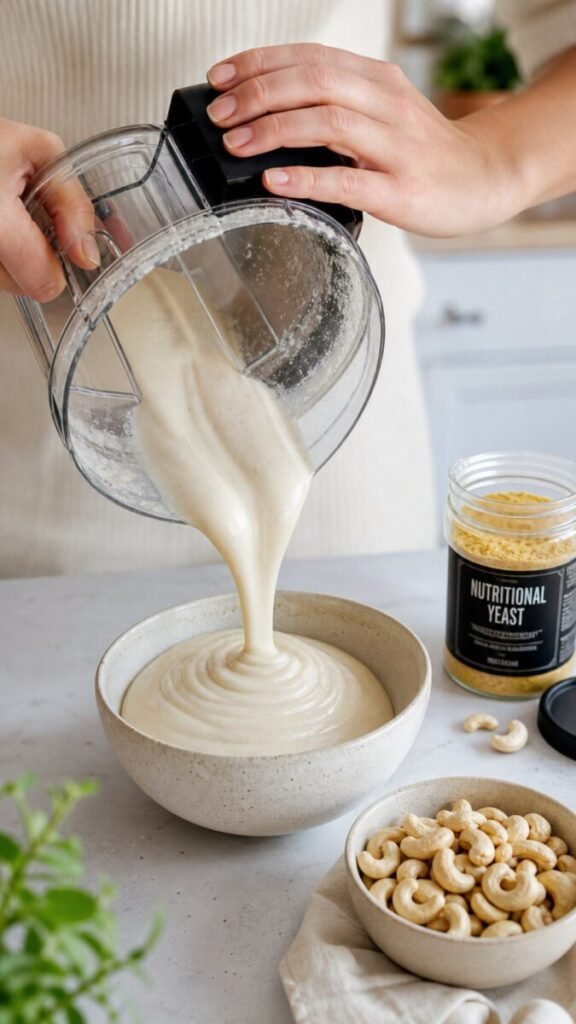
- Step 3 — Blend the cream. While the onions work, drain the soaked cashews and blend them with the fresh water, the nutritional yeast, the miso, and the lemon juice. Blend longer than seems necessary — a full minute in a high-speed blender, two to three in a regular one, stopping to scrape down once or twice — because the difference between silky and grainy is purely a matter of blending time, and the smoothness test is the back of a spoon: the cream should coat it with no sandpaper speckle anywhere, just a smooth, pourable ivory. Too thick to pour? Add water a tablespoon at a time. It should be the texture of the cream you’d pour into coffee, not the cream you’d whip.
- Step 4 — The pasta, on the onion’s clock. Start the pasta when the onions are about ten minutes from done — the timing dance is tight on purpose, because the noodles want to meet the sauce while both are hot. Salt the boiling water until it tastes like a good soup, drop in the rigatoni, and cook it two minutes shy of the box’s al dente. Before draining, reserve a cup and a half of the cloudy water — cloudy is the point; that haze is starch, the sauce’s skeleton, and clear water means the pasta hasn’t given anything yet. Drain the pasta and keep it close.
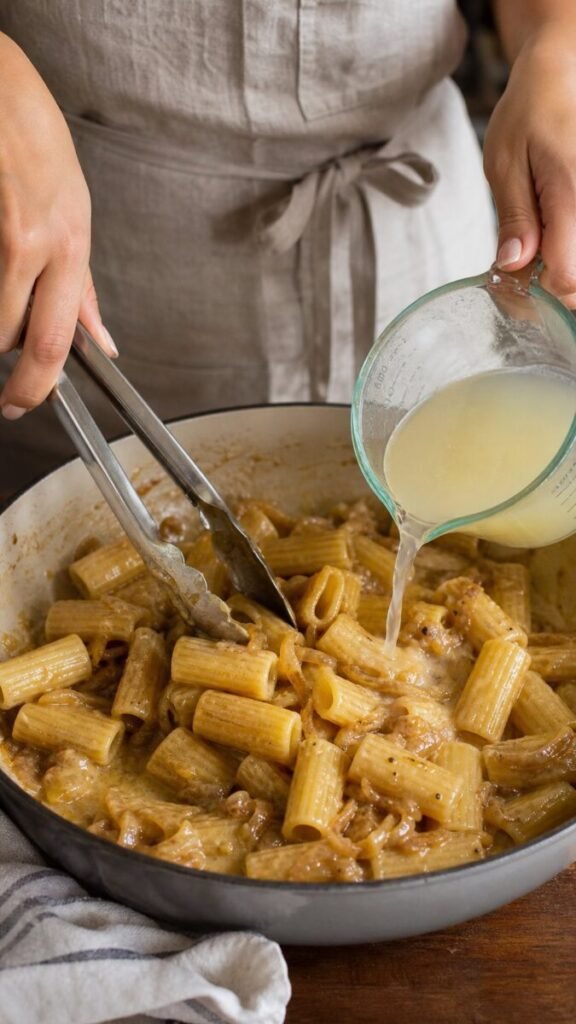
- Step 5 — The marry. With the jam finished, push the heat back to medium, add the garlic and thyme to the pan, and stir for one minute, until fragrant — the garlic goes in now and not sooner because forty minutes of low heat would have turned it sweet and lost, and it wants only a brief, brilliant appearance. Pour in the cashew cream and a half cup of the pasta water, and stir as they merge into a glossy, pale-caramel sauce that simmers gently. Now the tongs: add the rigatoni and toss it through the sauce for a full two minutes, letting it finish its last two minutes of cooking inside the sauce itself, absorbing flavor while its own surface starch thickens what clings to it. Add more pasta water, a splash at a time, whenever the sauce tightens — it should move like slow lava and coat every ridge. Off the heat, stir in the balsamic and a serious grind of black pepper, and taste: it should be sweet, savory, faintly tangy, and just barely short of salty enough, because the next ingredient is coming.
- Step 6 — The bowls. Serve it immediately — this is a fifteen-minute window dish, at its glossy best the moment the pasta and the sauce are the same temperature. Twirl or pile into shallow bowls, scatter a few extra thyme leaves, add another grind of pepper and a pinch of flaky salt, and if you keep a vegan parmesan or an extra spoon of nutritional yeast, now is its moment. Eat it while it’s hot enough that you have to be careful, which is the correct temperature for cream-of-anything pasta, and note the quiet triumph: nobody at the table is thinking about what isn’t in this bowl. That’s the review that matters.
The same onions, a different pot — the caramelized onion red lentil soup is this pasta’s Tuesday sibling, and the two should always be made in the same week.
Anna’s Kitchen Notes
Never add sugar to caramelizing onions. Recipes that call for a teaspoon of sugar are compensating for impatience — the onion already carries several grams of its own, and the slow pan is patient enough to claim all of it. Added sugar browns fast and flat, and it can push the onions from amber to burnt before their own sweetness has concentrated. If your onions taste mild at the end rather than sweet, they needed ten more minutes, not a spoonful of anything. Time is the only sweetener this recipe uses.
Make double the jam. Always. The onions are the long step, and they scale for free: eight onions in the same pan take maybe fifteen minutes longer, and the extra jam keeps two weeks in the fridge and three months in the freezer. I freeze mine in an ice-cube tray — caramelized onion cubes, one per future omelet, burger, tart, soup, or Tuesday slice of toast — and I consider that tray one of the more valuable objects in my kitchen. The pasta recipe uses the cup and a third; the future uses the rest.
Blend longer than you want to. Grainy cashew cream is almost always an under-blended cream, not an under-soaked nut. A high-speed blender makes silk in a minute; a regular blender needs two to three minutes and a scrape-down, and the patience is repaid in every bite. If your blender is modest, soak the cashews in boiling water for a full hour, or simmer them for fifteen minutes, and the softest possible nut blends smoothest. There’s a strainer fallback — push the blended cream through a fine mesh — but it’s a chore, and the extra minute at the machine is cheaper.
Reserve more pasta water than you believe you need. The recipe says a cup and a half, and I want you to pour two, because the sauce drinks it fast and the leftovers are the difference between a glossy reheated bowl tomorrow and a dry, clumping apology. The classic mistake happens at the sink: pasta drains, the water goes down, and the sauce — any sauce, every sauce — is suddenly a stranger to its own noodles. The cup goes in the mug before the colander comes out. Every time. No exceptions, and I say this as someone who has fished a measuring cup back out of a draining pot with my bare hands and learned.
The miso is small and mighty. One teaspoon of white miso disappears into the cream — you will not taste miso, you will taste depth, the same way a splash of fish sauce disappears into a stew and leaves only “why is this so good.” It’s fermented glutamate plus salt, and it does exactly what the aged cheese would have done here. No miso? An extra tablespoon of nutritional yeast and a pinch more salt covers most of the gap. The dish works without it and works noticeably better with it, which is my favorite kind of ingredient.
The Weeknight Table
This bowl wants something green and something crisp alongside, and the site’s shelves have both. The roasted Mediterranean Greek vegetables are the charred, lemony counterweight to all that cream — same oven freedom, and the two plates together cover every texture a dinner needs.
To fill the table out: the vegan no-yeast naan is the bread that was born to wipe this bowl clean, the creamy cashew cheese sauce is this cream’s saucier sibling for anyone who wants the technique twice, and the caramelized onion Gruyère tart is the onion family’s dairy branch — make it for the table’s vegetarians and this pasta for the vegans, and everyone eats from the same pantry. For the omnivores’ night off, the one-pot creamy salmon pasta is the other creamy pasta on the shelf, and the two recipes quietly teach each other’s tricks.
Same Pan, Other Pastas
The mushroom amendment. A half pound of cremini, browned hard in a second pan while the onions dawdle, folded in at the marry — the earthy depth doubles down on the umami, and the dish goes from bistro to woodland. Brown them properly, in batches, because wet gray mushrooms added to slow onions is a waste of two good ingredients.
The French-onion route. Double the thyme, swap the balsamic for sherry vinegar, finish each bowl under a blanket of extra nutritional yeast and a slice of toasted baguette — now it’s vegan French onion soup’s pasta phase, and it is unreasonably good. This is the version I make when the weather turns genuinely hostile.
Spinach and white beans. A can of cannellini, rinsed and stirred in at the end for warmth, and two big handfuls of spinach wilted in the final toss — the bowl gains protein, iron, and a color break, and becomes lunch-for-a-week. The beans are mild enough to ride along; the onions do the talking.
Walnut and sage, the autumn build. A handful of toasted walnuts, chopped coarse, and eight sage leaves crisped in olive oil for one minute, both scattered over the bowls at the end. The sage oil drizzled over the cream is the kind of detail that costs four minutes and makes people think you catered.
The 35-minute honest version. Slice the onions thinner — paper-thin on a mandoline if you have one — use the widest pan you own, and stand there stirring more often. The jam lands at maybe eighty percent of the slow version’s depth in a bit more than half the time, and I’d rather you make that than not make this at all. What I won’t do is call it caramelized without an asterisk, and neither should the recipe card. It’s very good browned-onion pasta. The slow one is the true one.
The gluten-free note. The sauce is already gluten-free, so the only swap is the noodle itself — a good GF rigatoni holds up to finishing in the sauce, and nobody at the table will be able to tell the difference through all that cream. Check the pasta water’s salt before you commit it to the sauce; GF pasta sometimes seasons it differently.
The Onion Ledger
| Nutrient | Per Serving (1 of 4) |
|---|---|
| Calories | 640 kcal |
| Protein | 18 g |
| Carbohydrates | 88 g |
| Fats | 24 g |
Estimates as written, pasta, cream, oil, and jam included, and honest about what they are: this is a full dinner bowl, and the calories sit exactly where a creamy pasta’s should. The interesting lines are the quiet ones. Eighteen grams of plant protein — the cashews and the pasta splitting the work — is genuinely substantial for a vegan dinner with no tofu or tempeh in sight, and the fat comes from olive oil and cashews, the two fats the Mediterranean crowd has been vouching for since before it was a diet. The fiber is where the onions earn their keep: what started as a mountain of alliums doesn’t vanish in the pan, it concentrates, and each bowl carries a real serving of it. For lighter numbers, the spinach-and-white-bean variation doesn’t so much lighten as fortify — same sauce, more of everything good — and the honest portioning trick is the same as any cream pasta’s: serve it in the bowl you’d use for soup, not the one you’d use for a lake.
The Make-Ahead Pan
The make-ahead story is really the onion’s story, because everything else in this recipe is fast. The jam keeps two weeks in the fridge and three months in the freezer, and a bowl of this pasta can be fifteen minutes from idea to table if the jam is already made — warm the jam, blend the cream, boil the noodles, marry. That makes the onion hour a weekend investment with weeknight dividends, and the double-batch note above is the whole strategy. The cream keeps five days in its jar in the fridge and wants a brisk re-whisk before it meets the pan, because it settles into stubbornness like every good emulsion does.
Assembled leftovers keep four days, covered, and reheat better than any dairy cream pasta has a right to — that no-casein advantage pays out here, since there’s nothing to curdle no matter how carelessly you reheat. The method still matters: a skillet over medium-low with a splash of water and a lid, stirred once or twice, brings the sauce back to slow-lava gloss; the microwave at half power works for single bowls with the same splash of water. The pasta drinks the sauce overnight, so day-two bowls are thicker — looser with water, not cream, and it re-balances in one minute.
Second careers, briefly: the leftover sauce thinned with pasta water and a squeeze of lemon becomes a dressing for roasted vegetables or a spread for toast — a vegan onion-garlic cream with opinions; the jam itself has a life beyond this dish that would fill its own post (burgers, galettes, eggs, the ice-cube tray knows); and any reserved pasta water, should some survive, is tomorrow’s soup stock with a head start. A recipe whose components all have second jobs is a recipe that respects a grocery budget.
Where It Goes Wrong
Burnt onions, bitter pan. The heat crept up, or the pan went unstirred too long, and sugar crossed from brown to black. Burnt onion is unrecoverable and contagious — even a few black strands bitter the whole jam — so at the first sharp, acrid smell, act: lower the heat, add a splash of water, and assess. If it’s only the pan’s film that’s dark, a careful deglaze may save it; if the onions themselves went black, start over and count it as tuition. Low heat and the five-minute stir are cheaper than onions.
Onions that never brown. The heat was too low from the start, or the lid stayed on, or the pan was crowded past the point of evaporation — the slices swim in their own juice and turn soft and gray, a nice topping for a burger and a failure as a jam. The fix is patience with the lid off and the heat at a true low-medium: you want gentle, steady bubbling, not silence. And if forty minutes in they’re still pale, raise the heat one notch and stay closer; the roadmap tolerates a late push better than an early flood.
Sauce that pools instead of clinging. The pasta water got skipped or shorted, or the noodles went into the sauce fully cooked instead of two minutes shy. The starch transaction is the whole physics of the cling: the water emulsifies the cream, and the underdone noodle finishes by absorbing sauce into its surface. Reserve the full cup and a half, marry the pasta while everything is hot, and loosen with water rather than tightening with cream — the sauce should chase the noodle, not the other way around.
Grainy, gritty cream. The cashews were under-soaked or the blender quit early, and the sauce carries sand instead of silk. Blend longer — a full minute past the point it looks done — and soak in boiling water, not tepid, if the clock is short. A fine-mesh straining is the last resort and it does work. The smoothness test exists because your tongue will find every shortcut your eyes forgave.
A bland beige bowl. The salt missed the onions, the pasta water was under-salted, the nutritional yeast was shy, or the balsamic got skipped — cream of any kind muffles flavor, and this sauce needs each of its seasoners doing its job. Salt the onions at the start, salt the pasta water like the sea, keep the full two tablespoons of yeast, and never skip the vinegar: one tablespoon of acid is what makes the sweet taste sweet instead of flat. Taste at the end and adjust with salt first, vinegar second, and patience always.
Mush by the second bowl. The pasta cooked to the box’s number before it met the sauce, and finishing it added four invisible minutes. Cook two minutes shy — the sauce’s simmer is the last two minutes — and serve in the fifteen-minute window while noodle and sauce are the same temperature. This dish does not hold on a warm stove for late eaters; plate theirs, accept the slight softening, and know that the microwave revival with a splash of water is what day-two is for.
Onion Questions
Can I make this without cashews?
Yes, with expectations. Sunflower seeds make the closest cream — same method, same soak, slightly earthier — and sunflower seed butter whisked with water is the fast version. Silken tofu blended in gives a lighter, Japanese-leaning cream that’s lovely but won’t cling the way cashew does. Coconut milk works and brings coconut, which is a flavor decision you should make on purpose. Full instructions and honest ratings for each are in the cream notes of the sister recipe linked above; the rest of this dish doesn’t change.
Why do the onions take a full hour?
Because caramelization is evaporation plus browning, and an onion is ninety percent water that only leaves a tablespoon at a time over gentle heat. The recipes promising twenty-minute caramelized onions are browning the outside and calling it a transformation. You can shave the time — thinner slices, a wider pan, the 35-minute honest version in the variations — but below that, you’re making a different, still-tasty dish, and the label should say so. The hour is mostly unattended, and the kitchen smells like a bistro the entire time, which I consider part of the yield.
Can I caramelize the onions in the oven?
Yes — the hands-off route. Toss the sliced onions with the oil and salt, spread them in a covered roasting pan or Dutch oven, and hold them at 400°F for about an hour, stirring twice. The color lands a shade lighter than the stovetop version and the flavor a touch softer, but it’s genuinely passive, it can’t burn while you’re elsewhere, and for a double batch it’s arguably the better method. The recipe proper stays stovetop because the fond-and-deglaze flavor is deeper, and now you have both tools.
Do I really need a high-speed blender?
No — you need time, which is cheaper. A regular blender makes fully smooth cashew cream if you soak the nuts in boiling water for a full hour (or simmer them fifteen minutes) and blend two to three minutes with a scrape-down. The high-speed machine just does it in sixty seconds. The one tool that genuinely doesn’t work is a food processor, whose blade spins too slowly to shear the nuts into silk — you’ll get paste, not cream, and the sauce will taste like it.
Is nutritional yeast actually necessary?
It’s doing the job the cheese would have done — free glutamates, savory depth, the thing your tongue reads as “complete” — so in a vegan cream sauce, yes, it’s load-bearing. Two tablespoons in the cream is invisible in itself and obvious in its absence. If you can’t find it, a second teaspoon of miso covers most of the function, or a small handful of finely grated vegan parmesan melted into the sauce. Without any of the three, the bowl is still good and noticeably flatter, and now you’ll know exactly why.
What’s the best pasta shape for this?
Rigatoni, and the reasoning is in the slow pan section: ridges grip the cream, tubes bank the jam, thick walls survive finishing in the sauce. Linguine is the twirlable runner-up for a slicker, more elegant bowl. The shapes to avoid are the delicate ones — angel hair, thin shells — which overcook in the marry before they’ve picked up enough sauce to matter. Use whatever short, sturdy shape you have before you buy anything new; this sauce is forgiving of geometry.
Can I make the whole thing ahead?
In pieces, brilliantly — the jam up to two weeks ahead (or frozen), the cream up to five days in its jar — and then the final dish is fifteen minutes from pantry to bowl. What doesn’t hold is the assembled bowl: the pasta-sauce marriage is best eaten in its first fifteen minutes, and the day-two version is a good-but-different reheated bowl, looser and softer. The weekend-onion, weeknight-pasta rhythm is how this recipe actually lives in my house, and the ice-cube tray of jam in the freezer is the whole system’s battery.
Creamy Vegan Caramelized Onion Pasta
Ingredients
As an Amazon Associate I earn from qualifying purchases.
Caramelized onions
- 4 large yellow onions, about 2½ lb, peeled and evenly sliced
- 3 tablespoons olive oil
- ¾ teaspoon salt, plus more as needed for the pasta water
- Water, in small splashes as needed for deglazing
Cashew cream
- ¾ cup raw unsalted cashews, soaked and drained
- ¾ cup fresh water, for blending, plus more if needed
- 2 tablespoons nutritional yeast
- 1 teaspoon white miso, optional
- 1 tablespoon fresh lemon juice
Pasta & finish
- 1 lb dry rigatoni or linguine, made without egg
- 4 cloves garlic, minced
- 1 teaspoon chopped fresh thyme, plus extra leaves for finishing
- 1 tablespoon balsamic vinegar
- Freshly ground black pepper, to taste
- Reserve 1½–2 cups of the pasta cooking water before draining; add only as needed.
Optional toppings
- Vegan Parmesan or additional nutritional yeast, to taste
- A small pinch flaky salt, only if needed
Kitchen Tools
- Wide, heavy 12-inch deep sauté pan, large enough for the onions and finished pasta
- Large pasta pot
- Blender, preferably high-speed
- Heatproof bowl, for soaking cashews
- Flat-edged wooden spatula
- Heatproof measuring jug, for reserving pasta water
- Measuring cups and spoons
- Cutting board and sharp knife
- Colander
- Tongs or large cooking spoon
Directions
- Soak the cashews and slice the onions. Cover the cashews with freshly boiled water in a heatproof bowl and soak for 30–60 minutes while preparing the onions. Halve the onions from root to stem, peel, and slice into even, thin half-moons. Allow about 75–90 minutes for the full recipe, depending on how quickly the onions brown.
- Slowly caramelize the onions. Heat the olive oil in the wide pan over medium heat. Add the onions and ¾ teaspoon salt, adding the onions in stages if necessary so they stay contained in the pan. Cook for about 10 minutes, stirring regularly, until softened. Reduce to medium-low or low and continue cooking uncovered until deeply amber, soft, and jammy, usually 45–60 minutes total, sometimes longer. Stir every few minutes and more frequently as they darken. When a brown film forms on the bottom, add a small splash of water and scrape it into the onions. Avoid blackened bits; deglazing cannot remove burnt flavor.
- Blend the cashew cream. Drain the softened cashews and place them in the blender with ¾ cup fresh water, nutritional yeast, optional miso, and lemon juice. Blend until completely smooth, pausing to scrape down as needed and following your blender’s operating limits. Add water a tablespoon at a time if needed to make a smooth, pourable cream. Use cool or lukewarm ingredients unless your blender is specifically designed to handle hot mixtures.
- Cook the pasta and reserve its water. When the onions are nearly ready, cook the pasta in moderately salted boiling water. Stop about 1–2 minutes before the package’s al dente time, checking the texture rather than relying solely on the clock. Carefully reserve 1½–2 cups of the cooking water in a heatproof jug before draining. Do not rinse the pasta.
- Combine the onion jam, cream, and pasta. Add the garlic and chopped thyme to the finished onions and cook over medium-low heat for about 1 minute. Stir in the cashew cream and ½ cup reserved pasta water. Bring to a gentle simmer, stirring along the bottom. Add the drained pasta and toss for about 2 minutes, or until al dente, adding more pasta water in small splashes as needed. The sauce should coat the pasta while remaining loose and glossy. Cashew cream can thicken, scorch, or separate if overheated, so avoid prolonged hard boiling.
- Finish and serve. Remove from the heat and stir in the balsamic vinegar and freshly ground black pepper. Taste before adding more salt, especially if using miso or salty pasta water. Loosen with another splash of pasta water if needed, then divide among four bowls. Finish with fresh thyme leaves and optional vegan Parmesan or nutritional yeast. Serve promptly while the sauce is creamy and the pasta still has a firm bite.
Nutrition
| Nutrient | Approximate amount per serving (¼ batch) |
|---|---|
| Calories | 770 kcal |
| Protein | 23 g |
| Carbohydrates | 119 g |
| Total fat | 25 g |
Estimated using 1 lb dry wheat pasta, approximately 105 g cashews, 2½ lb onions, 3 tablespoons olive oil, nutritional yeast, and optional miso. Excludes optional finishing toppings. Actual values vary with brands, trimmed onion weight, ingredient measurements, and portion size.