
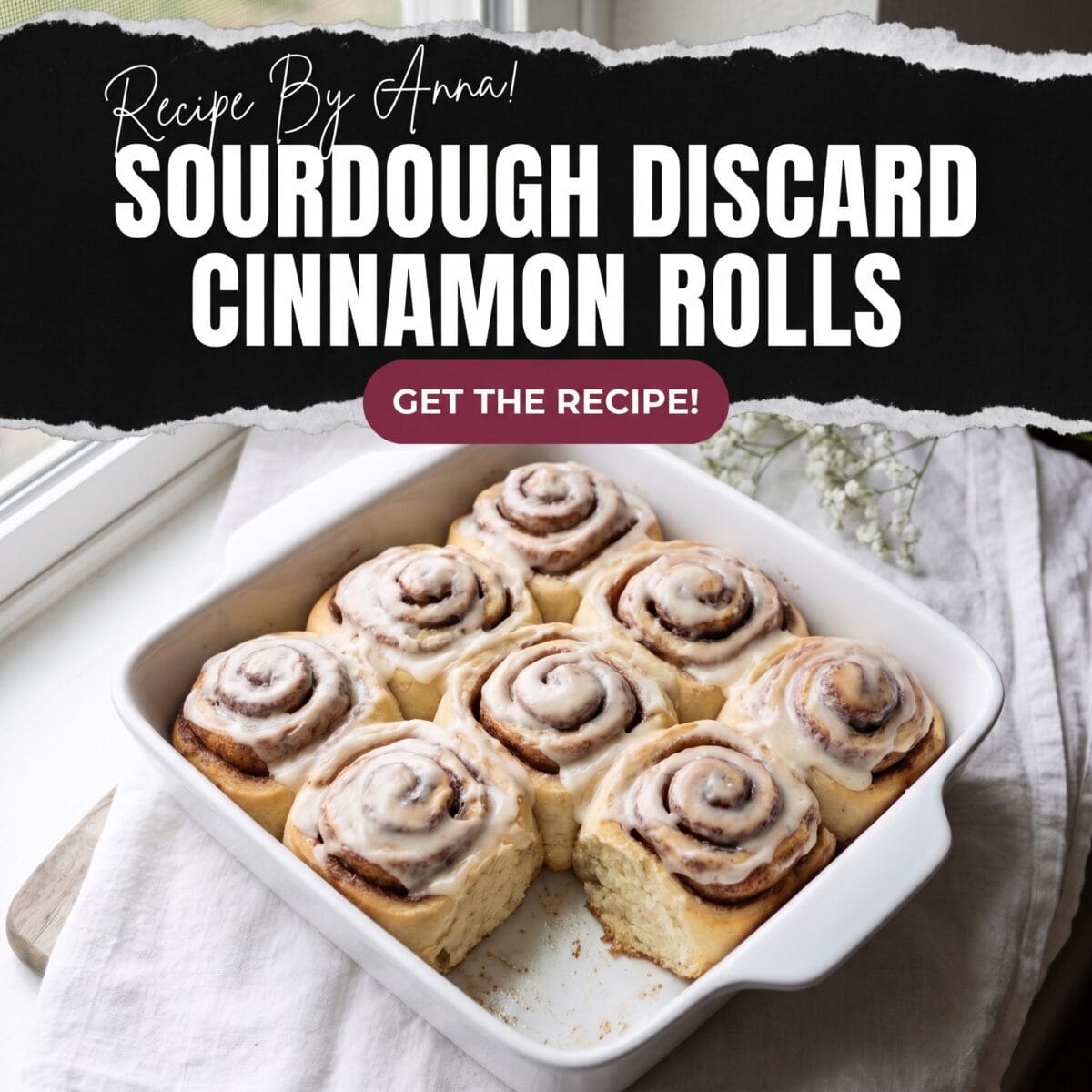
Sourdough Discard Cinnamon Rolls — Fluffy, Tangy and Absolutely Perfect
These Sourdough Discard Cinnamon Rolls are the recipe that makes the most compelling case for keeping a sourdough starter — tender, pull-apart rolls with a genuine depth of flavour that standard cinnamon rolls made from a packet of dry yeast simply cannot match, because the discard adds a subtle tang that makes the sweetness of the cinnamon sugar filling taste more complex and less one-dimensional than the same filling in a plain enriched dough.
Sourdough discard — the portion of starter removed and discarded before feeding — contributes both flavour and dough chemistry to this recipe without requiring the levain strength to do the actual leavening. Commercial yeast does the rising work here, which means these rolls are reliably fluffy and predictably timed rather than dependent on the activity level of your starter. The discard is purely a flavour ingredient, which is the most approachable way to use it for anyone who doesn’t want to build a fully discard-leavened roll with a 12 to 18 hour timeline.
They are the version of cinnamon rolls that people who consider themselves indifferent to cinnamon rolls find themselves going back for a second, and occasionally a third.
Why Sourdough Discard Makes Cinnamon Rolls Genuinely Better
The lactic and acetic acids in sourdough discard do two things in an enriched dough: they add the subtle tang that gives these rolls their flavour depth, and they gently weaken the gluten structure over time, which produces a more tender, more extensible dough than one made from yeast alone. The result is a roll that is lighter and more pull-apart soft than a standard cinnamon roll at the same size.
The discard also slows the staling process slightly — the acids in sourdough create an environment that inhibits the starch retrogradation responsible for baked goods going stale, which means these rolls stay softer longer than equivalent rolls without it.
- Prep Time: 30 minutes
- Rise Time: 1 hour 30 minutes (two rises)
- Cook Time: 22 to 25 minutes
- Total Time: 2 hours 30 minutes active and passive
- Yield: 12 rolls in a 9×13 inch pan
What You Need
For the dough:
- All-purpose flour: 3 1/2 cups (440g), plus more for dusting
- Instant yeast: 2 1/4 teaspoons (1 standard packet)
- Granulated sugar: 3 tablespoons
- Fine sea salt: 1 teaspoon
- Sourdough discard (unfed, straight from the fridge): 1/2 cup (120g)
- Whole milk, warmed to 110°F: 3/4 cup (180ml)
- Large eggs, at room temperature: 2
- Unsalted butter, softened: 1/4 cup (56g)
For the cinnamon filling:
- Unsalted butter, very soft (almost spreadable): 1/4 cup (56g)
- Light brown sugar, packed: 3/4 cup (150g)
- Ground cinnamon: 2 teaspoons
- Ground cardamom: 1/4 teaspoon (optional but excellent)
- Fine sea salt: a small pinch
For the cream cheese frosting:
- Full-fat cream cheese, softened: 4 oz (113g)
- Unsalted butter, softened: 2 tablespoons
- Powdered sugar, sifted: 1 1/2 cups (180g)
- Pure vanilla extract: 1 teaspoon
- Whole milk or heavy cream: 1 to 2 tablespoons, to thin
- Fine sea salt: a small pinch

Making the Rolls
Making and rising the dough:
- Combine the warm milk, sugar, and instant yeast in the bowl of a stand mixer or a large mixing bowl and stir gently. Let sit for 5 minutes until slightly foamy — this proofs the yeast and confirms it is active before the rest of the ingredients go in.
- Add the sourdough discard, eggs, and softened butter to the yeast mixture and whisk until combined — the discard will not fully integrate at this stage, which is normal.
- Add the flour and salt and mix with the dough hook on medium speed, or knead by hand, for 8 to 10 minutes until the dough is smooth, slightly tacky, and passes the windowpane test — stretch a small piece of dough between your fingers; if it stretches thin enough to be translucent without tearing, the gluten is sufficiently developed.
- Shape the dough into a ball, place in a lightly oiled bowl, cover with plastic wrap, and let rise at room temperature for 60 to 75 minutes until doubled in size.
Filling, rolling, and cutting:
- While the dough rises, stir the brown sugar, cinnamon, cardamom, and salt together in a small bowl. The butter goes on the dough separately — it should not be mixed into the sugar in advance as a paste, which results in an uneven filling.
- Turn the risen dough out onto a lightly floured surface and roll into a rectangle approximately 16 x 12 inches, keeping the thickness as even as possible across the whole surface.
- Spread the softened butter evenly across the entire surface of the dough rectangle, going all the way to the edges.
- Sprinkle the cinnamon sugar mixture evenly over the buttered surface — the layer should look generous but not so thick that it falls out during rolling.
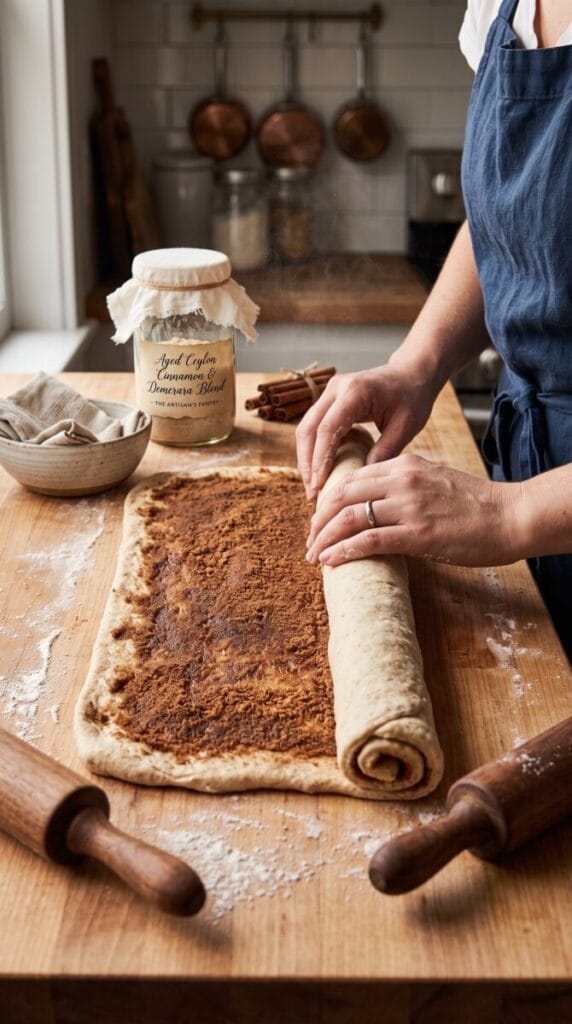
- Starting from the longer edge, roll the dough tightly into a log — tight enough that there are no gaps between the layers but not so tight that the dough tears.
- Use a sharp knife or unflavoured dental floss to cut the log into 12 equal rolls, each approximately 1.5 inches wide. Dental floss produces cleaner cuts than a knife since it does not compress the roll the way a blade does.
- Arrange the rolls cut-side up in a lightly greased 9×13 inch baking pan, leaving small gaps between each roll — they will expand during the second rise to fill the gaps and create that pull-apart characteristic.
- Cover loosely with plastic wrap and let rise for 30 to 45 minutes until the rolls are puffed and touching each other.
Baking and frosting:
- Preheat the oven to 350°F (175°C) while the rolls complete their second rise.
- Bake for 22 to 25 minutes until the tops are deep golden brown and a thermometer inserted into the center of the middle roll reads 190°F — the center roll takes the longest to bake and is the most reliable indicator of doneness.
- While the rolls bake, beat the softened cream cheese and butter together until completely smooth, then add the sifted powdered sugar, vanilla, salt, and enough milk to reach a thick, spreadable consistency.
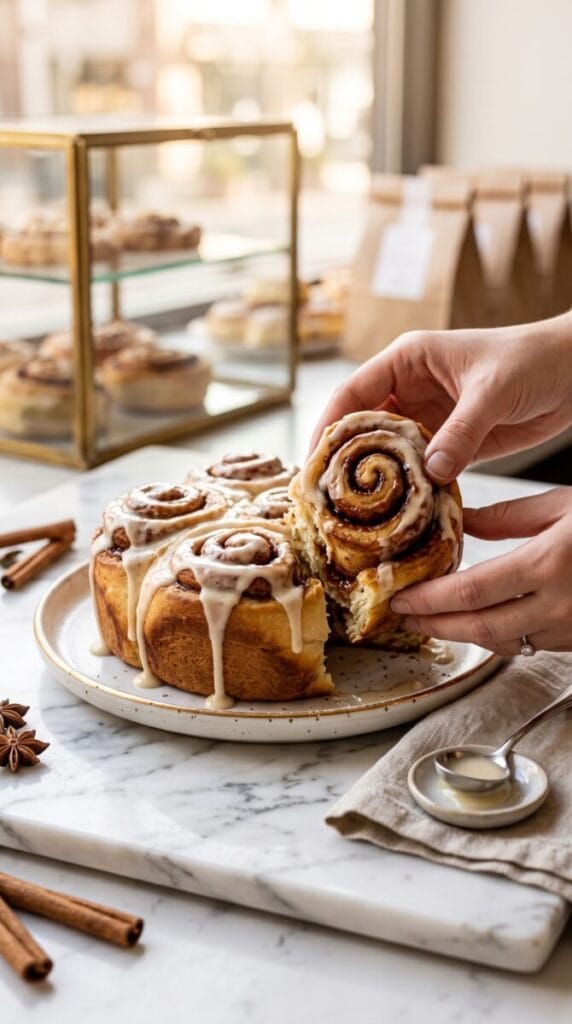
- Remove the rolls from the oven and let cool for exactly 5 minutes before frosting — frosting them too hot melts the cream cheese frosting completely into the rolls rather than sitting as a visible layer, and waiting too long means the rolls lose the warmth that allows the frosting to melt slightly into the crevices between the layers.
- Spread the cream cheese frosting generously over the warm rolls and serve immediately.
Love the tang that sourdough discard adds to baked goods? Our Cream Cheese Frosting recipe is the full standalone version of the frosting used here — worth making in a larger batch if you’re also baking the Homemade Carrot Cake or any other recipe that needs a generous cream cheese frosting at the same time.
The Techniques That Make These Rolls Genuinely Fluffy
The windowpane test is the most reliable indicator of properly developed gluten in an enriched dough — under-kneaded dough produces rolls that are dense and slightly gummy in the center rather than light and pull-apart tender. Take the 8 to 10 minutes of kneading seriously and test the dough by stretching a small piece before ending the kneading phase.
Rolling the dough log tightly is the detail that produces defined cinnamon swirls in the finished roll rather than a roll where the layers have separated and the filling has pooled to the bottom. Roll from the long edge, maintain even tension across the width, and finish the seam side down when cutting.
The 5-minute rest before frosting is as specific as it sounds — the cream cheese frosting should melt slightly into the warm rolls and coat the crevices rather than sitting entirely on top as a cold slab, but the rolls should be warm rather than hot when the frosting goes on or it will completely liquefy and run off the sides of the pan. According to King Arthur Baking, cream cheese frosting applied to rolls between 100°F and 120°F surface temperature produces the ideal result — warm enough to melt slightly and seep between layers, cool enough to stay visible and creamy on the surface rather than soaking in entirely.
Make-Ahead Options for These Rolls
The rolls can be assembled the night before and refrigerated before the second rise — after cutting and arranging in the pan, cover tightly with plastic wrap and refrigerate overnight rather than letting them rise at room temperature. The cold temperature slows the yeast significantly, and the sourdough discard continues adding flavour complexity during the long, cold fermentation. Remove from the fridge 45 minutes to 1 hour before baking to let them come to room temperature and finish the second rise, then bake as directed.
Overnight refrigerator rolls are noticeably more flavourful than same-day rolls because the extended time allows the sourdough discard’s acids and the yeast to develop a more complex flavour profile in the dough — this is the version that tastes most deeply of tangy, caramelised cinnamon roll rather than just sweet enriched bread.
What to Serve Alongside Them
A warm cinnamon roll and a cold glass of milk is the classic pairing that needs no improvement. For a full weekend brunch spread, serve these alongside our High-Protein Blueberry Cottage Cheese Breakfast Bake — the bright, fruity, protein-rich bake provides a light, fresh counterpoint to the richness of the rolls that makes the overall brunch feel balanced rather than overwhelmingly sweet.
These rolls with a cup of the Instant Iced Coffee alongside is a genuinely excellent combination — the cold, slightly bitter coffee contrast cuts through the sweetness of the cinnamon filling and cream cheese frosting in a way that makes both the roll and the coffee taste better for being next to each other.
Variations Worth Trying
Brown the butter for the filling instead of using it soft — cook the butter in a light-coloured pan over medium heat until the milk solids turn golden and it smells nutty, then cool to solid and use at a spreadable consistency. Brown butter in a cinnamon roll filling is significantly more complex and interesting than plain butter and is worth the extra 10 minutes on a weekend baking day.
Add a layer of 1/4 cup of cream cheese beaten smooth spread under the cinnamon sugar filling for an interior cream cheese layer that creates a tangy pocket alongside the cinnamon filling in every swirl — particularly good with the sourdough discard dough since the triple dairy tanginess of discard, cream cheese filling, and cream cheese frosting creates a remarkably complex flavour.
Replace the cream cheese frosting with a simple vanilla glaze — 1 cup of powdered sugar, 2 tablespoons of milk, and 1/2 teaspoon of vanilla — for a lighter, more transparent topping that lets the caramelised cinnamon sugar on the top of each roll remain visible and slightly crisp.
Nutritional Information
| Nutrient | Amount Per Roll (based on 12 rolls) |
|---|---|
| Calories | 410 kcal |
| Protein | 7 g |
| Carbohydrates | 62 g |
| Fats | 15 g |
These values are estimates based on the full recipe including the cream cheese frosting divided by 12 rolls. These are an indulgent breakfast or dessert and the nutrition reflects that honestly — the sourdough discard contributes virtually no change to the calorie count but a significant change to the flavour.
Storing These So They Stay Soft
Cover the pan tightly with plastic wrap or transfer to an airtight container and store at room temperature for up to 2 days — the sourdough discard’s acids genuinely slow staling, and these rolls remain notably softer on day two than equivalent cinnamon rolls made without the discard.
To reheat, microwave individual rolls for 20 to 25 seconds, or warm the entire pan covered with foil in a 300°F oven for 10 to 12 minutes. The brief warmth brings back the soft, pull-apart texture and makes the frosting slightly fluid again.
Unbaked rolls freeze well after the second rise — freeze them on the baking sheet until solid, then transfer to a freezer bag for up to 2 months. Thaw overnight in the fridge, let come to room temperature for an hour, then bake as directed. Do not freeze baked rolls with the cream cheese frosting already applied — frost after reheating from frozen for the best result.
What Goes Wrong With Cinnamon Rolls and Why
Dough that doesn’t rise during the first rise is almost always caused by yeast killed by milk that was too hot — 110°F is warm, not hot. Milk above 120°F kills yeast. If the milk felt hot rather than comfortably warm on your wrist, start again with properly tempered milk rather than trying to rescue a yeast-killed dough.
Filling that leaks out during baking rather than staying in the swirls is almost always caused by butter that was too warm and liquid when spread on the dough — the filling pooled rather than adhering to the dough surface. The butter should be very soft and spreadable but not melted, and the dough should be cold enough from the fridge (if making overnight rolls) or at room temperature to hold the butter in place when rolled.
Rolls that are doughy in the center with a done exterior are under-baked — the thermometer test is more reliable than visual colour for the center roll in a 9×13 pan. 190°F in the center is the target, and a roll that reads 175°F but looks golden on top needs another 4 to 5 minutes regardless of what the surface looks like.
Sourdough Discard Cinnamon Rolls
The perfect way to use leftover starter! Sourdough discard adds a subtle tang that beautifully balances the sweet cinnamon filling and creamy vanilla frosting.
Ingredients
Instructions
Add the warm milk, granulated sugar, and instant yeast to the bowl of a stand mixer or large bowl. Stir gently and let sit for about 5 minutes, until slightly foamy.
Add the unfed sourdough discard, eggs, and softened butter. Whisk or mix until combined.
Add the flour and salt. Mix with a dough hook on medium speed, or knead by hand, for 8–10 minutes. The dough should become smooth, soft, and slightly tacky.
Stretch a small piece of dough between your fingers. If it stretches thin enough to become slightly translucent without tearing, the gluten is properly developed.
While the dough rises, combine the brown sugar, cinnamon, cardamom, and salt in a small bowl. (Keep the softened butter separate for spreading).
Turn the risen dough onto a lightly floured surface. Roll the dough into an approximately 16 x 12-inch rectangle, keeping the thickness even.
Spread the softened butter evenly across the dough. Sprinkle the cinnamon sugar mixture evenly over the butter.
Starting from the long edge, tightly roll the dough into a log. Cut the log into 12 equal rolls using a sharp knife or unflavored dental floss.
Preheat the oven to 350°F (175°C). Bake for 22–25 minutes, until the tops are deep golden brown and the center of the middle roll reaches ~190°F (88°C).
While baking, beat the cream cheese and butter until smooth. Add the powdered sugar, vanilla, salt, and milk. Mix until thick but spreadable.
Let the baked rolls cool for about 5 minutes, then spread the cream cheese frosting generously over the warm rolls. Serve immediately!
Kitchen Notes
The milk should be around 110°F (43°C). Milk that feels hot to the touch will kill the instant yeast, and your dough won’t rise.
The butter for the filling must be spreadable, but not melted. Melted butter will cause the cinnamon sugar to leak out into the pan during baking.
Slide unflavored dental floss underneath the dough log, cross the ends over the top, and pull tight. This slices perfectly through the dough without crushing the layers!
The middle roll is the best indicator of doneness. Use an instant-read thermometer to check the center—it should be 190°F (88°C) to ensure it’s not doughy inside.
Delicious Variations
Brown the filling butter in a saucepan until golden and fragrant. Let it cool until spreadable again before using. It adds a rich, nutty flavor!
Beat ¼ cup cream cheese until smooth and spread it over the dough before adding the cinnamon sugar for a tangy interior layer.
For a lighter topping, skip the cream cheese and whisk together 1 cup powdered sugar, 2 tbsp milk, and ½ tsp vanilla extract.
After cutting and panning the rolls, cover tightly and place in the fridge overnight. The next morning, let them sit at room temp for 45-60 mins to rise before baking.
Store leftovers tightly covered at room temperature for up to 2 days, or in the fridge for longer. Microwave 20 seconds to soften.
Freeze the shaped rolls (after the second rise) on a baking sheet until solid. Transfer to a bag for up to 2 months. Thaw overnight in the fridge, let rise for 1 hr, then bake.
Freeze baked rolls (without frosting) tightly wrapped for up to 2 months. Thaw, warm in the oven, and add fresh frosting.