Easy Brioche Garlic Parmesan Chicken Sandwiches
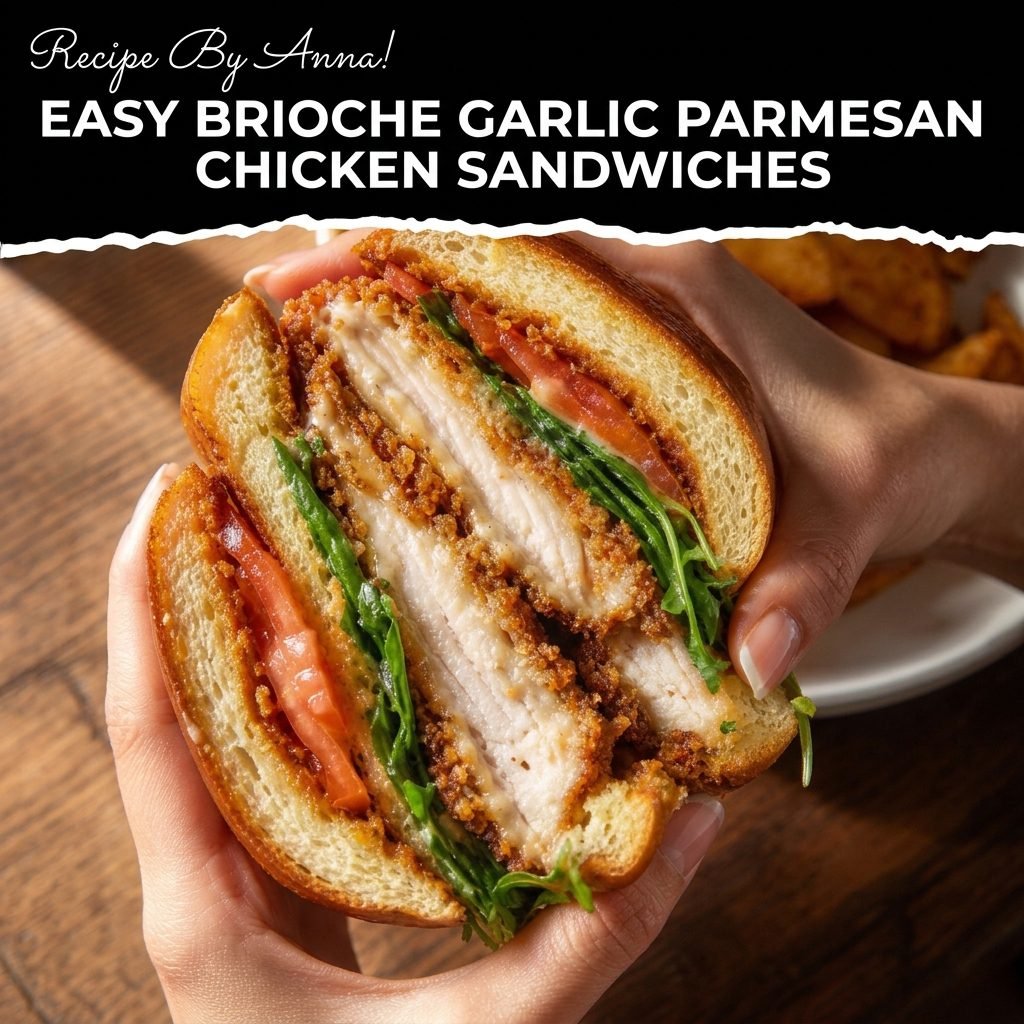
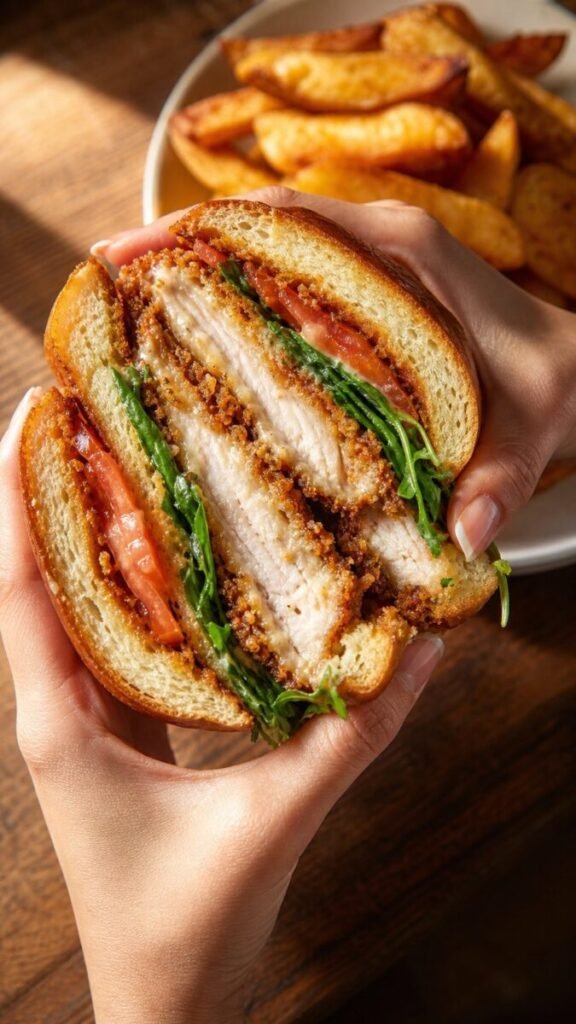
Every so often a fast-food commercial gets one right: crispy chicken, garlic parmesan, a soft golden bun. Then you order it, and it’s a drive-through approximation of an idea somebody had in a real kitchen once. This is the sandwich from the real kitchen. A boneless chicken thigh soaks in seasoned buttermilk for half an hour, gets pressed into a panko-and-Parmesan crust, shallow-fries to deep gold in a regular skillet, and lands on a brioche bun that’s been toasted in the same garlic-Parmesan butter that bastes the chicken. The name has three ingredients in it and every one of them is doing structural work.
The “easy” in the title is doing honest work too, so let me define it. This is not the dutch-oven, three-cups-of-oil, thermometer-clip-and-prayers version of a fried chicken sandwich — it’s a half inch of oil in a skillet, four minutes a side, and a sauce that takes five minutes and one small pan. What makes it feel like more than the effort is one decision: the garlic-Parmesan butter gets made once and used twice — melted over the hot cutlets so it drinks into the crust, and used to toast the brioche so the bun arrives as bread and leaves as garlic bread. One sauce, two jobs, and the sandwich tastes like a place you’d drive to.
The sandwich shelf on this site has been quietly filling up — the marinated tomato sandwich holds down the light lunches, the crack burgers hold down the beef — and this is the crispy-chicken corner of it. If you already make the garlic butter chicken thighs, you’ll recognize the flavor engine the second the butter hits the garlic; the sandwich is what happens when that dinner learns about lunch.
The Double Parm
Read the title again and notice that Parmesan shows up once but works twice, because that’s the recipe’s whole design. The first Parmesan is ground into the panko crust, where it does two things fried cheese always does: it browns faster and more deeply than bread ever could, and it brings the savory depth that makes a crust taste seasoned instead of coated. The second Parmesan melts into the garlic butter, turning a plain fat into a sauce. The same wedge does both jobs, which is why this recipe asks for a proper block of it and a grater — one lump, two destinations, and a name that’s telling the truth both times.
That crust deserves one paragraph of respect, because it’s the crispiest thing in the recipe and it’s built from the pantry in five minutes. Panko’s big open flakes are the architecture — they fry into shards and ridges instead of packing down flat the way fine breadcrumbs do — and the grated Parmesan scattered through them is the browning agent, so the color you’re watching for is deep golden, not pale beige. The flour-and-egg handshake underneath is what locks it on: flour gives the egg something to grip, egg gives the panko something to grip, and pressing the crumbs on with real pressure sets the whole chain. A crust you sprinkle on falls off in the pan; a crust you press on survives the flip, the drain, and the butter baste.
The chicken itself is a thighs decision, and I’ll defend it at length. A boneless thigh is the right thickness for a sandwich with no pounding required, it carries more fat than a breast so it forgives a minute of overcooking, and it stays juicy through a fry that would leave a breast dry and stringy before the bun even cooled. The buttermilk soak is the other half: its mild acid relaxes the meat’s fibers while its milk proteins start the tenderizing the salt finishes, and thirty minutes in the fridge is the sweet spot for a weeknight — an overnight soak is marginally better and honestly rated as such, but thirty minutes gets you ninety percent of the way there, and ninety percent on a Tuesday is a trade I’ll make every time.
⏱️ 20 MINUTES HANDS-ON + A 30-MINUTE SOAK | 🥪 MAKES 4 SANDWICHES | 🧄 ONE BUTTER, TWO JOBS
- Prep Time: 15 minutes — whisk, grate, press, toast the brioche while the chicken fries
- Soak Time: 30 minutes in the fridge; 10 at the floor, overnight at the ceiling
- Cook Time: about 16 minutes — two rounds of two cutlets, four minutes a side
- Total Time: about 1 hour from pantry to sandwich
- Yield: 4 sandwiches — lunch for four, or lunch and a very good tomorrow
The Shallow Fry
One skillet, a half inch of oil, and a short tool list:
- Large skillet, cast iron or heavy nonstick — twelve inches if you have it; the shallow fry needs floor space more than depth
- Neutral oil — about 1½ cups; canola, vegetable, or avocado, anything without an opinion of its own
- Instant-read thermometer — for the oil; the wooden-spoon trick below stands in if you don’t own one
- Wire rack over a sheet pan — the landing zone; paper towels steam the bottom of a fried thing soft, and the rack keeps every surface crisp
- Small saucepan — for the garlic-Parmesan butter
- Three shallow dishes — flour, egg, panko; the dredge line
- Tongs — for turning cutlets without piercing them
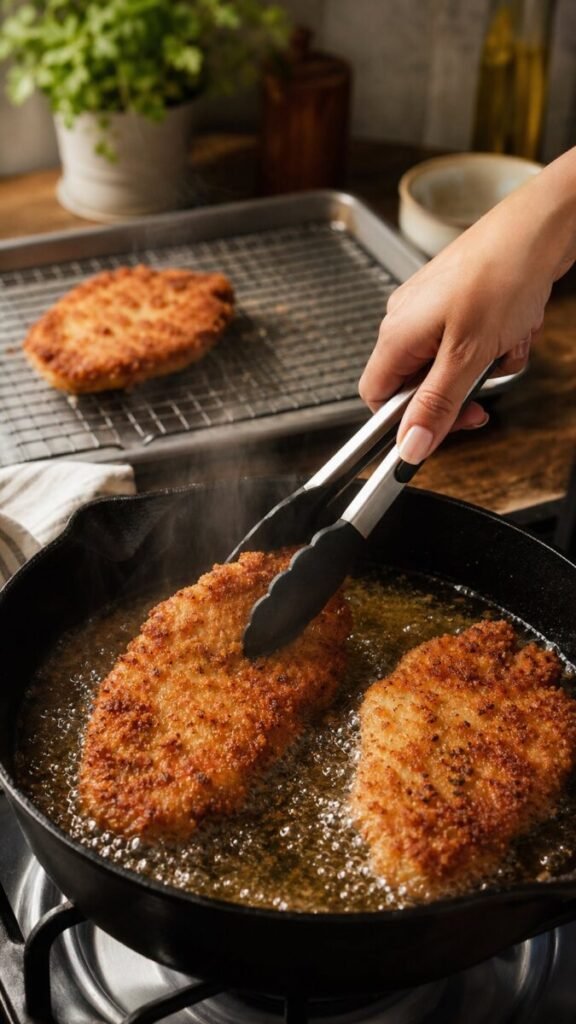
The method is shorter than the equipment list. Bring the half inch of oil to 350°F over medium heat — no thermometer? Dip the handle end of a wooden spoon into the oil, and if bubbles rise steadily around the wood within a second or two, you’re in the neighborhood. Fry two cutlets at a time, never three: each piece of cold chicken drops the oil temperature the moment it enters, and crowded oil goes cool and starts absorbing instead of frying, which is the technical definition of a greasy sandwich. Four minutes a side to deep gold and 165°F in the center, then straight to the rack for a two-minute rest while the next pair goes in. The oil comes back to temperature faster than you can grate more Parmesan, which is a hint.
And the Toast Rule, because the brioche is the ingredient most often wasted in this sandwich. Brioche is a rich, tender, barely-there bread, and an untoasted brioche bun under a buttered cutlet is a napkin with delusions — it compresses, it goes dense and gummy, and by the third bite it has surrendered entirely. Toasted, the same bun grows a thin crisp armor that holds the sandwich’s shape and its dignity. So the bun halves go cut-side down into the skillet the moment the last cutlet comes out, with a spoonful of the reserved garlic-Parmesan butter spread in the empty pan — sixty to ninety seconds to gold, and they come out as garlic bread wearing a bun costume. This is not a garnish step. In a sandwich with this much butter in it, the bun either fights back or disappears.
Ingredients (With Labels)
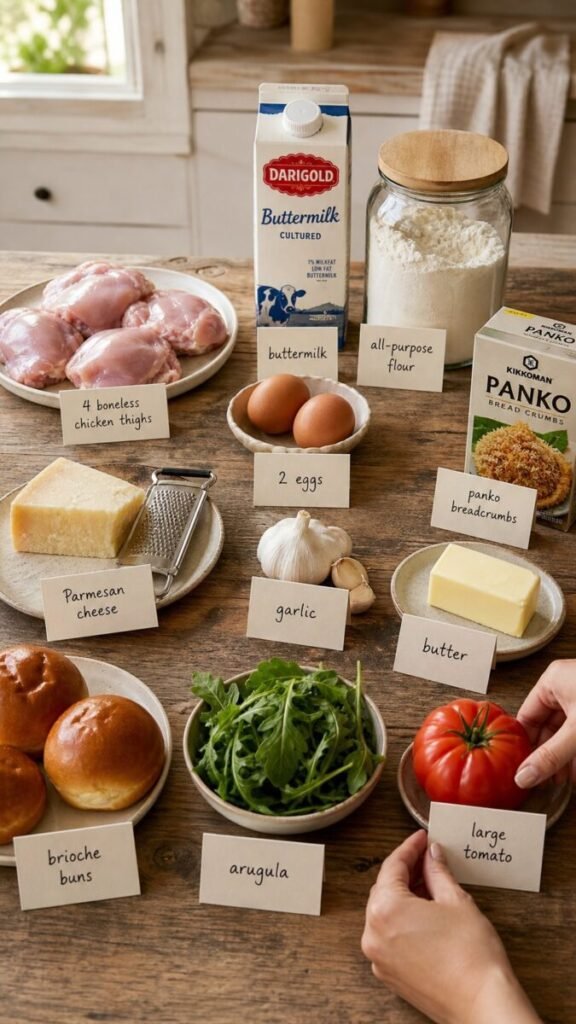
🍗 The Chicken and the Soak
- Boneless skinless chicken thighs: 4, medium-sized
- Buttermilk: 1 cup
- Salt: 1 teaspoon, into the soak
- Cayenne: ¼ teaspoon — background warmth, not heat
🥖 The Dredge
- All-purpose flour: ½ cup
- Eggs: 2, beaten with a splash of water
- Panko: 1 cup
- Parmesan, finely grated: ½ cup — half the wedge’s work
- Garlic powder: 1 teaspoon, into the panko
🧈 The Garlic-Parm Butter
- Butter: 6 tablespoons
- Garlic: 4 cloves, minced
- Parmesan, finely grated: ¼ cup — the other half of the wedge’s work
- Salt: a pinch
🥬 The Build
- Brioche buns: 4
- Arugula: a couple of big handfuls
- Tomato: 1 large, sliced and salted
Step by Step How to Make
- Step 1 — The soak. Whisk the buttermilk with the salt and cayenne in a bowl big enough to hold the thighs comfortably, add the chicken, turn to coat, and refrigerate for 30 minutes. This is the recipe’s only waiting, and it’s passive — the acid and the salt are downstairs doing the tenderizing while you set up the dredge line, grate the Parmesan, and slice the tomato. Salt the tomato slices now too, so they’ve drawn out their excess water and concentrated their flavor before they ever meet the bun.
- Step 2 — The butter. Melt the butter in the small saucepan over medium-low heat, add the garlic, and let it cook gently for a minute and a half until it’s fragrant and soft — pale gold, not browned, because browned garlic turns bitter and the sauce is meant to be sweet. Pull it off the heat, stir in the quarter cup of Parmesan and the pinch of salt, and set it aside. It will thicken as it sits, which is fine; it’s about to be re-melted twice.
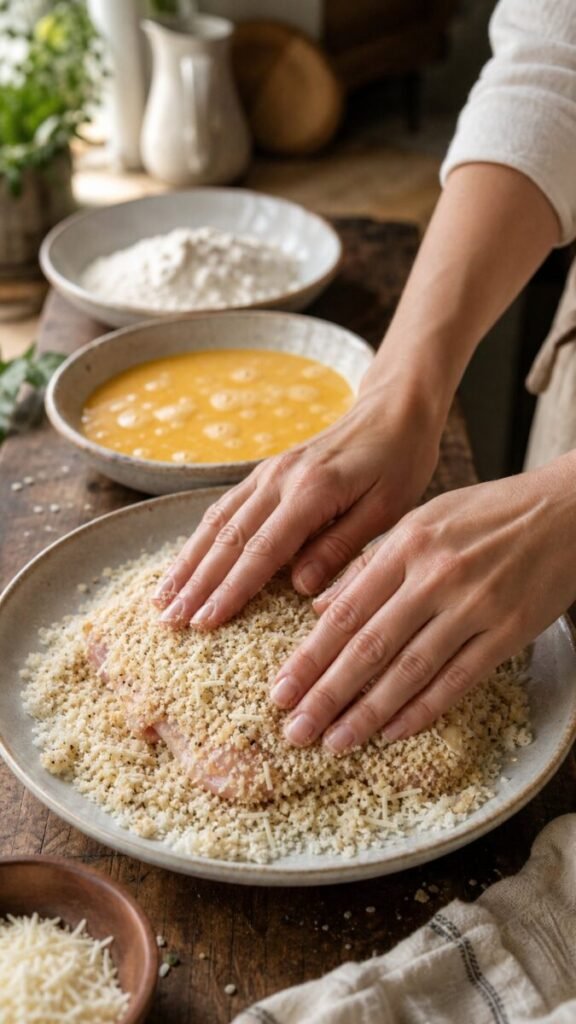
- Step 3 — The dredge. Set out the flour, the beaten eggs, and the panko mixed with its half cup of Parmesan and the garlic powder. Pull a thigh from the buttermilk, let the excess drip back into the bowl, and run it flour, then egg, then panko — and then press, hard, with the heel of your hand, five seconds a side. You’re not dusting this chicken; you’re installing a crust. The press is what keeps the panko attached through the flip and the butter baste, and it takes no extra time to do it right.
- Step 4 — The fry. Heat the half inch of oil to 350°F over medium. Lay in two cutlets and leave them alone for four minutes — the temptation to peek is real, and moving them early tears the crust off at the attachment points. Turn, fry four minutes more to deep gold, and check that the center reads 165°F. Onto the rack they go, and while they rest, the next two go in. When all four are out, take a spoonful of the garlic-Parm butter and paint it over the hot cutlets — the crust drinks it, and the sauce is now part of the sandwich rather than a topping for it.
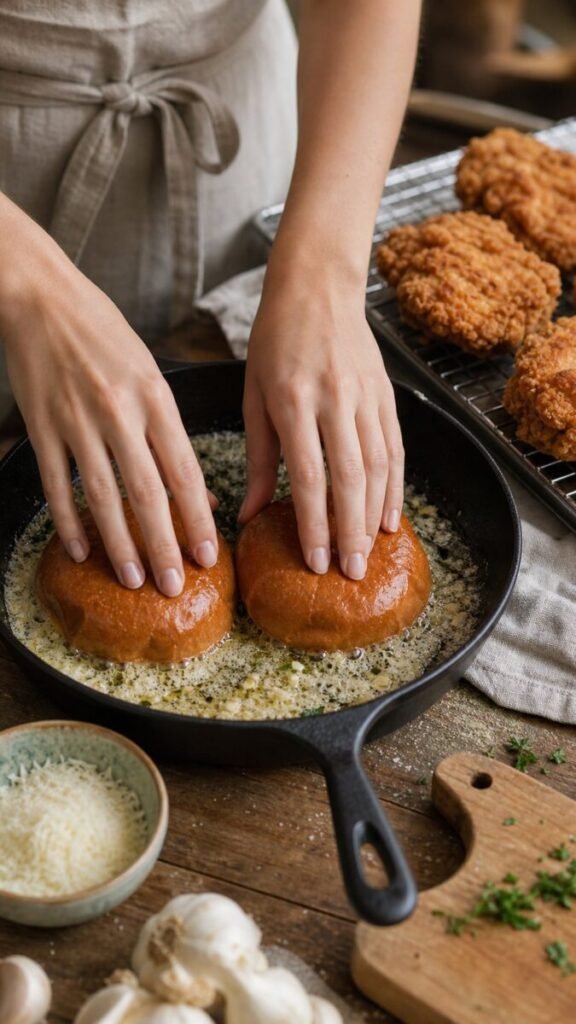
- Step 5 — The toast. Pour or spoon out the frying oil, wipe the skillet if it needs it, and set it back over medium-low with a spoonful of the reserved garlic-Parm butter. When it’s foaming, lay the brioche buns cut-side down and let them toast for sixty to ninety seconds, until the faces are golden and crisp at the edges. The butter has Parmesan in it, so watch them — cheese browns faster than bread, and the line between golden garlic bread and a regret is about fifteen seconds wide.
- Step 6 — The build. Arugula on the bottom bun — it goes under the chicken, where its slight bitterness and its dry crunch are positioned to do the most good — then the salted tomato, then the cutlet, then the lid. Press down gently, once, so the sandwich knows it’s a sandwich now, and cut it in half on the diagonal, because a build this tall owes you a look inside and you owe yourself the appetite that comes with seeing it. Eat immediately, while the crust still crunches and the bun still argues back.
The garlic butter chicken thighs are this sandwich’s weeknight-dinner twin — same fat, same garlic, same cut of chicken, no bun required. Make that one on the nights and this one on the weekends.
Anna’s Kitchen Notes
Buy the brioche from the bakery, not the bread aisle. A real brioche bun is rich enough that it toasts like pastry, and a mass-market one is often just a soft bun with a shine on it — the difference shows up the second the garlic butter hits the heat. Any bakery that makes them same-day is the target, and if your store stocks them in the bakery section, that’s the version you want. This is the one ingredient in the recipe I’ll make a second stop for, and the sandwich pays me back every time.
The press is the crust. I’ve watched people lose an entire panko crust in the frying pan and blame the oil, the flour, the humidity — anything but the step they skipped. The crumbs need to be pushed into the egg layer until they’re sitting in it, not on it, and the heel of the hand for five seconds a side does exactly that. It costs ten seconds per cutlet and it’s the difference between a crust that stays and a crust that abandons ship at the flip.
A note on the oil temperature, said plainly. 350°F is the number, and the spoon test stands in for a thermometer if you need it — steady bubbles around dry wood, no frantic sputtering. But the more useful habit is watching the color of the first cutlet like it owes you money: if it’s going dark before three minutes, the oil’s too hot; if it’s still pale at five, it’s too cool, and cool oil is how fried food ends up greasy, because the crust only seals when it’s hot enough to flash-fry on contact. Adjust once, early, and the rest of the batch takes care of itself.
The butter solidifies — that’s not a problem. Garlic-Parm butter left on the counter firms up like the compound butter it secretly is, and in the fridge it sets completely. Either state is fine: it re-melts in seconds in a warm pan, and the solid version is actually easier to spread thick on a bun face before it goes in the pan. Any extra keeps a week in the fridge and improves nearly everything — bread, rice, the edge of a steak, vegetables that have given up.
Double for a table, single for a lunch. The recipe as written is four sandwiches, and it doubles cleanly — the soak doubles, the dredge doubles, and the frying simply runs one more round. Four more minutes of standing at the stove is the entire cost of feeding eight. And if you’re cooking for one or two, fry all four cutlets anyway: the leftovers are the second recipe hiding in this one, and the storage section below explains why I consider a cold one at noon a feature.
The Sandwich Board
Sandwich night wants sides that crunch and don’t need a plate. The crispy onion Parmesan chips are the first mate here — same cheese, same crunch doctrine, ten minutes apart in the oven while the chicken soaks. Salt-and-pepper potato wedges are the classic, and a pile of them next to these sandwiches is a full fast-food meal that tastes handmade, because it is.
If the table runs bigger than four, the cheesy slider buns scale the bread-and-cheese energy to a crowd, and the homemade chicken tempura is the project-night cousin — same crispy-chicken satisfaction, batter instead of breading, and a dipping-sauce evening instead of a sandwich one. For the lighter days between this kind of lunch, the marinated tomato sandwich shares the tomato and the bread and none of the frying.
And for the indecisive, a confession: my favorite way to serve these is exactly one sandwich, exactly one handful of chips, and the sandwich cut in half on a plate I’ll have to wash anyway. Some meals earn a dish.
Same Sandwich, Other Fillings
The oven route, honestly rated. Skip the oil entirely and bake the breaded cutlets on a wire rack over a sheet pan at 400°F for 20 to 24 minutes, flipping once. You lose some crunch and gain a kitchen with no splatter and a free burner — an air fryer at 375°F for 14 to 16 minutes lands between the two. Both routes want a spritz of oil over the crumbs before they go in, and both are completely legitimate on a weeknight.
Hot honey, the modern classic. A drizzle over the buttered cutlet before the lid goes on — the heat, the sweet, and the garlic-Parm base are a known trio at this point, and the sandwich earns its trend honestly. Start with a teaspoon; this is a flavor that escalates.
The bacon amendment. Two strips per sandwich, cooked crisp while the chicken soaks and laid on the tomato. It’s the fast-food version’s favorite add for a reason: the smoke and the extra crunch slot straight into this build’s architecture. The sandwich gets taller and so does its reputation.
The parm-pizza pivot. Mozzarella melted over the cutlet in the last minute of its rest — slide it under the broiler for sixty seconds — and a spoonful of good marinara on the bottom bun instead of the arugula. Suddenly it’s a chicken parm sandwich, which is this recipe’s closest relative and the one my youngest orders by name.
The ranch table. A ramekin of ranch alongside for dunking, extra napkins, and no apologies. The garlic-Parm crust and ranch were born in the same flavor family, and anyone who pretends otherwise has never been to a good party.
The Sandwich Math
| Nutrient | Per Sandwich (1 of 4) |
|---|---|
| Calories | 620 kcal |
| Protein | 38 g |
| Carbohydrates | 44 g |
| Fats | 30 g |
Estimates as written, full butter ration and the tomato counted, the chips beside it left to your own arithmetic. Thirty-eight grams of protein is the quiet headline — a fried chicken sandwich that out-proteins most post-gym shakes, thanks to a whole thigh and two eggs’ worth of crust infrastructure. The money math is the loud one: four sandwiches run me about fourteen dollars of groceries — brioche from the bakery counter included — which is $3.50 apiece against the $8-and-up drive-through version, and mine has a crust you can hear across the table.
The Leftover Crisp
Fried cutlets keep three days in the fridge, and they re-crisp in a 375°F oven in about eight minutes or an air fryer in five — the crust comes back with almost no ceremony, because panko’s ridges forgive a night in the cold. What they do not survive is the microwave, which softens the crust into sadness in forty seconds flat; the microwave is for the sauce, never the sandwich. Leftover garlic-Parm butter keeps a week refrigerated and re-melts on demand. Assemble sandwiches fresh, always — a built sandwich is a countdown, and a stored one is a soggy bun’s origin story.
The cold cutlet, though, deserves its own paragraph. Sliced and set on bread with the tomato and the arugula, it’s a genuinely excellent next-day sandwich — the crust softens to a savory crumb, the garlic butter goes waxy and rich, and the whole thing eats like the world’s best deli chicken. I now fry four on purpose for two people, and I’d defend the strategy in court.
Brioche buns freeze beautifully for a month, well-wrapped, and thaw in twenty minutes on the counter — toast them straight from thawed in the re-melted butter, same as fresh. A stash of buns in the freezer plus a jar of the butter in the fridge means a future sandwich is never more than one chicken thigh and a soak away.
Where It Goes Wrong
The bun collapsed. It went in untoasted, or the butter went on the bun instead of the chicken. An untoasted brioche under a sauced cutlet has the structural integrity of a cloud — the Toast Rule exists precisely for this failure, sixty seconds in the garlic butter, and the sandwich holds its shape to the last bite.
The crust fell off in the pan. Three usual causes: the crumbs were sprinkled instead of pressed, the chicken went from soak to dredge dripping wet, or the cutlet was moved before its crust had set. Press with intent, let the buttermilk drip off, and leave each cutlet alone for its full four minutes — the crust earns its bond in the first thirty seconds of frying and spends the rest of the time proving it.
A greasy sandwich. Cool oil. Every time. Oil that’s under temperature soaks into the crust instead of flash-frying its surface shut, and the cutlet comes out heavy and wet. Heat the oil properly before the first piece goes in, fry two at a time so the temperature doesn’t crash, and give the oil a minute to recover between rounds. A hot fry is a dry fry.
Burnt crust, raw center. The heat ran high and the Parmesan in the panko browned faster than the thigh could cook through. Parm browns quicker than bread — that’s its gift and its demand — so medium, not medium-high, and pull the color down with the flame rather than racing it. If a cutlet goes dark early, it finishes in a 350°F oven for five minutes instead of the pan.
Dry, stringy chicken. Breasts happen. A breast pounded to thigh-thickness will work in this recipe, but it needs guarding — pull it at the first sign of done and let the carryover finish it. This is also the soak’s revenge: a breast that skipped the buttermilk has nothing standing between it and overcooking, which is why the thighs get the job by default.
A bland first bite. The soak was skipped or shortened to nothing, or the sauce went shy. The buttermilk’s salt is the seasoning of the meat itself — it can’t be painted on later — and the garlic-Parm butter is the sandwich’s voice, so paint the cutlets generously and let the crust drink. Between the salted tomato and the arugula, the flavor architecture is already balanced; the middle just has to carry its end.
Sandwich Questions
Can I use chicken breasts instead of thighs?
Yes — slice a large breast horizontally into two flat cutlets, or pound them to an even half-inch, and shorten the fry by a minute per side. The trade is honesty: a breast is leaner, less forgiving, and drier at the exact doneness where a thigh is still juicy. If you fry breasts, pull them the second they hit 165°F and not one degree later.
What can I use instead of buttermilk?
A cup of milk with a tablespoon of lemon juice or vinegar stirred in, rested for ten minutes until it looks slightly curdled and smells faintly tangy. It performs the same job — the acid and the milk proteins — with barely a detectable difference at this soak length. Plain thinned yogurt works too; the goal is tang and body, not a specific bottle.
Can I bake or air-fry instead of shallow-frying?
Both, with expectations set. Oven at 400°F on a wire rack over a sheet pan, 20 to 24 minutes flipped once, with a spritz of oil over the crumbs — you trade maybe a quarter of the crunch for zero splatter. The air fryer at 375°F for 14 to 16 minutes gets closer to fried and fits two cutlets at a time. The butter baste and the bun toasting stay identical in every route.
Can I use store-bought garlic Parmesan sauce?
You can, and the ones in the wing-sauce aisle are better than they used to be — but they’re made to sit on wings, not melt into a crust, and they bring a shelf-stable flatness that the five-minute homemade butter doesn’t. My honest rating: the bottled version gets you 70 percent of the sandwich. The pan version takes one small saucepan and four ingredients you already bought for everything else in this recipe.
Can I make these ahead for a crowd?
Yes, in stages, never as finished sandwiches. Soak the chicken overnight, make the butter up to a week ahead, toast nothing in advance. An hour before serving, fry the cutlets and hold them uncovered on the rack — covering them traps steam and costs you the crust — then give them five minutes back in a 375°F oven and toast the buns while people find their chairs. Assembled-to-order is the non-negotiable at a table of eight.
Are these gluten-free?
Not as written — the flour, the panko, and the brioche are all wheat. The build converts cleanly, though: a gluten-free flour blend works in the dredge, GF panko exists and toasts well, and the garlic-Parm butter never had gluten in it. The bun is the hard part; a sturdy GF brioche does exist, and it needs the Toast Rule even more than the regular one.
Why thighs and not the classic breast filet?
Because a thigh is the better sandwich piece, and the fast-food filet has convinced everyone otherwise. A thigh is already sandwich-thin, carries fat that forgives frying, and stays juicy through the carryover rest where a breast is busy drying out. The crust-to-meat ratio comes out the same, and nobody at my table has ever filed a complaint about the swap — only requests.
Easy Brioche Garlic Parmesan Chicken Sandwiches
Ingredients
As an Amazon Associate I earn from qualifying purchases.
Chicken & buttermilk soak
- 4 medium boneless, skinless chicken thighs, about 1¼ lb / 567 g total, unfolded and trimmed
- 1 cup buttermilk
- 1 teaspoon fine salt
- ¼ teaspoon cayenne pepper
Parmesan breading & frying
- ½ cup all-purpose flour
- 2 large eggs, beaten with 1 tablespoon water
- 1 cup panko breadcrumbs
- ½ cup (about 40 g) finely grated Parmesan cheese
- 1 teaspoon garlic powder
- Canola oil or another neutral high-heat oil, enough for about ½ inch in the skillet; quantity depends on pan size
Garlic-Parmesan butter
- 6 tablespoons unsalted butter
- 4 cloves garlic, finely minced
- ¼ cup (about 20 g) finely grated Parmesan cheese
- 1 small pinch fine salt, optional
Sandwich assembly
- 4 brioche buns, split
- 2 generous handfuls arugula, washed and dried
- 1 large tomato, sliced
- 1 small pinch fine salt, for the tomato
Kitchen Tools
- Deep, heavy 12-inch skillet, suitable for shallow-frying
- Frying thermometer, suitable for shallow oil
- Instant-read meat thermometer
- Oven-safe wire rack and rimmed sheet pan
- Small saucepan
- Separate clean skillet, for toasting the buns
- Three shallow breading dishes
- Covered mixing bowl, for marinating
- Kitchen tongs; use clean utensils for cooked chicken
- Fine cheese grater
- Measuring cups and spoons
- Chef’s knife and cutting boards, keeping raw poultry separate from produce
- Pastry brush or spoon, for the garlic butter
Directions
- Marinate the chicken and prepare the vegetables. Unfold the thighs and check for unusually thick sections; flatten those gently to about ½ inch for more even cooking. Do not rinse raw chicken. Whisk the buttermilk, 1 teaspoon salt, and cayenne in a bowl. Add the thighs, turn to coat, cover, and refrigerate at 40°F or below for 30 minutes, or up to overnight. Wash hands and clean raw-chicken preparation surfaces. On a clean board, slice the tomato, sprinkle lightly with salt, and let it drain while you prepare the remaining ingredients. Pat dry before assembly.
- Make and divide the garlic-Parmesan butter. Melt the butter in a small saucepan over medium-low heat. Add the minced garlic and cook gently for 1–2 minutes until fragrant and softened, without browning. Remove from the heat and stir in ¼ cup Parmesan. Taste before adding the optional pinch of salt. The cheese may remain slightly textured rather than dissolving completely. Divide the mixture between two clean bowls: half for the cooked chicken and half for toasting the buns. Keep both portions away from raw poultry and breading utensils.
- Bread the thighs. Place the flour in one shallow dish and the eggs beaten with water in a second. Combine the panko, remaining ½ cup Parmesan, and garlic powder in a third. Lift each thigh from the marinade and let excess liquid drip off. Coat lightly in flour, shake off excess, dip in egg, then press firmly into the crumb mixture on both sides. Set on a tray in a single layer. Discard the used marinade and any flour, egg, or crumbs that contacted raw chicken.
- Shallow-fry to 165°F. Add about ½ inch of oil to a deep, heavy skillet, leaving ample room above the oil for bubbling. Heat to approximately 350°F, measured with an oil-rated thermometer; a wooden-spoon bubble test is not a reliable temperature measurement. Carefully lower in two thighs, laying them away from you. Fry for about 3–5 minutes per side, adjusting the heat to maintain roughly 325–350°F. Cook until each thigh reaches 165°F in its thickest part; color and timing alone are not sufficient. If the coating browns too quickly, transfer to an oven-safe rack over a sheet pan and finish in a preheated 350°F oven until 165°F. Transfer cooked chicken with clean tongs to a clean rack. Bring the oil back to temperature before frying the second pair.
- Butter the chicken and toast the brioche. Spoon or brush the chicken’s reserved garlic butter over the fully cooked cutlets. Turn off the frying burner and leave the hot oil safely in place to cool; do not pour or wipe it out while hot. Use a separate clean skillet over medium-low heat for the buns. Spread the other portion of garlic butter thinly over the cut faces, then toast cut-side down in batches for about 60–90 seconds, watching closely so the garlic and Parmesan do not burn.
- Build and serve immediately. Divide the dry arugula among the bottom buns, add drained tomato slices, then a buttered chicken thigh and the top bun. Press gently and serve immediately. Allow approximately 60–75 minutes overall, including the 30-minute refrigerated soak and two frying batches. Refrigerate leftover chicken and garlic butter separately within 2 hours, or 1 hour above 90°F, and use within 3–4 days. Reheat chicken to 165°F and assemble with freshly toasted buns.
Nutrition
| Nutrient | Approximate amount per sandwich |
|---|---|
| Serving size | 1 sandwich; ¼ recipe |
| Calories | 800 kcal |
| Protein | 42 g |
| Carbohydrates | 55 g |
| Total fat | 46 g |
Rough estimates assume 567 g raw boneless, skinless thighs, four approximately 70 g brioche buns, the full garlic-butter portion, about three-quarters of the dry breading, one egg’s worth of retained egg wash, a small amount of retained buttermilk, and approximately 1 tablespoon frying oil absorbed per sandwich. Oil absorption, breading retention, chicken size, and bun brands can change these values substantially. Excludes side dishes. Contains wheat, egg, and milk.