
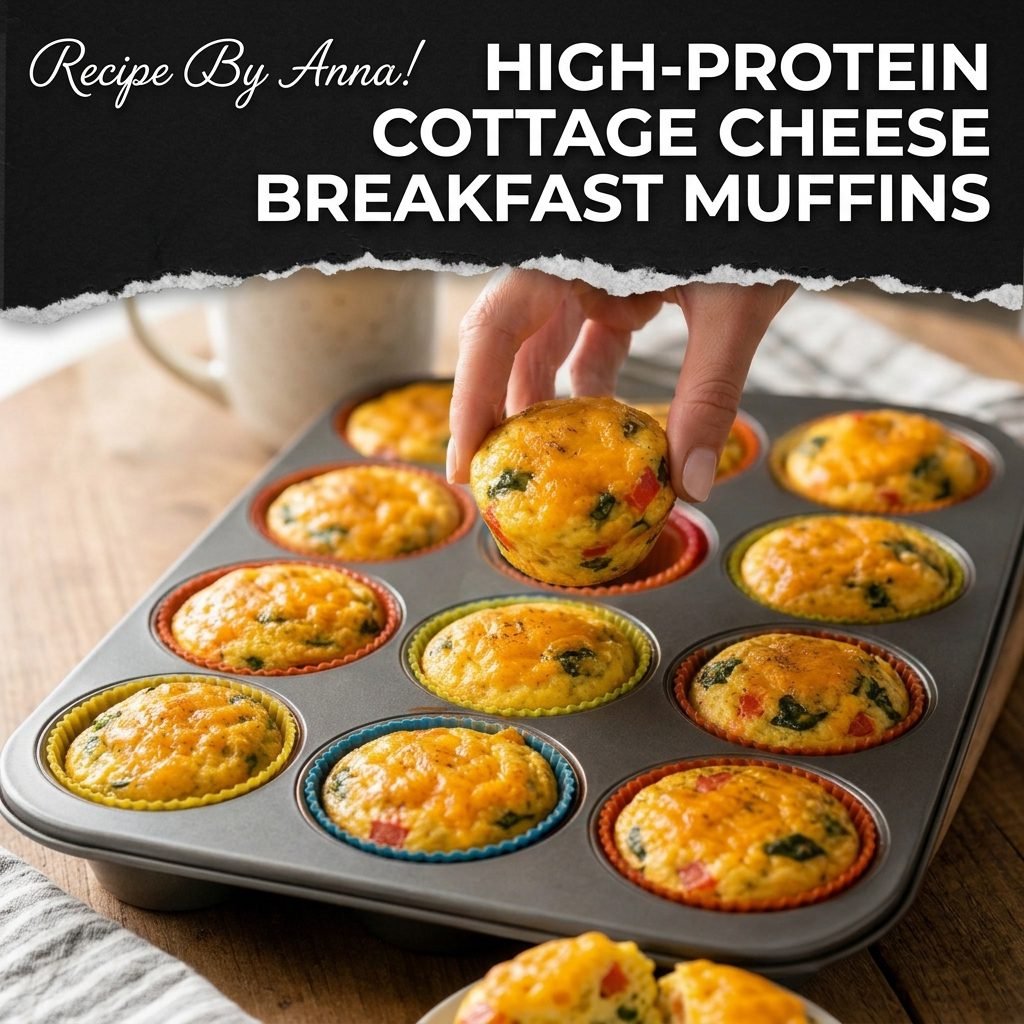
High Protein Cottage Cheese Breakfast Muffins
Most mornings around here are a race, and the racers are hungry. These muffins are how I win the race without cooking in it: on Sunday I blend cottage cheese with eggs, pour the golden custard over spinach, peppers, and cheddar in a muffin tin, and twenty-five minutes later there are twelve portable breakfasts cooling on the rack. Two of them — a real serving, not a teaser — carry twenty grams of protein. They reheat in forty seconds, they survive a lunchbox, they’re genuinely good eaten cold at a desk, and they have quietly ended the cereal era in my house.
If you’ve met the sad version of the egg muffin — rubbery little pucks that weep water and taste like the inside of a refrigerator — I need you to know those aren’t a flaw of the format. They’re a flaw of the formula, and the fix is the cottage cheese in this recipe’s name. Blended into the eggs until smooth, the curds disappear completely and take their dairy fat and milk proteins along for the ride, and that fat does for egg custard what it does for every sauce it’s ever been in: it gets between the proteins so they can’t link up into a tight, bouncy web when the heat hits. The result eats like the coffee-shop egg bites — velvet, soft, rich — except a batch of twelve costs about what one of those costs at the drive-through.
A quick word on the family tree, because this site likes to keep its shelf organized: the ham and cheese muffins already over there are the flour-and-baking-powder kind — a savory quick bread, wonderful, a different animal. These are the egg end of the muffin tin: no flour anywhere, gluten-free by accident, and built entirely around protein doing the structural work. Same pan, opposite philosophy, and my kitchen keeps both in rotation because a shelf with only one kind of muffin is a shelf that gives up too early.
The Curd Custard
Start with why the curds must vanish, since it’s the one step people are tempted to skip. A curd is a soft little pouch of moisture wrapped in protein, and an unblended curd in an egg muffin does exactly what it does in every other context: it stays a curd. You get pale, wet pockets in a set custard, and the water eventually leaves those pockets on its own schedule, which is how an innocent muffin ends up sitting in a puddle by Wednesday. Thirty seconds in the blender solves it permanently — the curds smear into the eggs, the water is held by the custard itself, and every muffin dries, sets, and stores at the same rate. The blend is also the skeptic converter: people who dislike cottage cheese dislike the texture of curds, and this recipe removes the texture while keeping everything the tub was bought for.
Then the tender part, which is the actual science of the dish. Eggs set when their proteins bond into a mesh, and the longer and hotter the bake, the tighter that mesh pulls — tight enough, eventually, to squeak against your teeth and squeeze its water out sideways. The blended cottage cheese makes that outcome nearly impossible. Its fat physically interrupts the protein bonds as they form, and its own milk proteins join the mesh loosely instead of tightly, so the custard sets to a soft surrender rather than a bounce. This is the same reason egg bites at the big coffee shops come out so velvety: gentle heat and a fat buffer. You do not need their machine. You need a blender and the willingness to pull the tin out on time.
The mix-ins have two rules and they’re both about water. First, everything goes in small — spinach chopped, peppers diced to pea-size, onions sliced thin — because a custard this soft can’t hold big pieces suspended; they sink and take the texture with them. Second, nothing goes in wet: raw mushrooms, thawed frozen spinach, and juicy tomatoes all leak during the bake, and a leaking mix-in walks the sogginess right back into the muffin. The cheddar gets split — half folded through the batter so every bite has cheese in it, half melted over the tops in the last minutes of the bake so each muffin wears a lid. You’ll know the batch is right when you cut one open and the cross-section looks like a frittata that learned logistics.
⏱️ 10 MINUTES HANDS-ON, ONE BLENDER | 🧁 12 MUFFINS, SIX BREAKFASTS | 💪 20 G PROTEIN PER PAIR
- Prep Time: 10 minutes — blend, fold, pour
- Bake Time: 22-26 minutes at 350°F
- Rest Time: 5 minutes in the tin before release
- Total Time: about 40 minutes, most of it hands-off
- Yield: 12 muffins — six breakfasts at two apiece, honestly portioned
The Twelve Cups
Short list, and one piece decides how your morning goes:
- 12-cup muffin tin — the standard size; a dark nonstick tin bakes these a touch faster than a light one, so peek early the first time
- Silicone muffin liners, or a generous greasing — the one make-or-break choice in the equipment. Egg custard and paper liners have a long, hostile history: the egg grips the paper, and you end up peeling your breakfast off its own wrapper like a banana with opinions. Silicone releases with a pinch, and a well-buttered bare tin is the honorable second choice
- Blender or food processor — for the custard base; a stick blender in a tall jar works too
- Large liquid measuring cup — pour the blended custard into it first, and filling twelve cups evenly becomes a two-minute pour instead of a spoon-and-slop situation
- Mixing bowl and silicone spatula — for the fold
- Wire rack — for cooling and for the muffins’ first standing appointment with the open air
Two notes on the tin itself. If you’re using silicone liners, set them on a sheet pan before filling — a freestanding silicone cup full of liquid custard is a wobbly thing, and the pan gives it a spine for the trip to the oven. And if you’re going the greased-tin route, brush the tops of the cups too, above the fill line, because these muffins puff as they bake and the rim is where a set custard loves to grab.
Ingredients (With Labels)
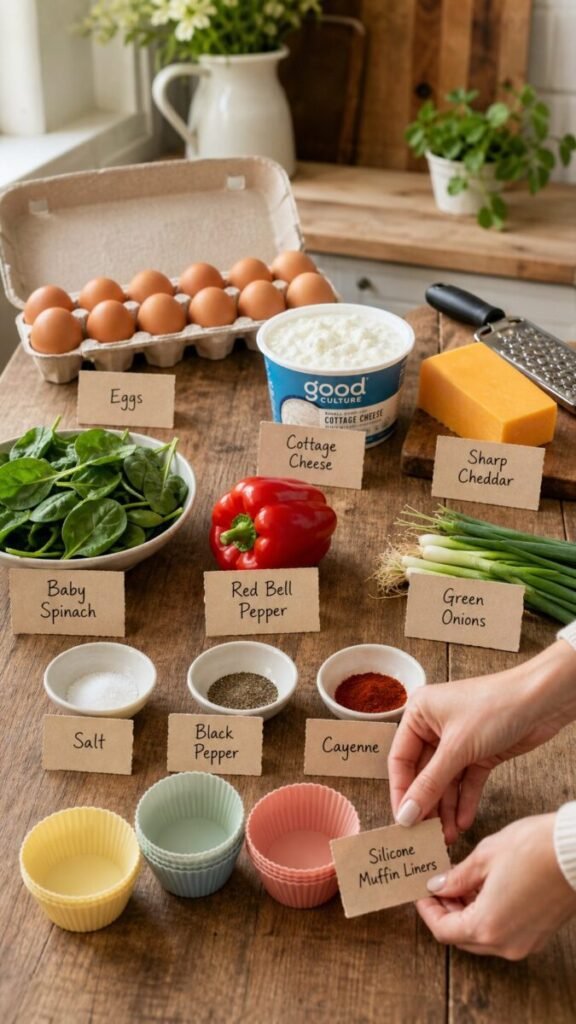
🥚 The Blended Base
- Large eggs: 10, room temperature if you think of it
- Small-curd cottage cheese: 1½ cups (a 12 oz tub) — 4% milkfat
- Salt: ½ teaspoon
- Black pepper: ¼ teaspoon
- Cayenne: one small pinch, optional but nice
🫕 The Fold-Ins
- Sharp cheddar: 1 cup shredded, divided — half folded in, half for the lids
- Baby spinach: 1 cup, roughly chopped
- Red bell pepper: ½ cup, diced small
- Green onions: 3, sliced thin
🧊 For the Tin
- Silicone liners or soft butter: enough for 12 cups, plus the rims if you’re going bare
Step by Step How to Make
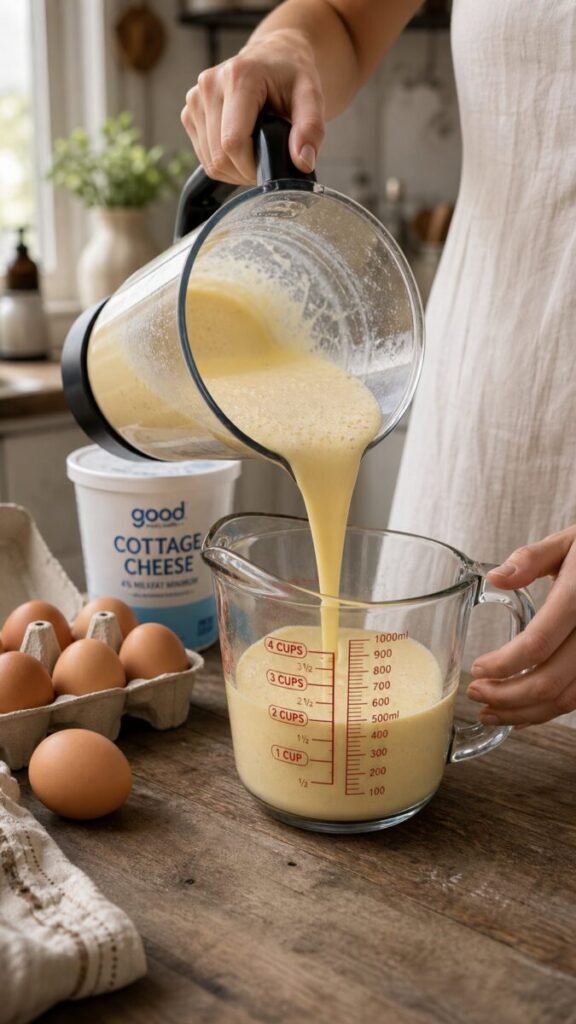
- Step 1 — The blend. Heat the oven to 350°F and set up your liners or grease the tin, rims included. Crack all ten eggs into the blender, add the cottage cheese, salt, pepper, and the pinch of cayenne, and run it on high for thirty to forty seconds, until the mixture is one smooth, pale-gold liquid with no visible curds and a frothy top. Stop and look at it: if you can see anything lumpy, run it again, because this is the step the whole recipe stands on. There’s no tasting this batter — it’s raw egg — so the salt is measured, not eyeballed, and the blend is the moment the recipe becomes forgiving.
- Step 2 — The fold. Pour the blended custard into the mixing bowl — or straight into the big liquid measuring cup, and save a bowl — and add the spinach, bell pepper, green onions, and the first half-cup of cheddar. Fold with the spatula just until everything is evenly distributed, eight or ten gentle turns. You’re mixing, not aerating; the blender already put all the air in that this custard wants.
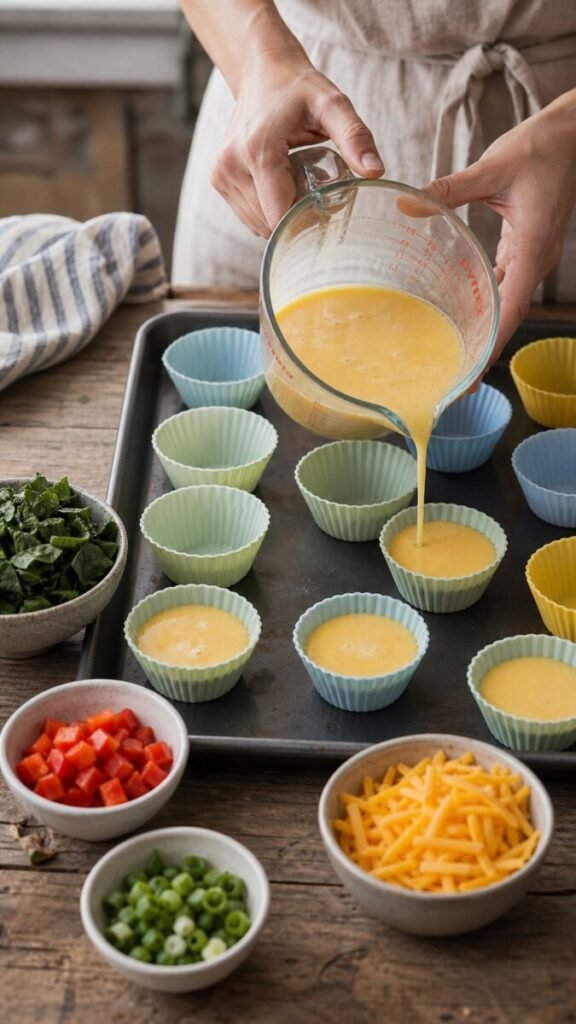
- Step 3 — Fill the cups. Set the silicone liners on a sheet pan if that’s your route, then pour the custard from the measuring cup into the twelve cups, filling each about three-quarters full — they puff meaningfully in the oven, and an overfilled cup becomes a mushroom with a soggy overhang. Divide the remaining half-cup of cheddar across the tops, a small pinch each; it will melt into a lid as they bake. If any cups look emptier than their neighbors after the pour, even them out with the spatula now, because the oven won’t do that work for you.
- Step 4 — The bake. Bake 22 to 26 minutes, rotating the pan once at the halfway mark. The finish line is a muffin that’s puffed, set at the center when you nudge the pan, and just turning gold at the edges — the tops should look softly domed, not risen into balloons. A muffin that has puffed tall and started to crack open is telling you it’s drying out, which is the one real failure this recipe knows; when you see it, the batch is done, pull it, and note the time for next round.
- Step 5 — Rest and release. Rest the tin five minutes on a rack. The muffins will sink slightly as the steam inside condenses — that settling is normal and I mean it, it’s steam leaving, not a collapse — and the five minutes let the custard finish tightening so the muffins release whole. Silicone cups turn out with a pinch at the base; a greased tin wants a thin spatula run around each muffin, and they lift out best when you’re confident about it. Eat the first two while they’re hot, with salt at the table, because the cook’s fee is paid in warm muffins.
- Step 6 — The week. Once completely cool, the other ten go into a container in the fridge, and that’s the entire maintenance plan. Reheating is forty seconds in the microwave with a damp paper towel over the bowl, or ten minutes in a 300°F oven if you want the cheddar lid crisp again. And the real discovery of the whole recipe: they are excellent cold. Room-temperature, lunchbox, desk-drawer-delayed cold. A breakfast that tastes right at every temperature is a breakfast that fits an actual week.

The ham and cheese muffins are this recipe’s flour-built sibling — a savory quick bread for the bread-lovers at the table. Between the two of them, the muffin tin has the whole workweek covered.
Anna’s Kitchen Notes
This is the recipe that converts cottage cheese skeptics. The objection is always the curds — the look, the pop, the whole wet-marble situation — and the blender erases every one of those objections in thirty seconds. What’s left in the custard is a mild, milky richness that reads as “this egg dish is expensive” without telling anyone why. I have served these to confessed cottage cheese avoiders, watched them take a second muffin, and said nothing, which is the correct amount of gloating.
Measure the salt; you can’t taste the batter. Unlike a cracker or cookie dough, this one has ten raw eggs in it, so there’s no dipping a finger to check the seasoning — the seasoning has to be right on paper before it blends. Half a teaspoon for this volume of egg and dairy is the tested number, and it matters more here than in most baked things, because eggs are quietly the blandest protein in the kitchen until salt shows up. If your first batch tastes polite, the fix is a bigger pinch next time, not a new recipe.
The cheese split is doing two different jobs. The folded half-cup suspends in the custard as little molten pockets — that’s flavor spread through the muffin’s whole interior. The topped half-cup melts across each lid and touches the hot air, which is where browning happens, so the tops come out of the oven tasting toasted while the insides stay custardy. Skip the fold and every bite between the cheese is plain; skip the lid and the muffin is flavor-rich but pale and one-textured. The split is the whole trick, and it costs one extra handful.
Buy the silicone liners; they pay for themselves on day one. A reusable twelve-pack costs about what a dozen eggs do, and they end the paper problem forever — egg custard clings to paper the way it clings to nothing else in cooking, and half a paper liner coming away with your breakfast is a slow way to start a morning. If you’d rather not own another gadget, a bare tin buttered generously, rims included, releases almost as well. What you truly can’t do is paper liners and hope.
Double the batch on the weeks that need it. The blender doesn’t care if it’s holding ten eggs or twenty — blend double, fold double, and bake two tins with the racks swapped halfway. The only real adjustment is timing your mornings: a double batch is six grab-and-go breakfasts per person in my house, which sounds excessive until you watch the container empty by Thursday and wish you’d had the foresight God gave a Sunday.
The Grab-and-Go Table
The muffin is the main, and the table around it wants fruit and something warm to drink — that’s the entire breakfast formula. On slow weekends, I’ll put a pair next to a small bowl of the satsuma breakfast gumbo, because a Louisiana morning and a make-ahead muffin get along famously, and the citrus cuts the richness of all that custard.
For households split on what breakfast should even be: the McGriddle breakfast bake covers the sweet-syrup contingent, the eggs benedict casserole covers the hollandaise loyalists, and these muffins cover everyone who has to leave the house by eight. And when the weekend finally arrives with no alarm, the fluffy apple muffins are the sweet-bookend version of this same tin — same pan, dessert-adjacent results.
The cottage cheese thread continues across the site if these send you looking: the 3-ingredient cottage cheese pancakes are the sit-down-Sunday use of the same tub, and the cottage cheese snack ideas are the no-cook afternoon version. One dairy case staple, a whole day’s worth of recipes, and the tub never gets old before it gets used.
Same Batter, Other Mix-Ins
Bacon and extra cheddar, the crowd-default. Four slices cooked crisp and crumbled, folded in with the green onions and a smoked paprika pinch in the blend. This is the version my household requests most, and the one I make when the muffins need to win over somebody new — bacon is a diplomatic tool.
The garden version. Sautéed mushrooms (cooked dry first — see the water rules), chopped steamed broccoli, and gruyère instead of cheddar. It tastes like the expensive end of a quiche in a commuting format, and it’s my favorite of all the variations, quietly.
Pizza muffins, for the lunchbox trade. Diced pepperoni, mozzarella, and a quarter teaspoon of dried oregano in the blend, with a small spoon of marinara served alongside for dunking. Kids treat these as a personal victory, and I’ve stopped arguing with the results.
Jalapeño and corn. Half a seeded jalapeño minced fine, a third cup of corn cut fresh off a cooked cob or thawed and patted dry, cheddar on top as usual. The sweet corn against the slow heat makes these taste like summer even in a February kitchen.
Smoked salmon and dill, the fancy one. Two ounces chopped smoked salmon, a tablespoon of fresh dill, and capers in the fold, with goat cheese crumbles instead of the cheddar lid. These show up at my sister’s brunches and vanish before the coffee is poured, which is the strongest endorsement a muffin gets in my family.
All-American diner ham. Diced leftover ham, a little Dijon whisked into the blended base, cheddar as written — the clean-out-the-fridge version that tastes deliberately planned. Around the holidays, when ham is everywhere, this is the recipe I point people to first.
The Dozen Math
| Nutrient | Per Serving (2 muffins, 1 of 6) |
|---|---|
| Calories | 250 kcal |
| Protein | 20 g |
| Carbohydrates | 5 g |
| Fats | 17 g |
Estimates as written, full-fat cottage cheese and the full cheddar ration counted, hot sauce and fruit at the table left out of the arithmetic. Twenty grams per pair is the honest accounting: ten eggs, a tub of cottage cheese, and a cup of cheddar divided six ways — for scale, that’s the protein of a diner omelet with none of the standing at the stove. Five grams of carbohydrates is what “no flour” looks like on paper, which makes these a genuinely low-carb breakfast that never advertised itself as one. And the batch economics are the quiet flex: twelve muffins run me about five dollars of groceries, which is six real breakfasts at eighty-odd cents apiece, in a year when a single drive-through egg sandwich crossed the seven-dollar line with a straight face.
The Fridge Tray
Storage is the reason this recipe exists, so here is the whole schedule. Cooled muffins keep four days in a covered container in the fridge — day four tastes like day one reheated, and the texture barely moves because a fat-buffered custard doesn’t dry the way a flour muffin does. The microwave reheat is forty seconds with a damp paper towel over the bowl; the 300°F oven for ten minutes is the luxury option that crisps the cheddar lid back up. Freezing works for two months, wrapped individually and bagged, straight from frozen into a 350°F oven for fifteen minutes or the microwave at half power for ninety seconds — the oven route protects the texture better, and it’s worth the wait on any morning that isn’t a race.
The one behavior to avoid is sealing them warm. A lid on a warm muffin traps the outgoing steam, and that steam lands back on the cheddar lid as condensation, which softens exactly the part you worked to crisp. Cool completely on the rack first — it takes twenty minutes and costs nothing — and the container stays dry and the muffins stay themselves all week.
And a scheduling note for the truly organized: the custard base can be blended the night before and kept in the blender jar in the fridge, with the fold-ins prepped in a container beside it. Morning-you pours, folds, and bakes while the coffee brews, and fresh muffins happen on a weekday, which feels like a small act of rebellion against the entire concept of mornings.
Where It Goes Wrong
Rubbery muffins. The signature failure of the whole genre, and it means one of two things: they baked too long, or the oven ran hot. The tell is in the bake itself — muffins that balloon tall and crack open at the top are over the line even if they look impressive. Pull at puffed-and-set, trust the rest period to finish the centers, and if your oven runs enthusiastic, drop the temperature 25 degrees and add a few minutes. The custard is protected by design; it just can’t be asked to survive an extra ten minutes.
Muffins sitting in a puddle. Water on the bottom of the container means something wet got in — unblended curds, thawed-but-unsqueezed frozen spinach, raw mushrooms, or juicy tomato. Every one of those is preventable at the fold: blend until smooth, squeeze frozen greens dry, cook the mushrooms first, and dice the tomato so small it behaves or leave it out. The custard itself doesn’t weep when it’s made right; it’s always a stowaway.
Half the muffin stuck to the liner. Paper happened. Egg custard bonds to paper liners like it was ordered to, and no amount of spraying the paper first fully saves it. Silicone, or a bare tin buttered with intent — those are the two doors out, and both of them lead to whole muffins.
Flavorless on the first bite. Under-salted eggs, almost always — with no tasting possible on a raw-egg batter, the half teaspoon has to go in on faith, and skimping reads instantly at the table. The other suspect is mild cheese: a mild cheddar disappears into this custard entirely, which is why the ingredient list says sharp. Season with conviction and buy cheese with a point of view.
All the vegetables on the floor. Mix-ins sank because the pieces were too big for the custard to carry — a soft egg custard suspends pea-size pieces happily and drops anything chunky straight to the bottom. Chop smaller, and if a mix-in is heavy and wet, give it a quick pre-cook so it’s both drier and lighter going in.
Flat, dense tops after the fridge. Not a failure — read that twice. They puffed in the oven, the steam condensed as they cooled, and the tops settled into a denser, almost quiche-like finish. That’s the physics of a flourless custard, and the muffins are exactly as good as they were at noon; the texture was always going to be velvet rather than airy. If the visual bothers you, the oven reheat re-domes them briefly, but honestly, Tuesday does not care what Sunday looked like.
Egg Questions
Can I make these without a blender?
Yes, with a fork and some acceptance. Beat the eggs thoroughly, then beat the cottage cheese in a cup at a time, whisking until the mixture is as smooth as your wrist can make it — you’re chasing the same no-visible-curds standard. A stick blender in the bowl is the easier middle path. What you can’t do is fold whole curds in and hope the oven sorts it out; the oven is not on your side in that negotiation.
Why cottage cheese instead of milk or cream?
Because it brings protein instead of water. Milk and cream thin the custard and dilute the very thing these muffins exist to deliver, while cottage cheese is a concentrated package of milk protein and fat that thickens the custard and buffers it against overcooking. In texture terms it plays the role cream plays in egg bites; in nutrition terms it’s the difference between a bread-ish muffin and a twenty-gram breakfast.
Can I use egg whites instead of whole eggs?
You can replace up to three of the ten with whites, and the muffins stay tender and rise a little paler. Beyond that, the custard loses the yolks’ fat — the same fat doing the anti-rubber work — and you’ll taste the difference as a leaner, slightly tougher bite. If protein-per-calorie is the whole mission, a partial swap is the honest compromise; a full conversion is a different recipe.
Are these gluten-free?
Yes, as written — eggs, cottage cheese, cheddar, and vegetables, with nothing wheat anywhere in the build. The two labels worth checking are the cottage cheese and the cheddar, since a few brands of each run shared-facility notes; beyond that, the recipe is naturally gluten-free with zero substitutions, which is the best kind of gluten-free.
How do I reheat them without rubber?
Gently and briefly. The microwave does forty seconds with a damp paper towel over the bowl — the towel’s steam keeps the surface from tightening while the middle warms. The oven at 300°F for ten minutes is the texture-preserving option, and it re-crisps the cheddar lid as a bonus. What turns a leftover rubbery is the same thing that turned the original rubbery: too much heat for too long, applied impatiently.
Can I make them in a mini muffin tin?
Yes, and they become excellent party food — fill the minis halfway and start checking at twelve minutes, because the small cups set fast. A mini batch is roughly thirty-six pieces, and they disappear at a brunch pace that regular muffins can only watch. The only adjustment beyond time is patience at the filling stage; a small scoop makes it go faster and more evenly.
How many is a breakfast?
Two, by the recipe’s own math — that’s the twenty-gram serving and the portion the nutrition table counts. One is a snack, three is a hungrier morning than usual, and the muffins are dense enough in protein that two genuinely holds most people to lunch. The batch is built for six two-muffin breakfasts, and in my house it runs out on schedule, which is how I know the math is right.
High Protein Cottage Cheese Breakfast Muffins
Ingredients
As an Amazon Associate I earn from qualifying purchases.
Blended egg base
- 10 large eggs
- 1½ cups (12 oz / 340 g) small-curd cottage cheese, 4% milkfat
- ½ teaspoon fine salt, or less if your cheeses are particularly salty
- ¼ teaspoon ground black pepper
- 1 small pinch cayenne pepper, optional
Vegetables & cheddar
- 1 cup (about 113 g) shredded sharp cheddar cheese, divided into ½ cup for the filling and ½ cup for the tops
- 1 cup baby spinach, washed, thoroughly dried, and finely chopped
- ½ cup finely diced red bell pepper, patted dry
- 3 green onions, thinly sliced
For greasing
- About 1 tablespoon softened unsalted butter, as needed for the muffin cups and rims; optional when using nonstick silicone liners
Kitchen Tools
- Standard 12-cup muffin tin
- Oven-safe silicone muffin liners, optional; avoid ordinary paper liners for this egg custard
- Blender or food processor with sufficient liquid capacity
- Large pouring jug or mixing bowl with a pouring spout
- Silicone spatula
- Measuring cups and spoons
- Cheese grater
- Chef’s knife and cutting board
- Rimmed baking sheet, if using freestanding silicone cups
- Instant-read food thermometer
- Oven mitts and wire cooling rack
Directions
- Prepare the pan and blend the custard. Preheat the oven to 350°F. Fit silicone liners into the muffin tin, or generously butter the cups and upper rims. If using freestanding silicone cups, place them on a rimmed baking sheet before filling. Blend the eggs, cottage cheese, salt, black pepper, and optional cayenne for about 30–40 seconds, just until smooth with no visible curds. Stay below the blender’s maximum fill line and blend in batches if needed. Do not taste the raw egg mixture.
- Fold in the vegetables and half the cheese. Pour the custard into a large pouring jug or mixing bowl. Gently fold in the thoroughly dried, chopped spinach, finely diced bell pepper, green onions, and ½ cup shredded cheddar. Stir only until evenly distributed.
- Fill without overfilling. Divide the mixture among the prepared cups, filling each no more than three-quarters full. Stir gently between pours to redistribute the vegetables. Sprinkle the remaining ½ cup cheddar over the tops. Muffin cup capacities vary: if the mixture does not fit, use additional prepared cups or a small greased oven-safe ramekin rather than overfilling. Refrigerate any batter awaiting a second batch.
- Bake until safely set. Bake on the middle rack for about 22–26 minutes, rotating the pan halfway through if your oven browns unevenly. Start checking a little earlier with dark metal tins; silicone cups or larger portions may take longer. The centers should be set and reach at least 160°F on an instant-read thermometer. Check a few muffins near the center of the pan without touching the metal. Remove when safely cooked to avoid unnecessary drying; puffing, cracking, or browning alone does not establish doneness. Check any extra ramekin separately.
- Rest and release. Rest the pan on a wire rack for 5 minutes. Some settling is normal for flourless egg muffins. Gently release from silicone liners, or loosen the edges of a greased tin with a small silicone spatula. Serve warm. Allow about 40–45 minutes for preparation, baking, and resting, with additional time if baking a second batch. The rest is for easier handling, not for finishing an undercooked center.
- Chill promptly and reheat gently. Let excess steam escape briefly, then refrigerate leftovers in a shallow container within 2 hours of baking, or within 1 hour when the room is above 90°F. Do not wait for complete room-temperature cooling if that would exceed these limits. Keep refrigerated at 40°F or below and use within 3–4 days, or freeze individually for up to 2 months for best quality. Reheat gently in the microwave under a microwave-safe cover or in a 300°F oven until the centers reach 165°F; time varies with portion size and starting temperature. For cold lunches, transport with ice packs and keep chilled until eating rather than leaving muffins in a desk drawer or unchilled lunchbox.
Nutrition
| Nutrient | Approximate amount per serving |
|---|---|
| Serving size | ⅙ batch; 2 muffins if the batch makes 12 |
| Calories | 275 kcal |
| Protein | 22 g |
| Carbohydrates | 5 g |
| Total fat | 18 g |
Estimates include 10 large eggs, 340 g full-fat cottage cheese, 113 g cheddar, the listed vegetables, and 1 tablespoon butter for greasing. Using silicone liners without butter reduces the estimate by approximately 17 calories and 2 g fat per serving. Values vary with brands and portion size. Contains egg and milk. For gluten-free needs, verify packaged ingredients and avoid cross-contact.