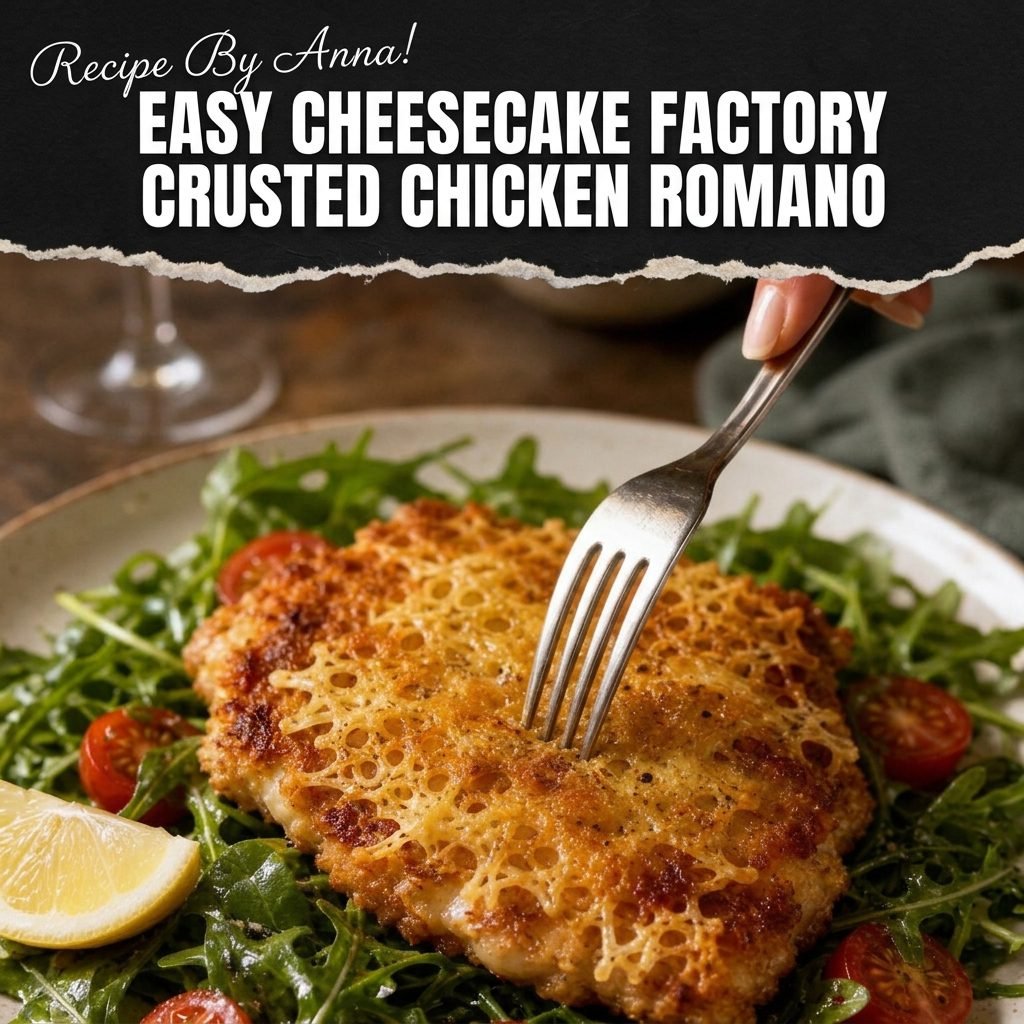
Easy Cheesecake Factory Crusted Chicken Romano
The Cheesecake Factory has been serving Crusted Chicken Romano for decades, on a plate roughly the size of a manhole cover, and it has quietly become the dish people order when they’re pretending to be good — because half the plate is salad. It’s a thin chicken cutlet in a crackling crust that’s mostly grated Romano, pan-fried and set over a heap of arugula with tomato and a lemony dressing, and it costs about what a week of lunches should. The Factory doesn’t publish the recipe, so what follows is my reconstruction, assembled the only honest way: by ordering it and eating it slowly with a notepad. This is a copycat with good manners, and the credit belongs to the original.
Here’s what makes the dish worth copying, and it’s not the chicken — it’s the crust. A normal breaded cutlet is mostly crumb with a little cheese for flavor. This one inverts that: the coating is grated Romano first and everything else second, and when it hits the hot oil, the cheese does what cheese does in a hot pan — it melts, it spreads, it fries into a thin, lacy, savory shell that crunches like a frico with a five-year plan. Breadcrumbs never achieve this. There is no breading machinery, no buttermilk, no double-dip: a dusting of flour, a swim in egg, a press into cheese, and a skillet with three tablespoons of olive oil. From pantry to plate in about thirty minutes, which is how the “easy” in the title keeps its word.
The copycat shelf on this site is small and choosy — the Chang’s copycat chicken lettuce wraps live over there — and this is its crispy, lemony, knife-and-fork addition. If you already make the quick chicken piccata, you’ll recognize the flavor family immediately: chicken, lemon, and a pan doing the heavy lifting. This is that dinner wearing its restaurant coat.
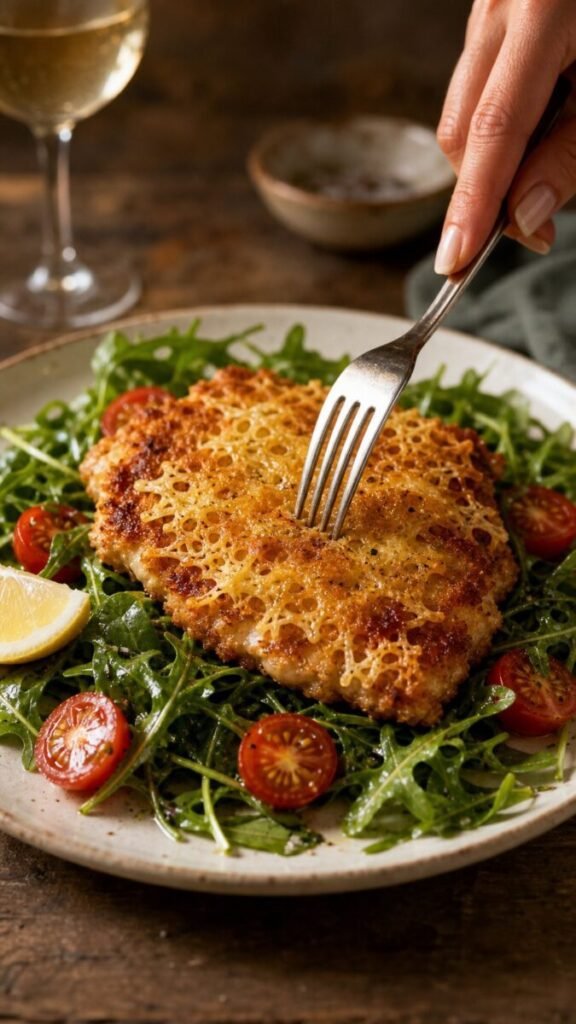
The Cheese Crust
Start with the ratio, because it’s the recipe’s single decision: three parts grated Romano to one part panko. The purist copycats — and the restaurant itself, as far as my notepad could tell — go all the way to cheese and nothing else, and you can too; the variation section explains the full-frico route. I keep a quarter cup of panko in mine as scaffolding, because a pure cheese crust is magnificent and slightly temperamental: cheese melts before it crisps, and in the wrong moment it slides. The panko gives the melting cheese something to cling to while it sets, the way a lattice gives a climbing vine somewhere to go while it grows. You still get lace, you still get seventy-five percent cheese in every bite, and you get a crust that survives the flip with its dignity intact.
Now the cheese itself, because Romano is in the dish’s name and the name means it. Romano is the older, sharper sibling of the Parmesan you already own: traditionally made from sheep’s milk, aged longer, saltier, with a bite that survives a hot pan instead of mellowing into background. That sturdiness under heat is exactly why it’s the frying cheese — Parmesan makes a lovely crust that tastes gently of toast, while Romano makes a crust that tastes like browned cheese and announces itself in every bite. A fifty-fifty blend is a respectable middle path if the Romano wedge you found runs fierce. What neither version can survive is the pre-grated bag or the green shaker can, whose anti-caking powder fights the lace; buy the wedge, run it over the small holes of your grater, and the crust is already halfway made.
And the arugula half of the plate, which deserves its defense. This dish has been ordered by the salad-adjacent for decades for a reason that isn’t penance: fried cheese crust and peppery greens are one of the great flavor pairings, and the lemon vinaigrette is doing sauce work — its acid and its sharpness cut straight through the richness of the fried crust, the way a pickle cuts a rich sandwich. The greens are not a side; they’re the sauce. A plate of this with no arugula is still delicious, the way a door with no hinges is still a door, but you’d be missing the part that makes it open.
⏱️ 15 MINUTES HANDS-ON | 🍗 4 CUTLETS, 4 PLATES | 🧀 A CRUST THAT IS MOSTLY CHEESE
- Prep Time: 15 minutes — butterfly, pound, grate, three dishes
- Cook Time: about 16 minutes — two rounds of two cutlets
- Total Time: 30 minutes, salad and all
- Yield: 4 servings — a cutlet apiece over a big handful of greens
The Pan and the Lace
Everything is ordinary, and one tool earns special mention:
- Large skillet — twelve inches, nonstick or well-seasoned, room for two cutlets without touching
- Thin fish spatula — the tool that matters; a thick spatula lifts a lace crust in fragments, and a thin one slides under it whole
- Meat mallet or rolling pin — plus plastic wrap, for the pounding
- Three shallow dishes — flour, egg, and the cheese crust
- A jar with a lid — the vinaigrette’s whole apparatus
- Instant-read thermometer — optional; 165°F is the number
- Wire rack — for the two-minute rest between pan and plate
The pan technique comes down to one word: medium. Cheese browns at a lower temperature than breadcrumbs — it’s full of milk proteins and fat that go golden fast — so the instinct that fried chicken needs a roaring hot pan is exactly wrong here. Medium heat gives the Romano time to melt, spread, and set into lace instead of leaping straight to dark brown while the chicken underneath is still thinking about cooking. You’ll know the temperature is right by the sound: a steady, conversational sizzle, never a shout. And between rounds, wipe the pan out with a paper towel — the stray cheese bits from round one burn in round two’s oil and lend a bitterness nobody ordered.
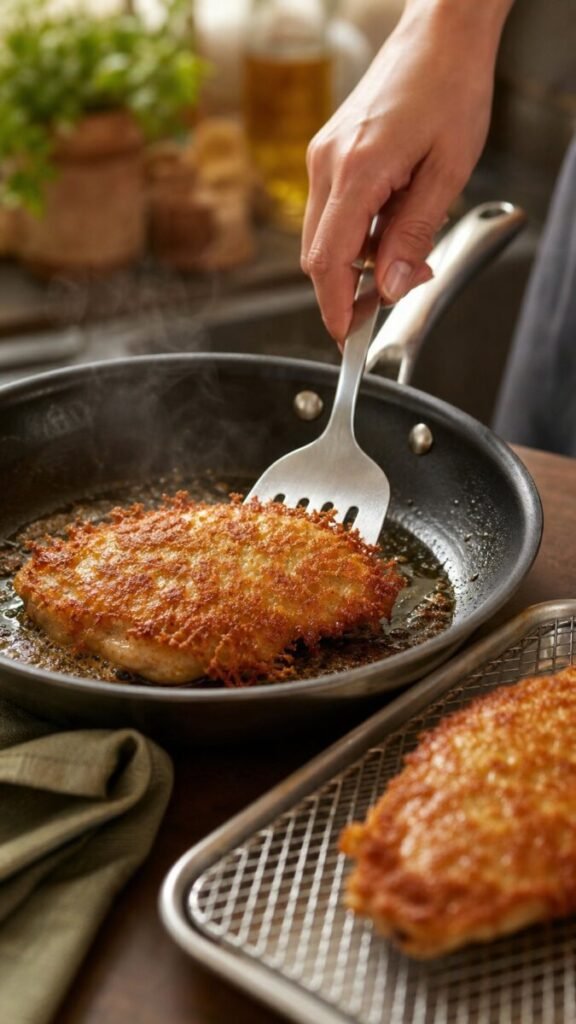
The flip is the recipe’s one moment of care. The crust sets from the edges inward, so watch the rim: when the border of the crust is deep lace-gold and the top is opaque, slide the fish spatula all the way under, and turn it in a single decisive sweep. A hesitant halfway flip is what tears a crust in half. Trust the pan, trust the medium heat, and turn it like you’ve done it before — even if this is the first time.
Ingredients (With Labels)
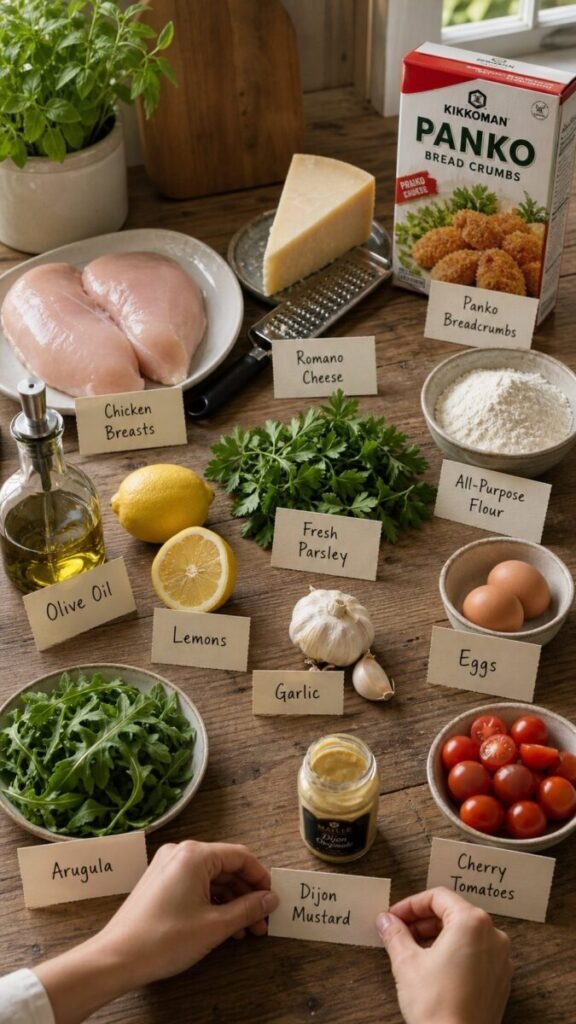
🍗 The Chicken
- Chicken breasts: 2 large, butterflied into 4 cutlets
- All-purpose flour: ⅓ cup, mixed with ½ teaspoon salt and ¼ teaspoon pepper
- Eggs: 2, beaten with 1 tablespoon water
🧀 The Crust
- Romano cheese, finely grated: ¾ cup, from a wedge
- Panko: ¼ cup — the scaffolding
- Flat-leaf parsley: 1 tablespoon, chopped
- Lemon zest: 1 teaspoon, from one of the salad lemons
🫒 To Fry
- Olive oil: 3 tablespoons, plus more for the second round
🥗 The Arugula Half
- Arugula: 5 oz, washed and thoroughly dried
- Cherry tomatoes: 1 cup, halved
- Lemon juice: 3 tablespoons, from 1-2 lemons
- Olive oil: ¼ cup, for the vinaigrette
- Dijon mustard: 1 teaspoon
- Honey: ½ teaspoon
- Garlic: 1 small clove, grated
- Dried oregano: ¼ teaspoon, plus salt and pepper
Step by Step How to Make
- Step 1 — Butterfly and pound. Slice each breast horizontally into two cutlets, lay them between sheets of plastic wrap, and pound to an even half inch — even being the operative word, because a cutlet that’s thick in one place is raw there and dry everywhere else by the time the thin end is done. Pat the pounded cutlets thoroughly dry with paper towels: flour hates a wet surface, and the crust’s grip begins with dryness. Salt them lightly on both sides; most of the seasoning lives in the crust, but the chicken should be able to stand alone if the crust wanders.
- Step 2 — The three dishes. Set out the flour mixed with its salt and pepper, the eggs beaten with the water, and the crust mixture — Romano, panko, parsley, and lemon zest — stirred together in the third dish. Lay them left to right in that order and you’ve built an assembly line your hands will remember on the second cutlet. This is also the moment to zest and juice the lemons, so the vinaigrette’s ingredients are waiting when the frying is done.
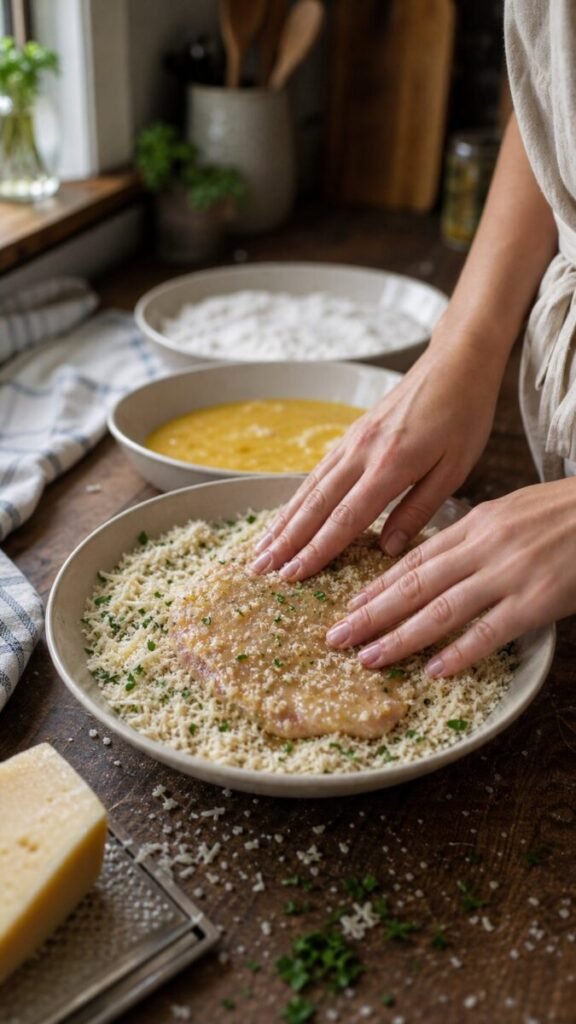
- Step 3 — Crust the cutlets. One cutlet at a time: flour, shake off the excess; egg, let the extra drip back; then lay it in the cheese and press — five seconds a side with your palm, pushing the Romano into the egg so it’s embedded in it rather than parked on it. The egg is the glue, and glue only holds what’s actually touching it. Do all four before the pan goes on, so the frying gets your full attention.
- Step 4 — The fry. Heat the 3 tablespoons of olive oil over medium heat until it shimmers, then lay in two cutlets and leave them be for three to four minutes. Peek at the rim when you can’t stand it: deep lace-gold at the edges means the flip is due, and the top should look opaque and set. Turn with the fish spatula in one committed motion, fry three minutes more, and check for 165°F in the thickest spot. Rest the cutlets on the wire rack while you wipe the pan, refresh the oil, and fry the second pair.
- Step 5 — The jar vinaigrette. While the second pair fries, build the dressing in the jar: lemon juice, the quarter cup of olive oil, Dijon, honey, grated garlic, oregano, and a generous pinch each of salt and pepper. Screw the lid on and shake it hard for fifteen seconds — a vinaigrette is just an emulsion that got motivated — and taste it on a leaf. It should be sharp enough to make you blink once; it’s about to meet a fried cheese crust, and a shy dressing disappears in that meeting.
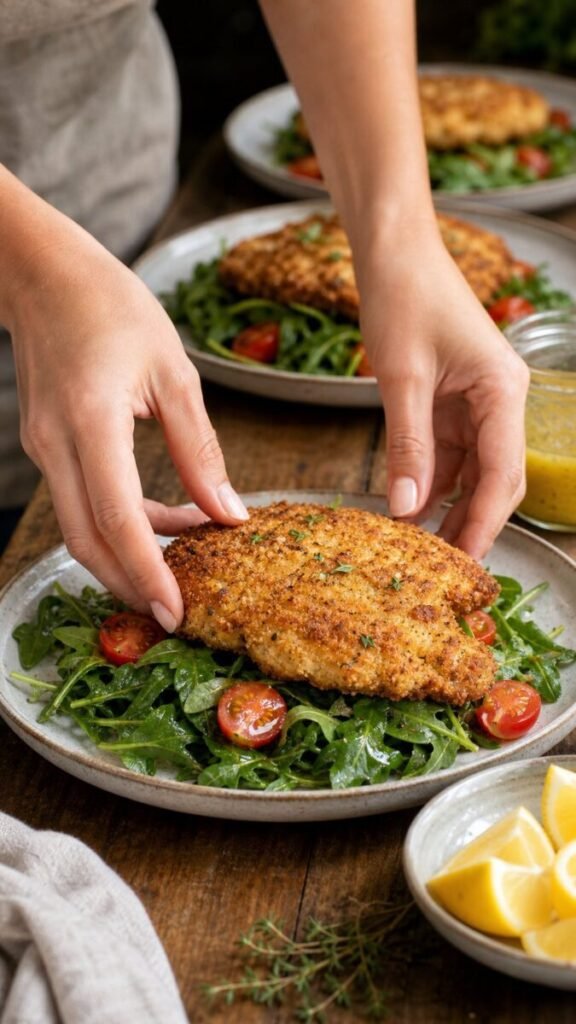
- Step 6 — The plate. Toss the arugula with the tomatoes and just enough vinaigrette to gloss the leaves — dressed at the last second, because arugula wears dressing beautifully for about ten minutes before it starts surrendering. Divide the greens among four plates, set a hot cutlet on top of each heap — the heat wilts the bottom leaves slightly, which is not a flaw but the plan — and finish with a lemon wedge and a few shavings of Romano if the wedge still has opinions left. Serve immediately, with the extra vinaigrette on the table for the people who always want more.
The quick chicken piccata is this dish’s weeknight twin — same lemon, same pan, butter and capers instead of a cheese crust. One of the two covers nearly every chicken mood I have.
Anna’s Kitchen Notes
Buy the wedge, not the green can. Grated-from-a-wedge Romano is moist enough to melt and lace; the shelf-stable stuff is dried and dusted with anti-caking powder, and it fries into something closer to a cheese-flavored freckle than a crust. The wedge keeps for months in the fridge and improves every pasta, soup, and roast vegetable it meets along the way, so nothing goes to waste while you’re waiting to make this again — which, in my house, is about a week.
The pounding is not optional garnish. An even half inch is the difference between a crust that browns while the chicken cooks and a crust that browns while the chicken is still deciding. Ten seconds per cutlet with the mallet, through plastic wrap, working from the center outward — the wrap keeps the meat from tearing and keeps the splatter off the counter, which your weeknight self will appreciate more than your weekend self expects.
Medium is a flavor decision. Every burnt Romano crust I’ve ever been served — and there have been a few — came out of a pan that was too hot. Cheese browns faster than bread, and high heat sends it from pale to bitter in the space of a minute. If your first cutlet darkens before three minutes are up, drop the flame and let the pan settle; the second pair will thank you, and honestly, so will the first pair’s replacement.
Shake the vinaigrette in a jar and make double. The jar method takes fifteen seconds and washes in fifteen more, and a doubled batch keeps a week in the fridge, ready to re-shake over tomorrow’s greens, Tuesday’s tomato sandwich, or a plate of cucumber slices eaten standing at the counter. It’s the lemon-iest dressing I make, and it exists on this site’s dressing shelf alongside the Greek salad dressing I keep in constant rotation.
Feeding six? Pound and crust ahead, fry in waves. The cutlets can be butterflied, pounded, and crusted an hour before dinner and held on a plate in the fridge; the frying runs in the same two-at-a-time waves, with each finished pair resting uncovered on the rack. The crust holds remarkably well for twenty minutes that way, and the last plate served is as crisp as the first — the perk of a cheese crust over a soggy-prone crumb one.
The Italian Table
This plate is a complete dinner on its own — protein, greens, and the dressing that ties them — but it plays beautifully with company. To build the full trattoria evening, start with the creamy Parmesan cannellini soup in small cups while the chicken rests, and put the crispy onion Parmesan chips out for the pre-dinner graze — same cheese family, same crunch doctrine, and they vanish while you set the table.
For a starch beside the cutlets, the garlic butter orzo is the natural landing pad — it catches the vinaigrette that runs off the greens, which is a sauce you did not have to make. And when you want the lighter lunch version of this same idea, slice a leftover cutlet over a fresh heap of arugula with the marinated tomato treatment on the side; the restaurant plates something like it, and the home version costs about one-fourteenth of the mall parking situation.
Same Crust, Other Cutlets
The full frico, for purists. Drop the panko entirely and press the cutlets into Romano alone — the crust comes out thinner, more lacy, more dramatic, and slightly more fragile. Use a well-seasoned pan, keep the heat firmly medium, and accept that the first cutlet is a rehearsal. This is as close to the restaurant’s version as my notepad ever got.
Turkey cutlets. Same pound, same crust, same pan — turkey takes the Romano shell beautifully and the dish turns into the dinner I make when chicken has been chicken too many nights in a row. The carryover finishing is even more useful with turkey, so pull the pan off the heat a breath early.
The chicken parm pivot. Lay the fried cutlets in a baking dish with a spoonful of good marinara and a slice of mozzarella, and run them under the broiler for two minutes. That’s chicken parmesan, which is this recipe’s closest cousin and the one my youngest orders by pointing at the cheese drawer.
Lemon-caper butter, the piccata bridge. While the last cutlets rest, melt two tablespoons of butter in the wiped pan with a teaspoon of drained capers and a squeeze of lemon, and spoon it over the crusts. Now the dish is halfway back to its piccata roots — the two recipes shaking hands across the week.
Pork cutlets, the Milanese route. Thin pork loin cutlets take this exact crust and turn the dish toward its Italian deli relatives. Serve with the same arugula and an extra squeeze of lemon, and call it what the restaurants call it: a very good Tuesday.
The Dinner Math
| Nutrient | Per Serving (1 cutlet + dressed salad) |
|---|---|
| Calories | 470 kcal |
| Protein | 45 g |
| Carbohydrates | 10 g |
| Fats | 25 g |
Estimates as written, full cheese ration and the vinaigrette counted, extra Romano shavings on top left to your own conscience. Forty-five grams of protein is the number that surprises people — a butterflied breast half is a serious piece of chicken, and the crust’s eggs and cheese add their own — and ten grams of carbohydrates is what a cheese-first crust looks like on paper. The money math is quieter but real: four plates of this run me about eleven dollars, against the restaurant’s seventeen-plus per plate before the parking garage gets involved. The copycat pays for the notepad by the second batch.
The Day-After Plate
A leftover crusted cutlet keeps three days in the fridge, and its second act is nearly as good as its first. The re-crisp is a dry skillet: three minutes over medium, crust-side down first, with nothing in the pan — the Romano re-laces in its own residual fat, and it comes back so close to fresh that I’ve stopped being surprised. The microwave softens the crust into chewiness in under a minute, so it’s the option of last resort, reserved for lunches eaten standing up.
The best leftover format, though, is the cold one: slice the cutlet thin and lay it over a new bowl of arugula with the vinaigrette that’s still in the jar. The crust softens to a savory crumb coating, the chicken is excellent cold, and the whole thing becomes the office lunch that makes coworkers ask where you ordered from. The answer, “my own kitchen, last night,” is delivered best with a shrug.
The vinaigrette keeps a week in its jar — shake before each use, since a resting vinaigrette separates and a shaken one reforms, no hard feelings. And if you’re planning ahead for a crowd, the crusted-raw cutlets hold in the fridge for an hour as described in the notes, which makes this one of the few fried-adjacent dinners I’ll serve to company without a sequence of apologies.
Where It Goes Wrong
The crust slid off in the pan. The chain broke at its weakest link: a wet chicken surface the flour couldn’t grip, cheese sprinkled instead of pressed, or a flip attempted before the crust had set. Dry the cutlets like you mean it, push the Romano into the egg rather than onto it, and let the rim tell you when the flip is due. The chain — dry chicken to flour to egg to cheese to lace — holds only if every link does.
Burnt lace, raw middle. The pan was too hot, full stop. Cheese out-browns breadcrumbs by a mile, and a Romano crust scorches in the time a panko one would still be pale. Medium heat, a sizzle no louder than the exhaust fan, and the patience to let three full minutes pass — if the first side darkens early, lift the cutlet off the heat for ten seconds and drop the flame before the second side pays for it.
A pale, greasy crust. The opposite failure, and it means the oil was cool when the cutlet went in — a cool pan lets the cheese melt into the oil instead of frying shut against the chicken. Heat the oil until it shimmers and thins out before the first cutlet enters, and between rounds, let it come back to a shimmer before the next pair. A hot-enough pan is the difference between a crust and a cheese-flavored oil slick.
Bland on the first bite. Two suspects: the flour skipped its salt and pepper, or the Romano was the mild pre-grated kind. The seasoning of this dish lives in its crust, and the crust is only as seasoned as the cheese and flour going into it — salt the flour, buy the wedge with the sharp bite, and add the lemon zest, which does more brightening per teaspoon than anything else in the recipe.
Soggy greens under a good cutlet. The arugula was dressed too early, or it went to the plate wet from washing. Dress at the last second, dry the leaves thoroughly, and remember the cutlet’s job is to wilt only the bottom leaves slightly — a puddle at the bottom of the plate means the greens brought their own water to the meeting. A salad spinner or a good hour of air-drying solves it permanently.
Dry, stringy cutlets. The pounding was uneven, or the chicken cooked past done. An uneven cutlet is done at different times in different places, which is why the mallet gets ten seconds per piece; and a breast half this thin needs exactly its minutes, not a safety margin — pull at 165°F and let the rest finish the work. The crust protects the surface, but nothing protects a cutlet from an extra three minutes of optimism.
Romano Questions
Can I use Parmesan instead of Romano?
Yes, and the crust will be golden and crunchy and a little gentler — Parmesan is nuttier and milder, and it fries beautifully. You lose the sharp, sheepy bite that makes the restaurant version taste like it does, which is why the dish carries Romano’s name. My standing recommendation is a fifty-fifty blend for the first batch, then adjust toward whichever direction your table votes.
Can I bake or air-fry the cutlets instead?
You can, with expectations set. Oven at 400°F on a wire rack over a sheet pan, 15 to 18 minutes flipped once, with a spritz of oil over the crust — the lace goes softer and more granola-ish, but the flavor holds. The air fryer at 375°F for 12 to 14 minutes lands closer to the pan version. Neither route delivers true lace; both deliver dinner on a weeknight, which counts for more.
What if I can only find the green can of Romano?
It works better here than its reputation suggests — the granules are dry, so they fry rather than melt, and the crust comes out more freckled than lacy. Press it on extra firmly, expect a slightly quieter flavor, and buy a wedge for next time. The wedge is the version that made me keep the recipe; the can is the version that keeps it possible.
Can I make this ahead for company?
Yes — butterfly, pound, and crust up to an hour ahead, hold the cutlets uncovered in the fridge, and fry in waves as your guests find their seats. The crust holds twenty minutes on the rack without complaint, which is longer than most fried things can say. What you can’t do ahead: dress the arugula, which waits for the last second, always.
Is this gluten-free?
Not as written — the flour dusting and the panko scaffold are both wheat. It converts cleanly, though: a gluten-free flour blend works in the dusting, GF panko exists and toasts well, and the full-frico variation skips the crumb entirely, which is the most delicious workaround on the list. The vinaigrette and the salad never had gluten to begin with.
Can I use chicken thighs instead?
You can — flatten boneless thighs lightly to an even thickness and proceed exactly as written. Thighs stay juicier and their flavor stands up nicely to the Romano, but the classic dish is a breast cutlet, and the wide, thin shape is part of the experience — the crust-to-chicken ratio is the whole point of the pounding. I make the thigh version when breasts are sold out and admit nothing.
What do I do with the leftover wedge of Romano?
Everything. Grate it over pasta and roast vegetables, drop a chunk into the next pot of white bean soup, shave it over the arugula salads you’ll now be making to justify this recipe — a wedge of Romano is the hardest-working object in my cheese drawer and it never once complains. If it dries out, it grates finer and goes further, which is the opposite of a problem.
Easy Cheesecake Factory Crusted Chicken Romano
Ingredients
As an Amazon Associate I earn from qualifying purchases.
Chicken & dredge
- 2 large boneless, skinless chicken breasts, about 1½ lb / 680 g total, sliced horizontally into 4 cutlets
- ⅓ cup all-purpose flour
- ½ teaspoon fine salt, for the flour
- ¼ teaspoon ground black pepper, for the flour
- 2 large eggs
- 1 tablespoon water, for the egg wash
Romano crust
- ¾ cup (about 60 g) finely grated Romano cheese, preferably grated from a wedge
- ¼ cup panko breadcrumbs
- 1 tablespoon finely chopped flat-leaf parsley
- 1 teaspoon finely grated lemon zest, taken before juicing the lemons
For pan-frying
- 3 tablespoons olive oil, plus 1–2 tablespoons as needed for the second batch
Arugula salad & lemon vinaigrette
- 5 oz (142 g) arugula, washed and thoroughly dried
- 1 cup cherry tomatoes, halved
- 3 tablespoons fresh lemon juice, from 1–2 lemons
- ¼ cup extra-virgin olive oil
- 1 teaspoon Dijon mustard
- ½ teaspoon honey
- 1 small clove garlic, finely grated
- ¼ teaspoon dried oregano
- Salt and black pepper, to taste
- Extra lemon wedges and Romano shavings, optional, for serving
Kitchen Tools
- Large 12-inch nonstick or well-seasoned skillet
- Thin fish spatula, compatible with the pan’s surface
- Meat mallet and food-safe plastic wrap
- Three shallow breading dishes
- Fine grater or zester
- Jar with a tight-fitting lid
- Instant-read meat thermometer
- Oven-safe wire rack and rimmed sheet pan
- Salad spinner and salad bowl
- Chef’s knife and cutting boards, keeping raw poultry separate from salad ingredients
- Measuring cups and spoons
Directions
- Prepare the salad ingredients and dressing. Wash and thoroughly dry the arugula, halve the tomatoes, and set aside without dressing. Zest the lemon for the crust, then measure 3 tablespoons juice into the jar. Add the ¼ cup olive oil, Dijon, honey, garlic, oregano, and a small pinch each of salt and pepper. Close tightly and shake until combined. Taste and adjust the dressing before handling raw chicken.
- Slice and flatten the chicken. On a separate board, slice each chicken breast horizontally all the way through to make 4 cutlets. Place between sheets of plastic wrap and gently pound to an even ½-inch thickness. Pat dry with paper towels; do not rinse raw chicken. The seasoned flour and Romano provide salt, so additional salt on the meat is not necessary. Wash hands and clean surfaces after handling the chicken.
- Build and apply the Romano crust. In the first shallow dish, combine the flour, ½ teaspoon salt, and ¼ teaspoon pepper. In the second, beat the eggs with 1 tablespoon water. In the third, mix the Romano, panko, parsley, and lemon zest. Lightly coat each cutlet in flour, shaking off excess, then dip in egg and let excess drip off. Press both sides firmly into the cheese mixture and place on a tray. Discard leftover coating ingredients that contacted raw poultry.
- Pan-fry the first batch. Heat 3 tablespoons olive oil in the skillet over medium heat until shimmering but not smoking. Add two cutlets without crowding. Cook undisturbed for about 3–4 minutes, checking the edges for a golden, set crust. Slide a thin spatula fully underneath and turn carefully. Cook the second side for about 3–4 minutes, or until the thickest part reaches 165°F. Adjust the heat downward if the cheese darkens too quickly. If the crust is browned before the center is cooked, finish the cutlets on an oven-safe rack over a sheet pan in a preheated 350°F oven until they reach 165°F.
- Refresh the pan and finish cooking. Transfer fully cooked cutlets to a clean rack using a clean utensil. Take the skillet off the heat and carefully remove loose browned cheese bits with a heat-safe utensil. If a thorough wipe is needed, let the pan and oil cool enough to handle safely; never wipe hot oil with a bare hand or add water. Add 1–2 tablespoons fresh oil as needed, return to medium heat, and cook the remaining cutlets in the same way, checking each for 165°F rather than relying on color or timing.
- Dress the greens and plate immediately. Shake the vinaigrette again. Toss the arugula and tomatoes with just enough dressing to lightly coat them, reserving the remainder for the table. Divide among four plates and top each with a hot chicken cutlet. Add optional lemon wedges and Romano shavings. Serve immediately for the crispest crust. Allow about 35–45 minutes overall, depending on preparation speed and pan recovery between batches. Refrigerate leftover chicken and dressing separately within 2 hours, or 1 hour above 90°F, and use within 3–4 days. Reheat chicken to 165°F before serving hot.
Nutrition
| Nutrient | Approximate amount per serving |
|---|---|
| Serving size | 1 cutlet with ¼ of the salad and dressing |
| Calories | 570 kcal |
| Protein | 47 g |
| Carbohydrates | 15 g |
| Total fat | 35 g |
Rough estimates assume 680 g raw chicken breast, 60 g Romano, approximately three-quarters of the dry coating, one egg’s worth of retained egg wash, 3 tablespoons frying oil retained across the batch, and the full vinaigrette. Using less dressing lowers the estimate; extra absorbed frying oil increases it. Excludes optional Romano shavings and side dishes. Actual values vary with chicken size, coating retention, and brands. Contains wheat, egg, and milk. These are estimates for this homemade version, not the restaurant’s nutrition information.