Pesto Chicken Flatbread with Mozzarella
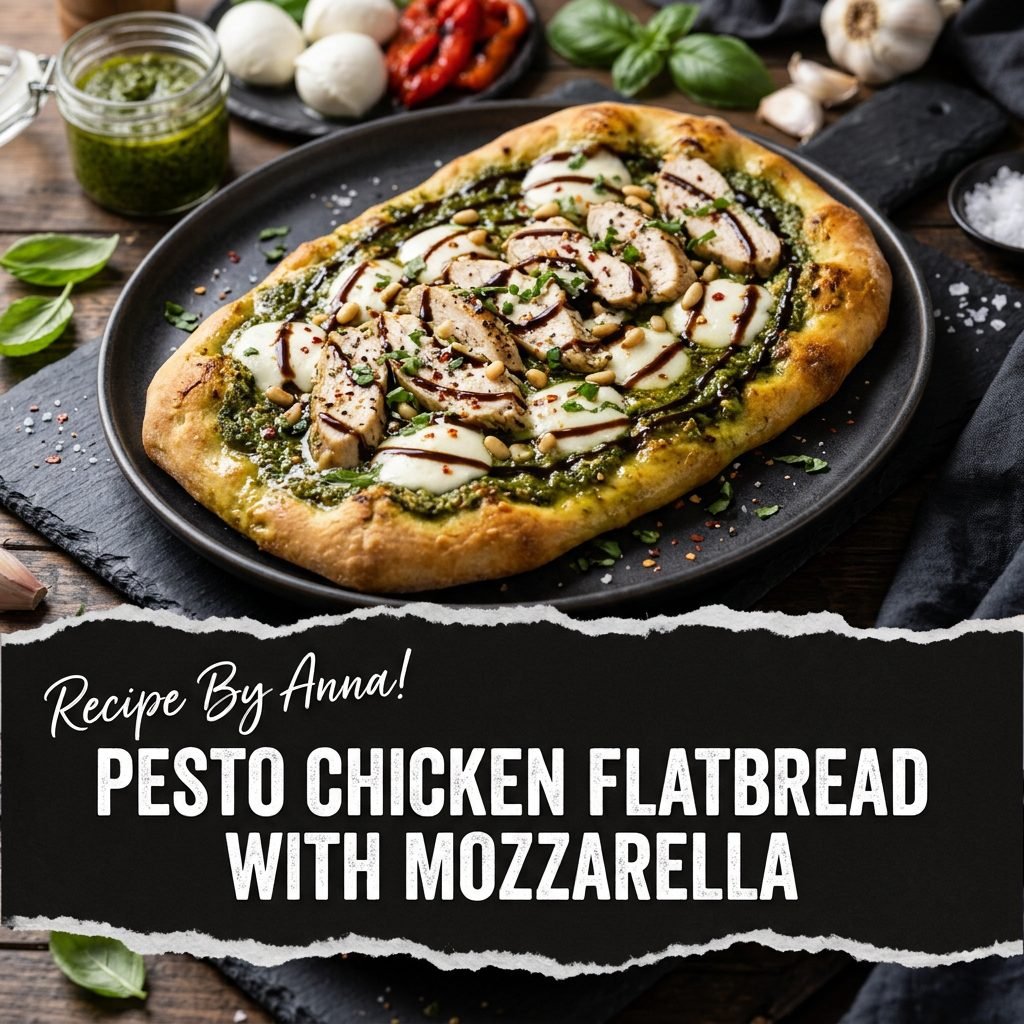
Every kitchen needs a dinner that looks like takeout and takes less time than the delivery estimate. This is mine: a store-bought flatbread turned pizza-adjacent with a thin sweep of pesto, chunks of chicken seared in garlic butter, and a serious quantity of mozzarella, baked until the cheese crosses from melted to actively bubbling and the edges of the bread turn crisp and golden. Cut into wedges, scattered with basil at the last second, eaten with hands or a fork depending on the day’s dignity level. Thirty-five minutes, one sheet pan, and a dinner that makes the whole kitchen smell like an Italian bakery that takes itself seriously.
The difference between a good version of this flatbread and a floppy, disappointing one is entirely architectural. Most recipes assemble everything on a cold base and bake once, which gives the cheese exactly enough time to melt and the bread exactly not enough time to crisp — the classic soggy-bottomed flatbread everyone has eaten at someone else’s house. This recipe bakes twice, on purpose: the base goes into the oven naked first, just long enough to dry out and stiffen into something that can carry a topping, and only then do the pesto, chicken, and cheese arrive for their short, hot, final melt. The base gets crisp; the cheese gets gooey; nothing gets sacrificed to the other. It’s the same compromise every good pizza oven solves with temperature, solved here with scheduling.
Shelf notes, as this site keeps them: the flatbread shelf has a za’atar-topped manakish and a focaccia, the pesto mentions around here are all guest appearances, and the chicken dinner shelf is crowded with worthies. This post is the combination nobody had written down yet — and it links the house breads and the house chicken favorites along the way. The base, if you want to go full homemade, has an in-house route covered below.’
The Two-Bake Build
The build runs on three rules, and each one is doing structural work. Rule one is the naked bake: the flatbreads go into a hot oven empty — brushed with olive oil, nothing else — for six minutes before any topping touches them. Those six minutes drive off the surface moisture that would otherwise spend the main bake steaming the bread from underneath, and they set the starches into a preliminary crispness that the second bake only deepens. It’s the same logic as toasting bread before making a sandwich, and it’s the single step that separates a flatbread you can pick up from one you have to fork.
Rule two is the strata — the order of the layers, which matters more than any single ingredient. Pesto first, spread thin, because pesto is a loud sauce and a thick coat commandeers the whole dish while a thin one seasons it. Then half the mozzarella, directly on the pesto — this under-layer is the glue that anchors the chicken and keeps it from sliding around at cut time. Then the chicken and the tomatoes, then the second half of the mozzarella over everything, where it has one job: melt into a blanket that holds the toppings down and browns under the broiler. Cheese under as structure, cheese over as lid. Skip the strata and pile it all on flat, and the first wedge you lift arrives half-dressed.
Rule three is the one everyone gets wrong: the basil goes on after the oven. Basil in a hot oven for ten minutes doesn’t intensify — it expires. The leaves blacken at the edges, turn dry and papery, and take on a dusty, oxidized flavor that reads as nothing so much as missed opportunity. Fresh basil, torn and scattered over the hot flatbread in the last moments, does the opposite: the residual heat releases its oils, the leaves barely wilt, and every bite gets that green, summery top note that made you want pesto in the first place. The pesto is the cooked basil; the fresh basil is its encore. Both belong, in that order.
⏱️ 35 MINUTES, ONE SHEET PAN | 🍕 SERVES 4 | 🌿 CRISP BASE, BROILED MELT, BASIL LAST
- Prep Time: 15 minutes — chunking and searing the chicken, slicing
- Naked Bake: 6 minutes at 425°F for the empty bases
- Second Bake: 8-10 minutes, then 1-2 under the broiler
- Total Time: about 35 minutes, start to wedges
- Yield: 2 large flatbreads — 4 dinners or 8 wedges-as-appetizers
The Sear First
Equipment is minimal, and one decision deserves its own paragraph:
- Sheet pan and parchment — the whole life of the flatbread happens here; parchment keeps the cheese from welding
- Large skillet — for the chicken; cast iron if you have it, any heavy pan if you don’t
- Pastry brush or the back of a spoon — for the olive oil on the naked bases
- Pizza cutter or sharp chef’s knife — for the wedges; a rocker is a luxury, not a requirement
- Tongs — for turning chicken and moving hot flatbreads with composure
The decision: what base, and what chicken. On the base — store-bought flatbreads (the large, roughly 9-inch ones) are the intended path, and naan is the better cousin: thicker, blistery, and structurally closer to what this recipe wants than thin tortilla-style wraps, which will never fully crisp and belong to different recipes entirely. If you want to bake the base itself, the focaccia dough pressed thin makes an extraordinary version — extra time, extra reward — and the homemade route has its own write-up below. On the chicken: raw breasts, chunked and seared, is the flavor lane this recipe was built around, and a shredded rotisserie is the legitimate shortcut lane, covered honestly in the Questions.
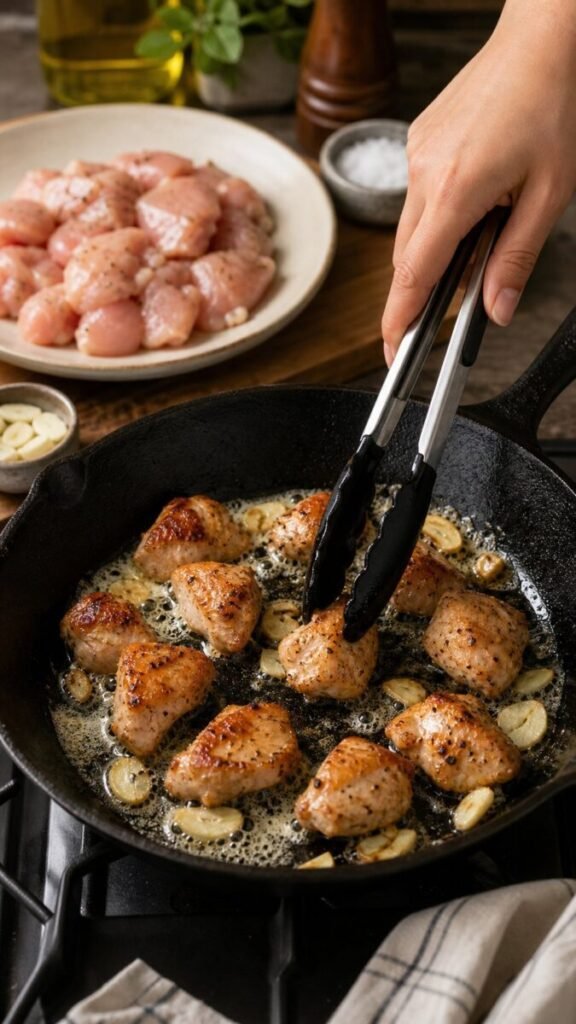
And the sear itself, because it’s the only real cooking in the recipe: cubed chicken breast, patted dry, seasoned, dropped into a skillet where garlic and butter have already met. Patting dry is not ceremony — wet chicken steams gray in the pan, dry chicken browns, and browning is where the flavor in this whole dish gets manufactured. The chunks should sizzle on contact and sit undisturbed long enough to take color on one side before you turn them, which is the whole difference between chicken that tastes like an ingredient and chicken that tastes like a topping. A meaty golden crust on the outside, just-cooked within, out of the pan and onto a plate to wait. The oven will finish nothing — the chicken arrives at the flatbread already done, so the second bake is free to focus entirely on cheese and bread.
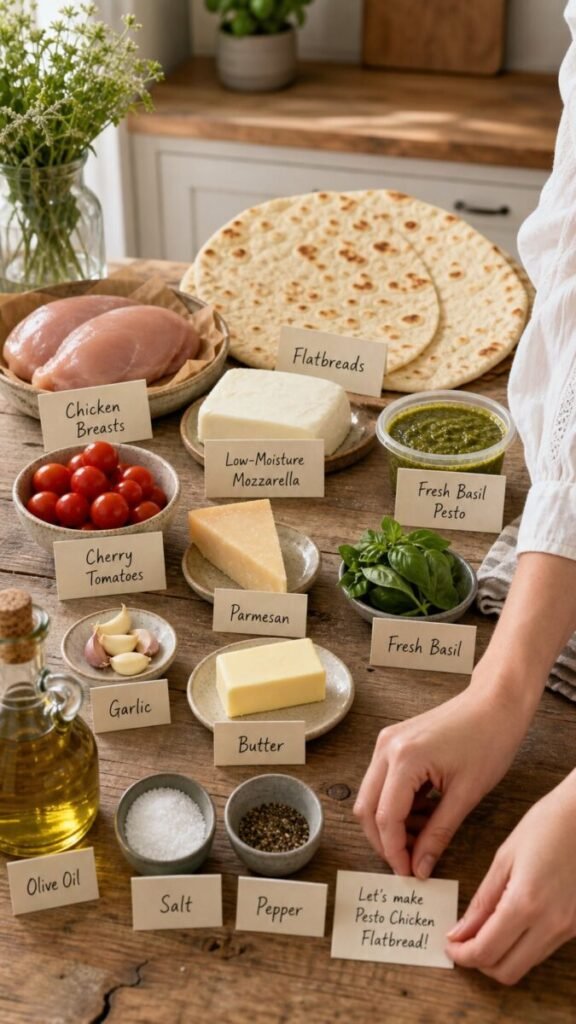
Ingredients (With Labels)
🌿 The Pesto
- Basil pesto: ½ cup — refrigerated fresh or homemade; shelf-stable jars taste like the aisle they live in
🍗 The Seared Chicken
- Boneless skinless chicken breasts: 1 lb — 2 average breasts, cut into ¾-inch chunks
- Butter: 1 tablespoon
- Garlic: 2 cloves, sliced
- Salt and black pepper: ½ teaspoon salt, ¼ teaspoon pepper, on the chicken
🧀 The Strata
- Large flatbreads: 2 — naan-style, about 9 inches
- Low-moisture mozzarella: 8 oz, shredded — low-moisture, not fresh: this is a melt job, not a caprese
- Cherry tomatoes: 1 cup, halved
- Grated parmesan: ¼ cup, for the top dust
- Olive oil: for brushing the naked bases
🍅 The Fresh Top
- Fresh basil: 12-15 leaves, torn — on after the oven, never before
- Red pepper flakes and olive oil: for the finish, to taste
Step by Step How to Make
- Step 1 — The sear. Heat the oven to 425°F with the sheet pan inside — an empty pan heating now is a hot landing pad for the flatbreads in a minute. Cube the chicken, pat it dry with a paper towel, and season it with the salt and pepper. Melt the butter in the skillet over medium-high heat, add the garlic slices, and let them sizzle for thirty seconds until fragrant but pale. Then the chicken goes in — listen for the sizzle, because a quiet pan means a steaming pan — and leave it alone for three full minutes to take color on the underside before turning. Six to eight minutes total, turning every few minutes, until the chunks are golden in patches and cooked through. Out of the pan and onto a plate to rest. The resting is real: juices redistribute, and the chicken will finish nothing in the oven, so this is its texture, set now.
- Step 2 — The naked bake. Pull the hot sheet pan from the oven, lay the two flatbreads on it, and brush their tops with olive oil — edge to edge, including the rim, where the oil will help the border turn golden and brittle. Into the oven, empty, for 6 minutes. They’ll puff gently in the middle, blister lightly, and come out matte and stiffened — a base that has already lost its surface moisture and can now carry a topping without steaming itself. This is the step the whole architecture stands on, and it costs six minutes of nothing else happening.
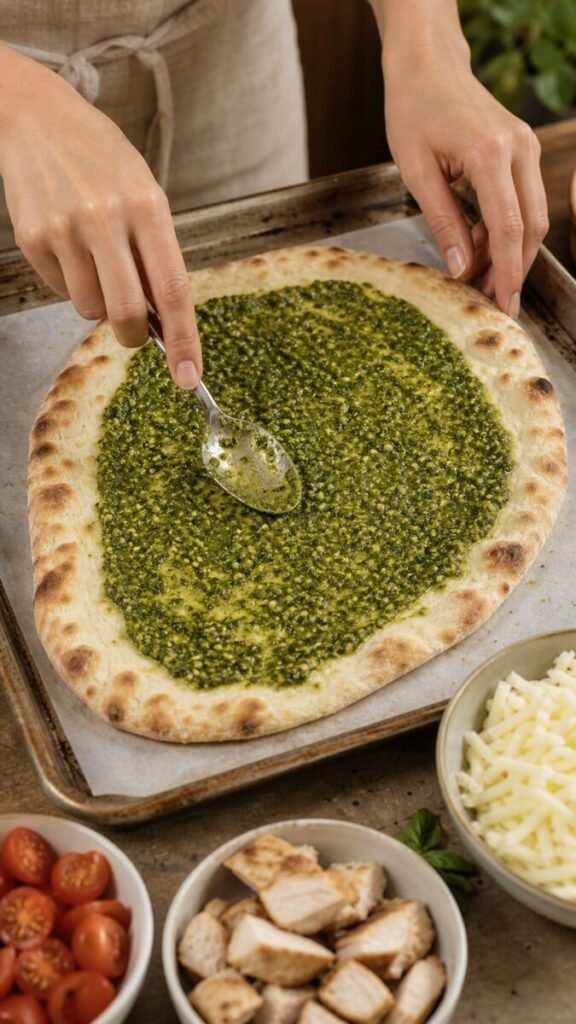
- Step 3 — The strata. Out of the oven, and the layering happens fast, in order, on the hot bases. Pesto first: a quarter cup per flatbread, spread thin with the back of a spoon, all the way to a finger-width of bare border — the sauce under the border would soak the crisp edge you’re about to build. Half the mozzarella over the pesto, the seared chicken spread across, the tomato halves scattered, then the remaining mozzarella over the top of everything and a dusting of parmesan across the cheese. Under-layer as glue, over-layer as blanket. The parmesan is up there for a reason: it browns faster than mozzarella melts, and its tan spots are the visual cue you’ll use in the next step.
- Step 4 — The melt. Back into the 425°F oven for 8 to 10 minutes, until the mozzarella has gone from shredded to fully liquid and bubbling at the edges of the pools. Then the last move, which I think of as the melt point: switch the oven to broil, slide the pan up to the top rack, and give the flatbreads one to two minutes of direct heat. The cheese browns in spots, the exposed tomato edges char lightly, the border of the bread goes from golden to genuinely crisp. Stand there and watch it — the distance between broiled and burnt is about forty seconds, and this is the one moment in the recipe that requires an audience. Pull the pan the moment the spots look right; the cheese will keep darkening on the hot pan for another half-minute after.
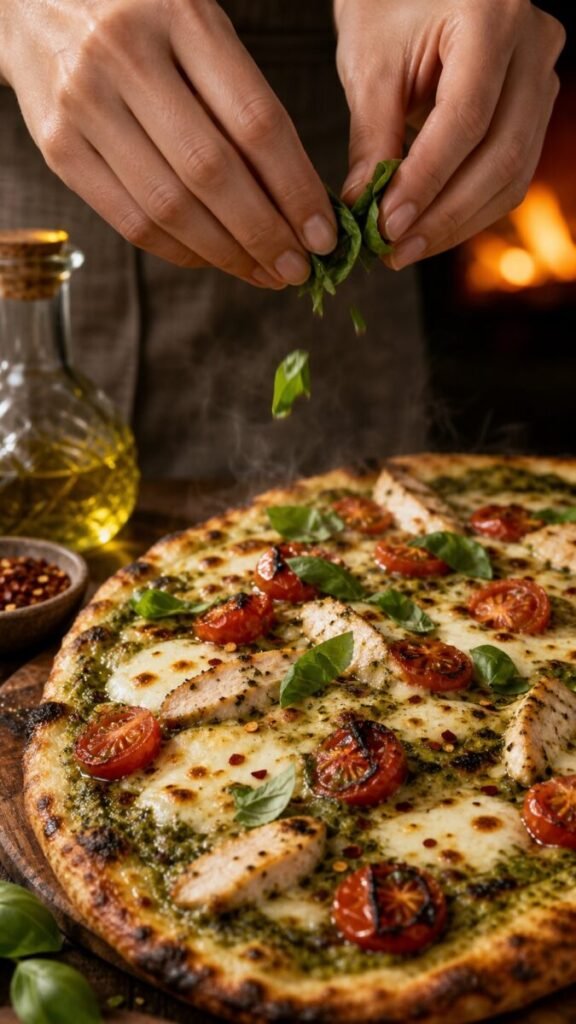
- Step 5 — The fresh top. The flatbreads come out, and everything raw and green happens now, while the cheese is still molten: torn basil scattered across both, a pinch of red pepper flakes for the heat-inclined, and a thin thread of olive oil around the border where it will soak into the crisp edge. Give them two minutes of rest before cutting — the cheese tightens just enough to hold a wedge together instead of stringing across the whole sheet pan, and the tomatoes cool from lava to merely hot.
- Step 6 — The wedges. Cut each flatbread into quarters with the pizza cutter, one confident pass per line — sawing drags the toppings. Lift the first wedge and check the bottom: it should be dry, freckled with golden brown, and stiff enough to hold level with the toppings on top. That’s the two-bake architecture, visible from underneath. Serve them stacked or fanned, napkins within reach, and if you’re feeding a crowd as an appetizer, cut the quarters into eighths and watch them disappear at a speed that will make you wish you’d made the second sheet.
Make the base yourself and the whole dish moves up a class: the no-yeast naan comes together in minutes flat, bakes into the same blistered base this recipe is built on, and turns a 35-minute dinner into the only one on the block with a house-made foundation.
Anna’s Kitchen Notes
Low-moisture mozzarella, and not a negotiation. Fresh mozzarella — the kind in water — is a beautiful thing in a cold salad and a liability on a hot flatbread: it holds its liquid, weeps it out in the oven, and turns the center of the bread into a swamp with a cheese flavor. Low-moisture mozzarella, the dense blocks sold dry, melts smooth, browns under the broiler, and behaves. Shred it yourself today, too — the pre-shredded bags are dusted with anti-caking starch that slows the melt and leaves the cheese slightly grainy, a small tax that compounds across eight ounces. Two minutes with a grater avoids the whole issue.
Jarred pesto, honestly rated. The refrigerated fresh pesto near the cheese counter is a genuinely good product and the honest shortcut. The shelf-stable jar in the pasta aisle is a different food — cooked-tasting, faintly metallic, all basil’s cousins and none of its brightness. If the jar is what’s in the pantry, use it and add the finish that wakes it up: an extra squeeze of lemon and the fresh basil on top doing double duty. Homemade pesto is a Saturday move and a lovely one; on the weeknights this recipe actually happens, the refrigerated tub is the answer I stand behind.
The rotisserie lane, honestly rated. A shredded store rotisserie in place of the seared chunks saves the skillet work and about ten minutes, and the flatbread comes out roughly 85 percent as good — what you lose is the garlic-butter fond, the browned crust on the chicken, and the pan juices, which are three flavors the full version leans on. To narrow the gap, toss the shredded rotisserie with a minced garlic clove and a teaspoon of olive oil before it goes on the flatbread. Both lanes end in a good dinner; only one of them smells like garlic butter while it happens.
One sheet pan or two? Two flatbreads fit a standard half-sheet with room to spare, and four will not — for a crowd, use two pans and swap their rack positions at the halfway mark of the second bake. What you can’t do is crowd four onto one pan and let the edges touch: overlapping borders steam instead of crisping, and the whole two-bake doctrine quietly fails at the point of contact. The pans are cheap; the architecture is not worth compromising.
The fold test. Before you commit to hands, fold the outermost wedge gently in half over itself. A crisp-based flatbread folds like a taco and holds; a steamed one buckles and sheds its toppings at the fold line. If the fold fails, don’t announce it — fork, knife, and nobody at the table will know the base underachieved. But run the test in the kitchen, because it tells you whether the naked bake needs another minute next time, and the answer is almost always yes.
The Flatbread Table
This flatbread is a self-contained dinner, but it likes the company of anything sharp and cold. A simple green salad with the house Greek dressing is the classic pairing — its vinegar cuts the mozzarella’s richness between wedges — and the roasted Mediterranean vegetables served just warm make the meal feel deliberately arranged rather than assembled. For a bigger spread, a bowl of the creamy parmesan tomato and cannellini soup turns wedges plus soup into the kind of dinner that ends with someone dragging the last wedge around the bowl.
For the rotation around it: the quick chicken piccata is the other weeknight chicken worth repeating monthly, and the garlic butter chicken thighs share this recipe’s fondness for garlic in hot butter — make all three in a two-week span and you’ll notice they shop alike: chicken, garlic, butter, parmesan, one fresh herb. That’s not a coincidence; that’s a grocery list that has learned your habits.
Same Flatbread, Other Toppings
The caprese build. Skip the chicken, double the tomatoes, and add thin shavings of the fresh mozzarella you weren’t allowed to melt — dropped on after the bake, where the residual heat softens it into cream. Basil last, as always. This is the meatless weeknight version, and it eats like June.
The prosciutto-and-arugula build. No chicken, and the prosciutto goes on after the oven, curled over the hot cheese where it barely warms and stays silky. Arugula dressed with lemon and olive oil piled on top, a scatter of parmesan. No broiler needed — the meat and greens ride the cheese’s heat. This is the version for a dinner that started as a lunch and got ideas.
The sausage version. Italian sausage, casings removed, browned in the skillet where the garlic butter was — same strata, same everything else. Fennel and pesto turn out to be close friends, and this is the version I make when the flatbread is the whole meal and nobody’s counting lightness.
The white-bean build. Cannellini beans drained and crushed lightly with a fork, lemon zest, and garlic stirred into the pesto — a vegetarian protein that holds its own under the mozzarella. The strata carries it; the crunch comes from a finishing handful of toasted pine nuts instead of nothing. Quietly one of the best versions I’ve made.
The hot-honey finish. Everything as written, plus a thin drizzle of hot honey over the fresh basil — sweet, spicy, salty, rich, all four corners of the flavor map. The first time I tried it I assumed it was a gimmick; the third time I made it in a month, I stopped pretending. Keep the honey thread thin: this is a seasoning, not a syrup situation.
The breakfast conversion. Pesto, mozzarella, and a cracked egg on each flatbread for the last three minutes of the bake — the white sets, the yolk stays loose, and the wedge gets dragged through it. Black pepper over everything. Sunday brunch handles sold separately.
The Flatbread Math
| Nutrient | Per Serving (half a flatbread, of 4) |
|---|---|
| Calories | 580 kcal |
| Protein | 42 g |
| Carbohydrates | 45 g |
| Fats | 26 g |
Estimates as written — real seared chicken, full mozzarella, the pesto counted honestly by the tablespoon. Forty-two grams of protein per half-flatbread is the number that makes this a legitimate weeknight dinner rather than an appetizer that got ambitious — the chicken and the mozzarella are both pulling real weight. The money math rounds out the argument: flatbreads, a pound of chicken, a tub of pesto, and eight ounces of mozzarella run about twelve dollars for four dinners, which is less than one delivery order, arrives exactly when you decide it arrives, and involves no one’s car idling outside your house.
The Second Slice
Storage, and the reheating doctrine that keeps day two honest. The flatbreads keep two days in the fridge, covered, and the enemy of the leftover is the microwave, which softens the crisp base into bread-flavored regret. The resurrecting move is a dry skillet: medium heat, the wedge base-down, lid off, three to four minutes, while the cheese re-melts from below and the base re-crisps exactly the way it got there in the first place. A toaster oven or the regular oven at 400°F for six minutes does the same job with less watching.
The broiled spots survive the fridge; the basil does not — day-old basil is dark and defeated, so pick it off before storing and re-crown at the reheat with a fresh leaf or two, or skip it and let the pesto carry the green alone. Fresh tomato halves reheat fine but release a little juice on the second pass; if that bothers you, day-two is the prosciutto’s moment to shine in its place.
Unbaked, the assembled flatbread freezes — but honestly, poorly: the tomato thaws wet, the mozzarella weeps on the thaw, and the naked bake’s whole point was moisture control. The better freezer play is components: sear a double batch of the garlic-butter chicken and freeze it in a bag, and a future flatbread is ten minutes of assembly away. The dough route freezes even better, if you’ve gone homemade — parbaked bases freeze beautifully, and go from freezer to sheet pan to toppings with no thawing at all.
Where It Goes Wrong
The soggy bottom. The classic failure, and it means the architecture got skipped: no naked bake, a base crowned cold onto a cold pan, or pesto spread all the way to the edge and soaked the border. The fix is always upstream — six empty minutes, a hot pan, a bare finger-width of border. If the wedge is already floppy at dinner, the fork is the fallback, and the fold test in the Notes will tell you exactly which corner got skipped.
The gray chicken. Chunks that went into the pan wet, or got turned every thirty seconds by an anxious spatula: no color, no crust, and a topping that tastes like protein rather than dinner. Dry the cubes with a paper towel, put them down in one layer, and let the skillet do its work for three uninterrupted minutes. Browning is flavor being manufactured in real time, and it cannot be rushed — only watched.
The pesto takeover. One bite in three tastes only of pesto — the layer went on thick, and a loud sauce ran the whole flatbread. Pesto at a quarter cup per large base is a seasoning with presence; at half a cup it’s a coup. If the jar you bought is especially fierce, start with two tablespoons, taste the first wedge, and add more at the table — the fresh top is a better place for excess enthusiasm than the oven.
The burnt minute. Dark spots everywhere, bitter edges, tomatoes gone to charcoal — the broiler ran unwatched, because the melt point is quick and merciless. One to two minutes is the window, and the pan keeps browning for a few seconds after it leaves the oven, so pull it while the spots still look slightly pale for your target. Stand at the oven for this part; it’s the only ninety seconds of standing the recipe asks of you.
The basil that was baked. Leaves blackened into confetti, the green top note replaced by something dusty — the basil went on before the oven and paid for it. This is the most common first attempt at this recipe, because assembling everything at once feels correct. It isn’t: pesto is your cooked basil, the fresh leaves are its encore, and the encore happens on the hot cheese, after. There’s no rescuing scorched basil, only learning its schedule.
The mozzarella that never melted. Shreds sitting intact after ten minutes, or melted into a grainy layer — pre-shredded cheese happened, and its anti-caking coating did exactly what it was engineered to do in the bag: prevent clumping, i.e., prevent melting. The block takes two minutes to shred and melts like it was born for this, because it was. If the bag is already open and in use, give the cheese an extra two minutes under the broiler and accept the texture with grace.
Flatbread Questions
Can I use naan instead of flatbread?
Not only can you — it’s an upgrade. Naan is the thick, blistered cousin of the store flatbread, and it takes the naked bake beautifully: the pocket bubbles char lightly, the interior stays soft, and the base crisps on the bottom the way this recipe wants. Use two large naan and follow everything else exactly. Smaller naan work too — four of them, all the same rules, five naked minutes instead of six.
Can I make this with tortillas?
You can, and it becomes a different, thinner, more snack-like thing — closer to a crisp taco shell wearing pesto. Large flour tortillas need only three to four naked minutes, won’t puff, and should be watched closely in the melt phase, because their thinness puts them much closer to burnt from the start. It works for a quick lunch; it isn’t the dinner this recipe is built around.
Can I use rotisserie chicken?
Yes, and the Notes cover the honest trade: you skip ten minutes of searing and lose the garlic-butter crust and pan flavor, landing most of the way to the full version. Toss the shredded meat with a minced garlic clove and a teaspoon of olive oil before it goes on, and the gap narrows. It’s the right call on a genuinely chaotic weeknight — the recipe has lanes for every level of available energy.
Do I have to broil at the end?
The bake alone gets you a fully melted, fully cooked flatbread; the broiler gets you the browning, the charred tomato edges, and the crisp border that make it look and taste like it came from a serious oven. If your broiler is unreliable or missing, run the bake at 425°F for the full 10 to 12 minutes on the top rack and let the colors come up more slowly. You’ll trade a little drama for a little safety, which is a legitimate trade on a Tuesday.
What if my pesto is homemade and thick?
Thick, spoonable homemade pesto is actually the ideal — spread it slightly thinner than you would a loose store version, and if it’s truly paste-like, loosen it with a teaspoon of olive oil until it spreads without tearing the parbaked base. Homemade pesto is also usually more assertive in garlic and basil, so the quarter-cup measure is a starting bid, not a rule. Taste as you layer; the flatbread will tell you when it’s dressed.
Can I make it ahead for guests?
The smart split: sear the chicken in the afternoon and refrigerate it, and run the naked bake on the bases an hour ahead — parbaked bases sit happily at room temperature and actually improve from the drying. Then the final assembly and melt take ten minutes while everyone’s getting seated, and the flatbreads arrive at the table broiled and bubbling instead of patiently waiting under foil. The garlic butter smell, timed to coincide with the first drinks, does most of the hosting for you.
Is there a dairy-free version?
In pieces, yes: olive oil in the pan instead of butter for the chicken, and the vegan mozzarellas that actually melt — the ones labeled for pizza — will carry the blanket role. The parmesan dust drops off without ceremony. What doesn’t convert is the pesto, most of which is cheese and oil by volume: make or buy a vegan pesto built on nutritional yeast, and expect the finished flatbread to be very good rather than identical. The two-bake architecture doesn’t care what it’s carrying; the crispness survives every substitution.
Pesto Chicken Flatbread
Ingredients
As an Amazon Associate I earn from qualifying purchases.
Garlic-butter chicken
- 1 lb (454 g) boneless, skinless chicken breasts, cut into ¾-inch pieces
- 1 tablespoon unsalted butter
- 2 cloves garlic, thinly sliced
- ½ teaspoon fine salt
- ¼ teaspoon black pepper
Flatbread layers
- 2 large, fully baked naan-style flatbreads, roughly 9 inches each
- ½ cup basil pesto, or less if strongly flavored
- 8 oz (227 g) low-moisture mozzarella, shredded and divided
- 1 cup cherry tomatoes, halved and lightly blotted dry
- ¼ cup (about 20 g) finely grated Parmesan
- About 2 teaspoons olive oil, for brushing the bases
Fresh finish
- 12–15 fresh basil leaves, torn
- Red pepper flakes, optional, to taste
- A light drizzle of extra-virgin olive oil, optional
Kitchen Tools
- Heavy metal baking sheet, suitable for empty preheating; use two pans if the flatbreads do not fit without touching
- Parchment rated for at least 425°F, optional for baking only; never use under the broiler
- Large skillet
- Chef’s knife and cutting boards, keeping raw chicken separate from ready-to-eat ingredients
- Kitchen tongs
- Instant-read meat thermometer
- Cheese grater
- Measuring cups and spoons
- Pastry brush or spoon
- Wide spatula and pizza cutter
- Oven mitts and heat-resistant trivet
Directions
- Preheat and cook the chicken. Preheat the oven to 425°F with a suitable heavy metal baking sheet inside. Pat the chicken dry and season with salt and pepper. Melt the butter in the skillet over medium to medium-high heat without letting it burn. Add the chicken in a single layer and cook undisturbed for about 2–3 minutes, then turn. Cook for approximately 6–8 minutes total, adding the sliced garlic during the final 1–2 minutes so it does not scorch. Check several larger pieces for 165°F in the center. Transfer with clean utensils to a clean plate; do not put undercooked chicken on the flatbread.
- Pre-bake the empty bases. Wearing oven mitts, place the hot sheet pan on a heat-resistant surface. Arrange the flatbreads without overlapping and brush their tops lightly with about 2 teaspoons olive oil in total. Bake for 4–6 minutes, checking early for thinner breads, until lightly crisped but not deeply browned. If using parchment, add it with the bread rather than preheating an empty sheet of parchment. Follow any more restrictive temperature guidance on the flatbread package.
- Layer the pesto, cheese, and toppings. Spread up to ¼ cup pesto over each pre-baked base, leaving a ½-inch bare border. Use less if the pesto is very oily or strongly flavored. Divide half the mozzarella between the bases. Add the cooked chicken and blotted tomato halves, distributing them evenly rather than piling them in the center. Finish with the remaining mozzarella and the Parmesan. Leave excess pan liquid off the bread to help protect its crispness.
- Bake, with optional careful broiling. Bake at 425°F for about 8–10 minutes, until the cheese is melted and bubbling and the edges are golden. For extra browning, broil briefly only if the metal pan is explicitly broiler-safe. Remove all parchment first, transferring the flatbreads to a bare broiler-safe pan if necessary. Use the rack distance and oven-door position specified by your oven manufacturer. Watch continuously for about 30 seconds to 2 minutes and stop as soon as the cheese is spotted golden. Broiling is optional, not a substitute for cooking the chicken.
- Add the fresh basil and rest briefly. Remove from the oven and scatter the torn basil over the hot cheese. Add optional pepper flakes and a very light drizzle of olive oil. Rest for about 2–3 minutes so the cheese settles and the tomatoes are less likely to burn your mouth. Keep fresh basil out of the oven to preserve its flavor and texture.
- Cut and serve. Transfer to a cutting board and cut each flatbread into four wedges. Serve two wedges per person for four dinner portions. For smaller appetizers, cut each flatbread into eight pieces. Allow about 35–45 minutes overall, including preheating and cooking the chicken. Refrigerate leftovers within 2 hours, or within 1 hour above 90°F, and use within 3–4 days. Reheat in the oven or toaster oven until the chicken reaches 165°F; timing depends on the size and starting temperature.
Nutrition
| Nutrient | Approximate amount per serving |
|---|---|
| Serving size | ½ flatbread; ¼ recipe |
| Calories | 700 kcal |
| Protein | 47 g |
| Carbohydrates | 37 g |
| Total fat | 40 g |
Estimates assume two approximately 125 g naan-style flatbreads, 454 g raw chicken breast, ½ cup pesto, 227 g low-moisture mozzarella, 20 g Parmesan, 1 tablespoon butter, and 2 teaspoons brushing oil. Excludes optional finishing oil. Flatbread size and pesto brands can change the totals substantially. Contains wheat and milk; pesto may contain pine nuts, cashews, or other nuts, and flatbread may contain additional allergens. Check package labels.