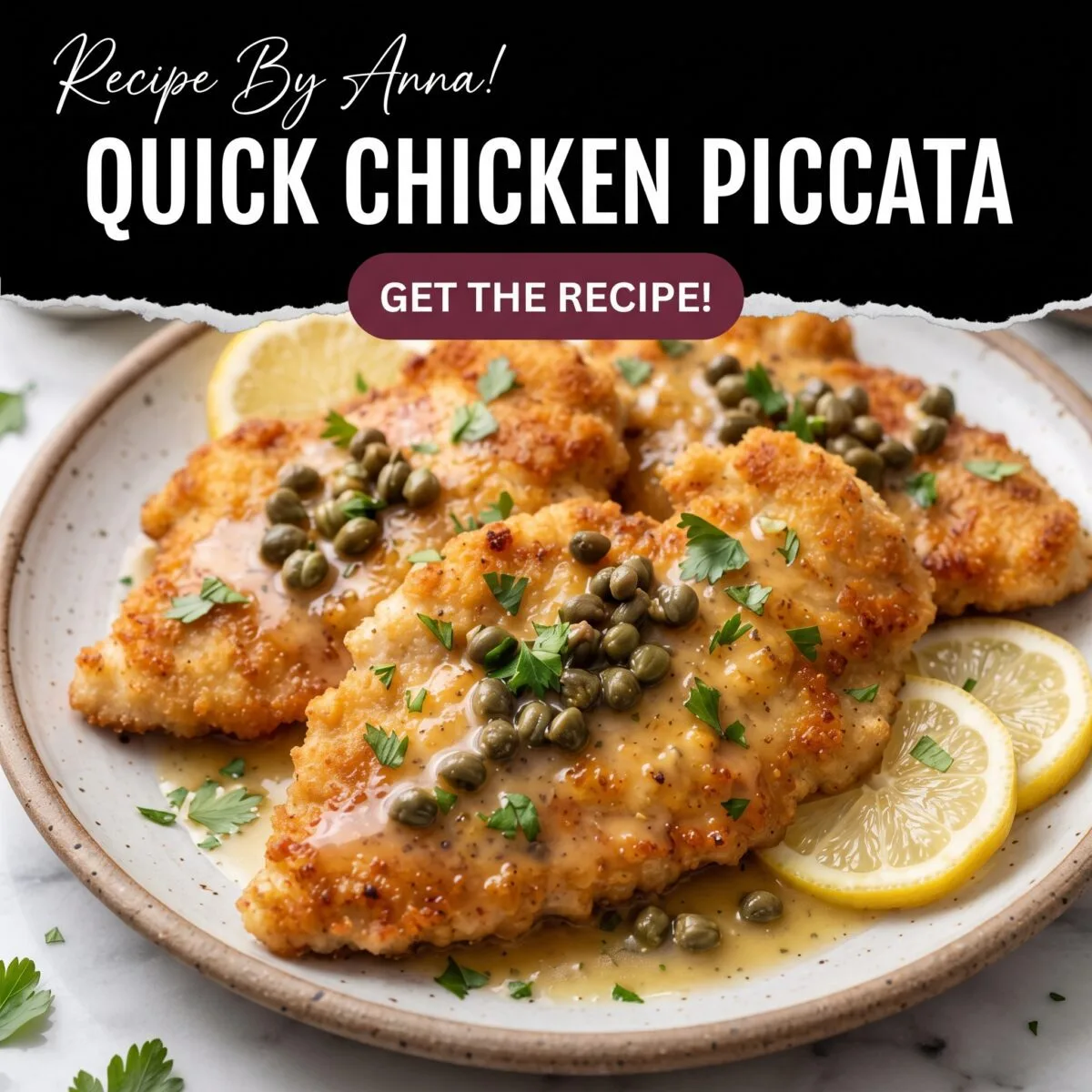
Quick Chicken Piccata — The Dinner the Whole Family Loves
This Quick Chicken Piccata is the Italian-American weeknight dinner that produces something that tastes restaurant-quality from a single skillet in under 30 minutes — thin, golden-crusted chicken cutlets seared in butter and olive oil until deeply golden, then rested while a bright, glossy pan sauce of dry white wine, fresh lemon juice, chicken broth, capers, and cold butter comes together in the same pan, using every flavour left behind by the searing chicken as its foundation.
Chicken piccata is one of the most searched Italian-American dinner recipes for a reason — it is genuinely fast, genuinely elegant, and produces a bright, buttery, lemon-forward sauce that feels celebratory even on a Wednesday night. The entire dish from raw chicken to plated dinner takes under 30 minutes, requires one skillet, and produces the kind of meal that makes the family ask when it’s happening again before the plates are cleared.
What Makes Piccata Specifically Piccata
Piccata is an Italian cooking technique — not a specific dish — that refers to meat or fish that has been sliced thin, dredged in flour, sautéed in butter, and finished in a sauce made from the same pan with lemon, white wine, and capers. The flour dredge is what creates the slightly thickened, golden crust on the chicken that also helps bind the pan sauce — the flour left in the pan after searing creates a very light roux that gives the piccata sauce its glossy, slightly thickened body rather than being a completely thin liquid.
The capers are the ingredient that most defines piccata as a flavour — their briny, slightly floral, intensely savoury character is what separates piccata from a plain lemon butter sauce and gives the dish its unmistakable identity. Piccata without capers is lemon chicken; piccata with capers is specifically piccata.
- Prep Time: 10 minutes
- Cook Time: 18 to 20 minutes
- Total Time: 28 to 30 minutes
- Yield: 4 servings
What You Need
For the chicken:
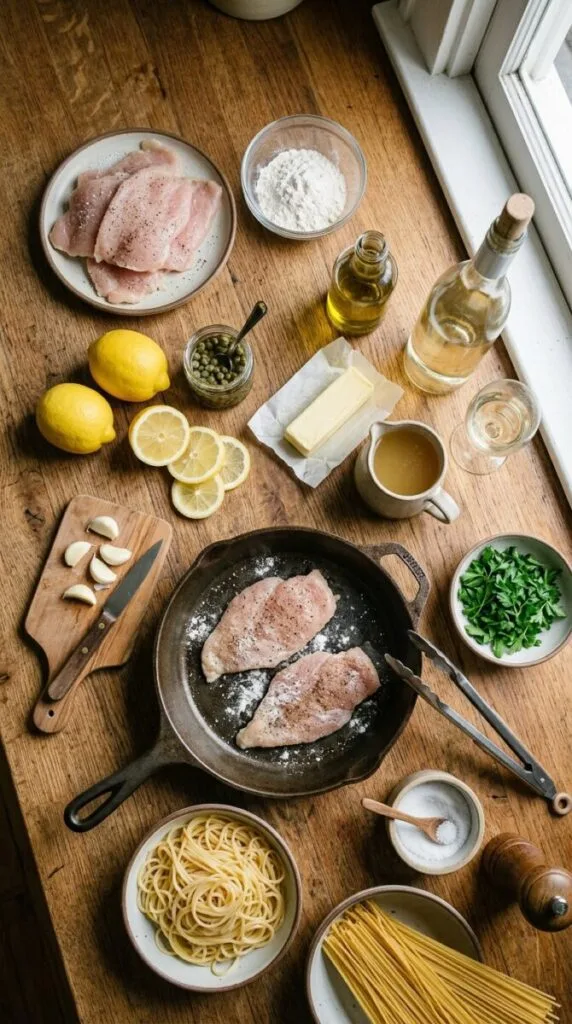
- Boneless skinless chicken breasts: 2 large (approximately 1.5 lbs / 680g), halved horizontally to make 4 thin cutlets — or purchase pre-sliced chicken cutlets
- All-purpose flour: 1/3 cup (42g) for dredging
- Fine sea salt: 1 teaspoon
- Black pepper: 1/2 teaspoon
- Garlic powder: 1/4 teaspoon
- Unsalted butter: 2 tablespoons
- Olive oil: 2 tablespoons
For the piccata pan sauce:
- Garlic cloves, minced: 4
- Dry white wine: 1/2 cup (120ml) — Pinot Grigio or Sauvignon Blanc; a wine you would drink, not cooking wine
- Chicken broth, low sodium: 3/4 cup (180ml)
- Fresh lemon juice: 3 tablespoons (approximately 1.5 lemons)
- Lemon zest: 1 teaspoon
- Capers, drained: 3 tablespoons — do not rinse; the caper brine contributes to the sauce’s flavour
- Cold unsalted butter: 3 tablespoons, cut into cubes — must be cold; cold butter creates the emulsification that makes the sauce glossy and cohesive
- Fresh flat-leaf parsley: 3 tablespoons, roughly chopped
- Fine sea salt and black pepper: to taste
For serving:
- Thin lemon slices
- Extra parsley
- Pasta, rice, or mashed potatoes to serve alongside
How to Make It
Preparing and searing the chicken:
- If starting with whole chicken breasts, place each one flat on a cutting board and slice horizontally through the center to produce two thin cutlets. Place each cutlet between plastic wrap and pound with a meat mallet or rolling pin to an even 1/4-inch thickness — even thickness is what produces cutlets that cook through completely and evenly in the short sear time.
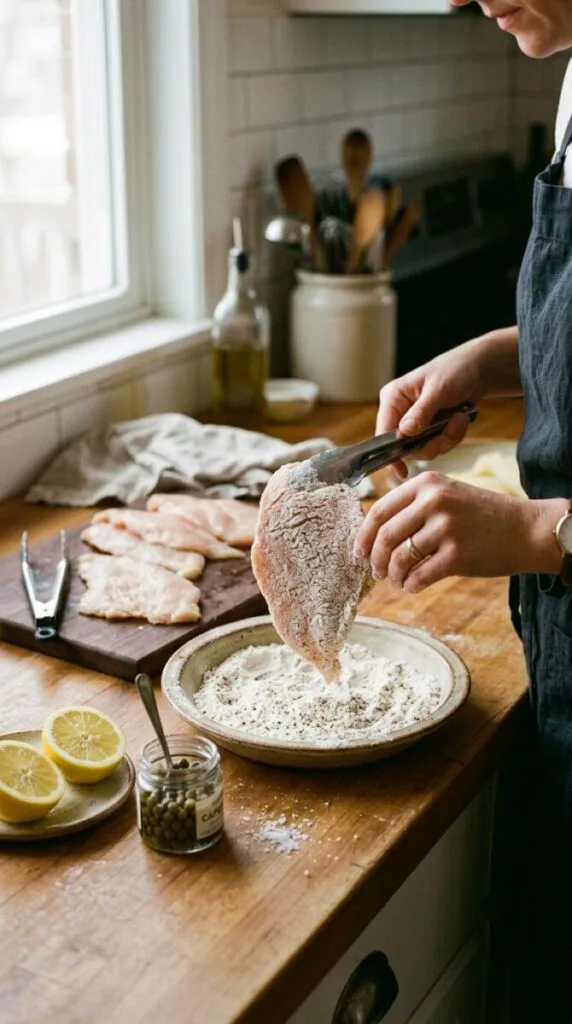
- Season the flour with salt, pepper, and garlic powder in a shallow dish. Dredge each chicken cutlet in the seasoned flour, shaking off the excess — a light, even coating is what produces the golden crust; too much flour produces a gummy, thick coating.
- Heat the butter and olive oil together in a large, wide skillet over medium-high heat until the butter has melted and the foam subsides. The combination of butter (for flavour) and olive oil (for higher smoke point) allows the pan to be hot enough to sear without burning the butter.
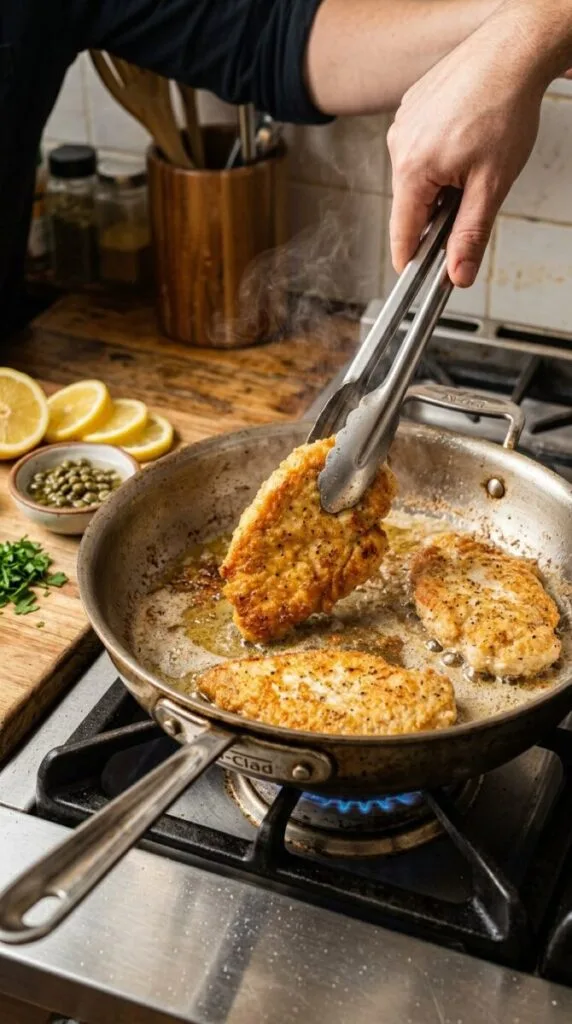
- Add the chicken cutlets in a single layer — do not crowd; cook in two batches if needed. Cook undisturbed for 3 to 4 minutes until deeply golden on the first side — the chicken will release from the pan naturally when the crust has formed; if it sticks, it needs another 30 seconds.
- Flip and cook for 2 to 3 minutes on the second side until golden and cooked through to 165°F. The thin cutlets cook quickly — overcooking produces dry, tough chicken. Transfer to a plate and tent loosely with foil.
Making the piccata sauce:
- Reduce the heat to medium. Add the garlic to the same skillet (with the browned butter and fond left from the chicken) and cook for 60 seconds, stirring, until fragrant but not browned.
- Add the white wine and bring to a simmer, scraping up all the browned bits from the bottom of the pan — this deglazing step incorporates the fond (the browned chicken and flour deposits) into the sauce and is the source of much of the piccata sauce’s depth. Simmer for 2 minutes until the wine has reduced by half.
- Add the chicken broth and lemon juice and simmer for 3 to 4 minutes until the sauce has reduced to approximately 2/3 of its original volume and looks slightly syrupy.
- Remove the pan from the heat. Add the cold butter cubes two or three at a time, swirling the pan or whisking constantly as each addition melts — the cold butter emulsifies into the hot sauce, thickening and glossing it into the specific shiny, cohesive piccata sauce rather than a thin, broken liquid. This technique is called monter au beurre — mounting with butter — and it is what separates a restaurant-quality piccata sauce from a homemade one that looks thin and oily.
- Stir in the capers, lemon zest, and parsley. Taste and adjust — more lemon for brightness, more salt if flat, a pinch of sugar if the lemon is particularly sharp.
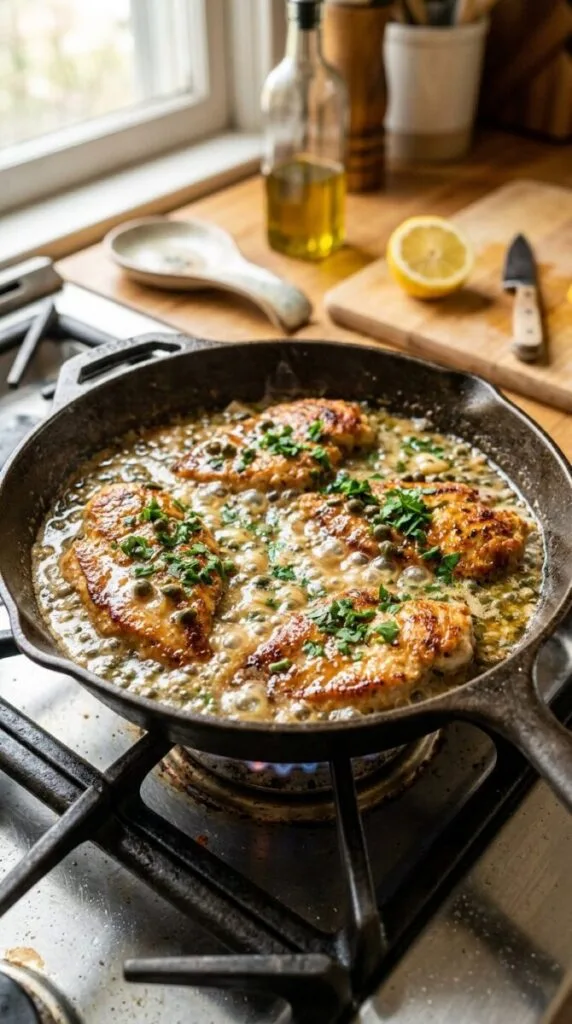
- Return the chicken cutlets to the pan and spoon the sauce over them. Garnish with lemon slices and extra parsley. Serve immediately — piccata sauce does not hold well; it should go from pan to plate as quickly as possible.
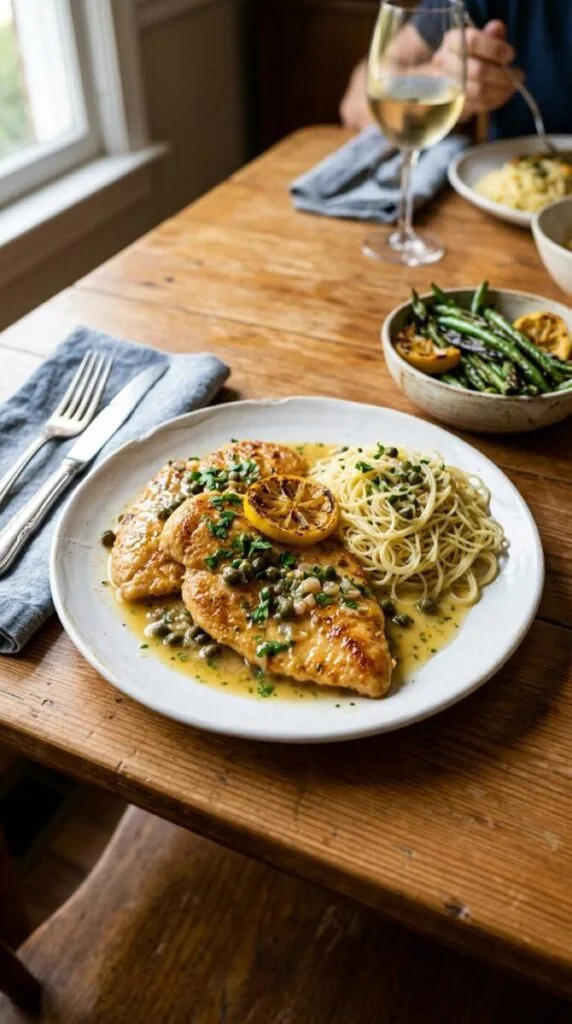
Quick chicken piccata over linguine with a side of our Chickpea Beet and Feta Salad with Lemon Garlic Vinaigrette is the complete Italian-American dinner that covers every flavour and texture at one table — the bright lemon vinaigrette on the salad connects directly to the lemon-butter sauce on the piccata, and the earthy beets and creamy feta provide the fresh, cold contrast that the warm, buttery chicken specifically benefits from alongside.
The Fond Deglazing, Cold Butter Mounting, and Thin Cutlet Details
The fond — the browned deposits left on the pan surface after searing the flour-dredged chicken — is the concentrated flavour base that makes piccata sauce taste deeper and more complex than a sauce made in a clean pan from the same ingredients. Every browned bit dissolved into the wine during deglazing contributes chicken-and-flour-and-butter flavour to the surrounding liquid; skipping the deglazing step or using a non-stick pan (which prevents fond formation) produces a noticeably flatter sauce.
The thin, even cutlet is the technique decision that makes chicken piccata a quick weeknight dinner rather than a 45-minute production — a 1/4-inch cutlet cooks through completely in 5 to 6 minutes total sear time, while a full chicken breast takes 12 to 14 minutes and risks overcooking the outside before the inside reaches temperature. The pounding to even thickness ensures every part of every cutlet cooks at the same rate, eliminating the thick-thin variation that produces dry edges and pink centers simultaneously.
Cold butter added off the heat to mount the sauce is the single technique that most dramatically improves the quality of the finished piccata sauce — cold butter added to a hot sauce that is no longer on direct heat emulsifies slowly into the surrounding liquid, incorporating fat into the water-based sauce as stable, small droplets that produce a glossy, cohesive sauce. Hot butter added to a still-simmering sauce separates immediately and pools on the surface as oil. Pull the pan off the heat, add the cold butter in stages, and swirl or whisk until each addition is fully incorporated before adding the next.
What to Serve Alongside
Linguine or spaghetti is the most natural pasta alongside — 8 oz cooked al dente and tossed with a small amount of olive oil and the piccata sauce spooned generously over both the pasta and the chicken on the plate. The pasta catches the excess sauce so nothing is wasted.
Creamy mashed potatoes are the most indulgent accompaniment — the lemon-butter piccata sauce pooled over mashed potatoes is one of the most satisfying sauce-and-starch combinations in Italian-American cooking. Our Homemade Lasagna as a sharing companion dish makes a full Italian-American spread for a larger gathering — the piccata for individual portions, the lasagna for the table.
For a lighter dinner, serve the chicken piccata over steamed jasmine rice with the sauce spooned over everything — the rice absorbs the piccata sauce beautifully and produces a lower-carbohydrate option that is equally satisfying. Our Veggie Rice Bake as a side rather than the main turns the piccata into a protein topping over a complete vegetable rice dish — the cheese and herb rice beneath the lemon-butter chicken is a combination that works better than it might sound.
Five Chicken Piccata Variations
Creamy Chicken Piccata — after adding the chicken broth and lemon juice and reducing by two thirds, stir in 1/4 cup of heavy cream and simmer for 1 minute before mounting with the cold butter. The cream adds richness and slightly mellows the sharpness of the lemon — the resulting sauce is more indulgent, slightly less bright, and significantly more family-friendly for households where the sharp lemon-caper edge of the classic version is occasionally too bold. Add 2 tablespoons of grated Parmesan stirred in with the capers for additional depth.
Chicken Piccata Pasta Recipe — cook 12 oz of linguine or spaghetti al dente and reserve 1/2 cup of pasta cooking water. Make the piccata sauce with an additional 1/4 cup of chicken broth. Toss the cooked pasta into the sauce in the pan, adding pasta water as needed to loosen. Return the chicken to the pan on top of the pasta. The pasta-integrated version produces a complete one-pan dinner where the piccata sauce coats every strand of pasta as well as the chicken — a considerably more substantial dish than piccata served alongside pasta separately.
Healthy Chicken Piccata — replace the flour dredge with almond flour or a light dusting of arrowroot powder. Use olive oil only (no butter) for searing. For the sauce, use 2 tablespoons of cold butter rather than 3, and substitute 1/4 cup of the chicken broth with an equal amount of water to reduce sodium. The healthy version produces a lighter, slightly thinner sauce that is genuinely excellent — the almond flour crust is slightly nuttier than wheat flour and pairs well with the lemon-caper sauce.
Baked Chicken Piccata — dredge and sear the chicken on both sides for 2 minutes per side (partial sear to develop the crust without fully cooking through). Transfer to a baking dish, make the piccata sauce in the same skillet, and pour over the partially cooked chicken in the baking dish. Bake at 400°F for 18 to 20 minutes until the chicken is cooked through and the sauce is reduced and concentrated around the chicken. The baked version produces a more tender chicken (the oven’s moist heat prevents drying) and a more intensely reduced sauce than the stovetop-only method.
Chicken Piccata Meatballs — combine 1.5 lbs of ground chicken with 1/4 cup of breadcrumbs, 1 egg, 2 tablespoons of grated Parmesan, 1/2 teaspoon of garlic powder, salt, and pepper. Roll into 1.5-inch balls and brown on all sides in butter and olive oil — 6 to 8 minutes total. Remove and make the piccata sauce in the same pan, then return the meatballs to simmer in the sauce for 5 minutes to cook through. Serve over pasta or rice. The meatball version is the most family-friendly format — the same bright lemon-caper flavour in a portion size and shape that works for every age at the table.
Nutritional Information
| Nutrient | Amount Per Serving (based on 4 servings, without pasta or rice) |
|---|---|
| Calories | 360 kcal |
| Protein | 38 g |
| Carbohydrates | 10 g |
| Fats | 18 g |
These values are estimates for the chicken and piccata sauce only, without pasta, rice, or mashed potatoes, divided by 4 servings. The 38-gram protein count reflects the lean chicken breast — one of the highest-protein dinners in this collection at a relatively moderate calorie count. Adding a 2-oz portion of pasta adds approximately 200 calories and 7 grams of additional protein; rice adds approximately 180 calories. The healthy variation with almond flour and reduced butter reduces to approximately 295 calories per serving.
Storing and Reheating
Store the chicken and sauce together in an airtight container in the fridge for up to 3 days. The lemon flavour deepens during storage and the sauce thickens as the butter emulsion sets — day-two chicken piccata has a more intensely lemon-butter flavour than day-one and many people prefer it.
Reheat gently in a skillet over medium-low heat with 2 tablespoons of additional chicken broth stirred into the sauce — the broth restores the sauce’s original loose, glossy consistency that thickens considerably during refrigeration. High heat breaks the butter emulsion in the stored sauce and produces the oily, separated appearance that makes leftover piccata look less appetising than it actually is. Low heat, added liquid, slow warming restores it completely.
The microwave works at 50 percent power in 60-second intervals — the lower power level prevents the sauce from overheating and the butter emulsion from breaking. At full power the butter separates immediately and the sauce looks oily rather than glossy. A 30-second rest between microwave intervals also helps the heat distribute evenly through the chicken before the next interval.
Mistakes That Produce Tough Chicken or Broken Sauce
Not pounding the chicken to even thickness produces cutlets that are thick in the center and thin at the edges — the thin edges overcook to dry, tough meat while the center reaches the correct temperature, producing every bite being slightly different rather than uniformly tender throughout. Pound to a consistent 1/4-inch and the entire cutlet cooks identically.
Adding the cold butter to a sauce that is still on the heat and actively simmering produces a broken, oily sauce where the butter melts and separates immediately rather than emulsifying slowly into the surrounding liquid. Remove the pan from the heat completely — every trace of direct heat must be off — before the first butter cube goes in. The residual heat in the pan is all that is needed to melt the butter slowly enough to emulsify.
Overcrowding the pan during searing produces steamed rather than seared chicken — moisture released from the chicken has nowhere to evaporate in a crowded pan and the chicken poaches in its own steam rather than making contact with the hot pan surface and developing the golden, flavoured crust. Sear in batches that leave space between each cutlet, regardless of how long it takes.
Quick Chicken Piccata
Thin golden chicken cutlets in a glossy lemon-butter-caper pan sauce with white wine, chicken broth, garlic, fresh parsley, and cold butter. Restaurant-quality flavor in under 30 minutes.
Why This Recipe Works
Chicken piccata works because thin, flour-dredged cutlets cook quickly and leave flavorful browned bits in the skillet. Those browned bits become the foundation of the lemon, wine, broth, caper, and butter sauce.
Cold butter added off the heat emulsifies into the reduced sauce, making it glossy and cohesive instead of oily. Capers give the dish its signature briny, savory piccata flavor.
Ingredients
Instructions
Slice each chicken breast horizontally into two thin cutlets. Pound between plastic wrap to an even ¼-inch thickness so the chicken cooks quickly and evenly.
In a shallow dish, combine flour, salt, pepper, and garlic powder.
Dredge each chicken cutlet in the seasoned flour, shaking off excess. A thin coating gives a golden crust without becoming gummy.
Heat 2 tablespoons butter and 2 tablespoons olive oil in a wide skillet over medium-high heat until the butter melts and the foam subsides.
Add cutlets in a single layer, working in batches if needed. Cook undisturbed for 3 to 4 minutes until deeply golden, then flip and cook 2 to 3 minutes more.
Transfer cooked chicken to a plate and tent loosely with foil.
Reduce heat to medium. Add minced garlic to the same skillet and cook for 60 seconds, stirring, until fragrant but not browned.
Add white wine and scrape up the browned bits from the bottom of the pan. Simmer for about 2 minutes, until reduced by half.
Add chicken broth and lemon juice. Simmer for 3 to 4 minutes, until reduced and slightly syrupy.
Remove pan from heat. Add cold butter cubes a few at a time, swirling or whisking until each addition melts into a glossy sauce.
Stir in capers, lemon zest, and parsley. Taste and adjust with more lemon, salt, or pepper if needed.
Return chicken to the pan and spoon sauce over the cutlets. Garnish with lemon slices and parsley. Serve immediately with pasta, rice, or mashed potatoes.
Key Technique Notes
Thin, even cutlets cook in minutes and stay tender instead of drying at the edges.
Crowding steams the chicken. Leave space so each cutlet develops a golden crust.
The browned bits from searing dissolve into the wine and give the sauce its depth.
Cold butter emulsifies into the reduced sauce, creating a glossy finish instead of an oily broken sauce.
Helpful Pairing Note
Variations
Stir ¼ cup heavy cream into the reduced broth and lemon sauce before adding cold butter. Add 2 tablespoons Parmesan with the capers for extra richness.
Toss cooked linguine or spaghetti directly into the pan sauce with a splash of pasta water, then place the chicken on top.
Use almond flour or arrowroot for dredging, sear in olive oil, and reduce the finishing butter to 2 tablespoons.
Sear chicken 2 minutes per side, transfer to a baking dish, pour sauce over top, and bake at 400°F for 18 to 20 minutes.
Make ground chicken meatballs with breadcrumbs, egg, Parmesan, garlic powder, salt, and pepper. Brown, then simmer in the piccata sauce.
Replace the white wine with extra chicken broth plus 1 teaspoon white wine vinegar for acidity and balance.
Nutrition
| Nutrient | Amount Per Serving |
|---|---|
| Calories | 360 kcal |
| Protein | 38 g |
| Carbohydrates | 10 g |
| Fat | 18 g |
Values are estimates for chicken and piccata sauce only, based on 4 servings. Pasta, rice, or mashed potatoes are not included.
Store chicken and sauce together in an airtight container in the fridge for up to 3 days.
Reheat gently over medium-low heat with 2 tablespoons chicken broth stirred into the sauce to loosen and re-gloss it.
Microwave at 50 percent power in 60-second intervals, resting briefly between intervals so the sauce does not break.
Chicken piccata is best served immediately because the butter-mounted sauce is glossiest right after making.
The cutlets were uneven or overcooked. Pound to ¼-inch thickness and cook only until just done.
Butter was added while the pan was still on direct heat. Remove from heat before whisking in cold butter.
The skillet was overcrowded. Sear in batches with space between each piece.
Add more salt for depth, lemon for brightness, or capers for the briny piccata signature.