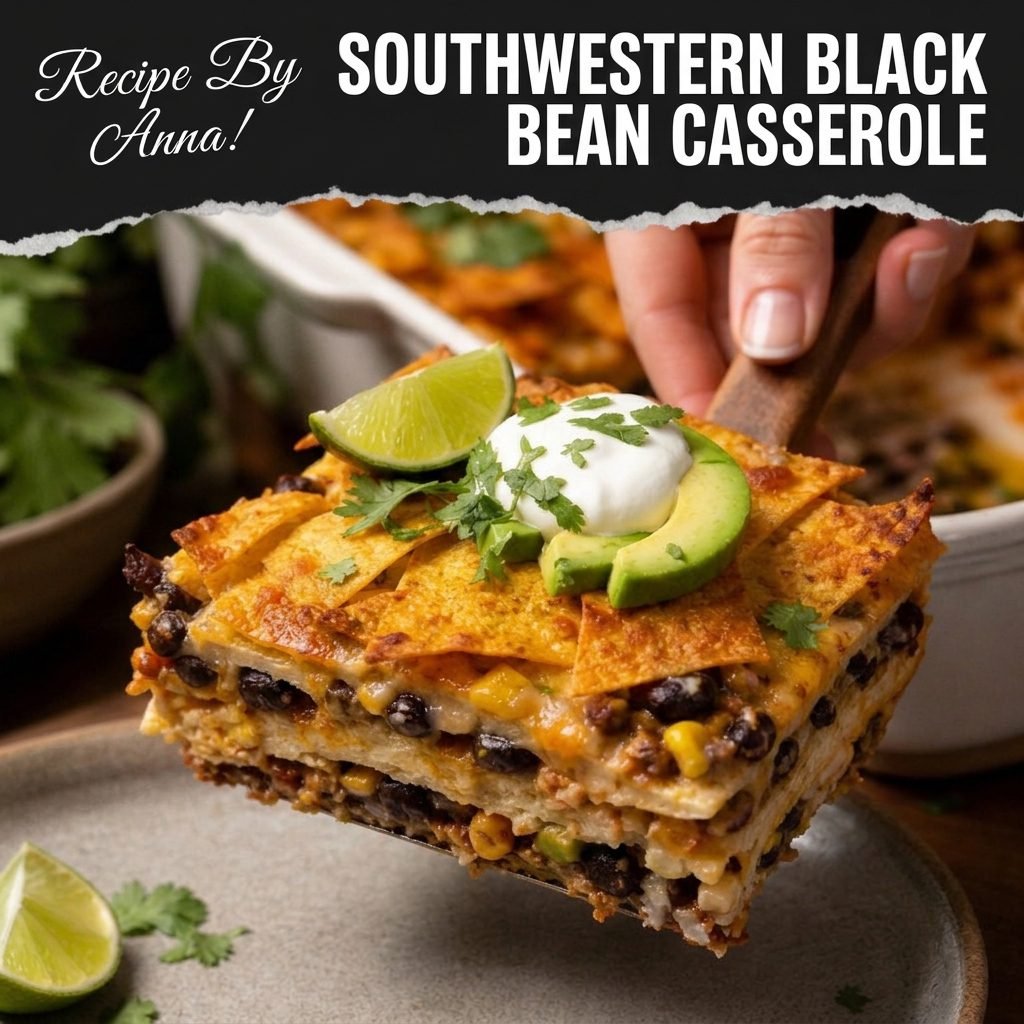
Fast Southwestern Black Bean Casserole
This is the dinner I make when the household asks for taco night but the household does not want to assemble anything at a counter at six o’clock. Everything taco night means — beans, corn, green chiles, cumin, melted cheese, tortillas, lime, cilantro — gets built into a dish instead: soft corn tortillas layered like lasagna noodles over a thick, smoky black bean base, cheese between every layer, and a lid of tortilla wedges that toast crisp while the middle stays tender. You bake it for twenty-five minutes, rest it ten, and cut it into squares that hold their layers when you lift them out. It costs about eight dollars, it feeds six, it’s vegetarian without trying, and it is the recipe my Meatless Monday skepticism gets argued with most often.
The genre has a problem, and you’ve probably eaten it: the soggy black bean casserole, the one where the tortilla layers collapse into a wet, corn-flavored paste and the whole dish eats like enchiladas that gave up. The cause is always water — watery salsa poured into the layers, beans straight from their can liquid, tomatoes never reduced — and the fix is a bean base that’s built thick on purpose. Mine reduces crushed tomatoes with the aromatics until it’s a spoon-coating sauce, then mashes a quarter of the beans directly into it, which releases their starch and thickens the base from the inside — the bean thickens itself, no flour, no paste, nothing but a masher and thirty seconds. The remaining beans stay whole for texture, the corn goes in for sweetness and pop, and the only moisture the interior tortillas meet is sauce that’s already dense. Salsa, which is mostly water, moves to the table where it belongs.
The other half of the engineering is the tortillas, and this is the part worth ten seconds of chemistry because it explains a swap the internet recipes get quietly wrong. Corn tortillas are masa — corn that’s been nixtamalized, soaked in alkali, which changes its proteins and starch into a matrix that softens in sauce without dissolving. That’s the whole architecture of enchiladas, and it’s why this casserole uses corn tortillas inside: they soak to tender and hold their layer, where flour tortillas turn gluey and structural-less under the same treatment. Then the same tortilla does a second job on top: cut in wedges and stood up in the melted cheese, the wedges sit above the steam and toast into chips while the middle bakes — one ingredient, two textures, and the crunch the soggy versions of this dish are missing. Soft inside, crisp on top, and not a single bowl of seasoned ground beef required.
The Bean Rule
The rule is three sentences long and it runs the whole recipe. First: rinse the beans, both cans — the can liquid is starchy, cloudy, and faintly metallic, and it’s the fastest way to make a bean dish taste like a can. Second: season the beans in the skillet, not in the dish — the base simmers five minutes with the spices so the beans drink the cumin and the chiles while there’s still heat and fat to carry them, and this is the difference between beans that are seasoned and beans that are merely adjacent to seasoning. Third: mash a quarter of them into the sauce, where their starch thickens it to spoon-coating body, and leave the rest whole. One bean, two forms, and the base comes out thick enough that the layers below the cheese never weep. If you take nothing else from this post, take the mashing — it’s the single step that separates this version from the soggy ones, and it costs thirty seconds.
The spice bloom matters nearly as much. Cumin and chili powder are aromatic oils locked in dry powder, and those oils dissolve in fat, not in water — so they go into the skillet when the onion and pepper are soft and the oil is hot, stirred for forty-five seconds until the kitchen smells like a taqueria, before any tomato touches the pan. Bloom the spices first and every bean in the dish carries them; dump them in with the tomatoes and half their aroma stays locked in the powder forever. Add the oregano with them — Mexican oregano if you have it, regular if you don’t — and hold the lime and cilantro for the end, where their brightness lands on top of the smoky base instead of being boiled away into it.
And the cheese, briefly, because it’s doing structural work. Monterey jack melts into long, gooey strings and holds the layers together; sharp cheddar brings the flavor punch and the color. Half and half is the tested blend — all jack is mild and lovely, all cheddar is louder and grainier when it melts — and the last handful goes on top under the tortilla wedges, where it acts as the glue that stands them up. Buy blocks, grate your own; the pre-shredded bags are dusted with anti-caking starch that fights every melt, and this dish asks its cheese to do too much work to fight it.
⏱️ 45 MINUTES, ONE SKILLET + ONE DISH | 🌽 SERVES 6 | 💛 VEGETARIAN, GLUTEN-FREE
- Prep Time: 15 minutes — onion, pepper, garlic, and opening cans
- Cook Time: 15 minutes for the base, 25 in the oven
- Rest Time: 10 minutes, while you set out the toppings
- Total Time: about 45 minutes start to squares
- Yield: a 9×13 dish — dinner for 6, lunch for days
The Layer Logic
The equipment is standard, and one piece of it is doing double duty:
- Large skillet — the bean base is built here, and it’s the flavor factory of the whole recipe
- 9×13 baking dish — glass or ceramic, and a shallow depth is right: this is a layered dish, not a deep one
- Potato masher — for the quarter of the beans that thicken the base; a sturdy fork works in a smaller skillet
- Spatula — for spreading the bean base in even, thin layers
- Cheese grater — the box kind, big holes, and a block of cheese
- Pizza cutter or sharp knife — for cutting the tortillas into wedges for the lid
- Small bowls for toppings — the toppings bar is half the meal, and it deserves vessels
Now the layer logic, which is lasagna logic wearing a sombrero it bought honestly. Three rules. One: every tortilla touches sauce — a dry tortilla bakes into leather, so each layer starts with a thin spread of the bean base and the torn tortilla halves go down onto it. Two: thin layers, not thick — this is a dish that’s meant to slice into squares, and two modest layers cut cleaner than one cavernous one. Three: the cheese goes between the layers and on top, never just on top — the interior cheese is what welds each layer to the next so the squares lift out intact. Assemble in that order — sauce, tortillas, sauce, cheese, repeat — and the dish builds itself in five minutes with nothing but a spatula and a little evenness.
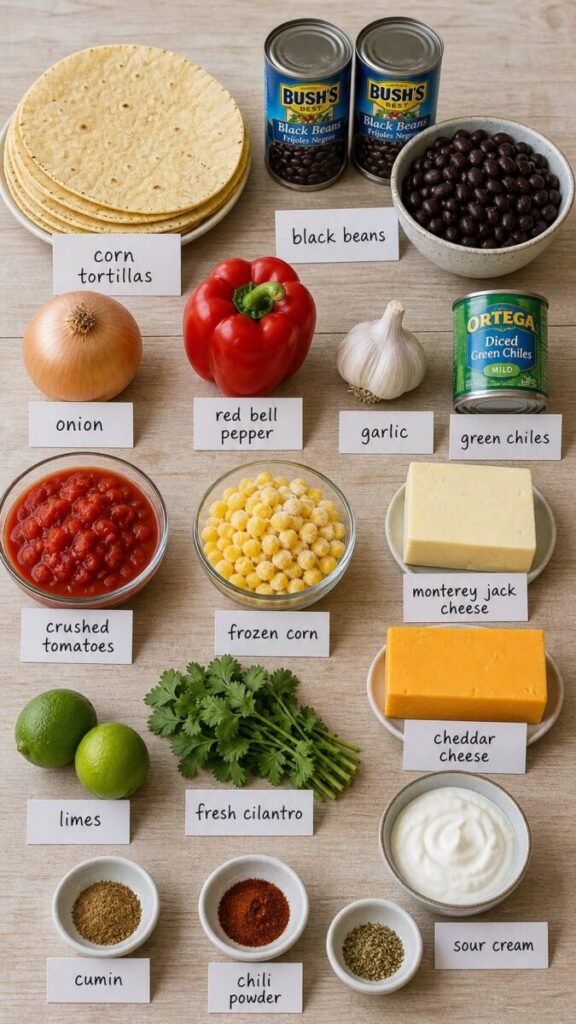
Ingredients (With Labels)
🌽 The Base
- Black beans: 2 cans (15 oz each), drained and rinsed
- Crushed tomatoes: 1 can (15 oz) — not tomato sauce, not salsa
- Yellow onion: 1 medium, diced
- Red bell pepper: 1, diced
- Garlic: 4 cloves, minced
- Green chiles: 1 can (4 oz), diced — mild or hot, your call
- Corn: 1 cup, frozen or canned and drained
🌶️ The Spice Cabinet
- Ground cumin: 2 teaspoons
- Chili powder: 2 teaspoons
- Dried oregano: ½ teaspoon — Mexican if you’ve got it
- Olive oil: 2 tablespoons
- Salt: ¾ teaspoon, plus more to taste
🫓 The Layers and the Lid
- Corn tortillas: 12 (6-inch) — 8 for the layers, 4 for the crisp lid
- Monterey jack: 1½ cups, grated
- Sharp cheddar: 1 cup, grated
🍋 The Finish
- Lime: 1 — half into the base, half into wedges
- Fresh cilantro: ⅓ cup, chopped
- Sour cream, avocado, and salsa: for the table
Step by Step How to Make
- Step 1 — Soften and bloom. Heat the oven to 375°F. In the big skillet over medium, warm the olive oil, add the onion and a pinch of salt, and cook five minutes until it’s soft and translucent at the edges; add the bell pepper and cook four more, until it sweetens and slumps. Add the garlic and stir for one minute, until fragrant — garlic burns fast and bitter, so it goes late. Now the bloom: push the vegetables aside slightly, add the cumin, chili powder, and oregano directly into the hot oil, and stir for forty-five seconds, until the color deepens and the pan smells like the outside of a good taco shop. That smell is the flavor, unlocked; from here on the dish can’t go wrong by much.
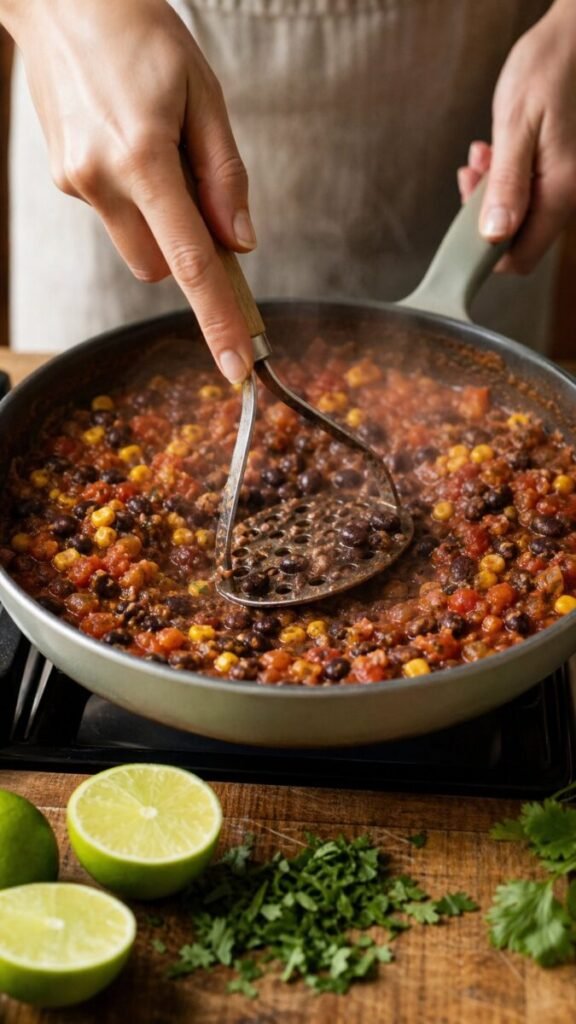
- Step 2 — The bean base. Pour in the crushed tomatoes and the green chiles with their juices, stir everything together, and let it come to a lively simmer — then cook five minutes, stirring occasionally, until the tomatoes darken and thicken from watery to saucy. Add both cans of rinsed beans and the corn, stir, and then mash: press the masher straight down through the skillet six or eight times, deliberately, in different spots — you’re breaking open roughly a quarter of the beans, and their starch will visibly thicken the sauce within a minute of simmering. You’ll see the base go from soup-adjacent to spoon-coating, with plenty of whole beans still riding through it. Simmer two more minutes, then kill the heat, squeeze in half the lime, scatter in the cilantro, taste, and adjust the salt — it should taste slightly too seasoned on its own, because the tortillas are about to dilute it.
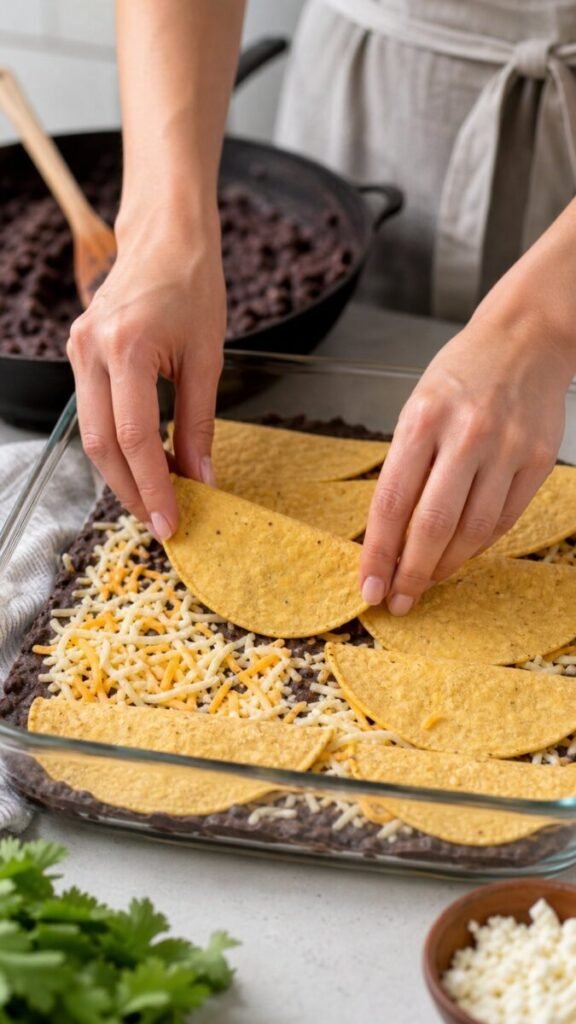
- Step 3 — The layers. Spread half a cup of the bean base thinly across the bottom of the baking dish — the glue for the first tortilla layer — then lay four tortillas over it, tearing a couple in half to fill the gaps, edges overlapped slightly. Spread a third of the remaining bean base over the tortillas, scatter a third of the cheese, and repeat: tortillas, base, cheese, tortillas, base, cheese, finishing with the last of the base and the last of the cheese spread to the corners. Press the stack gently down with the spatula as you finish each layer — it encourages the tortillas to start drinking the sauce — and keep the layers thin and even. The dish should look like a tidy, shallow lasagna, not a casserole with tortillas hidden somewhere in it.
- Step 4 — The lid and the bake. Cut the four remaining tortillas into wedges — quarters is right, sixths if you like them smaller — and stand them up in the top cheese, pointed ends down, fanning them like fence pickets across the dish with their edges just overlapping. The cheese underneath is doing the gluing; the wedges are doing the toasting. Bake 25 minutes, until the sauce bubbles at the edges, the cheese is fully molten, and the wedges have gone golden and crisp at their tips. There’s no need to cover the dish — the top is its own cover — and if the tips darken fast in a hot oven, a loose tent of foil for the last five minutes buys the middle the time it wants without costing the crunch.
- Step 5 — The rest and the toppings bar. Rest the dish ten minutes on a rack before cutting — the layers are settling and welding, and squares cut from a rested casserole lift out intact while squares cut hot avalanche. The ten minutes are not idle: that’s the toppings bar going out. Sour cream, sliced avocado with lime on it, salsa, extra cilantro, hot sauce for the brave, lime wedges for everyone. The toppings are not decoration; they’re the cool, creamy, fresh half of the flavor architecture, and the casserole is deliberately built smoky and deep so that the cold stuff on top completes it.
- Step 6 — The squares. Cut a three-by-four grid — twelve squares, two per person — and lift each one out with the spatula, holding the top briefly with a fork if the wedge fence needs encouragement. The cross-section is the payoff: soft tortilla layers in amber sauce, whole beans and corn kernels suspended in melted cheese, and the crisp wedge standing up out of the top like a flag planted on a very good hill. Eat it while it’s hot, with a squeeze of lime and whatever the toppings bar holds, and note that the vegetarians and the meat-eaters at the table have said nothing about each other’s plates all dinner, which is the quiet goal of every meatless recipe I write.
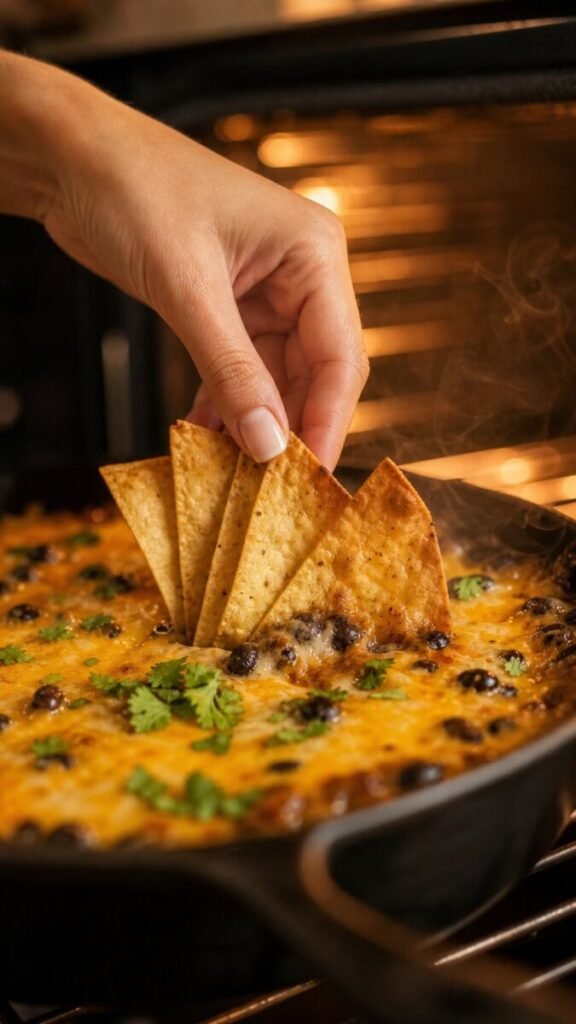
Black beans, tortillas, and cheese in two formats — the brown rice black bean casserole is this dish’s rice-built sibling, and the two of them rotate through my winter menu like a tag team.
Anna’s Kitchen Notes
Buy real corn tortillas. The difference between a good corn tortilla and a bad one is bigger than any other ingredient gap in this recipe, and the good ones come from three places: a tortilleria if your town has one, the refrigerated section of a Latin market, or the freshest stack your supermarket turns over fastest. A real corn tortilla smells like toasted corn, bends without cracking, and lists corn, water, and lime as its ingredients. Old, dried-out tortillas are still fine here — they’re getting soaked in sauce — but stale ones make a bland lid, so use the freshest of the stack for the wedges.
The green chiles are not optional. A four-ounce can of diced green chiles is the most underused flavor in the American pantry — mild, tangy, and quietly essential to anything that wants to taste Southwestern rather than generically Mexican-ish. They don’t make the dish spicy; they make it taste like a place. If your table runs hot, buy the hot ones or add a minced jalapeño with the onion. If your table runs mild, the standard can is still barely warming, and kids eat it without comment.
Salsa at the table, never inside. The internet recipes pour a cup or two of salsa into the layers, and salsa is ninety percent water with ambition — it’s the single biggest cause of the soggy-bottom failure this recipe is built to avoid. The base gets its tomato from a small can of crushed tomatoes, reduced until thick. The salsa you love goes into a bowl with a spoon at the table, where it lands cold and bright on each square instead of watering down the architecture from within. Same flavor, correct physics.
Double it for the potluck without doubling the work. The bean base scales by exactly the numbers: double everything in the skillet, and it still fits — a large skillet holds a doubled base, barely, and the simmer takes two minutes longer. Two dishes bake side by side with the racks swapped halfway, and you walk into the potluck carrying one and leave the second in the fridge for the week. This is the dish I bring to everything from November through March, and the dish comes home empty so reliably that I’ve stopped planning on leftovers.
The gluten-free fine print. Corn tortillas are naturally gluten-free, and everything else in the dish is too — the only label to check is the tortillas themselves, since a few brands run shared lines. Certified GF tortillas make this a celiac-safe dinner with zero substitutions, which makes it the most useful recipe in the rotation for the mixed table. The wedges, the cheese glue, the mashed-bean thickener — none of it needed flour in the first place.
The Fiesta Table
The casserole carries the main, and the table wants crunch and cool around it. The Texas trash dip is the hot, gooey appetizer if the gathering is bigger than the dish — same flavor family, different format — and the jalapeño cream cheese dip is the cold, creamy one for the hour before dinner.
For the rest of the plate: the sweet potato black bean enchiladas are this casserole’s rolled, saucier cousin — make one this week and the other next, and the pantry barely notices — and the chili lime chickpea cauliflower wraps share the lime-and-cumin heartbeat in lunch form. For the vegetarians who want seconds of everything, the vegetarian zucchini slice rounds out a multi-dish spread without adding another hot cheese to the table, which is a real service by that point in the evening.
Same Bake, Other Beans
Pinto beans, the Texas swap. Pintos mash even more willingly than black beans and the dish drifts toward Tex-Mex Sunday supper — serve it with pickled jalapeños and call it a bean-and-cheese stack. Same numbers, same layers, slightly softer interior, entirely correct.
The chicken amendment. Two cups of shredded rotisserie chicken folded into the bean base turns this into the full-household version for tables that want meat — seasoned with the same bloom, warmed through in the base, layered exactly where the beans go. The vegetarian half of the table loses nothing, because the chicken rides in the sauce rather than taking over the dish. Everyone’s plate looks the same, which at my table counts as diplomacy.
The beef-and-bean build. A half pound of ground beef browned after the onions and before the spices, with the rest of the recipe unchanged — this is the version my dad requests, and it eats like a stacked taco casserole from a church cookbook, in the best possible way. The bean rules all still apply; the mash still thickens, the layers still hold.
Chorizo, for the bold table. Half a pound of fresh chorizo, casings removed, browned and crumbled into the base — the paprika fat seasons the entire dish, and you’ll want to pull the added salt back to half a teaspoon. Serve with the avocado and plenty of sour cream, because this version arrives loud.
The vegan conversion, honestly rated. The base is already vegan; the work is the cheese. Vegan shreds have gotten genuinely good at melting in the last few years — use two full cups of the melty kind for the layers and top — and finish with a lime-cilantro crema made from soaked-cashew sour cream or store-bought. The result lands at about eighty percent of the dairy version’s goo, which the crisp wedge lid does a lot to cover for, and the squares hold their layers because the architecture was never the cheese’s job alone — it was the mash.
Breakfast, because of course. A fried egg on a reheated square, yolk broken over the layers, hot sauce on top — the casserole becomes huevos rancheros’ structural cousin, and it’s the best second-day breakfast on this entire site. The egg’s richness against the smoky beans needs nothing else except maybe the last tortilla wedge, saved on purpose.
The Potluck Math
| Nutrient | Per Serving (2 squares, 1 of 6) |
|---|---|
| Calories | 450 kcal |
| Protein | 17 g |
| Carbohydrates | 54 g |
| Fats | 17 g |
Estimates as written, full cheese ration and the tortillas counted, toppings bar left to your own conscience. The protein line is the quiet achievement — two cans of beans, cheese, and masa add up to seventeen grams per serving without a gram of meat, and the fiber line is the loud one, running well past half a day’s recommendation from the beans, the corn, and the masa all at once. The calorie count is honest dinner food, not diet food, and the toppings bar is where it flexes: avocado pushes it up, salsa and lime barely move it, and a square with salsa and hot sauce instead of sour cream lands back under 450 for anyone counting. The dish feeds six for roughly what one delivery burrito costs, which is a fact I find quietly radical on a Tuesday.
The Weeknight Window
Storage and scheduling, in the order a real week needs them. The bean base can be made up to three days ahead and refrigerated in its skillet or a container — the flavor improves overnight, as cumin-spiked tomato always does — and the casserole can be fully assembled and held in the fridge for 24 hours before baking, with the tortilla lid going on at the last minute so the wedges stay dry until they toast. A cold-from-the-fridge bake wants five extra minutes. Fully baked leftovers keep four days covered, and the squares reheat in the microwave with genuine dignity — the masa layers re-soften instead of turning to mush, which is the nixtamalization dividend paying out a second time.
The freezer takes the assembled dish for two months, with one architectural note: freeze it without the tortilla lid and add fresh wedges before the bake, because frozen-and-thawed wedges lose their crunch and the lid is half the point. Thaw overnight, top, bake as directed. A second dish in the freezer is the difference between a hard week and a handled one, and the bean base doubles so easily that the second dish barely adds effort.
Second careers, briefly: leftover squares reheated and folded into a soft tortilla with sour cream are a burrito that requires nothing new; the bean base thinned with a little broth and simmered five minutes becomes a smoky black bean soup for lunch, topped with the same cilantro and lime; and any base left over from a half-batch in an 8×8 gets spooned over rice with a fried egg, which is how the recipe ends up feeding me twice more than planned. A dish whose leftovers keep cooking is the whole point of a Wednesday.
Where It Goes Wrong
The soggy bottom. The classic, and it always has the same address: too much water in the base. Salsa poured inside, undrained beans, tomatoes not reduced — every extra tablespoon of liquid ends up in the tortilla layers, and masa softens generously before it gives up entirely. The prevention is the recipe’s spine: rinsed beans, crushed tomatoes cooked down five minutes, the bean mash for body, salsa at the table. A casserole that comes out loose anyway needed five more minutes in the oven, and the resting step tightens it further.
Leathery tortilla layers. The opposite failure, and it means a dry spot somewhere — a tortilla laid down onto bare dish, or a layer skimped on base. Every tortilla touches sauce on at least one side; that’s the layer logic. Corn tortillas are forgiving about soaking — that’s their job — but they can’t drink what was never poured. If the assembled dish looks dry at any seam, spoon an extra ladle of base over it before the oven.
Bland beige disappointment. The base wasn’t seasoned assertively enough, or the spices skipped the bloom and stayed locked in their powder. Salt the base until it’s a shade too salty on its own — the tortillas dilute it — bloom the cumin and chili in the hot oil, keep the green chiles, and finish with the lime, because acid is what makes smoky flavors taste bright instead of heavy. A finished square that still reads flat wants a hit of the toppings bar, and the next batch wants a braver hand in Step 2.
Burnt wedge tips, raw middle. The oven ran hot or the wedges were cut too thin and pointed. The tips toast fastest, so quarters rather than sixths, and a foil tent over the last five minutes is the tool for an oven that browns eagerly. The bake itself is short and gentle — 375°F, not a blast — because everything inside is already cooked and the oven is only melting, crisping, and marrying.
Squares that avalanche. Cut hot, always — the ten-minute rest is when the cheese and the mashed-bean sauce set into glue, and the layers weld to each other. A casserole cut at minute two is a pile of delicious gravel; the same dish cut at minute twelve lifts out in cross-section. If it still slides after a full rest, the layers were too thick or the cheese too shy inside, and the next batch gets the spatula’s attention in Step 3.
Gluey, pasty layers. Flour tortillas happened. Masa soaks to tender; flour tortillas absorb and then gelatinize into paste, and the dish turns into a cheese-topped dumpling. Corn tortillas only, for the layers and the lid both — the nixtamalization is doing the architectural work, and no substitution replaces it. This is the one swap where the internet recipes and I genuinely part ways.
Bean Questions
Can I use dried beans instead of canned?
Yes, and they’re better if you’re a planner: a cup of dried black beans, soaked overnight and simmered until tender, yields about what two cans hold, with better texture and no can-liquid question at all. Season the cooking water well, save a half cup of the cooking liquid, and mash a quarter of the beans with a splash of it — bean cooking liquid is what the canned version’s liquid wishes it were. But the recipe is tested and timed for canned, and canned is what Tuesday actually uses.
Why mash some of the beans?
Because bean starch is a free, flavorless thickener that’s already in the pan. Breaking open a quarter of the beans releases their starch into the sauce, which thickens it to spoon-coating body in about a minute of simmering — no flour, no paste, no roux — and that body is what keeps the tortilla layers sauced instead of souped. The whole beans left riding through provide the texture. One bean, two jobs, and the soggy-casserole problem solved from the inside.
Can I use flour tortillas instead of corn?
Please don’t — not in the layers. Corn tortillas are nixtamalized masa, which softens in sauce without dissolving; flour tortillas are wheat, which absorbs liquid and gelatinizes into paste, and the dish turns gluey. The lid could technically be flour-tortilla strips, but they don’t crisp the way masa wedges do. Corn is the architecture and the crunch both, and it’s the one ingredient in this recipe with no true stand-in.
How spicy is it?
As written, gently warm — standard canned green chiles run milder than most people expect, and the chili powder reads as flavor more than heat. The heat dials are all external: hot green chiles, a minced jalapeño with the onion, cayenne in the bloom, or hot sauce at the table. My household runs the base mild and puts the fire in bowls, which is the correct division of labor when kids and chili-lovers share a table.
Can I make it ahead?
Three ways, all in the weeknight window section: the bean base alone keeps three days and improves; the fully assembled dish holds 24 hours in the fridge; and the assembled dish freezes for two months, with the tortilla lid held back and added fresh before baking. The baked leftovers keep four days and reheat with real dignity. This is a recipe that wants to be made ahead, which is half its value.
Is it really gluten-free?
As written, yes — masa, beans, tomatoes, cheese, and spices, with nothing gluten anywhere in the build. The one label to check is the tortillas, since some brands share production lines with wheat products; certified GF corn tortillas close that gap entirely. Everything else on the ingredients list is naturally gluten-free, no substitutions required.
What do I serve with it?
A toppings bar is the meal’s other half — sour cream, avocado, salsa, cilantro, lime, hot sauce — and beyond that, something green and cold cuts the richness: a cabbage slaw with lime dressing takes four minutes and belongs next to this dish. Rice is redundant, the tortillas are the starch; chips and guacamole are welcome but constitutionally unnecessary. The casserole is the whole dinner, and the table’s job is mostly to show up hungry.
Southwestern Black Bean Casserole
Ingredients
As an Amazon Associate I earn from qualifying purchases.
Bean & vegetable base
- 2 cans (15 oz each) black beans, drained and rinsed
- 1 can (15 oz) crushed tomatoes
- 1 medium yellow onion, diced
- 1 red bell pepper, diced
- 4 cloves garlic, minced
- 1 can (4 oz) diced green chiles, mild or hot, with their juices
- 1 cup frozen corn, or drained canned corn
Oil & spices
- 2 tablespoons olive oil
- 2 teaspoons ground cumin
- 2 teaspoons American-style chili powder blend, not pure ground hot chile
- ½ teaspoon dried oregano
- Up to ¾ teaspoon salt, adjusted to taste
Tortilla layers & cheese
- 12 small 6-inch corn tortillas, divided: 8 for two interior layers and 4 for the topping
- 1½ cups grated Monterey Jack
- 1 cup grated sharp cheddar
Fresh finish & optional toppings
Kitchen Tools
- Large, deep skillet
- 9×13-inch baking dish, oven-safe at 375°F
- Potato masher or sturdy fork
- Spatula and cooking spoon
- Box grater
- Cutting board and sharp knife
- Pizza cutter, optional, for tortilla wedges
- Colander, for draining and rinsing beans
- Measuring cups and spoons
- Instant-read food thermometer
- Foil, for tenting if the topping browns early
- Small serving bowls, for toppings
Directions
- Soften the vegetables and bloom the spices. Heat the oven to 375°F. Warm the olive oil in the skillet over medium heat. Add the onion and a small pinch of the measured salt; cook for about 5 minutes. Add the bell pepper and cook for another 4 minutes, then add the garlic for 1 minute. Stir in the cumin, chili powder, and oregano for 30–45 seconds, just until fragrant. Reduce the heat if the spices begin to scorch.
- Build a thick bean filling. Stir in the crushed tomatoes and green chiles with their juices. Simmer uncovered for about 5 minutes, stirring, until reduced slightly. Mash about one-quarter of the drained beans in a bowl, then add them to the skillet with the remaining whole beans and corn. Cook until hot and thick enough to spread without watery pooling, about 3–5 minutes or longer as needed. Follow the corn package’s cooking instructions if using frozen corn. Remove from the heat and stir in the juice of half the lime and most of the cilantro. Taste and add the remaining salt only as needed.
- Assemble two tortilla layers. Combine the grated cheeses. Spread about ½ cup bean filling across the bottom of the baking dish. Arrange 4 tortillas over it, tearing or cutting them to distribute across the dish with minimal overlap; small gaps are fine. Spread half the remaining filling over the tortillas and sprinkle with half the cheese. Repeat with the other 4 interior tortillas, all remaining filling, and the remaining cheese. Spread the filling to the edges so no large dry tortilla areas remain exposed.
- Add the tortilla topping and bake. Cut the final 4 tortillas into quarters. Nestle their lower edges into the cheese at a shallow angle, leaving most of each wedge exposed rather than burying it in the filling. Bake uncovered for about 25–30 minutes, until the cheese is melted, the exposed tortilla edges are toasted, and the center reaches 165°F. If the wedge tips brown before the center is hot, tent loosely with foil. Expect crisp exposed edges and softer portions where the wedges touch the filling.
- Rest while preparing the toppings. Rest for 10 minutes to help the layers settle. Meanwhile, set out the sour cream, avocado, salsa, hot sauce, remaining cilantro, and lime wedges as desired. Keep dairy toppings refrigerated until serving. For vegetarian guests, choose cheeses made with vegetarian enzymes; for gluten-free needs, check tortillas, seasonings, and other packaged ingredients, not just the corn content.
- Cut and serve. Cut into 12 squares and serve 2 per person, or divide into 6 larger portions. Lift with a wide spatula and let guests add their own toppings. The casserole should be cohesive but may remain soft and spoonable, especially in the first portion. Allow about 65–75 minutes overall for chopping, cooking the filling, assembling, baking, and resting.
Nutrition
| Nutrient | Approximate amount per serving (⅙ batch) |
|---|---|
| Calories | 510 kcal |
| Protein | 24 g |
| Carbohydrates | 57 g |
| Total fat | 23 g |
| Fiber | 12 g |
Estimated using approximately 500 g drained black beans, twelve 6-inch corn tortillas, 170 g Monterey Jack, 113 g cheddar, and the full oil quantity. Includes the tortilla topping but excludes sour cream, avocado, salsa, and hot sauce. Actual values vary with brands, tortilla size, drained bean weight, and portions.