

Greek Chicken Burgers Recipe | 25-Minute Dinner
A beef burger coasts on fat. A chicken burger has to earn every bite of juiciness it delivers, and most of the chicken burgers out there never earn it — which is how an entire patty format got a reputation for being a punishment we eat in January. This recipe earns it the Greek way, with the fix built into the mix: crumbled feta folded directly into the ground chicken, so that as the patties cook, the cheese pockets soften and baste the lean meat from the inside. A burger that brings its own basting. Add wrung-dry spinach for the green flecks, garlic and dill and lemon zest for the taverna smell, and a tzatziki thick enough to sit on a bun instead of running off it, and dinner is thirty minutes away with a flavor beef could never apply for.
What makes ground chicken different from ground beef is that it’s the softest, stickiest, most easily wounded meat in the case — what I think of as the soft-meat problem. It has almost no fat to keep it moist, its proteins seize into rubber the moment they’re overworked or overcooked, and its texture when raw is closer to paste than to the springy stuff you shape beef into. So this recipe is a stack of small accommodations, each one cheap: a panko-and-egg binder to give the paste structure, spinach that’s been wrung within an inch of its life so it doesn’t water the mix down from inside, a chill that sets the patties before heat ever touches them, and a thermometer, because the difference between juicy and chalky at the finish is four degrees that your eyes cannot see. None of it is hard. All of it is the difference between the chicken burger you’ve tolerated and the one the table requests.
Shelf notes, as this site keeps them: there’s no chicken burger on the premises yet — the crack burgers have held the burger shelf alone, and they’re excellent, but they’re the beef branch. This is the chicken branch, Greek-tempered, and it opens the format to the weeknights when beef isn’t what the table wants. The Greek shelf itself is already well stocked — the dressing and the roasted vegetables and the yogurt traditions all get their links below — so consider this the main course that finally anchors the whole aisle.
The Soft-Meat Problem
Start with the problem, because every step in the recipe is an answer to it. Ground chicken is wet, soft, and low-fat — the three traits that make patties fall apart and dry out simultaneously, which is a genuinely unfair combination. The binder answers the softness: a third of a cup of panko and one egg, mixed through, gives the paste a scaffolding to set around, the way breadcrumbs steady a meatball. The wringing answers the wetness: spinach goes into a clean towel and gets twisted until the towel darkens, because a wet spinach patch inside a patty is a soft spot that never sets. And the feta answers the low-fat: it melts into little reservoirs that keep the meat company through the sear. Three traits, three fixes, and none of them takes longer than the mixing bowl already does.
Then the two rules that cost nothing. First, mix gently — hands in the bowl, a loose folding motion, thirty seconds, done. Chicken proteins cross-link fast, and a mix that’s been squeezed and re-squeezed bakes into something bouncy and close-textured, a patty with the personality of a hockey puck. The fork test tells you when to stop: the mix should mound and hold its shape when pressed into a ball, wet enough to be soft, firm enough to forget about crumble. Second, chill the shaped patties for at least ten minutes before they hit the pan. The chill firms the fat and the binder so the patty enters the heat as a solid object instead of a soft one, and cold patties sear before they can stick — the ten minutes is the exact amount of time the tzatziki takes to make, which is not a coincidence, it’s the schedule working.
And the feta deserves its own paragraph, because it’s doing two jobs at once and both of them are flavor. Crumble it big — pea-sized pieces, not sand. Big crumbles survive the mixing as distinct pockets, and in a hot pan those pockets turn molten and salty and creamy, basting the surrounding meat and leaving the cross-section freckled with little lakes. Fine crumbles dissolve into the mix instead and salt everything evenly, which sounds nice and tastes like a missed opportunity: you lose the reservoirs, you lose the freckles, and the burger reads as seasoned chicken rather than chicken with treasure in it. This is the rare recipe where being lazy about the crumble — big, rough, uneven — is the correct technique.
⏱️ 30 MINUTES, ONE BOWL | 🍔 MAKES 4 | 🧀 FETA-BASTED, NEVER DRY
- Prep Time: 15 minutes — the wring, the mix, the shape, the dimple
- The Chill: 10 minutes minimum, while the tzatziki comes together
- Cook Time: 9-10 minutes — one flip, no pressing, thermometer decides
- Total Time: about 30 minutes, buns buttered and toasted in the same window
- Yield: 4 pub-size burgers
The Grind Question
The equipment is ordinary, but two pieces of it actually matter here:
- Clean kitchen towel — the spinach’s wringing station, and the cucumber’s after it; the single most-used tool in the recipe
- Instant-read thermometer — the non-negotiable one. Ground chicken finishes at 165°F, and the window between done and dry is too narrow for eyeballing
- Large bowl — one bowl for the whole mix; a second small one for the tzatziki
- Heavy skillet or grill pan — cast iron preferred; it holds the heat the patties need on entry
- Box grater — for the cucumber and a rough pass at big feta crumbles if the block needs convincing
- Wide spatula — for the single flip; a fish spatula’s thin edge is ideal for sliding under a soft patty
The section’s real decision isn’t metal, though — it’s the grind itself. Ask the butcher counter for a thigh grind, or check the label on the package: ground chicken made from dark meat runs around fifteen percent fat, and that fat is the flavor and the moisture the patty will lean on. All-breast grinds exist, and they’re the lean option the health language on the front of the package celebrates — they also turn chalky with almost no provocation, and this recipe’s feta-and-binder system has to work twice as hard to rescue them. If breast grind is what’s in the fridge, it’s still a good burger — see the Notes for the one adjustment that patches the gap — but if you have a choice, choose thigh and taste the difference the case was hiding.
Ingredients (With Labels)
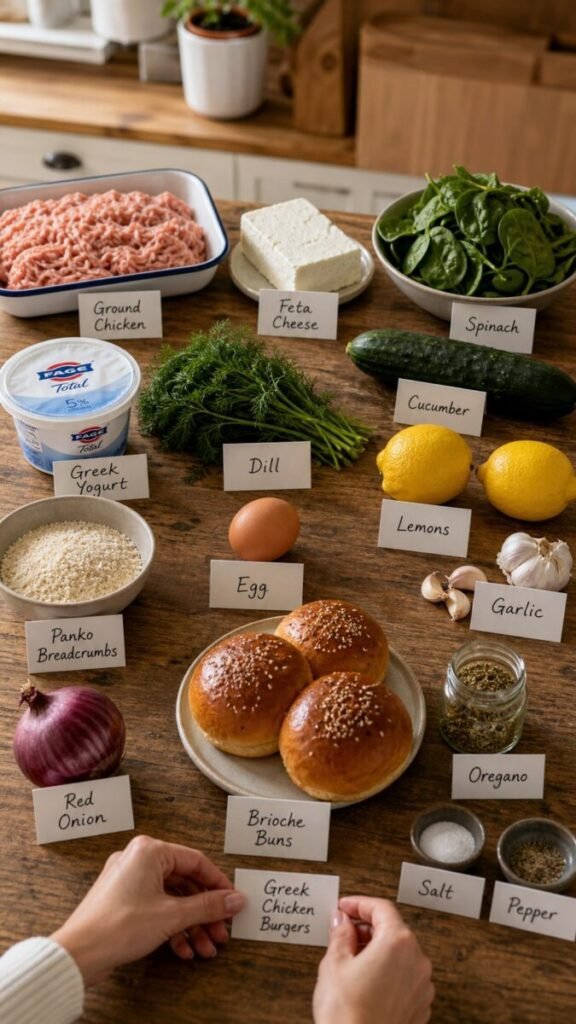
🍗 The Patties
- Ground chicken: 1¼ lb — thigh grind preferred, breast acceptable with the Notes’ patch
- Panko breadcrumbs: ⅓ cup — the scaffolding that answers softness
- Egg: 1 — the binder that answers crumble
- Salt and black pepper: ¾ teaspoon salt, ½ teaspoon pepper
- Dried oregano: 1 teaspoon — the Greek signature
🧀 The Mix-Ins
- Feta: ¾ cup, crumbled into pea-sized pieces — big crumbles become molten pockets
- Spinach: 1 cup finely chopped and wrung bone-dry — or ½ cup frozen, thawed and wrung twice
- Garlic: 2 cloves, grated
- Fresh dill: 2 tablespoons, chopped
- Lemon: the zest of one — the taverna smell lives here
🥒 The Tzatziki
- Greek yogurt: 1 cup — whole milk, thick enough to hold a ridged line from the spoon
- Cucumber: ½, grated and salted and squeezed — the towel takes half its weight
- Garlic: 1 small clove, grated
- Lemon juice and dill: 1 tablespoon each
- Olive oil and salt: a drizzle and a pinch to finish
🍔 The Build
- Buns: 4 — brioche, or pita pockets for the full Greek conversion
- Tomato and red onion: sliced, for the stack
- Butter: for toasting the buns — this step is not skippable and I will defend it
Step by Step How to Make
- Step 1 — The wring and the fold. Chop the spinach fine, pile it into the center of the clean towel, and twist hard over the sink — then re-pack it and twist again, until the towel comes away dark green and the spinach is a compressed, almost dry brick. The towel should show you what the patty would otherwise have absorbed. Unwrap the brick into the big bowl and break it up, then add the chicken, the pea-sized feta, the grated garlic, the dill, the lemon zest, the panko, the egg, the oregano, and the salt and pepper. Now mix gently, hands in, a loose folding motion — thirty seconds, just until the bowl stops looking like ingredients and starts looking like one mix. The fork test: press a ball of it; it should mound and hold. Stop there. Every squeeze past that point is texture you’re borrowing from dinner.
- Step 2 — The shape and the dimple. Divide the mix into four and shape each quarter into a patty about an inch thick and a touch wider than the buns — they’ll draw in as they cook, and a patty that starts bun-wide ends bun-sized. Press a deep thumbprint into the center of each one: patties dome because the edges set first and push the middle upward, and the dimple is the shallow crater that rises to meet the dome, so the finished burger lands flat instead of rounded. Lay the four patties on a plate and refrigerate them, uncovered, for at least ten minutes — the chill that turns a soft patty into a firm one before the pan gets its chance to test it.
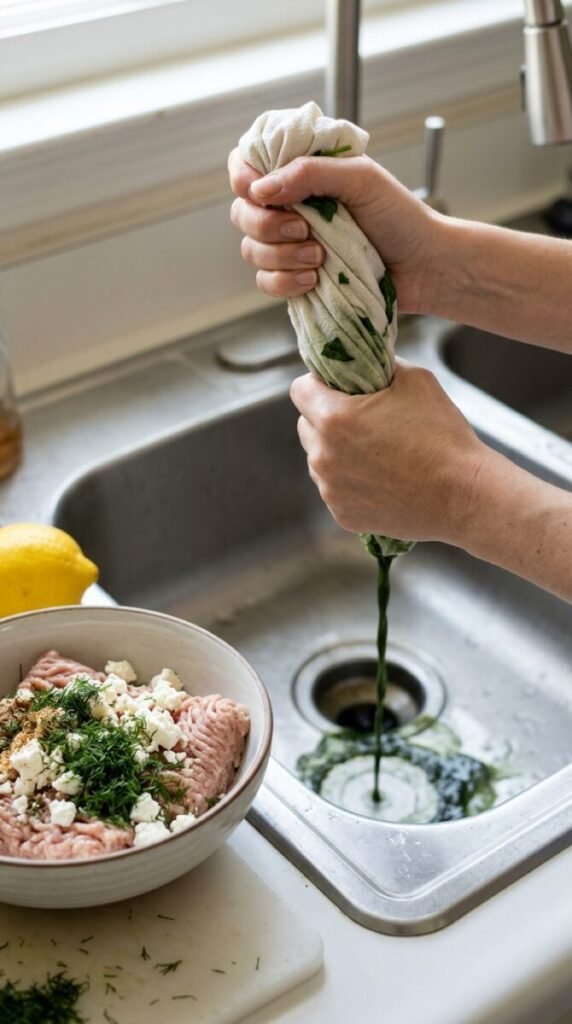
- Step 3 — The tzatziki. While the patties chill, grate the cucumber half directly onto the clean side of the towel, salt it lightly, and give it five minutes to weep — then gather and twist until it’s given up what feels like half its weight. That surrendered water is the difference between a sauce that sits on a bun and one that pools in the wrapper by the second bite. Fold the squeezed cucumber into the yogurt with the grated garlic clove, the lemon juice, the dill, a pinch of salt, and a drizzle of olive oil. The thickness test: drag a spoon through the bowl and the ridge it leaves should hold its shape. Tzatziki for dunking can be looser; tzatziki for a burger has to stand its ground.
- Step 4 — The sear. Heat the cast iron over medium heat with a film of olive oil until it shimmers — a patty that enters a lukewarm pan sticks, and a patty that enters a hot one releases itself the moment its crust sets. Patties in, dimple side up, and then hands off for five full minutes: the underside needs one uninterrupted stretch to build the golden crust that makes the single flip possible. Flip once — the thin edge of the fish spatula slides under a set patty like it was made for this, because it was — and cook another four to five minutes, resisting with all your might the reflex to press the patties down with the spatula. That press is a beef move, and a costly one even there: every sizzle you hear under a squished patty is juice leaving for the pan. Chicken has no juice to spare. Test the center of a patty with the thermometer — 165°F and dinner is done, 160-something and it needs two more minutes, and past 170 you’ve entered the chalk zone no sauce fully repairs.

- Step 5 — The rest and the toast. Burgers out of the pan onto a plate, three minutes of rest — the juices that were moving during the sear settle back into the meat instead of onto the first bite. While they rest, the buns take their turn: butter the cut sides and toast them in the same skillet, still hot, for a minute a side, until the edges turn gold and the centers go from spongy to crisp-edged-soft. A toasted bun is a small thing that changes everything — it stops the tzatziki from soaking through, it adds one more layer of texture, and the smell of butter browning in a pan that just cooked a burger is worth the recipe on its own.
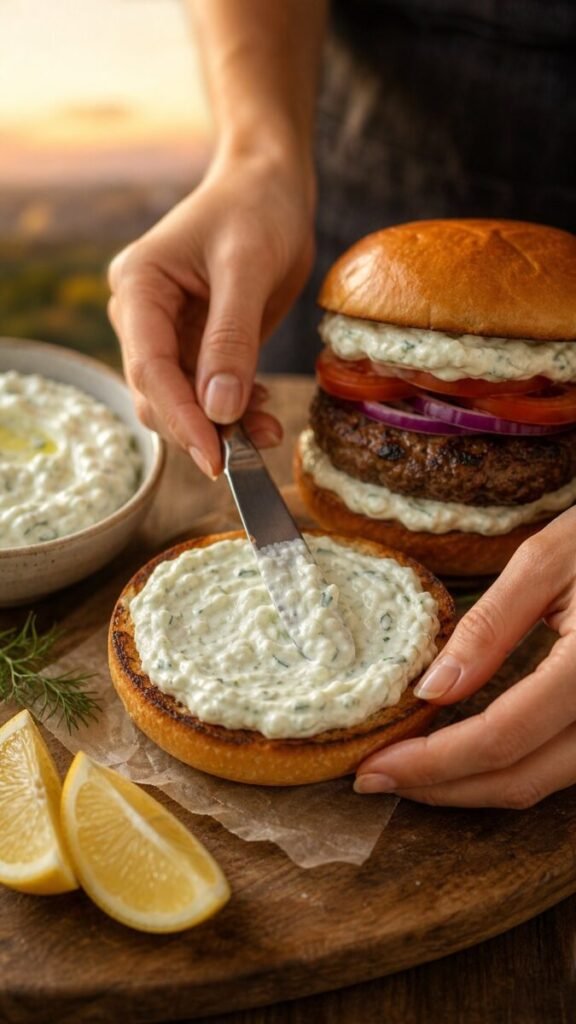
- Step 6 — The moat and the stack. The build starts with defense: spread tzatziki on the bottom bun, edge to edge, before anything else goes on. That layer is the moat — the moisture barrier between the resting patty’s juices and the bread below, and the reason the last bite of the last burger is as structurally sound as the first. Then the stack in ascending order of fragility: the patty, the tomato slice, a few rings of red onion, more tzatziki on the crown, and a final pinch of dill so the top of the burger announces what’s in it. Serve them tall, with the extra tzatziki bowl and a fistful of napkins, and listen for the specific quiet that means everyone’s first bite contained a feta pocket.
The crack burgers are this recipe’s beef branch — same weeknight, same one-bowl habit, a completely different flavor strategy. One of them runs on cheese and seasoning; the other runs on feta from the inside out. A household that masters both never argues about burger night again.
Anna’s Kitchen Notes
Thigh grind, and what to do if you can’t get it. Dark-meat ground chicken carries about fifteen percent fat, and that fat is doing quiet work for both texture and flavor through the entire recipe. If your store only stocks the all-breast grind — or if the lean number on the package won the argument — patch it with one spoonful of mayonnaise stirred into the mix. It sounds like a cafeteria trick and behaves like a charm: the mayo adds fat in emulsified form, it keeps the lean meat from drying on the exact edge the thermometer is watching, and nobody at the table has ever detected it. The burger stays honest; the juiciness becomes a given.
Crumble the feta with your hands, to pea size. The pre-crumbled bags are made of dust — convenient, and exactly wrong for this recipe, where the pockets are the point. Buy the block, break it over the bowl with your fingers, and let the pieces fall where they fall: pea-sized, rough, uneven. The big ones become the molten reservoirs in the cross-section; the small ones salt the meat between them. A distribution of sizes is the goal, which is the rare kitchen task where trying for consistency makes the dish worse.
Grill night, one accommodation. These patties grill beautifully with exactly one adjustment: everything about the chill matters more. A cold, firmly set patty hits an oiled grate and releases; a soft one arrives, sags into the bars, and leaves half of itself behind at the flip. Chill the shaped patties a full half hour if they’re headed outside, oil the grate with a folded paper towel and tongs, and commit to the single flip with the same discipline the skillet version demands. The thermometer decides the end on a grill even more than in a pan, because the grates lie about color.
The tzatziki improves overnight, so make double. The garlic and dill need a few hours to settle into the yogurt, and day-two tzatziki is noticeably rounder than hour-one tzatziki. Make a double batch — it keeps four days refrigerated — and the week gets a vegetable dip, a sandwich spread, and the standing invitation to repeat burger night at a moment’s notice. Salt the cucumber just before serving, not before storing: it keeps wringing, and a fridge-cold bowl of watered-down tzatziki is a disappointment scheduled in advance.
The mix holds for tomorrow. The shaped, dimpled patties keep 24 hours in the fridge, covered, and the flavor is better for the wait — the garlic, dill, and lemon zest use the night to introduce themselves to the chicken. This is the meal-prep lane: mix and shape on Sunday, cook on Monday in fifteen minutes flat, with the tzatziki already waiting from the day before. A burger that improves overnight and cooks in a quarter hour is the kind of planning that looks like spontaneity at the table.
The Burger Table
A burger this Mediterranean wants a warm, olive-oily side and a sharp, cold one. The warm side is the roasted Mediterranean vegetables, straight from the oven onto the plates beside the skillet — the same flavors that are in the patty, roasted instead of folded in, and the two halves of the meal taste like they planned it that way. The cold side is a true Greek salad with the house Greek dressing, its vinegar and oregano cutting cleanly through the feta and yogurt richness, and its cucumber doing friendly recon for the tzatziki. Two sides, one oven and one bowl, and the whole table reads as a single idea.
For the bun decision, the no-yeast naan is the Greek conversion: warm, blistered, brushed with olive oil instead of butter, and folded around the patty like the pita’s more dramatic cousin. And because the recipe leaves you with most of a tub of Greek yogurt, the end of the meal takes care of itself — a spoon of the yogurt cookie dough situation, or the five ways to use the rest of the tub, whichever the household’s sweet tooth votes for. For the rotation around it: the garlic butter chicken thighs are this recipe’s whole-muscle counterpart — same garlic-forward instincts, no bowl, no patties — and the two of them alternate nicely through the month.
Same Grind, Other Flavors
The lamb lane. Ground lamb instead of chicken, everything else nearly the same — the dill doubles, the oregano stays, and a tablespoon of chopped mint goes in with the lemon zest. Now it’s a kofta-adjacent burger, the tzatziki is exactly where it always wanted to be, and the mix-in doctrine transfers untouched. This is the version for the dinner where burger night gets upgraded to an occasion.
The sun-dried tomato lane. Swap the spinach and feta for chopped oil-packed sun-dried tomatoes and torn basil, the oregano for Italian seasoning, and the tzatziki for a spread of ricotta or fresh mozzarella. The soft-meat doctrine is flavor-agnostic — the same binder, the same wringing discipline (tomatoes get patted dry), the same single flip — and the whole dish moves one country west without changing any of its structure.
The harissa lane. A tablespoon of harissa stirred into the mix and the feta held back to crown the cooked patty, where it softens against the heat instead of melting inside it. Sweet heat from the paste, salt from the cheese, cool from the tzatziki — the three-way conversation makes this the loudest burger in the set and the one my spice-forward friends request by name.
The meatball conversion. The exact same mix, rolled into golf-ball meatballs and baked at 400°F for 15 minutes, over a skillet of orzo or a bowl of buttered rice with the tzatziki drizzled over the top. Same thirty minutes, no buns, and dinner eats like the patty dressed up for company. The dimple step gets skipped; everything else travels whole.
The lettuce-wrap lane. Skip the bun entirely, double the tomato and onion, and wrap the patties in crisp romaine or butter lettuce with the tzatziki as the binder. The burger becomes the protein course of a lighter dinner, the carb column drops to near zero, and nothing about the patty itself changes — it was never counting on the bread for its juiciness. That was always the feta’s job.
The breakfast patty. Cook one leftover patty in the morning and set it on an English muffin with a soft fried egg and a swipe of the leftover tzatziki. The lemon and dill turn out to be morning flavors wearing evening clothes, and this has quietly become the reason I shape five patties when the recipe says four.
The Burger Math
| Nutrient | Per Serving (1 burger of 4) |
|---|---|
| Calories | 480 kcal |
| Protein | 38 g |
| Carbohydrates | 28 g |
| Fats | 24 g |
Estimates as written — thigh grind, the full feta and tzatziki counted honestly, butter-toasted buns included with no apologies. Thirty-eight grams of protein is a number most burgers would have to fake with a supplement, and it arrives surrounded by vegetables on a bun. The money math is short and satisfying: a pound and a quarter of ground chicken, a quarter of a feta block, a tub of yogurt, and a bag of spinach put four pub-quality burgers on the table for about eleven dollars — while the gastropub down the street charges more than that per burger for the version with less feta, a brioche ceiling, and no tzatziki moat. The pub keeps the atmosphere; your kitchen keeps the change.
The Second Patty
Storage, and the good news that this format is built for it. Cooked patties keep three days refrigerated and reheat gently — a covered skillet on medium-low for four minutes, with a spoonful of water to steam them back to soft, beats the microwave, which tightens chicken the way it tightens everything. The tzatziki keeps four days in its own jar and improves for the first two of them. Raw shaped patties, covered and refrigerated, hold a day and get better overnight. The system stacks: mix Sunday, cook Monday, reheat Wednesday, and the last patty of the week eats like the first one’s quieter sibling.
The freezer takes the raw patties for a month, individually wrapped — freeze them on a sheet until solid, then bag them, dimples and all, and thaw overnight in the fridge before the pan. What does not freeze well is the tzatziki: yogurt breaks and the cucumber turns watery, and a thawed tzatziki is a sauce that has clearly been through something. Make that part fresh — it takes ten minutes and the cucumber needs grating anyway — and let the patties be the part of the recipe that waits.
The unbuilt components make burger night a five-minute assembly any night of the week: patties thawed, buns in the bread box, tzatziki in its jar with the cucumber waiting on the counter. This is the version of meal prep that doesn’t taste like Sunday’s reheated afterthoughts — it tastes like a burger that was always planning to be here.
Where It Goes Wrong
The patty that fell apart. The soft-meat problem won, and it usually wins at the flip: the first side never set because the pan wasn’t hot enough, the patty wasn’t chilled, the spinach was wet, or the mix got overworked into a texture that holds nothing. The fixes are all upstream and all cheap — hot pan, ten-minute chill, the double wring, the thirty-second gentle mix. If the flip is already upon you and the patty is arguing, slide the spatula fully under, support the top with your fingers shielded by a folded paper towel, and turn it in one decisive motion. Half-measures at the flip are where burgers go to die.
The chalky bite. Dry, tight, drumstick-of-the-desert texture — the thermometer was ignored and the patties sailed past 165°F, or the squish reflex fired and pressed the juice into the pan, or the breast grind went in unpatched. Pull the patties at 165, not a degree of sightseeing past it; keep the spatula flat and idle; and give the lean grind its spoonful of mayo. A chalky patty can be sauced back toward edible with extra tzatziki, but it can’t be sauced back to good, and the table knows the difference even when it’s polite about it.
The flavorless first bite. Tastes like chicken that once heard about Greece — the lemon zest got skipped, the feta was pre-crumbled into dust, or the salt was reduced on principle. Zest and salt are not the negotiable parts of this recipe: the zest carries the whole fragrance of the dish, and the feta’s salt is a structural flavor, not a garnish. If the burger is already cooked and tasting shy, a crumble of raw feta and a pinch of dill on the stack closes most of the gap at the table.
The burst pockets. Feta escaped the patty and burned onto the pan in pale streaks — the crumbles were pushed to the edges during shaping, or the heat ran high enough to blow the pockets out through the crust. Center the crumbles when shaping, keep the pan at medium rather than medium-high, and accept that a little feta escape is the recipe’s cost of doing business — those pan streaks brown, crisp, and taste like the best accident in the skillet. Scrape them up with the spatula and call them chef’s toll.
The dome. A patty that finished rounded as a rolling hill — the dimple got skipped, and the setting edges pushed the soft center upward with nothing waiting to absorb it. It’s purely geometric, purely cosmetic, and purely preventable: one thumbprint at shaping time, and the burger ends flat, the toppings stay aboard, and the top bun doesn’t teeter. If the dome has already happened, slice the bump off flush with a serrated knife and eat the trim standing at the counter like everyone else does.
The soggy bottom bun. The last quarter of the burger is a wet handshake — no tzatziki moat on the bottom bun, no toasting, or the patty went from pan to stack without its rest. All three defenses take under three minutes total: butter-toasted bun, tzatziki edge to edge on the bottom, patty rested before it’s stacked. The moat is not a flourish; it’s the reason this burger survives to its final bite with its architecture intact.
Greek Burger Questions
Can I use ground turkey instead?
Yes, one to one, same binder, same chill, same 165°F finish — turkey is the soft-meat problem’s other patient, and everything in this recipe treats it identically. Turkey runs even leaner than chicken breast in most packages, so the mayonnaise patch goes from optional to recommended, and the feta pockets matter double. The burger comes out a shade milder and every bit as juicy as the chicken version promises to be.
Can I make these gluten-free?
Easily. Swap the panko for gluten-free breadcrumbs, or take the binder’s other road: skip the crumbs and the egg entirely and stir in two tablespoons of mayonnaise instead — the mayo school of chicken burgers holds together just as well and was gluten-free before that meant anything. The buns are the remaining decision: GF buns, or the lettuce-wrap lane, or the pita pocket route with a GF flatbread. The patty itself doesn’t care; it was never about the bread.
Do I really need the thermometer?
For ground chicken, yes — this is the one number in the recipe with no visual substitute. A whole chicken breast gives you juice color and opacity to read; ground meat has been through a grinder, every surface is a surface, and pinkness in a patty is unreliable in both directions. The good news is that the window is generous at both ends if you respect it: 165°F is instant doneness and instant safety, and pulling at exactly that number keeps the feta’s work from being undone. A thermometer costs less than the feta block and outlives years of burgers.
Can I grill these instead of using a skillet?
Yes — with the one accommodation the Notes covers: the half-hour chill and an oiled grate, which between them take the patty’s survival rate from dicey to reliable. Cold patties release from hot grates once the crust sets; soft warm ones weld. The single flip is even more important over coals, and the thermometer is even more necessary, because grilled color runs darker than skillet color and lies about it confidently.
Can I use frozen spinach?
Yes — half the volume the fresh calls for, thawed completely, and wrung twice as hard, because frozen spinach holds water with a commitment fresh spinach never developed. The towel will darken more than you expect on the second twist; keep going. What frozen doesn’t give you is the bright green fleck in the cross-section — frozen spinach goes darker and quieter — so the fresh version photographs better and both versions taste the same once the bun closes.
How do I stop the tzatziki getting watery?
Two habits, both in the recipe: salt the grated cucumber and wait five minutes before wringing — the salt pulls the water out of the cells so the towel can take it — and salt the finished tzatziki lightly and only at serving, never before storing, because cucumber keeps weeping in the fridge. If a stored batch has thrown off some water anyway, pour it off and stir; the bowl underneath is usually still right. The burger-thickness standard is the whole defense: a tzatziki that holds a spoon’s ridge doesn’t slide, and a sliding tzatziki was a watery one first.
What do I serve with them?
The short version of the table above: warm roasted Mediterranean vegetables on the plates, a true Greek salad with the house dressing beside, and something from the yogurt tub for after — the tzatziki already bought the main ingredient for dessert. If burger night has grown into a crowd, cut the patties into sliders, halve the shape time, and serve the tzatziki in a bowl with a spoon, because a slider table is a self-serve table and the moat becomes everyone’s own responsibility.
Greek Chicken Burgers
Ingredients
As an Amazon Associate I earn from qualifying purchases.
Chicken patties
- 1¼ lb (567 g) ground chicken, preferably containing thigh meat; check the label for fat content
- ⅓ cup panko breadcrumbs
- 1 large egg
- Up to ¾ teaspoon fine salt; use less if the feta is particularly salty
- ½ teaspoon black pepper
- 1 teaspoon dried oregano
- 2 teaspoons olive oil, for the skillet
Feta & herb mix-ins
- ¾ cup (about 113 g) feta, drained and crumbled into small pea-size pieces
- 1 cup finely chopped fresh spinach, thoroughly dried; or ½ cup thawed frozen spinach, squeezed very dry
- 2 cloves garlic, grated
- 2 tablespoons chopped fresh dill
- Finely grated zest of 1 lemon
Tzatziki
- 1 cup plain whole-milk Greek yogurt
- ½ medium cucumber, grated; remove large watery seeds if present
- 1 small clove garlic, grated
- 1 tablespoon fresh lemon juice
- 1 tablespoon chopped fresh dill
- 1 teaspoon extra-virgin olive oil
- A small pinch fine salt, for the cucumber, plus more only if needed
Burger assembly
- 4 burger buns, split
- 1 tablespoon softened unsalted butter, for toasting
- 1 medium tomato, sliced and lightly blotted dry
- ¼ small red onion, thinly sliced
- Extra fresh dill, optional, for finishing
Kitchen Tools
- Large mixing bowl and small sauce bowl
- Clean kitchen towels, keeping cucumber preparation separate from raw poultry
- Box grater and fine zester
- Chef’s knife and cutting board
- Measuring cups and spoons
- Large heavy skillet
- Wide spatula
- Instant-read meat thermometer
- Tray, for chilling the raw patties, and a separate clean plate for cooked burgers
Directions
- Dry the greens and gently mix the patties. Wash and thoroughly dry fresh spinach, then chop finely. If using frozen spinach, thaw and follow any package cooking instructions, cool, and squeeze very dry in a clean towel. Combine the egg, panko, garlic, dill, lemon zest, oregano, salt, and pepper in the large bowl. Add the ground chicken, spinach, and feta, then fold gently just until evenly distributed. Do not taste the raw mixture.
- Shape and chill. Divide into four equal portions and form patties about ¾ inch thick, slightly wider than the buns. Make a shallow indentation in the center of each. Tuck large exposed feta pieces into the meat where practical. Place on a tray, cover, and refrigerate for at least 10–15 minutes. The mixture may remain somewhat sticky; chilling helps handling but does not replace proper cooking. Wash hands and clean raw-poultry surfaces before preparing the sauce or toppings.
- Make the thick tzatziki. Lightly salt the grated cucumber and let stand for 5 minutes, then squeeze thoroughly in a clean towel that has not contacted raw chicken. Stir into the Greek yogurt with the garlic, lemon juice, dill, and teaspoon of olive oil. Taste before adding more salt. The sauce should hold a soft ridge when stirred. Refrigerate until assembly.
- Cook every patty to 165°F. Heat 2 teaspoons olive oil in the skillet over medium heat. Add the chilled patties without crowding, cooking in batches if necessary. Cook for about 5–6 minutes on the first side, until the underside is browned and releases with a spatula. Flip carefully and cook for another 5–7 minutes, adjusting the heat if browning too quickly. Do not press the patties. Insert the thermometer horizontally from the side into the center of each burger and check that every patty reaches at least 165°F. Timing varies with thickness; cook longer as needed rather than relying on color or a fixed number of minutes. Never steady a hot patty with your fingers.
- Rest the burgers and toast the buns. Transfer the fully cooked patties with a clean utensil to a clean plate and rest for about 3 minutes. Reduce the skillet heat and remove any loose scorched bits with a heat-safe utensil. Lightly butter the cut faces of the buns and toast cut-side down for about 1–2 minutes, until golden. The rest is for texture and handling, not for bringing undercooked chicken up to a safe temperature.
- Build and serve promptly. Spread a modest spoonful of tzatziki on each bottom bun. Add a patty, blotted tomato slices, red onion, and another small spoonful of sauce. Finish with optional dill and the top bun. Serve remaining tzatziki alongside. Toasting and well-drained toppings help the bun stay intact; yogurt sauce is not a waterproof barrier. Allow about 40–50 minutes overall, with extra time if cooking in batches. Refrigerate cooked patties and tzatziki separately within 2 hours, or 1 hour above 90°F, and use within 3–4 days. Reheat cooked patties to 165°F. Keep raw patties at 40°F or below and cook within 1–2 days of purchasing the ground chicken, or freeze.
Nutrition
| Nutrient | Approximate amount per burger |
|---|---|
| Serving size | 1 assembled burger with ¼ of the tzatziki |
| Calories | 650–730 kcal |
| Protein | 44–48 g |
| Carbohydrates | 43–48 g |
| Total fat | 33–41 g |
Broad estimates assume 567 g ground chicken, 113 g feta, four approximately 60 g buns, the full yogurt sauce, panko, egg, listed oil, and butter. Ground chicken fat content and bun brands vary substantially; thigh meat does not automatically mean a specific fat percentage. Using less sauce reduces the totals. Contains wheat, egg, and milk. For gluten-free needs, use verified gluten-free panko and buns while retaining the tested-style egg and breadcrumb binder.