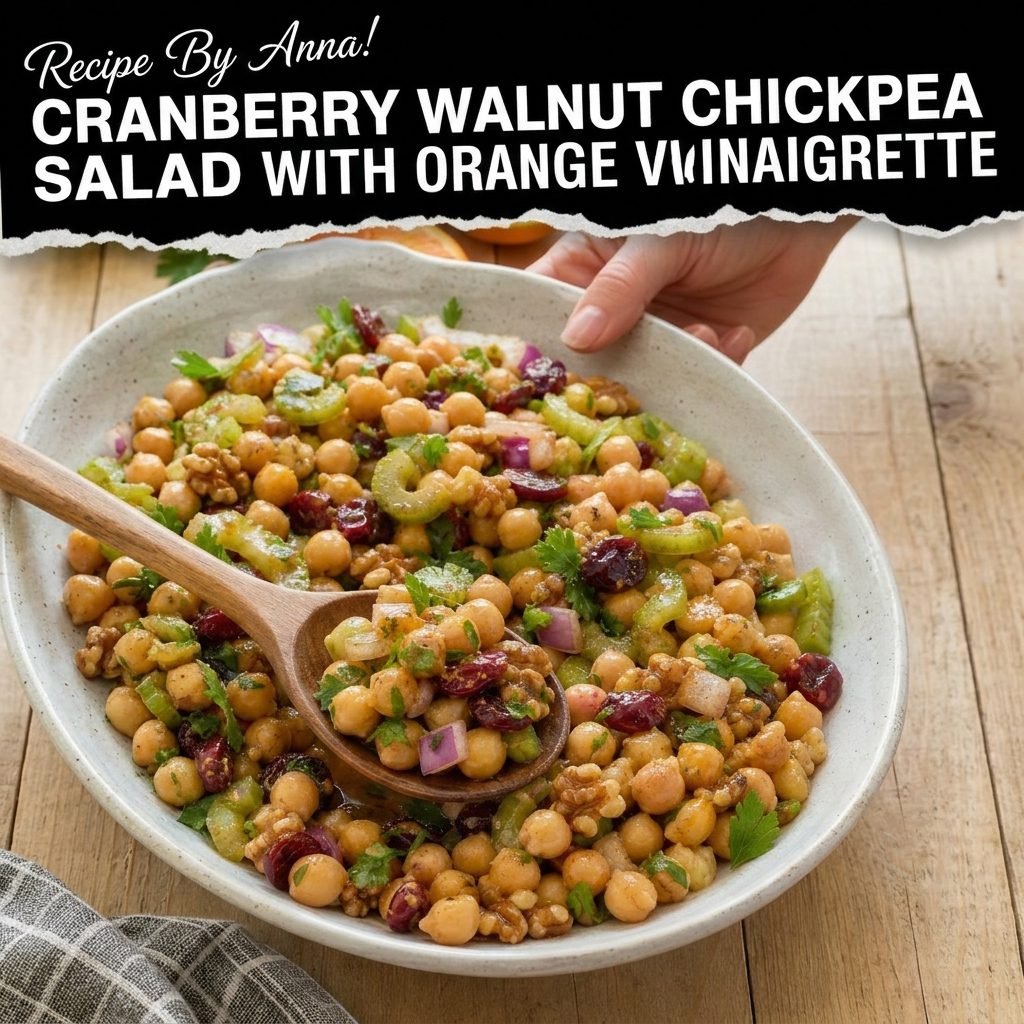
Cranberry Walnut Chickpea Salad (Orange Vinaigrette)
The desk-lunch problem, stated plainly: most salads are a countdown. Lettuce wilts by ten-thirty, cucumbers weep by noon, and by the time you’re eating at your desk, the bowl has quietly given up on both of you. Chickpeas never got that memo. They are the one salad base with no clock running — sturdy at assembly, sturdier at noon, and genuinely better on day two, after a night of marinating in the dressing. This bowl builds on that patience: two cans of chickpeas, dried cranberries, toasted walnuts, celery, red onion, and parsley, all tumbled in an orange vinaigrette bright enough to make the whole thing taste like it has somewhere better to be.
Chickpea salads come in two schools, and it’s worth knowing which one you’re in before you start chopping. The smashed school mashes the chickpeas into a paste with mayonnaise and mustard — a sandwich filling, excellent in its way. The tossed school, which is where this recipe lives, keeps the chickpeas whole and lets a real vinaigrette do the flavor work: nothing mashed, no mayo, every chickpea an individual with its own skin still on. The texture argument is the whole point — a bowl you eat with a fork and chew, not something you spread. And because there’s no dairy and no egg in it, the bowl travels in a lunchbox without the morning anxiety that potato salad and its mayonnaise relatives bring to a warm day.
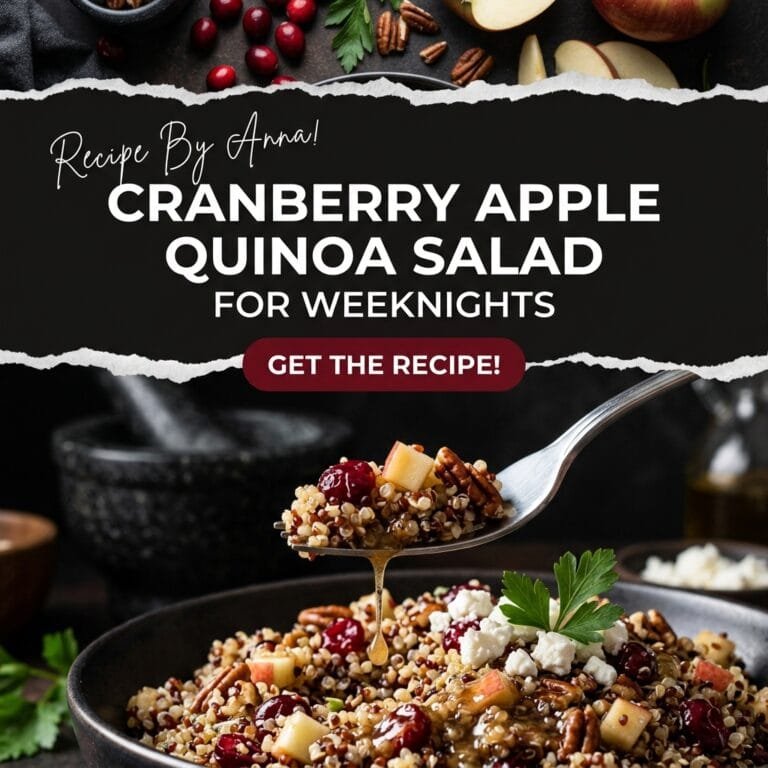
Shelf notes, because this site keeps them: the chickpea lunch shelf has a sesame-ginger chickpea salad already on it and a feta-avocado cousin beside it, and the cranberry-at-lunch tradition is anchored by the cranberry apple quinoa salad. This one is the no-mayo, pantry-can entry: nothing in it spoils fast, everything in it is a grocery-store staple, and the whole bowl comes together in fifteen minutes with nothing cooked except a handful of walnuts.
The Can Doctrine
Start with the beans, because the beans are where the recipe is quietly won or lost. Canned chickpeas are the honest path here — home-cooked-from-dry are slightly better and entirely unreasonable on a lunch-prep Sunday — but the can comes with two duties. First, the rinse: the can liquid (aquafaba, if you’ve met it in baking) is slick and starchy and tastes like the inside of the can, and it clings. Rinse thoroughly in a colander, moving them around under cold water for a full ten seconds. Second, the rinse’s hidden cost: it takes the salt with it. Canned chickpeas arrive seasoned from the factory, and a good rinse leaves them clean and ready — which also means this salad needs more added salt than your instincts will suggest. Budget for it, taste at the end, and trust the bowl when it asks for another pinch.
Then dry them, and I mean actually dry them: spill the rinsed chickpeas onto a clean kitchen towel, fold it over, and press, then roll them around a little. This sounds like fuss and is the difference between a dressed salad and a damp one. A wet chickpea wears vinaigrette the way a waxed car wears rain — it beads up and slides off, and you find the dressing pooled at the bottom of the bowl instead of on the beans. Thirty seconds of towel work buys the grip that makes every chickpea carry flavor. It’s the same physics that makes restaurants dry their greens obsessively, applied to a bean that everyone treats carelessly.
The skin question arrives next, because somebody always asks. Leave the skins on. Peeling chickpeas one by one — a real thing people do, usually for hummus, always for serenity — buys a silkier texture that matters when the chickpea is being pureed. In a tossed salad the skin is the jacket: it holds the bean’s shape through stirring, overnight marinating, and the general rough-and-tumble of lunchbox transit. The texture of a whole skinned chickpea in a salad is barely different from an unskinned one, and the hour you’d spend peeling two cans is an hour this recipe does not want from you.
⏱️ 15 MINUTES, ONE SKILLET FOR THE NUTS | 🫘 SERVES 4 | 🥗 NO MAYO, LUNCHBOX-PROOF
- Prep Time: 15 minutes — chop, toast, whisk, tumble
- Chill (optional): 10-15 minutes for the flavors to marry
- Total Time: about 30 minutes, mostly waiting
- Yield: 4 lunch bowls, or 6 side salads
The Two-Crunch Rule
Equipment is nearly irrelevant here, which is part of the recipe’s charm — but the few pieces that matter:
- Colander — for the rinse, and for the cranberries after their bath
- Clean kitchen towel — the chickpeas’ drying station; doubles as the cranberries’
- Dry skillet — the walnuts’ five minutes of glory; a small one, no oil
- Small bowl and whisk — or a jar with a lid, shaken hard, for the vinaigrette
- Large bowl — the tumbling arena
- Microplane or zester — for the orange, whose zest is half the dressing’s identity
The rule the section is named for: this salad runs on exactly two crunches and one chew, and each has its own job. The walnuts are the deep crunch — toasty, fatty, structural — and they get toasted because a raw walnut is a shy ingredient while a toasted one is the reason people hover near the bowl. The celery is the fresh crunch, high and watery, keeping the low ingredients company at the top of each bite. The cranberries are the chew — sweet, dense, tart — and they’re the only ingredient that needs fixing before they join, because straight from the bag they eat like dried fruit with a grudge. The fix is the trade in the next paragraph, and it’s the single most useful trick in the recipe.
Here it is: while you chop everything else, soak the dried cranberries in the orange juice — the actual juice the vinaigrette is made of. Ten minutes in the liquid and the cranberries plump back from leather toward fruit, and the juice, meanwhile, goes faintly pink and picks up a cranberry undertone. The dressing and the cranberries trade favors, and neither one is the same afterward. There’s a whole genre of recipes that plumps dried fruit in warm water and throws the water away; this version plumps in flavor and keeps every drop of it. You get softer cranberries and a more interesting vinaigrette from one bowl, and the entire maneuver costs you zero extra minutes, because the juice was getting squeezed anyway.
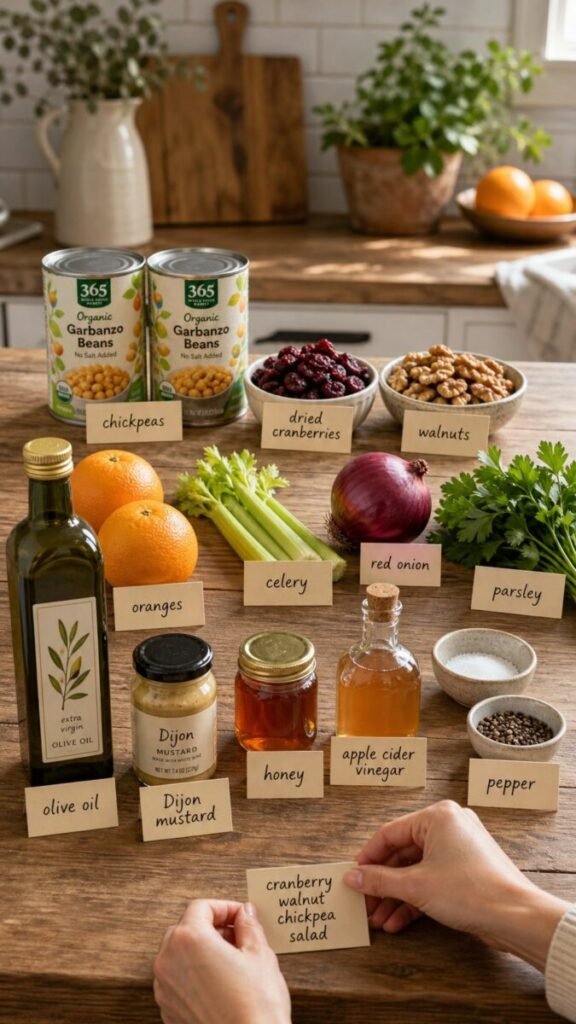
Ingredients (With Labels)
🫘 The Base
- Chickpeas: 2 cans (15 oz each), drained, rinsed, and towel-dried
- Celery: 2 stalks, sliced thin — the fresh crunch
- Red onion: ¼ cup, finely diced — mellows as it sits; see the Notes
- Flat-leaf parsley: ½ cup, roughly chopped
🍊 The Vinaigrette
- Orange: 2 large — the zest of one, ¼ cup of juice
- Apple cider vinegar: 1 teaspoon — the sharpener orange can’t provide alone
- Dijon mustard: 1 tablespoon — the emulsifier, and a flavor in its own right
- Honey: 1 teaspoon — maple syrup for the vegan lane
- Olive oil: ¼ cup, extra virgin
- Salt and black pepper: ½ teaspoon salt to start, more at the end; pepper generously
🌰 The Sweet and the Crunch
- Dried cranberries: ½ cup — plumped in the orange juice while you chop
- Walnuts: ½ cup, toasted and roughly chopped
Step by Step How to Make
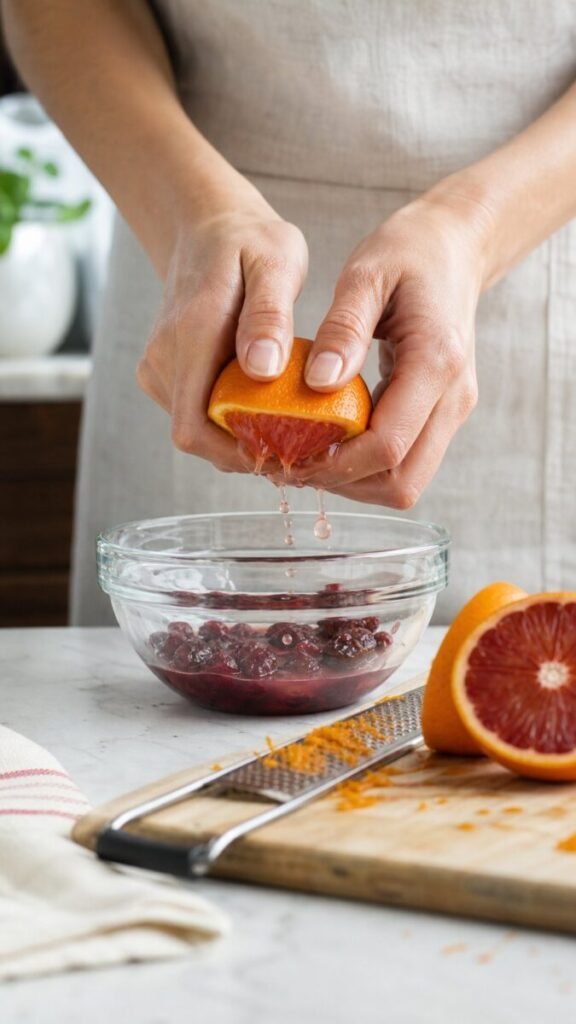
- Step 1 — The trade. Squeeze the oranges first — a firm roll on the counter before halving loosens the juice, and ¼ cup from two large oranges is the usual take. Drop the dried cranberries straight into the juice and leave them there while you do everything else. Ten minutes minimum, twenty if the chopping goes slowly; the cranberries swell, the juice blushes pink, and both of them come out of the bath improved. This is the recipe’s one non-standard move, and it costs nothing because the juice was already spoken for.
- Step 2 — The rinse and the dry. Drain the chickpeas into the colander and rinse under cold water for a full ten seconds, moving them around, until the water runs clear and the slick can-liquid feeling is gone. Spill them onto the clean kitchen towel, fold the towel over, press, and roll them gently. You’re not polishing them; you’re taking the surface water off so the vinaigrette can grab. A damp chickpea repels dressing, and the whole bowl depends on the opposite.
- Step 3 — The toast. Walnuts into the dry skillet over medium heat, five to six minutes, shaken twice, pulled the moment they smell like toasted nuts instead of like the cupboard. They carry their own oil and need nothing added, and the window between toasted and scorched is narrow at the end — trust your nose over the clock, and tip them out of the pan immediately so the residual heat doesn’t carry them past done. Roughly chop once they’ve cooled a minute; big pieces, the kind that announce themselves in a bite.
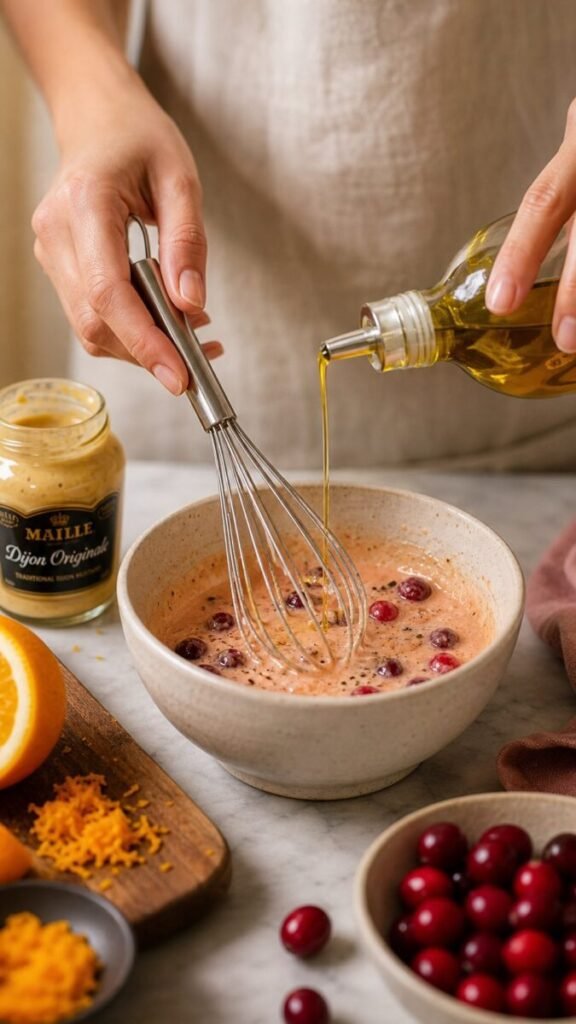
- Step 4 — The vinaigrette. Zest one orange directly over the small bowl, then add the pink cranberry-soaked juice, the cider vinegar, Dijon, honey, ½ teaspoon of salt, and a few grinds of pepper. Whisk to combine, then pour the olive oil in a thin stream while whisking continuously — the Dijon is doing the emulsifying, but it needs the oil arriving slowly to do it, and about thirty real seconds of whisking turns the bowl from separated ingredients into one creamy, opaque dressing. Taste it on a chickpea, not a spoon: the bean’s neutrality is the backdrop the dressing actually has to work against.
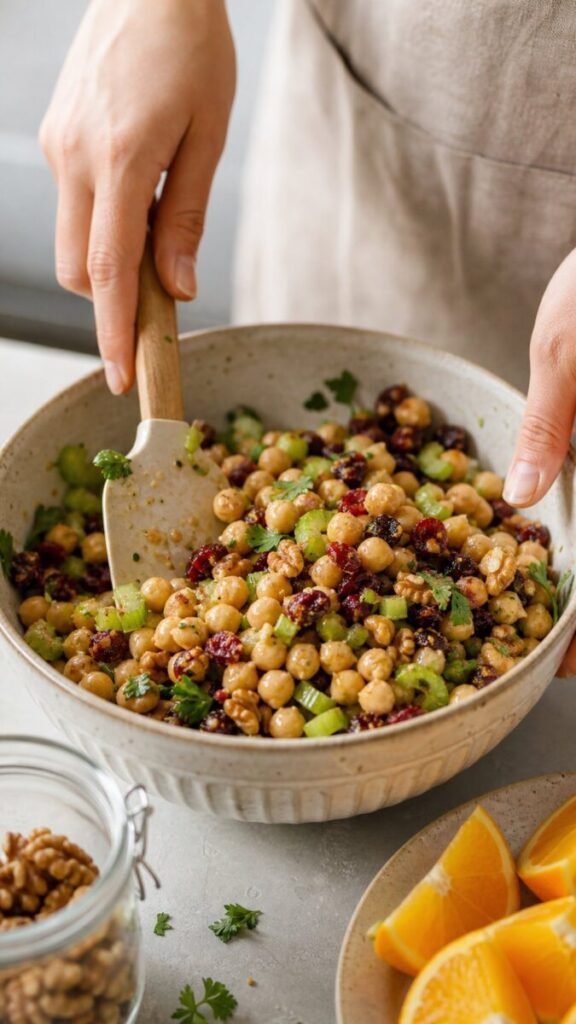
- Step 5 — The tumble. The dried chickpeas, sliced celery, diced onion, and chopped parsley go into the large bowl. Pour the vinaigrette over, add the plumped cranberries and their leftover pink tint, and fold with a spatula or two spoons — a turning motion, not a stirring one, the way you’d fold anything you didn’t want to break. Chickpeas are sturdy, but the point of the tossed school is beans that keep their faces, so treat them like guests rather than cargo. Fold until every chickpea glistens and no pocket of dry ingredients hides at the bottom of the bowl, then scatter the walnuts over and fold twice more, just to distribute.
- Step 6 — The rest and the taste. Let the bowl sit ten to fifteen minutes before serving if you have them — the onion mellows, the chickpeas start drinking the dressing, and the flavors introduce themselves to each other. Then taste one chickpea and adjust: this is the moment for the final salt, because the rinse took the factory seasoning away and acid makes salt taste quieter than it is. Serve it heaped in wide bowls with the parsley that climbed to the top pushed back down into the dressing, extra walnuts for anyone who lost theirs to the fold, and a wedge of orange for the brightness maximalists. If it’s going to the fridge instead of the table, it only gets better from here.
The sesame-ginger chickpea salad is this recipe’s other passport — same sturdy beans, same lunchbox-proof philosophy, entirely different seasoning. One of them is Tuesday and one is Thursday, and the week is better with both.
Anna’s Kitchen Notes
Tame the onion if your table is onion-shy. Raw red onion arrives loud and stays loud for exactly the people you feed. Two fixes: dice it smaller — the flavor mellows as the surface area spreads — or drop the diced onion into the orange juice with the cranberries for its own ten-minute bath, where the acid takes the edge off while the onion lends the juice a little sharpness back. The bath is the better trade, and it’s already sitting there. If your household likes its onion bold, skip all of this and let it be itself.
Two oranges are not optional, and here’s the arithmetic. One large orange gives about ⅓ cup of juice on a good day, and this dressing needs ¼ cup plus a tablespoon of patience — but cranberries plump by absorbing some of what they sit in, which is exactly why you squeeze two. Start with ⅓ cup in the soaking bowl, and after the bath, if the juice measures shy of ¼ cup, top it up from the second orange. The zest comes from whichever orange wore the brighter skin, and the second orange gets cut into wedges for the table. Nothing wasted, nothing squeezed in a panic at the end.
Toast the walnuts even when you’re in a hurry. It’s five unattended minutes in a pan that needs no oil and no attention beyond a shake, and it is the difference between a walnut that fills space and a walnut that gets compliments. Raw walnuts taste faintly of the bag; toasted ones taste like the reason this salad gets requested again. The same logic runs across the site’s salads for a reason — it’s the highest-value five minutes in the cold-kitchen repertoire.
Chickpeas from dry, for the overachievers, honestly rated. A pound of dried chickpeas, soaked overnight and simmered until tender, yields the texture of a much more expensive bean and takes roughly a day of mostly-unattended time. Rate it a genuine upgrade and an honest hassle: worth it on a Sunday that’s already about cooking, never worth it on the Sunday this salad was actually invented for. If you do go dry, salt the simmering water like pasta water and save a ladle of the cooking liquid — it’s the family broth that aquafaba wishes it were.
Keep the walnuts apart for the meal-preppers. If this bowl is destined for four days of lunches, toast and chop a double batch of walnuts and keep them in a jar on the counter instead of in the bowl. Everything else in the salad improves overnight — the chickpeas marinate, the celery holds, the onion sweetens — but walnuts in liquid slowly surrender their snap, and a day-three walnut is a pale memory of a day-one walnut. Crown each bowl fresh from the jar, and every lunch eats like the first one. It’s one small extra step, and it’s the difference between meal prep that works and meal prep that fades.
The Lunch Table
This salad is a complete lunch on its own, and it plays well with the rest of the lunch rotation. A mug of the slow-cooker corn chowder beside it makes a soup-and-salad lunch that feels catered; the roasted Mediterranean vegetables at room temperature make a warm-cold contrast worth arranging on purpose. For a desk lunch, pack the salad in the container and the walnuts in a folded paper cup, and assemble at the desk to a small audience of coworkers who want the recipe.
To turn the bowl into a dinner plate: spoon it over a bed of rice with the thirty-minute veggie rice bake alongside for a fully vegetarian evening, or pile it onto the roasted chickpea bowl format — roasted spiced chickpeas on the bottom, this salad on top, a spoon of yogurt between them and a drizzle of the house Greek dressing over everything. The cranberry-walnut-citrus chords survive every one of those conversions, which is the test of a dressing built on real structure rather than a single loud note.
Same Bowl, Other Pulses
The white bean version. Cannellini or great northern beans swap in straight across, and the salad goes softer and more Provençal — add a few torn basil leaves and shave the celery thinner, since white beans can’t lean on the chickpea’s nutty structure. Same vinaigrette, same trade, a quieter bowl.
The lentil version. French du Puy lentils, cooked until just tender, replace the chickpeas and the salad turns earthy and herby — double the parsley, consider a spoon of Dijon more, and you’ve wandered into a very good French deli. The cranberries and walnuts stay exactly where they are; they turn out to be French at heart.
The edamame blend. Half chickpeas, half shelled edamame, and each bite gets two different beans and two different greens — the salad turns brighter and faintly sweet, and packs more protein per spoonful than any other version in this list.
The cracked-wheat lane. A cup of cooked pearl couscous or farro folded in turns the salad from a lunch into a potluck dish that feeds eight — the grains drink the vinaigrette exactly the way the chickpeas do, and the whole bowl gains a slow, starchy backbone. Add five minutes of cooking, subtract zero flavor.
The apple swap. Diced crisp apple in place of the cranberries — Honeycrisp or something equally loud — with the walnuts staying put. The salad goes from autumn-late to autumn-early, the chew becomes a crunch, and a tablespoon of cider vinegar replaces the orange’s role. Same skeleton, different season.
The protein add-ons. A can of drained tuna, a shredded rotisserie chicken, crumbled feta, or two soft-boiled eggs halved on top — any of the four turns the lunch bowl into a dinner plate without asking the salad for anything. The vinaigrette is sturdy enough to dress all of them, which is what building it on Dijon and structure instead of whim buys you.
The Salad Math
| Nutrient | Per Serving (1 lunch bowl of 4) |
|---|---|
| Calories | 450 kcal |
| Protein | 11 g |
| Carbohydrates | 46 g |
| Fats | 23 g |
Estimates as written — two full cans of chickpeas, a half cup each of walnuts and cranberries, and the complete vinaigrette counted to the last tablespoon of oil. Eleven grams of protein is solid meatless territory, and the fiber column would be the showpiece if the table had one — two cans of chickpeas carry most of what a desk-luncher needs between here and dinner. The money math is the friendlier ledger: two cans of chickpeas, a bag each of cranberries and walnuts, two oranges, and a stalk of celery run about seven dollars and change for four lunches — under two dollars a bowl for a lunch that outperforms the twelve-dollar version at the takeout counter, and has never once made anyone wait in line.
The Desk Lunch
Storage, and the rare pleasure of a salad that gets better with a past. The fridge keeps this bowl four days covered, and day two is the peak: the chickpeas have marinated overnight, the onion has sweetened, the celery has mellowed a shade — the bowl isn’t surviving the week, it’s using it. Pack lunches straight from the big container and keep the walnuts in their counter jar for crowning at the table, and the fourth-day bowl is barely distinguishable from the first.
The vinaigrette does thicken in the cold, the way every emulsion does — it’s the olive oil firms-up-in-the-fridge instinct, and it’s cosmetic. Twenty minutes on the counter, or a thirty-second stir, brings the dressing back to glossy. If you’re packing lunches at night, portion them then and let the fridge do its marinating work directly in the containers — one less bowl to wash, one more hour of flavor for each lunch.
What the desk lunch does not need is an ice pack the size of a paperback. No mayo, no dairy, nothing in the bowl with a two-hour countdown — a morning in a lunch bag is well within every ingredient’s comfort zone, and that specific peace of mind is the quiet reason this recipe exists in the form it does. Freeze it? No — the chickpeas come back mealy and the celery comes back defeated, and this bowl asks so little of you that four days of fridge is plenty of runway anyway.
Where It Goes Wrong
The naked chickpea. Dressing pooled at the bottom, beans dry on top — the chickpeas went into the bowl wet, and the vinaigrette beaded straight off them and ran for the bottom of the bowl. The towel-dry step is the entire defense, thirty seconds of it. If the bowl is already assembled and the dressing has settled, drain the pooled dressing off, blot the beans with a paper towel, and re-toss: the rescue works, and it’s faster than the prevention should have been.
The grudge cranberries. Dry, dense, chewing like fruit that was interrupted — they went in straight from the bag, unplumped. Every version of this salad that skips the orange-juice bath has this flaw baked in, and there’s no fixing it after assembly, only eating around it. The bath takes ten minutes you were spending on chopping anyway. Next bowl, cranberries first, knife second.
The bland first bite. Everything present, nothing arriving — the salt never caught up with the rinse. Canned chickpeas are born salted and you washed it off, which was correct, and the acid in the dressing further mutes what salt remains, which nobody warns you about. The fix is the final taste: one chickpea, one judgment, one pinch, after the rest. A salt shy of where it should be is the number-one flavor gap in bean salads, and it’s a ten-second repair.
The quiet walnuts. Folded in raw because the skillet felt like one step too many, and the salad runs on without its bass note — pleasant, and it never becomes the bowl people ask about. Raw walnuts taste like a snack eaten out of obligation; toasted ones taste like a decision. The pan is dry, the oil is already inside the nut, and five minutes of shaking is the whole cost. Do it while the cranberries soak and it doesn’t even cost time.
The onion that took over. One bite in three tastes like the onion’s idea of a salad — the dice was too large or the onion too fierce. Diced finer, it distributes its heat across the bowl instead of concentrating it in ambushes; soaked ten minutes in the orange juice with the cranberries, it steps back nearly to a garnish. The red onion’s job here is punctuation, not a plot.
The dressing that never came together. Two layers in the jar, oil floating sulkily on juice no matter the shaking — the oil went in all at once, or the Dijon was skimpy, or the whisking was more of a suggestion. Start over without shame: it’s four ingredients and a minute. Pour slowly, whisk hard enough to feel it in your shoulder, and watch for the moment it turns cloudy and creamy — that’s the emulsion, arrived on schedule, thirty seconds in.
Chickpea Salad Questions
Can I use lemon instead of orange?
You can, and it becomes a different, good salad — but you lose the trade that makes this one distinctive. Orange juice is the plumping bath that softens the cranberries and borrows their color; lemon is sharp enough to do the job chemically but too sharp to do it gently, and its flavor fights the cranberries instead of backing them. If you only have lemons, use one, skip the soaking (warm water for the cranberries instead), and add a teaspoon more honey. Expect a brighter, more confrontational bowl.
Can I make the smashed version instead?
Different school, different rules. The smashed doctrine wants mayonnaise, a fork-mashed texture, and sandwich bread — it’s a filling, not a bowl, and it’s delicious in its own right. What it can’t do is sit in the fridge improving for four days or ride in a lunchbox without refrigeration anxiety, because mayonnaise keeps a close eye on warm afternoons. This recipe chose the tossed school precisely for the week-ahead life. If it’s a sandwich kind of day, mash a bowl’s worth with a fork and a spoonful of mayo and call it a second recipe.
How long does the salad keep?
Four days in the fridge, with day two as the flavor peak — the chickpeas marinate, the onion mellows, everything integrates. Keep the walnuts in a separate jar on the counter so they keep their snap, and crown each bowl at serving. The vinaigrette will thicken in the cold; a brief counter rest or a good stir restores it. The fifth day is technically edible and culinarily forgettable — the celery goes soft-spoken and the parsley has told all its stories.
Can I use different nuts?
Pecans are the nearest swap — same toasting rules, slightly sweeter, faintly more southern. Almonds want slivered and a minute less in the pan; pistachios turn the salad festive and double its grocery bill; sunflower seeds make it school-safe and keep every bit of the crunch. The rule the section runs on: whatever carries the deep crunch gets toasted, whatever gets toasted gets watched at the end, and the jar on the counter rule applies to all of them.
Is this salad gluten-free?
Entirely, and without a single substitution — chickpeas, cranberries, nuts, vegetables, citrus, and oil, none of them with any wheat business to attend to. The one label worth reading is the dried cranberries, where a few brands dust with oil or add sweeteners that are irrelevant to gluten but interesting to the ingredient-list readers at your table. Everything else is what it says it is.
Can I make it ahead for a crowd?
It’s one of the rare salads built for exactly that. Assemble to the walnuts the night before, refrigerate the whole bowl, and toast the nuts an hour before serving so they’re at their loudest. It scales to a potluck crowd by doubling — two bowls rather than one giant one, for the same tossing-arena reasons every fold recipe has — and it holds at room temperature through a long lunch without any mayonnaise countdown in the background. A make-ahead dish that improves overnight is the catering equivalent of found money.
What if I can’t find flat-leaf parsley?
Curly parsley steps in fine and nobody at the table will file a report; mint is the more interesting substitution, turning the bowl a shade more Moroccan and pairing beautifully with the orange. Cilantro works if your household is pro-cilantro and ruins the bowl entirely if it isn’t. The herb is the salad’s fresh top note — any green, bright-voiced leaf can carry it, as long as it’s added fresh rather than cooked-soft, because that top note is the last thing the dressing reaches.
Cranberry Walnut Chickpea Salad with Orange Vinaigrette
Ingredients
As an Amazon Associate I earn from qualifying purchases.
Chickpea salad base
- 2 cans (15 oz each) chickpeas, drained, rinsed, and patted dry; about 3 cups drained
- 2 stalks celery, thinly sliced
- ¼ cup finely diced red onion
- ½ cup roughly chopped flat-leaf parsley, washed and dried
Cranberries & walnuts
- ½ cup (about 65 g) dried cranberries
- ½ cup (about 55 g) walnuts, toasted, cooled, and roughly chopped
Orange vinaigrette
- 2 large oranges: use the zest of one, ⅓ cup juice for soaking, and enough extra juice to measure ¼ cup after soaking; reserve any surplus for another use or serving wedges
- 1 teaspoon apple cider vinegar
- 1 tablespoon Dijon mustard
- 1 teaspoon honey, or maple syrup for a vegan version
- ¼ cup extra-virgin olive oil
- ½ teaspoon fine salt, or less initially if the chickpeas or mustard are salty
- Freshly ground black pepper, to taste
Kitchen Tools
- Colander, for rinsing the chickpeas
- Clean kitchen towel, for drying
- Small skillet, for toasting walnuts
- Large mixing bowl
- Small bowl and whisk, or a jar with a tight-fitting lid
- Fine-mesh strainer, for draining cranberries while saving their juice
- Citrus zester and juicer
- Chef’s knife and cutting board
- Measuring cups and spoons
- Silicone spatula or salad spoons
Directions
- Zest the orange and soak the cranberries. Wash and dry the oranges. Finely zest one before juicing, avoiding the bitter white pith. Reserve the zest for the dressing. Measure ⅓ cup fresh orange juice into a small bowl and add the cranberries. Let soak for 10–20 minutes while preparing the remaining ingredients. Reserve extra orange juice to top up the dressing later.
- Rinse, dry, and prepare the salad base. Drain the chickpeas and rinse thoroughly under cold running water. Drain well, spread on a clean towel, and gently pat dry to avoid diluting the dressing. Leave the skins on. Place in the large bowl with the sliced celery, finely diced onion, and chopped parsley.
- Toast and cool the walnuts. Place the walnuts in a dry skillet over medium-low heat. Toast for about 4–6 minutes, stirring or shaking frequently, until fragrant and lightly browned. Watch closely near the end. Immediately transfer to a plate to stop the cooking, then cool and roughly chop.
- Whisk the orange vinaigrette. Drain the cranberries through a strainer set over a bowl, saving the soaking juice. Measure ¼ cup of that juice, topping up with reserved fresh juice if necessary. Whisk it with the orange zest, vinegar, Dijon, honey or maple syrup, salt, and pepper. Slowly whisk in the olive oil until blended, or shake everything in a tightly closed jar. Taste on a chickpea and adjust seasoning. If the dressing separates while standing, simply whisk or shake it again.
- Fold together and chill briefly. Add the drained, plumped cranberries to the chickpea mixture. Pour over the vinaigrette and fold gently until evenly coated. Refrigerate for 10–15 minutes if time allows, then taste again and adjust salt and pepper. Fold in the cooled walnuts just before serving. For packed lunches, keep the walnuts separate and add them at mealtime for the best crunch.
- Serve or pack chilled. Divide into four lunch portions or six side servings. Allow approximately 25–35 minutes including the optional short chill, with soaking and toasting overlapping the chopping. Store covered at 40°F or below and use within 3–4 days. Pack in an insulated lunch bag with ice packs and refrigerate at your destination when possible. The absence of mayonnaise, dairy, or eggs does not make this cooked-bean salad shelf-stable: limit total time without refrigeration to 2 hours, or 1 hour above 90°F. Stir before serving to redistribute the dressing.
Nutrition
| Nutrient | Approximate amount per lunch serving |
|---|---|
| Serving size | ¼ of the finished salad |
| Calories | 455 kcal |
| Protein | 11 g |
| Carbohydrates | 50 g |
| Total fat | 25 g |
| Fiber | 10 g |
Estimates assume approximately 500 g drained chickpeas, 65 g sweetened dried cranberries, 55 g walnuts, the full ¼ cup olive oil, honey, and the listed vegetables and citrus. Excludes surplus orange juice and serving wedges. Actual values vary with drained bean weight, cranberry sweetening, and brands. Contains walnuts and mustard. Use maple syrup instead of honey for a vegan version. For gluten-free needs, verify packaged ingredients, including mustard and cranberries, and prevent cross-contact.