

Crockpot Lemon Chicken Soup | Dump-and-Go Meal
There is a bowl of chicken soup, and then there is this bowl, which has been standing in a sunny window all day. The crockpot does the long work in the morning — chicken, broth, carrots, celery, and herbs left alone for seven or eight hours while you live your life — and at the end, in the last sixty seconds, the lemon arrives and the whole pot turns bright. Shredded chicken in coarse pieces, rice that cooked in the final hour so it still has its shape, spinach wilted by residual heat, dill snipped over the top. It’s the chicken soup that classic chicken noodle becomes when it moves somewhere with better weather.
The whole recipe runs on one piece of chemistry: heat spends brightness. Lemon juice is a live thing — its aromatics are volatile, its acid mellow — and eight hours in a slow cooker will spend every cent of it, leaving a broth that tastes like it heard about a lemon once. So the lemon never goes in at sunrise. It goes in at the very end, off the heat, zest and juice together, when it has nothing left to survive. I call it the brightness budget: you can spend it in the last minute and taste it all evening, or spend it in the first minute and spend the day getting nothing back. Every other rule in this recipe is just scheduling around that one.
The lemon-and-chicken partnership is already house law here — chicken piccata runs the fast lane, a pan and twenty minutes. This soup is the same idea at crockpot speed: the same two leads, given a whole day to get comfortable. And it’s the rare weeknight bowl that comes with a nutrition flex — twenty-eight grams of protein per serving and not a drop of cream, the silkiness coming from long-simmered broth and rice instead of anything dairy.
The Brightness Budget
Start with the doctrine, because it decides the schedule. Acid is the loudest flavor in any pot, and it’s also the most perishable. Simmer lemon juice for hours and two things happen: the volatile compounds that smell like lemon lift off with the steam and never return, and the acid itself softens until the broth loses its edge. A soup that tasted brightly sour at nine in the morning tastes politely bland about it by five. The budget metaphor fits because the spending is one-directional: brightness can be spent by heat, but it can’t be saved for later. The only winning move is to deposit it at the end.
So the lemon goes in twice, both late. The zest first — grated off both lemons just before serving, stirred into the hot-but-off-the-broth pot, where its oils perfume the whole surface — and then the juice, a third of a cup, tasted and adjusted one spoonful at a time. The zest is the aroma; the juice is the edge. Use both and the soup reads as lemon in the front of the mouth and the back of it; use only the juice and it reads sour without the smell, which is half the lemon missing.
The rest of the flavor build happens without you. A long, low simmer does things to chicken broth that a quick one can’t: the onions melt to sweetness, the carrots give up their sugar, the thyme and bay unfurl slowly, and the chicken itself seasons the liquid as it cooks — broth in, richer broth out. That’s the trade the crockpot makes. You give it the day; it gives you a base with more body than anything you could build in forty hurried minutes. Then you spend the brightness, and the bowl wakes up.
⏱️ 10 MINUTES IN THE MORNING | 🍋 SERVES 6 | 🍲 LOW AND SLOW, 7-8 HOURS
- Morning Prep: 10 minutes — chop, dump, lid on
- Slow Cook: 7-8 hours on LOW (5-6 on HIGH, honestly rated below)
- Last Hour: rice in, lid back on
- Last Minute: spinach, then lemon and dill, off the heat
- Yield: 6 generous bowls
The Rice Decision
The equipment list is short, because the appliance is the recipe:
- 6-quart crockpot — the whole soup lives here; an oval one fits the chicken flat
- Cutting board and knife — the morning’s ten minutes are mostly this
- Two forks — for the shred; the single most satisfying job in the recipe
- Microplane or zester — for the end-of-day lemon; a box grater’s smallest holes stand in
- Ladle — and bowls that deserve the color
And the decision the section is named for: what rides under the chicken. Long-grain white rice is my default — it goes in raw for the last hour, drinks seasoned broth the whole time it cooks, and comes out plump and intact. Orzo is the faster, silkier alternative, cooked in the last twenty-five minutes, and it turns the bowl softer and more pasta-soupy — lovely, but it blows out faster and it’s hopeless as a leftover, drinking the bowl dry overnight. Potatoes are the third lane: diced small, added at the four-hour mark, and the soup goes sturdy and wintry. There’s no wrong answer, but there is one right answer for your week: rice if there will be leftovers, orzo if there won’t, potatoes if it’s snowing.
One equipment confession for the searers, because somebody always asks: no, the chicken doesn’t need browning first. A quick sear adds a roasty depth, and if you have a spare ten minutes and a hot skillet at eight in the morning, it’s a genuine upgrade. But the long simmer extracts so much from the bird and the aromatics that the soup is excellent without it, and the honest crockpot promise — the whole point of the machine — is that ten minutes of morning work is the entire price of admission. I skip the sear on weekdays and do it on weekends, and both pots get finished to the last drop.
Ingredients (With Labels)
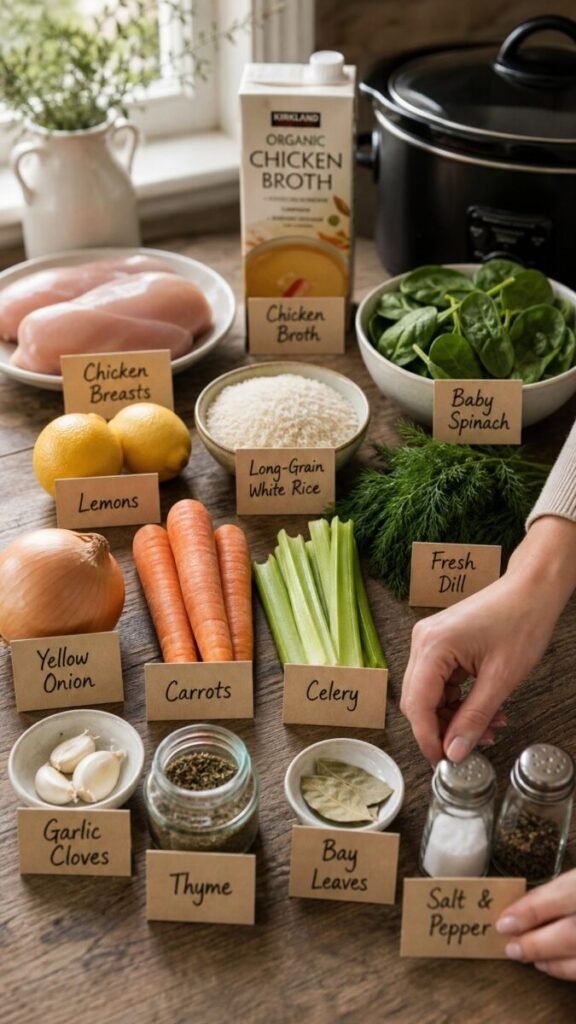
🍋 The Broth
- Boneless skinless chicken breasts: 1½ lb — three average breasts
- Low-sodium chicken broth: 8 cups — low-sodium, because you’ll salt at the end
- Yellow onion: 1 medium, diced
- Carrots: 3, sliced into coins
- Celery: 2 stalks, sliced
- Garlic: 3 cloves, smashed
- Dried thyme: ½ teaspoon
- Bay leaf: 1 — and remember it exists, because it must leave before serving
- Salt and black pepper: 1 teaspoon salt now, ½ teaspoon pepper; more at the end
🍚 The Rice
- Long-grain white rice: ¾ cup, added raw in the last hour — or 1 cup orzo in the last 25 minutes
🌿 The Bright End
- Lemons: 2 large — the zest of both, ⅓ cup of juice
- Baby spinach: 5 oz, stirred in at the shutdown
- Fresh dill: ¼ cup, snipped — flat-leaf parsley if dill isn’t your household’s friend
- Feta or parmesan: a small crumble or grate for the bowls, strictly optional
Step by Step How to Make
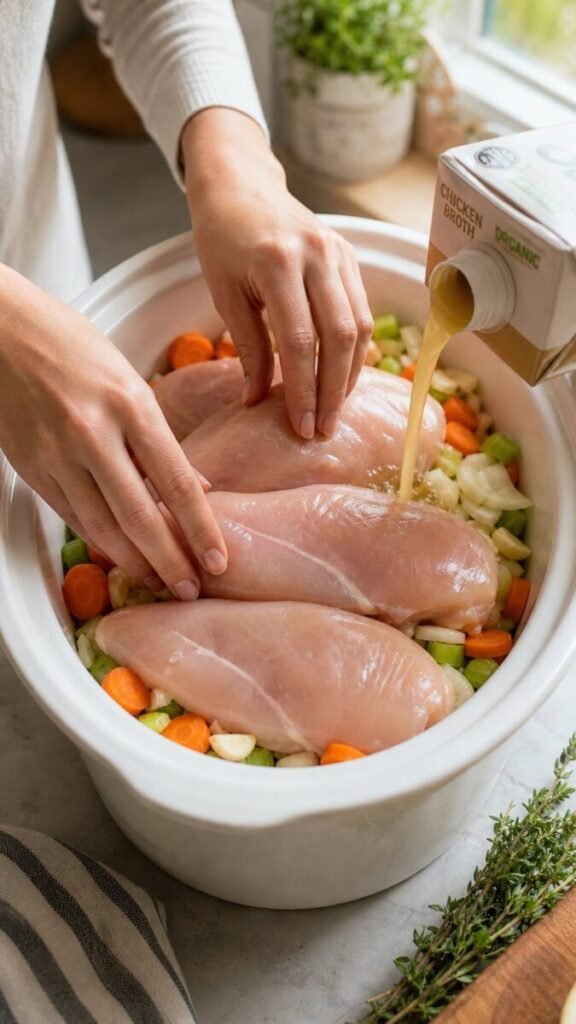
- Step 1 — The morning dump. Onion, carrots, celery, and garlic into the crockpot first, making a vegetable raft. Lay the chicken breasts on top — flat and slightly overlapping is fine — then the thyme, bay leaf, salt, and pepper, and pour the broth over everything. Lid on, LOW, and walk away. That’s the entire morning: the machine is now making dinner at a volume you can’t hear.
- Step 2 — The last hour. About sixty minutes before you want to eat, lift the lid, stir the rice in, and put the lid back. The timing looks casual and isn’t: an hour on LOW cooks raw rice to tender in hot broth exactly, where an extra hour turns it to paste and a short hour leaves it gritty in the middle. Set a timer, because the crockpot’s one design flaw is that it looks the same at every stage.
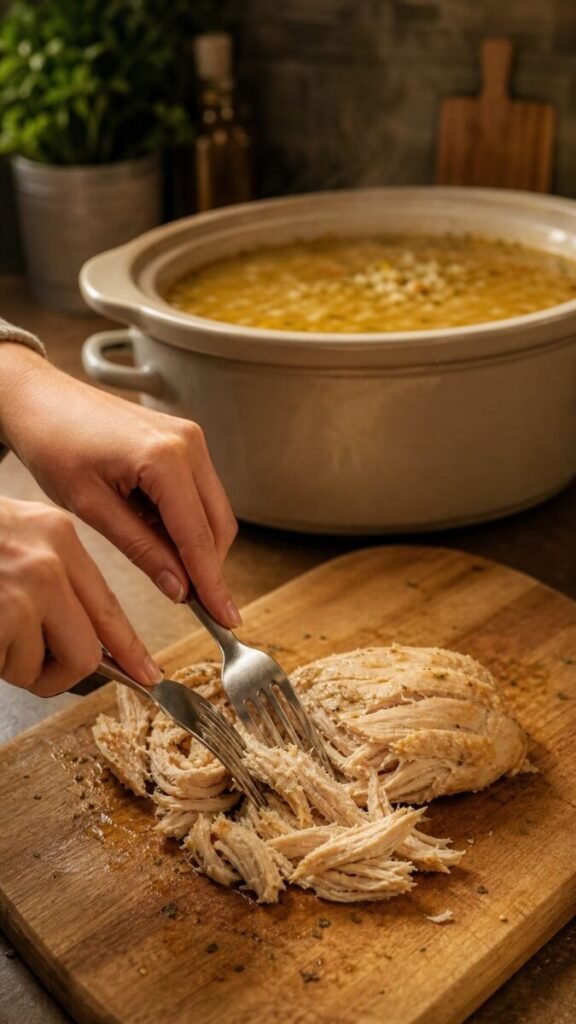
- Step 3 — The shred. When the chicken gives no resistance to a fork — usually right around the rice’s hour mark — lift the breasts out onto a cutting board and shred them with two forks, pulling the forks away from each other down the grain. You want coarse, raggedy shreds, the size of hearty bites, not a fine mince: texture is a flavor here, and over-shredded chicken turns to fuzz in the broth. Slide the shreds back in, fish out the bay leaf while you’re in there, and taste the broth for salt — noting that the real seasoning moment is still ahead.
- Step 4 — The shutdown. Turn the crockpot off — fully off, not warm — and stir the spinach in. The residual heat of a just-switched-off pot is exactly the right temperature for wilting greens gently; five minutes, and it’s glossy and dark and done, with none of the olive-drab overcooking that boiling spinach into soup gives you.
- Step 5 — The brightness. Zest both lemons directly over the pot — hold the microplane up high and let the yellow dust fall across the whole surface, where the oils will hang in the steam — then stir it in. Add the lemon juice a splash at a time, tasting between splashes, until the broth lifts: the moment the whole pot goes from good to vivid is usually somewhere near the full third of a cup, but lemons vary in enthusiasm, and your budget is allowed to be smaller. Stir in the dill last, off the heat, so it stays green and present instead of cooking away.
- Step 6 — The bowls. Ladle generously — this is a soup that wants deep bowls, so the lemon and dill can ride on top of the broth instead of sinking — and finish each bowl with a pinch more dill, a crumble of feta or a grate of parmesan if the table likes its decoration salty, and a lemon wedge on the rim for the people who want to spend a little of their own budget. Bread is not optional in spirit. The bowl is bright, hot, and faintly golden, and the first spoonful should taste like somebody turned a light on inside the chicken soup.

The quick chicken piccata is lemon and chicken at pan speed — twenty minutes, a bright sauce, weeknight energy. This soup is the same two leads on a slow day. One of them should always be on your calendar.
Anna’s Kitchen Notes
Fresh lemon juice, and I mean it more here than anywhere. Bottled lemon juice is pasteurized and preserved, and it tastes like a lemon that has been through something — flat, faintly bitter at the edges, all acid and no aroma. In a vinaigrette you can hide it; in this soup it’s the headline, and the zest — which bottled juice doesn’t even pretend to offer — is half the point. Two lemons cost a dollar. This is not the place to save it.
Let everyone tax their own bowl. The ⅓ cup of juice is my pot-wide number, but the brightness budget has a personal rate too: some of the table will want more, and a few people are certain it’s already too much. Serve the last lemon cut into wedges alongside the pot, and let the loud minorities self-medicate. It’s the difference between a soup everyone likes and a soup everyone likes exactly the way they want it.
The egg-silk upgrade, honestly rated. There’s a Greek-style version of lemon chicken soup where eggs and lemon juice get whisked together, warmed gradually with ladles of hot broth, then streamed into the pot off the heat — no cream, just a silky, opaque body from the eggs alone. It’s beautiful, and I rate it an eighty-five: gorgeous on the day you make it, but it reheats carefully or not at all, and the tempering is genuinely a stovetop move — a crockpot can’t hold the exact warm-not-hot temperature the eggs need, and eggs that meet full heat go from silk to scrambled strings in seconds. If you want that lane, make it a stove day and whisk like you mean it; if you want the bowl that waits for you all day, this is the recipe.
Thighs versus breasts, no diplomatic hedging. Breasts are the right call here: they stay clean-tasting, shred into pretty pale pieces, and hold together through the long swim. Thighs bring more fat and flavor, but they shred dark and slightly fuzzy, and the extra fat makes the broth heavier — which is the opposite of what a lemon soup wants to be. Buy breasts for this one, and save the thighs for the braises that deserve them.
The separate-rice strategy, for the lunch-planners. Rice never stops drinking. If you know there will be leftovers and you don’t love thick day-two soup, pull the chicken and broth at the end of the day, and cook the rice separately, combining only in the bowls — the flavors marry identically, and the leftover broth stays clean for reheating all week. My lunch containers of this soup are the single best argument I have for planning ahead on a Sunday.
The Broth Table
This soup is a meal, but it’s a bright one, and it likes company with edges. Buttermilk biscuits are the classic move — something warm and buttery to drag through the golden broth — and a sharp little salad with the house Greek dressing resets the palate between bowls, its vinegar speaking the soup’s language. For the dill skeptics at the table, the salad’s oregano and the soup’s dill turn out to be excellent neighbors.
For the slow-cooker household, this soup travels with its own kind: the corn chowder is the creamy member of the family, the vegetable curry is the spiced one, and this lemon bowl is the bright one — one machine, three moods, and a week of dinners that started before you were awake for any of them. If the table needs more than soup on a hosting night, garlic butter chicken thighs out of the oven share this soup’s garlic backbone and take ten minutes of attention you’ll actually have.
Same Pot, Other Citrus
The lime version. Swap lemon for lime and dill for cilantro, and the soup turns south-of-the-border overnight — serve it with crushed tortilla chips, a spoon of sour cream, and a shake of hot sauce at the table. Same budget rules, same last-minute arrival, completely different accent.
The orange-ginger version. Half orange juice and half lemon, with a coin of fresh ginger simmered in the broth from the morning and fished out at the shred. Warmer, sweeter, more autumn — the citrus version of putting on a heavier coat.
The meyer lane. Meyers when they’re in season are gentler and more floral, and they let you push the juice to half a cup without the soup turning stern. This is the version for the people at your table who say they don’t love lemon, and it converts a surprising number of them.
The Greek treatment. Orzo instead of rice, a fistful more dill, and the egg-silk finish described in the Kitchen Notes — this is the full Mediterranean version, and it’s the one I make when the soup is the whole point of the evening rather than the end of a working day.
The chili-honey version. The lemon as written, plus a teaspoon of honey to round it and red pepper flakes at the bowls — hot, sweet, and sour in one spoonful. It sounds like a lot for a Tuesday, and it is exactly a lot for a Tuesday, which is sometimes the right amount.
No-rice nights. Skip the grain entirely and double the spinach and carrots: the bowl goes lighter, more broth-forward, closer to a restorative than a meal, and a soft-boiled egg on top patches the heartiness for the hungry. Naturally gluten-free this way, no substitutions and no apologies.
The Soup Math
| Nutrient | Per Serving (1 bowl of 6) |
|---|---|
| Calories | 310 kcal |
| Protein | 28 g |
| Carbohydrates | 31 g |
| Fats | 4 g |
Estimates as written — chicken breasts, broth, rice, and a vegetable’s worth of spinach, with the optional cheese left to its own conscience. Twenty-eight grams of protein from a crockpot bowl with four grams of fat is the number I’d want printed on the front of the recipe, if recipes had fronts: this is the rare comfort food that behaves like a training meal. The money math is the second column of good news — chicken, broth, a bag of carrots, and two lemons put six bowls on the table for about nine dollars, which makes it the cheapest thing I make that doesn’t taste cheap.
The Second Ladle
Storage, and the honest behavior of a rice soup over time. The fridge keeps this four days in a covered container, and day two is genuinely good — the flavors marry, the dill softens, and the broth goes a shade rounder. The rice, meanwhile, keeps drinking: expect the soup to thicken overnight, and treat that as a feature with a fix, not a failure — a splash of water or extra broth at the reheat brings it right back to ladle-ability.
The brightness, though, fades in the cold. Acid that woke the pot at serving settles back down overnight, and a reheated bowl without attention tastes like the memory of the soup rather than the soup. The fix is the day-two lemon: a few drops of fresh juice stirred into each reheated bowl — not a re-zest, just a squeeze — and the whole thing comes back up to pitch. It’s the same budget, spent twice, and the second spend costs five seconds.
The freezer takes this soup well for three months, with one strategic note: freeze before the rice goes in if you can plan that far ahead, because rice thaws soft and starchy while the broth and chicken freeze perfectly. Thaw, reheat gently, cook a fresh handful of rice into it for the last twenty minutes, and re-brighten with a squeeze — a future bowl of soup that costs you ten minutes and two lemons, which is a trade I make every time the pot runs empty.
Where It Goes Wrong
The flat soup. Tastes fine in the memory, dull in the bowl — the lemon went in at the start of the day, and eight hours of heat spent the whole budget. There’s also a sneakier version: the lemon went in at the end, but into a pot still on HIGH, and even twenty minutes of hard heat takes the top off it. The rule has no exceptions: lemon enters when the heat is gone. If the soup is already flat and it’s soup night, a fresh squeeze plus a grate of zest at the bowl repairs most of it.
The paste. Rice that’s dissolved into the broth, thickening it to gruel — the rice went in too early, or the leftover soup was reheated too long. The last hour is a real schedule, not a suggestion, and reheats should be gentle and just-until-hot. If the pot has already gone pasty, loosen with broth and call it rustic; the flavor survives, even if the texture doesn’t.
The chalky chicken. Breasts that shred into dry, cottony bits were cooked too hot, too long, or in too little liquid — HIGH for a full day is the usual culprit, and bone-dry is where it ends. LOW with the full eight cups of broth keeps them tender; if you must use HIGH, five hours is the ceiling, and pull the chicken the moment it shreds without resistance.
The salted-early trap. You tasted at the shred, salted to perfection, then added the lemon — and now the soup tastes under-salted, because acid changes what salt tastes like. Always do your final salting after the lemon, not before; one spoonful of broth, one judgment, one adjustment, in that order. Chefs call it seasoning the finished dish; the rest of us call it tasting twice.
The lost bay leaf. Small, dark, and camouflaged against the broth, it hangs out in the bottom of the pot until it lands, whole and leathery, in someone’s bowl — a flavor that was never meant to be bitten. Fish it out at the shred, when the pot is already open and your stirring utensil is already wet. This is the cheapest fix in the entire Where It Goes Wrong catalog, and I still forget it roughly every third pot, which is why it’s written here in permanent ink.
The olive-drab spinach. Spinach that went in during the slow cook instead of at the shutdown comes out the color of old army gear and the flavor of the school cafeteria. The greens go in after the heat is off, five minutes before serving, and they stay bright and barely-cooked instead. If you’re feeding a crowd in shifts, add each round’s spinach to the pot as it’s ladled — thirty seconds of extra care that keeps every bowl green.
Crockpot Lemon Chicken Soup
Ingredients
As an Amazon Associate I earn from qualifying purchases.
Chicken & broth
- 1½ lb (680 g) boneless, skinless chicken breasts, fully thawed
- 8 cups low-sodium chicken broth, plus extra if needed to loosen
- 1 medium yellow onion, diced
- 3 carrots, thinly sliced
- 2 stalks celery, sliced
- 3 cloves garlic, smashed
- ½ teaspoon dried thyme
- 1 bay leaf
- Up to 1 teaspoon fine salt initially, plus more to taste; adjust for the broth’s saltiness
- ½ teaspoon black pepper
Rice
- ¾ cup (about 140 g) uncooked long-grain white rice, rinsed and drained
Lemon, greens & herbs
- 2 large lemons, washed; use their finely grated yellow zest and up to ⅓ cup juice, to taste
- 5 oz (142 g) baby spinach, washed as needed according to the package
- ¼ cup chopped fresh dill, or flat-leaf parsley
Optional finishing toppings
- Crumbled feta or grated Parmesan, to taste
- Extra fresh dill and lemon wedges, for serving
Kitchen Tools
- 6-quart slow cooker, used within its manufacturer’s fill limits
- Chef’s knife and cutting boards, keeping raw poultry separate from ready-to-eat ingredients
- Measuring cups and spoons
- Fine-mesh strainer, for rinsing the rice
- Instant-read meat thermometer
- Kitchen tongs and two forks, for shredding
- Fine zester and citrus juicer
- Ladle and long-handled spoon
- Small saucepan with a lid, if cooking the rice separately for more predictable timing
Directions
- Load the slow cooker. Place the onion, carrots, celery, and garlic in the slow cooker. Lay the fully thawed chicken on top, then add the thyme, bay leaf, pepper, and salt to suit your broth. Pour in the broth and cover. Follow the appliance’s recommended fill range; do not double this recipe in the same 6-quart cooker. Do not use frozen chicken or a delayed start.
- Cook until the chicken is safely done. Cook on LOW, beginning to check around 4 hours, or on HIGH, beginning to check around 2½–3 hours. Many cookers take roughly 4–6 hours on LOW or 3–4 hours on HIGH, but breast thickness, broth temperature, and the appliance affect timing. Check the thickest part of each breast for at least 165°F. Do not rely on shreddability alone, and do not automatically leave breasts cooking for 7–8 hours if already done. Vegetables should also be tender; continue cooking the broth and vegetables if they need longer.
- Shred the chicken and cook the rice. Transfer the cooked chicken to a clean board and shred into coarse pieces. If continuing to cook the rice or vegetables for an extended period, refrigerate the chicken promptly in a shallow container rather than leaving it on the counter. Turn the slow cooker to HIGH and stir the rice into the hot broth. Cover and cook until tender, starting to check at about 40 minutes; allow roughly 45–75 minutes or longer depending on the cooker. One hour on LOW is not a reliable rice-cooking rule. For predictable timing, cook the rice separately according to its package and add it at the end or directly to bowls.
- Return the chicken and wilt the spinach. Remove and discard the bay leaf. Return the shredded chicken to the soup and stir in the spinach. Keep the heat on until the spinach has wilted and any refrigerated chicken has reheated to 165°F throughout. Add extra broth if the rice has made the soup thicker than you prefer. Once everything is hot, switch off the cooker if serving immediately.
- Add the lemon and fresh herbs last. Finely grate only the yellow zest from the lemons, avoiding the bitter white pith, and stir it into the soup. Add the lemon juice gradually, beginning with about 3 tablespoons and working toward ⅓ cup to taste. Stir in the dill or parsley, then adjust salt and pepper. Adding citrus late preserves its fresh aroma; prolonged cooking does not simply remove all its acidity.
- Ladle and serve. Divide among six bowls and finish with optional cheese, extra dill, and lemon wedges. If serving over time, keep the soup hot at 140°F or above rather than leaving the cooker switched off, and add lemon and herbs to individual bowls. Refrigerate leftovers promptly in shallow containers within 2 hours, or within 1 hour above 90°F. Use within 3–4 days, or freeze for up to 3 months for best quality. Rice softens and absorbs broth during storage. Reheat leftovers on the stovetop or in the microwave to 165°F, adding broth as needed and fresh lemon after reheating.
Nutrition
| Nutrient | Approximate amount per serving |
|---|---|
| Serving size | ⅙ of the finished soup |
| Calories | 275 kcal |
| Protein | 30 g |
| Carbohydrates | 31 g |
| Total fat | 4 g |
| Fiber | 3 g |
Estimates assume 680 g raw chicken breast, 140 g dry white rice, 8 cups low-sodium chicken broth, and the listed vegetables, lemon, and herbs. Excludes optional cheese and extra broth. Broth brands vary considerably in calories, protein, and sodium. The base recipe is dairy-free; cheese adds milk. For gluten-free needs, verify the broth and other packaged ingredients. Orzo is not included in this rice-based version or its nutrition estimate.