

Slow Cooker Vegetable Curry: Creamy Coconut Milk Recipe
This is the curry I make when the day belongs to errands, work, or the couch, and dinner still needs to be real food. Sweet potato, cauliflower, red pepper, carrots, and green beans go into the slow cooker with a tomato-spice base and a can of coconut milk. Six hours later the vegetables are tender, the sauce is golden and creamy, and the house smells like a restaurant you’d happily wait in line for. All that’s left is rice, a squeeze of lime, and cilantro.
The method is built around one rule: sturdy vegetables in the pot, delicate things at the end. Sweet potato and cauliflower can simmer all day and come out better for it. Spinach and peas would turn to nothing in that time, so they wait by the door and go in during the last ten minutes, along with the second can of coconut milk. That late addition is what makes the curry taste fresh and coconutty instead of cooked-down and flat.
It’s vegan as written, it feeds six over rice, and it’s genuinely forgiving. The spice measurements are a suggestion, not a contract. Swap the vegetables for whatever is aging in your crisper drawer and the curry will absorb the news without complaint. Few dinners do more with less attention than this one.
Before You Start
Five things worth knowing before you chop anything:
- The vegetable list is flexible. The recipe needs about 6 cups of hearty vegetables, and almost any combination works. Details in the variations section.
- Check your spices. Curry powder, cumin, and turmeric older than a year taste like dust, and this dish has nothing to hide behind. Open the jars and smell them first.
- Buy two cans of coconut milk, not one. The first can simmers all day for body. The second gets stirred in at the end for fresh coconut flavor. This is the whole trick, and it’s explained below.
- Plan the rice. If you’re out all day, a rice cooker with a timer solves this. Otherwise, start rice when you walk in the door and the timing works out on its own.
- Make the full batch even for two people. Curry is one of the few dishes that’s better on day two. Tomorrow’s lunch is part of the deal, not an accident.
Why This Curry Works
Slow cookers are rough on delicate flavors and kind to sturdy ones, so this recipe assigns each ingredient a shift. The aromatics — onion, garlic, ginger, and tomato paste — go in first, where hours of low heat mellow them into a deep, sweet base. Whole spices and curry powder bloom in the warm liquid and slowly infuse everything in the pot. Hard vegetables simmer in that broth until their edges soften and their centers turn sweet, and they release their own juices into the sauce along the way. Everything that benefits from long cooking cooks long.
Everything that doesn’t, waits. Coconut milk that simmers all day loses its fresh, floral edge and can even look slightly oily where the fat separates. So one can goes in early — it rounds out the tomato base and gives the sauce body — and the second can goes in cold at the end, stirring in as it warms, so the finished curry tastes like coconut right now. Spinach wilts in a minute, frozen peas need five, and lime juice dies under heat. All three land in the final stretch. The result is a curry with the depth of an all-day braise and the brightness of something just made, because technically, it’s both.
⏱️ 15 MIN PREP + 6-7 HRS LOW | 🥥 COCONUT CREAMY | 🌱 VEGAN
- Prep Time: 15 minutes
- Cook Time: 6 to 7 hours on LOW (3 to 4 on HIGH)
- Finish Time: 10 minutes
- Yield: 6 servings over rice
The Slow Cooker Setup
One pot, one small pan if you want the optional upgrade:
- 5- to 6-quart slow cooker — the recipe fits with headroom; a 4-quart works but will look crowded.
- Large knife and board — the only real work is chopping, and chunky cuts are correct here. Small pieces turn to mush over six hours.
- Small skillet (optional) — for the three-minute spice bloom in Step 2. Skip it on busy mornings; the curry will still be good.
- Wooden spoon — for the stir and the finish.
- Can opener — three cans deep, this recipe respects tradition.
- Rice pot or cooker — for serving. Rice is the plan; this sauce on rice is the entire point.
Ingredients (With Labels)
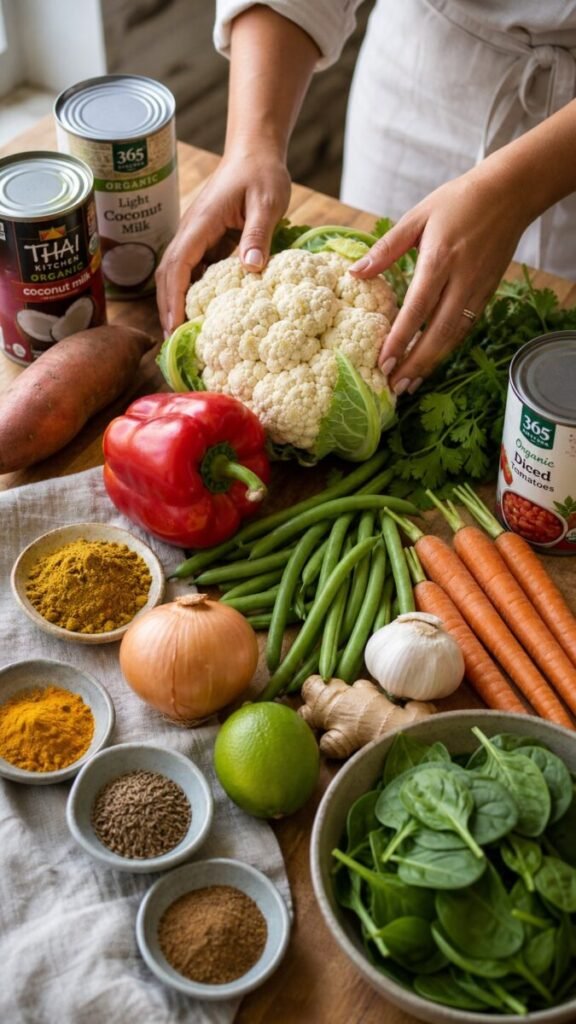
🥕 The Hearty Vegetables
- Sweet potato: 1 large, peeled and cut into 1-inch chunks
- Cauliflower: 1 small head, cut into bite-size florets
- Red bell pepper: 1, cut into thick strips
- Carrots: 2, sliced into thick coins
- Green beans: 8 oz, trimmed and snapped in half
🧅 The Aromatic Base
- Yellow onion: 1, diced
- Garlic: 4 cloves, minced
- Fresh ginger: 1 tablespoon, grated
- Tomato paste: 2 tablespoons
- Diced tomatoes: 1 can (14.5 oz), with juices
- Vegetable broth: 1 cup
🌶️ The Spices
- Curry powder: 2 tablespoons — mild or hot, your call
- Ground turmeric: 1 teaspoon
- Ground cumin: 1 teaspoon
- Ground coriander: 1 teaspoon
- Garam masala: 1 teaspoon
- Salt: 1 1/2 teaspoons, plus more at the end to taste
- Red pepper flakes: 1/4 teaspoon, optional
🥥 The Creamy Finish
- Full-fat coconut milk: 2 cans (13.5 oz each) — one for the pot, one for the end
- Baby spinach: 3 large handfuls (about 4 oz)
- Frozen peas: 1 cup, no thawing
- Lime: 1, juiced, plus wedges for serving
- Fresh cilantro: a handful, chopped — for the top
- Cooked rice and lime wedges: for serving
Step by Step How to Make
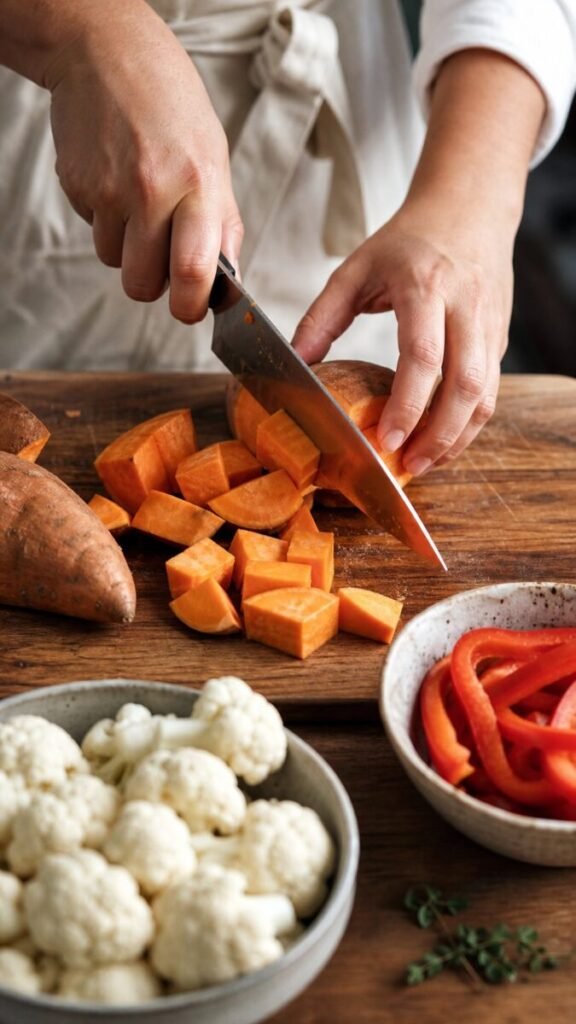
- Step 1 — Chop big. Peel and cut the sweet potato into 1-inch chunks, break down the cauliflower into florets, slice the pepper into strips and the carrots into coins, and snap the green beans. Everything should look slightly too large. Six hours of cooking shrinks and softens everything, and pieces that start small end up as memory. Dice the onion, mince the garlic, and grate the ginger while you’re at it.
- Step 2 — Start the base. The fast way: put the onion, garlic, ginger, tomato paste, and all the spices plus the salt directly into the slow cooker crock and stir them into a rough paste with a fork. The better way: heat a tablespoon of oil in a small skillet, cook that same mixture for 3 minutes until it smells alive, then scrape it into the crock. The skillet step deepens the flavor. It is not required. The slow cooker has always understood busy mornings.
- Step 3 — Load the pot. Add the diced tomatoes with their juices, the broth, one can of coconut milk (shake it first), and all the hearty vegetables. Stir everything together, put the lid on, and set it — LOW for 6 to 7 hours, or HIGH for 3 to 4. Walk away. This is now the slow cooker’s problem, and it has been waiting its whole life for an assignment like this.

- Step 4 — Check for tenderness. At the end of the cook time, poke a sweet potato chunk with a fork. It should slide in with no argument. If it resists, give the pot another 30 to 60 minutes — sweet potatoes run on their own schedule, and there’s no rescuing an undercooked one at serving time.
- Step 5 — The finish. Stir in the second can of coconut milk, the spinach, and the frozen peas. Put the lid back on for 10 minutes to warm everything through — the spinach wilts, the peas turn bright green, and the coconut milk melts into the sauce. Then stir in the lime juice, taste, and adjust: more salt if it tastes flat, more lime if it tastes heavy, a pinch of sugar if the tomatoes ran tart. This tasting minute is the difference between a good curry and your curry.
- Step 6 — Rice, cilantro, done. Pile rice in bowls, ladle the curry over it generously, and top with cilantro and a lime wedge. Anything warm and flat — naan, roti, thick toast in a pinch — is welcome for the sauce. Serve hot, and expect the pot to empty faster than six servings suggests it should.

The slow cooker earned its counter space with dishes like this — our Quick 5-Ingredient Slow Cooker Corn Chowder is the same deal for a different mood: five ingredients, all day unattended, and a creamy pot of dinner at the end. Curry one week, chowder the next.
Anna’s Kitchen Notes
Know your pot’s temper. Slow cookers are like ovens — no two run the same. My old one ran hot and turned HIGH into a rolling boil that scorched the edges; my current one is gentle enough that HIGH is nearly a simmer. The first time you make this, check at hour five on LOW. You’ll learn your pot’s personality in one evening, and every slow cooker recipe you make after that gets easier to time.
The second can of coconut milk is not optional. I tested a single-can version once, with the whole can in from the start. It was fine — thick, golden, and a little dull, like a curry that had been on a long flight. The two-can method costs one extra dollar and fixes it completely. One can builds, one can brightens. I don’t mess with it anymore.
Day two is the real headliner. Overnight in the fridge, the spices settle and the sauce thickens, and lunch the next day is better than dinner was. It reheats gently on the stove in ten minutes with a splash of water. My husband has been known to check whether curry is hiding in the fridge before he’s finished taking off his coat.
Curry powder is a fine shortcut. Really. Purists will tell you to toast whole cumin and coriander and grind your own, and on a quiet Sunday, I do. On a Tuesday at 7 a.m., a good fresh jar of curry powder plus the extra teaspoon of garam masala gets you 90 percent of the way there. The last 10 percent is not worth missing the rest of your morning over.
Where this fits in the week. This curry, the Crockpot Hot and Sour Soup, and the Vegetarian Chili Mac basically run my meatless rotation — one slow cooker main, one soup, one stovetop pasta, and nobody at my table notices the meat is gone. Rotate them and even the leftovers stop repeating on you.
The Plate Around It
Rice is the base, so build out from there. The curry is rich and saucy, which makes fresh, crunchy sides the right company — steamed or quick-sautéed greens work well, and Easy Garlic Bok Choy is my usual pick since it’s done in ten minutes, right when the curry is resting. For a change of base, the curry over the veggie rice bake treatment is a fun mashup, or keep it lighter with a scoop of quinoa like our Mediterranean Quinoa Bowl does. Warm flatbread for wiping the bowl is the only other thing on the table, and the only thing anyone fights over.
Different Directions
Use up the crisper drawer. Six cups of sturdy vegetables, any mix: butternut squash, parsnips, potatoes, eggplant, zucchini (add during the last hour), broccoli, chickpeas straight from the can. The spice base carries whatever shows up. This is the recipe’s best feature.
Warmer curry, hotter curry. For a Madras-style heat, use hot curry powder and double the red pepper flakes. For a gentle, kid-friendly pot, use mild curry powder and skip the flakes entirely — the coconut milk and sweet potato do the persuading.
Add a protein. Two cans of drained chickpeas go in with the vegetables and hold up all day. Cubed extra-firm tofu goes in during the last 30 minutes, just to warm through. For a mixed table, boneless chicken thighs can cook right in the sauce — pull them at 165°F — though then it’s no longer the vegan pot, and the vegans at your table will notice. They always notice.
Thai-leaning version. Skip the curry powder and garam masala, and use 2 tablespoons of Thai red curry paste plus an extra teaspoon of ginger. Same pot, same times, completely different accent. Finish with basil instead of cilantro.
Soup-ify it. Add two extra cups of broth and skip the rice, and dinner becomes a curry soup with a ladle. On a cold-weather week, this version has a permanent seat in my rotation.
Bowl Math
| Nutrient | Per Serving (1 of 6, rice not included) |
|---|---|
| Calories | 285 kcal |
| Protein | 7 g |
| Carbohydrates | 29 g |
| Fats | 17 g |
Estimates for the curry as written with both cans of full-fat coconut milk. The fat is mostly coconut, and the calorie count is honest comfort-food math — light coconut milk trims about 60 calories a serving if that matters to you (see the FAQ). Seven grams of protein is modest on its own, which is why chickpeas and rice are such good teammates here. Add both and the bowl rounds out to a real meal.
Tomorrow’s Curry
Leftovers keep covered in the fridge for 4 to 5 days, and as the notes above say, day two is the good version. The sauce thickens as it sits — reheat it gently on the stove or in the microwave with a splash of water or coconut milk, and stir until it loosens back to a spoonable consistency. The vegetables hold their texture better than most slow cooker leftovers, since they were cut big to begin with.
The curry also freezes well, which surprises people. Cool it fully, then freeze in portions or freezer bags for up to 3 months. Thaw overnight in the fridge and reheat gently. The sauce sometimes looks slightly separated coming out of the freezer — a good stir over low heat brings it right back, and the flavor doesn’t lose a step. A labeled bag of curry in the freezer is one of the more reliable forms of weeknight insurance I know.
Rice is best made fresh each time. Reheated rice is fine, but fresh rice under day-two curry is the correct finish, and it takes eighteen minutes you can spend doing nothing, which is its own kind of reward.
When the Pot Misbehaves
Thin, soupy sauce. Either the lid came off midday, or the vegetables released more water than expected. Fix it now: scoop a ladle of liquid into a cup, whisk in a tablespoon of cornstarch, stir it back in, and let the HIGH setting or a stovetop simmer thicken it for ten minutes. Or fix it at serving: the sauce is supposed to soak into rice, and slightly loose curry over rice is not a problem anyone has complained about.
Mushy vegetables. They were cut too small or cooked too long. Six hours on LOW is the target, and 1-inch chunks survive it fine. If your pot runs hot, shift to the shorter end of the range. Mushy curry still tastes right — it just loses the satisfying bite, so next time, cut bigger.
Oily film on top. Coconut fat separating, usually from cooking too hot or too long. It’s harmless and mostly stirs back in, which is why the finish includes a good stir with that second cold can — it re-emulsifies the sauce. The cold-can trick isn’t just about flavor. It’s structural.
Bland curry. Almost always old spices or a missing finish. Refresh the jar if it’s been open more than a year. Then check the finish order — salt, lime, and one more taste — because a curry that tastes flat at hour six is usually a curry that hasn’t met its lime yet.
Burnt edges or smell. The pot ran too hot, the liquid was low, or sugary tomato paste stuck to a spot above the liquid line. Scrape gently around the burnt area and don’t stir the dark bits in — the rest of the pot is usually fine. Next time, use the LOW setting and make sure the sauce covers most of the vegetables before you leave.
Curry Questions
Can I use light coconut milk?
Yes, both cans. The curry will be thinner and less rich, and honestly, still good. If you want the creamier body back, stir a tablespoon of cornstarch into the second can before adding it. Full-fat is what the recipe was built around, but this is dinner, not a doctrine.
Which vegetables should I not use?
Anything delicate — zucchini and yellow squash go mushy over six hours, so add them in the last hour if you use them at all. Leafy greens besides spinach can go in at the end. Frozen vegetables work for the sturdy roles too; frozen cauliflower holds up better than you’d expect. The rule is simple: dense vegetables all day, soft vegetables late.
Can I cook it on HIGH instead?
Yes — 3 to 4 hours on HIGH, and check at 3. The tradeoff is small: LOW gives the spices a little more time to mellow, and the vegetables hold their shape a touch better. HIGH is the right call when the plan changed midday, and the curry will not tell on you.
Is this spicy?
It’s warm, not hot — the kind of spice kids and heat-shy adults eat happily. The heat lives in the curry powder choice and the red pepper flakes, so both are adjustable before anything touches the pot. Anyone who wants more fire gets hot sauce or chili crisp at the table, which is the correct place for that negotiation anyway.
Can I make it in an Instant Pot?
Yes — sauté the base right in the pot, add everything except the second can of coconut milk, spinach, and peas, and pressure cook for 3 minutes with a natural release. Then do the same ten-minute finish. It trades the all-day unattended part for speed, so pick based on your day, not the equipment. The finish stays the same either way, because the finish is what makes it taste like this recipe.
What do I serve it with besides rice?
Warm flatbread, quinoa, couscous, or mashed sweet potatoes all work — anything that can receive sauce. The quinoa bowl link above is the same idea in lunch form. What I’d avoid is another saucy dish alongside; one pot of sauce per meal is plenty, and this curry doesn’t like sharing the spotlight. Neither do I, when I made it.
Slow-cooked vegetables · Creamy coconut · Fresh lime
Slow Cooker Vegetable Curry with Coconut Milk
Sweet potato, cauliflower, peppers, carrots, and green beans simmer in a warmly spiced tomato-coconut sauce. A second can of coconut milk, spinach, peas, and fresh lime make the creamy finish.
As an Amazon Associate I earn from qualifying purchases. Ingredient and equipment links below are affiliate links.
Equipment
- 6-quart slow cooker — check the manufacturer’s fill limits
- Chef’s knife and cutting board
- Small skillet (optional)
- Wooden spoon
- Can opener
- Measuring cups and spoons
- Instant-read thermometer
- Rice cooker or saucepan with lid
Ingredients
The hearty vegetables
- 1 large sweet potato, peeled and cut into 1-inch chunks
- 1 small head cauliflower, cut into large bite-size florets
- 1 red bell pepper, cut into thick strips
- 2 carrots, sliced into thick coins
- 8 oz (227 g) green beans, trimmed and halved
The aromatic base
- 1 yellow onion, diced
- 4 cloves garlic, minced
- 1 tablespoon grated fresh ginger
- 2 tablespoons tomato paste
- 1 can (14.5 oz / 411 g) diced tomatoes, with juices
- 1 cup vegetable broth
- 1 tablespoon neutral cooking oil (optional, for the skillet method)
The spices
- 2 tablespoons curry powder, mild or hot
- 1 teaspoon ground turmeric
- 1 teaspoon ground cumin
- 1 teaspoon ground coriander
- 1 teaspoon garam masala
- 1½ teaspoons salt, plus more to taste; use less initially if the broth is salty
- ¼ teaspoon red pepper flakes (optional)
Coconut milk & fresh finish
- 2 cans (13.5 fl oz / about 400 ml each) full-fat coconut milk, divided: 1 can for cooking and 1 for finishing
- 4 oz (113 g; about 3 large handfuls) baby spinach
- 1 cup frozen peas
- Juice of 1 lime, plus extra lime wedges
- 1 handful fresh cilantro, chopped
- Cooked rice, for serving
- 1 pinch sugar (optional, to balance tart tomatoes)
Capacity check: The listed vegetables can exceed 6 cups, depending on their size. Use the listed quantities as your guide, but stay within your slow cooker’s recommended fill range and leave room for the finishing ingredients. Do not force the batch into a crowded 4-quart cooker.
Instructions
-
Prepare the vegetables
Cut the sweet potato into 1-inch chunks, the cauliflower into large bite-size florets, the pepper into thick strips, and the carrots into thick coins. Trim and halve the green beans. Dice the onion, mince the garlic, and grate the ginger. Keep the vegetables chunky to help them hold their shape during cooking.
-
Build the aromatic base
For the no-sauté method, combine the onion, garlic, ginger, tomato paste, curry powder, turmeric, cumin, coriander, garam masala, salt, and optional red pepper flakes directly in the slow cooker. Alternatively, heat the optional tablespoon of oil in a skillet over medium heat. Cook the onion for about 2 minutes, then add the garlic, ginger, tomato paste, spices, and salt. Stir for about 1 minute until fragrant, without scorching, and transfer to the slow cooker.
-
Load and slow-cook
Add the diced tomatoes with their juices, vegetable broth, one can of coconut milk, and all the hearty vegetables. Stir to distribute the sauce and seasonings. Cover and cook on LOW for 6–7 hours or HIGH for 3–4 hours. Keep the lid on between checks. If your cooker runs hot, begin checking around 5 hours on LOW or 3 hours on HIGH.
-
Check for tenderness
Test a large sweet potato chunk and a carrot coin with a fork. They should be tender throughout. If still firm, cover and continue cooking, checking every 30 minutes. Cooking time varies with the appliance, vegetable size, and fullness of the pot. Prepare the rice toward the end of cooking.
-
Add the creamy finish and heat through
Turn the cooker to HIGH. Stir in the second can of coconut milk, spinach, and peas. Cover and cook until the spinach is wilted and the curry is thoroughly hot throughout, allowing about 10–30 minutes or longer as needed. Stir and check several spots for 165°F (74°C); do not rely on a fixed 10-minute finish after adding cold ingredients. Follow the peas’ package cooking directions, cooking them separately first if required. Once hot, stir in the lime juice. Taste and adjust the salt, adding the optional pinch of sugar only if the tomatoes taste too tart.
-
Finish the bowls
Spoon the hot curry over cooked rice. Top with chopped cilantro and add lime wedges for squeezing over each bowl.
Plan the full time: Allow approximately 6 hours 25 minutes–7 hours 45 minutes on LOW, or 3 hours 25 minutes–4 hours 45 minutes on HIGH, including prep and finishing. Extra tenderizing or heating time may be needed. The optional skillet step adds a few minutes. This is a soft, slow-cooked vegetable curry; cauliflower and peppers will be more tender than the root vegetables.