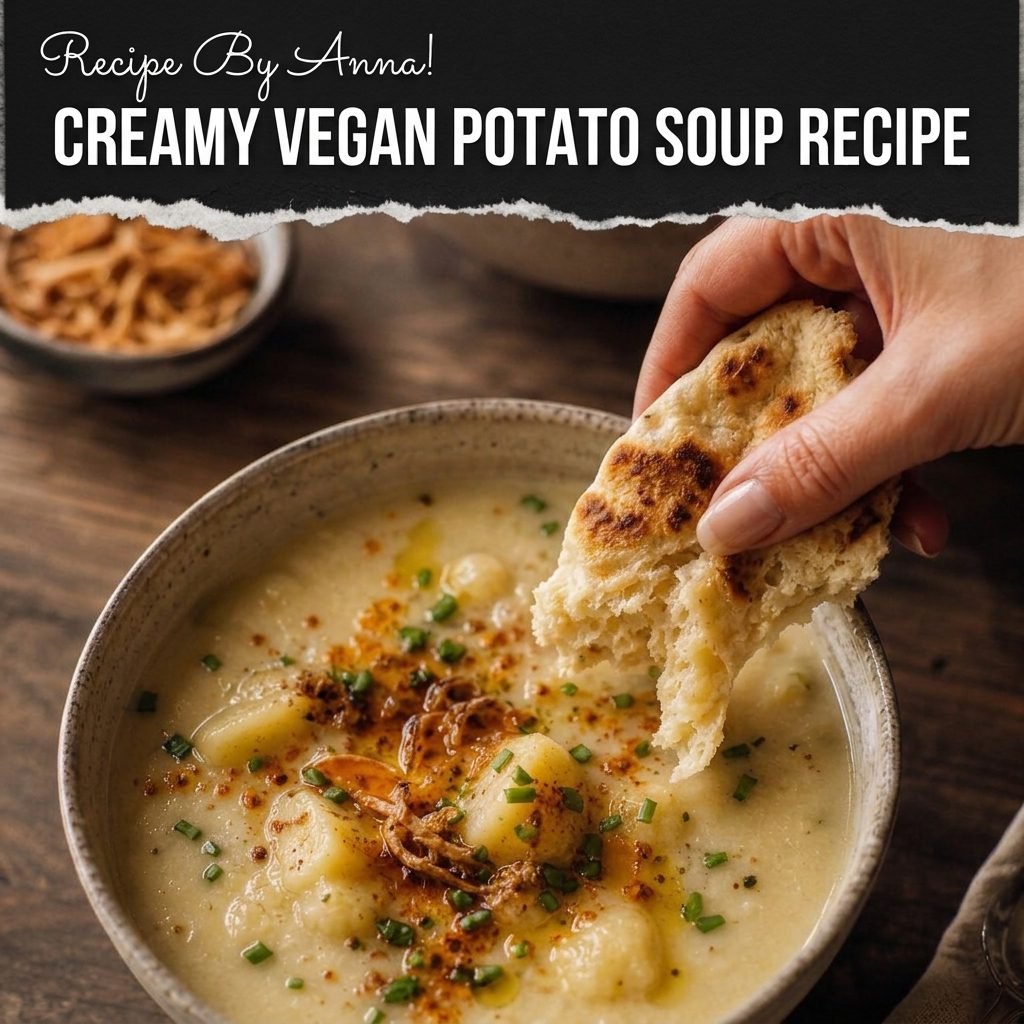
Creamy Vegan Potato Soup | One-Pot Family Meal
Here’s the sentence that runs this whole recipe, and it’s the reason a vegan potato soup can be creamy without a single drop of cream: the cream is already in the pot — it’s just shaped like a potato. Russets are starch bombs, and when they simmer in seasoned stock and then get smashed, their starch swells and bursts into the liquid and turns it opaque, glossy, and thick. The soup creams itself. There’s no cashew soaking, no coconut milk, no blender required unless you want one — a potato masher and twenty minutes of simmering do all the dairy’s work, and the bowl that results is the one people ask about.
What the vegan version asks for in return is honesty in the seasoning, and I want to be direct about that up front, because it’s where most vegan soups quietly fail. Dairy is a flavor blanket — it makes weak stock and shy seasoning taste rounded and forgiving. Take the dairy out and everything shows: the vegetable stock you use is the actual flavor floor, the salt has to be right, and the finish needs a squeeze of lemon, because acid is what dairy’s gentle tang does for every creamy soup, and here it has to be hired on purpose. Do those three things and this soup doesn’t taste “good for vegan” — it tastes like the potato soup a diner would be proud of, and nobody at the table conducts an interview with it.
The family tree on this site now has both halves of potato soup: the pork sausage potato soup is the dairy-and-meat version of this exact bowl, and it’s delicious, and it is a completely different shopping trip. One potato, two philosophies. This one exists for the meatless Mondays, the vegan guests, the dairy-free households, and the Januarys — and because it’s built on the cheapest ingredients in the produce aisle, it also exists for the budget weeks, which overlap all of the above more often than any of us admits.
The Starch Doctrine
Everything starts with which potato you buy, because potatoes are not interchangeable — they’re a spectrum from starchy to waxy, and soup lives or dies on where you land. Russets sit at the starchy end: their cells are packed with starch that swells, then bursts, then releases into the surrounding liquid as they cook, which is exactly the sequence that turns broth into cream. Yukon Golds are the middle path — buttery-flavored, moderately starchy, and they make a lovely but looser soup. Red potatoes and other waxies hold their cells shut like clenched fists; simmer them all afternoon and you’ll have a perfectly good potato-and-broth situation that never thickens into anything. Buy russets for this recipe — the ugliest ones in the bin are fine, and they’re usually the cheapest thing in the store, which makes this soup a budget recipe before it’s anything else.
Then the glue line, which is the one piece of real science in this recipe and worth thirty seconds. The same starch that creams the soup can turn on you: shear it too hard — a blender running long, working the potatoes past the point of breaking — and the starch strands link up into a stretchy, wallpaper-paste network, and the soup goes gluey. The fix is built into the method: a potato masher has a physical ceiling. It cannot over-shear. Mash all you want and the worst case is rustic; there is no masher on earth that can make glue. If you take the blender route for a silkier bowl, the rule is fifteen seconds and out — blend to smooth and stop, because glue is just cream that lost its manners.
And the flavor architecture, which in a dairy-free soup needs to be deliberate. The base: a well-sweated onion and celery in olive oil, garlic at the end, and a low-sodium vegetable stock you’d drink warm — the soup will taste exactly as good as its stock, no better. The simmer gets a bay leaf and a few thyme sprigs, which cost nothing and read as slow-cooked. The finish is where vegan cream soups are won: a tablespoon of lemon juice for the tang dairy would have brought, white pepper for the gentle heat cream would have rounded, and — optional but powerful — a tablespoon of nutritional yeast, whose nutty, savory backnote is the closest a pantry item gets to butter’s memory. None of these taste like cheese or lemon on their own. Together they make the soup taste like it has a secret, and the secret is just thoroughness.
⏱️ 40 MINUTES, ONE POT | 🥔 SERVES 6 | 🌱 NO CREAM, NO BLENDER REQUIRED
- Prep Time: 15 minutes — dice, chop, measure the stock
- Cook Time: about 25 minutes — a sweat, a simmer, a smash
- Total Time: 40 minutes from pantry to bowl
- Yield: about 8 cups — six generous bowls
The Smash Method
One pot, one masher, and a blender with the night off:
- Large soup pot or Dutch oven — everything happens in here, start to finish
- Potato masher — the workhorse and the insurance policy in one; a sturdy fork stands in for the masher in a small pot
- Wooden spoon — for the sweat and the stir
- Blender, strictly optional — only for the silk route, and only for fifteen seconds
- Ladle — for bowls and for the loosening fix later in the week
The method itself is two textures living in one soup, made in that order. When the potatoes are tender, you take the masher to the pot and smash — deliberately, against the side and through the middle, maybe forty presses — until about half the potatoes have dissolved into the stock and turned it creamy, and the other half survive as soft, spoon-sized chunks. That’s the whole move. What you get is a chowder-style bowl with velvet body and real potato pieces in it, which is the texture most potato soups are chasing and most blenders destroy. The silk route, if you want it: blend briefly and return — but know that the smashed version is the one I serve, because it holds up in the fridge all week without a thought in the world.
Two small technique notes before the ingredients. The sweat matters more than it looks — onion and celery cooked soft and translucent in olive oil for a full six or seven minutes, not rushed, because raw-tasting alliums are the most common quiet failure in quick soups. And the liquid is deliberately conservative: four cups of stock for two pounds of potatoes, because a too-thin soup cannot be un-thinned but a thick one is one ladle of water from perfect, every single time. You can always loosen. Tightening is a project.
Ingredients (With Labels)
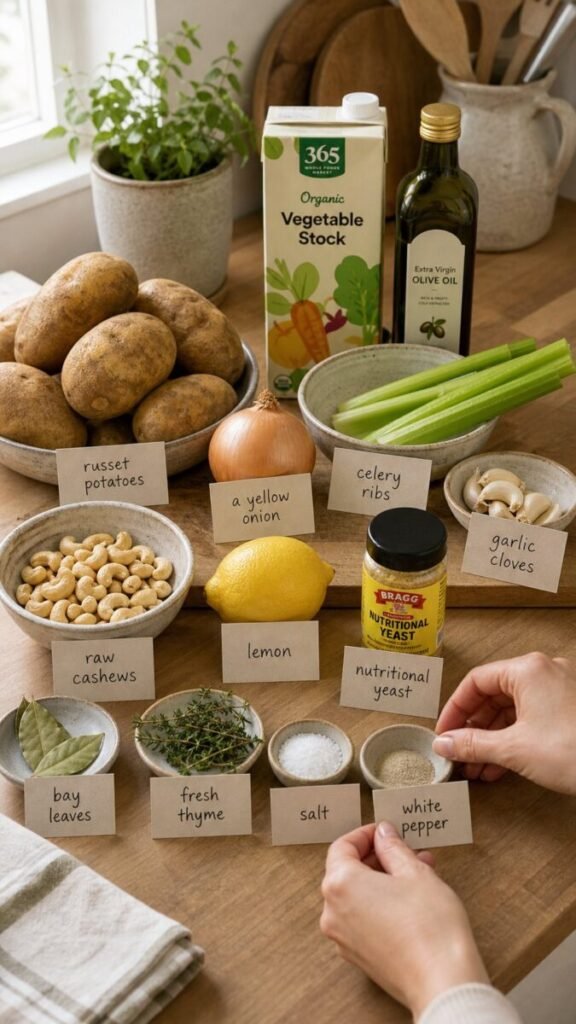
🥔 The Pot
- Russet potatoes: 2 lb — peeled or well-scrubbed, cut into ¾-inch dice
- Yellow onion: 1 large, diced
- Celery: 2 ribs, diced
- Garlic: 3 cloves, minced
🌿 The Simmer
- Low-sodium vegetable stock: 4 cups, plus hot water or stock to loosen later
- Bay leaf: 1
- Thyme: 4 sprigs, or ½ teaspoon dried
- Salt: 1½ teaspoons, plus more to taste at the finish
- White pepper: ½ teaspoon
🥛 The Cream Trade
- Olive oil: 3 tablespoons — the fat that makes the creaminess read rich
- Raw cashews: ⅓ cup, optional — the luxury booster; a cup of white beans is the nut-free route
- Lemon juice: 1 tablespoon, at the end
- Nutritional yeast: 1 tablespoon, optional — the buttery backnote
🧅 The Toppings Bar
- Chives: a handful, snipped
- Crispy shallots, smoked paprika, or cracked pepper: any or all
- Good bread: for the side, and for the bowl’s internal affairs
Step by Step How to Make
- Step 1 — The sweat. Heat the olive oil in the soup pot over medium, add the onion and celery with a pinch of salt, and cook six or seven minutes, stirring now and then, until the onion is soft and translucent and smells like the beginning of something. Add the garlic and stir for one minute more, until fragrant — garlic goes late because it burns fast and bitterness can’t be unsimmered.
- Step 2 — The simmer. Add the diced potatoes, the stock, the bay leaf, the thyme, the salt, and the white pepper, and bring everything to a gentle boil. Lower it to a steady simmer and cook 18 to 20 minutes, until a potato cube gives completely to the edge of a spoon — the simmer is done when the potatoes have started shedding starch into the liquid on their own, and the broth around them has already begun to look like weak cream. If you’re using the cashews, add them to the pot now, straight from the bag — they’ll soften with the potatoes and blend invisibly into the soup later, no soaking required at this size.
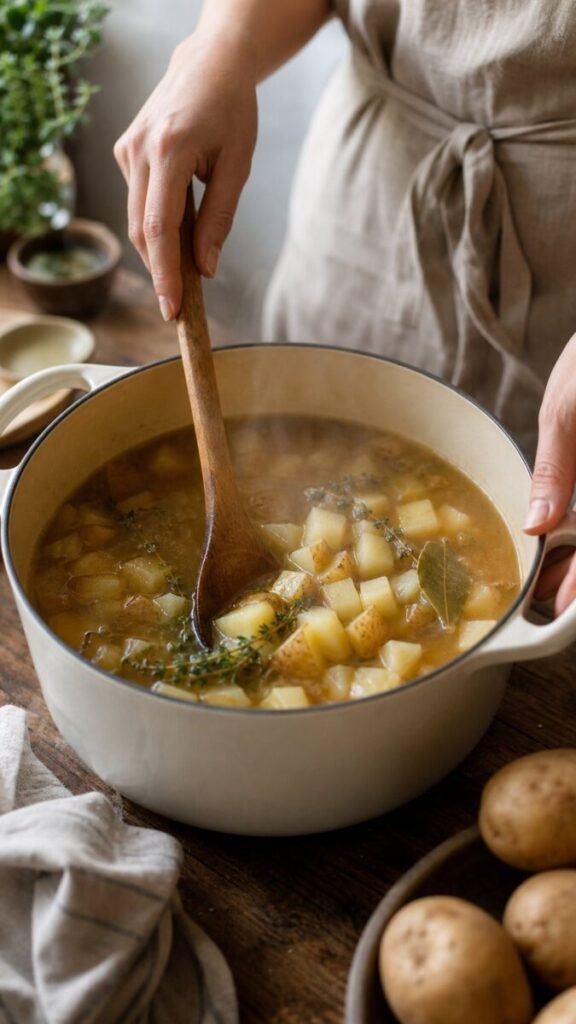
- Step 3 — The smash. Fish out the bay leaf and thyme stems. Take up the masher and go to work right in the pot: press through the middle, drag against the side, and keep counting — by press thirty or forty, half the potatoes will have dissolved into the stock and half will remain as soft chunks, and the whole pot will have turned opaque and velvety. This is the recipe’s signature moment, and it takes ninety seconds. Taste the texture on a spoon: if you want it creamier, keep smashing; if you want it silkier than a masher can go, blend one ladleful for fifteen seconds and stir it back in.
- Step 4 — The cream trade. Now the richness, in one of three dialects: as written, the soup is already creamy from starch and olive oil alone, and that’s the version I make most weeks. For a rounder, richer bowl, blend a ladleful of the soup with the now-softened cashews and stir it back — the cashews disappear completely and the soup gains a glow. For the nut-free route, mash a cup of white beans into the pot the way you mashed the potatoes. Each upgrade is one step; the base doesn’t judge.
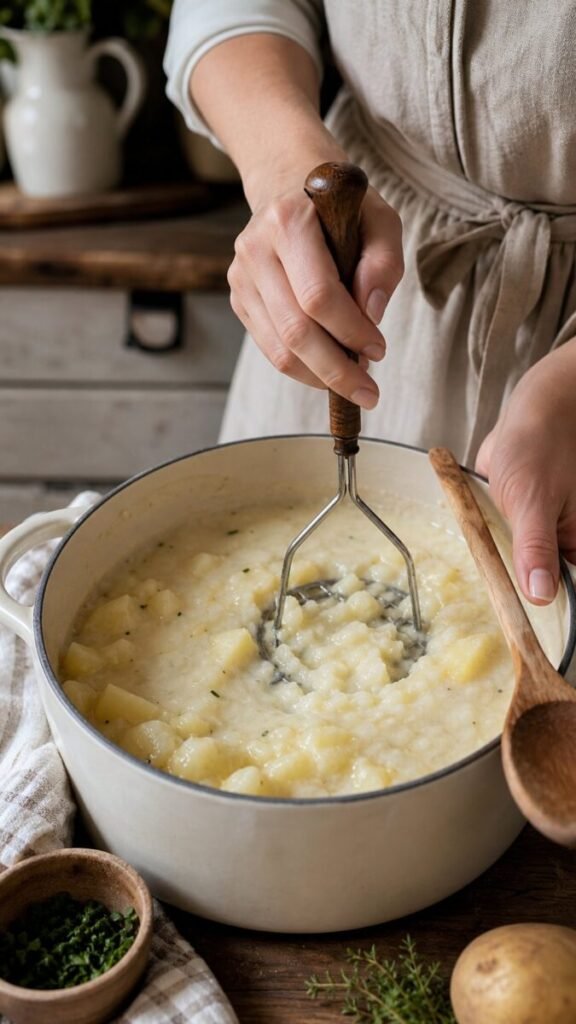
- Step 5 — The seasoning pass. The final five minutes decide whether this soup is good or memorably good, so don’t skip the pass: taste, then add the lemon juice, taste again, then correct the salt upward until the flavor stops being polite. This is the step where the soup acquires its dairy impression — the acid brightens, the salt opens, and if you’re using the nutritional yeast, it goes in now and dissolves into the background. Let the soup sit five minutes off the heat before serving; potato soup needs a moment to settle into its final thickness, and it always thickens slightly as it stands.
- Step 6 — The bowls. Ladle into bowls, then finish each one individually: a scatter of chives, a pinch of smoked paprika or cracked pepper, a thread of your best olive oil, and something crunchy if you’ve got it. The toppings bar isn’t decoration — a dairy-free soup benefits from texture and brightness on top more than a cream soup ever did, because the garnish is carrying the contrast. Put the bread basket out, call the household, and watch a soup with no cream in it get treated like it has a secret.
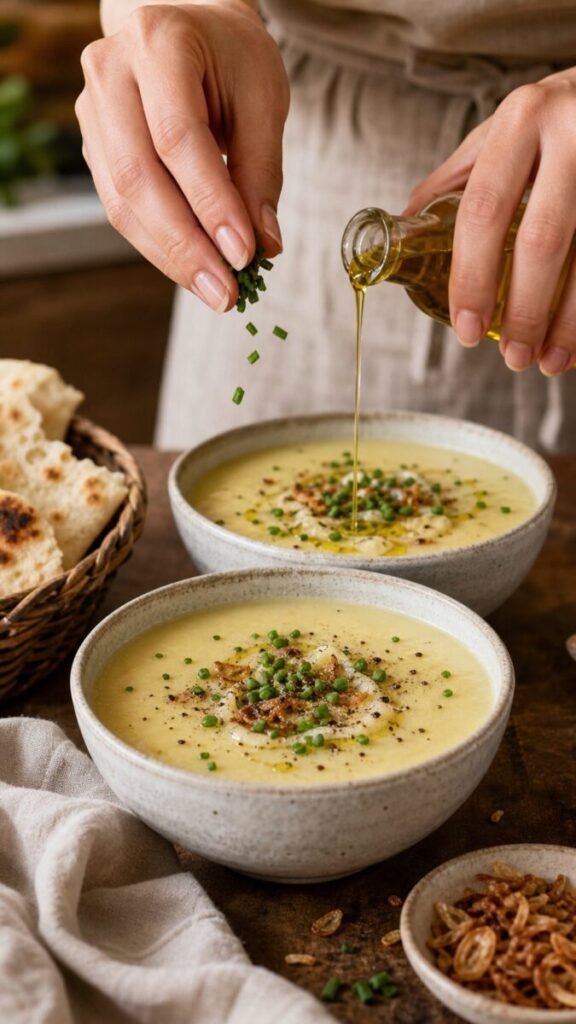
The pork sausage potato soup is this bowl’s other half — same potato, different faith. Between the two of them, potato soup covers every table I’ve ever set.
Anna’s Kitchen Notes
The stock is the flavor floor. I’ll say it once more because it’s the note that matters most: with no dairy to round things off, this soup tastes exactly as good as its stock. The carton you’d sip warm is the carton to buy, and the store-brand stuff that tastes like salty sadness will make a salty, sad soup — no technique rescues it. If your favorite stock runs thin, simmer it five minutes with the thyme and bay before the potatoes go in, and you’ve built yourself a better one on the spot.
The cashew question, answered honestly. The soup is complete without them — starch and olive oil do the real cream work — and the cashew blend is a luxury, not a crutch. What it adds is a rounder mouthfeel and a little richness that reads, faintly, as the memory of cream. If your kitchen is nut-free, the white-bean mash does ninety percent of the same job and adds protein besides. If your kitchen is everything-free, plain is genuinely good. I rotate between all three depending on what the pantry’s doing, and no one has ever detected the difference from across a table.
Nutritional yeast is optional and I always use it. One tablespoon, dissolved into eight cups of soup, doesn’t taste like cheese — it tastes like depth, the way a parmesan rind in minestrone doesn’t taste like parmesan so much as like attention. Skip it and the soup is still excellent; use it and guests ask what’s in this. The answer is attention. The jar just makes it measurable.
Russets forgive everything except substitution. They’re cheap, they’re ugly, and they do the one job this recipe needs — bursting their starch into the stock. Yukons make a looser, butterier soup that’s still worth eating; red potatoes make a broth with potatoes in it. If the store’s out of russets, buy Yukons and plan on blending a ladleful to make up the thickness they don’t give. Buy waxies and you’re eating a different, sadder recipe that shares this one’s name.
Double it, and the week is handled. This soup doubles into the same pot without adjustment and keeps — beautifully, because there’s no dairy to turn — for five days in the fridge. A double batch on Sunday is lunch through Friday, and it thickens as it stands, so keep a ladle of water or stock handy at reheating and loosen to taste. The soup that greets you on Thursday is every bit as good as the one from Sunday, which is more than most of us can say for ourselves by Thursday.
The Soup Table
Soup asks two things of a table: bread and something that contrasts. The bread: wedges of the vegan no-yeast naan are the soft, warm route, and strips of the olive oil focaccia are the crisp, salty one — either one turns a bowl of this into a full dinner without a second thought.
For the rest of the spread: the hearty potato bowl with roasted chickpeas is this soup’s lunchtime sibling and the source of the smoky chickpea topping idea, and a plate of simple dressed greens beside the bowl does the fresh, bright work that rich soup wants next to it. If you’re building a whole soup night, the pumpkin soup recipes cover the orange end of the pot, and for mixed tables — some vegan, some not — the broccoli cheese soup and the hearty white bean soup fill out a board where everybody’s diet is nobody’s business.
Same Pot, Other Vegetables
The leek version. Two leeks, washed ruthlessly and sliced, in place of the onion — the soup goes from pantry-plain to French-leaning, and it’s the version I make when leeks look good and I’m feeling ornamental. Save a handful of the sweated leeks to crown each bowl.
Green and gold. Two big handfuls of chopped kale or spinach stirred in during the last five minutes — the greens wilt into the cream and the bowl gains a color and a vitamin it was missing. This is the weeknight default at my house between October and March.
The roasted-garlic upgrade. A whole head of roasted garlic squeezed in at the smash — mellow, sweet, and it makes the soup taste like it simmered all day when it simmered for forty minutes. Roast the head while the soup cooks; the timing works out to the minute.
Curried potato soup. A tablespoon of curry powder and a teaspoon of turmeric bloomed with the garlic, plus a can of coconut milk if the vegan flag is staying up — the soup goes gold and warm and completely different. This is the variation that convinces skeptics that “vegan potato soup” was never a compromise.
The loaded baked-potato direction. Smoked paprika in the simmer, and a toppings bar of chives, crispy shallots, and smoky roasted chickpeas standing in for bacon bits — the bowl eats like a loaded baked potato that learned to be dinner. Nutritional yeast moves from optional to mandatory here.
White bean and potato, the protein build. A whole can of white beans mashed in with the potatoes — the soup gains body, protein, and a creaminess that’s entirely legume-powered, and a bowl of it with bread is a complete meal by any ledger. This is the version I hand to anyone who asks where vegans get their anything.
The Pot Math
| Nutrient | Per Serving (1 of 6) |
|---|---|
| Calories | 230 kcal |
| Protein | 5 g |
| Carbohydrates | 37 g |
| Fats | 7 g |
Estimates as written — olive oil counted, cashews off duty, the bread basket between you and your conscience. Five grams of protein is honest potato-soup arithmetic; add the white bean build and it more than doubles, which is why that variation exists in the same post as the numbers. The money math is the part I’ll defend at volume: two pounds of russets, an onion, celery, stock, and pantry staples put six bowls on the table for about four dollars, which is under seventy cents a bowl for something that eats like comfort and photographs like intent. The potato has been the budget cook’s best friend for four hundred years, and this recipe is one of the reasons.
The Week of Soup
Storage is where this soup quietly outclasses its dairy cousins: with no cream to sour or separate, it keeps five days covered in the fridge and freezes for three months without a second thought. It will thicken in the cold — potato starch is serious about its work — so plan on loosening each reheated bowl with a splash of water or stock until the ladle moves like it did on day one. The microwave handles a single bowl in two minutes; the pot handles the week’s remainder at a gentle simmer, and the soup comes back tasting like it made an effort.
The texture note worth knowing: if a stored bowl goes gluey, it was blended too long back at Step 3, and the fix is prevention rather than repair — the smash method doesn’t have this failure mode, which is half my argument for it. A properly smashed soup reheats into the same bowl it was on Sunday, chunk and velvet both.
And the make-ahead plan for company: everything through Step 4 can happen a day early, with the lemon and the final salt held for the reheat — acid brightens when it’s added late and dulls when it’s boiled, so the last-minute squeeze is the one worth taking. The toppings bar keeps in the fridge all week regardless, and the soup on day two, loosened, re-acidified, and re-garnished, is the version my guests actually rave about, which I’ve stopped finding insulting.
Where It Goes Wrong
Gluey, stretchy soup. The blender ran long — starch over-sheared into a paste network, and there’s no undoing it, only diluting. Prevention is the whole game: the masher route can’t get there, and the blender route gets exactly fifteen seconds. A gluey pot can be loosened with stock and forgiven by bread, but learn the lesson at the pot, not the bowl.
Thin, watery soup. Too much liquid at the start, waxy potatoes, or an impatient simmer. The recipe’s four cups for two pounds of russets is the tested ratio — resist adding more stock mid-simmer, because you can always loosen at the end and never tighten. If it’s already thin, simmer uncovered for ten minutes and mash harder; starch fixes what patience allowed.
A bland bowl. The soup told you its three secrets and you skipped one: weak stock, shy salt, or no acid. Vegan soup has no dairy blanket, so each of those reads immediately — fix them at the seasoning pass, where a squeeze of lemon and a braver pinch of salt do the work cream was doing for every soup you’ve ever loved. Taste at the end like the recipe depends on it, because it does.
Potatoes that never softened. The simmer ran low or short, or the dice was inconsistent — a ¾-inch cube is the size that’s tender at twenty minutes, and an inch-and-a-half “cube” is a potato that’s still negotiating. Keep the dice even, keep the simmer steady, and test with the spoon-edge, not the clock.
A gray, dull-looking pot. Potatoes oxidize and the soup loses its warm ivory to a flat beige — the prevention is the lemon juice at the finish, a lid on the pot during the simmer, and serving sooner rather than later after the smash. The smoked paprika on top does honest cosmetic work here too. The soup will taste the same; the eye eats first, and the eye has opinions.
Reheated glue. It thickened in the fridge — that’s the starch doing its job, not a fault — and then it was reheated hard with no liquid and no stirring. The fix is rhythm: splash of water or stock, gentle heat, a stir, another splash if the ladle resists. Five days of this soup are five days of the same soup, as long as each bowl gets its splash.
Potato Questions
Do I have to peel the potatoes?
No — scrub them well and leave the skins on, and the soup gains a rustic, faintly earthy character with flecks of russet skin through the cream. Peeling gives a cleaner look and a smoother color, which is what I do for company. Both are correct; the skin-on version has more fiber and fewer dishes, and those are two virtues I respect.
Can I make this without a blender?
That’s the default, not the workaround — the smash method was built precisely so no appliance is required. The masher makes the soup’s signature texture in ninety seconds, and the only reason a blender appears anywhere in this post is the optional silk route for people who own one and want to use it. If you don’t own one, you have lost nothing here.
What can I use instead of cashews?
A cup of white beans, mashed straight into the pot at the end of the smash — same body, nut-free, plus protein. Unsweetened oat milk, a splash at a time, is the other route, and it’s the one to reach for when the soup needs both loosening and rounding on day three. Coconut milk works too and brings its own flavor, which is a decision rather than a substitution.
Is this soup gluten-free?
As written, yes — potatoes, vegetables, stock, oil, and seasoning, with nothing wheat anywhere in the build. The two labels worth checking are the stock (a few brands sneak barley or yeast extract blends in) and, obviously, the bread beside the bowl. Everything else on the ingredient list is naturally gluten-free, no substitutions required.
How do I make it thicker or thinner?
Thicker: mash longer, simmer uncovered for five minutes, or blend one more ladleful. Thinner: a splash of hot water or stock, stirred in off the heat, until the ladle moves the way you like. The recipe is deliberately mixed thick for exactly this reason — thick is a starting position you can steer, and thin is a destination you can’t leave.
Can I make it in a slow cooker?
Yes — everything through the simmer goes in on low for 6 to 7 hours, and the smash happens right in the crock at the end with the heat off. Two notes: hold back a half cup of the stock, because slow cookers lose almost no liquid and the soup can arrive thick past the point of steering; and the seasoning pass — lemon, salt, taste — happens after the smash, never before, since slow-cooked flavors concentrate on their own schedule.
What’s the best bread to serve with it?
Anything with structure — the vegan naan for soft and warm, the focaccia for crisp and salty, a toasted baguette for the classic route. What the soup actually wants is a bread that can stand in for a spoon on the last quarter of the bowl, because the final quarter of a potato soup is the best part and deserves better than being left behind.
Creamy Vegan Potato Soup
Ingredients
As an Amazon Associate I earn from qualifying purchases.
Potatoes & aromatics
- 2 lb (907 g) russet potatoes, peeled or thoroughly scrubbed, cut into even ¾-inch cubes
- 1 large yellow onion, diced
- 2 ribs celery, diced
- 3 cloves garlic, minced
- 3 tablespoons olive oil
Stock & seasonings
- 4 cups low-sodium vegan vegetable stock, plus more as needed to loosen
- 1 bay leaf
- 4 sprigs fresh thyme, or ½ teaspoon dried thyme
- Up to 1½ teaspoons fine salt, added gradually to taste; stock saltiness varies
- ½ teaspoon ground white pepper, or less to taste
- 1 tablespoon fresh lemon juice
- 1 tablespoon nutritional yeast, optional
Optional richness — choose one or neither
- ⅓ cup raw unsalted cashews, for a separately blended cashew cream
- Or 1 cup cooked white beans, drained and rinsed if canned, for a nut-free addition
Optional toppings & serving
- A handful of fresh chives, snipped
- Crispy shallots, to taste; check the label for vegan ingredients
- Smoked paprika or freshly cracked black pepper, to taste
- A small drizzle of extra-virgin olive oil, optional
- Vegan bread, for serving
Kitchen Tools
- Large soup pot or Dutch oven with a lid
- Potato masher
- Wooden spoon and ladle
- Chef’s knife and cutting board
- Vegetable peeler, optional
- Measuring cups and spoons
- Small saucepan, only for the optional cashew preparation
- Blender, only for the optional cashew cream or a smoother soup
Directions
- Soften the onion and celery. Heat the 3 tablespoons olive oil in the soup pot over medium heat. Add the onion and celery with a small pinch of the measured salt. Cook for 6–8 minutes, stirring occasionally, until softened and translucent. Add the garlic and cook for about 1 minute more, without letting it brown.
- Simmer until the potatoes are very tender. Add the potatoes, 4 cups stock, bay leaf, thyme, white pepper, and enough of the measured salt to bring the initial addition to about ½ teaspoon. Bring to a gentle boil, then reduce to a steady simmer with the lid partly covering the pot. Cook for about 18–25 minutes, stirring occasionally, until the potato cubes crush easily against the side of the pot. Add a little extra stock if needed to prevent sticking or to keep the potatoes mostly submerged. Use tenderness, not the clock, as the test.
- Prepare an optional richness addition. The base soup needs no cashews or beans. If using cashews, simmer them separately in enough water to cover for about 15–20 minutes until softened, then drain. Let cool slightly and blend with a little cooled vegetable stock until smooth, adding liquid only as needed. This avoids leaving whole nuts in a mashed soup or over-blending potatoes to smooth the nuts. If using white beans instead, add the cooked, drained beans to the soup for its final 5 minutes of simmering.
- Mash to a creamy, chunky consistency. Remove the pot from the heat. Discard the bay leaf and thyme stems. Gently mash the potatoes directly in the pot until roughly half have broken down and the broth is thick and creamy, leaving some soft chunks. Mash the beans at the same time if using. Stop when you like the texture; avoid unnecessary vigorous processing. For a smoother soup, blend only a small portion briefly and stir it back. If using a countertop blender, follow its hot-liquid instructions, work in small batches, vent steam as directed, and never seal hot soup in a personal blender.
- Finish with lemon and adjust the thickness. Stir in the optional cashew cream, if prepared, and the optional nutritional yeast. Warm gently if needed, stirring to prevent sticking. Remove from the heat and stir in the lemon juice. Taste and add more of the remaining salt gradually, along with extra pepper if desired. Let stand for about 5 minutes. Thin with a splash of hot stock if it becomes thicker than you prefer; if too thin, simmer gently uncovered before adding the final lemon.
- Ladle, garnish, and chill leftovers promptly. Divide among six bowls and finish with chives, optional crispy shallots, smoked paprika or black pepper, and a small drizzle of olive oil. Serve with vegan bread. Allow about 45–55 minutes from preparation through the final rest; finished volume varies with evaporation and added stock. Divide leftovers into shallow containers and refrigerate within 2 hours, or within 1 hour above 90°F. Keep at 40°F or below and use within 3–4 days, or freeze for up to 3 months for best quality. Dairy-free soup still needs prompt refrigeration. Reheat leftovers to 165°F, loosening with stock and stirring frequently. Frozen potato soup may have a slightly grainier texture after thawing.
Nutrition
| Nutrient | Approximate amount per serving |
|---|---|
| Serving size | ⅙ of the base soup |
| Calories | 210 kcal |
| Protein | 4 g |
| Carbohydrates | 34 g |
| Total fat | 7 g |
| Fiber | 3 g |
Estimates include the potatoes, vegetables, 3 tablespoons olive oil, stock, lemon, and seasonings, divided into six servings. Excludes cashews, beans, nutritional yeast, toppings, extra oil, and bread. Optional cashews add approximately 40 calories per serving; one cup of white beans adds roughly 2–3 g protein per serving, depending on the beans. Values vary by brand and preparation. For gluten-free needs, check the stock, nutritional yeast, crispy shallots, and bread. The base soup is nut-free; the cashew version contains tree nuts.