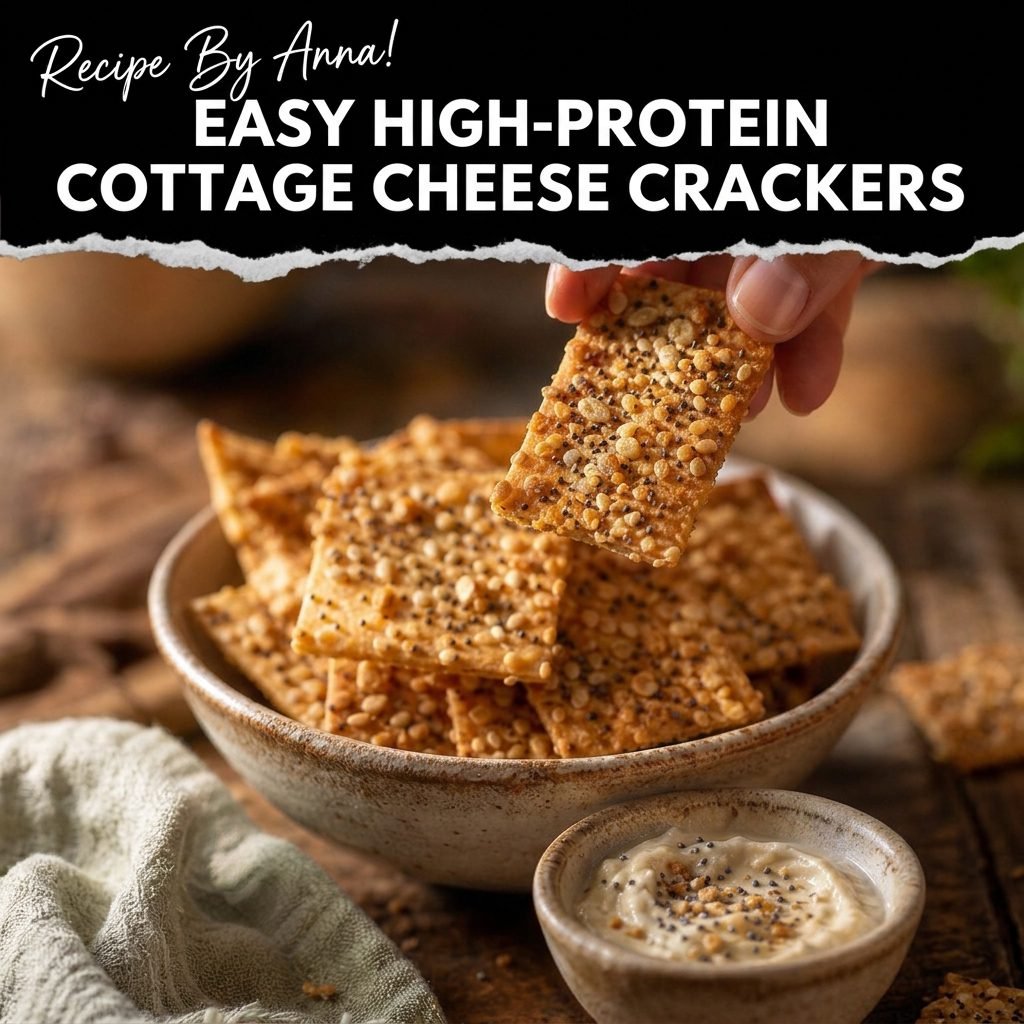
Easy High-Protein Cottage Cheese Crackers
Three o’clock hits the same way every afternoon: I want something crunchy, and the pantry offers me chips I’ll regret or a protein bar I’m already bored of. These crackers are the answer to both cravings in one handful. Cottage cheese gets blended smooth, stirred together with grated Parmesan, spread thin on a sheet pan, blanketed in everything bagel seasoning, and baked low and slow until every cracker snaps. A bowl of nine of them carries sixteen grams of protein — the same as two eggs — and the ingredient list is short enough to say out loud in one breath while reaching for the cottage cheese.
Here’s the part that still surprises people who watch me make them: there’s no flour, no dough, no rolling pin, no chilling. The batter is a purée, and it spreads like thin frosting before the oven turns it into a cracker. The entire recipe is really a controlled drying operation — which sounds industrial, but in practice it means you spread something, slide it into the oven, and go live your life for fifty minutes. Hands-on time is about ten minutes. The oven does the part that would make you tired.
This site already keeps a list of quick no-cook cottage cheese snack ideas for the days the oven should stay off, and this is the crunchy chapter of that same story — the one you make on Sunday and snack from all week. Store-bought crackers mostly deliver flour and oil and about two grams of protein per serving; these deliver a snack that actually holds you until dinner. The cottage cheese renaissance has been going strong for a while now, and I’m fully on board with the part where the humblest tub in the dairy case turns out to be the most useful one.
The Water Problem
The whole recipe hangs on one piece of physics, so let’s start there: a cracker is a dried thing, and cottage cheese is a wet thing — around eighty percent water by weight. Making a cottage cheese cracker means getting that water out without losing the protein that came along with it, and every step in this recipe is a move in that negotiation. The first move is blending. Whole curds are wet pockets sealed inside soft walls, and a curd that survives to the oven bakes into exactly what it is — a chewy, pale spot in the middle of a crisp cracker. Blend the curds smooth and the moisture is spread evenly through the purée, so the whole sheet dries at the same rate and the whole sheet crisps.
The second move is the Parmesan, which is doing three jobs while pretending to be a flavor. A hard aged cheese is the driest thing in the dairy case, and half a cup of it finely grated acts like a sponge stirred straight into the batter — it drinks up moisture on contact, it melts into structure as it bakes, and it brings the glutamates that make a three-ingredient cracker taste like it has a secret. The third move is heat, applied gently. At a high temperature, the outside of the sheet browns long before the water in the middle has left, and you get the worst of both worlds: dark edges wrapped around a soggy center. At 325°F, the water leaves at roughly the pace the cracker browns, and the two finish together. Then comes the quiet trick at the end: the oven goes off, the door cracks open, and the crackers sit in the falling heat for ten more minutes, drying like they’re in a dehydrator you didn’t have to buy. They finish crisping as they cool on the pan, the same way a meringue does — a hot cracker bends, and a cooled one snaps. Patience at the end is the last ingredient.
One decision worth defending: the seasoning goes on top of the cracker, never mixed in. Sesame and poppy seeds are little waterproof capsules of crunch, and buried inside a wet batter they steam soft and sad; sitting on the surface, they toast individually and stay distinct, so every bite has seeds that crackle between your teeth. To make them stick, a thin brush of egg white over the scored sheet before seeding — the white dries into a glassy glue in the oven and holds every seed in place. And notice what isn’t in the ingredient list: salt. There is no added salt anywhere in this recipe, because between the Parmesan and the everything blend, the dish already arrives seasoned. The first time I made these I added a pinch out of habit, ate one, and quietly put the salt shaker away for good.
⏱️ 10 MINUTES HANDS-ON, ONE BOWL | 🧀 ABOUT 3 DOZEN CRACKERS | 💪 16 G PROTEIN PER BOWL
- Prep Time: 10 minutes — blend, stir, spread, seed
- Bake Time: 45-55 minutes at 325°F, plus a 10-minute oven-off finish
- Cool Time: 15 minutes, and this is where they become crackers
- Total Time: about 75 minutes, ten of which are yours
- Yield: about 36 crackers — four snack bowls
The Parchment Rule
Nothing here is fancy, and one item is non-negotiable:
- Food processor or blender — for smoothing the curds; a stick blender in a tall jar does the same job with less dishwashing
- Rimmed half-sheet pan — the 13×18 kind; a smaller pan means a thicker spread and a longer bake
- Parchment paper — the rule of the recipe: the crackers release from parchment and nothing else. Not foil, which grips and tears them, and absolutely not wax paper, which melts its coating onto the pan and the cracker in one sad experiment
- Offset spatula or butter knife — for spreading the batter thin and even
- Bench scraper, pizza cutter, or sharp knife — for scoring the sheet into crackers
- Pastry brush — for the egg white; clean fingers work fine on a weekday
- Wire rack — for cooling the pan so the carryover heat escapes underneath
Two technique notes before the ingredients. First, spread thin — a scant quarter inch, no more — and spread even, because thickness is the one variable the oven can’t fix for you: a thin edge and a thick middle means burnt edges holding hands with a bendable center. Take the extra twenty seconds to even it out with the spatula held flat. Second, score before baking, not after. The warm sheet cuts cleanly into squares along the lines you draw in the soft batter, and the crackers dry as individuals with air reaching their edges — which is the whole point of scoring, since edge exposure is where crisp comes from.
Ingredients (With Labels)
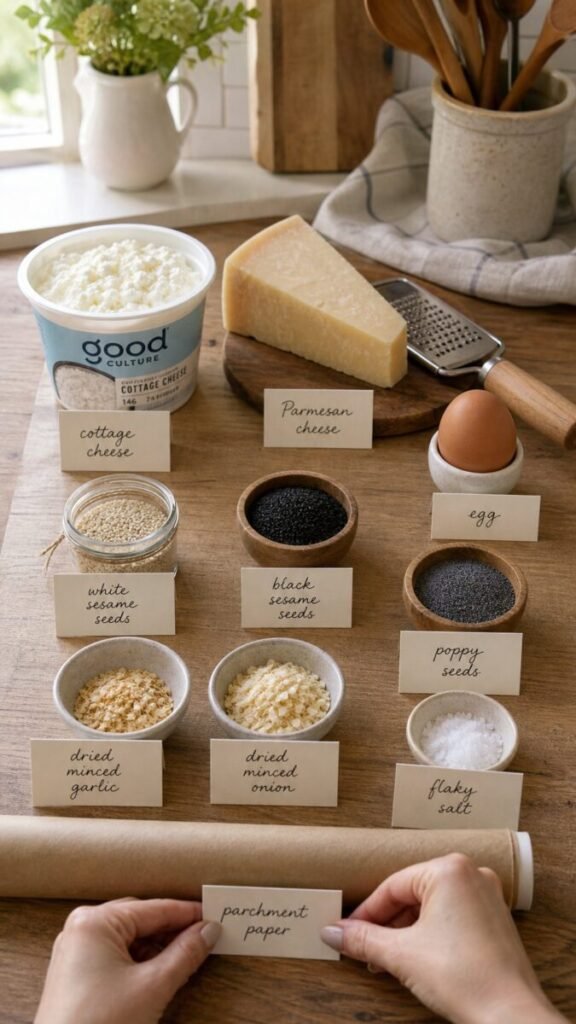
🧀 The Base
- Small-curd cottage cheese: 16 oz (about 2 cups) — 4% milkfat if you can
- Parmesan, finely grated: ½ cup, from a wedge
🌾 The Everything Blend
- Everything bagel seasoning: 2½-3 tablespoons — store-bought, or homemade from the build below
- To make your own: 1 tablespoon white sesame seeds, 2 teaspoons black sesame seeds, 1 teaspoon poppy seeds, 1½ teaspoons dried minced garlic, 1½ teaspoons dried minced onion, ½ teaspoon flaky salt
🥚 To Stick the Seeds
- Egg white: 1, lightly beaten
Step by Step How to Make
- Step 1 — Blend the curds. Scrape the whole tub of cottage cheese into the food processor and run it until the purée is completely smooth — sixty to ninety seconds, no visible curds, no lumps, the texture of very thick pancake batter. Stop once and scrape the sides down with the spatula so nothing rides the wall unblended. This is the single most important step in the recipe: every curd you leave whole is a chewy spot in a finished cracker, and every curd you blend is protein that dries crisp.
- Step 2 — The dry-cheese stir-in. Transfer the purée to a mixing bowl, add the finely grated Parmesan, and stir until it’s one even, pale, thick mixture — it should hold a spoon-track for a few seconds before slowly settling. Taste it now: the batter has no raw egg in it yet, so this is the moment to check the seasoning, and what you want is just barely too salty on a spoon, because drying concentrates everything and mellows it at the same time. It should taste pleasantly, cheese-ly seasoned — if it tastes flat, the Parmesan was shy, and another two tablespoons fixes it.
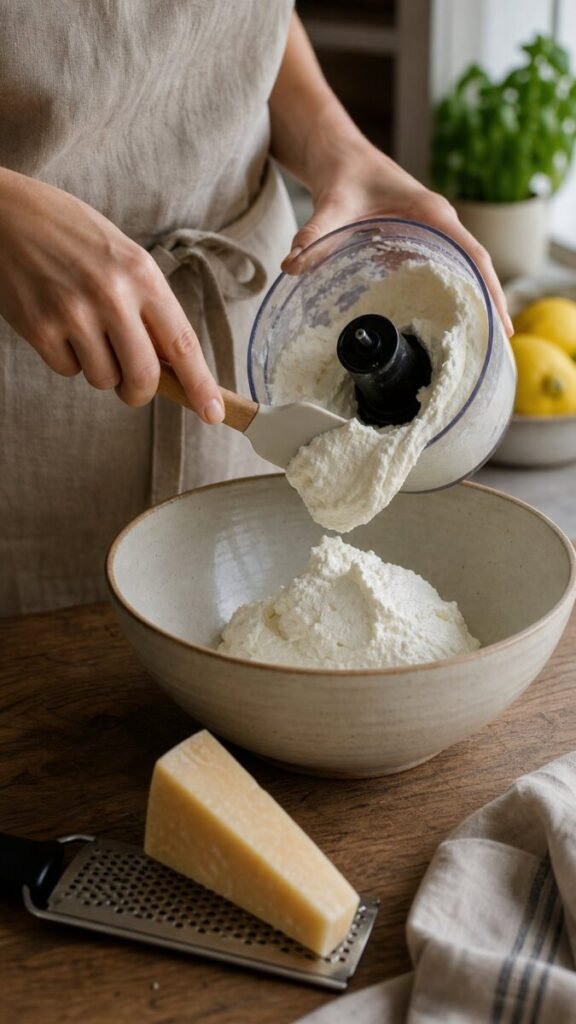
- Step 3 — Spread and score. Line the half-sheet pan with parchment and scrape the batter into the middle. With the offset spatula held flat, spread it into an even rectangle about 10×14 inches and a scant ¼ inch thick, nudging it into square corners and patching any thin spots by eye — the goal is a sheet that’s the same thickness everywhere, because the oven can forgive many things but not that one. When the spread is even, score it into squares with the bench scraper: six cuts one way, six the other, giving you thirty-six crackers with room to breathe. The batter is soft, so the lines need no pressure at all — a gentle draw of the blade leaves them.
- Step 4 — The seed blanket. Brush the whole scored surface lightly with the beaten egg white — thin is the word, a wet sheen rather than a wash, because pooled egg white turns to little glassy patches in the bake. Then sprinkle the everything blend evenly from about a foot up, letting the seeds rain across the whole sheet, and press them in with the flat of your palm or the back of the spatula, just enough that they’re sitting in the batter rather than on it. The scoring lines will mostly heal themselves under the seeds, which is fine — you’ll re-cut them later with almost no effort, and the crackers break cleaner along a pressed line than a perfect one.
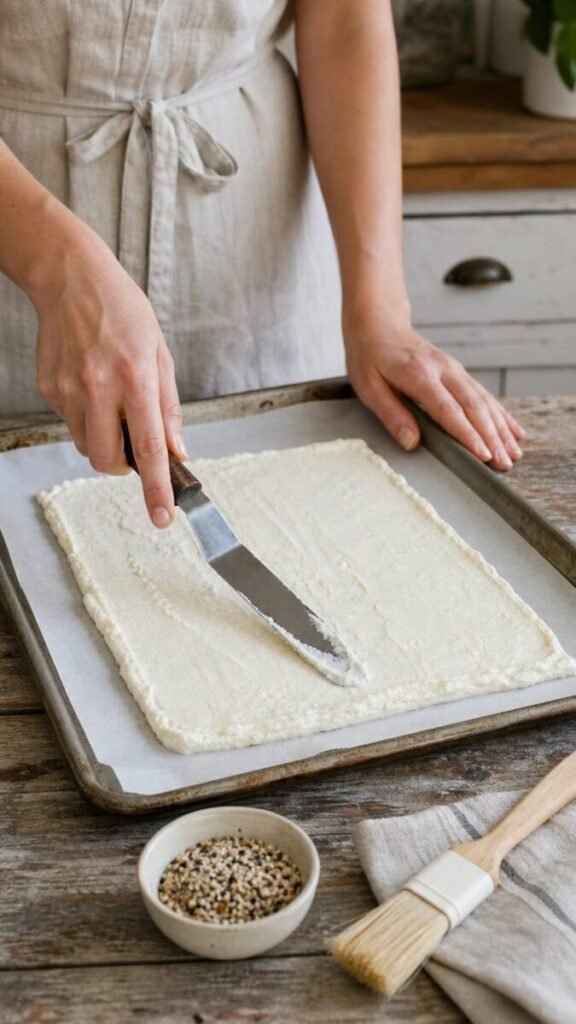
- Step 5 — Low, slow, and then off. Bake at 325°F for 45 to 55 minutes, rotating the pan once at the halfway mark so both ends brown the same. You’re watching for deep even gold and a surface that looks dry and matte all the way to the center squares — pale and shiny means the water is still in there, and color is flavor here, not risk. When it’s ready, turn the oven off, crack the door open, and leave the pan inside for ten minutes while the falling heat finishes the drying for free. If the edges are browning well ahead of the middle at any point, slide the pan up or down a rack rather than lowering the heat — the sheet is simply sitting in a hot spot.
- Step 6 — Cool, snap, repeat. Move the pan to the wire rack and let the crackers cool completely — fifteen honest minutes, and the hardest instruction in the recipe, because they smell like a bakery that only makes one thing. A warm cracker bends; a cooled cracker snaps, and the snap is the certificate that the drying worked. Re-run the knife along your score lines, break the sheet into crackers, and eat the corner one standing at the counter, because the cook collects a fee and the corner cracker is the crispest one on the pan.
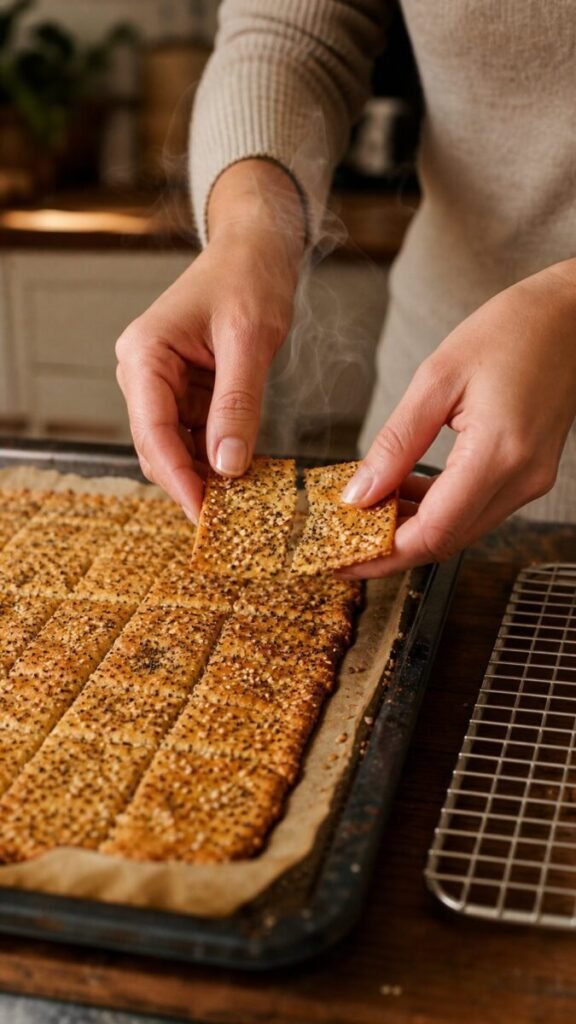
The 3-ingredient cottage cheese pancakes are the breakfast end of the same tub — one curd-blending trick, two completely different snacks, and a grocery store that keeps paying out.
Anna’s Kitchen Notes
Buy small curd, full fat. Small curds blend smooth in about half the time large ones do, and the 4% milkfat version bakes into a cracker with actual golden color and a rounded, buttery edge — the fat is flavor, and it fries the surface just slightly as the water leaves. Low-fat cottage cheese works, honestly, and it’s what I use when it’s what’s open, but it runs pale and takes five to eight extra minutes in the oven to reach the same snap. Fat-free I’d rather not: the crackers turn styrofoam-ish, and this is a snack, not a penance.
The blender is the whole trick. Every soggy-center failure I’ve been shown traces back to curds that survived the blend — visible lumps in the batter are future chewy spots in the cracker, one for one. If you don’t own a processor or blender, push the cottage cheese through a sieve with the spatula, which works and takes about as long as washing the processor bowl; and if you skip both and dollop unblended curds straight onto the pan, know that you’re making the lacy, rustic chips version, which is its own legitimate snack with a different personality and a shorter bake. But for even, snappable crackers, smooth is the standard.
Taste the batter — it’s the only raw-egg-free moment. The batter is just cottage cheese and Parmesan at Step 2, so it’s completely safe to taste, and it’s the only seasoning checkpoint in the recipe: the finished cracker should taste seasoned-but-not-salty, and the batter is where you steer that. Too flat means more Parmesan. Just right means stop. Too salty means your everything blend runs heavy on the salt — use less of it on top and let the cracker carry itself.
The re-crisp is a superpower. By day three or four, ambient humidity finds every cracker and they soften at the edges — this is a baked snack with no oil to repel moisture, not a packaging failure. Five minutes in a 300°F oven brings them back to day-one snap so completely that I’ve stopped believing in stale crackers. It works on the jar’s whole contents at once, so the snack never really ends, it just pauses.
Double it while the oven’s on anyway. Two tubs, two sheet pans, the processor run once — the batter doubles cleanly and the pans swap racks at the rotation. Thirty-six crackers sounds like a lot until the household finds them; seventy-two sounds like a lot until Thursday. Cost-wise, the single batch runs me about four dollars of ingredients for four protein servings, which beats the protein-cracker boxes at my store by half and tastes like something a person made on purpose.
The Snack Table
These were born to be dipped, and the dip decides the occasion. The jalapeño cream cheese dip is the standing favorite — cool and creamy against the seeded snap, with a slow burn that keeps the bowl interesting. For a party spread, the crackers go next to anything scoopable, and they hold up to thick dips without shattering, which is more than I can say for most store-bought boxes.
On the shelf next to them: the ranch Ritz crackers are the dressed-up store-bought end of the cracker aisle, five minutes of seasoning with no baking at all, and the crispy onion Parmesan chips are the frico end — pure cheese, zero curds, same snap. The everything bagel cucumber bites share the exact seasoning jar with no oven required, which makes them this recipe’s hot-weather twin. And when the table wants the sweet end of the protein snack shelf, the Greek yogurt cookie dough finishes what the crackers started, and nobody has to choose.
Same Bake, Other Flavors
Sesame and flaky salt, the minimalist. White and black sesame seeds with a dusting of flaky salt, nothing else — this is the version that tastes most like an expensive Japanese snack cracker, and it’s the one I make for guests who distrust fun. A tiny drizzle of toasted sesame oil stirred into the batter tips it over the top.
Chili and lime. Chipotle powder and a pinch of cayenne in place of the everything blend, with the zest of half a lime stirred into the batter after it comes out of the processor — the zest holds up beautifully in the low oven, and the finished cracker tastes like it wants a margarita nearby. Half a teaspoon of honey in the batter rounds the heat out.
Garlic and dill. Dried dill, garlic powder, and a whisper of onion powder over the top, with black pepper in the batter — the flavors of a ranch dip baked straight into the delivery vehicle, so the cracker is its own dip. My kids call these the green ones and pretend they invented them.
Rosemary and olive oil. Finely chopped dried rosemary and coarse salt on top, with a teaspoon of good olive oil whisked into the egg white before brushing — the closest the recipe gets to a focaccia in cracker form, and the one I put next to soup when soup season starts.
Cinnamon sugar, honestly rated. Cinnamon and a scant tablespoon of sugar over the top, Parmesan and all — I’ll say it before you ask: yes, you can taste the cheese, and it lands somewhere around a cheese blintz with cinnamon, which is a real dessert in several cuisines and no accident. My assessment is eighty percent delicious, twenty percent confusing, and the kids vote a straight hundred. Bake these a shade lighter than the savory ones.
The Protein Math
| Nutrient | Per Serving (9 crackers, 1 of 4) |
|---|---|
| Calories | 180 kcal |
| Protein | 16 g |
| Carbohydrates | 7 g |
| Fats | 10 g |
Estimates as written, full-fat cottage cheese, the seed blanket counted, the dip bowl left to your own conscience. Sixteen grams is the honest headline: a bowl of nine crackers carries the protein of two eggs, against the two grams a typical boxed cracker serving manages — eight times more, from a dairy case staple that costs less than a bag of chips. The carbohydrates run seven grams because there’s no flour in the build, which makes these a snack that people who count such things can actually count on. And at roughly a dollar per protein serving, the batch undercuts every protein bar at the register while tasting like a deliberate treat instead of an obligation.
The Pantry Jar
Storage is where this recipe’s one weakness lives, so let’s be direct about it: these are a baked snack with almost no oil, and ambient humidity is patient. Keep them in an airtight jar at room temperature and they hold their snap for about four days; by day five, the edges soften and the five-minute re-crisp at 300°F becomes part of the routine — it works so well that I’ve started running it preemptively on day three, just to hear the noise again. What you absolutely do not do is refrigerate them: the fridge is a humidity chamber, and cold crackers collect condensation the moment they meet warm air, softening in hours what the jar would have protected for days.
The batter, on the other hand, is a make-ahead dream — it keeps covered in the refrigerator for two days, which means Sunday’s blend can become Tuesday’s fresh crackers with nothing but a spread and an oven. Baked crackers also travel well in a lunchbox or a jacket pocket in a pinch, surviving far better than any chip, though I’d pack them for the day, not the week. And the broken pieces, of which there are always a few, are not casualties: they’re croutons. A handful of shards over a salad or a bowl of soup does everything a crouton is supposed to do, with sixteen grams of protein per bowl’s worth instead of a bread cube’s resume.
Where It Goes Wrong
Pale, bendable crackers. The number one failure, and it’s always the same cause: they came out too soon. Water that’s still inside the cracker keeps it flexible no matter how golden it looks, and fear of color is the enemy — deep gold is the goal, not the risk, at this temperature. If a cooled cracker bends instead of snapping, the whole pan goes back into a 325°F oven for eight more minutes, and the problem is solved without ceremony.
Chewy spots in the middle. Curds that escaped the blender, or a spread that ran thick in the center. Both show up as soft patches in an otherwise crisp sheet. The blender fix is running it longer than looks necessary; the spread fix is the flat spatula and twenty extra seconds of evenness. There’s no oven setting that repairs either one, so both get caught before the pan goes in.
Stuck to the sheet. Foil and wax paper are the usual suspects, and both are strict upgrades to parchment in this recipe — foil grips the cheese and tears the crackers off in patches, and wax paper melts its coating onto both the pan and your afternoon. The other cause is skipping the egg-white brush and pressing the seeds straight into the batter so hard they weld the surface down. Parchment, light press, no problems.
Burnt edges, soft middle. A hot spot in the oven or a lopsided spread. The rotation at thirty minutes is the insurance for the first; the flat spatula is the cure for the second. If your oven runs hot enough that the edges race ahead anyway, drop the temperature 25 degrees and let the bake run longer — this recipe would always rather go lower and slower than faster and browner.
Soft by day two. Humidity found the jar — a lid left loose, a fridge sojourn, or a steamy kitchen with the dishwasher running. The crackers themselves are fine; they just need the 300°F re-crisp, five minutes, and the snap returns so completely it’s a little bit funny. Store them airtight, keep them out of the cold, and the issue mostly never starts.
Too salty to finish. Double-salting is the only way this happens, because the recipe adds none: a salted everything blend plus a heavy hand with the shaker, or a Parmesan that runs aggressive plus the blend’s full ration. If the batter tastes too salty at Step 2, the fix is not more of anything — it’s using the blend sparingly on top and trusting the cheese. The finished cracker should taste seasoned and ready for dip, never like a punishment.
Curd Questions
Which cottage cheese should I buy?
Small-curd, 4% milkfat, from a brand whose tub you like the taste of straight — the cracker tastes like an amplified version of whatever tub you started with. Small curds blend smooth fastest, and the full-fat version bakes golden with a rounder flavor. Low-fat works with five to eight extra minutes of bake time; fat-free turns styrofoam-ish, and I’d rather you spend the calories somewhere that pays you back.
Can I make these without a food processor or blender?
Yes, with one of two workarounds: push the cottage cheese through a sieve with a spatula, which reaches the same smoothness and takes about as long as washing the processor; or skip the smoothing entirely and dollop teaspoon-sized rounds straight onto the parchment, which bakes into lacy, rustic chips in about 35 minutes. That second version is a different, equally snackable thing — but it isn’t the even, snappable sheet cracker in the photos.
Are these gluten-free?
As written, yes — cottage cheese, Parmesan, an egg white, and seeds, with nothing wheat anywhere in the build. The one item to check is the everything blend if it’s store-bought, since a few brands process their dried garlic and onion on shared lines; the homemade blend in the ingredients list closes that gap with five pantry jars and thirty seconds of measuring.
Why did my crackers go soft, and how do I fix them?
Ambient humidity, a loose lid, or a stint in the fridge — crackers with almost no oil are honest about their surroundings. The fix is five minutes in a 300°F oven, which brings back the day-one snap so completely that it’s worth doing even before they soften if the weather’s damp. For prevention: airtight jar, room temperature, and never the refrigerator.
What else can I season them with?
Anything dry and sprinklable — the variations section runs sesame-salt, chili-lime, garlic-dill, and rosemary-olive oil, and the only rule is that the seasoning goes on top with the egg white, not stirred into the batter, where the moisture softens it. Wet ingredients are the exception: lime zest works stirred in, but fresh garlic or herbs bring water with them and are better dried or skipped.
How much protein is really in these?
Per bowl of nine crackers — a quarter of the sheet — about sixteen grams, which is the honest arithmetic of two cups of cottage cheese plus half a cup of Parmesan divided by four servings. Per single cracker it’s under two grams, same as a boxed cracker; the difference is that nine of these is a bowl and nine boxed crackers is an appetizer. Serving size is doing the work here, so I keep the servings honest and the crackers small.
Can I use a different cheese instead of Parmesan?
Any hard, dry grating cheese works: Pecorino Romano is the classic swap and runs saltier, so pull back slightly if your everything blend is already bold; aged Asiago lands between the two. Softer cheeses — cheddar, Gruyère, anything that grates gooey rather than powdery — bring moisture instead of drinking it, and the crackers bake softer and greasier for it. If soft cheese is what’s in the fridge, the frico-style chips on this site are the better home for it.
Easy High-Protein Cottage Cheese Crackers
Ingredients
As an Amazon Associate I earn from qualifying purchases.
Cracker base
- 16 oz (454 g; about 2 cups) small-curd cottage cheese, 4% milkfat
- ½ cup (about 40 g) finely grated Parmesan cheese, preferably grated from a wedge
- 1 large egg white, lightly beaten; use only enough for a thin coating
Everything topping
- 2½–3 tablespoons everything bagel seasoning, or the homemade blend below; use less if your blend is very salty
Optional homemade blend — use instead of store-bought
- 1 tablespoon white sesame seeds
- 2 teaspoons black sesame seeds
- 1 teaspoon poppy seeds
- 1½ teaspoons dried minced garlic
- 1½ teaspoons dried minced onion
- Up to ½ teaspoon flaky salt, optional; reduce or omit for a less salty topping
Kitchen Tools
- Food processor or blender
- 13×18-inch rimmed half-sheet pan
- Nonstick baking parchment, rated for at least 325°F; not wax paper
- Mixing bowls and silicone spatula
- Fine cheese grater
- Measuring cups and spoons or a kitchen scale
- Offset spatula
- Pastry brush
- Bench scraper or pizza cutter
- Oven mitts and wire cooling rack
Directions
- Preheat and blend. Preheat the oven to 325°F and line the half-sheet pan with nonstick baking parchment. Blend the cottage cheese for 60–90 seconds, stopping to scrape down the sides, until completely smooth. Do not add water to help it blend.
- Stir in the Parmesan. Transfer the purée to a bowl and stir in the finely grated Parmesan. If desired, taste with a clean spoon before handling the raw egg white. Keep the seasoning modest: baking concentrates salt, and the topping adds more. If making the homemade blend, combine its ingredients separately; it makes slightly more than 3 tablespoons, so reserve any excess.
- Spread thinly and mark the portions. Spread the cheese mixture into an even rectangle about 10×14 inches, roughly ⅛ inch thick. Avoid thick patches in the middle and paper-thin edges. Lightly mark a six-by-six grid with five interior lines in each direction for about 36 crackers. The wet mixture may flow back together; these initial lines are guides, not permanent cuts.
- Add the seed topping. Gently brush with just enough beaten egg white to leave a thin sheen, without puddles or dragging the batter out of place. Sprinkle evenly with 2½–3 tablespoons everything seasoning, using less if salty. Press very lightly with the spatula. Discard unused egg white and wash utensils that contacted raw egg before using them again.
- Bake, separate, and finish drying. Bake on the middle rack, rotating the pan after about 25 minutes. Once the sheet is firm enough to hold a cut, carefully re-score the grid without cutting through the parchment. Start checking at 40 minutes; allow about 45–55 minutes or longer, depending on moisture and thickness. Look for a dry surface and golden color rather than very dark edges. Remove crisp edge pieces if they finish first. If the center remains soft while the edges brown, reduce the oven to 275–300°F, separate the firm pieces, and continue in 5–10-minute intervals. When dry, switch off the oven and leave the crackers inside for 10 minutes; keep the door closed unless the manufacturer permits an ajar-door drying step.
- Cool, check the snap, and refrigerate leftovers. Place the pan on a wire rack and cool for about 15 minutes, then gently release the crackers from the parchment and separate along the score lines. If cooled pieces bend, return them to a 275–300°F oven in short intervals, checking frequently, then cool again. Expect about 80–90 minutes overall, with extra drying time possible. Crispness does not establish shelf stability: this homemade dairy-and-egg recipe has not been validated for room-temperature storage. Refrigerate leftovers airtight within 2 hours, or within 1 hour above 90°F, and use within 3–4 days. Re-crisp refrigerated crackers briefly in a 300°F oven and cool before eating.
Nutrition
| Nutrient | Approximate amount per serving |
|---|---|
| Serving size | ¼ batch, about 9 crackers |
| Calories | 180 kcal |
| Protein | 18 g |
| Carbohydrates | 7 g |
| Total fat | 9 g |
Estimates assume 454 g full-fat cottage cheese, 40 g Parmesan, one egg white, and approximately 3 tablespoons of the homemade seasoning blend. Actual values vary with brands, cheese weight, topping, and the amount of egg white used. Sodium varies substantially with the cheeses and seasoning. For gluten-free needs, verify all packaged ingredients and avoid cross-contact. Contains milk, egg, and sesame.