

Best Pioneer Woman French Toast Casserole
Every December I run into the same problem: everybody wants french toast, and the cook wants to stand there watching faces open presents, not standing over a griddle flipping bread while the good part of the morning happens in the other room. This casserole is the solution, and I can’t even claim it as mine — it’s the Pioneer Woman’s. Ree Drummond has been making her cinnamon-baked french toast for her family for years, and she has called it, flatly, the best. Having made it through more holiday mornings than I’ll admit to, I understand the confidence.
Here’s the whole idea. The night before, torn chunks of crusty sourdough go into a buttered dish and get drowned in a custard of eight eggs, whole milk, cream, two kinds of sugar, and a frankly startling two tablespoons of vanilla. Overnight, the bread does all the work — it drinks the custard down to the last drop. In the morning you scatter a cold-butter streusel over the top and slide the whole cold dish into a 350°F oven, and about fifty minutes later it comes out puffed and golden under a crisp, sugary lid. Syrup at the table, coffee in your hand, and the cook is never more than warm.
If you know this site, you know it already has a blueberry french toast casserole on it — that’s the summer branch of this same family, with challah and maple and the fruit doing half the sweetening. This is the original prairie model, and it’s a genuinely different recipe wearing the same overnight trick: bread with a backbone, no fruit anywhere, and a flour-and-cold-butter streusel cap instead of a drizzle that soaks in. The two dishes earn their two posts, and the difference between their toppings is a small lesson in baking all by itself.
The Overnight Soak
The entire recipe rests on one piece of physics: dry bread drinks. A fresh loaf is already full of water, and there’s no room in it for custard — but a day-old loaf has given up its moisture to the air, and every one of those empty air pockets in the crumb becomes a little reservoir waiting to fill with eggs and cream. That’s why every french toast recipe you’ve ever read asks for stale bread; the overnight soak just takes the principle seriously. Twelve hours in the fridge, and the custard has migrated all the way to the center cubes, not just painted the outsides. The corner pieces and the middle pieces drink the same amount, which is why a scoop from anywhere in the dish eats the same — no dry pockets, no puddle at the bottom.
The ratio matters as much as the time. Eight eggs to two and a half cups of dairy is custard, not dip — rich enough that it sets around 180°F into one soft, sliceable slab instead of weeping whey at the edges. Heavy cream carries a third of the dairy load, and it’s doing more than tasting good: its fat coats the egg proteins and slows them down as they set, which is the difference between a tender bake and one that tastes like a folded omelet with bread in it. Two sugars split the job too — granulated for clean sweetness, brown sugar for the caramel note that makes the top edges of this dish the first thing people fight over.
And then there’s the vanilla. Two full tablespoons of it, which looks like a typo the first time you measure it out and is not. This is the single most recognizable fingerprint of Ree’s original, and in a big baked dish with this much bread in it, the amount reads as warm and round rather than perfumy — a quarter teaspoon gets lost in nine cups of custard-soaked sourdough the way a whisper gets lost at a parade. Use the real stuff. At two tablespoons, imitation extract stops pretending and gets sharp, and the whole dish pays for the savings.
⏱️ 20 MINUTES TONIGHT + 50 IN THE MORNING | 🍞 FEEDS 8-10 | 🥞 MAKE-AHEAD, ONE DISH
- Prep Time: 20 minutes tonight — tearing, whisking, one bowl
- Soak Time: 8 hours overnight; 30 minutes at the bare minimum
- Bake Time: 45-50 minutes at 350°F
- Rest Time: 10 minutes before the first square
- Yield: a 9×13 dish — 8 generous servings, 10 polite ones
The Sugar Lid
The equipment is short, and one piece of it lives in the fridge:
- 9×13 baking dish — glass or ceramic; this is a shallow soak, not a deep one
- Large mixing bowl — big enough to whisk eight eggs and two and a half cups of dairy without splashing the counter
- Whisk — the custard comes together in about a minute
- Small bowl and a sturdy fork — for cutting the cold butter into the streusel; a pastry cutter if you own one, but a fork has done this job for a century
- Silicone spatula — for pressing the bread down into the custard
- Plastic wrap or foil — the dish’s overnight blanket
Now the topping, because it’s where this recipe earns its fame. The streusel is flour, brown sugar, cinnamon, salt, and cold butter cut in until the whole thing looks like wet sand. The flour is doing structural work most toppings skip: it gives the melting sugar a scaffold to crisp around, so the top bakes into an actual cap instead of dissolving into the custard underneath. A drizzle of butter and brown sugar — the topping on plenty of french toast bakes, including this site’s blueberry one — soaks in and makes the top of the dish sweet and soft. A streusel lid stays up. You get two textures on one spoon instead of one very good one.
Cold matters twice over. The butter has to stay cold so it cuts into small pebbles instead of smearing into the sugar — those pebbles are what bake into little crisp layers, and warm butter just makes paste. And the lid goes on cold, straight from the fridge onto the cold dish, directly into the hot oven: the cap sets before the custard underneath comes up to temperature, which is how you get a crisp roof over a steamy middle. Keep the streusel in its bowl or a bag in the fridge next to the soaking dish, and add the quarter teaspoon of salt — it’s the pinch that keeps the lid from tasting like a mall muffin top.
Ingredients (With Labels)
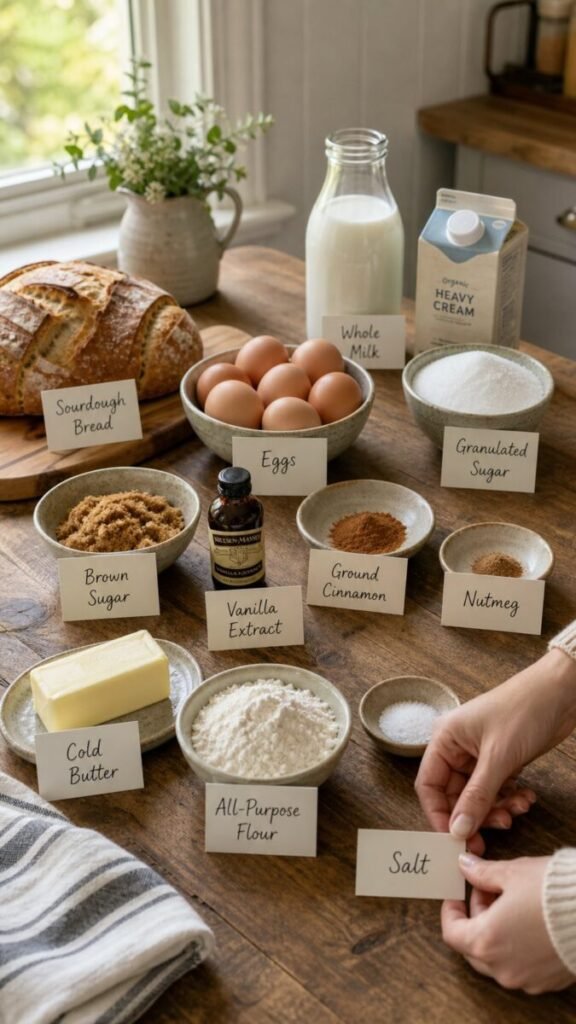
🍞 The Loaf
- Crusty bread: 1 loaf (about 1 pound) — sourdough or French bread, torn into big chunks
- Softened butter: about a tablespoon, for the dish
🥛 The Custard
- Large eggs: 8
- Whole milk: 2 cups
- Heavy cream: ½ cup
- Granulated sugar: ½ cup
- Brown sugar: ½ cup, packed
- Vanilla extract: 2 tablespoons — yes, tablespoons
🧁 The Streusel Lid
- All-purpose flour: ½ cup
- Brown sugar: ½ cup, packed
- Ground cinnamon: 1 teaspoon
- Salt: ¼ teaspoon
- Fresh nutmeg: a few scrapes, optional
- Cold butter: ½ cup (1 stick), cut into small pieces
🍁 At the Table
- Maple syrup: warmed, and plenty of it
- More butter: for anyone who asks, and someone will
- Fresh blueberries: 1 cup, optional — Ree’s own suggestion
Step by Step How to Make
- Step 1 — Dry the bread. Tear the loaf into big, ragged chunks — ripping, not slicing, because a torn edge is all hills and valleys where a sliced edge is a wall, and custard climbs hills far better than it climbs walls. If your bread is fresh, spread the chunks on a sheet pan and give them 10 minutes at 300°F while you assemble everything else; they should feel dry to the touch, not toasted. Day-old bread from the counter can skip this entirely. Pile the chunks into the buttered 9×13 dish as you go, filling it evenly to the corners.
- Step 2 — Build the custard. Crack all eight eggs into the big bowl and whisk until they’re one uniform color — thirty seconds of actual effort. Add the milk, cream, both sugars, and the full two tablespoons of vanilla, and whisk another thirty seconds until the sugars dissolve and the whole thing looks like a very pale milkshake. Taste a fingertip’s worth if you’re curious; it should smell like a bakery and like breakfast is already handled.
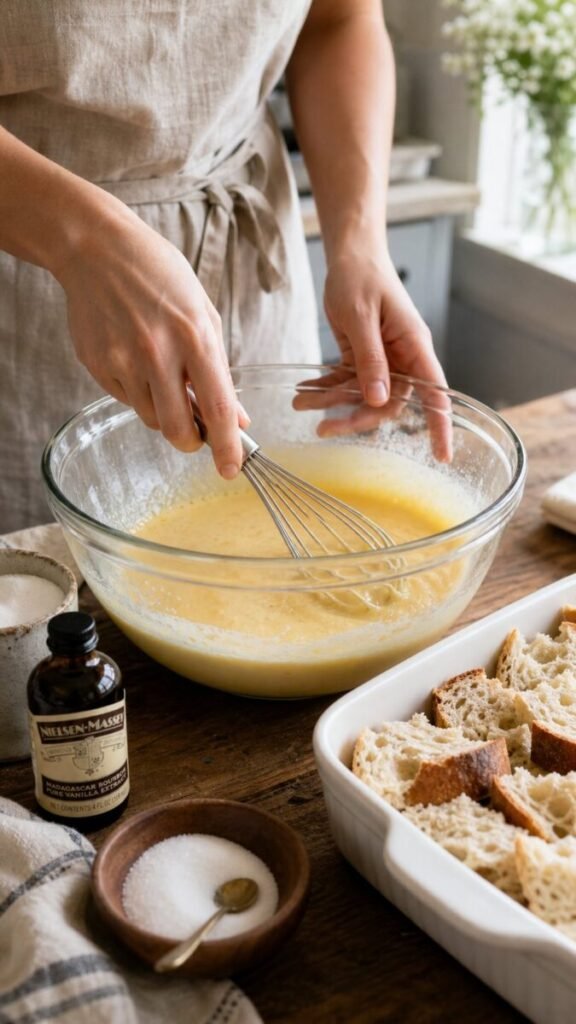
- Step 3 — The soak. Pour the custard slowly and evenly over the bread, then take the spatula and gently press every chunk down into the liquid — the top layer will bob, and your job is to make sure each piece takes a drink before it gets the chance to float dry all night. Press, wait ten seconds, press again; the custard level will visibly drop as the bread pulls it in. Cover the dish tightly with plastic wrap or foil and refrigerate. Overnight is the goal — a full eight hours moves the custard to the center of every chunk — and thirty minutes is the documented minimum. Ree says you can bake it straight away and it’s still delicious, and she’s right; the center just eats softer and the story is better with the wait.
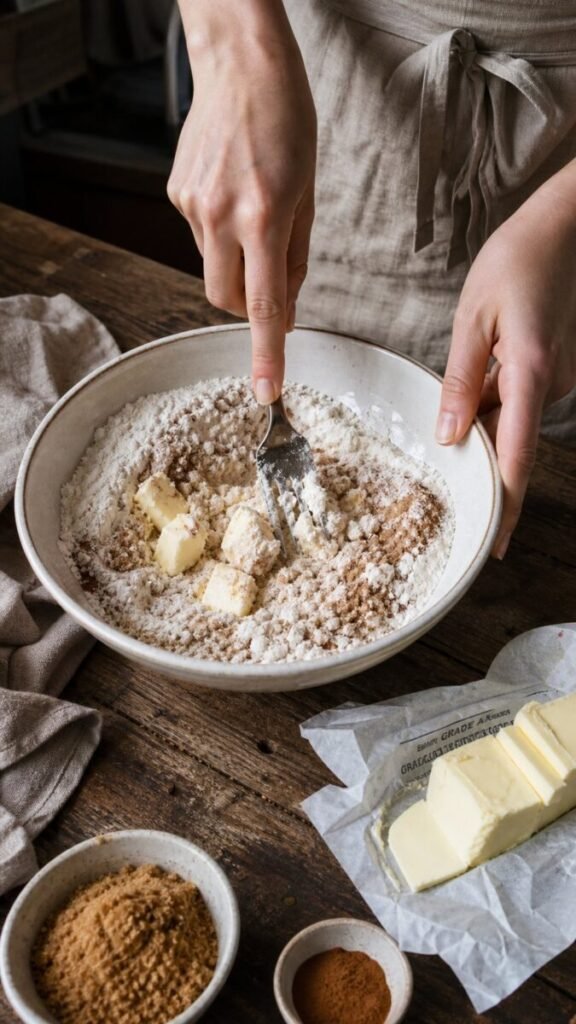
- Step 4 — Cut the lid. While the dish soaks, make the streusel: flour, brown sugar, cinnamon, salt, and a few scrapes of nutmeg in the small bowl, stirred together with the fork. Add the cold butter pieces and cut them in — press and roll the fork through the butter again and again, smearing it into smaller and smaller bits — until the mixture looks like wet sand with some pebbles the size of small peas running through it. That pebble size is the target: too fine and the lid bakes dense, too coarse and it collapses into buttery puddles. Cover the bowl and keep it in the refrigerator next to the soaking dish, because everything about this lid is cold.
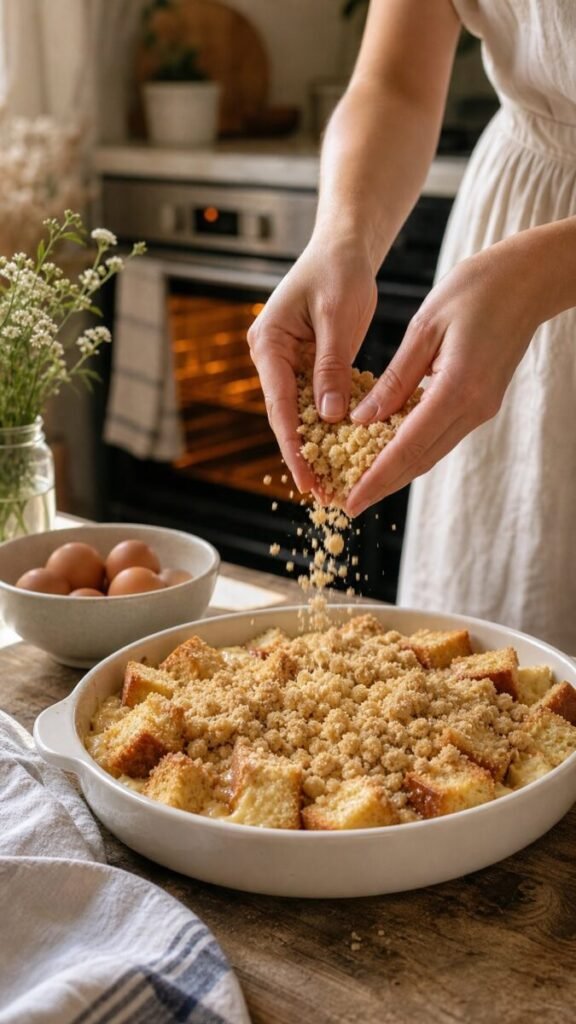
- Step 5 — The morning bake. When you’re ready, heat the oven to 350°F — no need to wait for it; the dish is designed to go in cold. Pull the plastic off, scatter the cold streusel evenly over the top with your hands, and slide the dish onto the middle rack. Bake 45 to 50 minutes, until the lid is deep golden, the edges are puffed like a rising loaf, and a knife slid into the center comes out mostly clean with a few moist crumbs clinging to it. If the lid browns fast in a hot-running oven, lay a loose sheet of foil over the top for the last ten minutes — the middle needs the time more than the lid needs the color.
- Step 6 — Rest and serve. Rest the dish ten minutes on a rack before cutting — the custard finishes setting in those minutes, and squares cut from a rested dish hold their shape while squares cut hot slump into something you’d have to call rustic. Scoop big squares with a serving spoon, put the warm syrup and the butter and the berries on the table, and take the middle piece for yourself, because you know exactly where it is and nobody else does.
The blueberry french toast casserole already on this site is the summer branch of the same family — challah, maple in the custard, the fruit doing half the sweetening. The overnight trick is identical; you’re really just choosing your season.
Anna’s Kitchen Notes
Two tablespoons of vanilla is the recipe. It’s the number that makes this taste like Ree’s version and not like every other breakfast bake on the internet, and every time I’ve watched someone “adjust” it down to a teaspoon, the dish comes back tasting like sweet eggs. Measure the full amount, use real extract, and pour it without flinching — in a dish with a pound of bread in it, that quantity lands as warmth, not perfume.
Sourdough is the quiet genius of the bread pick. A mild sourdough’s slight tang sits under the sweet streusel lid the way salt sits on caramel — you don’t taste the tang, you taste the sweet getting sharper because of it. French bread is the neutral route if your table includes sourdough skeptics. Brioche and challah work beautifully too, but they’re richer and drink faster, so start checking the oven at the 40-minute mark instead of 45.
The pan size is doing real work. Ree’s original says “a large baking pan,” and a 9×13 is the size this ratio is built for — the custard comes up the sides of the bread just high enough to soak everything without a lake forming at the bottom. A deeper dish traps custard below the bread and bakes unevenly, so if you’re feeding a crowd beyond ten, bake two 9×13 dishes side by side rather than one taller one. They swap racks halfway through and nobody can tell.
Make the streusel tonight, not tomorrow. The lid takes four minutes with a fork, and those four minutes are the only real work the morning asks of you — if you leave them for the morning, you’ll be cutting butter into sugar before the coffee has even landed. Make it while the custard is still fresh in the bowl, park it in the fridge, and the entire next-day recipe is: sprinkle, oven, wait.
The honest bake-it-tonight option. Ree is clear that you can skip the soak entirely, assemble, and bake right away, and she’s not wrong — it bakes into a softer, looser version that still disappears. If the crowd is arriving in an hour, do it. But if you have even thirty minutes, give the dish a thirty-minute rest before the oven; the center cubes drink enough in that window to close most of the gap between the two versions.
The Sunday Spread
The casserole is sweet and rich, so the table around it wants salt and brightness. Something salty is nearly mandatory: air fryer carrot bacon is the colorful, crispy route, and a tray of regular bacon has never once been complained about at a brunch I’ve hosted. Put the syrup next to the salt and let people work it out — they always do.
If this is the anchor of a full brunch buffet, the eggs benedict casserole is the savory other half of the table — same hands-off spirit, hollandaise instead of streusel — and the easy McGriddle casserole covers the guests who consider syrup a beverage. One sweet bake, one savory bake, and the hostess is drinking her coffee instead of babysitting a griddle, which is the entire philosophy of this kind of morning.
And for the pancake loyalists who will never fully convert: the fluffy banana pancakes take twenty minutes whenever the casserole’s already in the oven, and honestly, a table with both is a table nobody leaves early.
Same Soak, Other Breads
Ree’s pecan pie version. The Pioneer Woman’s other famous french toast bake swaps the streusel for a goo of butter, brown sugar, corn syrup, maple syrup, and a cup and a half of pecans, cooked on the stove and poured over before baking — it comes out closer to a praline-topped dessert than a breakfast, and it belongs at a holiday table at least once. Same custard, same soak, completely different hat.
Cinnamon-raisin bread. Swap the loaf for cinnamon-raisin and the spice work arrives pre-installed — the raisins plump in the custard overnight and the whole dish drifts toward cinnamon-roll territory. Drop the cinnamon in the lid to half if the bread is assertive.
Chocolate chip and dried cranberry. A half cup of each folded between the bread layers, strictly for the kids’ table and the adults who still sit at it in spirit. The chocolate melts into little pockets and the cranberries go jammy; the streusel lid stays exactly the same.
A shot of orange. The zest of half an orange whisked into the custard wakes the whole dish up — it reads bright rather than orange-flavored, and it’s my favorite small edit when this bake shows up in spring instead of December.
Day-old croissants. Torn croissants make a version so rich it should probably be filed under dessert — all those buttery layers drink custard like they were designed for it, because in a sense they were. Cut the soak back to an hour or two; croissants give up faster than bread does.
The savory direction. The same overnight assemble-and-bake trick runs savory with zero adjustments to the technique — the pancake sausage casserole is that exact move with syrup baked into the middle, and it’s the reason this site’s breakfast shelf leans so hard on casseroles in the first place. For the weekday after a big brunch, the 3-ingredient cottage cheese pancakes are the light, fast landing after a weekend of streusel.
The Breakfast Math
| Nutrient | Per Serving (1 of 10) |
|---|---|
| Calories | 490 kcal |
| Protein | 13 g |
| Carbohydrates | 62 g |
| Fats | 19 g |
Estimates as written, with the streusel and a reasonable hand on the syrup counted, berries left to your own conscience. Thirteen grams of protein per serving is honest breakfast fuel for a sweet dish — the eight eggs and the whole milk do that quietly while everyone’s busy arguing over the crispest corner. Count the money too: a crusty loaf, eight eggs, milk, cream, and the pantry’s sugar, flour, and butter come to about ten dollars all-in where I shop, which is ten servings at a dollar a plate — less than one bakery croissant, and it feeds the whole table while the bakery feeds one person one sad paperback-sized pastry.
The Second Morning
Baked leftovers keep four days covered in the fridge, and here’s the part that surprises people every time: day two is arguably better. Overnight in the cold, the flavors round out the way bread pudding’s do, and the custard settles into a denser, almost custard-slice texture that cuts cleaner than the first-day version. Cover the dish or move squares to a container; either way, the lid softens in the fridge, which leads directly to the reheating question.
Reheat with the texture in mind. A covered dish back in a 300°F oven for ten to twelve minutes warms everything through gently. But the single best reheat for a single square is a buttered skillet: medium-low heat, square set lid-down, two minutes — the streusel re-crisps in the butter in a way no other method manages, and you get a breakfast that tastes deliberately made rather than recovered. The microwave works when the schedule is cruel, and it turns the whole square soft and steamy; eat it and enjoy it, but know that the skillet is sitting right there.
The freezer takes baked squares happily — wrapped tight, up to a month, thawed overnight and then skillet-reheated as above. What the freezer does not take well is the unbaked soak: the bread keeps drinking as it thaws, over-saturates, and the lid ends up sinking into a sodden top instead of crisping over it. Bake first, freeze after, in that order, and the dish stays a two-texture experience all month long.
Where It Goes Wrong
The soggy middle. The classic, and it’s almost always one of two things: the bread was too fresh (nothing to drink with, so the custard pooled instead of absorbing) or the bake was short. The knife test is the arbiter — mostly clean with moist crumbs is done, wet batter is not. Some movement in the center as the dish comes out is correct; custard finishes setting during the rest, and a jiggle is texture, not failure. Sloshing, on the other hand, goes back in the oven.
Dry, eggy middle. The opposite end: baked ten minutes past done, the custard tightens up and turns dense and the squares taste like sweet scrambled eggs holding bread hostage. Pull the dish when the knife reads mostly clean — the carryover heat during the ten-minute rest finishes the job — and if your oven runs hot, that’s the number to interrogate first.
The lid sank into the custard. The butter was too warm when it went into the streusel, so instead of pebbles it smeared into paste, and paste soaks. Or the streusel sat out at room temperature overnight instead of in the fridge and softened into the same mistake. The fix is temperature discipline: cold butter, cold bowl of crumbs, cold dish, and the lid holds its shape over the custard for the whole bake.
Burnt lid, raw middle. An oven running hot browns the streusel long before the center sets. Tent the dish with foil for the last ten minutes, and if your oven has a known temper, drop the temperature 25 degrees and extend the bake — this dish would rather sit in a gentle oven for five extra minutes than sprint through a hot one.
It tastes flat. Three suspects, in order of likelihood: the quarter teaspoon of salt got skipped (sweetness with no salt reads as dull the moment the syrup hits), the vanilla got timid, or the bread was sandwich bread — soft, closed-crumb, flavorless stuff that brings nothing to a dish where bread is half the ingredients. A crusty loaf with an open crumb is carrying the architecture and the flavor; don’t hand that job to white sandwich bread.
It fell after baking. Some settling is completely normal — this is a custard, not a soufflé, and the dish dropping half an inch as it cools is the steam leaving. What comes out puffed and dramatic relaxes into something denser and better to cut, and that’s not a failure, that’s the plan. Serve it with confidence and nobody will know there was ever a taller version.
French Toast Questions
Do I really have to make it the night before?
Overnight is the goal — eight hours is what moves the custard all the way into the center of the bread — but the documented minimum is thirty minutes, and Ree herself says you can bake it immediately, still delicious, just softer in the middle. My honest ranking: overnight first, a thirty-minute rest a close and perfectly respectable second, straight to the oven when the crowd is already at the door.
Can I use brioche or challah instead of sourdough?
Yes, and both are wonderful — richer and more tender, because those breads are built on eggs and butter themselves. Two adjustments: they drink custard faster than sourdough does, so start checking at 40 minutes instead of 45, and their sweetness means the finished dish lands closer to dessert. Challah is what this site’s blueberry version uses, so you can see the whole family tree before you commit.
Why is there flour in the topping?
Because flour is the difference between a lid and a drizzle. Brown sugar and butter alone melt into the custard and vanish — sweet, but soft. The flour gives the melting sugar a structure to crisp around, so the top of the dish bakes into an actual cap you can hear when your spoon breaks it. It’s the single detail that sets the Pioneer Woman version apart from the butter-drizzle school of french toast bakes.
Can I halve it?
Easily, and the math is clean: half the bread in a buttered 8×8 dish, 4 eggs, 1 cup of milk, ¼ cup of cream, ¼ cup of each sugar, and a full tablespoon of vanilla — keep the vanilla high, it’s the signature. Halve the streusel too, and start checking the oven around 35 minutes. An 8×8 version feeds four generously and is the right size for a regular Sunday rather than a holiday.
Can I make it dairy-free?
Mostly. Oat milk stands in for the milk and cream better than any alternative I’ve tried — the custard sets tender and the flavor stays quiet. The lid is the hard part: plant butters vary wildly, and coconut oil makes a softer, more fragile cap. The result lands around eighty percent of the original — still sweet, still custardy, with a lid that crunches politely rather than loudly.
Isn’t this just bread pudding?
The family resemblance is real and nobody’s hiding it — bread, custard, a bake, a topping. The differences are scheduling and syrup: this is built to soak overnight and bake while the household wakes up, it’s served with maple syrup like french toast rather than eaten with a spoon like dessert, and the streusel lid makes it crackle where bread pudding sighs. Call it whatever gets it to the table; it answers to both.
How do I know when it’s done?
Three signs together: the lid is deep golden, the edges have puffed up like the dish is proud of itself, and a knife in the center comes out mostly clean with moist crumbs. The center will still move slightly when you nudge the dish — that’s custard, and the ten-minute rest finishes it. If the knife comes out wet and shiny with uncooked egg, it needs more time, foil over the top if the lid’s already dark.
Best Pioneer Woman French Toast Casserole
Ingredients
As an Amazon Associate I earn from qualifying purchases.
Bread & baking dish
- 1 loaf (about 1 lb / 454 g) day-old crusty sourdough or French bread, torn into roughly 1-inch chunks
- 1 tablespoon softened unsalted butter, for greasing the dish
Vanilla custard
- 8 large eggs
- 2 cups whole milk
- ½ cup heavy cream
- ½ cup granulated sugar
- ½ cup packed brown sugar
- 2 tablespoons pure vanilla extract
Cinnamon streusel
- ½ cup all-purpose flour
- ½ cup packed brown sugar
- 1 teaspoon ground cinnamon
- ¼ teaspoon salt
- A small pinch freshly grated nutmeg, optional
- ½ cup (1 stick / 113 g) cold unsalted butter, cut into small pieces
For serving
- Warm maple syrup, to taste
- Additional butter, optional
- 1 cup fresh blueberries, optional
Kitchen Tools
- 9×13-inch metal baking pan, or another baking dish used according to its manufacturer’s temperature-change instructions
- Large mixing bowl and whisk
- Small bowl and pastry cutter or sturdy fork
- Silicone spatula
- Measuring cups and spoons
- Rimmed sheet pan, if drying fresh bread
- Food-safe plastic wrap or a fitted lid, for refrigeration
- Aluminum foil, for tenting during baking
- Instant-read food thermometer
- Oven mitts and heat-resistant trivet
- Serving spatula
Directions
- Prepare the bread and pan. Grease the 9×13-inch pan with the softened butter. Tear the bread into roughly 1-inch chunks and distribute evenly in the pan. If the bread is fresh and moist, first spread it on a sheet pan and dry in a 300°F oven for about 10–15 minutes, stirring once. Let it cool before adding custard. The bread should feel dry on the surface, not become deeply toasted.
- Whisk the vanilla custard. Whisk the eggs until uniform. Add the milk, cream, granulated sugar, brown sugar, and vanilla. Whisk until well combined and most of the sugar has dissolved. Do not taste the raw egg mixture. Pour slowly and evenly over the bread.
- Press and refrigerate overnight. Gently press the bread with a spatula so every piece is moistened. Cover tightly and refrigerate at 40°F or below for 8–12 hours, or up to 24 hours. If using a shorter soak, allow at least 30 minutes in the refrigerator and expect less even absorption. Keep the soaking dish refrigerated rather than leaving it on the counter.
- Make and chill the streusel. Mix the flour, brown sugar, cinnamon, salt, and optional nutmeg in the small bowl. Cut in the cold butter with a fork or pastry cutter until the mixture forms coarse crumbs with small pea-size pieces. Cover and refrigerate separately from the casserole until baking. Do not taste the uncooked streusel because it contains raw flour.
- Bake until the custard is safely set. Fully preheat the oven to 350°F. Remove the casserole’s covering and scatter the cold streusel evenly over the bread. Use bakeware approved for the temperature transition; refrigerated glass or ceramic must not go directly into a hot oven unless its manufacturer permits it. Bake on the middle rack, beginning to check at 45 minutes and allowing about 50–65 minutes or longer as needed. The center must reach at least 160°F and have no liquid custard remaining. Tent loosely with foil if the topping browns before the center is cooked. A golden top or slight wobble alone does not establish safe doneness.
- Rest and serve. Rest the fully baked casserole on a heat-resistant trivet for 10 minutes before cutting into 8–10 portions. Some settling as it cools is normal. Serve with warm maple syrup, optional butter, and fresh blueberries. Do not rely on the resting period to finish cooking an underdone egg center.
Nutrition
| Nutrient | Approximate amount per serving (¹⁄₁₀ batch) |
|---|---|
| Calories | 460 kcal |
| Protein | 12 g |
| Carbohydrates | 58 g |
| Total fat | 20 g |
Estimated using a 454 g loaf, whole milk, heavy cream, the full custard and streusel, and the butter used for the pan. Excludes serving syrup, extra butter, and blueberries. Each tablespoon of maple syrup adds approximately 52 calories and 13 g carbohydrate. Actual values vary with bread, brands, and portion size.