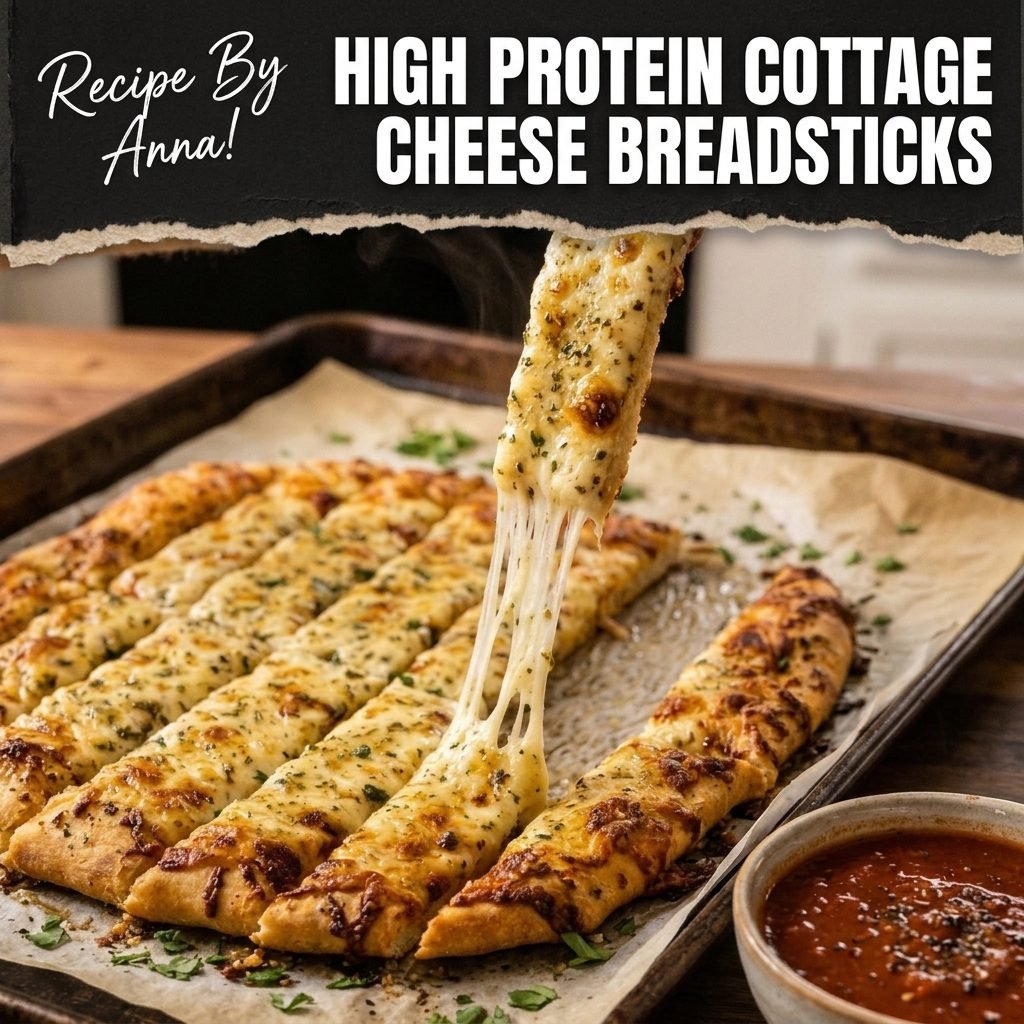
High Protein Cottage Cheese Breadsticks: Healthy Low Carb Snacks
Let’s name the craving honestly: you want a breadstick. The soft middle, the garlic butter, the cheese on top, the marinara situation — the whole pizza-adjacent ritual — but the version that fits the way you’re eating this month, which probably means more protein and far fewer carbs than a strip of white bread is offering. That’s the exact gap these high protein cottage cheese breadsticks were built to fill. The dough is a blender batter of cottage cheese, eggs, and Parmesan; it bakes into a golden slab that slices into twelve sticks and then — this is the part the internet’s versions skip — goes back in the oven cut-side down to sear into something that genuinely crunches at the edges. Garlic butter, mozzarella, marinara, and numbers a snack has no business posting: seven grams of protein and about two of carbs per stick.
I want to be upfront about what this is, because the recipes already online hedge and it helps nobody. This is not bread. There’s no yeast, no wheat, no kneading, no rise, and no pretending — it’s closer kin to a very cheesy flat omelet that studied breadsticks closely and took notes. What the blender batter becomes in the oven is a tender, savory slab that sets like a custard and slices like a breadstick; what the second bake adds is the crisped, butter-seared edge that makes your brain file it under “breadstick” anyway, at a tenth of the carbs. The honest pitch isn’t “just like the real thing.” It’s “the real thing’s job, done by a better-qualified candidate.”
The method runs about an hour, but only fifteen minutes of it belong to you, and the blender does most of your fifteen. The sequence matters more than usual and it’s worth reading once before starting: blend, spread thin, bake, cool, top, broil, slice, sear. Each step sets up the next one, and two of them — the cool and the sear — are the steps the internet’s versions skip, which is why the internet’s versions are soft and a little sad and get described by their own authors as “they’ll do the trick.” These won’t need the apology. And as with every cottage cheese recipe on this site, the doctrine holds: small curd, real fat, from a tub, no negotiations.
The Dough That Isn’t
Start with what’s missing, because the absences are the recipe. No wheat flour means no gluten, and gluten is what lets bread be bread: the protein network that traps gas from yeast, stretches into bubbles, and sets into a chewy crumb. Take it away and you can’t fake it — so this recipe stops trying and builds a different structure entirely. The batter sets the way a quiche sets: egg proteins unwind with heat and knit into a firm web, and they bring reinforcements. The Parmesan arrives mostly as protein and fat with almost no moisture, so it co-sets with the eggs and tightens the crumb the way a second beam tightens a floor. Cottage cheese brings the same trick in a wetter package, plus its famous résumé. The result of all this co-setting is a slab that’s sturdy enough to slice and lift, tender enough to bite, and chemically incapable of tasting like cardboard, because there is no card in the board.
The one flour that does make the cut is almond, and it has a specific job rather than a structural one. Almond flour carries no gluten and no setting protein to speak of — its work here is absorption. Cottage cheese rides in with whey, and whey that has nowhere to go becomes a wet slab that steams itself soft. A quarter cup of almond flour drinks that liquid up and holds it inside the crumb as moisture rather than letting it pool; it also adds just enough body that the batter spreads like a thick pancake batter instead of pouring like a crepe. The baking powder’s role is smaller but real: a modest lift that keeps the slab from packing dense, the difference between a crumb and a brick. And the whole low-carb case hangs on this same swap math — a classic breadstick runs around twenty grams of carbohydrate with three of protein; one of these runs about two and seven. It’s not a smaller version of the same food. It’s a different food doing the same job better.
Then there’s the step that earns the name, and it deserves its own paragraph because it’s the difference between this recipe and the genre’s: the second bake. A baked slab, however golden, has soft sides all over — it has never touched direct heat except on its bottom. But slice it into sticks and suddenly there are twelve fresh cut faces, and a hot, butter-smeared pan touching those faces does to them what a skillet does to a grilled cheese edge: it browns, it dries, it crisps. The mozzarella on top stays soft and pull-able while the cut sides turn golden and firm, and that two-texture architecture — soft top, crackly base — is exactly what a pizzeria breadstick is. One extra step, eight extra minutes, and an honest-to-goodness crust where the genre settled for “set.” The oven does the work. You just have to let it.
⏱️ 15 MIN HANDS-ON | 🥖 12 STICKS | 💪 7 G PROTEIN, 2 G CARBS EACH
- Prep Time: 15 minutes — ten of them the blender’s
- Bake Time: 22 to 26 minutes for the slab
- Broil and Sear: 3 minutes plus 6 to 8 more
- Cooling: 10 minutes, and they’re working minutes
- Total Time: about 1 hour
- Yield: 12 breadsticks from one 9×13 slab
The Slab Station
The equipment list is short, and every piece has a reason:
- Blender or food processor — the whole batter in forty-five seconds. A bowl and a fork works too, with a rustic texture; see the FAQ.
- 9×13 baking pan and parchment — the slab’s real estate. Size matters here: the batter must spread thin, and 9×13 is the pan that makes it happen.
- Offset spatula or the back of a spoon — for spreading the batter to the corners, evenly and thin.
- Pastry brush — garlic butter deployment.
- Pizza cutter or bench scraper — twelve straight sticks in ten seconds.
- Tongs — for flipping the sticks cut-side down without disturbing the cheese top.
- Oven-safe sheet pan or the same 9×13 — the sear happens right where the slab grew up.
Ingredients (With Labels)
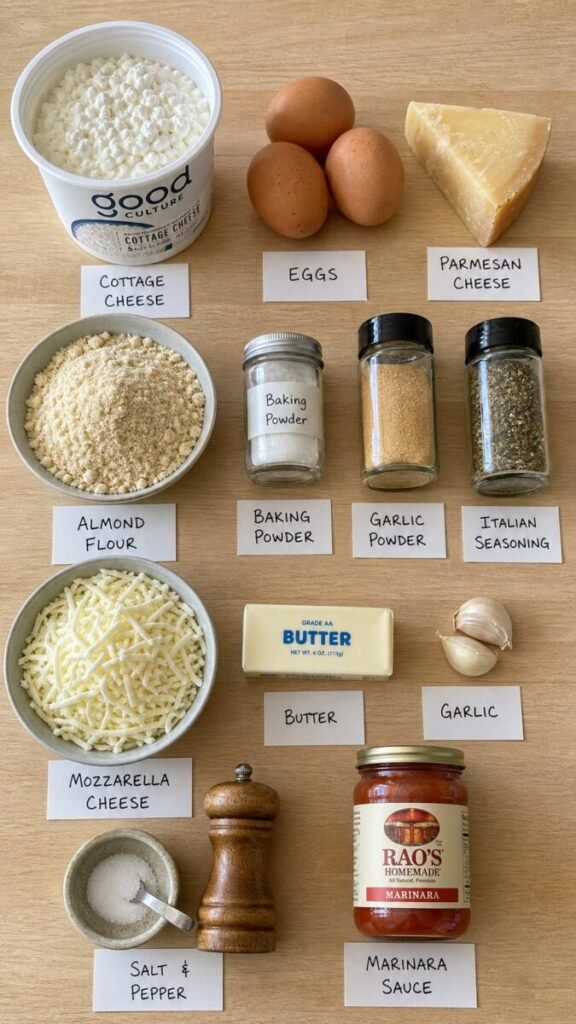
🧀 The Slab
- Cottage cheese: 1 cup (8 oz) small-curd, full-fat or 2%
- Eggs: 2 large
- Parmesan: ½ cup finely grated
- Almond flour: ¼ cup — blanched, spooned and leveled
- Baking powder: 1 teaspoon
- Garlic powder: ½ teaspoon
- Salt and pepper: ¼ teaspoon salt, ⅛ teaspoon pepper
🧄 The Garlic Butter
- Butter: 1½ tablespoons melted — half brushed on hot, half for the sear
- Garlic: 1 small clove, minced fine
🍅 The Top and the Dip
- Mozzarella: ¾ cup shredded
- Italian seasoning: 1 teaspoon
- Marinara: ¾ cup, warmed, for serving
- Fresh parsley and red pepper flakes: to finish
Step by Step How to Make
- Step 1 — Blitz the batter. Into the blender: the cottage cheese, eggs, Parmesan, almond flour, baking powder, garlic powder, salt, and pepper. Blend on high for 45 seconds, scrape down once, and give it another 10. The batter should be smooth, pale, and thick — it should cling to the spatula and slowly drop, closer to muffin batter than to anything pourable. If your tub of cottage cheese was watery to begin with, pour off the liquid on top before measuring; a wet batter bakes into a wet slab, and we did not come here for that.
- Step 2 — Spread thin and bake. Heat the oven to 375°F and line the 9×13 with parchment, leaving handles hanging over two sides — those handles are how you’ll move the slab later. Spread the batter with the offset spatula all the way to the corners, as evenly and as thin as it will go. This is the surface-area game: a thin slab bakes through and dries out at the edges while the middle sets, where a thick slab steams in its own whey and stays damp in the center forever. Bake 22 to 26 minutes, until the whole slab is evenly golden and firm to a gentle press, with no pale, jiggly middle. Pull it when it looks done — underbaked here means wet later, and wet later means everything after this goes sideways.
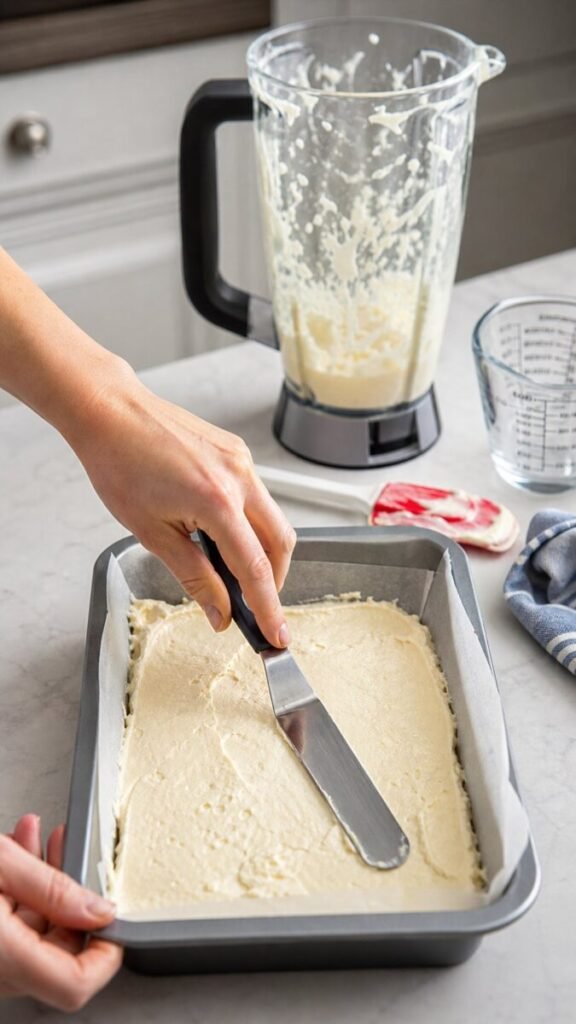
- Step 3 — The cooling set. Lift the slab out by the parchment handles onto a rack and give it a full 10 minutes. This is not a rest; it’s construction. Egg-and-cheese custards finish setting as they come down in temperature, and a slab that slices clean at cool will smear and tear when it’s lava-hot — the difference between twelve breadsticks and twelve apologies. The slab will firm noticeably as it sits, going from soft and flexible to sliceable. Use the ten minutes: mince the garlic, melt the butter, shred the mozzarella if it’s not already, and get the marinara started on the stove over the lowest heat.
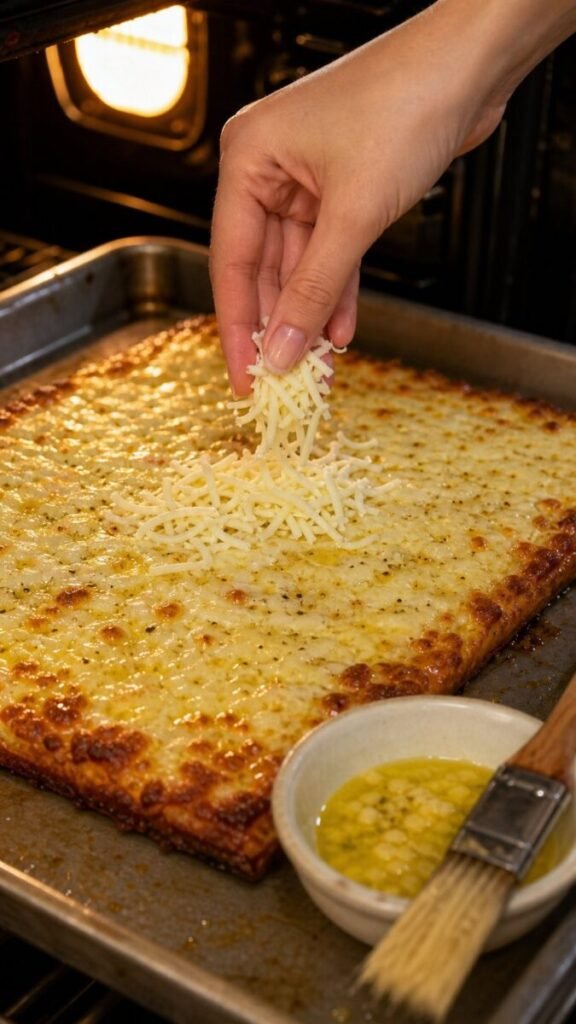
- Step 4 — Garlic butter, mozzarella, broil. Slide your oven rack to the upper third and crank the broiler. Stir the minced garlic into the melted butter and brush half of it across the top of the slab, edge to edge — the garlic butter is non-negotiable; it’s the flavor bridge that makes a cheese slab read as a breadstick. Scatter the mozzarella over the top and dust with the Italian seasoning. Under the broiler it goes, 2 to 3 minutes, door cracked, watching it the entire time — broilers go from bubbling to black in the time it takes to answer a text. You want deep golden bubbles across the cheese, not a tan. Pull it when it looks like the top of a very good pizza.
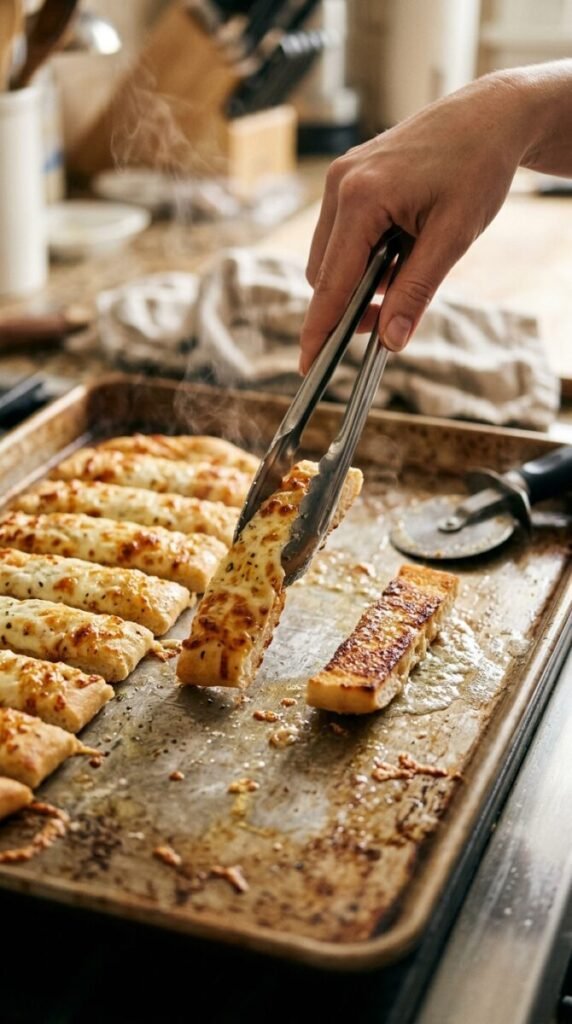
- Step 5 — Slice and sear. Turn the oven back to 400°F. Cut the slab lengthwise down the middle, then across into six columns — twelve sticks, or go skinnier for sixteen if the crowd is dainty. Now the move that makes the recipe: smear the remaining garlic butter across the hot pan or a sheet pan, lay the sticks cut-side down in it with a little space between, and slide them back into the oven for 6 to 8 minutes. The cut faces brown and firm in the hot butter while the mozzarella tops stay soft, and somewhere in those minutes the slab officially becomes breadsticks. You’ll hear the faint crackle when the tongs lift one. That’s the sound you were promised.
- Step 6 — The dip and the pull. Out of the oven, onto a plate with the warm marinara in the middle, parsley and red pepper flakes over the top. Serve them while the edges still crackle and the mozzarella still pulls — the first stick off the pan belongs to the cook, per the standing house rule, and this is one recipe where the quality-control bite is genuinely load-bearing. Around here, a double batch disappears by the second quarter of whatever game is on, and nobody asks what’s in them until they’re gone. Then they ask, and the tub of cottage cheese gets to have its moment.
Same mission, different dairy — where these breadsticks chase the high-protein snack title, the Greek yogurt cookie dough holds the sweet half of the belt. One grocery philosophy, two snacks, zero regret.
Anna’s Kitchen Notes
Audit the tub before you blend. Cottage cheese quality swings wildly between brands, and the failure mode is water: a tub sitting on a pool of whey will make a batter that bakes into a slab that never fully dries. Pour off the surface liquid, and if the curds themselves seem wet, let them drain in a fine strainer for five minutes while you assemble everything else. Small curd, full-fat or 2%, every time — fat-free replaces fat with water, and this recipe has enough water management to do already.
Thin wins. Say it twice. The single most common reason this style of recipe disappoints is a thick slab. Batter depth is the whole game: thin means maximum evaporation and even baking; thick means a steamed middle and edges that dry out waiting for it. In a 9×13, this batter should spread to roughly a quarter inch. If your pan is smaller, the slab is thicker, and both the bake time and the wet-middle risk go up. Don’t improvise a smaller pan. The 9×13 is the recipe.
The cool is a set, not a suggestion. Ten minutes on a rack is when the custard finishes itself — the proteins finish linking, the slab firms from flexible to sliceable, and the structure that holds a stick together locks in. Slice early and you tear the slab, smear the interior, and end up with ragged sticks that crumble at the sear. I have never once regretted waiting ten minutes, and I have regretted skipping it in front of guests, which is worse.
The sear is the whole trick. Everything before step five makes a very good cheesy slab, and the genre stops there — which is why the genre’s breadsticks are soft all over and get described by their own authors with a shrug. Eight minutes cut-side down in garlic butter is what puts a crackle on the edges and a name on the recipe. Skip it and you’ve made a flat cheese omelet, which is fine, but call it that. Do it and you’ve made breadsticks.
The foil tent rule. If the slab is browning deeply before minute 18, tent it loosely with foil — but only then. Foil traps steam, steam is the enemy of everything this recipe is building, and the tent is an emergency measure, not a default. An oven that runs hot will show you this; an oven that runs true never will. Know thy oven, and when in doubt, rotate the pan once at the halfway mark and keep the foil in the drawer.
The Dipping Pool
Marinara is the classic and the default — warm, garlicky, slightly acidic against all that cheese — but the sticks are happy to diversify. The jalapeño cream cheese dip is the spicy-cool counterpart that makes these stick feel like game-day food instead of health food, and it takes about five minutes to stir together while the slab bakes.
And when the snack table grows: the puff pastry twists are these sticks’ full-butter opposite number — all flake and splurge, standing next to the high-protein version like a sibling on a different meal plan. The soft gluten-free pretzel bites bring the chewy side of the family, the keto Rotel sausage balls round out the low-carb tray, and the olive oil focaccia is the full-carbon original these sticks politely reimagine — invite it when nobody’s counting. One oven, one tray, one very short halftime.
Same Dough, Other Shapes
The everything upgrade. Stir a teaspoon of everything-bagel seasoning into the batter and press more into the mozzarella top before the broil. Serve with whipped cream cheese instead of marinara and watch people eat their vegetables’ favorite seasoning in breadstick form.
Pizza sticks. The same slab with a ladle of warm marinara stirred into the batter before baking, plus a pinch of dried oregano — the flavor moves fully pizzeria, and the dip on the side becomes the sauce on repeat. Kids treat this version like a main course, and I let them.
The ranch route. A tablespoon of ranch seasoning in the batter, a dusting on the mozzarella, and a side of marinara mixed with a spoon of ranch. It tastes exactly like the pizza-parlor ranch ritual it’s imitating, which is to say it disappears, and nobody needs to know the numbers.
Jalapeño popper sticks. Half a jalapeño, minced and folded into the batter, with a small handful of crisped crumbled bacon over the mozzarella before the broil. Cream cheese isn’t needed — the cottage cheese is already doing that job with better numbers — and the popper flavor lands anyway.
The bite-size build. The same batter divided into a mini muffin tin — about a tablespoon each, topped with a pinch of mozzarella — bakes at 375°F for 15 to 18 minutes into popable little bites with seared edges all around. Potluck gold, lunchbox gold, and the first tray gone every single time I make them.
Cheddar and chive. Sharp cheddar for the mozzarella, snipped chives in the batter, a pinch of mustard powder. This is the version that tastes like a grown-up goldfish cracker, and I mean that as the highest possible compliment.
The Cheese Math
| Nutrient | Per Stick (1 of 12) |
|---|---|
| Calories | 90 kcal |
| Protein | 7 g |
| Carbohydrates | 2 g |
| Fats | 6 g |
Estimates as written, butter and mozzarella included. The comparison is the point: a classic pizzeria breadstick runs about twenty grams of carbohydrate and three of protein, so a two-stick serving here flips the script — fourteen grams of protein against four of carbs, roughly the protein of two string cheeses with the carbohydrate of two celery sticks. Nearly a third of the calories in each stick come from protein, which is a ratio most “protein snacks” in the vending machine would rather you didn’t check. The fats come from cheese, eggs, almonds, and butter — the tasty column of the ledger — and the marinara barely moves any of the numbers. Two sticks with dip is a real snack that holds you for hours. Four is a meal, and I say that from research.
The Crisp Keeper
These sticks are at their peak hot from the sear, but they hold their texture far better than bread ever did, because there’s no starch to go stale — the enemy is moisture, not time. Cooked sticks keep four days in the fridge, and the revival is the air fryer at 350°F for 3 to 4 minutes or a hot dry skillet for a minute a side, which brings the crackle back so faithfully it’s almost suspicious. The microwave heats them fine and softens them completely, which some people prefer and which I have stopped fighting.
The freezer takes the whole program: freeze sliced, unseared sticks solid on the pan, then bag them for two months. From frozen, straight onto a buttered sheet in a 400°F oven for 10 to 12 minutes — they thaw and sear in one move — or into the air fryer at 360°F for 6 to 8 minutes. A stocked freezer of these is the after-school and game-day insurance policy, and a double batch costs you eight extra minutes of spreading.
The baked, uncut slab is the make-ahead hero nobody mentions: bake it the night before, refrigerate the whole thing, then broil, slice, and sear straight from cold the next day, adding two minutes at each stage. Cold custard slices even cleaner than warm, the broiler and sear re-thermalize everything, and dinner-party-you walks into the kitchen at zero hour to find the hard part already done. Leftover sticks have one more career in them: split, toasted, and used as the world’s most durable garlic bread base for a sandwich. I regret nothing.
Where It Goes Wrong
A wet, floppy middle. The genre’s signature failure, and it comes from stacking small mistakes: a watery tub of cottage cheese, a batter spread thick, a slab pulled early, or a foil tent from the start. Each one traps moisture, and together they steam the slab from the inside. Audit the tub, spread to a quarter inch in a real 9×13, bake until the middle is golden and firm with no jiggle, and keep the foil for emergencies. A slab that’s fully baked will still be tender — wet and tender are different things, and you can tell them apart with a fork.
A weeping, oily top. The mozzarella went onto a hot slab and straight under the broiler, or the broiler ran long. Cheese releases fat when it overheats, and a slab that hasn’t cooled won’t hold it. That’s part of why the ten-minute cooling set exists: it firms the base and tempers the slab so the cheese melts into a blanket instead of splitting into a sweater. If it happens anyway, blot gently with a paper towel and call it rustic — the flavor survived.
Sticks that never crisp. The sear got skipped, rushed, or done cold. The cut faces need a genuinely hot surface and a little fat — the garlic butter is doing structural work, not just flavor — and six to eight minutes at 400°F is the real number. A cold pan, a crowded pan, or a three-minute errand run all leave the edges soft. If the first stick doesn’t crackle, give the rest two more minutes and pay attention; the crackle is the recipe’s finish line, and it announces itself.
An eggy taste and smell. Overbaked eggs pass from set to sulfur, and in a recipe this cheese-forward, the egg flavor rides forward when it happens. The fix is the pull-time: golden slab, set middle, broiler watched like a hawk, no heroic extra minutes “just to be sure.” The garlic, Italian seasoning, and Parmesan do their part too — a batter that’s seasoned correctly reads as savory, not eggy, and a slice of this done right tastes like cheese and garlic first, everything else later.
Crumbly sticks that fall apart. Almost always a slab sliced hot — the set hadn’t finished, so the sticks never had structure to keep. Second suspect: a packed cup of almond flour, which throws the ratio dry. Wait the full ten minutes, spoon and level the almond flour, and if the crumb is still fragile, one extra egg white in the next batch tightens it without much cost. The sear also mends a fragile stick better than you’d expect — butter and heat are forgiving that way.
Stuck to the parchment. Cheap parchment or a batter spread past the paper’s edge. Use decent parchment with the overhang handles, keep the batter inside its borders, and after the bake give the slab its ten minutes — cooling releases the bond the way it does with cookies. The sear-side butter goes on the pan, not the paper, and from there the sticks lift with tongs and zero drama.
Breadstick Questions
Can I make these without almond flour?
Yes, with adjustments. Coconut flour absorbs even more than almond, so use just 1½ to 2 tablespoons or the batter turns dense and dry. Fine oat flour works at the same quarter cup if low-carb isn’t the mission — the sticks get a bit bready, which some people prefer. Or skip flour entirely and accept a softer, more delicate stick with a slightly shorter bake. The almond version is the calibrated one; the others are close family.
Do I really need a blender?
No — a fork and a bowl get you there with more texture. Mash the cottage cheese against the side of the bowl until the curds break down and it looks roughly whipped, whisk the eggs in thoroughly, then stir in everything else. Small curd helps a lot here. The baked slab is slightly more rustic, with faint curd texture in the crumb, and it still slices, sears, and dips like the blended version. The blender is convenience, not magic.
Are these gluten-free?
Yes, as written — almond flour, cheese, and eggs, nothing from wheat. Two labels to check: the baking powder (most are gluten-free, a few carry starches worth verifying) and the almond flour for cross-contamination if the table is strictly celiac rather than gluten-avoidant. Everything else in the recipe is naturally clear. Same answer for the marinara — check the jar’s label for thickeners.
Can I make the slab ahead of time?
Yes, and it’s the smart hosting move: bake the slab the day before, cool it fully, refrigerate it whole, then broil, slice, and sear straight from cold the next day, adding a couple of minutes at each stage. The cold slab slices cleaner than a warm one, and the broiler and sear bring everything back to temperature in under fifteen minutes. The full pipeline — seared sticks — also reheats well, but the half-done version is the true make-ahead trick.
Why is the batter so thin compared to bread dough?
Because it isn’t bread dough — it’s a custard batter that sets in the oven instead of a dough that rises. The whole texture strategy changes: gluten dough needs kneading and time, while this needs a blender and heat. If the batter seems thick for a batter and thin for a dough, that’s exactly right — it should spread with a spatula, resist slightly, and hold a ridge for a second before settling. Pourable like a crepe means too wet; holdable like cookie dough means too dry.
How do I get more protein per stick?
The honest levers: use 2% cottage cheese instead of full-fat (same protein, less fat), bump the Parmesan to two-thirds cup, or fold the mozzarella into the batter instead of just topping with it — each adds a gram or two per stick at some texture cost. The dishy move is serving them with a garlicky Greek yogurt ranch, which adds protein where nobody’s counting. Beyond that, you’re eating two sticks, which is the answer I actually give people.
What dips work besides marinara?
The rule is acid or heat against all that cheese, so: warm marinara is the classic, the jalapeño cream cheese dip linked in the pairings is the house favorite, ranch is the pizzeria ritual, and a jarred bruschetta topping spooned over the sticks turns them into an unplanned appetizer course. Garlic butter on its own, in a small warm bowl, is the version my family fights over. Even good vinegar with herbs works — the sticks are rich enough to meet anything sharp halfway.
No yeast · Blended cheese batter · Garlic-butter finish
High Protein Cottage Cheese Breadsticks: Healthy Low Carb Snacks
Cottage cheese, eggs, Parmesan, and almond flour baked into a tender slab, topped with garlic butter and mozzarella, then sliced and baked again to firm the bottoms and edges. Serve warm with marinara for dipping.
As an Amazon Associate I earn from qualifying purchases.
Ingredients
The cottage cheese slab
- 1 cup (about 8 oz) small-curd cottage cheese, full-fat or 2%, with visible excess whey drained
- 2 large eggs
- ½ cup finely grated Parmesan
- ¼ cup blanched almond flour, spooned and leveled
- 1 teaspoon baking powder
- ½ teaspoon garlic powder
- ¼ teaspoon salt, or less if your cheeses are very salty
- ⅛ teaspoon black pepper
The garlic butter
The cheese topping & dip
- ¾ cup shredded low-moisture mozzarella
- 1 teaspoon Italian seasoning
- ¾ cup marinara sauce, warmed, for dipping
- Chopped fresh parsley, for finishing
- Red pepper flakes, to taste
The slab station
- Blender or food processor
- 9 × 13-inch metal baking pan
- Parchment paper, for the first bake only
- Offset spatula
- Pastry brush
- Pizza cutter and cutting board
- Broiler-safe metal sheet pan, for topping and the second bake
- Wide, thin spatula, for supporting the delicate slab
- Wire cooling rack
- Instant-read food thermometer
Set expectations: these are cheese-and-egg sticks, not yeast bread. Expect a tender, slightly custardy center with browned edges—not a chewy bread crumb or a guaranteed shattering crust.
Keep the thin sticks flat: a thin slab will not reliably balance on its narrow cut edges. The second bake below keeps the cheese facing up and browns the broad undersides against a buttered metal pan.
Broiler safety: remove all parchment before broiling. Use a pan specifically approved for broiler use, never glass, and follow your oven’s instructions for rack position and whether the door stays open or closed.
How to make them
-
Preheat and blend the batter
Heat the oven to 375°F. Line a 9 × 13-inch metal pan with parchment, leaving a modest overhang for lifting. Drain visible pooled whey from the cottage cheese before measuring. Blend it with the eggs, Parmesan, almond flour, baking powder, garlic powder, salt, and pepper for about 45 seconds. Scrape down and blend briefly again until smooth. The mixture should be a spreadable batter, not a kneadable dough. Do not taste the raw batter.
-
Spread evenly and bake until set
Spread the batter evenly across the lined pan, keeping it thin and avoiding thicker patches in the center. Bake for approximately 22–26 minutes, until lightly golden, set throughout, and no longer wet in the middle. Confirm the center reaches 160°F, inserting a thin thermometer probe at an angle without touching the pan. Allow extra time if needed, but avoid baking until dry and rubbery.
-
Cool and prepare the garlic butter
Carefully lift the slab using the parchment, supporting it underneath if necessary, and place on a rack for 10 minutes. Let it firm enough to handle before peeling away the paper. Stir the minced garlic into half the melted butter; reserve the remaining plain butter for the second bake. Warm the marinara separately over low heat.
-
Add garlic butter and mozzarella
Remove the parchment completely and transfer the cooled slab to an unlined, broiler-safe metal sheet pan. Brush the top with the garlic butter and scatter with mozzarella and Italian seasoning. Broil briefly, approximately 1–3 minutes, watching continuously, until the cheese melts and develops a few golden spots. Keep the pan at your oven manufacturer’s recommended distance from the element. If not broiling, melt the topping in the 375°F oven instead.
-
Slice and bake again to brown the bottoms
Set the oven to 400°F. Carefully slide the slab onto a cutting board. Cut it in half lengthwise, then crosswise into six sections to make twelve sticks. Brush the warm metal sheet pan with the reserved plain butter, taking care around the hot rim. Return the sticks to the pan with their broad undersides down and cheese facing up, leaving gaps between them. Bake for 6–8 minutes, checking underneath with a spatula, until the bottoms are lightly browned and the edges firmer. Remove before the cheese or butter scorches.
-
Finish and dip
Let the sticks settle briefly, then transfer to a platter. Sprinkle with parsley and red pepper flakes to taste. Serve warm with marinara alongside, while the mozzarella is soft and the browned bottoms are at their best.
Dietary and nutrition note: these contain dairy, eggs, and almonds. For vegetarian guests, choose cheeses made with vegetarian enzymes. For gluten-free needs, check all ingredient labels and cross-contact information. Protein and carbohydrate amounts depend on the brands, portion size, and dip; the quoted per-stick figures have not been verified here.