Easy Spinach & Feta Crisps Recipe | Quick Snack
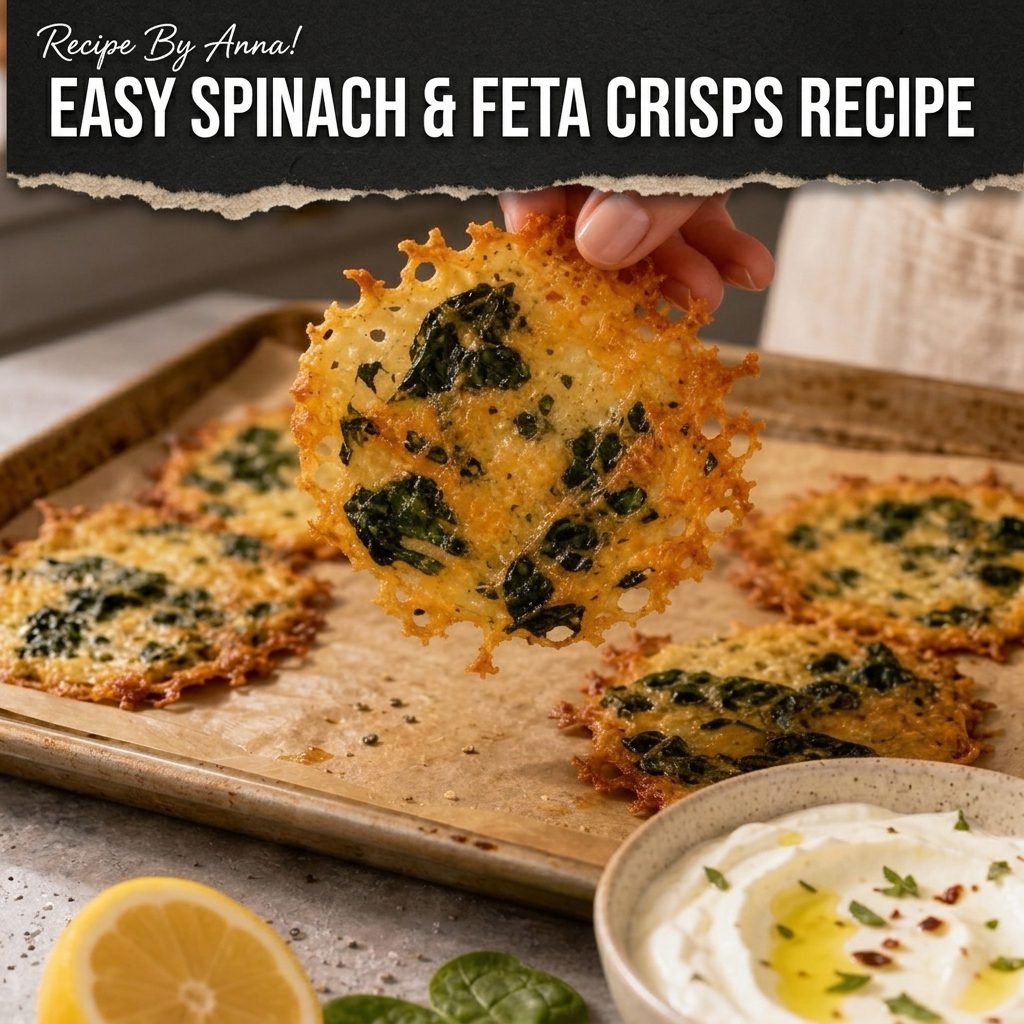
These crisps are what happens when a cheese crisp and a plate of spanakopita have a very small, very crunchy baby. Each one is a thin round of parmesan that bakes into lace around a scatter of seriously squeezed spinach and crumbles of feta — glassy and shattery at the edges, chewy-crisp in the middle, with the feta staying soft and creamy in its little pockets because feta doesn’t crisp, it just warms up and gets more opinionated. They’re green-flecked and gold-laced, they take about ten minutes of actual work, and they are the snack my family refers to simply as “the good ones,” usually while taking the last one.
Most recipes for spinach-feta crisps online are lying to you slightly, and I say that with love. The popular versions bind everything with almond flour and bake up as soft, savory little patties — nice, snackable, and about as crisp as a pancake. A true crisp has no flour in it at all. It’s built on the frico principle — the Italian trick of melting finely grated parmesan into a thin wafer — and the physics of that is worth thirty seconds, because it explains every rule in this recipe. Parmesan is a hard, aged, low-moisture cheese: when it melts, its proteins and fat form a continuous sheet, and when it cools, that sheet sets rigid and glassy, like a tuile or a brittle. That’s the lattice. The spinach and the feta are guests in the house parmesan builds, and the house only comes out crisp if the guests arrive dry, get spread thin, and are given their five minutes of cooling respect after the oven. Skip any of that and you’ve made something else — again, a fine something, but call it a patty and be honest about it.
The spinach deserves its own paragraph, because it’s the one place this recipe is strict. Spinach is ninety-one percent water, and a crisp is, by definition, a thing that has had its water removed. Every drop that stays in the spinach turns to steam inside your lattice and tunnels through it on the way out, leaving you a lace curtain with holes where the glass should be. So the spinach gets wilted, then squeezed in a towel like it owes you money, until what started as five ounces of leaves is a dark green brick the size of a plum. It sounds excessive. It is the recipe. The good news is that the same squeeze concentrates the spinach’s flavor down to something almost sweet and deeply green, so the strictness pays you back with interest — the crisp is more spinach-flavored than the raw leaves ever were.
The Crisp Case
The case for building this on parmesan is a texture case, and it comes down to how cheeses behave when they melt and cool. Mozzarella melts into long, stretchy strands — great on pizza, wrong here, because it cools into soft chew and the round never sets glassy. Aged cheeses like parmesan (and its cousins pecorino and aged gouda) have had most of their moisture removed during months of aging; what’s left is a dense knot of protein and fat and crystallized crunch, and when a thin layer of it melts and re-sets, it does so as a rigid sheet. That’s why the parmesan is the biggest ingredient in the bowl — it’s not a flavoring, it’s the architecture. The feta plays the opposite role: a brined, crumbly cheese that holds its shape in the oven’s heat and comes out warm and creamy, never crisp. Put the two together with the spinach and every bite has three textures at once — glass, cream, and the faint chew of greens — which is more texture than most snacks manage in the whole bag.
The egg white is the quiet trick. One white, no yolk: the white is almost pure protein and water, and it bakes into a crisp, invisible glue that binds the spinach and feta into the lattice; the yolk is fat and lecithin, which enrich and soften — wonderful in a cookie, treason in a crisp. Yolk in this mixture gives you tenderness, and tenderness is the enemy. One white, whisked lightly and mixed through, and the rounds hold together without a speck of flour — which is why these are gluten-free without trying and naturally low-carb without a single substitution. I don’t build recipes around diet labels, but when the delicious version and the virtuous version are the same recipe, I consider it my duty to report it.
Then the flavor crew, which is where the crisps stop being a frico and start being a snack with a passport: scallions for the onion note that rawness usually provides, fresh dill because dill and feta are a legendary partnership, lemon zest because green things need acid’s perfume the way cheese needs salt, and black pepper plus a pinch of cayenne for the warm note underneath. The salt question answers itself — parmesan and feta are two of the saltiest things in the fridge, so the bowl needs no more. If you taste the raw mixture (and you should — it’s fully edible, egg white and all, and this is the good-cook move) it should taste slightly too salty on its own, because the salt reads quieter once baked and cooled.
⏱️ 25 MIN, ONE BOWL | 🧀 16 LACY CRISPS | 🥬 SPINACH, SQUEEZED SERIOUSLY
- Prep Time: 15 minutes — half of it the squeeze
- Bake Time: 10 to 12 minutes, one pan
- Cool Time: 5 minutes on the pan, and this is where crisps are born
- Total Time: about 25 minutes, start to first crunch
- Yield: 16 crisps — snack for 6, or four people with no self-control
The Parchment Verdict
The kit is a short list with one emphatic entry:
- Parchment paper — non-negotiable. Melted parmesan welds itself to a bare pan with a grip that no spatula and no amount of soaking will apologize for. Parchment is the difference between lifting crisps off the pan and excavating them. A silicone mat also works beautifully; foil does not, whatever the box implies.
- Large sheet pan — sixteen rounds want room; two pans beat one crowded one, and crowding steams
- Big bowl and a fork — the whole mix comes together in one bowl with no machine
- Clean kitchen towel — the spinach’s squeeze station; paper towels work but a proper towel wrings harder
- Spoon for dolloping, and an offset spatula or the spoon’s back — for flattening the rounds thin
- Thin spatula or fish slice — for lifting the finished lace without cracking it more than you want to
- Wire rack, optional — the crisps cool nicely right on the pan; the rack is for the batch you’re keeping crisp while the second bakes
And the verdict on the oven itself: 375°F, with the rack in the middle. Hotter, and the lace browns before the centers dry — the edges go from gold to bitter in the time it takes to answer a text. Cooler, and the rounds dry slowly into pale toughness, which is a texture nobody ordered. 375 is where the cheese melts fast, bubbles at the edges, and toasts evenly, and it’s the temperature the whole recipe is timed around. If your oven runs hot or cold in a way you already know about, this is the recipe to trust your oven thermometer for.
Ingredients (With Labels)
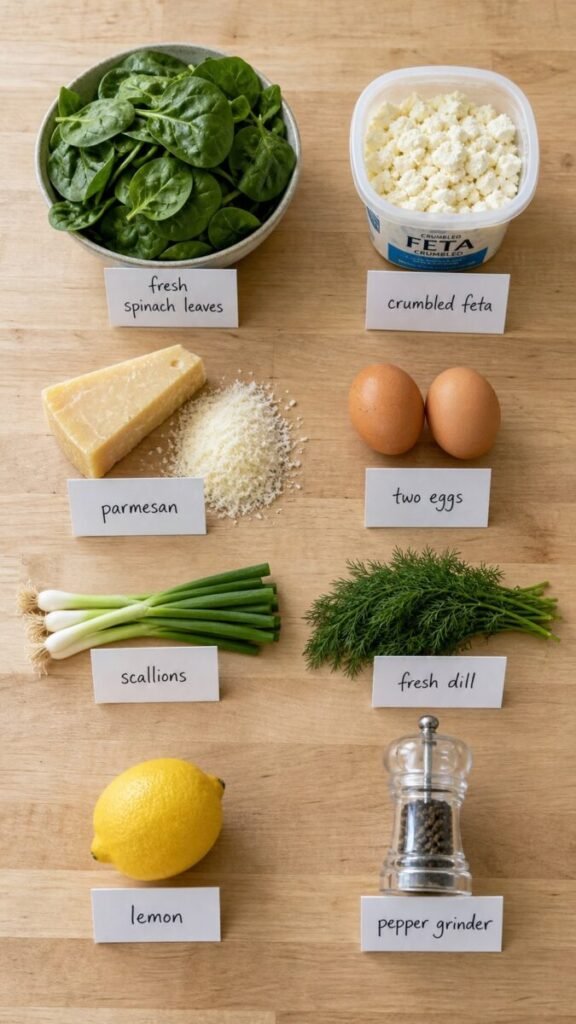
🥬 The Greens
- Fresh spinach: 5 oz — one of the big clamshell boxes, or a generous bag
🧀 The Cheeses
- Parmesan: 1½ cups, finely grated off the block
- Feta: 1 cup, crumbled
🌿 The Flavor Crew
- Egg white: 1, from a large egg, lightly beaten
- Scallions: 2, thinly sliced
- Fresh dill: 1 tablespoon, chopped
- Lemon: 1 — the zest goes in, the wedges go alongside
- Black pepper: ¼ teaspoon, plus a pinch of cayenne
Step by Step How to Make
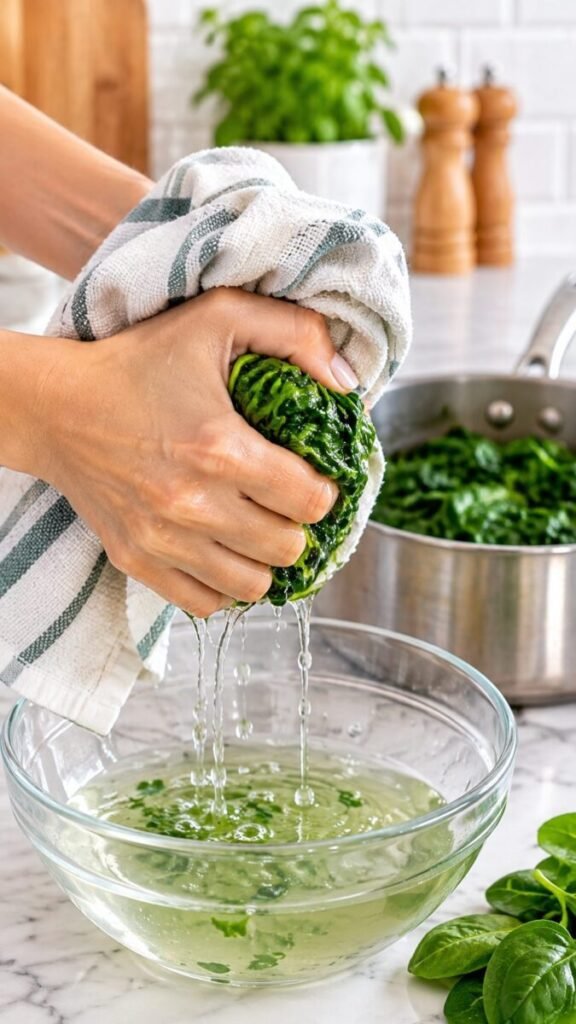
- Step 1 — Wilt and squeeze. Put the spinach in a wide pan with just the water clinging to its washed leaves, set it over medium heat, and toss for a minute or two until it collapses into a dark, glistening heap — no added water needed; the leaves steam in their own. Turn it out onto a plate to cool for two minutes, then pile it into the center of the towel. Now the honest part: gather the towel’s corners into a bundle and wring, hard, over the sink or a bowl, then wring again. You should see an alarming amount of green water leave. Open the towel and you’re holding a dense brick of spinach about the size of a plum — five ounces of leaves reduced to roughly half a cup of solid green. Chop it roughly on the board so it distributes in flecks rather than mats. If you take one thing from this recipe, take the squeeze: it is the whole difference between lace and sadness.
- Step 2 — The mix. In the big bowl, crumble in the feta, add the grated parmesan, the chopped spinach, the scallions, dill, lemon zest, pepper, and cayenne, and toss with the fork until the green is evenly scattered through the cheese. Pour the lightly beaten egg white over everything and mix with your hands, squeezing and crumbling until the mixture holds together when pressed. The pinch test: squeeze a spoonful in your fist — it should pack like damp sand, holding its shape with no visible wetness and no weeping liquid. Too dry to pack? The white of a second egg, a teaspoon at a time. Wet? You know which step to blame, and the fix is another wring through a fresh towel. Taste a pinch of the raw mix — it should be assertively salty, bright with lemon, and green in a way that reads as vegetable rather than garnish.
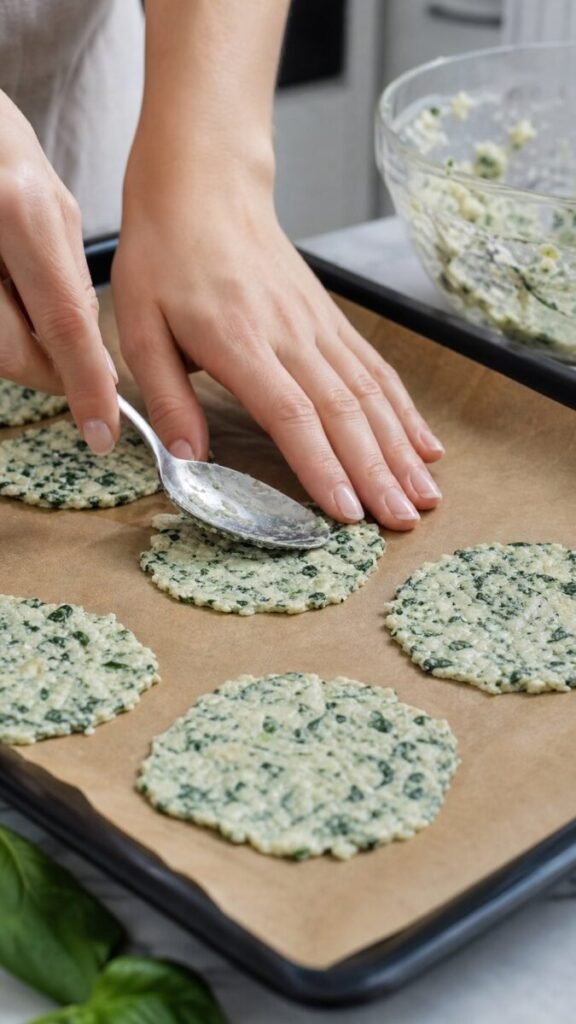
- Step 3 — Shape thin. Heat the oven to 375°F and line the sheet pan with parchment. Dollop the mixture by the heaping tablespoon onto the parchment — sixteen dollops, with an inch of space between them, and two pans if that means crowding — then flatten each one with the back of the spoon into a round roughly three inches across and thin enough that you can almost see the parchment through the center. This thinness is the make-or-break measurement of the recipe: a ¼-inch round bakes into a soft, bready puck, and a thin one bakes into lace. Err on the side of thinner than looks sensible. The edges can be ragged — ragged edges are where the best lacy bites live — but the center should be an even, sparse layer where the cheese will melt and knit on its own.
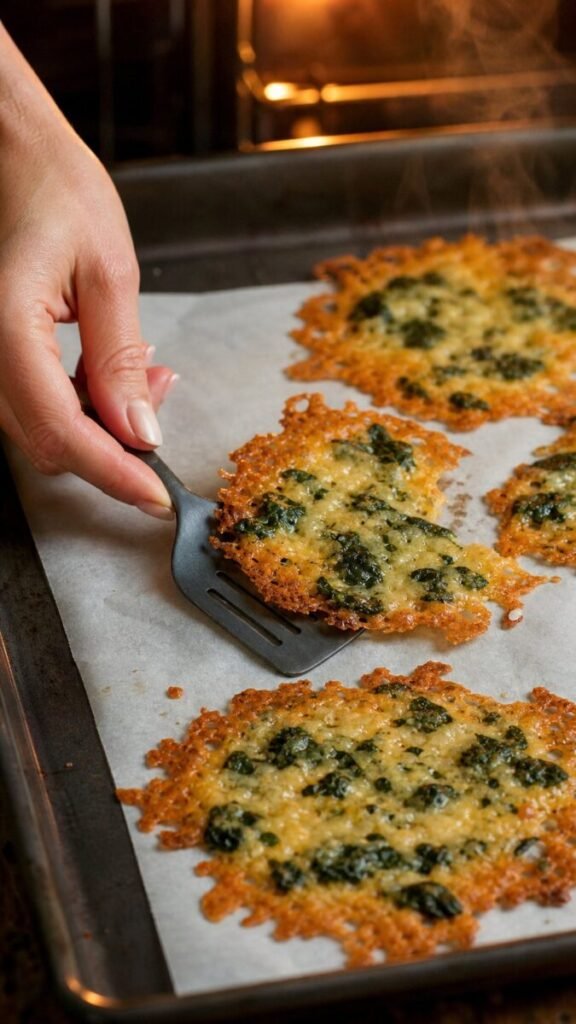
- Step 4 — The bake. Bake 10 to 12 minutes, rotating the pan front to back at the 7-minute mark. What you’re watching for is a two-stage transformation: first the cheese melts and each round slumps flat and starts bubbling at the rim like a tiny crepe; then the bubbling slows and the edges go from pale gold to deep lacy gold-brown. Pull the pan when the edges are properly golden and the centers still look slightly moist and bubbly — they finish on the pan. There’s a narrow window between “lacy gold” and “scorched and bitter,” and it’s about two minutes wide, so for the last three minutes of the bake, stay in the kitchen and pay attention to the pan rather than your phone. The crisps do not reward multitaskers.
- Step 5 — The cool, where crisps are born. Take the pan out and leave the crisps exactly where they are, on the parchment, for a full five minutes. This is the step people skip and then wonder why their crisps are floppy: melted parmesan is pliable, like a just-made tuile, and it sets into its glassy snap only as it cools. Pull a crisp off the pan at minute one and you get something droopy and cheese-leathery; leave it the five and you get the snap. They’ll lift cleanly off the parchment with the thin spatula, leaving a satisfying ghost of lace behind on the paper — the residue of the bubbles that didn’t make it. Move them to a wire rack if you’re baking a second batch, so the bottom stays crisp on all sides.
- Step 6 — The serve. Pile them on a plate in a slightly chaotic stack — they’re handmade lace, they don’t do geometry — with lemon wedges alongside and a small bowl of something cool and creamy for contrast: plain thick yogurt with a scrape of garlic and lemon, or good hummus. A few flakes of salt over the top if you want the full effect, and serve them warm-ish or at room temperature. They are at their absolute best within the hour, excellent for the rest of the day, and by tomorrow they want the revival treatment in the storage section below. The honest serving intel: make more than you think you need, because the cook’s tax on this recipe runs high — warm, lacy, salty things coming off a parchment sheet have a way of being quality-controlled down to nothing before anyone else is called.
The same two ingredients in folded, melty form — the spinach and feta quesadillas are this crisp’s soft-spoken sibling, and both disappear at the same speed.
Anna’s Kitchen Notes
Grate the parmesan yourself, on the small holes. The pre-grated tubs are dusted with cellulose to keep the shreds from clumping, and that anti-caking powder is exactly the opposite of what a frico needs — it interferes with the protein-and-fat sheet that makes the lace. Parmesan grated off the block, on the fine side of a box grater or a microplane, melts into a continuous sheet and sets glassy. This is the single highest-leverage shopping decision in the recipe: block cheese, thirty seconds of grating, visibly better lace. The wedge keeps for weeks in the fridge, and you’ll find reasons to use it.
Feta in brine, crumbled by hand. The blocks packed in brine are moister, tangier, and crumble into the irregular nuggets that make good pockets. Pre-crumbled feta comes dry and floury, and its anti-caking dust does the lattice no favors either. If your feta comes in a solid block, a coarse crumble with your fingers over the bowl is faster and better than a knife. And keep the crumbles smallish — pea-sized or smaller — so a pocket of feta never spans the whole width of a thin crisp and melts a hole through the middle.
The cayenne is one pinch, not a decision. It’s there as warmth at the bottom of the flavor, the way black pepper behaves — nobody should taste “spicy” in these crisps, they should just notice the snack has a floor under it. If your table includes real heat-lovers, push it to a generous pinch and the lemon and dill will keep it in proportion. Cayenne also reads hotter after cooling, so the batch you taste at minute five is the batch you get.
Make-ahead, in the honest order of operations. The mixture holds beautifully — mix it, refrigerate it up to 24 hours, and bake on demand, which is the genuinely great party trick here: your guests get warm, fresh-laced crisps and you get to have made them yesterday. The mixture firms in the cold and wants five minutes on the counter before dolloping. The baked crisps themselves are a same-day creature and only mostly revive — the revival is in the storage section, and it works, but nothing beats them warm from their own five-minute rest.
The cook’s tax is real; budget for it. A recipe that yields sixteen and serves six will serve four the first time you make it, because the cook eats somewhere between two and four standing at the counter, as is right and ancient. When I’m making these for company I bake eighteen and announce sixteen. This is not deception; it is arithmetic with an appetite, and every good cook I know runs the same ledger.
The Snack Drawer
A plate of warm crisps wants cool, fresh company. The caprese bites are the tomato-basil counterweight — soft where the crisps are glassy, sweet where they’re salty. And the everything bagel cucumber bites bring the cold crunch on the other side, so the plate has texture going in both directions at once.
To round out a party spread: the cheesy thumbprint appetizers are the other cheese-forward bite for a double-act platter, and the chickpea beet feta salad shares the feta gene and adds something substantial for the guests who arrived hungry. For a bigger table, the quinoa lentil spinach bake is this flavor family scaled all the way up to dinner — greens, cheese, and the same green-gold palette in casserole form.
Same Crisp, Other Cheeses
Pecorino Romano for the sharper lattice. Same technique, same amounts, and the crisp comes out saltier, sheepier, and a shade more brittle — the feta pockets get a run for their money. This is my favorite swap, and the one I make when the parmesan wedge has run out but the pecorino hasn’t.
Aged gouda, the caramel edge. A cup of grated aged gouda replacing a third of the parmesan gives the lace a butterscotch note that plays unexpectedly well with the lemon zest. The lattice sets slightly less glassy and slightly more snappy-chewy, in the way gouda does. Watch the oven closely — gouda browns faster than parmesan and its window between gold and dark is narrower.
The almond-flour build, honestly rated. Two-thirds cup of almond flour, the egg instead of just the white, everything else the same: this is the internet’s version, and it bakes into soft, savory, moderately crisp-edged patties — more like a tiny baked fritter than a frico. It’s a genuinely good snack, it’s more filling, and it travels and stores better than true crisps. It is not what this recipe is. Make it when you want a lunchbox item; make the lace when you want the snack.
Za’atar and mint, the eastern swing. A teaspoon of za’atar in the mix and mint standing in for the dill — the crisp goes lemony-herbal in a new direction, and suddenly it wants to sit next to grilled chicken instead of a yogurt dip. The sumac in the za’atar doubles down on the lemon zest beautifully.
Kale or chard, the sturdier green. The squeeze doctrine applies to any wilted green, and lacinato kale — stripped, wilted, wrung, and chopped — makes a chewier, earthier fleck that some people actively prefer. Swiss chard works the same way and brings its ruby stems, sliced thin, as a bonus scatter of color. Both want their squeeze every bit as badly as spinach does.
The everything dusting. A pinch of everything bagel seasoning pressed onto each round before baking — the sesame and garlic toast into the lace, and you get a crisp that tastes like the bagel shop and the mezze table had a meeting. It sounds like a lot. It is a lot. It works anyway.
The Crisp Math
| Nutrient | Per Serving (4 crisps, 1 of 4) |
|---|---|
| Calories | 240 kcal |
| Protein | 13 g |
| Carbohydrates | 4 g |
| Fats | 19 g |
Estimates as written, cheese, spinach, and the full flavor crew included. Let’s be clear-eyed about the arithmetic: this is cheese wearing spinach’s clothes, and the numbers say so — the fat is parmesan, feta, and the little they bring between them, and the four grams of carbohydrate are mostly the spinach’s own. The protein line is the quiet surprise, thirteen grams for a snack that eats like chips, which is what puts these in the after-gym rotation in my house. The spinach contributes vitamins and fiber and its green conscience, but it is the conscience, not the bulk. If you want the numbers gentler, the almond-flour build above runs a bit leaner per crisp, and the honest serving intel is the same either way: these are rich, four is a real serving, and the crisps make portioning easy because the pan only made sixteen of them and everyone at the table can count.
The Cookie Tin
Storage, with the crisps’ lifespan told straight. Day one, in an airtight container at room temperature, they’re excellent — still snappy at the edges, chewy-crisp in the centers. Day two and three, they soften, because cheese lattice is hygroscopic — it pulls moisture from the air the way a cookie does, and for the same reason they live in the same kind of tin. The revival: five to seven minutes in a 350°F oven on parchment, straight from the tin, and the lace re-crisps to something close to first-day snap. The microwave is not a revival; it is a surrender, and it produces warm, floppy, sad rounds in fifteen seconds flat.
The better make-ahead is the mixture, not the crisps — mixed and refrigerated, it holds 24 hours and bakes on demand in twelve minutes, which is the whole party strategy in one sentence. The mixture is forgiving, but not enough to bake itself. Beyond 24 hours the spinach’s residual water starts weeping into the cheese and the dollops get wetter; a fresh bake from a fresh mix is the reliable path. For a truly big batch, grate the cheese and crumble the feta a day ahead and keep them in separate containers — the last-minute mix takes eight minutes, and the squeeze is the only step that can’t be delegated.
Second careers, briefly: a broken or leftover crisp crumbled over a salad is a garlicky, cheesy crouton that needs no toasting; two crisps propped against a scoop of thick yogurt with a drizzle of olive oil is a legitimately elegant lunch plate; and the mixture, rolled into smaller balls and pressed flat, makes cocktail-size crisps that fit a party napkin. The recipe scales down easily, though in my experience it never needs to — it scales up, and the cook’s tax scales with it.
Where It Goes Wrong
Soggy, floppy centers. The number-one failure, and it always comes back to water: spinach that skipped the serious squeeze, dollops left too thick, or a crowded pan that steamed instead of baked. The fix is the doctrine — wring the greens to a plum-sized brick, flatten the rounds until the parchment nearly shows through, and give every dollop its inch of space. A crisp that comes out floppy from a properly thin round was wet at the source, and the answer is the towel, wrung harder, next time.
Welded to the pan. Bare metal, or a pan “lined” with foil, which melted parmesan treats as a personal challenge. Parchment or a silicone mat, every time. If it’s already happened, don’t scrape hot — let the pan cool completely, then soak the welded spots briefly and lift; the cheese releases when it’s cold and brittle in a way it refuses to be when warm and stretchy. Then buy parchment, because you’re going to want these again.
Greasy puddles around the rounds. The cheese was mounded in the center instead of spread evenly, so the thick middle couldn’t set and its fat separated out as it overbaked. Flatten with intent — the back of the spoon in one confident pass, the thinnest layer you can manage, and the fat stays emulsified in the lattice where it belongs. A sparse-looking round before baking is a proper-looking crisp after.
Scone, not crisp. The rounds went into the oven thick, or the mix got the whole egg instead of the white, or the almond-flour variation snuck in without adjusting expectations. Tenderness is the enemy of lace: thin rounds, egg white only, no flour. A thick round isn’t ruined — it’s a soft, savory, perfectly edible puck — but it isn’t the recipe, and now you know which step to flatten harder.
Bitter, scorched lace. The pan stayed in two minutes too long, or sat too near the bottom of a hot oven. The window between golden and bitter is narrow, and the edges — the thinnest, most lacy parts — are the first to cross it. Pull the pan when the rims are deep gold and the centers still bubble, trust the carryover, and for the last three minutes of the bake, stand there and watch. This is not the recipe for walking away.
They went soft by day two. That’s not failure; that’s physics — the lattice collecting airborne moisture overnight, same as a cookie. Store airtight from the start, and when they soften, run the revival: 350°F, five to seven minutes on parchment, and the snap comes back. Anyone who tells you their cheese crisps stay crisp for a week in a tin is eating them faster than they’re aging, which — honestly — is the correct technique.
Crisp Questions
Why do I have to squeeze the spinach so hard?
Because spinach is ninety-one percent water, and a crisp is a thing that has had its water removed. Every drop left in the greens turns to steam inside the baking lattice and tunnels through it, and what comes out is a soft round with holes where the glass should be. The squeeze — wilt, towel, wring hard, twice — turns five ounces of leaves into a dense brick and concentrates the spinach flavor at the same time, so it’s the step that makes both the texture and the taste work. It takes ninety seconds. It is the recipe.
Can I use frozen spinach?
Yes, and it’s actually pre-wilted for you — thaw a 10-oz box completely, then squeeze it in the towel exactly as hard as the fresh stuff, or harder; frozen spinach holds water with real commitment and half a squeeze is the most common frozen-spinach mistake in any recipe. One box yields about the same brick as five ounces of fresh. The flavor is a shade flatter than fresh, and the lemon zest and dill paper over the difference nicely.
Can I use a different cheese?
The parmesan is structural — it’s the lattice, and only a hard aged cheese sets glassy — so it stays, though pecorino or a portion of aged gouda swap in beautifully (see the variations). The feta, though, is negotiable: crumbled goat cheese makes tangier, softer pockets; a sharp white cheddar makes the whole thing rounder and more kid-friendly. Keep the crumbles small whatever you choose, so no pocket spans the full width of a thin crisp.
Can I make these in the air fryer?
Yes — line the basket with a fitted piece of parchment (crucial; the basket welds cheese like a pan does), and air fry at 350°F for 6 to 8 minutes, checking at 5 because air fryers run assertive. The rounds come out evenly golden and slightly less lacy than the oven version, and the small batch size means the oven remains the right call for all sixteen at once. Both paths get the same five-minute cool before anyone touches them.
Can I make the mixture ahead for a party?
That’s the best way to do it — mix up to 24 hours ahead, refrigerate, and bake on demand while everyone’s arriving; twelve minutes later, warm lace. Let the mixture sit five minutes at room temperature before dolloping, since the cold firms it. Grating the cheese and crumbling the feta a day further ahead is fine in separate containers. The one thing not to do ahead is the bake: a crisp’s best hour is its first one.
Why did my crisps lose their crunch?
Cheese lattice collects moisture from the air, the same way cookies and crackers do, and by day two it’s soft even in a sealed tin. Two possible answers: eat them on day one, which is the household default, or revive them — 350°F for five to seven minutes on parchment takes them most of the way back to first-day snap. The microwave makes them warm and floppy, which is a different snack and a lesser one.
Are these gluten-free and low-carb?
Both, and by accident rather than design — there’s no flour in a true frico, and the only carbohydrates in the bowl are the spinach’s own, about four grams a serving. The egg white binds, the parmesan structures, and nobody had to substitute anything. Check your feta’s label if you’re cooking for someone strict, but the recipe as written is gluten-free without ever mentioning it, which is my favorite way for a recipe to be anything.
Flourless cheese rounds · Fresh dill & lemon · Oven baked
Spinach & Feta Crisps
Thin baked Parmesan rounds flecked with well-squeezed spinach, scallions, dill, and lemon zest, with small pockets of feta. Expect golden, crisp edges and a more tender center where the feta and greens sit.
As an Amazon Associate I earn from qualifying purchases.
Ingredients
The spinach
- 5 oz fresh spinach, washed and wilted, then cooled and squeezed very dry
The cheeses
- 1½ cups finely grated Parmesan, preferably grated from a block
- 1 cup crumbled feta, thoroughly drained, blotted dry, and crumbled into small pieces
Binder & fresh flavor
- 1 large egg white, lightly beaten
- 2 scallions, thinly sliced
- 1 tablespoon chopped fresh dill
- 1 lemon, finely zested, then cut into wedges
- ¼ teaspoon black pepper
- 1 small pinch cayenne pepper
Texture expectations: with 1 cup feta, spinach, and egg white, these are not pure Parmesan frico. The centers may remain chewy or tender even when the edges crisp. A uniformly glassy, shattering wafer is not guaranteed by this formulation.
No extra salt needed: Parmesan and feta already season the mixture generously. Taste the cheese-and-herb mixture only before adding the egg white, or cook a small test round to check seasoning.
The crisp-making kit
- Two large rimmed sheet pans, for spacing the rounds comfortably
- Parchment paper rated for 375°F, or silicone baking mats
- Wide skillet, for wilting spinach
- Clean kitchen towel, for squeezing cooled spinach
- Mixing bowl and fork
- Fine grater, for Parmesan and lemon zest
- Measuring cups and spoons
- Cutting board and knife
- Offset spatula, for flattening
- Thin turner and wire rack
- Oven mitts
*Allow for pan space: sixteen 3-inch rounds with gaps generally need two standard half-sheet pans. Bake together with a rack swap, or bake sequentially and allow another 10–12 minutes.
Dry before mixing: squeeze the spinach only after it has cooled enough to handle safely. Blot feta and washed herbs separately. Do not try to wring the completed cheese-and-egg mixture in a towel.
How to make them
-
Wilt, cool, and squeeze the spinach
Heat the oven to 375°F. Wilt the washed spinach in a wide skillet over medium heat with the moisture clinging to its leaves, tossing for about 1–2 minutes. Transfer to a plate and cool until safe to handle. Wrap in a clean towel and squeeze firmly to remove as much liquid as possible. Finely chop the squeezed spinach and separate any compact clumps.
-
Combine the cheeses and flavorings
Mix the Parmesan, drained and blotted feta, chopped spinach, scallions, dill, lemon zest, black pepper, and cayenne in the bowl. Distribute the spinach evenly and keep feta pieces small. Taste now if desired, then add the lightly beaten egg white and mix until evenly moistened. Do not taste after adding raw egg white.
-
Divide and flatten into thin rounds
Line the sheet pans with parchment or silicone mats. Divide the full mixture into 16 equal portions rather than relying on a fixed tablespoon measure. Flatten each portion into an even round about 3 inches across, leaving roughly 1 inch between rounds. Avoid thick mounds in the centers; spread slightly wider if needed to keep the layer thin and even.
-
Bake until golden and set
Bake for about 10–12 minutes, checking from 8 minutes onward. Rotate the pans around the 6–7-minute mark; if using two racks, swap their positions as well. Look for golden edges and set centers, with no visibly raw egg mixture. Cheese may still bubble, but the rounds should not have wet, unset middles. Timing varies with thickness, cheese moisture, and the oven. Remove finished rounds before their edges scorch.
-
Let the rounds firm on the pan
Rest on the pan for about 5 minutes without disturbing them. Slide a thin spatula underneath and transfer gently to a wire rack. Cooling firms the melted cheese, but it will not turn a moist feta-filled center into a dry wafer. Let any remaining steam escape before stacking.
-
Serve while the edges are crisp
Arrange on a platter and serve warm or briefly cooled, with lemon wedges alongside. Add lemon juice only at the moment of eating so it does not soften the rounds on the platter. Their crisp edges are best shortly after baking.
Raw egg safety: raw egg white is not automatically safe to taste. Use pasteurized egg white if preferred, and bake the rounds until fully set. For an egg-containing mixture, 160°F at the center is the food-safety target where a thin-tip thermometer can obtain a reliable reading.
These are perishable, not shelf-stable crackers: spinach and feta retain moisture. Refrigerate within 2 hours of baking, or 1 hour above 90°F, rather than keeping them in a room-temperature tin all day or overnight. Store refrigerated for up to 3–4 days; expect softer texture. If reheating leftovers, heat through to 165°F and watch closely to avoid burning the edges.
Allergen & dietary checks: contains milk and egg. No flour is added, but verify packaged ingredients for gluten-free needs. Traditional Parmesan uses animal rennet; choose a vegetarian hard-cheese alternative and vegetarian-enzyme feta if serving vegetarians.