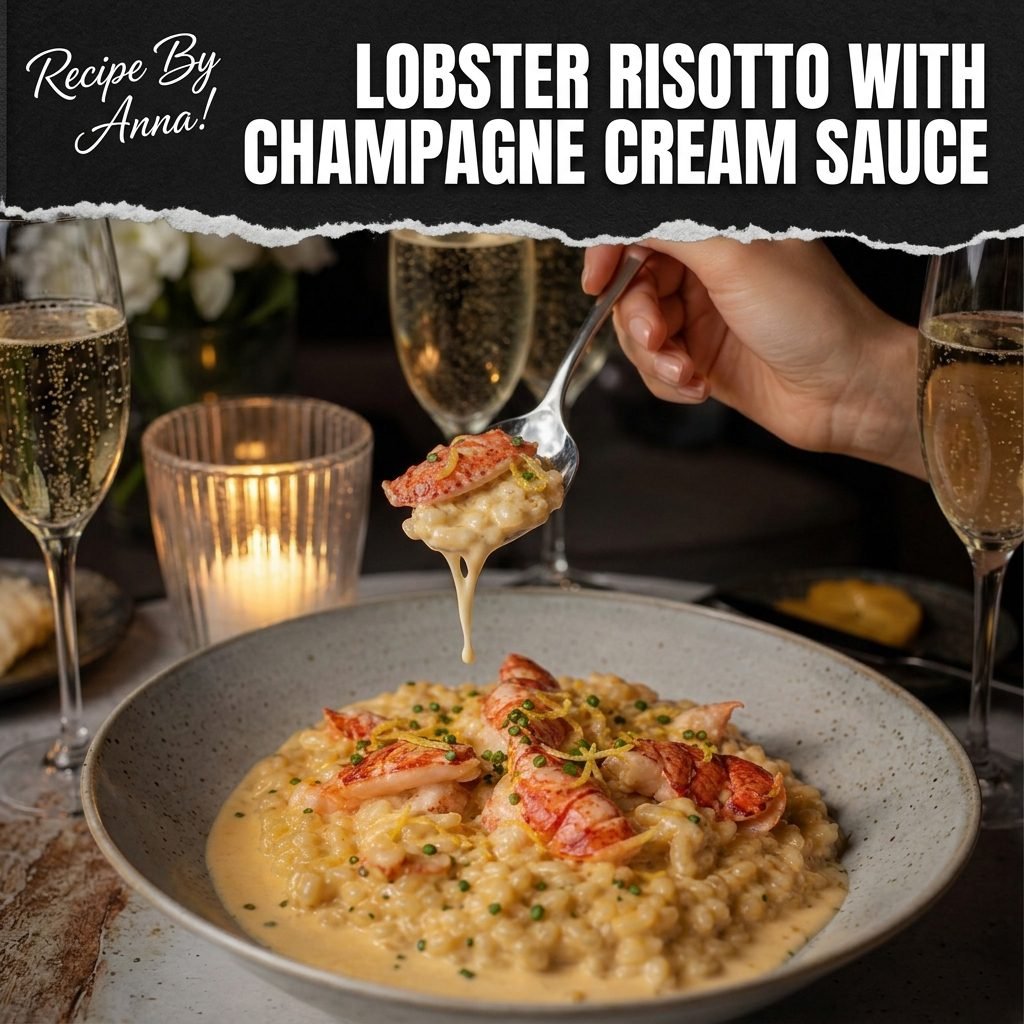
Lobster Risotto with Champagne Cream Sauce
There are dinner recipes, and then there is the one you make when the occasion is real: an anniversary, a promotion, a proposal you’ve been tipped off about. Lobster risotto with champagne cream sauce is the full version of that plate — a wide pan of arborio stirred to a glossy, flowing cream, sweet chunks of lobster folded in at the last moment so they stay tender, and a separate sauce of shallots, champagne, and cream that gets pooled and swirled on top like the kitchen knows something you don’t. It’s the dish that makes a Tuesday feel like a private restaurant, and the part nobody tells you is the best part: the thirty minutes of stirring, done slowly with a glass of the same champagne in your other hand, is not the labor of the meal. It is the evening. The risotto just gives you something to do with your hands while it happens.
Let me be honest about the machine underneath the romance, because this dish is two techniques stacked, and knowing them makes it easy. Technique one: risotto, which is not a recipe so much as a hydration schedule — short-grain rice, hot stock added ladle by ladle, stirred often, until the grains are tender at the center and the starch they’ve released has turned the liquid to cream. Technique two: a champagne cream sauce, which is a shallot pan-deglaze reduced hard, cream added and simmered to silk, mounted with cold butter off the heat. Two pans, about ten minutes apart in their timelines, meeting on the plate. The lobster itself is the easy part — it’s already cooked when you buy the tails or the picked meat, and its entire job is to be warmed gently at the end. The only way to ruin this dish is to rush the stirring or overcook the lobster, and both mistakes are preventable with a timer and a glass of patience.
One honest economics note before the shopping list, because someone should say it plainly: do not put good champagne in the pan. The bubbles don’t survive the heat, the subtleties you paid for don’t either, and the sauce needs exactly one thing from the wine — dry acidity, which a twelve-dollar cava or prosecco delivers identically. Buy one bottle of inexpensive dry sparkling: three-quarters of a cup reduces into the sauce, half a cup deglazes the rice, and the rest goes in the glasses where it belongs. The lobster budget is better spent on the lobster. Now that we’re spending wisely, let’s talk about what the stirring is actually doing, because it’s physics worth knowing.
The Stir Tax
Risotto creaminess is starch, and understanding that one fact turns the whole dish from folklore into procedure. Arborio and carnaroli are short-grain rices bred for their starch profile: their grains carry a high proportion of amylopectin, a branched, sticky starch that leaches out of the grain’s surface as it cooks and thickens the surrounding liquid into gloss. (Long-grain rice is the opposite — more amylose, which stays firm and separate, which is why basmati never makes risotto and never wanted to.) The method exists to manage that leaching. Toasting the dry rice in butter first sets the outer layer, so grains hold their shape instead of bursting. Hot stock, added a ladle at a time, keeps the rice cooking at a steady simmer instead of stalling — cold stock shocks the pan and the timeline goes sideways — and the gradual hydration gives the starch time to release into a small amount of liquid rather than drowning in a big one. Cream is not added anywhere in this process. The cream is the process. When a risotto recipe tells you it serves four with no cream in the ingredient list, that’s what it means.
Now the stir itself, and the truth that will save your arm: “constant stirring” is a myth, and a useful one to retire. The stirring’s job is agitation — knocking starch off the grains so it disperses — and it needs to happen often, not continuously. Stir vigorously for a few seconds every minute or so, making sure nothing catches on the bottom, and spend the gaps sipping, tasting, and adjusting. The final minute is where the real work happens: off the heat, cold butter beaten in hard — the classic mantecatura — which whips air and fat through the starch suspension and turns creamy into glossy. The texture you’re chasing has a name: all’onda, “the wave” — when you shake the pan, the risotto should move like slow lava, holding together but flowing. A risotto that stands in a spoon-shaped mound is underworked or under-liquid; a risotto that moves like a wave is done. You’ll know it when you see it, usually around minute twenty, and it’s one of the great sights in home cooking.
The champagne’s job is the least romantic and most important part of the sauce: acid. Cream and butter and lobster are all rich, low-acid foods, and a sauce built from them alone tastes flat no matter how expensive its parts — it needs a sharp, dry counterweight for the flavors to read as bright instead of heavy. That’s what the reduced sparkling wine contributes: the wine goes into the pan, boils down to a couple of tablespoons of concentrated dry acid, and that concentrate then flavors and lifts the entire cream sauce. The bubbles are long gone by then, along with most of the alcohol; what survives is exactly what the sauce needs. The nutmeg is the other quiet key — a small pinch in a cream sauce is the Italian trick that nobody identifies but everybody tastes, warming the cream without announcing itself. Same with the lemon at the very end: zest on the plate, not juice in the pan.
And the cheese question, addressed head-on because it’s the doctrine of the dish: Italian tradition says no Parmesan with shellfish, and the tradition has a point — aged cheese’s assertive glutamates can crowd out lobster’s delicate sweetness. My verdict, after making this more times than my budget admits: skip the cheese in the pot. The champagne cream already provides the savory depth the parmesan would bring, and the lobster stays the headline. A tiny dusting at the table for a guest who insists is harmless; a cup in the pan turns lobster risotto into cheese risotto with a lobster rumor in it. The recipe stands with the Italians on this one.
⏱️ 45 MIN ACTIVE | 🥂 SERVES 4 | 🍾 ONE BOTTLE, THREE JOBS
- Prep Time: 15 minutes — shallots, lobster, and the two-pan setup
- Cook Time: about 30 minutes, both pans in parallel
- Total Time: 45 minutes, glass in hand for most of it
- Yield: 4 first-course portions, or 2 date-night mains plus tomorrow’s arancini
The Lobster Decision
Three honest routes to the lobster, priced in money and effort. Route one: two lobster tails (about 8 oz of meat) — my default for this recipe. Steam or butter-poach them for six to eight minutes while the stock heats, pull the meat, chop it, and — this is the part that earns the route — simmer the empty shells in the stock for the entire time you stir the risotto. Those shells turn decent seafood stock into something that tastes like you spent fifty dollars more than you did, and the effort is dropping them in a pot. Route two: picked cooked lobster meat, from a good fish counter or a tub — the sane shortcut, identical in the finished dish, no shell stock, ten minutes saved, roughly the same price per ounce. Route three: langostino, the budget move I’ve defended on this site before — sweet, lobster-adjacent, and honestly hard to distinguish under champagne cream. Whichever route, the rule at the end is the same: the lobster is already cooked, so it gets warmed, never re-cooked. Fold it in during the last two minutes, off the heat, and it stays sweet and tender all the way to the bowl.
The Stir Station
Two pans, one spoon, and a setup that makes the half-hour pleasant instead of harried:
- Wide heavy pan or Dutch oven — the risotto’s home. Wide means more evaporation and faster cooking; heavy means no hot spots scorching the starch.
- Small saucepan — keeps the stock at a bare simmer beside the big pan, and the shells simmering in it if you’re running route one.
- Second small pan — the champagne cream sauce, built parallel, about ten minutes behind the rice.
- Wooden spoon — flat-edged if you have it, for scraping the pan’s bottom on every pass.
- Ladle — half-cup portions of hot stock, one at a time.
- Whisk — for mounting the cold butter into the cream sauce.
- Shallow bowls, warmed — risotto cools fast on cold ceramic; hot tap water in the bowls for a minute is the restaurant trick that buys you five extra minutes of the perfect texture.
Ingredients (With Labels)
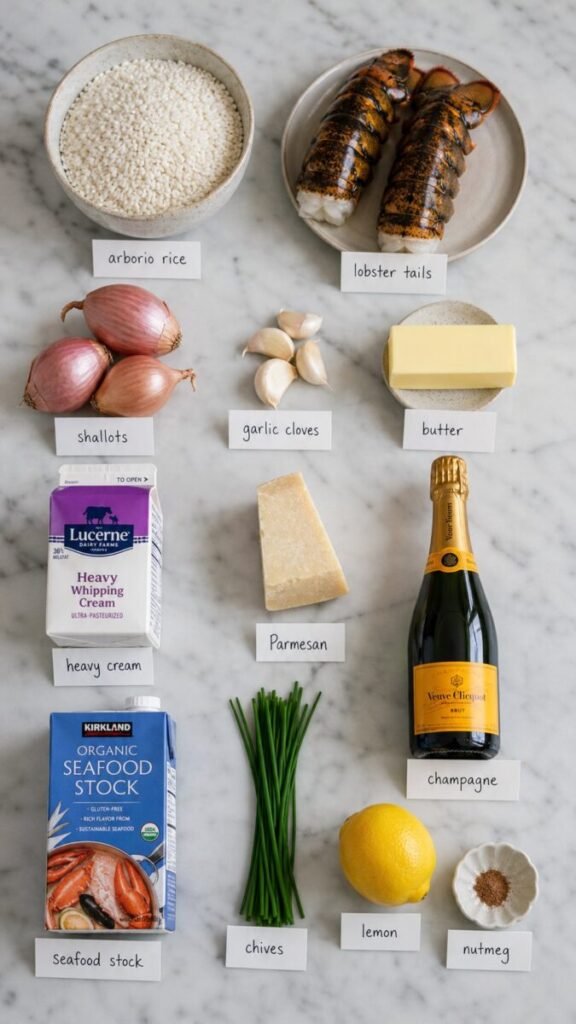
🦞 The Lobster
- Lobster tails: 2 small (4 to 5 oz each) — or 8 oz picked cooked meat, or langostino
- Butter: 1 tablespoon, for poaching the tails
🍚 The Risotto
- Arborio or carnaroli rice: 1½ cups
- Seafood stock: 5 cups, at a bare simmer — clam juice thinned with water works
- Shallots: 1, finely diced
- Garlic: 1 small clove, minced
- Dry sparkling wine: ½ cup — champagne, cava, or prosecco
- Butter: 2 tablespoons, plus 2 more cold for the mount
- Salt: to taste, added progressively — see the notes
🥂 The Champagne Cream
- Dry sparkling wine: ¾ cup, for the sauce
- Shallot: 1, very finely diced
- Heavy cream: ¾ cup
- Cold butter: 1 tablespoon, for mounting
- Nutmeg: 1 small pinch
- Champagne vinegar or lemon juice: 1 teaspoon, at the end
✨ The Finish
- Chives: 1 tablespoon, snipped small
- Lemon: 1 — zest only, over the plates
- Flaky salt and white pepper: for serving
Step by Step How to Make
- Step 1 — Set the station. Bring the stock to a bare simmer in the small saucepan and hold it there — the risotto needs hot stock from its first ladle to its last. If you’re cooking tails, do it now: an inch of water or a spoon of melted butter in a lidded pan, six to eight minutes over medium heat until the meat is opaque and just firm, then out, cool slightly, chop into bite-size pieces, and drop the shells into the simmering stock to do their quiet work. Warm your serving bowls with hot tap water. The whole dish is about to become a thirty-minute rhythm of stir, ladle, sip, repeat, and every piece of setup you do now is a piece of calm you’ll have then.
- Step 2 — Soffritto and toast. In the wide pan over medium-low, melt 2 tablespoons of butter with the shallot and a small pinch of salt, and cook 3 to 4 minutes until the shallot is soft and translucent — no color, only sweetness. Add the garlic for 30 seconds, then pour in the dry rice and stir it through the butter for a full 2 minutes, until the grains look pearly at the edges and slightly translucent at their tips. That toasting sets the grain’s outer layer and starts the nutty flavor; skip it and the rice cooks soft and anonymous. Pour in the ½ cup of sparkling wine — it will hiss and steam — and stir until the pan is nearly dry again.
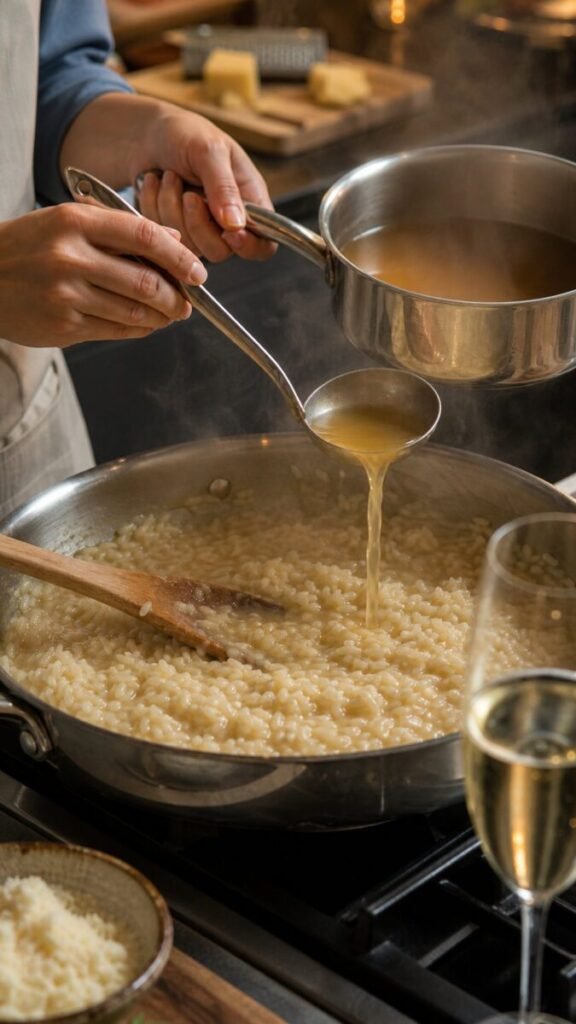
- Step 3 — The ladle rhythm. Add the hot stock half a cup at a time, stirring well after each addition and letting the rice absorb most of it before the next ladle — the pan should never be soupy, never bone dry, but always moving at a lazy simmer. Stir vigorously for a few seconds every minute or so, scraping the bottom; between stirs, you are officially free. Taste at minute 15 and start salting progressively, a pinch at a time — the stock varies, the wine is tart, and salt added in layers beats salt dumped at the end. At 18 to 20 minutes, the rice should be al dente: tender with the faintest firm thread at the center, and the surrounding liquid glossy and thickened. If you run out of stock before the rice is done, hot water finishes the job without shame.
- Step 4 — The champagne cream, in parallel. While the rice works, build the sauce in the second pan: the last tablespoon of butter over medium-low, the finely diced shallot until translucent, then the ¾ cup of sparkling wine turned up to a hard simmer and reduced to about two tablespoons of syrup — three to four minutes, and don’t rush it, because unreduced wine in cream tastes like a hangover. Pour in the cream with the pinch of nutmeg, bring barely to a simmer, and let it thicken until it coats the back of a spoon, five or six minutes. Off the heat: whisk in the cold butter and the teaspoon of vinegar or lemon. The sauce should taste bright, faintly sweet, and alive — if it tastes heavy, another few drops of lemon.
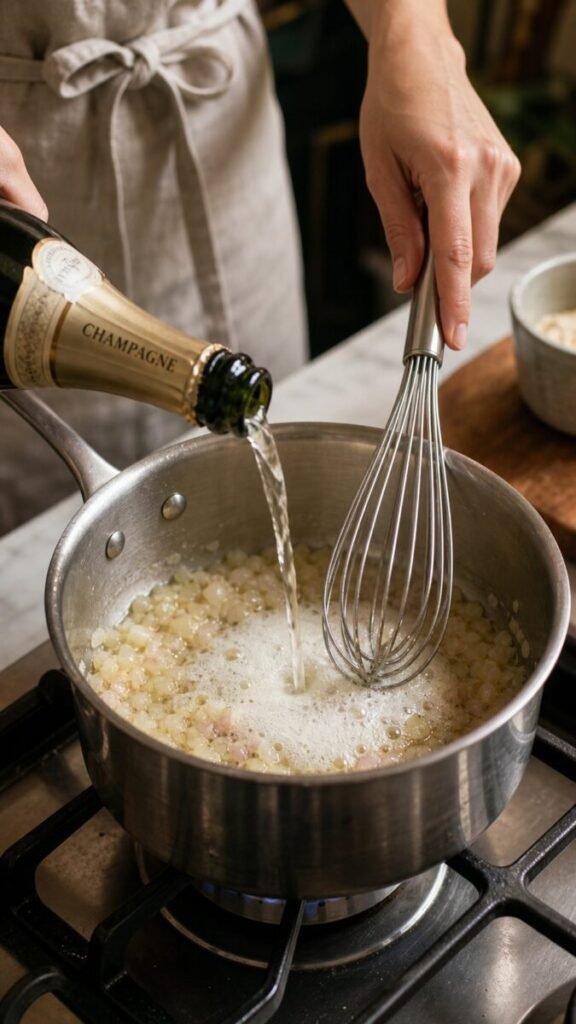
- Step 5 — The mount and the fold. When the rice is al dente, kill the heat. Beat the 2 cold tablespoons of butter into the risotto with real energy — thirty seconds of hard stirring, which is the mantecatura, the step that turns creamy into glossy and makes the wave happen. Give the rice a splash of hot stock if it’s stiffer than slow lava. Now the lobster: spoon two tablespoons of the warm champagne cream over it, fold the pieces gently through the risotto — half of them, that is, reserving the best-looking chunks for the tops of the plates — and let everything sit together for two minutes, lid off, so the temperatures equalize and the lobster is warmed through by the rice rather than cooked by a pan.
- Step 6 — The restaurant plate. Pull the warm bowls from their hot water and dry them. The plating order is the trick: a spoonful of champagne cream in the bottom of each bowl first, then the risotto nudged into a low, loose nest on top, then the reserved lobster piled at the center. Swirl a little more cream around the edge, hit everything with the lemon zest, the chives, flaky salt, and a grind of white pepper, and carry them to the table while they still move like a wave. Two flutes with what’s left of the bottle. This is the part of the evening the stirring was buying, and it needs no garnish beyond someone to share it with.
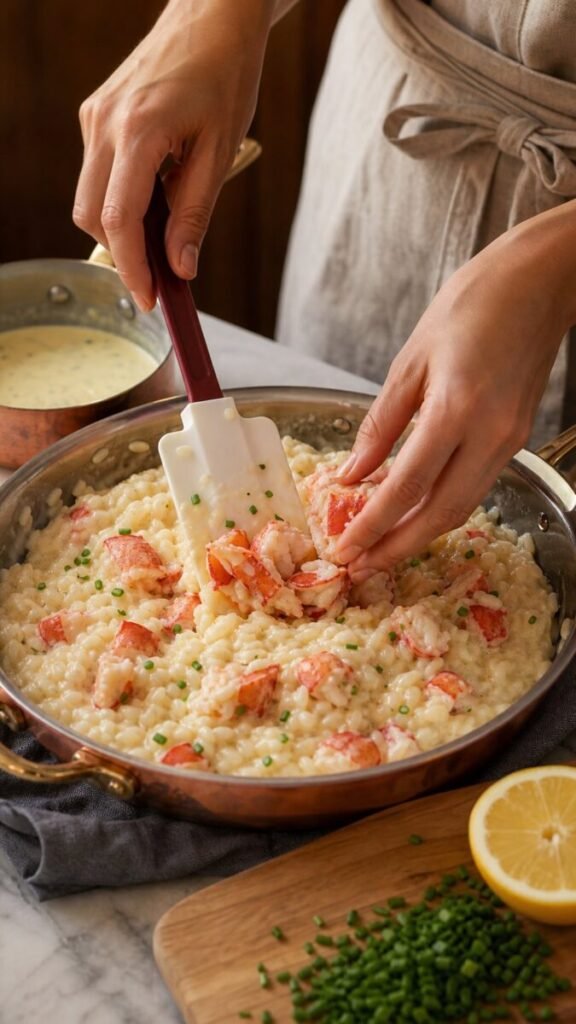
Two pans, two moods — where this risotto spends the champagne budget, the miso butter mushroom risotto proves the same technique runs happily on vegetables. Learn one, and you own both.
Anna’s Kitchen Notes
The bottle economics. One bottle of inexpensive dry sparkling covers the entire recipe — three-quarters of a cup reduced into the sauce, half a cup deglazing the rice, and two healthy glasses left for the cook and the company. Do not put anything in the pan that you’d mourn; the heat strips the bubbles and the subtleties both, and keeps only the dry acidity the sauce actually wants. A twelve-dollar cava performs identically to vintage champagne here, and the difference in price converts directly into better lobster. This is the rare recipe where being frugal makes it taste better.
Hot stock, always. The stockpot stays at a bare simmer from first ladle to last, because cold stock hitting the pan drops the rice’s cooking temperature, stalls the starch release, and turns your smooth timeline into a lumpy one. If the stock reduces while the shells steep, top it up with water — it’s seasoning you can adjust, not a chemistry experiment. And taste the stock itself before you start: it should be pleasantly salty, because rice seasoned only at the end never tastes fully seasoned at all.
Nutmeg, quietly. A small pinch of nutmeg in the cream sauce is the Italian move that nobody ever names and everybody notices — a warmth under the cream that reads as “restaurant” without identifying itself. Grate it fresh if you can, and keep it to a pinch: at a quarter teaspoon the sauce starts tasting like a bakery, and this is not that. The same rule governs the lemon: zest over the finished plates, never juice in the pan, where it curdles cream and dulls its color.
The wave is the doneness test. Forget timers as gospel and learn the pan-shake: when you nudge the pan, finished risotto should move in one slow, glossy roll — all’onda, the wave — holding together but willing to flow. A mound that sits still needs another splash of stock; a soup that runs needs two more minutes of simmering. The texture drifts as it sits, which is why the bowls are warm and the plates happen fast. Risotto waits for no one, and that’s a feature — it keeps the evening on schedule.
Double the rice, not the lobster. For four date-night mains, double everything except the lobster — eight ounces of lobster across four bowls of this still reads as luxurious, because the cream and the stock carry the flavor while the lobster punctuates it. Halving the lobster per bowl is the caterer’s trick, and it works exactly as well at home. If the table runs to serious appetites, stretch with a handful of peas in the last three minutes, which the champagne cream considers a close personal friend.
The Date-Night Table
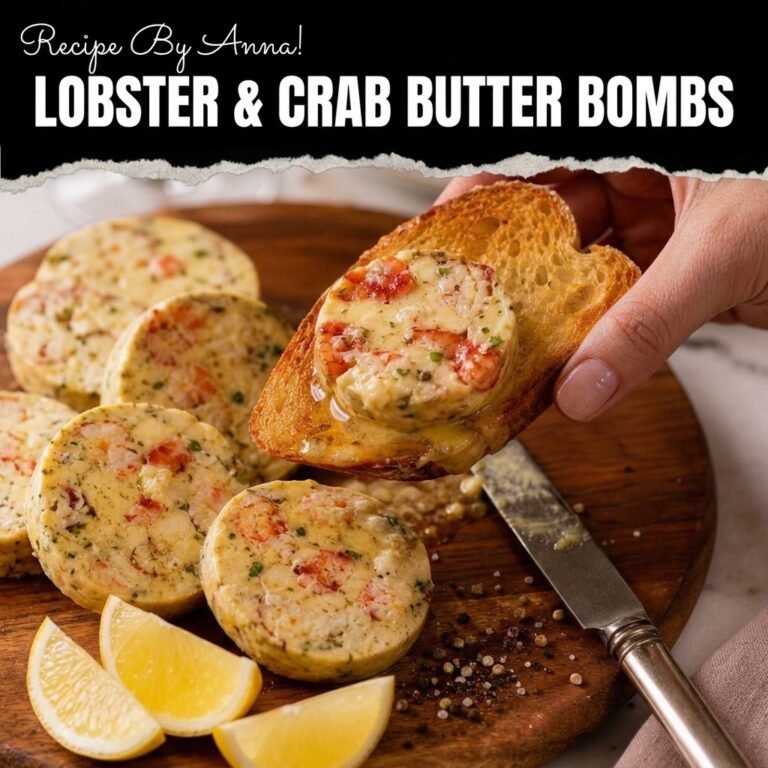
This plate is the whole event, and the supporting cast should be light, bright, and mostly cold. A simple plate of lemony roasted vegetables eats alongside without competing, and the shrimp and crab garlic toast is the splurgy starter if the evening calls for a full arc — sweet seafood on toast before sweet seafood on rice, and nobody has ever complained about the theme.
For the rest of the evening: the classic French butter cake is the make-ahead dessert this dinner deserves — slice it with berries while the risotto rests — and the garlic butter orzo is the weeknight descendant of this same technique, for the Tuesday when the champagne budget has recovered. And for the date who doesn’t eat shellfish, the garlic butter chicken thighs run on the same buttery logic in a separate pan. One table, everybody fed, nobody negotiating.
Same Rice, Other Splurges
The shrimp weeknight. A half-pound of shrimp, butter-poached and chopped, in place of the lobster — same folding, same sauce, and the dish shifts from anniversary food to a very good Tuesday at a third of the price. The champagne cream does not discriminate between shellfish.
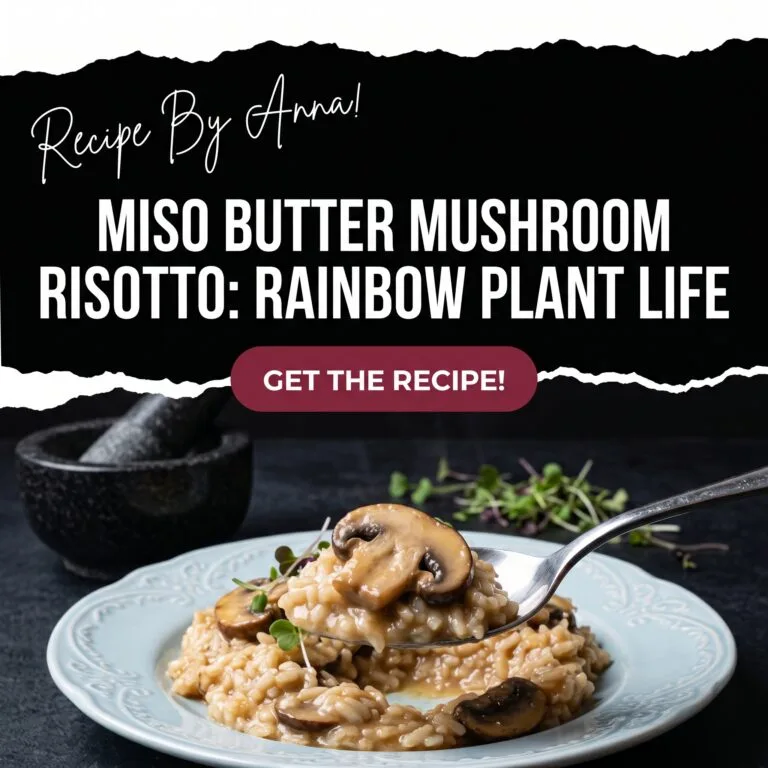
The mushroom version, no seafood at all. Wild mushrooms browned hard and folded in at the mount, with a spoon of their pan juices in the cream — this is the same dish that the miso mushroom risotto on this site already does its own way, and both are correct. The technique is the investment; the payload is your business.
Scallop and pea spring build. Seared bay scallops and a handful of sweet peas, lemon zest doubled — the same plate wearing pastels. This is the version for the first warm evening of the year, when the table moves outside and the champagne tastes even better for the view.
The saffron route. A pinch of saffron steeped in the first cup of hot stock turns the whole pot faintly golden and perfumed — the Milanese move, and it pairs with champagne cream like they were introduced on purpose. Saffron is the one upgrade here with a flavor you can’t fake, and a small jar lasts years of occasions.
Crab and brown butter. Lump crab instead of lobster, and the mount done in brown butter — nutty, sweeter, and the whole dish tips toward the Chesapeake. The champagne cream stays exactly as it is; crab and champagne is a marriage with no known conflicts.
The no-wine version, honestly rated. Skip the wine entirely — extra stock deglazes the rice, and the sauce built on shallot, cream, a squeeze of lemon, and a touch more nutmeg lands at about eighty-five percent. Fully delicious, quietly missing the dry snap. For a table where wine doesn’t cook, this is the honest build, and I’d serve it without a single caveat.
The Plate Math
| Nutrient | Per Bowl (1 of 4) |
|---|---|
| Calories | 560 kcal |
| Protein | 24 g |
| Carbohydrates | 52 g |
| Fats | 26 g |
Estimates as written, lobster, cream sauce, butter, and all. This is a celebration plate and the numbers carry the passport: five hundred sixty calories, with an honest twenty-four grams of protein riding along — the lobster and the stock doing quiet work under the luxury. The fat comes from butter, cream, and lobster, which is to say from the recipe’s entire personality, and the carbohydrate line is the arborio being what it is. The portion philosophy matters more than the math: served as a first course — the Italian way, and what this quantity actually is — it’s four elegant plates. Served as date-night mains, it’s two generous bowls and a scheduled arancini situation for tomorrow, which the storage section below considers a feature.
The Arancini Clause
Risotto is a now food — the wave lasts ten minutes on the plate and the magic doesn’t survive a night intact. The fridge keeps leftovers two days, and the champagne cream three in its own jar, but plan for the transformation rather than the revival: cold risotto is not sad leftover rice, it is arancini batter waiting for its assignment. Chill it firm, ball it around a cube of mozzarella, roll in breadcrumbs, and shallow-fry until golden — the starch that made the rice creamy is precisely the glue that makes arancini hold, which is why no other leftover performs like this one. The champagne cream warms up as a dipping sauce in thirty seconds, and the lobster, if any survived, goes inside the balls where it becomes a surprise instead of a memory.
The make-ahead trick that restaurants actually use, if you want the timing split: par-cook the risotto to about three-quarters done — ten to twelve minutes of ladling — spread it thin on a sheet pan to cool fast, and hold it up to a day in the fridge. At dinner time, return it to the pan with hot stock and it finishes in eight minutes, which is exactly how a kitchen serving forty risottos a night does it. The champagne cream holds warm beautifully and even improves after a night in the fridge. The lobster, the only fragile citizen, should always be bought and folded the same day.
Second careers for any surviving components: extra champagne cream is a superb sauce for seared scallops, chicken, or the butter cake if you’re bold; extra stock with shells steeped in it is tomorrow’s soup base or the cooking liquid for rice you’re not planning to stir; and the last of the bottle has an obvious appointment at the table. Nothing in this recipe has only one job, which is exactly how I like a splurge to behave.
Where It Goes Wrong
Gluey, paste-like risotto. Over-stirred, over-cooked, or both — grains burst instead of releasing, and the cream crosses into paste. The fixes are rhythm and timing: stir often and briefly rather than constantly, pull the rice at al dente with its white core just gone, and loosen with hot stock at the mount. A gluey batch also usually means the heat was too low and the rice stewed — keep the pan at a lazy, visible simmer throughout.
Crunchy centers at minute twenty. Under-hydrated rice — either the stock wasn’t hot, the additions were too stingy, or the lid of patience closed early. Test a grain at fifteen minutes and adjust the pace; if the stock runs out, hot water finishes the job. And check the pan width: a narrow, deep pan slows the whole timeline down, where a wide one cooks the rice at the speed this recipe was written for.
A sauce that tastes like warm alcohol. The champagne wasn’t reduced before the cream went in. That hard, three-minute simmer down to a couple of tablespoons is what burns off the raw edge and concentrates the dry acid; skip it and the cream carries a boozy harshness no amount of butter hides. If the sauce is already built and tastes hot with alcohol, simmer it gently for two more minutes — it usually comes around.
A split or greasy cream sauce. It boiled hard after the cream, or the cold butter went in over heat — both break the emulsion and leave you with fat floating on liquid. Cream sauces simmer barely, and the mount happens off the flame with cold butter and a fast whisk. A mild split can be pulled back with a teaspoon of cold cream and vigorous whisking; a full break is a lesson, and the risotto is still good underneath it.
Rubbery, chewy lobster. It got re-cooked — folded into a hot pan instead of a finished pot, or left in the steam too long the first time. Lobster in this dish is warmed, not cooked: off the heat, into the residual warmth of the rice, two minutes, done. The tails route has its own trap — pull them at just-opaque and just-firm, because they’ll cook another shade as they cool and another as they fold in. Every degree past done is traded for tenderness, and lobster’s margin is narrow.
A gorgeous plate that tastes quiet. Under-salt, almost always, and always at the same spot: the rice. Stock varies in saltiness, wine brings acid that reads as seasoning but isn’t, and risotto salted only at the end tastes like a photograph of itself. Salt progressively from minute fifteen, taste at eighteen, and remember the stock itself should be pleasantly salty before the first ladle. A last pinch of flaky salt over the plate is not decoration — it’s the final adjustment.
Risotto Questions
Do I really have to stir constantly?
No — and retiring that myth makes the dish better, not lazier. The stirring exists to agitate starch off the grains and keep the bottom from catching, and it needs to happen often, not continuously: a good vigorous pass every minute or so, with the gaps free for sipping and tasting. The one moment that deserves real effort is the mount — cold butter beaten in hard off the heat at the very end. Constant stirring actually risks bursting the grains into paste. Stir often, stir well, put the spoon down between times.
Can I use prosecco or cava instead of champagne?
Please do — that’s the house recommendation, not the compromise. The sauce needs dry acidity from the wine and nothing else; the bubbles and the vintage subtleties don’t survive the pan, so a twelve-dollar cava or an extra-dry prosecco performs identically to something with a famous label. The one thing to check is that it’s genuinely dry — an off-dry sparkling will make the sauce taste like dessert, and not in a way the lobster endorses. Cook with the modest bottle, drink the good one, and pocket the difference.
What’s the best lobster to buy for this?
The three routes are priced out in The Lobster Decision above: tails with their shells simmered in the stock (the flavor-maximizing default), picked cooked meat (the sane shortcut), and langostino (the budget swap that works). Cold-water tails — Maine, or their Canadian kin — are sweeter and firmer than warm-water ones if the counter offers both. And thawed-frozen is fine everywhere in this recipe; lobster freezes beautifully and this dish is gentle with it.
Can I make this without alcohol?
Yes, with honest trade-offs. Skip the wine in the risotto and deglaze with extra hot stock; build the sauce on shallot, cream, nutmeg, and a firm squeeze of lemon at the end. The plate lands around eighty-five percent — fully delicious, missing only the dry snap the reduction brings. A splash of white grape juice plus the lemon gets a little closer, but I’d make the clean version and let the lemon do the talking.
Can I make risotto ahead of time?
The restaurant method, yes: par-cook the rice to about three-quarters done, spread it thin on a sheet pan to cool, and refrigerate up to a day. To serve, return it to the pan with simmering stock and it finishes to order in eight minutes — the texture comes back almost entirely, and it’s how professional kitchens serve risotto at volume. The champagne cream holds warm or reheats gently. The lobster is the one ingredient that shouldn’t be bought ahead; it wants to be folded in the same day it’s cooked.
Cheese with seafood — what’s the actual rule?
Italian tradition says no, and my kitchen agrees with a small footnote. Aged Parmesan’s assertive savor crowds lobster’s sweetness, and this recipe already builds its depth from the shell-steeped stock and the champagne cream — so the pot gets no cheese, and nothing misses it. The footnote: a light dusting at the table for a guest who insists is harmless, because at that point it’s a condiment, not a co-star. In the pan, it takes over. On top, it behaves.
What do I serve with it?
Light and bright, with the risotto as the event: lemony roasted vegetables or a sharp little salad alongside, the shrimp and crab garlic toast if you want a starter, and the butter cake waiting at room temperature for dessert. Something crisp and cold in the glasses — the rest of the bottle has been waiting for this since the saucepan. Avoid a second heavy cream dish on the same table; the dinner works because everything around the risotto is doing less, not more.
Special-occasion dinner · Sweet lobster · Dry sparkling wine
Lobster Risotto with Champagne Cream Sauce
Glossy arborio risotto finished with butter and tender cooked lobster, served with a separate shallot, sparkling-wine, and cream sauce. Fresh chives and lemon zest bring a bright finish to this rich, restaurant-inspired plate.
As an Amazon Associate I earn from qualifying purchases.
Ingredients
The lobster
- 8 oz fully cooked, shelled lobster meat, cut into bite-size pieces
The risotto
- 1½ cups arborio rice or carnaroli rice, not rinsed
- 5 cups seafood stock, kept hot; you may not need it all
- 1 shallot, finely diced
- 1 small garlic clove, minced
- ½ cup dry sparkling wine, such as brut Champagne, cava, or prosecco
- 4 tablespoons unsalted butter, divided: 2 tablespoons for cooking and 2 tablespoons cold and cubed for finishing
- Fine salt, to taste
- Hot water, only if additional cooking liquid is needed
The champagne cream sauce
- ¾ cup dry sparkling wine
- 1 shallot, very finely diced
- ¾ cup heavy cream
- 2 tablespoons unsalted butter, divided: 1 tablespoon for the shallot and 1 tablespoon cold for finishing
- 1 small pinch nutmeg
- 1 teaspoon Champagne vinegar or lemon juice, added gradually to taste
The finish
- 1 tablespoon snipped fresh chives
- Finely grated zest of 1 lemon, to taste
- Flaky salt and white pepper, to taste
*Start with cooked lobster: timing excludes thawing or cooking raw tails. Buy 8 oz of actual cooked, shelled meat—not 8 oz of shell-on tails. Two small tails generally will not provide 8 oz of picked meat.
The risotto station
- Wide, heavy sauté pan, for the risotto
- Two small saucepans, one for stock and one for sauce
- Flat-edged wooden spoon
- Ladle and small whisk
- Cutting board and knife
- Measuring cups and spoons
- Fine zester
- Instant-read food thermometer
- Shallow serving bowls
Butter accounted for: this version uses 6 tablespoons total: 4 for the risotto and 2 for the sauce. The sauce needs a separate tablespoon for softening its shallot as well as the cold tablespoon whisked in at the end.
Choose brut: sparkling wine labeled “extra dry” can be sweeter than brut. Use an inexpensive genuinely dry bottle. Reducing wine does not remove all its alcohol; this is not an alcohol-free dish.
Three vessels, two parallel preparations: the rice and sauce cook alongside a saucepan of hot stock. Start the sauce early in the rice-cooking stage so the reduction has enough time.
How to make it
-
Prepare the stock and lobster
Bring the seafood stock to a gentle simmer in a small saucepan and keep it hot over low heat. Check the cooked lobster for shell fragments and cut it into bite-size pieces, reserving the best-looking pieces for topping. Keep the lobster refrigerated until needed. Measure the sauce ingredients and separate the cooking butter from the cold finishing butter.
-
Soften the shallot and toast the rice
Melt 2 tablespoons butter in the wide pan over medium-low heat. Add the risotto shallot and a small pinch of salt; cook for 3–4 minutes until softened without browning. Stir in the garlic for 30 seconds. Add the rice and stir for about 2 minutes until coated and lightly translucent at the edges. Add ½ cup sparkling wine and simmer, stirring, until most of the free liquid has evaporated.
-
Add hot stock gradually
Add about ½ cup hot stock and maintain a gentle, steady simmer. Stir frequently, sweeping the bottom of the pan, and add more stock when most of the previous addition has been absorbed. Do not let the rice catch or become completely dry. Begin tasting after about 15 minutes; allow roughly 18–25 minutes from the first stock addition, or longer if needed. The grains should be tender with a slight bite, not chalky or crunchy. Use hot water if the stock runs out, and season gradually to taste.
-
Make the champagne cream alongside the rice
While the rice cooks, melt 1 tablespoon butter in the second saucepan. Soften the sauce shallot over medium-low heat for 3–4 minutes. Add ¾ cup sparkling wine and simmer briskly until approximately 2–3 tablespoons of liquid remain; this may take 6–10 minutes or longer depending on the pan. Add the cream and nutmeg and simmer gently for about 4–6 minutes, until lightly thickened. Reduce to very low heat while finishing the rice.
-
Heat the lobster and finish both pans
Gently heat the lobster in the cream sauce near the end of cooking, following its package directions. Previously cooked, refrigerated leftover lobster should reach 165°F; residual warmth off the heat is not a reliable reheating method. Once heated, remove the sauce from the burner. Gently stir in its remaining 1 tablespoon cold butter and add the vinegar or lemon juice a few drops at a time, tasting as you go. Separately, remove the finished risotto from the heat and vigorously stir in its 2 tablespoons cold butter. Loosen with a little hot stock until it flows when the pan is nudged. Fold in half the lobster and a spoonful or two of sauce, keeping the remaining pieces for topping.
-
Plate immediately in warm bowls
Warm the bowls with warm water and dry thoroughly. Spoon a little champagne cream into each bowl, then add the loose, glossy risotto. Top with the reserved lobster and spoon additional sauce around the edges. Finish with chives, finely grated lemon zest, white pepper, and flaky salt only if needed. Serve promptly; risotto thickens as it stands.
Raw tails are not ready-to-eat lobster: if starting with raw tails, cook them separately to 145°F in the thickest part before removing the meat. Cooking time and yield vary with tail size. Do not rely on a fixed 6–8-minute timer, shell color, or the finished rice to cook raw lobster safely.
Rice and seafood safety: refrigerate leftovers promptly in shallow containers, within 2 hours or 1 hour above 90°F. Do not leave cooked rice on the counter to cool for an extended period. Reheat leftovers to 165°F; reheating cannot reliably make improperly stored rice safe. Contains crustacean shellfish and milk; seafood stock may also contain fish or mollusks. Check labels for other allergens.