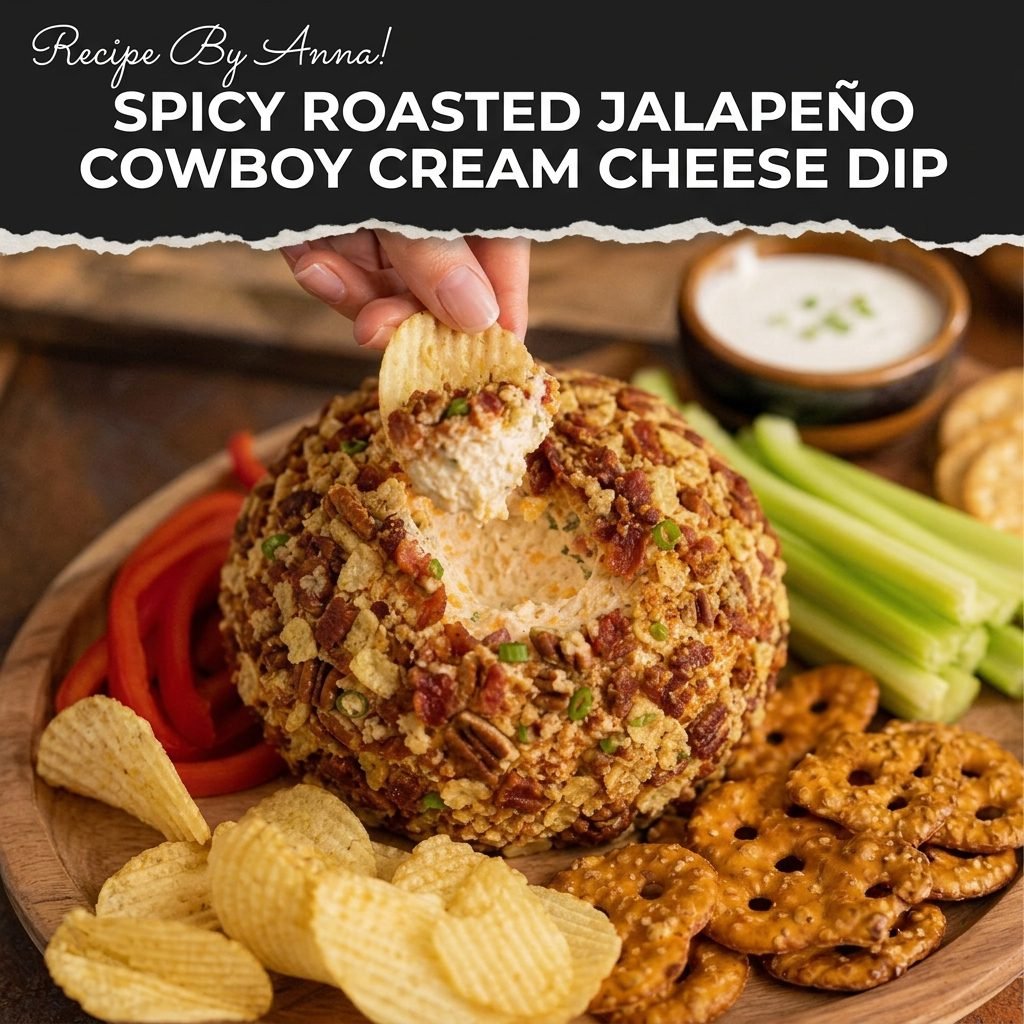
Spicy Roasted Jalapeño Cowboy Cream Cheese Dip
Every party has its dip, and every once in a while the dip deserves a promotion. That’s what this recipe is: all the flavors of the spicy roasted jalapeño cowboy cream cheese dip everyone crowds around — blistered jalapeños, sharp cheddar, charred corn, bacon, smoked paprika — but chilled, shaped into a ball, and rolled in a crust of crumbled bacon, toasted pecans, and crushed potato chips. Instead of a bowl and a spoon, you get a centerpiece: a ball that people stand around, crack into, and spread on chips for two hours. It feeds a room, it travels to potlucks without spilling, and it makes the exact dish everyone asks you to bring again next year.
The move that carries the whole recipe is roasting the jalapeños, and it’s not optional. Raw jalapeño in a cream cheese base tastes sharp and grassy — heat with no manners. Run the peppers under the broiler until their skins blister and blacken, though, and two things happen: the heat softens from a bite into a warm glow, and the char itself becomes flavor — smoky, sweet, a little nutty, the same magic that makes fire-roasted salsa taste like it came from a real kitchen instead of a processor. It’s ten minutes of mostly waiting, and it’s the difference between a cheese ball that’s spicy and one that’s spicy and interesting. The rest of the cowboy roster — bacon, corn, smoked paprika, cumin — piles onto that smoky foundation until the whole ball tastes like it was made over a campfire by someone who knew what they were doing.
A few honest notes before you start. This is a schedule recipe more than a technique recipe: the mix takes twenty minutes, then the ball needs an hour in the fridge to set before it can be shaped and coated, so start it at least two hours before the party (or a day ahead — the make-ahead split is in the notes and it’s the smart way). The cream cheese must be properly softened — a full hour on the counter — because cold cream cheese beats into lumps that never fully mix in. And the crust goes on the day you serve it, not before: crunchy coatings and creamy interiors are a time-limited partnership, and the fridge’s humidity is patient and relentless. Plan the ball for the party, the crust for the day, and the ranch drizzle for the last five minutes. The rodeo runs on a schedule.
Char Is the Flavor
Let’s talk about what the broiler actually does to a jalapeño, because it explains half the recipe. A pepper’s flavor compounds sit in its flesh and skin, and raw, they’re bright, grassy, and sharp. Apply real heat and the skin blisters and blackens — that’s the Maillard reaction and a little carbonization doing to the pepper what toasting does to bread — and underneath, the flesh goes soft and sweet while the capsaicin (the heat) mellows. You’re trading raw sharpness for smoke and sweetness, and the trade is enormously profitable. The old trick after charring — into a bowl, covered, for five minutes — steams the skins loose so they slide off in sheets, taking the bitter, papery layer with them and leaving the soft, smoky flesh behind. Restaurants call this fire-roasting. It takes eleven minutes at home with a broiler, and it’s the single highest-value step in this entire post.
The ball itself works because of what cream cheese is: a cold-set matrix. At fridge temperature, cream cheese plus shredded cheddar is firm enough to hold any shape you press it into — that’s the physics of a cheese ball, and the reason the chill hour is not negotiable. At room temperature, the same mix is spreadable, which is why the ball softens back into a dip as the party goes on — a feature, honestly, since by hour two the crust crumbs have mingled with the cream and the last guests are scooping with broken chips. Sharp cheddar is the flavor backbone here (mild cheddar makes a ball that tastes like cream and regret), a modest splash of sour cream keeps the texture from turning dense, and the charred corn — my cowboy signature — folds in little sweet pops that play against the smoke. Everything else is seasoning: smoked paprika and cumin for the trail-drive depth, lime for lift, green onion and cilantro for the fresh top notes.
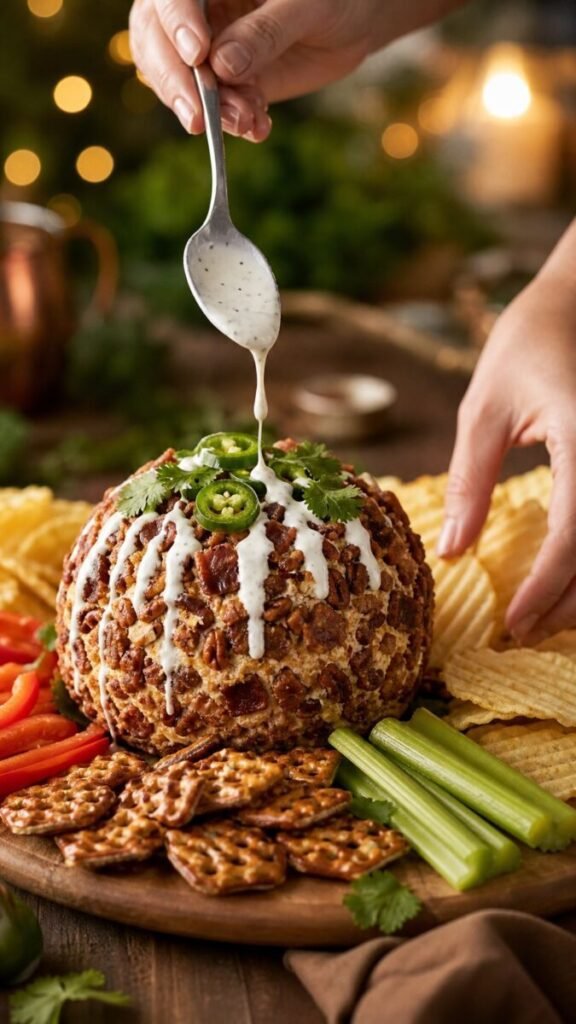
Then the crust, which is where the “cowboy” earns its hat. A coating of crisp crumbled bacon, finely chopped toasted pecans, and crushed wavy potato chips gives the ball three crunches in every swipe — smoky, nutty, and salty — plus a rough, rust-colored texture that photographs like a campfire dinner. The chips are the quiet genius in the mix: they’re pre-seasoned, they stay crisp longer than breadcrumbs, and they echo the wavy chips you’re serving alongside. Press the crust on firmly so it adheres in a thick, even layer, and don’t be shy with it — the ratio of crust to ball is a big part of why people remember this thing. A drizzle of ranch over the top at serving time, and the whole board goes from appetizer to event.
⏱️ 1 HR 45, MOSTLY CHILL | 🌶️ CHARRED, NOT RAW | 🤠 THE COWBOY CRUST
- Prep Time: 25 minutes
- Roasting: 10 minutes under the broiler plus a 5-minute steam
- Chill Time: 1 hour, non-negotiable
- Coating and Board: 10 minutes
- Total Time: 1 hour 45 minutes
- Yield: one big ball — 24 party servings
The Ball Kit
Basic tools, one bowl’s worth of them:
- Sheet pan — for the jalapeños under the broiler, and later for toasting the pecans alongside them.
- Heatproof bowl with a lid or plate — the steam bowl that loosens the charred skins.
- Skillet — for the bacon; the pecans can toast in the residual fat or on the sheet pan.
- Mixing bowl and sturdy spatula — the mix is thick, and the spatula does real work.
- Plastic wrap — for the chill and the shaping; a wrapped ball is easy to mold into a smooth sphere.
- Rimmed plate or baking dish — the rolling station for the crust.
- Wooden board — the serving stage, big enough for the ball plus its chips and dippers.
Ingredients (With Labels)
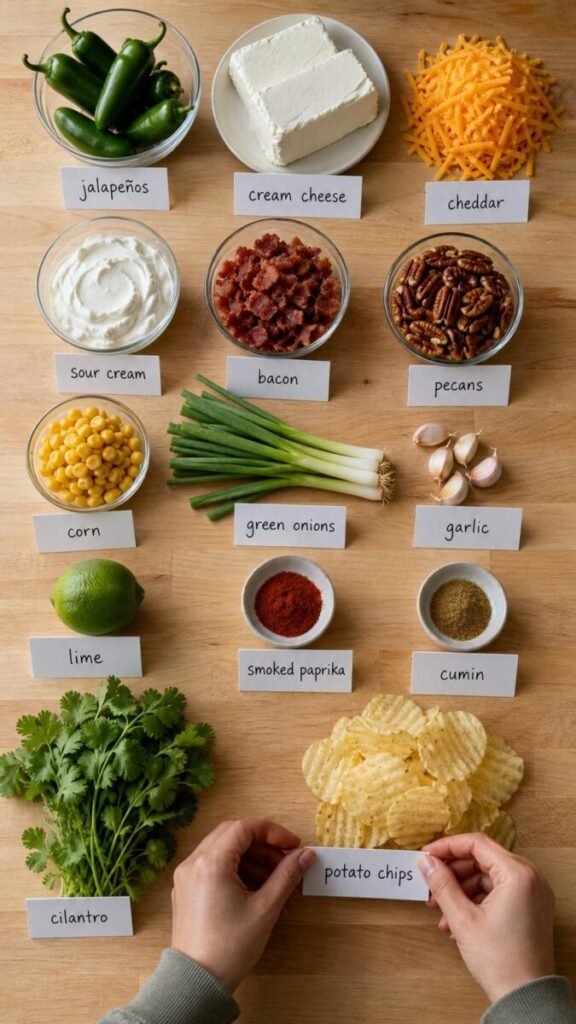
🌶️ The Roasted Heat
- Jalapeños: 6 medium
- Charred corn: ⅓ cup — run under the broiler with the peppers, or straight from a fire-roasted can
- Olive oil: a light rub for the peppers
🧀 The Ball
- Cream cheese: 16 oz, two blocks, fully softened
- Sharp cheddar: 1½ cups shredded
- Sour cream: 2 tablespoons — more softens the ball
- Bacon: 6 slices, cooked crisp — 4 in the ball, 2 in the crust
- Green onions: 3, sliced
- Garlic: 1 clove, finely grated
- Lime: 1 tablespoon juice
- Smoked paprika: 1 teaspoon
- Ground cumin: ½ teaspoon
- Cayenne: 1 pinch
- Salt: ½ teaspoon
🤠 The Cowboy Crust
- Bacon: the reserved 2 slices, crumbled fine
- Toasted pecans: ⅓ cup, finely chopped
- Wavy potato chips: 1 cup, crushed to coarse crumbs
- Cilantro: 1 tablespoon chopped, plus leaves for the top
- Chili powder: 1 pinch, stirred into the crust
- Ranch dressing: a few tablespoons, for the drizzle
Step by Step How to Make
- Step 1 — Char the peppers. Set the broiler to high with a rack near the top. Rub the jalapeños lightly with oil, set them on the sheet pan, and broil 4 to 5 minutes per side, turning with tongs, until the skins are blistered and blackened in big patches — you want char, not a fully blackened pepper. Drop them straight into the bowl, cover with the lid or plate, and let them steam for 5 minutes while you move on. Then peel: the skins slide off in sheets under your fingers or the back of a knife, over the sink, with a quick rinse for the stubborn bits. Stem them, and decide your heat — the seeds and white ribs hold most of the capsaicin, so leave the ribs and seeds of two peppers in for a warm ball, one for gentle, none for mild. Chop everything finely.
- Step 2 — Bacon, pecans, corn. While the peppers steam, crisp the bacon in the skillet over medium heat until it’s deeply crisp — floppy bacon in a cheese ball is a texture crime — then drain and crumble it. Toast the pecans in the bacon fat for 2 minutes (the pan is already hot and the fat is already bacon; this is the system working), or on the sheet pan in the cooling oven. Char the corn under the broiler for 3 minutes at the end if you’re starting from fresh or frozen — the black spots are flavor — and pat it dry. Divide the bacon: four slices for the ball, two for the crust.
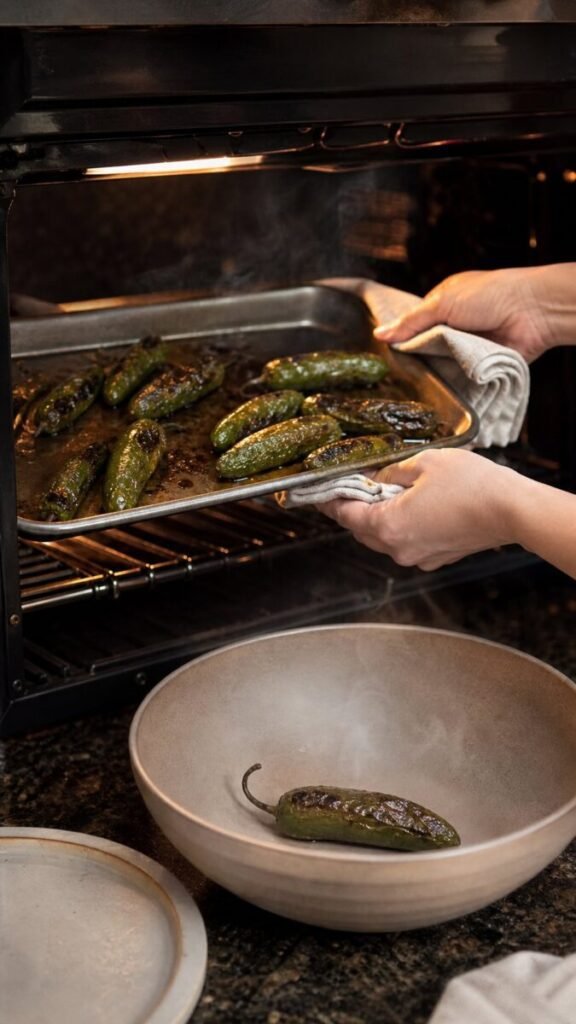
- Step 3 — Mix the ball. In the big bowl, beat the softened cream cheese alone for a full minute with the spatula until it’s completely smooth — this is the anti-lump step, and it only works if the cheese was truly soft to begin with. Add the cheddar, sour cream, the four slices of crumbled bacon, the chopped roasted jalapeños, the corn, the green onions, the garlic, lime juice, smoked paprika, cumin, cayenne, and salt. Fold and stir until evenly mixed — it should look speckled, orange-cream, and frankly a little rustic. Now taste it, with a chip, and adjust: more salt if it’s quiet, more lime if it’s flat, and know that the flavor will deepen a notch overnight in the fridge.
- Step 4 — Chill, then shape. Scrape the mix onto a big square of plastic wrap, gather the corners, and twist it into a rough ball — the wrap does the shaping for you. Into the fridge for at least 1 hour, until the ball is firm throughout and holds its shape when you squeeze it. This is the step that makes a cheese ball a cheese ball: cream cheese at fridge temperature is a set structure, and shaped warm, it slumps into a cheese mound. The mound still tastes fine. The ball looks like you meant it.
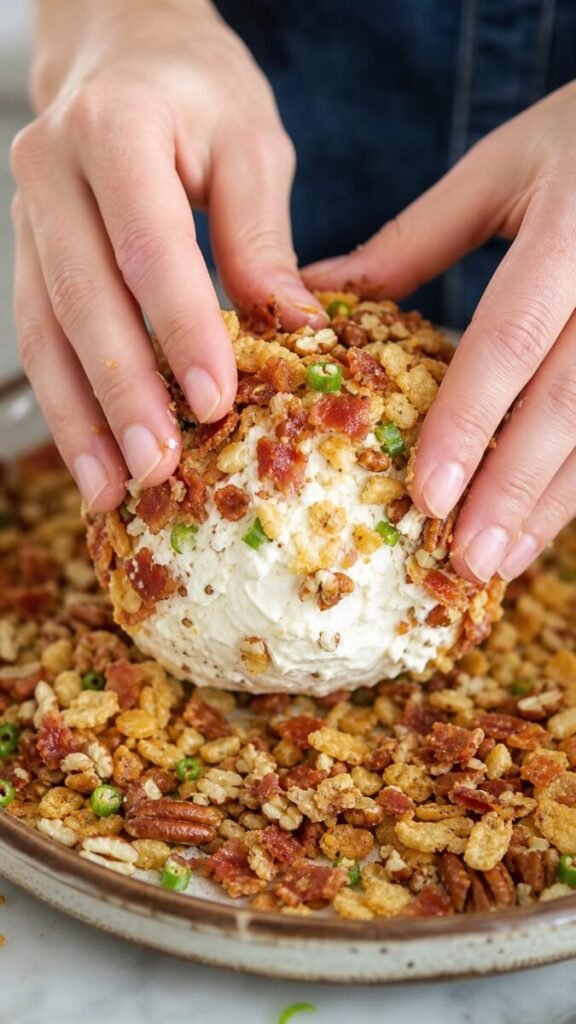
- Step 5 — The cowboy crust. On the rimmed plate, combine the two reserved crumbled bacon slices, the chopped pecans, the crushed chips, the cilantro, and the pinch of chili powder. Unwrap the cold ball and roll it in the crust, pressing firmly with your palms so the coating adheres and sticks in a thick, even layer — this is pressing, not dusting, and it takes a minute of real pressure. Patch any bare spots by pressing crumbs on with your fingers. The finished ball should look rough, rustled, and completely covered, with no cream cheese showing through anywhere.
- Step 6 — The board and the drizzle. Set the ball on the wooden board and give it 20 to 30 minutes at room temperature before serving — straight-from-the-fridge cheese ball is too firm to spread, and a softened one sweeps onto a chip like frosting. Arrange the wavy chips, pretzel crackers, celery sticks, and red pepper strips around it, drizzle the ranch over the top in ribbons, and scatter a few cilantro leaves and thin jalapeño rings for color. Then stand back: the first crack into the ball is the party’s starting gun, and the board empties on a predictable schedule. Bring the recipe card, because someone will ask, and they will ask with their mouth full.
Cheese balls are a family tradition at this point — this spicy cowboy is the newest member of the cheeseball recipe collection, and the spreadable sibling of the secret jalapeño cream cheese dip that started it all.
Anna’s Kitchen Notes
Soften the cream cheese for real. An hour on the counter, still wrapped — not ten minutes, not a hopeful 30 seconds in the microwave that melts the edges while the middle stays cold. Cold cream cheese beats into permanent lumps that no amount of stirring fixes, and a lumpy ball reads as unfinished from across the room. If you forgot until the last minute, cut the blocks into cubes and spread them on a plate for fifteen minutes; the increased surface area speeds things up honestly. The microwave remains the enemy: melted cream cheese breaks the set, and the set is the whole ball.
The heat dial is in the ribs. Jalapeño heat lives mostly in the white ribs and the seeds attached to them, not the green flesh — so the pepper prep is the spice decision. I seed and rib all six, then fold the seeds and ribs of two back in, finely minced: the ball lands warm and friendly, with an occasional bright spark. Zero ribs makes it mild enough for a church picnic; four makes it a conversation piece. And remember that roasting already tamed a third of the heat — taste a piece of the charred, seeded pepper before you commit, because jalapeños vary from mild to fiery with no warning label.
Sharp cheddar, or don’t bother. The cheese is two-thirds of the ball’s volume, and its personality is the ball’s personality. Mild cheddar makes a creamy, forgettable base; extra-sharp gives the ball its tang and its edge, and it stands up to the bacon and the smoke instead of hiding behind them. Grate it yourself if you can — pre-grated cheese is coated in anti-caking starch that makes the mix grainy — and save a pinch of it to sprinkle into the crust for color. Two blocks of cream cheese, one and a half cups of sharp cheddar: that ratio has never needed adjusting.
Make-ahead: the ball waits, the crust doesn’t. The mix — and even the shaped, uncoated ball — keeps beautifully for two days in the fridge, and the flavor genuinely improves overnight as the smoke and the spice soak into the cream. The crust is a same-day job: crushed chips and crisped bacon both soften in the fridge’s humidity, and a crust applied Thursday for a Saturday party is a crust that arrives chewy. The split is easy: mix and shape ahead, roll in the crust an hour before the doorbell, and your party-day workload drops to ten minutes.
Pat the corn dry. Really dry. Corn is the one ingredient that can waterlog the ball — a wet ⅓ cup of corn turns the bottom of the ball weepy over two days in the fridge. After charring (or draining the canned version), spread it on a paper towel and press another one on top. The same rule applies to anything else moist you might fold in: roasted red peppers, canned chiles, even the cilantro — wet hands wrung and patted, always. The ball’s texture is a moisture budget, and everything pays in.
The Party Corral
The ball is the rich centerpiece, so the board around it wants crunch and fresh. It comes with its own dippers built in — chips, pretzel crackers, celery, and peppers — but the wider table can hold a bowl of Rotel sausage balls for the hot-and-savory faction, and the ranch Ritz crackers on the side have a habit of disappearing into this ball two at a time.
For a bigger spread, add the Texas Trash Dip — the warm, melty counterpart to this cold, creamy ball — and a plate of Hog Pogs for the kids’ end of the table. Cold ball, hot dip, something on a stick: that’s a full appetizer table by any standard, and it feeds a surprising number of people before dinner is even mentioned.
Same Ball, Different Rodeo
The cactus-free version. Skip the jalapeños entirely and double the charred corn with a pinch of chipotle powder — the ball goes sweet-smoky and mild, and becomes the version that travels to spice-shy crowds and kids’ parties without a single warning label. Same crust, same board, different audience, zero complaints.
The smoky trout detour. Fold in a cup of flaked smoked trout or hot-smoked salmon in place of the bacon — the ball goes elegant, the crust swaps to toasted pecans and dill, and suddenly it belongs on a holiday board with crackers and champagne. This is the version my sister requests for Christmas, and I have stopped pretending it’s the same recipe wearing a hat.
The log, for easy slicing. Shape the chilled mix into a log instead of a ball, roll it in the same crust, and slice it into rounds for a cocktail party — one slice per cracker, no spreading required, and the ratios per bite come out perfect. The log also packs into a cooler more forgivingly than a sphere, which matters if your potlucks involve distance.
The mini-ball herd. Divide the mix into eight walnut-size balls, coat each, and serve them as individual portions with a chip stabbed into each one — party food that solves its own serving problem. Kids choose a whole ball over a shared big one every single time, and adults, it turns out, are no different.
The hatch green chile version. In late summer, swap the jalapeños for fresh Hatch chiles — same broiler treatment, same everything else — and the ball tastes like New Mexico in August. It’s the one seasonal variation worth planning a party around, and around here, we have.
The Grazing Count
| Nutrient | Per Serving (2 tbsp, 1 of 24) |
|---|---|
| Calories | 110 kcal |
| Protein | 3 g |
| Carbohydrates | 2 g |
| Fats | 9 g |
Estimates for the ball with its crust and a conservative pour of the ranch drizzle, dippers counted as their own business. At two tablespoons a serving — a fair, generous swipe-allowance — this ball serves twenty-four as a party appetizer, which makes it one of the cheapest-per-serving things on the entire snack shelf. The fats are cream cheese, cheddar, bacon, and pecans, which is to say the flavor section of the ledger; the carbs stay low enough that keto guests will make a beeline for it, and they always do. As always, estimates — and nobody at a party has ever eaten exactly two tablespoons of anything, including the person writing this.
Keeping the Ball
The uncoated ball keeps beautifully: two days wrapped tightly in the fridge, and it’s honestly better on day two, after the char and the smoke have had a night to soak into the cream. Once coated, the clock is shorter — the crust holds its crunch for a day, mellowing to chewy by the second — so the practical schedule is shape ahead, crust on serving day, and serve within four hours of coating at the outside. Leftover coated ball still eats fine the next day; it just eats quieter.
Freezing works on the uncoated ball alone: wrap it double and freeze up to a month, thaw overnight in the fridge, then coat fresh and serve. The texture survives the round trip well — cream cheese is a forgiving freezer — though the charred corn comes back a shade softer, so pat it as dry as you can before freezing. A frozen uncoated ball in the deep freeze is the host’s emergency button: ranch, chips, and ten minutes stand between you and an unplanned party.
The serving-time rule that matters: once the ball has been at room temperature for more than two hours, wrap up what’s left and refrigerate it — cream cheese and bacon are sturdy, but party hours are party hours, and the food-safety math doesn’t care how good the ball is. Properly stored leftovers make an excellent spread for toast, biscuits, or a burger bun the next day, applied generously, with hot sauce. In my experience, that “next day on a biscuit” phase of the cheese ball’s life is one of the great under-discussed pleasures of party cooking.
Where It Goes Wrong
A lumpy, grainy ball. The cream cheese went in cold. Cold blocks never fully incorporate — they beat into flecks that stay flecks — and the fix is entirely upstream: a full hour of softening, and a minute of beating the cream cheese alone before anything else joins. If the mix is already lumpy, a fork-mash against the bowl wall smooths most of it, but prevention is the honest answer.
A ball that slumps and spreads. It skipped or shortened the chill, or the sour cream got enthusiastic. Cream cheese sets with cold and time — the full hour — and a warm ball holds nothing. If it’s already soft, re-wrap it and give it another forty-five minutes in the fridge; the shape recovers. And if it softens badly, serve it as the world’s best dip with a spoon and a shrug. Flavor survives; only the geometry suffers.
A bland ball despite plenty of ingredients. Under-salted, under-limed, or cheddar that wasn’t sharp. Cream cheese is a flavor sponge and it eats seasoning for sport — which is why the mix gets tasted on a chip before it ever chills. Fix salt first (a quarter teaspoon at a time), then lime, then heat. A ball that tastes “fine” warm will taste quiet cold, and cold is how it gets served.
A weepy, wet patch on the board. Moisture got folded in — unpatted corn, weepy roasted peppers, wet cilantro. The moisture collects and pools as the ball sits, and by hour two the board has a moat. Pat every add-in dry as a habit, and if you’re making the ball a day ahead, fold the corn in on day-of rather than letting it sit in the mix. Dry ingredients, dry hands, dry ball — that’s the whole religion.
A crust that falls off in sheets. It was dusted on instead of pressed, or the ball was too cold and slick for it to grab. Take the ball out of the fridge ten minutes before coating, then press the crust on with real palm pressure, a minute of it, turning the ball as you go. The coating should look shoved into place — because it was, and that’s what makes it stay.
Raw-pepper heat that overwhelms everything. The jalapeños skipped the broiler. Raw jalapeño heat is sharp and one-note and it dominates a cream base in a way roasted heat never does — roasting rounds it. If you’re already committed and the mix tastes too hot, more cheddar and a squeeze more lime will pull it back toward balanced, but the real cure is ten minutes under the broiler next time. This is the step the whole recipe is named for, and it’s the one that can’t be skipped.
Rodeo Questions
Can I use canned roasted jalapeños or green chiles?
Yes — a 4-oz can of fire-roasted diced green chiles, drained very well and patted dry, is the honest shortcut, and it lands about eighty percent as good. You lose a little of the fresh char character, and the canned version runs milder, so add the cayenne and consider a pinch of chipotle powder to buy back the smoke. On a Tuesday, this substitution is completely correct, and I’ve made the ball this way plenty.
How spicy is the ball, honestly?
As written — six jalapeños, seeded, with two peppers’ ribs returned — it’s a warm, friendly heat that most tables handle happily. Roasting genuinely tames jalapeños, so the flavor lands smokier than it does hot. The dial is entirely in the ribs and seeds, and you can run it from mild (no ribs) to lively (four peppers’ worth). Taste a piece of your roasted, seeded pepper before you decide — jalapeños swing wide, and yours may be milder or meaner than average.
Can I serve it as a dip instead of a ball?
Any time — skip the shaping and the coating, spread the mix into a serving dish, and top it with the crust ingredients scattered over plus the ranch drizzle. It’s the same recipe in its other uniform, and it keeps better as a dip, since there’s no geometry to protect. The ball exists for drama and travel; the dip exists for Tuesday. Both are correct.
How far ahead can I make it?
The mix or the shaped, uncoated ball: up to two days ahead, refrigerated and wrapped, and it improves overnight. The crust: day-of, within a few hours of serving. The full timeline for a Saturday party looks like Friday evening mix-and-shape, Saturday afternoon crust-and-board, and the ranch drizzle right at the doorbell. The schedule is the recipe’s only real demand, and it’s a polite one.
Is there a vegetarian version?
A strong one: skip the bacon, add a quarter teaspoon of chipotle powder and an extra pinch of smoked paprika to the ball for the smoke the bacon was carrying, and build the crust from the toasted pecans, crushed chips, and crispy fried onions. Smoked almonds in the crust are even better if you can find them. The ball loses nothing structurally and honestly not much in flavor — smoke was always the point of the bacon, and there’s more than one source.
Why did my ball sweat on the board?
Either moist add-ins (see the mistakes — pat everything dry) or a straight-from-the-fridge ball meeting warm room air, which pulls condensation onto its surface. The latter is harmless and disappears as the ball softens; the twenty-minute rest before serving mostly prevents it. If a chilled ball must go straight to the table, blot it gently with a paper towel before the crust — or better, plan the rest and skip the sweat entirely.
Can I freeze it?
Yes — uncoated, double-wrapped, up to a month. Thaw overnight in the fridge, coat fresh, and serve; the texture holds up well. Don’t freeze the coated ball — the crust’s crunch doesn’t survive the thaw, and a chewy crust undersells everything the ball worked for. Freeze the future, coat the present: that’s the whole storage philosophy in six words.
Roasted peppers · Creamy cheddar center · Crunchy crust
Cheese Ball: Spicy Roasted Jalapeño Cowboy Cream Cheese Dip
Roasted jalapeños, sharp cheddar, charred corn, and crisp bacon folded into cream cheese, chilled into a ball, and coated with toasted pecans, bacon, and crushed potato chips. Finish with ranch and cilantro for a shareable party centerpiece.
As an Amazon Associate I earn from qualifying purchases.
Ingredients
The roasted heat
- 6 medium jalapeños
- A little olive oil, for lightly coating the peppers
- ⅓ cup charred or fire-roasted corn, cooled, drained, and patted dry
The creamy center
- 16 oz full-fat block cream cheese, softened but not melted
- 1½ cups shredded sharp cheddar
- 2 tablespoons sour cream
- 6 slices bacon, cooked crisp, cooled, and crumbled — 4 slices for the filling and 2 reserved for the crust
- 3 green onions, thinly sliced
- 1 clove garlic, finely grated
- 1 tablespoon fresh lime juice
- 1 teaspoon smoked paprika
- ½ teaspoon ground cumin
- 1 pinch cayenne pepper, or to taste
- Up to ½ teaspoon salt, to taste
The cowboy crust & finish
- Reserved 2 slices of cooked bacon, finely crumbled
- ⅓ cup pecans, toasted, cooled, and finely chopped
- 1 cup wavy potato chips, measured before crushing into coarse crumbs
- 1 tablespoon chopped cilantro, plus leaves for garnish
- 1 pinch mild American-style chili powder blend
- A few tablespoons ranch dressing, for drizzling
- Thin slices of additional jalapeño, optional garnish
For the board
- Extra wavy potato chips and pretzel crackers, as desired
- Celery sticks and red bell pepper strips, as desired
The cheese ball kit
- Broiler-safe metal sheet pan
- Tongs and oven mitts
- Heatproof bowl with a lid or plate, for steaming peppers
- Skillet, for the bacon and pecans
- Mixing bowl and sturdy spatula
- Plastic wrap
- Rimmed plate, for coating
- Serving board and cheese spreader
- Food-safe gloves, recommended for handling chilies
Roasting changes flavor, not a predictable amount of heat: jalapeños vary widely. Removing the white inner ribs reduces heat, but does not guarantee a mild ball. Add the roasted peppers gradually and taste before adding cayenne.
Firm, not warm: use block cream cheese, cool all cooked add-ins, and thoroughly dry the corn and peppers. A large cheese ball may need longer than 1 hour to become firm enough to coat.
How to make it
-
Roast, steam, and chop the jalapeños
Heat the broiler and position the rack according to your oven’s instructions, usually about 6 inches below the element. Lightly coat the jalapeños with olive oil and place on a broiler-safe metal pan without parchment. Broil for roughly 4–5 minutes per side, watching continuously and turning with tongs, until blistered in patches and softened. Transfer to a heatproof bowl, cover, and steam for 5 minutes. Once safe to handle, peel away loose charred skin, remove stems, and remove the seeds and white ribs as desired. Finely chop, pat dry, and let cool.
-
Cook the bacon and prepare the crunchy ingredients
Cook the bacon in a skillet over medium heat until fully cooked and crisp. Drain, cool, and crumble; reserve two slices’ worth for the crust. In a clean, dry skillet, toast the pecans over medium-low heat for about 3–5 minutes, stirring frequently, then transfer to a plate to cool before chopping. Drain canned fire-roasted corn thoroughly. If using frozen corn, cook according to its package instructions before briefly charring in a hot skillet. Cool and pat dry before measuring ⅓ cup for the filling.
-
Mix the creamy filling
Beat the softened cream cheese until smooth. Fold in the cheddar, sour cream, four slices’ worth of cooled bacon, corn, green onions, garlic, lime juice, smoked paprika, and cumin. Add the cooled roasted jalapeños gradually to suit your heat preference. Taste with a chip, then add cayenne and salt only as needed; the bacon, cheese, and coating already bring salt. Keep the filling thick rather than adding extra sour cream.
-
Wrap and chill until firm
Spoon the filling onto a large piece of plastic wrap. Gather the wrap around it and gently shape into a rounded ball. Place on a plate and refrigerate at 40°F or below for at least 1 hour, or longer until firm throughout and able to hold its shape. Refrigerate the reserved cooked bacon separately. Reshape the ball through the wrap after chilling if needed.
-
Press on the cowboy crust
Shortly before serving, combine the reserved bacon, cooled toasted pecans, crushed potato chips, chopped cilantro, and chili powder on a rimmed plate. Unwrap the cold cheese ball and roll it gently in the coating, pressing crumbs onto bare spots with clean hands. If the surface is too firm for the coating to adhere, let it soften for a few minutes, then try again. Keep refrigerated until close to serving time.
-
Finish the board and serve
Place the coated ball on a serving board with a spreader. Allow about 15–20 minutes at room temperature for easier spreading, counting this toward its total time out of refrigeration. Arrange chips, pretzel crackers, celery, and pepper strips around it. Drizzle with ranch just before serving and finish with cilantro leaves and optional fresh jalapeño rings.
Party food safety: keep track of cumulative time out of refrigeration, including cream-cheese softening, mixing, coating, and serving. Refrigerate before reaching 2 hours total, or 1 hour when temperatures exceed 90°F; discard perishable food left out longer. Chilling does not reset that clock. For longer parties, serve smaller portions and replenish from the refrigerator.
Allergen check: this recipe contains dairy and pecans. Ranch may contain egg, and pretzel crackers usually contain wheat. Check all packaged ingredients and clearly label the board for guests.