Authentic Tom Kha Gai Soup
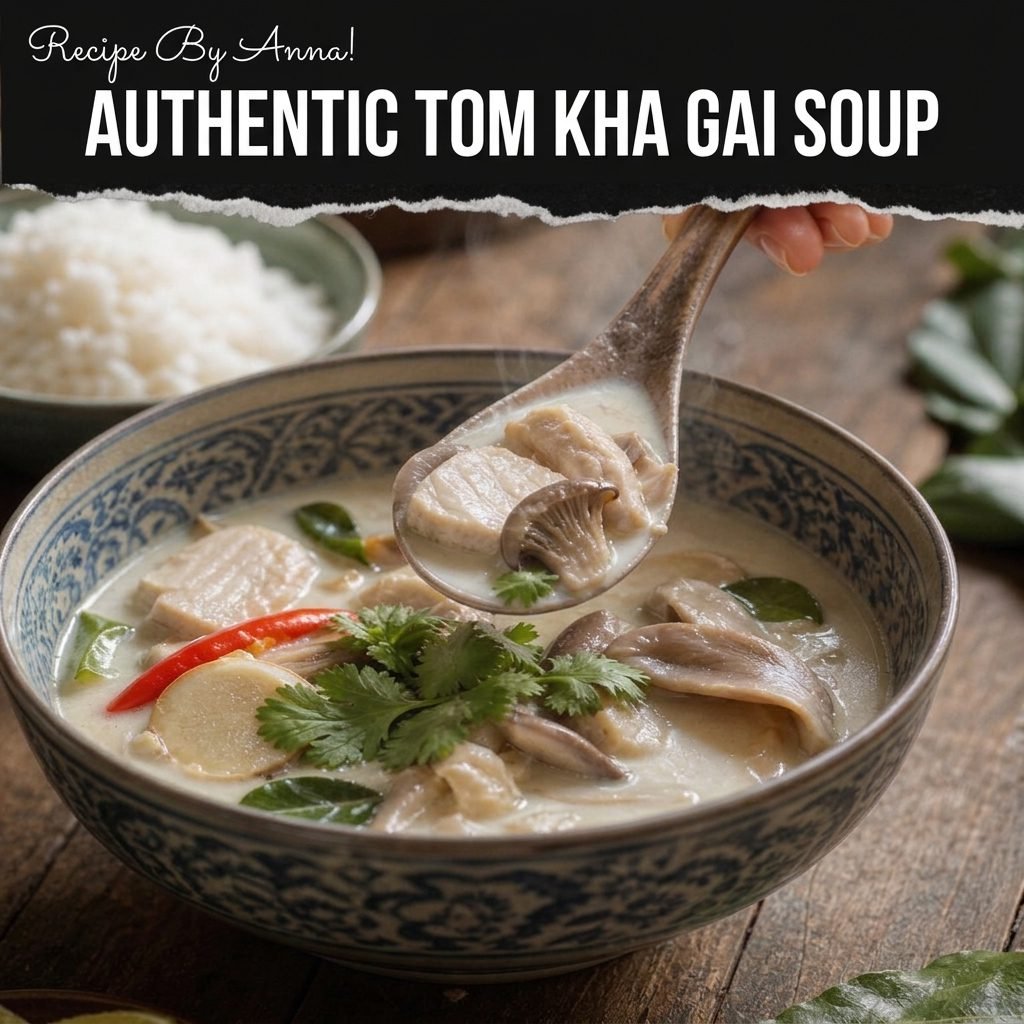
Tom kha gai is the soup I make when I want Thai restaurant flavor from my own stove, and the honest secret is that it’s easier than almost anything else in the Thai repertoire. Chicken and oyster mushrooms in a coconut broth perfumed with galangal, lemongrass, and makrut lime leaves, seasoned with fish sauce and palm sugar, finished with lime — about forty minutes, one pot, and a short shopping list from the international aisle. The name translates roughly to “boiled galangal chicken,” which tells you right away where the flavor lives: not in a curry paste, not in a blender, but in three fresh aromatics steeped in coconut milk like a tea.
Here’s the part worth understanding before you cook, because it’s what separates the authentic bowl from the imitations. Tom kha is an infusion, not a stew. The galangal gets sliced into coins, the lemongrass gets bruised and cut into batons, the lime leaves get torn — and all of it goes into the pot in pieces so large you’ll fish them out as you eat, exactly the way it’s served in Thailand. Nothing is minced, nothing is ground, nothing is blitzed. Those volatile oils release slowly into the broth over a gentle five-minute simmer, the way flavor steeps out of tea leaves, and the result is clean, floral, and bright instead of muddy and sharp. Every shortcut that pulverizes the aromatics makes the soup worse, and every restaurant bowl you’ve loved was made this exact way: big pieces, low heat, patience.
A few honest notes before you start. Galangal is the one ingredient I won’t let you skip — it’s the “kha” in the name, and its peppery, citrusy, almost piney flavor is something ginger genuinely cannot imitate (more on where to find it below). The coconut milk goes in after the broth, and the soup never boils hard from that point — a rolling boil breaks coconut milk into oily curds, and a gentle braise keeps it silky. And the lime juice goes in off the heat at the very end, always, because cooked lime turns flat and bitter while fresh lime is the top note the whole bowl is built around. Serve it with jasmine rice, not before it — in Thailand this is a rice-accompanying dish, eaten spoon-and-fork style, and it’s the correct way.
The Infusion Rule
Let’s talk about why the pieces stay big, because it’s the technique the entire recipe hangs on. Aromatics carry their flavor in volatile oils — compounds that are released by heat, time, and surface area. Mince galangal and lemongrass finely and you get a huge surface area releasing everything at once: the first minute tastes explosive, the next ten taste cooked-down and dull, and the broth goes hazy. Cut them large and bruise them instead — the back of a knife cracking the lemongrass fibers, the lime leaves torn so their oil glands open — and the extraction happens slowly and gently, over a low simmer, giving up perfume instead of pulp. The broth stays clear-ish and pale, the flavor stays bright for the whole bowl, and the aromatics do their job and then politely step aside. It’s the same reason a whole cinnamon stick beats cinnamon powder in a curry, and once you cook this way, you start noticing it everywhere.
Then the balance, which in Thailand is treated as five dials, not a recipe. Salty: fish sauce, and it must be fish sauce — soy sauce makes the broth darker and flatter in a way everyone notices. Sour: lime, added off the heat. Sweet: palm sugar, just enough to round the coconut’s own sweetness, never enough to make the soup sweet. Spicy: Thai chilies, smashed and dropped in whole, where they perfume the broth without detonating it — the heat arrives as a warm glow you can dial up by actually eating one. Rich: the coconut milk itself, which carries all four of the other flavors and softens their edges. The authentic bowl sits in the middle of all five, and the final taste-and-adjust — a splash more fish sauce, a squeeze more lime — is not optional. It’s the last step of the recipe and the first thing a Thai cook would check.
The chicken gets the same treatment as the aromatics: gentle. Boneless thighs poach in the broth at the barest simmer until just tender — fifteen minutes — because thighs hold up to poaching where breast meat turns to cardboard, and because the poaching liquid becomes the soup, so the chicken flavors the broth while the broth flavors the chicken. They come out, get sliced or shredded, and go back in at the end just to warm through. The mushrooms — oyster mushrooms, the traditional choice, torn into strips along their gills — need only the final five minutes, and they arrive silky and soaked with broth. That’s the whole dish: an infusion with passengers.
⏱️ 40 MIN | 🍵 STEEPED, NEVER BLENDED | 🥥 GALANGAL IS NOT OPTIONAL
- Prep Time: 15 minutes
- Poach Time: 15 minutes
- Infusion: 5 to 8 minutes
- Total Time: 40 minutes
- Yield: 4 bowls with rice, or 6 as a starter
The Tom Kha Kit
One pot and a knife — this is a short-equipment recipe:
- Medium pot, 3 to 4 quarts — wide enough to poach the thighs without crowding.
- Heavy knife — for bruising the lemongrass with the flat of the blade and slicing the galangal thin.
- Cutting board — one end for aromatics, one for the raw chicken, or do the aromatics first.
- Tongs or a slotted spoon — for lifting the chicken out to slice.
- Mortar and pestle, optional — the traditional tool for bruising lemongrass and chilies; the flat of a knife does the same job in the same time.
- Ladle — for the bowls, and for tasting from the middle of the pot where the seasoning is honest.
- Small bowl of jasmine rice per person — the official accompaniment, and the soup’s best friend.
Ingredients (With Labels)

🍗 The Base
- Chicken thighs: 1 lb boneless, skinless
- Chicken broth: 2 cups
- Salt: ½ teaspoon
🌿 The Three Aromatics
- Galangal: a 3-inch knob, sliced into 12 to 15 thin rounds — fresh or frozen, never dried
- Lemongrass: 2 stalks, bottom third only, bruised and cut into 2-inch batons
- Makrut lime leaves: 5 to 6, torn in half, center rib removed — frozen work beautifully
🥥 The Coconut Pot
- Full-fat coconut milk: one 13.5-oz can
- Oyster mushrooms: 5 oz, torn into strips
- Thai chilies: 2 to 4, smashed with the flat of a knife
- Fish sauce: 2 tablespoons, plus more for the final adjustment
- Palm sugar: 2 teaspoons, finely chopped (light brown sugar in a true emergency)
🍋 The Finish
- Lime: 1 large, juiced off the heat
- Cilantro: a handful of leaves and tender stems, for the bowls
- Jasmine rice: cooked, for serving — the traditional partner, not a garnish
Step by Step How to Make
- Step 1 — Bruise and slice the aromatics. Prep the three ingredients that are the soup. Trim the lemongrass to the bottom third — the pale, swollen part — and peel off any dry outer layer. Smash each stalk flat with the side of your knife until the fibers split and it smells loud, then cut into 2-inch batons. Slice the galangal crosswise into thin rounds — thin enough to be flexible, about the thickness of two quarters, because thick slices hoard their flavor and never give it up. Tear the makrut lime leaves in half and pull out the tough center rib, which is bitter and sharp-edged. Smash the chilies with the flat of the knife, just until they blister.
- Step 2 — Poach the chicken gently. Bring the broth and salt to a boil in the pot, then slide in the chicken thighs and drop the heat until the liquid barely trembles — a lazy, occasional bubble, not a boil. Poach 12 to 15 minutes, until the thighs are just cooked through. Lift them out onto the board to rest and slice into bite-size strips. The poaching broth has been quietly becoming chicken broth-plus this whole time, and it’s about to become the soup.

- Step 3 — Coconut goes in, heat goes down. Pour the coconut milk into the broth and stir. From this moment the soup never boils again — coconut milk that boils hard separates into oil and curds, and the silky texture you’re paying for is gone. Keep it at the gentlest simmer your stove can hold, the surface barely moving. Add the galangal rounds, lemongrass batons, torn lime leaves, and smashed chilies, and let them steep 3 to 4 minutes, until the kitchen smells floral and citrusy and faintly peppery. This is the tea-brewing stage of the recipe.
- Step 4 — Mushrooms, chicken, the two seasonings. Stir in the oyster mushrooms, the sliced chicken, the fish sauce, and the palm sugar. Simmer gently 4 to 5 minutes more — just enough for the mushrooms to turn silky and drink the broth, and for the chicken to warm back through. The aromatics keep working the whole time; that’s fine, that’s the design.

- Step 5 — Off the heat, then lime. Turn the burner off. Now — and only now — squeeze in the lime juice and stir. Taste, and adjust like a Thai cook would: a splash more fish sauce if it needs depth, a squeeze more lime if it needs lift, a pinch more sugar if the coconut reads flat. The soup should taste balanced in all directions at once — salty, sour, sweet, creamy, warm — with no single note winning. When you taste it and involuntarily say “oh,” it’s ready.
- Step 6 — Bowls and rice. Ladle the soup into bowls, making sure each one gets a fair share of chicken and mushrooms — and, yes, a galangal round or two and a lemongrass baton, which are meant to be seen and left at the side of the bowl as you eat. Scatter cilantro over each bowl and set out the jasmine rice. The traditional way to eat it: a spoonful of soup, a bite of rice, alternating — the rice is the temperature-and-richness valve that keeps the balance going bite after bite. Napkins advised; the broth at the bottom is where the flavor concentrates, and someone at your table will drink it from the bowl. Historically, it’s me.

Thai night at our table is a rotation, not a single dish — this pot is the soup course, and the Thai chicken skewers with coconut-milk glaze are what’s coming off the grill beside it.
Anna’s Kitchen Notes
Finding galangal, honestly. Any Asian grocery carries fresh galangal — look for a firm, tan, knobby root that looks like ginger’s more serious cousin, and snap off a 3-inch piece if the store sells it by weight. Frozen galangal, sold in the freezer case or from your own freezer, works nearly as well, and frozen slices actually cut cleaner. Dried galangal is a disappointment and powdered is a rumor. If there is truly no galangal to be had, ginger plus a strip of lime zest gets you a different but respectable soup — just know you’ve made ginger-coconut soup with a Thai accent, and the soup knows it too.
Makrut lime leaves freeze like a dream. These dark, double-lobed leaves are the soup’s perfume — floral, resinous, and completely unsubstitutable by regular lime. Buy the whole pack, use your six, and freeze the rest in a zip-top bag straight away: they hold their oils for months, and you can tear them straight from frozen. This is the single ingredient most people skip, and the one that makes people ask what your secret is. It’s the leaves. It’s always the leaves.
Fish sauce is the salt here — treat it with respect, not fear. Two tablespoons in a whole pot sounds bold until you remember it’s doing the job salt does everywhere else, with umami as a bonus. The broth will not taste fishy; it will taste seasoned and deep, the way a restaurant broth tastes. Use a Thai or Vietnamese brand if you can (they’re gentler and less salty than some others), and keep the bottle on the counter for the final adjustment — the difference between a good bowl and a great one is usually one more teaspoon at the end.
The boil that breaks the broth. Coconut milk is an emulsion, and a hard boil is the fastest way to scramble it — the fat separates out and the soup goes from silky to speckled and oily. Once the coconut goes in, everything is a tremble, not a bubble. If you see the surface rolling, lift the pot off the burner for a moment and drop the heat. This one bit of patience is most of the texture, and the texture is most of the luxury.
Oyster mushrooms, torn not cut. The traditional mushroom for this soup, oyster mushrooms tear cleanly along their gills into ragged strips that drink broth better than any knife-cut edge, and their silkiness against the coconut is part of the authentic experience. Cremini, beech, or even sliced button mushrooms all work — but tear the oysters if you’ve got them. And if the cluster has a tough base, trim it; the rest wants only to be pulled apart and dropped in.
The Thai Table
Tom kha is one course of a Thai table, not the whole story. Beside the bowl: jasmine rice for every person, and something with a char on it — our coconut-glazed Thai chicken skewers are the house pairing, or a plate of simply stir-fried greens like Garlic Bok Choy, whose bitterness is exactly what a rich coconut broth wants next to it.
For a fuller Thai spread, whip up a batch of our Thai peanut sauce for dipping anything grilled, or push the table wider across Asia with the Sichuan Dan Dan Noodles — the numbing-spicy counterpoint to this bowl’s creamy-gentle — and the Potsticker Noodle Bowl for the other noodle-soup nights. And on soup weeks, this pot trades shifts with the Hot and Sour Soup: hot-and-sour for the days you want vinegar and white pepper, tom kha for the days you want coconut and calm.
Tom Kha, Rewired
Tom kha with shrimp. Swap the chicken for half a pound of shell-on or peeled shrimp, added raw for the final 3 minutes only — they cook fast, and overcooked shrimp is the one crime this soup can’t absorb. The shells, simmered in the broth for five minutes before straining, make it better. This version is arguably even more traditional than the chicken one; “gai” is simply what this recipe grew up calling it.
The mushroom-only version. Skip the chicken, use mushroom or vegetable broth, and double the oyster mushrooms — the soup becomes fully vegetarian with the fish sauce swapped for a salty soy or mushroom sauce, and it loses remarkably little. The aromatics were always the headline; the mushrooms happily carry the rest of the front page.
Tom kha noodles. Ladle the finished soup over a nest of cooked rice noodles in wide bowls — the coconut broth clings to them, and the soup crosses into full-meal territory with no other changes. Wheat noodles or thin rice vermicelli both work. This is weeknight tom kha at my house, and it’s dangerous knowledge.
The richer version. Thai cooks sometimes use “cream” — the thick coconut cream from the top of an undisturbed can — and simmer it briefly with the aromatics before the thinner milk goes in. It deepens the body noticeably. If your can has a distinct thick layer on top, use it this way and stir the rest in as usual. One extra step, one degree of luxury.
The winter vegetable detour. Cubed kabocha or delicata squash, simmered with the aromatics until tender, turns the soup golden and heartier — a December version that drifts toward stew. Baby corn and halved cherry tomatoes are the other classic add-ins; the tomatoes burst into the broth and add a gentle sweetness that’s very much at home here.
The Broth Tally
| Nutrient | Per Bowl (1 of 4) |
|---|---|
| Calories | 410 kcal |
| Protein | 27 g |
| Carbohydrates | 12 g |
| Fats | 29 g |
Estimates for the soup as written, rice counted as its own honest business on the side. Twenty-seven grams of protein per bowl is real dinner territory for a soup — the thighs and the mushrooms split the work — and the fats are overwhelmingly coconut, which is to say the satisfying kind that also happens to make the broth taste like a restaurant’s. At twelve grams of carbohydrate, this is one of the lowest-carb bowls on the whole soup shelf, and naturally gluten-free as long as your fish sauce is (most are; a few use wheat — the label knows). As always, estimates, and the chili count is between you and your own tolerance.
Bowls Beyond Tonight
The honest storage news: tom kha is best the day it’s made, when the aromatics are still perfume and the coconut is still silk. It keeps three days in the fridge and reheats gently — low heat, a stir, never a boil — and the flavor deepens overnight, but the delicate top notes fade a little, the way a tea does when it sits. The fix for day two is the revival move: a fresh squeeze of lime and a pinch of cilantro at the bowl, plus one drop of fish sauce if it tastes like it lost its floor. Thirty seconds, and yesterday’s soup remembers itself.
The smarter make-ahead is the split: the broth base — poached chicken, broth, coconut, aromatics — can be made a day ahead and reheated to a tremble, with mushrooms, fish sauce, sugar, and lime held for the last five minutes. The infusion actually benefits from the overnight, like most broths. The aromatics can stay in the fridge pot and go one more round, though round two is noticeably gentler — add one fresh torn lime leaf and one new galangal round when you reheat, and the perfume comes back.
Freezing works with a caveat: coconut milk soups can separate slightly in the thaw, and a vigorous stir over low heat brings most of the silk back. Freeze without the lime juice (add it fresh at serving) and expect the mushrooms to come back a shade softer. A frozen quart of tom kha base in January is still a genuinely good dinner, and I keep one in there on purpose — but the fresh pot is the reason the recipe exists, and Sunday is a fine day for it.
Where It Goes Wrong
A greasy, speckled, broken broth. It boiled hard after the coconut went in. Coconut milk is an emulsion — fat suspended in water — and a rolling boil forces the two apart, leaving oil slicks and grainy curds. From the coconut moment onward, the pot trembles. If it breaks anyway, low heat and patient whisking can bring it mostly back, but prevention is the only real fix.
A soup that tastes like nothing despite good ingredients. The aromatics went in small, or got skipped in favor of curry paste, or the infusion was rushed. Big pieces, gentle heat, five full minutes — that’s the extraction, and there’s no substitute. If the broth tastes thin at the end, it’s almost always the fish sauce that’s missing: one teaspoon at a time until it tastes seasoned, not salty.
Sharp, bitter, perfume-less soup. The lime juice cooked. Squeezed into a simmering pot, lime loses its bright top note and gains an edge of bitterness — it’s the most common home-cook mistake in every Thai soup. The pot comes off the heat first, every time. If it’s already happened, a fresh squeeze stirred in off the heat covers most of the damage.
Muddy, fibrous mouthfuls in every bite. The lemongrass got minced or the galangal got blended in a food processor. Those pieces are meant to be big precisely so they stay in the bowl and out of your teeth — bruised batons and thin coins that steep and step aside. The fiber is the reason; the size is the strategy.
Rubbery, dry chicken. Breasts were used, or the thighs boiled instead of poaching. Thighs at a bare tremble take fifteen minutes and stay tender; breasts at any heat over gentle turn to pencil erasers. If only breasts are available, halve the poaching time and pull them the moment they’re opaque through the middle.
A bowl that’s one note — just creamy, or just sour. The five dials weren’t balanced at the end. The authentic taste is all five at once: salt from fish sauce, sour from lime, sweet from palm sugar, heat from chili, richness from coconut. Taste before serving and fix the quiet dial — a soup that’s only creamy is usually missing fish sauce, and one that’s only sour is usually missing sugar. Adjust in small drops; the balance lives in the teaspoons.
Tom Kha Questions
Can I substitute ginger for galangal?
You can, and you’ll have a pleasant ginger-coconut soup — but it won’t be tom kha, and the name on the pot will know. Galangal is peppery, citrusy, almost piney where ginger is hot and sweet; there’s no overlap in character, only in appearance. Most Asian groceries stock galangal fresh or frozen, and frozen keeps for months. If you make the swap anyway, use a little less than you think and add a strip of lime zest to borrow back some of the citrus notes galangal would have carried.
Where do I find makrut lime leaves?
The fresh herbs or produce cooler of any Asian grocery, often labeled kaffir lime leaves, and increasingly the freezer case — where they’re actually a smart buy, because they hold their oils beautifully frozen and keep for months. Buy the pack, freeze what you don’t use, and tear straight from frozen whenever the pot calls. Online spice merchants sell dried ones; they work in a quiet, diminished way, so use twice as many and add them earlier in the infusion.
Can I use light coconut milk?
You can, and the soup becomes thinner, quieter, and slightly sad about it. The full-fat can is the texture and half the flavor architecture — “light” coconut milk is mostly water with the fat removed, and this is a recipe where the fat is the point. If you must lighten it, go half full-fat and half light rather than all light, and let the aromatics steep a minute longer to compensate.
How spicy is it, honestly?
As written — two to four chilies, smashed and left whole — the broth carries a gentle, building warmth rather than actual heat, because whole chilies perfume more than they detonate. The heat lives in eating one directly, which is a choice each bowl makes for itself. To make it genuinely mild, use one chili and don’t smash it; to make it fierce, slice the chilies into rings and add an extra one. The soup scales in both directions without complaint.
What’s the difference between tom kha and tom yum?
Same family, opposite textures. Tom yum is the clear, brothy, aggressively sour-and-hot sibling — no coconut, more chili, often shrimp, and a louder punch of lime and tamarind. Tom kha is the gentle one: coconut milk softens the same aromatic base into something creamy and round. They share the galangal-lemongrass-lime-leaf spine, which is why learning one puts you most of the way toward the other.
Can I make it in advance for company?
Yes, with the split in my storage notes: make the coconut broth with chicken and aromatics a day ahead, then reheat to a tremble and finish with the mushrooms, fish sauce, sugar, and lime in the last five minutes before serving. The overnight actually improves the broth. What you can’t do is fully finish it and reheat — the lime goes flat and the mushrooms go soft, and the bowl arrives at the table at eighty percent of itself.
Is there a vegan version?
A good one. Vegetable or mushroom broth, extra mushrooms, and the coconut pot unchanged — the aromatics were always the soul. For the fish sauce, use a vegan fish sauce or a light soy with a small pinch of dried mushroom powder for the umami floor, and swap the palm sugar to taste (it’s usually already vegan, but labels vary). The lime-off-the-heat rule survives every version, vegan included, because it’s not an ingredient rule — it’s a law.
Gently simmered · Fragrant aromatics · Lime to finish
Tom Kha Gai — Thai Coconut Chicken Soup
Tender chicken and oyster mushrooms in a coconut broth infused with galangal, bruised lemongrass, and makrut lime leaves. Fish sauce, palm sugar, Thai chilies, and fresh lime bring salty, sweet, spicy, and sour notes to this fragrant Thai soup.
As an Amazon Associate I earn from qualifying purchases.
Ingredients
The chicken base
- 1 lb boneless, skinless chicken thighs
- 2 cups chicken broth, preferably low-sodium
- Up to ½ teaspoon salt, to taste; use less with salty broth
The three aromatics
- 1 approximately 3-inch piece fresh or frozen galangal, sliced into 12–15 thin rounds
- 2 stalks lemongrass, tough outer layers removed, lower pale portions bruised and cut into 2-inch pieces
- 5–6 makrut lime leaves, fresh or frozen, torn with tough center ribs removed
The coconut pot
- 1 can (13.5 oz) unsweetened full-fat coconut milk
- 5 oz oyster mushrooms, tough bases trimmed, torn into strips
- 2–4 Thai chilies, lightly bruised; use fewer for less heat
- 2 tablespoons fish sauce, added to taste, plus more if needed
- 2 teaspoons finely chopped palm sugar, or light brown sugar
The fresh finish
- 1 large lime, juiced, plus extra juice to taste
- 1 handful cilantro leaves and tender stems
- Cooked jasmine rice, for serving
The tom kha kit
- 3–4-quart soup pot
- Sharp chef’s knife
- Separate cutting boards, for raw chicken and ready-to-eat ingredients
- Tongs or a slotted spoon
- Mortar and pestle, optional, for bruising aromatics
- Instant-read food thermometer
- Ladle
- Citrus juicer
Aromatics are for infusing: galangal rounds, lemongrass pieces, and lime leaves are tough and not intended to be eaten. Remove them before ladling, or clearly tell diners to set them aside.
Chili heat varies: even whole, bruised Thai chilies can make the broth quite hot. Start with fewer if sensitive to spice; removing them later will not remove heat already released.
How to make it
-
Prepare the aromatics
Trim the lemongrass to its lower pale portions and remove dry, tough outer layers. Bruise with a pestle or carefully press with the flat side of a broad knife, keeping fingers clear of the blade, then cut into 2-inch pieces. Thinly slice the galangal, tear the makrut lime leaves, and remove their tough center ribs. Lightly bruise the chilies. Wash your hands after handling chilies and avoid touching your eyes.
-
Gently poach the chicken
Bring the chicken broth to a simmer in the pot. Add a little of the salt only if needed, since fish sauce will season the soup later. Add the thighs, arranging them in a single layer as much as possible. Add a small splash of water if needed to nearly cover them. Maintain a gentle simmer and turn the thighs partway through. Begin checking after 12–15 minutes and continue cooking until the thickest part reaches 165°F. Transfer with clean utensils to a clean board, then slice into bite-size strips.
-
Infuse the coconut broth
Stir the coconut milk into the poaching broth and lower the heat to maintain a gentle simmer. Add the galangal, lemongrass, makrut lime leaves, and chilies. Simmer gently for 3–4 minutes, stirring occasionally, until fragrant. Avoid a vigorous rolling boil to help preserve a smooth broth; a little natural coconut oil separation is not a safety problem.
-
Add mushrooms and season
Add the oyster mushrooms, sliced cooked chicken, palm sugar, and about 1 tablespoon of the fish sauce. Simmer gently for another 4–5 minutes, or until the mushrooms are tender and the chicken is hot throughout. Stir in more of the measured fish sauce to taste. The aromatics will have infused for about 7–9 minutes in total.
-
Finish with lime off the heat
Turn off the heat. Stir in the lime juice gradually, tasting as you go. Balance with a little more fish sauce for saltiness, lime for acidity, or palm sugar for a softer finish. Keep the sweetness restrained so the galangal, lemongrass, and lime remain prominent.
-
Ladle into bowls with rice alongside
Remove the tough galangal, lemongrass, and lime leaves before serving, or leave the large pieces visible and tell diners to set them aside rather than eat them. Remove whole chilies if preferred. Divide the chicken, mushrooms, and broth among bowls, scatter with cilantro, and serve with cooked jasmine rice alongside. Start the rice separately according to its package instructions so it is ready with the soup.
Chicken and allergen safety: do not wash raw chicken. Wash and sanitize any board or utensil that touched it before using it for cooked chicken or garnishes. Fish sauce contains fish; check broth and sauce labels if avoiding gluten.