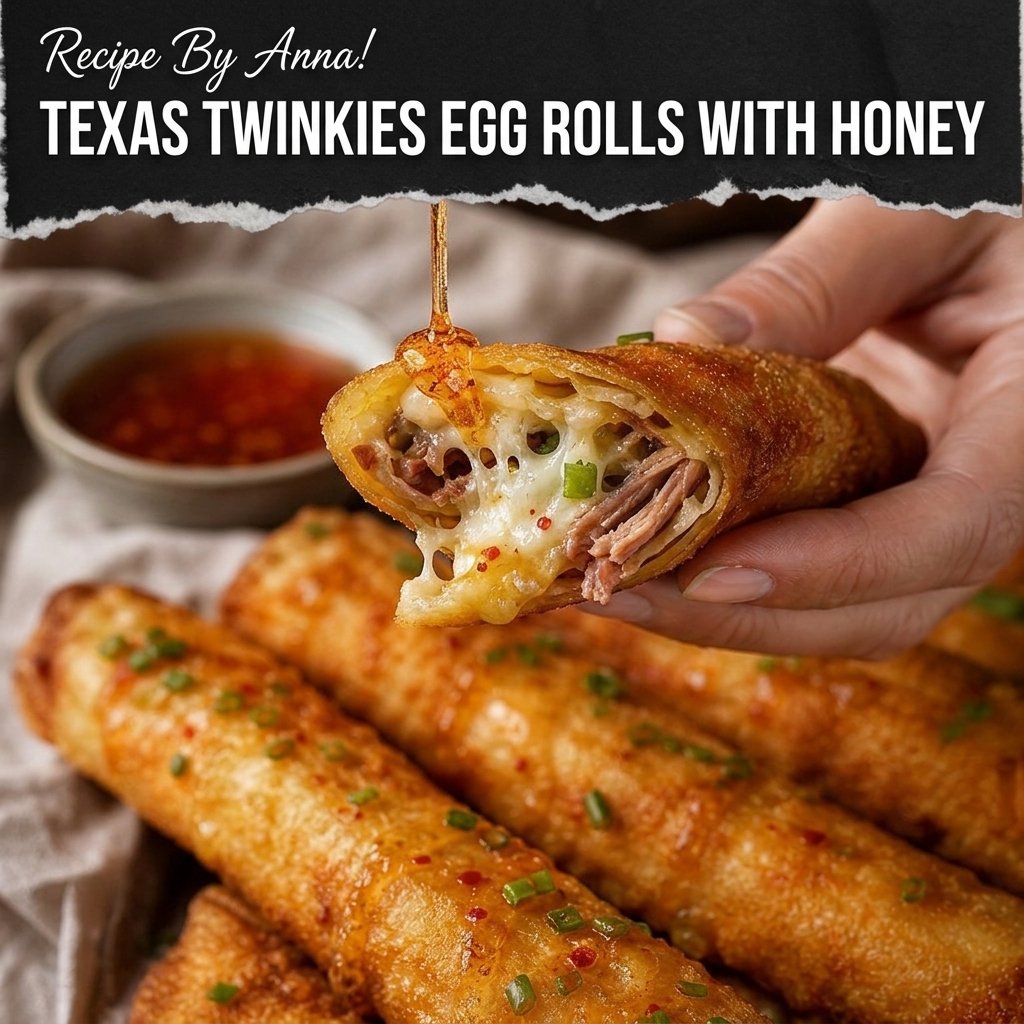
Easy Texas Twinkies Egg Rolls with Honey Recipe
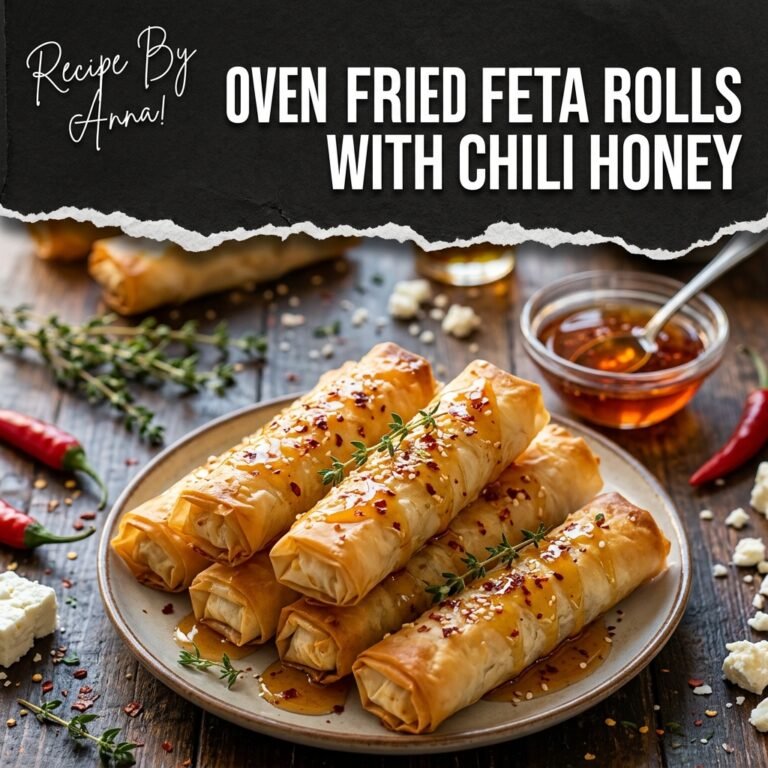
If you’ve ever waited in line at a Texas barbecue joint, you may have seen the tray they pull out between the brisket and the ribs: Texas Twinkies — jalapeños stuffed with cream cheese and smoky chopped brisket, wrapped in bacon, and smoked until everything melts together. They’re the first thing to sell out, every single day, and there’s a reason. This recipe takes that smokehouse legend and hands it to the home fryer: the same filling — brisket, cream cheese, pepper jack, jalapeño — rolled tight in egg roll wrappers and fried to a deep, blistery gold, then finished with warm honey spiked with cayenne. Twelve rolls, about forty-five minutes, and a platter that makes people forget there’s a main course coming.
The name deserves a minute, because it’s doing honest work. The original Texas Twinkies got their nickname the way all good barbecue slang does — somebody looked at a cream-filled, golden, irresistible little thing and the snack cake comparison stuck. The egg roll version keeps everything the name promises: molten cream cheese inside, golden crunch outside, one perfect two-bite package. What the wrapper adds over the traditional bacon wrap is containment and logistics. An egg roll wrapper seals the filling completely — no leaks, no drips, no toothpicks — and it freezes uncooked and fries straight from frozen, which the bacon version simply can’t do. In other words: the smokehouse gets the flavor, the egg roll gets the party plan.
A few honest notes before you start. The filling is best with real smoked brisket — a half pound of leftovers, or a quarter pound bought at the counter specifically for this (a legitimate move, and the BBQ joint will not judge you) — but there’s an honest no-smoker route in the notes below, and it works. Cream cheese is the leak risk in this recipe: it expands when it heats, and an overfilled or loosely rolled egg roll will blow its seam in the oil. The two rules that prevent this — two tablespoons of filling, rolled tight with no air — are written into the steps, and they’re the difference between twelve golden logs and twelve oily casualties. And the honey goes on after frying, warm and spiked with cayenne, so it lacquers the crisp shell instead of soaking it. Hot honey on a hot shell is a five-second job that tastes like a decision.
The Story in the Name
Let’s be precise about what’s happening when this filling hits hot oil, because it explains the rolling technique. Cream cheese is mostly water and fat bound in a tight emulsion — and in a 350°F fryer, that water flashes to steam. The filling literally puffs and swells inside the wrapper as it cooks, which is exactly why the rolls come out taut and molten, and exactly why the rolling has rules. Two tablespoons of filling gives the expansion somewhere to go. A tight, burped roll — pressed gently after each fold so no air pockets hide between wrapper layers — leaves no balloons of steam to blow the seam. A pea-sized chop on the brisket keeps the filling a uniform, rollable paste instead of a lumpy mattress that tears the wrapper from inside. None of this is fussiness; it’s the physics of frying something stuffed with a cheese that wants to become a liquid. Respect the physics and the egg rolls respect you back.
The wrapper itself is the upgrade worth appreciating. Bacon-wrapped Twinkies are magnificent, but bacon needs the smoker’s low-and-slow to render and crisp without incinerating the pepper inside — that’s smokehouse equipment doing smokehouse work. An egg roll wrapper does its job in a pot of oil on any stove in any kitchen in three minutes. It seals fully, so the molten filling stays in the roll instead of on the bottom of your smoker; it fries to a shatter-crisp, blistered gold that bacon can’t match for crunch; and — the quiet superpower — an assembled, uncooked egg roll freezes beautifully and fries from frozen with zero thawing. The BBQ joint sells out of Twinkies daily because bacon-wrapped ones can’t be inventoried. Yours can. Make a double batch, freeze half, and be the person who has smokehouse appetizers on demand.
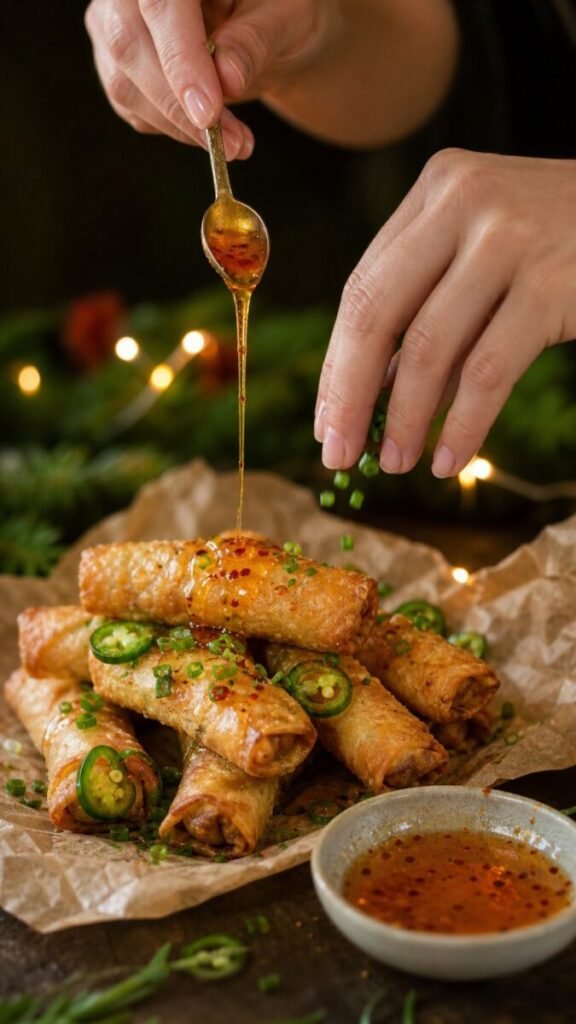
Then the honey, which is not a garnish — it’s the finish that makes the whole concept sing. The filling is smoky, salty, rich, and warm with jalapeño; the shell is savory and crisp. What’s missing is a high, bright sweetness to cut all that fat, and hot honey delivers it with a cayenne warmth that ties back to the smoke. Warm the honey with the cayenne for a minute so the spice actually blooms in it (cold honey plus cayenne tastes like two strangers; warmed, they’re a couple), and drizzle it from a height so it lands in thin ribbons on the crisp shells instead of pooling. A scatter of chives and a few thin jalapeño rings, and the platter is dressed. The first bite is the whole argument: crunch, then molten smoke, then sweet heat arriving a half-second late. People go quiet in a very specific way.
⏱️ 45 MIN | 🤠 SMOKEHOUSE MEETS FRYER | 🍯 THE HOT HONEY FINISH
- Prep Time: 20 minutes, including the filling’s short chill
- Rolling: 10 minutes for a dozen
- Frying: 12 to 15 minutes in batches
- Total Time: 45 minutes
- Yield: 12 egg rolls — 6 as a snack, 4 as a meal
The Rolling Line
Set up like an assembly line and the work goes fast:
- Large bowl and spatula — for the filling mix, which is stiff work for a spoon.
- Clean counter or large board — the rolling station; give yourself room for the wrapper, the filling bowl, and the finished rolls.
- Small bowl of beaten egg and a pastry brush — the glue. A fingertip works in a pinch and is tradition in every kitchen I’ve rolled in.
- Damp paper towel — to keep the stack of wrappers covered while you work; they dry and crack fast in open air.
- Deep skillet or pot plus 1½ inches of oil — a deep medium pan beats a wide shallow one for stable temperature.
- Tongs and a spider or slotted spoon — for turning and lifting without piercing the rolls.
- Wire rack over a sheet pan — the draining station; paper towels steam the bottom crust soft, and this recipe lives for the crust.
- Instant-read thermometer, if you have one — 350°F is the number; if not, the notes below cover the no-thermometer route.
Ingredients (With Labels)
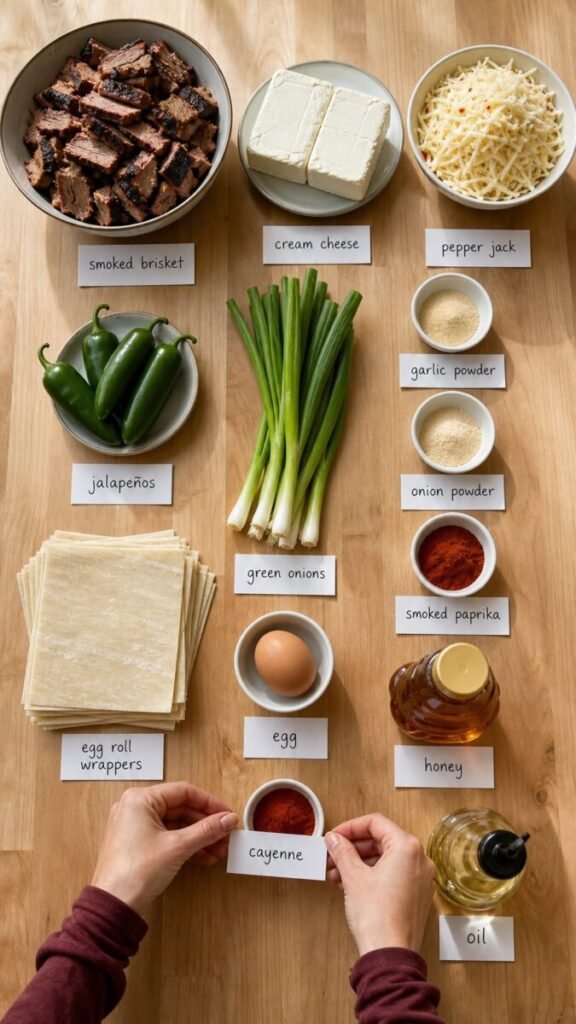
🥩 The Filling
- Smoked brisket: 2 cups, chopped pea-small
- Cream cheese: 8 oz, fully softened
- Pepper jack: 1 cup shredded
- Jalapeños: 4, seeded and finely diced — keep the ribs of one for a warmer roll
- Green onions: 2, thinly sliced
- Garlic powder: 1 teaspoon
- Onion powder: 1 teaspoon
- Smoked paprika: 1 teaspoon
- Black pepper: ½ teaspoon
- Salt: ¼ teaspoon — brisket brings its own; taste first
🌯 The Roll and the Fry
- Egg roll wrappers: 12, square, thawed if frozen
- Egg: 1, beaten, for sealing
- Neutral oil: 1½ inches in the pot, for frying
🍯 The Hot Honey Finish
- Honey: ½ cup
- Cayenne: ½ teaspoon, plus more to taste
- Smoked paprika: 1 pinch
- Chives: 1 tablespoon, chopped, for the platter
- Thin jalapeño rings: a few, for color and warning
Step by Step How to Make
- Step 1 — Mix, then chill the filling. Beat the softened cream cheese alone until it’s completely smooth, then stir in the chopped brisket, pepper jack, jalapeños, green onions, garlic powder, onion powder, smoked paprika, pepper, and salt. Taste it — brisket seasoning varies wildly from pit to pit, so this is where the salt decision happens. Now the step people skip: chill the mix for 15 minutes in the fridge. Warm filling is soft and sticky and rolls badly; cold filling holds its log shape inside the wrapper, and cold cream cheese also puffs less violently in the oil. Fifteen minutes, and the rolling goes from frustrating to assembly-line smooth.
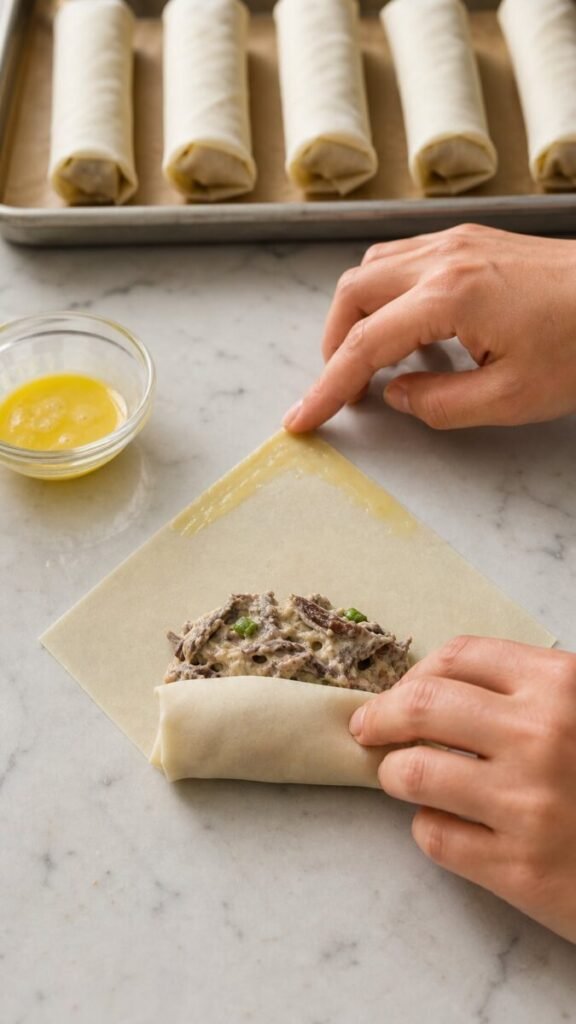
- Step 2 — The rolling line. Lay one wrapper on the counter like a diamond, a corner pointing at you, and keep the stack covered with the damp towel. Spoon a scant 2 tablespoons of filling onto the lower third, shaped roughly into a log across the wrapper. Fold the bottom corner up and over the filling, and tuck it snug — snug enough that the filling is squeezed gently into a tight cylinder. Fold in the two side corners like an envelope, pressing out any air as you go; a gentle squeeze after each fold is the “burp” that keeps steam from having a balloon to inflate. Brush the top corner with beaten egg, roll the rest of the way, and press the seam closed. It should feel firm, tight, and a little proud of itself. Repeat eleven times.
- Step 3 — Heat the oil to 350. Bring the oil to 350°F over medium heat — and if you have no thermometer, the first egg roll is the thermometer: it should hit a steady, lively sizzle within two seconds of touching the oil, foam gently around its edges, and turn noticeably gold in about 90 seconds. Furious boiling oil is too hot; a lazy, quiet sizzle is too cool and makes greasy rolls. Adjust before committing the batch. This is also the moment to warm the honey: combine it with the cayenne and the pinch of smoked paprika in a small bowl, 20 to 30 seconds in the microwave or a minute in a small pan, just until it flows freely and smells like a promise.
- Step 4 — Fry in batches, turn once. Fry three or four rolls at a time — never more, because a crowded pan drops the oil temperature and greasy rolls follow. They’ll want about 2 to 3 minutes per side; turn them with the tongs when the underside is deep golden and blistered, and lift them onto the wire rack when the second side matches. Between batches, give the oil a minute to come back to temperature. The rolls should look like they were made by a restaurant — shaggy, bubbled, evenly brown — and they’ll audibly crackle on the rack, which is the sound of everything having gone right.
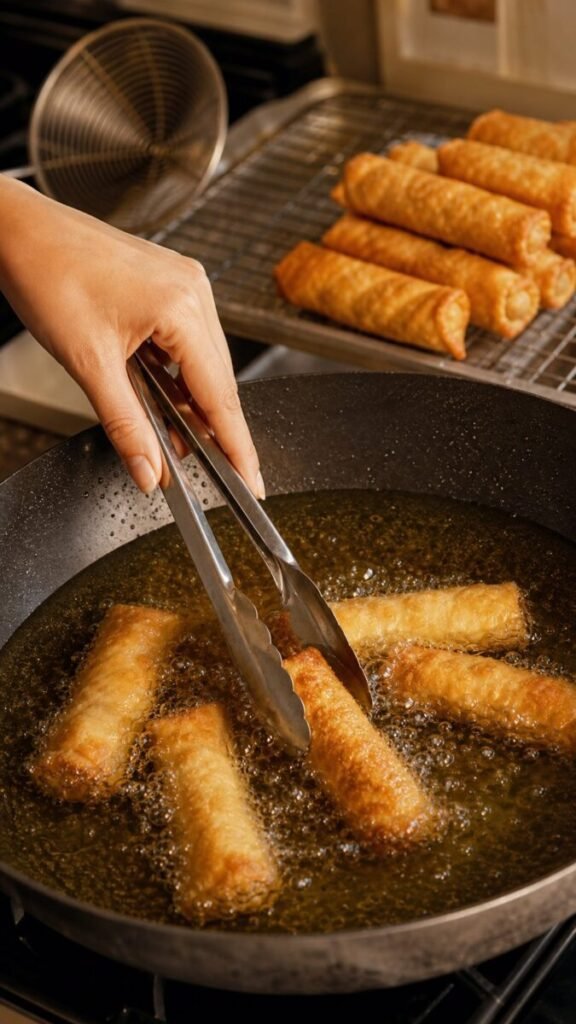
- Step 5 — Rest two minutes, then honey. Give the rolls a full two minutes on the rack before anyone touches one — the filling inside is at lava temperature straight from the fryer, and those two minutes are the difference between a flavor experience and a minor kitchen injury. Then the finish: pile the rolls on butcher paper or a platter, drizzle the warm hot honey over them in ribbons from a height, and scatter the chives and jalapeño rings over the top. Serve the extra hot honey alongside for the dunkers, because there is always a dunker, and they are always right.
- Step 6 — The two-bite plan. Eat them hot, while the shell shatters and the filling pulls in strings. A plate of twelve with the honey on the side and cold drinks in hand is a self-regulating party: the rolls demand attention, the honey slows everyone down, and the batch somehow disappears exactly when the main course should be coming out — which, if you planned it that way, was the whole idea. These are unit food, like dumplings and wings: nobody eats one, nobody eats twelve, and everyone loses count somewhere in between. Plan accordingly, or make the freezer batch in the notes and simply not care.
Every party menu needs its Texas entry — these egg rolls are the smoked-and-fried one, the Texas Trash Dip is the warm and melty one, and between them the Lone Star column of the appetizer table is fully staffed.
Anna’s Kitchen Notes
No smoker? No problem — the honest brisket routes. Real smoked brisket is the ideal, and a half pound from the BBQ counter, bought on purpose, is a completely legitimate ingredient. If there’s no brisket to be had: leftover smoked pork or smoked turkey works one-for-one, and my no-smoke-at-all move is 2 cups of shredded rotisserie chicken mixed with a teaspoon of smoked paprika and two or three drops of liquid smoke — it lands surprisingly close to the real thing in this filling, where cream cheese, jalapeño, and honey are doing half the flavor work anyway. Deli pastrami, chopped small, is the scrappy third option and honestly delicious.
The pea-sized rule for the brisket. This is the chop that matters. Brisket pieces the size of peas fold invisibly into the cream cheese and roll like a dream; anything bigger tent-polies the wrapper from inside, tears it during rolling, and punctures it during frying — and a punctured roll in hot oil is how you learn about blowouts the vivid way. Take the extra two minutes with the knife. Your twelve rolls will all look like they came from the same professional kitchen, and the filling will slice molten and even in every bite.
Wrappers dry out faster than you’d believe. Egg roll wrappers are sheets of pasta-thin dough, and on an open counter they crack within minutes — a cracked wrapper can’t seal, and an unsealed wrapper is a fryer incident. Keep the stack under a damp paper towel the entire time, and take them out one at a time as you roll. If a wrapper does crack, patch it with a spare piece brushed with egg wash. If your stack has dried out overnight in an opened package, a barely damp towel over the whole pile for ten minutes brings most of them back.
Freeze a tray, thank yourself later. The assembled, uncooked rolls are a freezer asset: freeze them solid on a tray first (so they don’t fuse), then bag them for up to a month. Fry straight from frozen — add about a minute per side and keep the oil steady at 350 — and they come out indistinguishable from fresh-rolled. This is the whole advantage the egg roll has over the bacon-wrapped original, and it turns a 45-minute party recipe into a 15-minute one you can execute on a weeknight with no warning. I currently keep a bag of six in the freezer at all times, for reasons I decline to explain further.
The honey is a sauce, so treat it like one. Half a cup of honey with cayenne and smoked paprika, warmed until it flows, is a real hot honey — the same stuff sold in little squeeze bottles for real money. Warm it before drizzling so it lands in thin ribbons, and taste it: the cayenne should arrive a half-second after the sweet, warm rather than sharp. Too fierce? More honey. Too polite? More cayenne, five seconds at a time. The finished rolls take about half the batch; the rest goes on the table because the dunkers exist and they are us.
The Smokehouse Board
These rolls are rich, fried, and smoky, so the table around them wants cool, fresh, and creamy. A bowl of the secret jalapeño cream cheese dip echoes the filling in cool, spreadable form — the same flavors at a different temperature — and a plate of everything bagel cucumber bites resets the palate between rolls better than anything else I’ve put out.
For the bigger game-day spread, add the Rotel sausage balls for the hot-and-cheesy faction, a plate of Hog Pogs for the kids’ end, and a bowl of the puff pastry twists because every fry-heavy board needs something flaky beside it. That’s a full appetizer table with exactly one pot of oil used, and the oil earned its keep.
Same Roll, Different Smoke
The original, bacon-wrapped. For the purists and the smoker-owners: halve and seed the jalapeños, stuff with the same cream cheese-brisket mix, wrap each half in a half-slice of bacon, and smoke at 250°F for about an hour, until the bacon has rendered and the peppers have slumped. No honey needed — though nobody has ever stopped me from adding it. This is the smokehouse ancestor of everything above, and it’s worth making once just to know both versions.
The pulled pork swap. Leftover pulled pork replaces the brisket one-for-one, with a teaspoon of the barbecue sauce stirred into the filling — the rolls go sweeter and tangier, and they’re arguably even better for a crowd because everyone recognizes the flavor instantly. If the pork is sauced heavily, cut the filling’s salt in half and let the honey do the sweetening.
The air-fryer route. Brush the assembled rolls lightly with oil all over and air-fry at 390°F for 10 to 12 minutes, flipping once, until deeply blistered. You trade a little of the shatter for none of the oil, the kitchen stays cool, and the hot honey covers a multitude of sins. In my house the fryer makes them for parties and the air fryer makes them for Tuesdays, and both get eaten standing up.
The popper version, no meat. Double the jalapeños and pepper jack, skip the brisket, and add a half cup of thawed, squeezed-dry frozen spinach — the rolls become jalapeño-popper hand pies, fully vegetarian, and the hot honey becomes non-negotiable for balance. This is the version that made a committed brisket fan at my table forget what was missing, which I still consider a personal best.
The breakfast detour. Scrambled eggs (cooked soft, they reheat gently inside), breakfast sausage, and cheddar in the filling; maple syrup warmed with a pinch of cayenne instead of the honey. Weekend-morning egg rolls are a genre that deserves more attention than it gets, and this is the recipe that opens the door to it.
The Roll Tally
| Nutrient | Per Roll (1 of 12) |
|---|---|
| Calories | 240 kcal |
| Protein | 9 g |
| Carbohydrates | 19 g |
| Fats | 14 g |
Estimates for the rolls as fried in fresh oil with reasonable absorption, the hot honey counted generously across the batch. Nine grams of protein per roll is real snack territory — the brisket and the two cheeses split the work — and the fats are a mix of the fry oil, cream cheese, and pepper jack, which is to say the section of the ledger that tastes like this. Two rolls with the honey is a satisfying plate; four is dinner; the data on what people actually eat at a party is anecdotal, alarming, and consistent. As always, estimates — and the honey drizzle is administered by hand, which is the least standardized measurement in home cooking.
The Fry-Later Plan
Storage, in honest order. The filling keeps three days covered in the fridge and can be made straight into a weekend plan — it actually improves overnight as the smoke settles into the cheese. The assembled, uncooked rolls keep a day in the fridge on a covered tray, or a month in the freezer (tray-frozen, then bagged) frying straight from frozen with an extra minute per side. Fried leftovers reheat respectably: 375°F oven, directly on the rack or on a wire rack over a pan, 8 to 10 minutes, until the shell re-crisps and the filling re-melts — and the hot honey goes on fresh, always, because reheated honey on a cold roll is just sticky.
The one thing I’d never do: refrigerate fried rolls overnight and eat them cold or microwaved. The wrapper’s whole personality is the shatter, the microwave’s whole personality is steam, and those two are sworn enemies. The oven route takes ten minutes and returns about ninety percent of the original — which, for a leftover smokehouse egg roll on a Monday, is a trade I make with my eyes open every time.
For party logistics, the clean schedule is this: make the filling up to three days out, roll the day before (or the week before, into the freezer), and spend party day frying in two batches of six so the second tray lands hot just as the first disappears. Total day-of effort: about twenty minutes at the stove, with the honey warming in its bowl and the platter getting its ribbons while people are still greeting each other. Hosting looks best when it looks effortless, and this recipe has learned how to fake it honestly.
Where It Goes Wrong
Blowouts and oily leakage in the pan. The classic, and it’s almost always one of three causes: overfilling past the two-tablespoon line, an air pocket left inside a loosely rolled wrapper, or a filling that went in warm and soft instead of chilled. The cream cheese expands as it heats and it needs room, a tight wrapper, and a firm filling. Patch a small seam tear with egg wash before frying; pull a leaking roll from the oil early rather than letting it flood the pot; and next batch, burp the rolls.
Pale, greasy, heavy rolls. The oil was too cool, or the batches were too big. Cool oil soaks into the wrapper instead of flash-sealing it, and every degree the temperature drops shows up as grease in the bite. Medium heat, 350°F, three or four rolls at a time, and a minute of patience between batches while the oil recovers. A cheap instant-read thermometer solves this category entirely — one of the best ten dollars a fry cook spends.
Dark shells, molten-raw centers. The opposite problem: oil too hot, so the wrapper browns before the filling has even warmed. The color clock on an egg roll wrapper at 350 is about two to three minutes per side; at 375 it’s ninety seconds and the inside lags. If the first test roll colors fast, back the heat off before the batch goes in. Frying is a temperature negotiation, and the oil does not win arguments — it just wins rolls.
Wrappers that split during rolling. They dried out on the counter, or the brisket was chopped too big and tented the wrapper from inside. Keep the stack under the damp towel, take one at a time, and hold the pea-size chop. A cracked wrapper cannot be sealed, cannot hold filling, and cannot be saved — it can only be replaced, which takes ten seconds and a little humility.
A filling that tastes quiet despite good brisket. Under-salted — and the culprit is usually assuming the brisket will season everything. Pit brisket ranges from aggressively rubbed to barely, and cream cheese is a salt sponge that eats seasoning for sport. Taste the raw filling before you chill it (it’s cooked brisket and cheese — safe), and fix the salt there. After frying, it’s archaeology.
Burned mouths, ruined evening. Skipped the two-minute rest. The filling comes out of the oil at approximately the temperature of the sun’s surface, cream cheese holds heat like a grudge, and the first eager guest always learns this the hard way. The rest is part of the recipe, printed right there in Step 5, and the honey drizzle during those two minutes is the built-in way to spend them. Let the rolls cool enough to be food, and everyone gets to keep their evening.
Twinkie Questions
What exactly are Texas Twinkies?
The original is a Texas barbecue-joint specialty: jalapeños stuffed with cream cheese and chopped smoked brisket, wrapped in bacon, and smoked until melty — named with a wink at the golden, cream-filled snack cake. They sell out early at smokehouses across the state, and this egg roll version is the home-kitchen evolution: the same filling, sealed in a wrapper and fried instead of smoked, so anyone with a pot of oil can make them. Same nickname, same spirit, different cooking vessel.
Can I make these without smoked brisket?
Yes, and honestly well: use shredded rotisserie chicken tossed with a teaspoon of smoked paprika and two or three drops of liquid smoke, or leftover smoked pork or turkey, or chopped deli pastrami. The cream cheese, jalapeño, and hot honey carry so much of the flavor that the smoke note is the only thing you’re replacing — and paprika-plus-drop-of-liquid-smoke covers it better than anyone expects. Brisket from the BBQ counter remains the gold standard, and buying a half pound on purpose is a respected move.
Where do I find egg roll wrappers?
In nearly every supermarket, in the refrigerated produce section — usually near the tofu, wonton wrappers, and fresh herbs. They’re typically square, sold in stacks of about 20, and labeled “egg roll wrappers” or “spring roll pastry.” Keep them refrigerated until use, thaw completely if frozen, and remember the damp-towel rule once the stack is open: they crack when they dry, and a cracked wrapper is a sunk cost.
How spicy are they?
Friendly-warm as written: four jalapeños, seeded, with one pepper’s ribs kept in. Seeding removes most of the heat, and the cream cheese buffers what remains — but the cayenne in the honey adds its own late arrival, so the total effect is a roll that warms rather than burns. The dials: more ribs for a hotter filling, more cayenne for a hotter finish, and both can go to zero for a mild crowd without hurting the recipe’s feelings.
Can I bake them instead of frying?
You can — brushed generously with oil and baked at 425°F for about 15 minutes, flipping once, until blistered and brown. Expect a firmer, pastry-like shell rather than the shatter of frying, more egg-roll-in-the-oven than egg-roll-from-the-fryer, with everything inside exactly as good. The air fryer at 390°F gets closer to the real thing. Neither is the fried version; both are legitimately delicious, and Tuesday is allowed to be different from Saturday.
Can I make them ahead for a party?
That’s their best format — the filling up to three days ahead, the rolls assembled up to a day (fridge) or a month (freezer), and the frying done in two batches on party day so half the platter arrives hot just as the first half vanishes. Fry from frozen with an extra minute per side. The only thing that can’t wait is the hot honey drizzle, which takes thirty seconds at the end. A recipe that preparks almost everything is the host’s favorite kind, and this one does.
What do I serve with the hot honey?
Besides the rolls themselves, warmed hot honey is excellent on the buttered cornbread, the smoked wings, and the biscuit that follows all of it — make the full half cup and keep the leftover in a jar by the stove. If you want a second dip for the table, a small bowl of ranch or a cool jalapeño-cream dip gives the heat-shy a landing zone, and the dunkers will alternate between them happily. The honey, for the record, always runs out first. It always has.
Smoky filling · Golden wrapper · Sweet heat finish
Texas Twinkies Egg Rolls with Honey
Finely chopped smoked brisket, cream cheese, pepper jack, and jalapeños tucked into crisp fried egg roll wrappers. Warm cayenne honey, fresh chives, and jalapeño rings finish this smokehouse-inspired appetizer.
As an Amazon Associate I earn from qualifying purchases.
Ingredients
The smoky filling
- 2 cups fully cooked smoked brisket, chopped into pea-size pieces
- 8 oz cream cheese, softened but not melted
- 1 cup shredded pepper jack
- 4 jalapeños, seeded, ribs removed as desired, and finely diced
- 2 green onions, thinly sliced
- 1 teaspoon garlic powder
- 1 teaspoon onion powder
- 1 teaspoon smoked paprika
- ½ teaspoon black pepper
- Up to ¼ teaspoon salt, to taste
The wrappers & frying oil
- 12 square egg roll wrappers, thawed if frozen
- 1 egg, beaten, for sealing
- Neutral frying oil, enough for a 1½-inch depth in a deep, heavy pot
The hot honey finish
- ½ cup honey
- Up to ½ teaspoon cayenne pepper, or to taste
- 1 pinch smoked paprika
- 1 tablespoon chopped chives
- A few thin jalapeño rings, for garnish
The rolling line
- Large mixing bowl and sturdy spatula
- Large cutting board and sharp knife
- Small bowl and pastry brush, for egg wash
- Barely damp paper towel, for covering wrappers
- Deep, heavy pot, with ample space above the oil
- Frying thermometer
- Instant-read food thermometer, for checking the filling
- Tongs and a spider or slotted spoon
- Wire rack over a sheet pan
- Small saucepan, for warming the honey
Filling quantity check: twelve rolls with a scant 2 tablespoons each use less than 1½ cups of filling. The listed filling makes substantially more. Do not force it all into twelve wrappers; promptly refrigerate the surplus, or use additional egg roll wrappers and allow extra rolling and frying time.
Choose the right wrapper: use square wheat-based egg roll wrappers intended for frying, not rice-paper wrappers. Thin spring-roll pastry behaves differently, so follow its package instructions if substituting.
Heat is adjustable: jalapeños and cayenne vary in strength. Removing the pepper’s inner ribs reduces heat, but does not guarantee a mild filling. Start with less cayenne in the honey and increase after tasting.
How to make it
-
Mix and briefly chill the filling
Beat the softened cream cheese until smooth. Fold in the finely chopped, fully cooked brisket, pepper jack, diced jalapeños, green onions, garlic powder, onion powder, smoked paprika, and black pepper. Taste before adding salt, since brisket and cheese vary in saltiness. Refrigerate for about 15 minutes, until easier to portion. Keep the raw sealing egg separate from the filling.
-
Roll snugly without overfilling
Place one wrapper on a clean board with a corner pointing toward you. Keep the remaining wrappers covered with a barely damp towel. Place a scant 2 tablespoons of filling across the lower third. Fold the bottom corner over the filling, tuck gently, then fold in the sides. Roll snugly to minimize large air pockets without stretching or tearing the wrapper. Brush the final corner lightly with beaten egg and press the seam closed. Repeat with the remaining wrappers. Refrigerate surplus filling promptly and discard unused egg wash.
-
Heat the oil and warm the honey
Set a wire rack over a sheet pan. Add about 1½ inches of oil to a deep, heavy pot, leaving generous headroom and never filling the pot more than halfway. Heat the oil to 350°F, checking with a frying thermometer. Separately, combine the honey, cayenne to taste, and pinch of smoked paprika in a small saucepan. Warm gently just until fluid, then remove from the heat. Do not boil.
-
Fry in small batches and check the center
Carefully lower three or four rolls into the oil without crowding. Fry for approximately 2–3 minutes per side, turning gently, until golden and crisp. Timing varies with wrapper thickness and filling temperature. Lift a test roll out of the oil and check that the center reaches 165°F, since the filling contains cooked brisket being reheated. Do not rely on shell color alone. If the wrapper darkens before the center heats through, lower the oil temperature slightly and allow more cooking time. Transfer finished rolls to the rack and let the oil recover between batches.
-
Rest until safe to bite
Leave the rolls on the rack for at least 2–3 minutes, and longer if the filling is still very hot. Molten cheese can remain hot after the shell feels comfortable to touch. Keep the rolls uncovered so steam can escape instead of softening the crust.
-
Finish with hot honey and fresh herbs
Arrange the rolls on a platter and drizzle lightly with warm hot honey immediately before serving. Scatter over the chives and jalapeño rings, and serve the remaining honey alongside for dipping. Add the drizzle only to the rolls being served now to preserve their crunch.
Frying safety: keep water and wet utensils away from hot oil, never leave the pot unattended, and never use water on an oil fire. Use only intact, well-sealed wrappers. These cooking times are for refrigerated, unfrozen rolls; frozen rolls require a separate timing check and must still reach 165°F in the filling.
Food and allergen safety: use properly refrigerated cooked brisket within its original 3–4-day leftover window; mixing it into a filling does not restart that clock. Limit cumulative room-temperature time to 2 hours, or 1 hour above 90°F. This recipe contains dairy, wheat, and egg; check wrappers and other packaged ingredients for additional allergens.