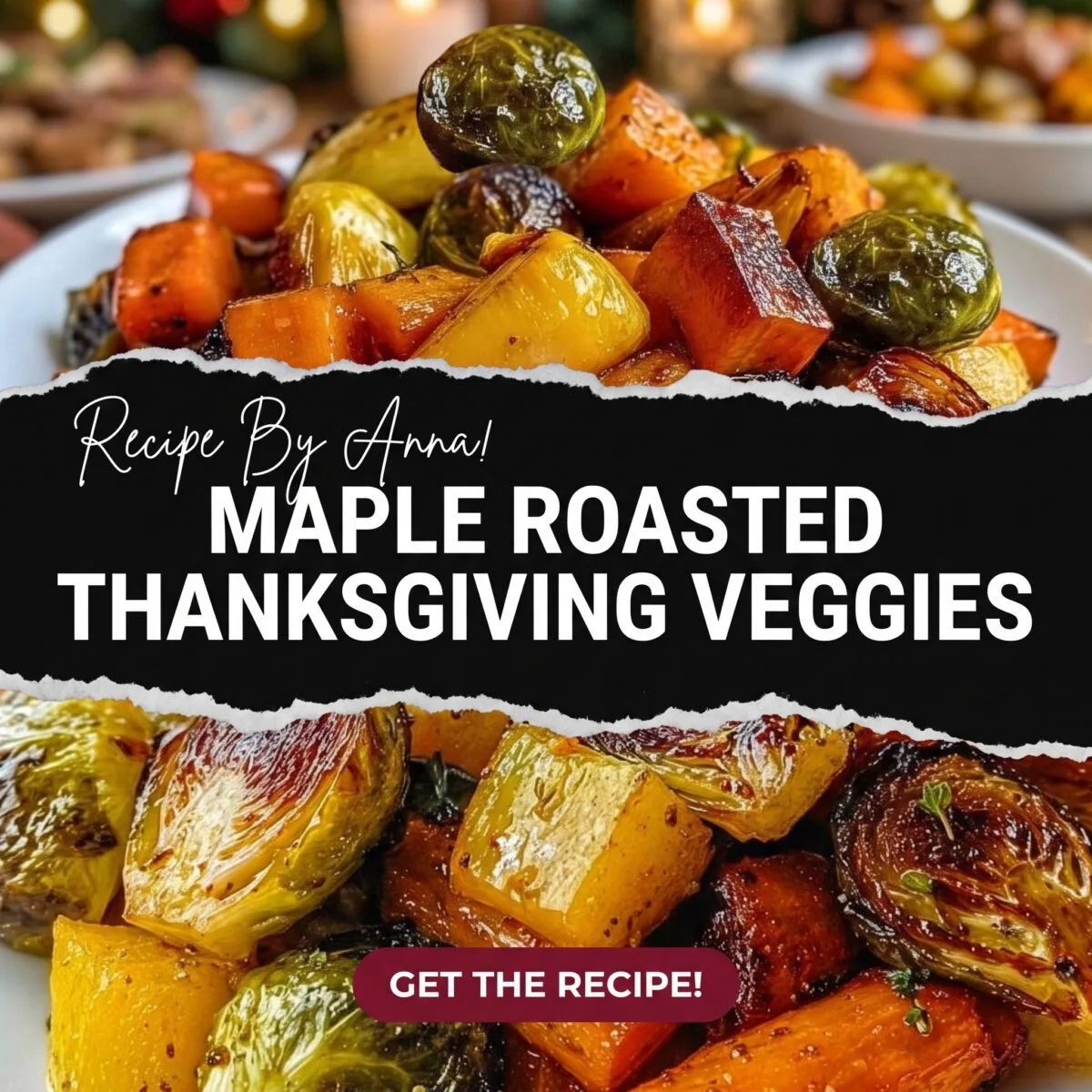
Maple Roasted Thanksgiving Veggies
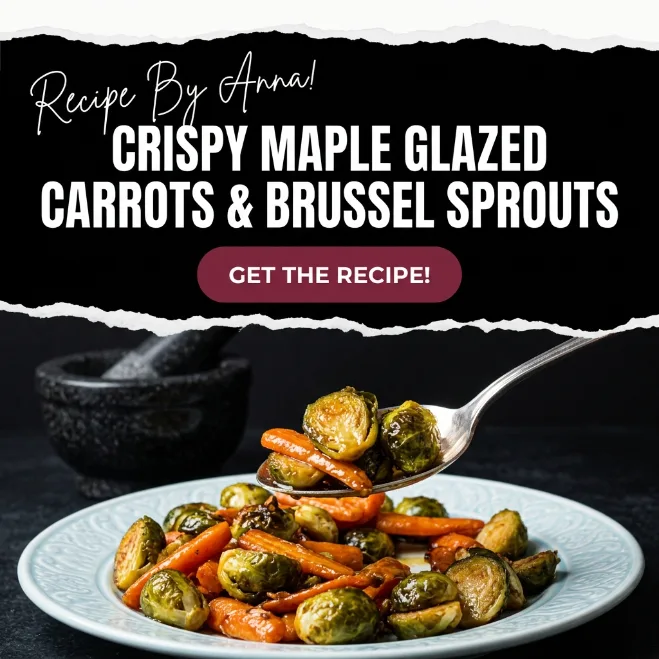
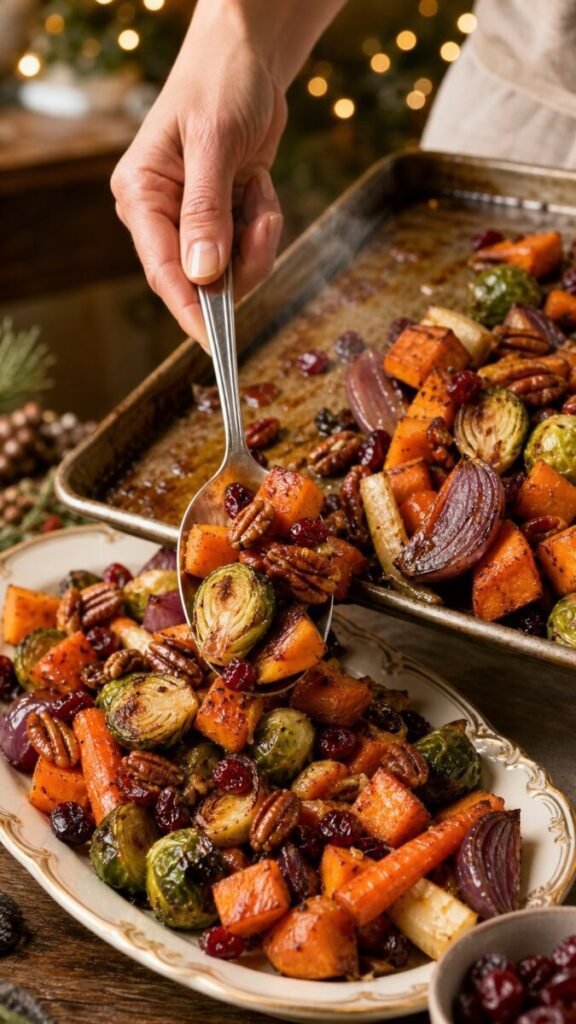
Every Thanksgiving table has a dish that quietly outperforms its job title, and on my table it’s this sheet pan. Sweet potatoes, Brussels sprouts, carrots, parsnips, and red onion, all cut to the same cheerful one-inch scale, tossed in a maple-Dijon glaze, and roasted at 425°F until the edges lacquer dark and the insides go tender. By the time the pan comes out, the maple has reduced to a sticky shellac, the sprouts have brown flat faces that taste like nuts instead of punishment, and the red onion wedges have slumped into jam. A scatter of toasted pecans and dried cranberries at the end, and it’s the most festive thing on a table that also contains a turkey.
Here’s the engineering problem this dish actually solves, because a holiday side is a logistics assignment as much as a recipe. On Thanksgiving, oven space is the scarcest resource in the house, every burner is occupied, and the turkey spends its last hour resting on the counter, smug, while the oven sits empty at the exact moment you need it most. This dish is built for that window: fifteen minutes of prep you can do the day before, twenty-five to thirty minutes of unattended roasting that fits precisely inside the turkey’s rest, and — the part that makes it a holiday dish rather than a Tuesday one — it holds at room temperature for a genuinely long time without declining. The glaze stays glossy, the edges stay chewy-crisp, and an hour later the platter is as good as it was at minute five. Most sides wilt under that schedule. This one was designed around it.
The flavor architecture is a four-way balance worth understanding before you cook it, because it’s why the dish tastes complete instead of sweet. The maple brings caramel and warmth; the Dijon brings tang and its own quiet mustardy heat; the apple cider vinegar brings the acid that keeps all that sugar in line; and the rosemary-thyme-garlic trio brings the woodsy savory floor that makes everything read as Thanksgiving rather than dessert. Underneath all of it, the roasting itself is doing the heaviest lifting — high heat concentrates the vegetables’ own sugars until the sweet potato tastes sweeter than any glaze could make it — so the maple is a lacquer and an amplifier, not the whole story. The result is the side dish that makes sprout skeptics take seconds, and I keep receipts on this: my nephew, a man of firm opinions and a childhood of sprout trauma, now requests the pan itself.
The Maple Case
The case starts with the syrup, and there’s a hard line here: pure maple syrup, not pancake syrup, and the difference is chemistry rather than snobbery. Pancake syrup is corn syrup with maple flavoring — a single-note sweetness that burns fast and flat. Real maple syrup is tree sap, boiled down, and it carries sucrose alongside invert sugars and trace minerals, plus the darker grades the long boil gives a caramel, almost smoky depth that corn syrup has no equivalent for. On a screaming-hot sheet pan, that difference becomes visible: real maple reduces into a glossy lacquer that clings and browns evenly, while pancake syrup scorches into bitter spots before the vegetables underneath are even tender. Buy the real thing — it’s a holiday, and the whole recipe uses a third of a cup.
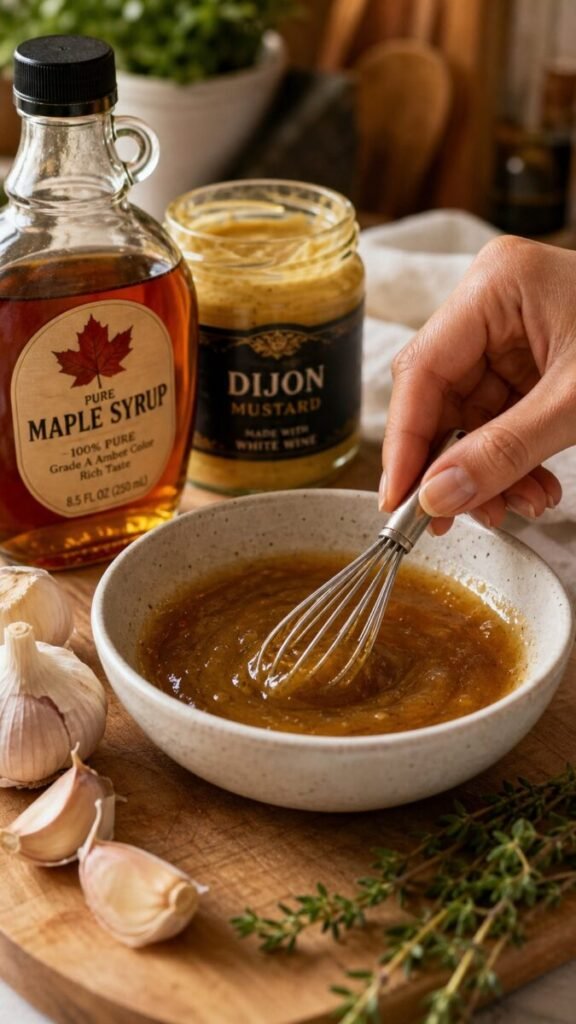
The glaze itself is a vinaigrette in disguise, and knowing that makes it behave better. Maple syrup and olive oil don’t want to mix — sugar-water and fat never do — and the Dijon is the diplomat: mustard’s own structure emulsifies the two into a glossy, unified sauce that coats every piece evenly instead of splitting into oily and syrupy patches on the pan. The whisk matters too: thirty real seconds until it’s smoothly amber and slightly thickened, not five casual ones. The vinegar’s role is the flavor fulcrum — one tablespoon of acid is what makes the maple taste balanced rather than candy-sweet — and the cinnamon stays at a whisper, a quarter teaspoon across an entire pan, present only as warmth nobody can quite name. A cinnamon-forward glaze is a different, lesser dish; this one keeps the spice in the background where it does its work invisibly.
And the sprouts get their own doctrine, because they’re the ingredient most often ruined in holiday cooking. A Brussels sprout is a tightly packed bud of cabbage-family sulfur compounds, and the difference between a nutty, sweet one and a sulfurous one is heat geometry: boiled or steamed, the compounds intensify in the wet heat; roasted hard with a cut face flat against the pan, they brown into something that tastes closer to a roasted chestnut than to cabbage at all. So the sprouts are halved and placed cut-side down, and — this is the part that requires discipline — left alone for the first half of the roast, because every early stir lifts the flat face off the hot metal before the sear sets. The pan does the work. Your job is patience and a single well-timed flip.
⏱️ 15 MIN PREP + 30 MIN ROAST | 🍁 SERVES 8 | 🦃 FITS THE TURKEY-REST WINDOW
- Prep Time: 15 minutes — cutting everything to one-inch scale
- Roast Time: 25 to 30 minutes, one flip at the midpoint
- Total Time: about 45 minutes, most of it the oven’s
- Yield: 8 holiday servings, or 6 for a table of people who mean it
The Two-Pan Doctrine
The kit is modest, and one decision in it is doing most of the work:
- One extra-large rimmed sheet pan, or two standard ones — the doctrine of the recipe. Vegetables piled on top of each other trap their own steam and braise into pale softness; vegetables with air around them roast and caramelize. If everything doesn’t fit in one roomy layer, use two pans without a flicker of shame — the recipe would rather wash a second pan than serve a steamed one.
- Parchment paper — non-negotiable with maple involved. Reduced maple syrup welds to bare metal with a grip that survives soaking and arguments. Parchment is the difference between lifting vegetables off the pan and archaeology.
- Large bowl — the toss happens here, glaze and vegetables together, hands preferred
- Small bowl and whisk — for the glaze, which wants a real thirty-second emulsion
- Sharp knife and a big board — for the one-inch doctrine below
- Dry skillet — the pecans toast in it while the pan roasts; four minutes, no oil
Now the doctrine itself, which is really two arguments wearing one name. The first is the size argument: everything on the pan gets cut to a comparable one-inch scale — sweet potato and parsnip in cubes, carrots in fat one-inch coins or halves, sprouts halved, onion in wedges — because a pan of mixed sizes is a pan with mixed doneness, and the small pieces will be char while the large ones are still raw at the center. The second is the density argument: sweet potato and parsnip are dense roots that roast at one speed, sprouts and onion are lighter and faster, and a single pan at one-inch scale lands them all tender inside the same half hour. If you like your sprouts darker than your roots — some people do, and they’re right — the two-pan version lets you stage it: roots on the lower rack, sprouts and onion up top, and pull the top pan five minutes early. One pan is the simple, excellent default; two pans is the same dish with a volume knob.
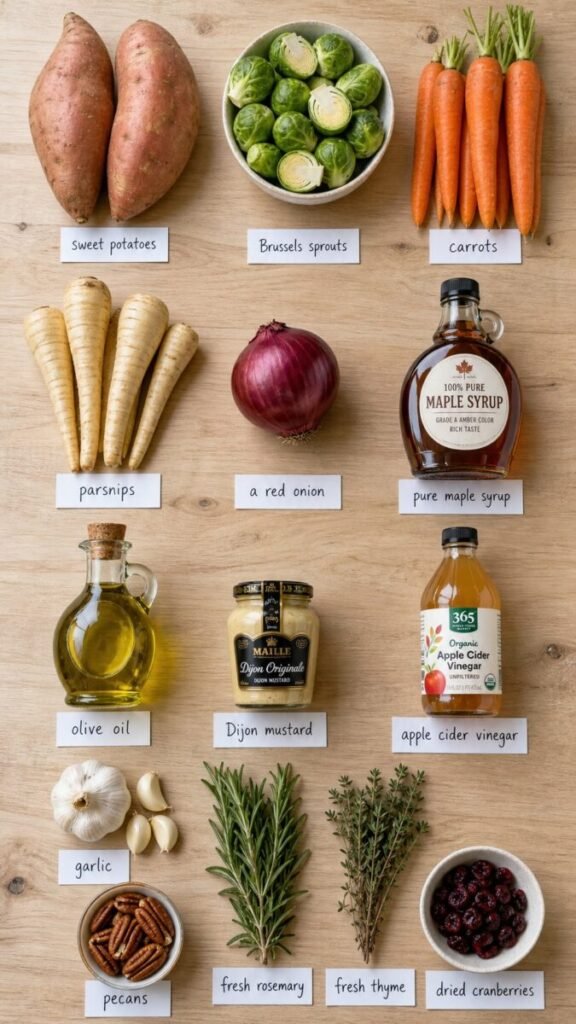
Ingredients (With Labels)
🍁 The Glaze
- Pure maple syrup: ⅓ cup — dark amber for the deepest flavor
- Extra-virgin olive oil: ¼ cup
- Dijon mustard: 2 tablespoons — the emulsifier and the tang
- Apple cider vinegar: 1 tablespoon
- Garlic: 3 cloves, minced
- Fresh rosemary: 1 tablespoon, finely chopped
- Fresh thyme: 1 tablespoon, leaves stripped
- Cinnamon: ¼ teaspoon — a whisper, no more
- Salt and black pepper: 1 teaspoon and ½ teaspoon
🥕 The Roots
- Sweet potatoes: 2 medium, peeled, 1-inch cubes
- Carrots: 4 medium, peeled, fat 1-inch pieces
- Parsnips: 2 medium, peeled, 1-inch pieces
🥬 The Sprouts and the Onion
- Brussels sprouts: 1 lb, trimmed and halved
- Red onion: 1 large, cut into wedges
✨ The Finish
- Pecans: ½ cup, toasted and coarsely chopped
- Dried cranberries: ⅓ cup
- Fresh parsley: a handful, chopped
Step by Step How to Make
- Step 1 — Heat and cut. Get the oven to 425°F with racks in the upper and lower thirds, and line your pan or pans with parchment. Then the cutting, which is the recipe’s only real labor and its only real rule: everything to a comparable one-inch scale. Sweet potatoes and parsnips into cubes, carrots into fat coins (halve them lengthwise first if they’re thick, so no piece is a cylinder wider than an inch), Brussels trimmed and halved through the core so each half stays held together, onion peeled and cut through the root into eight or so wedges — the root end is what keeps the layers from scattering into strings that char. Fifteen minutes with a sharp knife and a podcast, and the hard part of the holiday side is over.
- Step 2 — The glaze. In the small bowl, whisk the maple syrup, olive oil, Dijon, vinegar, garlic, rosemary, thyme, cinnamon, salt, and pepper for a full thirty seconds, until it’s one glossy, smoothly amber sauce with no oily streaks floating on top. The Dijon is doing the emulsifying here — sugar and oil won’t marry on their own — and a properly whisked glaze coats the vegetables uniformly while a lazy one splits and leaves some pieces syrupy and others bare. Smell it: it should smell like the whole holiday in a bowl, and if it smells mostly of mustard, that’s correct. Mustard is loud raw and quiet roasted.
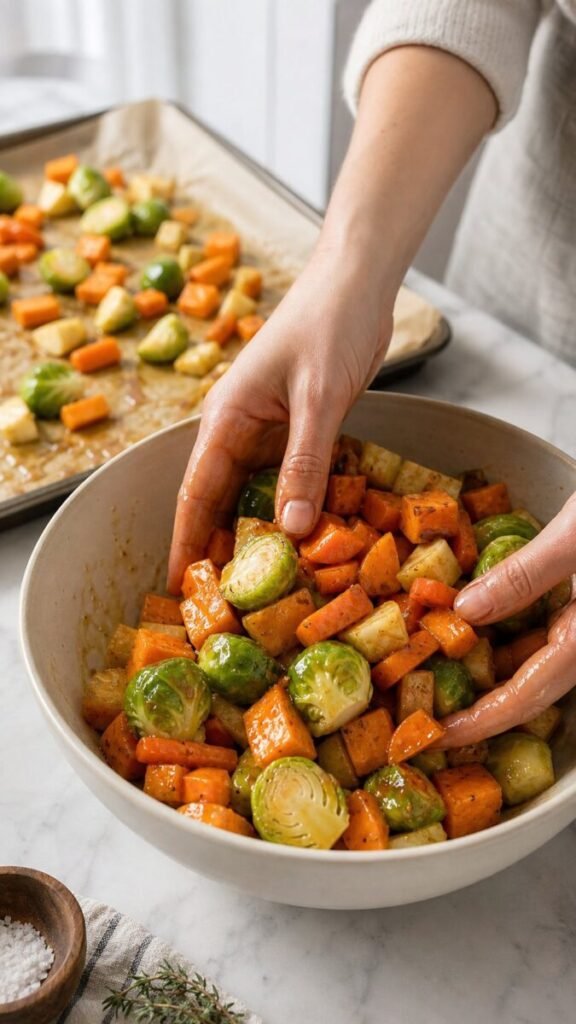
- Step 3 — Toss and arrange. Pile all the vegetables into the big bowl, pour the glaze over, and toss with your hands — hands, because you’re checking for full coverage on every surface, and fingers find the bare spots a spoon glides past. Everything should glisten. Then transfer to the pan in a single roomy layer, and here’s the arrangement detail that pays for itself: sprouts go cut-side down, flats against the parchment, and as many sweet potato and carrot flats down as the geometry allows. Flat metal contact is where browning happens; a pan of rounded sides up is a pan of missed opportunities. If the pan is filling up, start the second one — crowding is the one mistake this recipe cannot forgive, and it’s also the easiest one in cooking to avoid.
- Step 4 — The roast. Into the oven: 25 to 30 minutes total, with one flip at the 15-minute mark and a rotation of the pans front-to-back and top-to-bottom if you’re running two. The flip is a single decisive motion — spatula under, turn, redistribute — not a stir-fry, and the sprouts should land their second faces down. You’ll know it’s done by color and texture rather than the clock: vegetables tender at the center when poked, edges deeply browned and sticky, the glaze reduced to a lacquer that pulls in slight strings when you lift a piece. While the pan works, toast the pecans in the dry skillet — three to four minutes over medium, shaking, until they smell like butter and dessert had a meeting — and rough-chop them. The pecans cost you four minutes of the roast time you were standing near the oven anyway.
- Step 5 — The platter. Pull the pan and admire it briefly, because this is peak pan. Then pile everything onto a large platter — a slotted fish slice lets the excess glaze stay behind if the pan collected any — and scatter the toasted pecans, the cranberries, and the parsley over the top with a free hand. Give the whole platter a few grinds of fresh pepper and, if you want the full holiday effect, a tiny extra drizzle of maple across the top, thin, from a height. The garnish isn’t decoration for its own sake: the pecans bring crunch against the soft, the cranberries bring tart against the sweet, and the parsley brings the one fresh green note the whole plate is missing.
- Step 6 — The hold and the serve. Serve warm, or let it sit — and this is the holiday superpower — for up to an hour at room temperature without meaningful decline, because the glaze stays glossy and the edges stay chewy as it cools rather than going soggy the way most roasted vegetables quietly do. That window is what lets this dish slot into the turkey-rest schedule instead of fighting it: pan in when the turkey comes out, platter on the counter whenever it’s ready, dinner at everyone else’s convenience for once. It’s also excellent at actual room temperature on a buffet table, and the leftovers — should any exist — have a second life documented in the storage section that you’ll want to know about.

For the vegans at the table, these veggies and the vegan Thanksgiving pot pie are a complete holiday plate — and honestly, the omnivores will be eating off both platters too.
Anna’s Kitchen Notes
Dark maple, when you can find it. The grade on the bottle — Golden, Amber, Dark — is a flavor dial, not a quality ladder. Dark syrup comes from later-in-season sap boiled longer, and it carries the caramel, almost smoky notes that make the glaze taste deep; Golden is delicate and lovely on pancakes and too polite for a 425°F pan. Any real maple works beautifully here, but if the store gives you the choice, take the Dark, and don’t pay extra for fancy packaging to get it.
The day-before cut is the holiday cheat code. All the vegetables can be cut up to 24 hours ahead and held in covered containers or zip bags in the fridge — sweet potato and parsnip included, which resist browning far better than their reputation suggests, and a pinch of the glaze’s vinegar tossed with them insurance-polishes even that. The glaze itself can be whisked and jarred three days ahead. Thanksgiving morning then becomes fifteen minutes of tossing and pan-arranging, which is exactly the amount of kitchen bandwidth that day actually has available.
The pecans are listening. Toast them, don’t just scatter them — four minutes in a dry skillet converts a raw pecan from a suggestion into a decision, and the smell alone earns the step. The same doctrine as always: shake the pan, trust your nose, and pull them the moment they’re fragrant, because pecans cross from toasted to scorched in the time it takes to answer the doorbell on a holiday. If your cranberries are elderly and stiff, a two-minute soak in a splash of hot water plumps them back to chewy-jewel status before the scatter.
Rainbow carrots earn their dollar. The orange ones taste identical and cost less, but a bunch with the purple and gold ones in it turns the platter from “vegetable side” into “centerpiece” with zero extra technique, and on a holiday table, that’s the cheapest set design available. If you do buy them, don’t peel the colored ones — scrub them — because a lot of the pigment and a surprising amount of the flavor lives right at the skin.
My favorite Thanksgiving confession. I have, in years when the oven schedule collapsed entirely, roasted this pan the night before, refrigerated it overnight, and re-crisped it for twelve minutes at 400°F while the gravy reduced — and the platter was empty anyway, with compliments, and only I knew. The make-ahead route lives in the storage section below, and I’m telling you about it here because a holiday kitchen needs escape hatches, not ideals.
The Holiday Table
This platter plays well with the whole holiday shelf. The roasted Mediterranean Greek vegetables are its everyday sibling — the same sheet-pan doctrine pointed at a different spice map — for the November weekends on either side of the big day. And the crispy olive oil focaccia is the bread that was born to mop the maple glaze off the platter’s edges, which is a job someone at the table will take very seriously.
For the rest of the menu: the garlic butter chicken thighs are the small-holiday main that shares this pan’s oven footprint, the honey cranberry chicken bake is the same sweet-tangy-savory idea scaled up to a main dish, and the cranberry apple quinoa salad is the bright, cold counterpart for the buffet table’s other end — cranberry showing up twice on one menu is not a redundancy, it’s a theme.
Same Pan, Other Holidays
The butternut-and-sage version. Swap half the sweet potato for peeled butternut cubes and press six to eight fresh sage leaves into the glaze — the sage crisps in the oven’s heat into little fragrant chips, and the pan goes from harvest-festival to fancy-restaurant. This is also the version to make in late October, when squash is everywhere and sage is still going strong in the garden.
The balsamic twist. Replace the cider vinegar with two tablespoons of balsamic — the glaze darkens, the sweetness goes molasses-deep, and the affinity with Brussels sprouts specifically becomes almost unfair. Balsamic burns a touch easier than cider vinegar, so check the pan at 20 minutes the first time you run this version.
Maple-chipotle, for the adults’ end. A teaspoon or two of adobo sauce from a can of chipotles whisked into the glaze — smoky heat against sweet maple, and suddenly the pan is the thing the grown-ups are hovering over. Start with one teaspoon; adobo is louder than it looks, and the holiday table is not the venue for surprises.
The December build. Pomegranate seeds instead of cranberries, a strip of orange zest in the glaze, and a scatter of fresh rosemary over the finished platter — the same architecture in red and green, now for the December table. The pomegranate goes on at the very end, off the heat, raw, where it bursts cold and tart against the warm glaze.
The spring-Easter swing. Same glaze, new vegetables: asparagus spears in fat pieces, halved new potatoes, thin carrots, and radishes — yes, roasted radishes, which mellow into something almost sweet — with the rosemary swapped for dill and the whole roast shortened to 20 minutes. The pan is a format, not a season.
The sheet-pan dinner amendment. Toss a few halved baby potatoes and some chicken thighs brushed with extra glaze onto a second pan, run both racks, and the side dish becomes the whole dinner on a Tuesday in November — the doctrine of the two-pan version, promoted from contingency to plan.
The Holiday Math
| Nutrient | Per Serving (1 of 8) |
|---|---|
| Calories | 220 kcal |
| Protein | 3 g |
| Carbohydrates | 32 g |
| Fats | 10 g |
Estimates as written, glaze included, pecans and cranberries counted — they’re part of the dish’s point, not an optional garnish, and they add most of the modest fat line. The honest framing: this is the vegetable course wearing its holiday clothes, and the carbohydrate number is vegetables’ own sugars plus a third of a cup of maple across eight servings, which works out to less than a teaspoon of added sugar per plate. Naturally vegan and gluten-free without a single substitution, heavy on fiber and vitamin A, and the one holiday side that makes the post-meal walk feel earned rather than aspirational. For bigger appetites, the serving math is friendly: the pan scales by simply adding vegetables, and the glaze stretches to cover four pounds’ worth before it needs a second batch — double the glaze, not the recipe, and the pan grows to feed the whole extended table.
The Thursday Clock
Storage and schedule, told as the holiday timeline it actually is. The day before: cut everything, hold it cold in bags, whisk and jar the glaze — fifteen minutes total, done in slippers. Thanksgiving day: the vegetables can also be tossed with the glaze and held on the pan, covered, in the fridge for a few hours, which moves even the tossing off the critical path. The roast itself — 25 to 30 minutes at 425°F — is timed to slide into the turkey’s resting window with room to spare, and the finished platter then holds at room temperature for a genuinely useful hour without decline.
Leftovers keep four days covered in the fridge, and they reheat better than most roasted vegetables because the maple glaze re-liquifies and re-clings: 10 to 12 minutes at 400°F on a pan, or 4 to 5 minutes in the air fryer at 375°F, which is secretly the best reheat in the genre for a single serving. The microwave works and disappoints in the same thirty seconds — warm, soft, edges surrendered — so reserve it for lunch-priority situations. The glaze’s sugar is the preservative here; a chilled platter of these keeps its flavor fully for the whole four days, which puts it ahead of most of the holiday table.
Second careers, and this is where the recipe quietly becomes two meals: the leftovers chopped rough and fried next to eggs is a breakfast hash with a built-in glaze that most hashes would have to build from scratch; the cold pieces over greens with goat cheese and a squeeze of orange make the day-after salad that tastes intentional; and any glaze left on the pan, scraped up with a spatula and thinned with a splash of cider vinegar, is a vinaigrette that already matches the leftovers. On the Friday after, none of this feels like leftovers management. It feels like the sequel.
Where It Goes Wrong
Pale, steamed vegetables. The pan was crowded, full stop — piled vegetables trap their own steam, and steam is the anti-caramel. The fix is space, always: two pans for one pan’s worth of food if that’s what the geometry says. The second suspect is a timid oven — this recipe needs its full 425°F, and an oven that runs cool should be checked with a thermometer you trust, because vegetables that roast at a cheerful 375 by accident come out tender, pale, and forgettable.
Burnt glaze, bitter spots. Real maple still has sugar, and sugar browns faster than vegetables cook — usually where the glaze pooled at the pan’s low spots or on parchment-less metal. Line the pan, distribute the glaze by tossing rather than pouring, and flip at the fifteen-minute mark so no face stays against the hot metal too long. If your pan runs hot or you see edges darkening fast at minute 20, drop to 400°F and add three minutes — the finished dish won’t know the difference, and you’ll keep the lacquer on the right side of caramel.
Sprouts that taste like regret. They were stirred early, boiled by trapped steam, or roasted soft-side down the whole time. The sear doctrine: halve, cut-face down, leave alone for the first fifteen minutes. The browned flat face is where a Brussels sprout converts from cabbage-family duty to something people request; without it, you’ve made warm, polite vegetables, and the holiday deserves better.
Hard centers, burnt edges. The cuts weren’t even — a one-inch cube next to a two-inch wedge is a doneness coin flip — or the roots were cold from the fridge when they hit the pan. Cut to scale, and if you’ve cut everything the day before, let the bag sit out for twenty minutes while the oven heats. The pan is only as even as its least even piece.
Sweet, cloying, one-note. The vinegar got skipped or shorted, or the Dijon was measured shy. The glaze’s balance is load-bearing: one full tablespoon of cider vinegar and two real tablespoons of Dijon against the third of a cup of maple, no rounding down. A glaze that tastes slightly too tangy raw lands perfectly roasted — the heat mutes the acid and doubles the sweetness, so what seems bold in the bowl is correct on the pan.
Soggy toppings, lost garnish. The pecans, cranberries, and parsley went into the oven instead of onto the platter — and pecans scorch, cranberries turn to leather, parsley vanishes to nothing. Everything in the finish pile goes on after the roast, off the heat, every time. The one exception is knowing the crowd: if the platter will sit two hours on a buffet, hold the parsley until it’s served, because its fresh note fades while the nuts and cranberries hold all night.
Veggie Questions
Can I make these ahead for Thanksgiving?
Yes, and the recipe is staged for it: cut everything up to 24 hours ahead and refrigerate, whisk the glaze up to three days ahead, and even the tossed pan can sit covered in the fridge for a few hours. The roast itself is 25 to 30 minutes, which is sized for the turkey’s resting window — and the finished platter holds an hour at room temperature without declining. The full timeline, including my confession about the year I roasted the pan the night before and re-crisped it on the day, is in the Thursday Clock section.
Does it really matter if I use pancake syrup?
It matters more here than almost anywhere else in cooking. Pancake syrup is corn syrup with flavoring — it burns fast, tastes one-note sweet, and never forms the glossy lacquer. Real maple syrup carries invert sugars and minerals that caramelize evenly and taste of caramel and smoke, and it’s the difference between a glaze and a coating. The recipe uses a third of a cup; on a holiday grocery bill, the delta is invisible, and on the plate, it’s everything.
Can I use frozen Brussels sprouts?
Fresh, please, and it’s not snobbery — frozen sprouts are blanched before freezing, so they carry extra water and a softer structure, and they roast into damp, flabby halves instead of seared, nutty ones. Fresh sprouts are also one of the easiest holiday vegetables to prep: trim, halve, done. Frozen works in a true emergency with thorough thawing and aggressive patting-dry, but the pan’s best self needs the fresh ones.
What other vegetables can I add?
Butternut squash cubes swap in for half the sweet potato at the same size and timing; cauliflower florets join the sprout-speed crowd; halved baby potatoes add heft and want five extra minutes. Beets are delicious and dye the whole pan pink — a warning, not a rule. The two constants for anything new: cut it to the one-inch scale, and match it to the right pan speed — roots with roots, florets with sprouts.
Is this dish vegan and gluten-free?
Both, straight off the pan — maple, oil, mustard, vinegar, garlic, herbs, and vegetables, with nothing to substitute and nothing to announce. Check the Dijon label if you’re cooking for someone strict (a few mustards use white wine, which is a vegan-gray-area item some tables care about), and otherwise the dish is exactly what it claims to be, which on a holiday table full of butter is its own kind of public service.
Why 425°F and not 350 like the turkey?
Because browning and steaming live on opposite sides of about 400°F. At 350, vegetables cook through by drying slowly — soft, pale, forgettable. At 425, the surfaces brown before the interiors dry out, the maple reduces to a lacquer instead of soaking in, and the sprout faces sear. The temperature is also why the dish is scheduled after the turkey rather than beside it — most turkeys roast lower and slower, and this pan wants the oven to itself for half an hour, which the resting window happily provides.
How do I reheat the leftovers?
Oven or air fryer, never enthusiasm. Ten to twelve minutes at 400°F on a pan re-liquifies the maple and brings the edges back; the air fryer at 375°F for four to five minutes is the best single-serving reheat in the business. The microwave is the fallback that costs you the texture you worked for. And before you reheat anything, consider the cold route: the day-after salad and the breakfast hash in the Thursday Clock section are the leftovers’ better careers.
Maple Roasted Thanksgiving Veggies
Ingredients
As an Amazon Associate I earn from qualifying purchases.
Maple-Dijon glaze
- ⅓ cup pure maple syrup, preferably dark for a stronger maple flavor
- ¼ cup extra-virgin olive oil
- 2 tablespoons Dijon mustard
- 1 tablespoon apple cider vinegar
- 3 cloves garlic, minced
- 1 tablespoon finely chopped fresh rosemary
- 1 tablespoon fresh thyme leaves
- ¼ teaspoon ground cinnamon
- 1 teaspoon salt
- ½ teaspoon black pepper, plus more for finishing if desired
Vegetables
- 2 medium sweet potatoes, peeled and cut into ¾–1-inch cubes
- 4 medium carrots, peeled and cut into ¾–1-inch pieces; halve thick sections lengthwise
- 2 medium parsnips, peeled and cut into ¾–1-inch pieces
- 1 lb Brussels sprouts, trimmed and halved; quarter very large sprouts
- 1 large red onion, peeled and cut into wedges
Finishing toppings
- ½ cup pecans, toasted and coarsely chopped
- ⅓ cup dried cranberries
- A handful of fresh parsley, chopped
- A small additional drizzle of pure maple syrup, optional
Kitchen Tools
- Two large rimmed sheet pans, for roasting without crowding
- Parchment paper, rated for at least 425°F
- Large mixing bowl
- Small bowl and whisk
- Large cutting board and sharp knife
- Vegetable peeler
- Measuring cups and spoons
- Small skillet, for toasting pecans
- Wide spatula and oven mitts
- Large serving platter
Directions
- Preheat the oven and prepare the vegetables. Heat the oven to 425°F with racks in the upper and lower thirds. Line two rimmed sheet pans with parchment rated for that temperature. Cut the sweet potatoes, carrots, and parsnips into evenly sized pieces. Halve the sprouts through their cores and quarter any especially large ones. Cut the onion into wedges, leaving a little root attached to hold the layers together. Dry the vegetables well.
- Whisk the maple-Dijon glaze. Whisk together the maple syrup, olive oil, Dijon mustard, apple cider vinegar, garlic, rosemary, thyme, cinnamon, salt, and pepper until evenly combined. Reserve about one-third of the glaze in a separate clean portion for the final stage of roasting; this helps reduce the time that all the maple spends exposed to high heat.
- Coat and arrange in roomy layers. Toss the vegetables with the remaining two-thirds of the glaze. Spread the roots on one pan and the Brussels sprouts and onion on the other, leaving space between pieces. Place sprouts cut-side down and arrange flat root surfaces against the parchment. Do not pour excess pooled glaze into empty areas of the pans, where it can burn.
- Roast, turn, and finish with the reserved glaze. Roast for 15 minutes, then turn the vegetables and rotate the pans front to back and between racks. Continue roasting, checking after another 10 minutes. During the final 5–8 minutes, toss with the reserved glaze and return to the oven. Allow about 25–35 minutes total for sprouts and onion and 30–40 minutes for the roots, depending on size and oven performance. Remove each pan when its vegetables are browned and fork-tender. If the glaze darkens too quickly, reduce the oven to 400°F and continue checking frequently.
- Toast the pecans and finish the platter. While the vegetables roast, toast the pecans in a dry skillet over medium-low heat for about 3–5 minutes, stirring frequently, until fragrant. Transfer to a plate promptly, then chop when cool enough to handle. Combine the roasted vegetables on the serving platter and scatter with pecans, dried cranberries, and parsley. Add more black pepper and an optional thin drizzle of maple syrup to taste.
- Serve warm or briefly cooled. Serve warm for the best roasted texture, allowing about 45–60 minutes from prep to platter. The vegetables can be served at room temperature, but their edges will soften as they sit. Without hot holding at 140°F or above, refrigerate within 2 hours of cooking, or 1 hour above 90°F. The maple glaze does not make cooked vegetables shelf-stable.
Nutrition
| Nutrient | Approximate amount per serving (⅛ batch) |
|---|---|
| Calories | 280 kcal |
| Protein | 4 g |
| Carbohydrates | 39 g |
| Total fat | 13 g |
| Fiber | 7 g |
Estimated using approximately 400 g sweet potato, 250 g carrots, 300 g parsnips, 454 g Brussels sprouts, 200 g onion, 55 g pecans, and 45 g dried cranberries, with the full glaze included. Excludes the optional extra maple drizzle. Actual values vary with vegetable sizes, brands, and the amount of glaze left on the pans.