

Cozy Greek Lentil Meatballs with Tzatziki
These Greek Lentil Meatballs are the plant-based dinner that does not need to announce itself as plant-based to win people over. They are warmly spiced, deeply savoury, golden on the outside, tender in the middle, and served with a cool, garlicky tzatziki that makes the whole plate taste specifically and unmistakably Greek — the kind of meal that earns the word “cozy” not because it is simple but because it is genuinely comforting in the way that Mediterranean food at its best always is.
Lentils make an excellent meatball base because they have the right combination of starch, protein, and earthy flavour to bind without eggs, brown without falling apart, and carry spicing without the spicing overpowering them. Green or brown lentils hold their texture better than red lentils in a meatball context — they stay slightly firm rather than dissolving into a paste — and when combined with breadcrumbs, garlic, fresh herbs, and the warm spice blend that Greek cooking does so well, they produce a meatball that holds its shape on the pan and its flavour on the plate.
The tzatziki is not optional. It is the reason the rest exists.
Why Lentil Meatballs Work Better Than Most Plant-Based Substitutes
Most plant-based meatball attempts fail in one of two ways — they are either so soft they fall apart in the pan, or so dense they taste like compressed health food rather than something you actually want to eat. Lentil meatballs sidestep both problems because cooked green lentils have the right amount of structure (they hold their shape) and the right amount of starch (they bind without becoming gummy). They also brown properly in olive oil, which gives them the golden exterior that makes any meatball look finished and taste more complex than the inside alone would suggest.
The Greek spice combination — cumin, coriander, oregano, cinnamon, allspice — is the element that makes these specifically Greek rather than just “lentil balls with herbs.” The cinnamon and allspice in particular are the signature warm-spice notes of Greek meat preparations like keftedes and moussaka, and they translate directly to a lentil base.
- Prep Time: 20 minutes (plus 30 minutes chilling)
- Cook Time: 20 minutes
- Total Time: 1 hour 10 minutes
- Yield: approximately 18 to 20 meatballs, serves 4
What You Need
For the lentil meatballs:
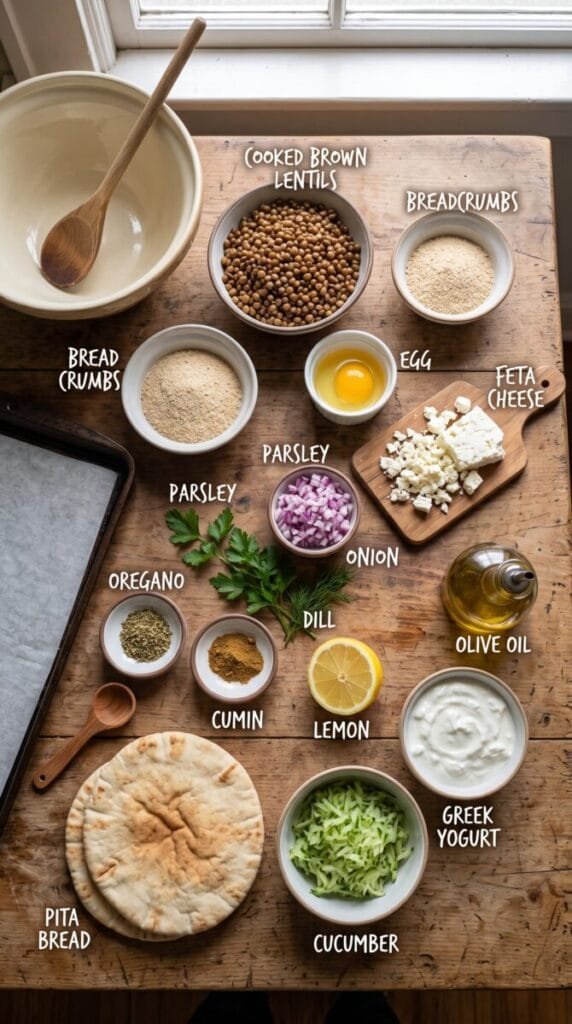
- Green or brown lentils, cooked and cooled: 2 cups (approximately 3/4 cup dry lentils, cooked in salted water until just tender — not mushy) — or 1 can (15 oz) canned lentils, drained and rinsed thoroughly, then patted dry
- Breadcrumbs (plain or panko): 1/2 cup (50g)
- Parmesan or feta cheese, finely grated or crumbled: 1/4 cup (25g) — feta adds a saltier, tangier flavour more specific to Greek cooking; Parmesan adds richness; either works
- Garlic cloves, minced: 4
- Yellow onion, very finely diced or grated: 1/2 small
- Large egg: 1 (omit for vegan and add 1 extra tablespoon of breadcrumbs)
- Fresh flat-leaf parsley, finely chopped: 3 tablespoons
- Fresh mint, finely chopped: 2 tablespoons — mint is the specific fresh herb in Greek keftedes and it makes the lentil meatballs taste unmistakably Greek
- Ground cumin: 1 teaspoon
- Ground coriander: 1/2 teaspoon
- Dried oregano: 1 teaspoon
- Ground cinnamon: 1/4 teaspoon — this is the warm spice note that makes Greek meatballs taste specifically Greek and not just “spiced meatballs”
- Ground allspice: 1/4 teaspoon
- Smoked paprika: 1/4 teaspoon
- Fine sea salt: 1 teaspoon
- Black pepper: 1/2 teaspoon
- Lemon zest: 1 teaspoon
- Olive oil: for pan-frying
For the tzatziki:
- Full-fat Greek yogurt: 1 cup (225g)
- English cucumber: 1/2 large, grated and squeezed very dry
- Garlic cloves, finely grated or minced: 2 — raw garlic; the tzatziki is meant to be assertively garlicky
- Fresh dill, finely chopped: 2 tablespoons
- Fresh lemon juice: 1 tablespoon
- Extra-virgin olive oil: 1 tablespoon, plus more for serving
- Fine sea salt: 1/2 teaspoon
- White pepper: a pinch
For serving:
- Warm pita bread
- Sliced cucumber and tomato
- Kalamata olives
- Extra fresh dill and lemon wedges
- A drizzle of good olive oil over everything
How to Make the Tzatziki First
Make the tzatziki before the meatballs — it improves significantly with 30 minutes in the fridge while the meatball mixture also chills. The resting time allows the garlic and dill to infuse into the yogurt and the cucumber to release any remaining moisture into the mixture, which tightens and concentrates the flavours.
- Grate the cucumber on the large holes of a box grater, then place in a clean kitchen towel and wring out as much liquid as possible — the cucumber needs to be as dry as you can make it. Watery cucumber produces a thin, watery tzatziki that slides off the meatballs and pools on the plate. Squeezed cucumber produces a thick, creamy tzatziki that holds its shape.
- Combine the Greek yogurt, squeezed cucumber, grated garlic, dill, lemon juice, olive oil, salt, and white pepper. Stir thoroughly and taste — it should be tangy, garlicky, and cool. Adjust with more lemon if it needs brightness or more salt if it tastes flat.
- Cover and refrigerate for at least 30 minutes before serving.


How to Make the Lentil Meatballs
- If using freshly cooked lentils, spread them on a baking sheet to cool and dry slightly before mixing — wet lentils make wet meatballs that do not hold their shape. If using canned lentils, drain, rinse, and pat dry with paper towels. The drier the lentils, the better the meatballs hold together.
- Place the lentils in a large bowl and mash roughly with a fork or potato masher — leave a combination of mashed and whole lentils for texture. Fully puréed lentils produce a meatball with no interior texture; partially mashed lentils produce one that has some bite.
- Add the breadcrumbs, feta or Parmesan, garlic, onion, egg, parsley, mint, cumin, coriander, oregano, cinnamon, allspice, paprika, salt, pepper, and lemon zest. Mix thoroughly until everything is evenly combined and the mixture holds together when pressed. If it seems too wet, add another tablespoon of breadcrumbs. If too dry to press together cleanly, add a teaspoon of olive oil.
- Refrigerate the mixture for 30 minutes — this firms the mixture significantly and makes it much easier to roll into neat balls that hold their shape during cooking. Skipping this step produces meatballs that stick to your hands and fall apart in the pan.
- With slightly dampened hands (to prevent sticking), roll the chilled mixture into balls approximately 1.5 inches in diameter — about the size of a golf ball. Press firmly as you roll to ensure they are compact and will not crack during cooking. Place on a parchment-lined plate.
- Heat 2 tablespoons of olive oil in a large, wide skillet over medium to medium-high heat. Add the meatballs in a single layer without crowding — cook in two batches if needed. Cook, turning every 2 to 3 minutes, until golden brown on all sides — approximately 8 to 10 minutes total. The outside should be deeply golden and slightly crispy; the inside is already fully cooked from the pre-cooked lentils so you are developing the crust rather than cooking raw meat.
- Transfer to a plate. Repeat with the second batch if needed, adding more olive oil as necessary.


Greek lentil meatballs with tzatziki served alongside our Chickpea Beet and Feta Salad with Lemon Garlic Vinaigrette is the Greek dinner spread that covers every Mediterranean flavour direction at once — the warm, spiced lentil meatballs, the cold creamy tzatziki, and the earthy beet salad with feta and lemon vinaigrette together make a table that tastes like someone put genuine thought into the menu, even when all three components together took under an hour.
The Squeeze-Dry Cucumber and the Chilled Meatball Mix Rules
The squeezed cucumber rule for tzatziki is the same principle as the squeezed zucchini rule in the Zucchini Slice recipe — cucumber is approximately 96 percent water by weight, and that water goes directly into the yogurt if the cucumber is not wrung dry first. Good tzatziki is thick enough to hold a spoon upright; watery tzatziki is a sauce that pools. The difference is made entirely in the squeeze.
The 30-minute refrigerator rest for the meatball mixture does more than make the mixture easier to handle — it allows the breadcrumbs to absorb moisture from the lentils and onion, creating a more cohesive mixture that holds together during rolling and during the pan browning. At room temperature, the mixture is slightly sticky and soft; after 30 minutes in the fridge, it is firm, less sticky, and rolls into clean spheres that maintain their shape in the pan.
Medium to medium-high heat for the pan browning — not high — is the specific heat that gives the lentil meatball enough time to develop a golden crust on each side before the exterior burns. At high heat, the outside browns in under 60 seconds per side and the crust is thin and easily broken. At medium to medium-high heat, the exterior has 2 to 3 minutes of contact with the hot oil per side and develops a robust, stable golden crust that holds up to turning.
What to Serve This With
Warm pita bread is the most natural companion — use it to scoop the tzatziki, wrap around a couple of meatballs, and add some sliced cucumber and tomato for the most satisfying hand-held Greek experience.
Over a bed of steamed couscous or rice with the tzatziki spooned generously over everything and a drizzle of olive oil makes a more substantial plated dinner for anyone who wants the table setting rather than the wrap. Finish with a squeeze of lemon over the entire plate — the lemon brightens every element simultaneously.
For a mezze-style spread, serve the lentil meatballs alongside our Spring Roll Salad, sliced roasted red peppers, Kalamata olives, hummus, and a bowl of the tzatziki in the center of the table. Not Greek in a strict sense, but a vegetable-forward, protein-rich sharing spread that borrows the best elements from multiple Mediterranean traditions and loses nothing in the translation.
Variations Worth Making
Baked Rather Than Pan-Fried: Arrange the chilled meatballs on a parchment-lined baking sheet, brush generously with olive oil on all sides, and bake at 400°F for 20 to 22 minutes, turning once halfway through. The baked version is less golden and less crispy than the pan-fried version but requires no attention during cooking and produces meatballs that are slightly firmer and more structured. Good for a large batch where standing over a skillet for 30 minutes is impractical.
With Lemon Orzo: Toss cooked orzo with olive oil, fresh lemon juice, lemon zest, a handful of chopped parsley, and salt. Serve the lentil meatballs over the lemon orzo with tzatziki drizzled over. The lemon orzo is the base that turns this into a complete, substantial dinner rather than a meze component.
Spicier Harissa Version: Add 1 tablespoon of harissa paste to the meatball mixture and reduce the cinnamon to a small pinch. Replace the tzatziki with a harissa-spiked yogurt sauce (Greek yogurt + 1 tablespoon of harissa + lemon juice + salt). The spicy version is less traditionally Greek but deeply satisfying — the harissa heat against the cool yogurt sauce has the same contrast principle as the classic version.
Fully Vegan: Omit the egg and use 2 extra tablespoons of breadcrumbs. Replace the feta with 2 tablespoons of nutritional yeast for umami and saltiness. Use coconut yogurt or oat-based yogurt for the tzatziki. The vegan version is slightly less structurally stable — handle the meatballs more gently during turning and they will hold together. The tzatziki will be slightly less thick depending on the yogurt used; chill it for a full hour before serving to compensate.
Nutritional Information
| Nutrient | Amount Per Serving (4 to 5 meatballs plus tzatziki, based on 4 servings) |
|---|---|
| Calories | 310 kcal |
| Protein | 18 g |
| Carbohydrates | 35 g |
| Fats | 11 g |
These estimates are for the meatballs and tzatziki without pita or rice. The protein count of 18 grams per serving from a plant-based meal is notably high — the combination of lentils, feta (or Parmesan), egg, and Greek yogurt in the tzatziki produces a complete amino acid profile across the plate. Add a whole wheat pita per serving for approximately 170 additional calories and 6 additional grams of protein. Add 1/2 cup of cooked couscous for approximately 90 additional calories.
Storing and Reheating
Store the meatballs and tzatziki separately in airtight containers in the fridge for up to 4 days. The tzatziki stays fresh and thick for up to 4 days; by day 5 the cucumber begins releasing more water and the consistency thins slightly — give it a stir and it is still good, just looser.
Reheat the meatballs in a dry skillet over medium heat for 2 to 3 minutes, turning occasionally, until warmed through and the exterior has recrisped slightly. The microwave reheats faster at 60-second intervals but softens the exterior — acceptable, but the skillet is worth using for these specifically.
The meatballs freeze well for up to 2 months — freeze in a single layer on a baking sheet until solid, then transfer to a bag. Reheat from frozen in a 375°F oven for 15 to 18 minutes. The tzatziki does not freeze — the yogurt separates on thawing and the texture cannot be restored. Make fresh tzatziki when reheating frozen meatballs; it takes 5 minutes and is significantly better than thawed tzatziki.
The Mistakes That Are Easily Avoided
Wet lentils (not dried properly after cooking or draining) produce a meatball mixture that is too soft to roll cleanly and too wet to brown properly in the pan. The lentils should feel slightly tacky rather than wet before they go into the bowl — spread freshly cooked lentils on a sheet tray for 10 minutes to release steam, or pat canned lentils dry thoroughly with paper towels.
Crowding the pan during browning causes the meatballs to steam each other rather than browning individually — in a crowded pan, the moisture from multiple meatballs builds into steam that surrounds each one and prevents direct contact with the hot oil. Cook in batches that leave space between each meatball, regardless of how long it takes.
Serving the tzatziki immediately without the 30-minute rest produces a tzatziki where the garlic is sharp and raw-tasting rather than having mellowed slightly into the yogurt, and the cucumber has not had time to season the surrounding yogurt from the inside out. Thirty minutes does not seem like much but it changes the character of the sauce from assembled to integrated.
Cozy Greek Lentil Meatballs with Tzatziki
Golden Greek-style lentil meatballs made with green or brown lentils, herbs, warm spices, breadcrumbs, and cheese, served with cool garlicky tzatziki.
Ingredients
How to Make
Grate cucumber on the large holes of a box grater, then wring it very dry in a clean towel. Stir together Greek yogurt, squeezed cucumber, garlic, dill, lemon juice, olive oil, salt, and white pepper. Cover and refrigerate for at least 30 minutes.
If using cooked lentils, spread them on a baking sheet to cool and dry slightly. If using canned lentils, drain, rinse, and pat dry well with paper towels.
Place lentils in a large bowl and mash roughly with a fork or potato masher, leaving a mix of mashed and whole lentils for texture.
Add breadcrumbs, feta or Parmesan, garlic, onion, egg, parsley, mint, cumin, coriander, oregano, cinnamon, allspice, paprika, salt, pepper, and lemon zest. Mix until combined and the mixture holds together when pressed.
Refrigerate the lentil mixture for 30 minutes to firm it before rolling.
With slightly damp hands, roll the chilled mixture into 1.5-inch balls. Press firmly so they stay compact.
Heat 2 tablespoons olive oil in a wide skillet over medium to medium-high heat. Cook meatballs in a single layer, turning every 2 to 3 minutes, until golden brown on all sides, about 8 to 10 minutes total.
Serve warm lentil meatballs with chilled tzatziki, warm pita, cucumber, tomato, olives, lemon wedges, fresh dill, and a drizzle of olive oil.
Nutrition
| Nutrient | Amount Per Serving |
|---|---|
| Calories | 310 kcal |
| Protein | 18 g |
| Carbohydrates | 35 g |
| Fat | 11 g |
Values are estimates for 4 to 5 meatballs plus tzatziki, based on 4 servings, without pita or rice.