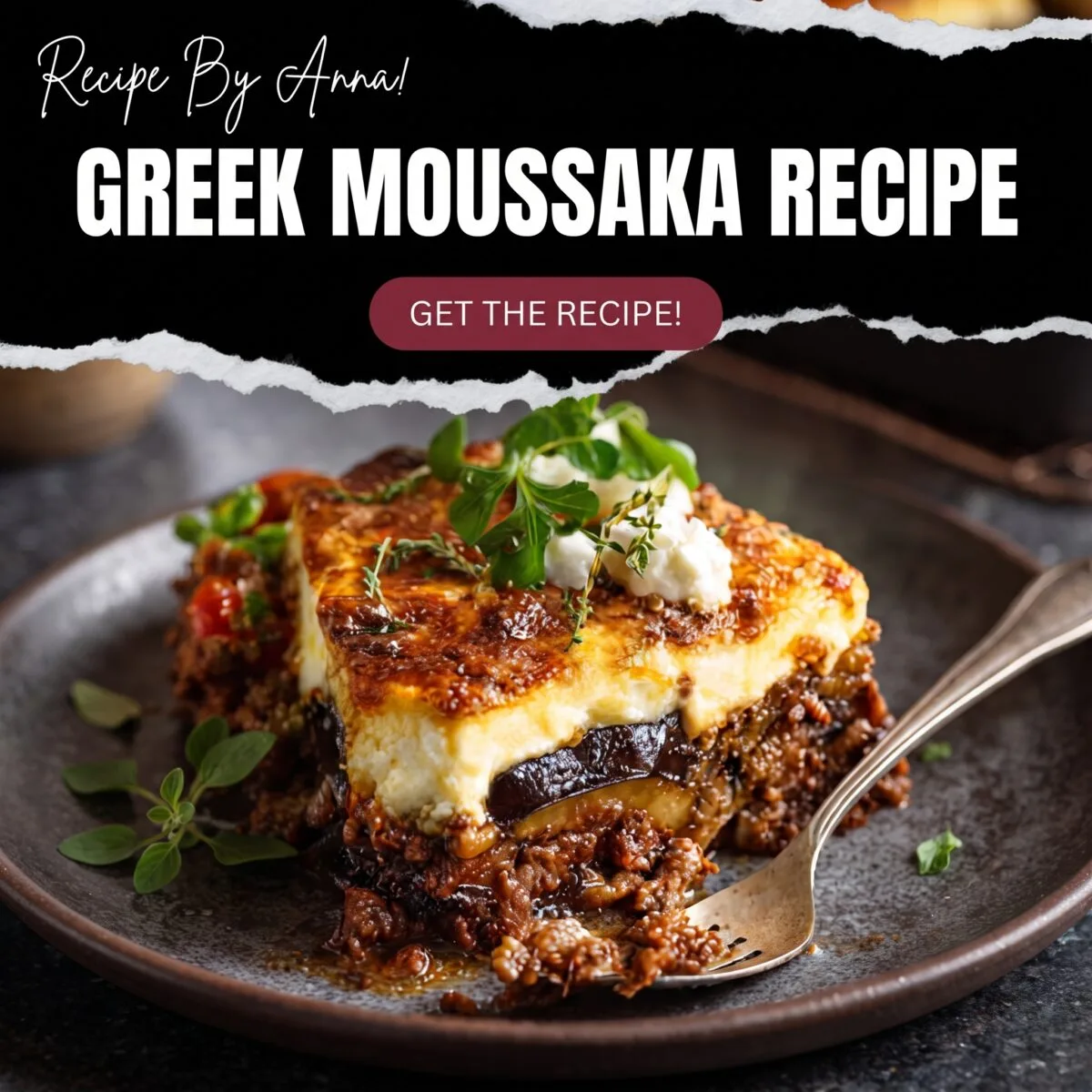
Greek Moussaka Recipe — Authentic, Rich and Worth Every Step
This Greek Moussaka is the recipe worth making when dinner is an occasion rather than a Tuesday night obligation — layered slices of salt-sweated, golden-roasted eggplant, a deep, cinnamon-and-allspice-spiced lamb and tomato meat sauce that has been simmering long enough to become something richer than the sum of its parts, and a thick, creamy béchamel that bakes into a golden, soufflé-like topping that is simultaneously the most impressive thing about moussaka and the simplest component once you know how to make it.
At 23,000 monthly searches, moussaka recipe is the most searched Greek recipe on Pinterest — and for anyone who has eaten genuine Greek moussaka in Greece or in a serious Greek kitchen, the appeal is immediately clear. It is a layered casserole of eggplant, spiced meat sauce, and béchamel that produces a flavour combination unlike any other Mediterranean baked dish — the warm spice of cinnamon and allspice in the meat sauce, the slightly bitter, buttery eggplant, and the rich, eggy béchamel together create something that is simultaneously comforting and genuinely complex.
This recipe is written as the traditional Greek version with ground lamb (or a lamb-beef combination) and the full from-scratch béchamel — the version worth the effort. A vegetarian moussaka and a simple easy moussaka shortcut are both covered in the variations below.
The Three Components and Why Each One Matters
Moussaka is a three-component recipe — the eggplant, the meat sauce, and the béchamel — and each needs to be prepared correctly for the assembled dish to work. Shortcuts in any one of the three produce a noticeably diminished result:
The eggplant must be salted and rested to draw out its moisture, then roasted or pan-fried until golden and soft — raw or steamed eggplant in a moussaka is watery, bitter, and structurally weak, collapsing the layers during baking. Properly roasted eggplant is silky, slightly caramelised, and provides the structural layer the meat sauce and béchamel need to build on.
The meat sauce must simmer long enough for the wine to reduce, the tomato to concentrate, and the spices to deepen into the surrounding fat and liquid — a 30-minute sauce is noticeably thinner and less developed than a 45-minute one. The cinnamon and allspice that define Greek moussaka’s flavour profile need time to mellow from sharp and aromatic into warm background notes that don’t announce themselves separately from the meat.
The béchamel must be made properly — properly, meaning roux cooked long enough to lose its raw flour taste, milk added warm rather than cold to prevent lumping, and eggs stirred in off the heat to produce a creamy, enriched béchamel rather than scrambled eggs in white sauce. A correctly made moussaka béchamel is silky, thick enough to hold a shape when poured, and sets into a creamy, soufflé-like topping in the oven.
- Prep Time: 45 minutes
- Cook Time: 1 hour 30 minutes (including baking)
- Total Time: 2 hours 15 minutes
- Yield: 8 to 10 servings
🍽️ Equipment I Need
Moussaka is a proper layered bake — silky salted eggplant, a slow-simmered meat sauce, and a blanket of béchamel that turns golden in the oven. It’s more steps than a weeknight stir-fry, but with the right equipment the whole thing comes together smoothly. Here’s what I use:
- 9×13-Inch Baking Dish — the foundation of every good moussaka. This Pyrex Easy Grab 3-Quart Oblong Baking Dish is the classic 9×13 size that fits three generous layers — eggplant, meat sauce, and béchamel — without spilling over as they bake. Tempered glass heats evenly so the top browns while the layers below finish cooking through.
- 12-Inch Skillet — where the flavor starts. The Cuisinart Chef’s Classic Nonstick Hard-Anodized 12-Inch Skillet is wide enough to brown the ground lamb or beef in a single layer, then soften the onions and garlic before everything simmers into the sauce. The roomy surface also works if you like to give eggplant slices a quick golden sear before layering.
- 3-Quart Saucepan — for the béchamel. The Cuisinart MultiClad Pro Stainless 3-Quart Saucepan heats evenly with no hot spots, so the butter, flour, and milk whisk into a smooth, lump-free sauce every time. Use it with a balloon whisk — the OXO Good Grips 11-Inch Balloon Whisk — to keep the béchamel silky as it thickens.
- Stainless Colander — the classic moussaka secret. Salting the eggplant draws out its bitter moisture before cooking, and the OXO Good Grips 5-Quart Stainless Steel Colander is where you let the salted slices drain. Its raised feet keep it steady over the sink, and the generous 5-quart capacity holds a whole eggplant’s worth of slices.
- 8-Inch Chef’s Knife — moussaka is all about even cuts. The Victorinox Fibrox Pro 8-Inch Chef’s Knife slices eggplant lengthwise into uniform planks and makes quick work of dicing onions and mincing garlic for the sauce.
- Large Cutting Board — a big board earns its keep here. This extra-large 17.6-inch bamboo cutting board gives you room to slice an entire eggplant without pieces hanging over the edge, and the juice groove catches any released liquid.
- Measuring Cups & Spoons — for the sauce and béchamel ratios that make moussaka taste authentic. The OXO Good Grips Stainless Steel Measuring Cups measure the tomatoes and milk, while the matching measuring spoons keep the cinnamon, nutmeg, and salt precise. Etched markings never wear off, and magnetic handles keep everything nested together.
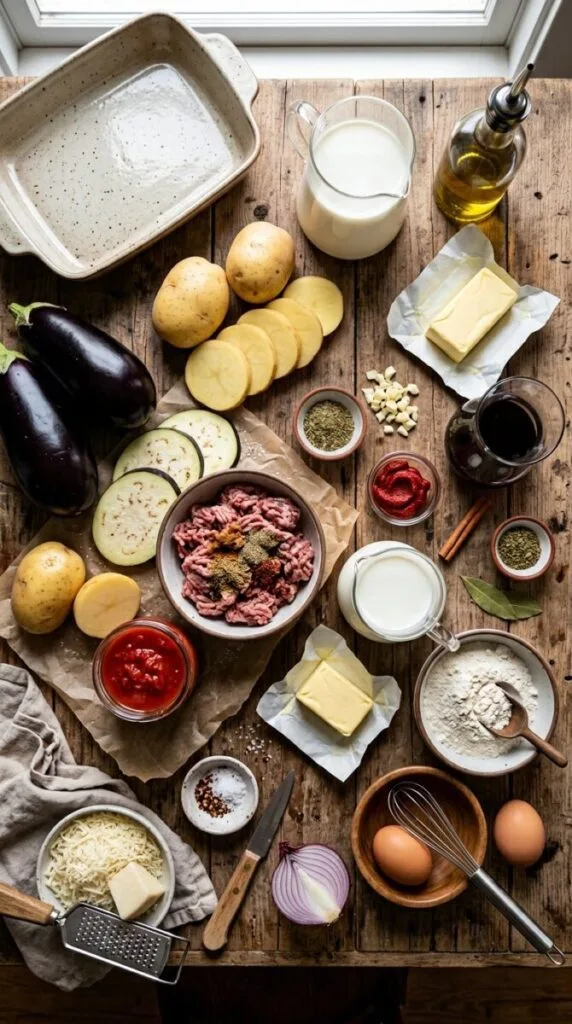
What You Need
For the eggplant:
- Large eggplants: 3 (approximately 3 lbs / 1.35kg total), sliced into 1/2-inch rounds
- Fine sea salt: 2 teaspoons (for sweating)
- Olive oil: 3 to 4 tablespoons (for roasting)
For the spiced meat sauce:
- Olive oil: 2 tablespoons
- Yellow onion, finely diced: 1 large
- Garlic cloves, minced: 5
- Ground lamb, or a 50/50 lamb-beef combination: 1.5 lbs (680g)
- Dry red wine: 1/2 cup (120ml) — a real wine that is drinkable; bad wine produces bad sauce
- Canned crushed tomatoes: 1 can (28 oz / 794g)
- Tomato paste: 2 tablespoons
- Ground cinnamon: 1 teaspoon — the signature Greek moussaka spice; essential, not optional
- Ground allspice: 1/2 teaspoon
- Ground nutmeg: 1/4 teaspoon
- Dried oregano: 1 teaspoon
- Bay leaves: 2
- Fine sea salt: 1 teaspoon
- Black pepper: 1/2 teaspoon
- Sugar: 1 teaspoon — balances the tomato acidity
For the béchamel:
- Unsalted butter: 6 tablespoons (85g)
- All-purpose flour: 6 tablespoons (50g)
- Whole milk, warmed: 3 cups (720ml) — warm milk incorporates into the roux without lumping; cold milk added to hot roux creates lumps that are difficult to smooth
- Large eggs: 2, beaten
- Parmigiano-Reggiano or Kefalotyri cheese, freshly grated: 1/2 cup (50g) — Kefalotyri is the traditional Greek hard cheese; Parmigiano-Reggiano is the most widely available equivalent
- Ground nutmeg: 1/4 teaspoon
- Fine sea salt: 3/4 teaspoon
- White pepper: 1/4 teaspoon
How to Make It
Step 1 — Sweating and roasting the eggplant:
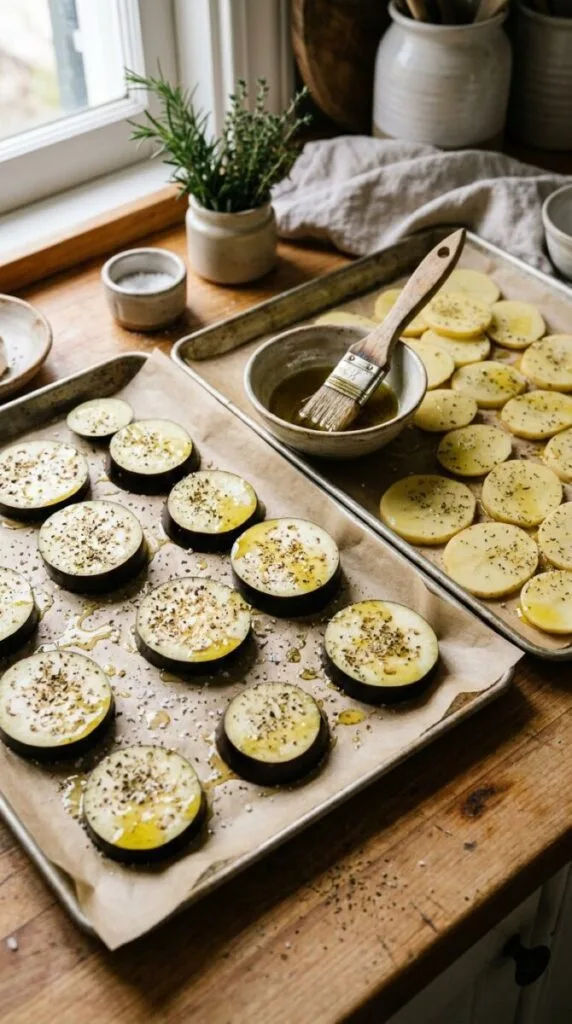
- Arrange the eggplant slices in a single layer on a rack or paper towel-lined baking sheet. Sprinkle both sides with salt and let rest for 30 minutes — the salt draws moisture from the eggplant through osmosis, and the drawn moisture takes some of the bitter compounds with it. After 30 minutes, blot dry with paper towels — the eggplant will look slightly wilted and the paper towels will be noticeably damp.
- Preheat the oven to 425°F (220°C). Brush both sides of each eggplant slice with olive oil and arrange on two parchment-lined baking sheets in a single layer.
- Roast for 20 to 25 minutes, flipping once at 12 minutes, until the eggplant is golden brown on both sides and completely soft when pressed — no resistance, no white flesh visible in the center when a slice is pressed. Set aside. Reduce oven to 375°F (190°C) for the final bake.
Step 2 — Making the meat sauce:
- Heat the olive oil in a large skillet or saucepan over medium-high heat. Add the onion and cook for 6 to 7 minutes until softened and golden.
- Add the garlic and cook for 60 seconds.
- Add the ground lamb and cook, breaking into fine crumbles, until fully browned — 6 to 8 minutes. Drain excess fat, leaving approximately 1 tablespoon.
- Add the red wine and cook for 3 to 4 minutes, stirring, until mostly evaporated — the raw alcohol smell should be gone.
- Add the crushed tomatoes, tomato paste, cinnamon, allspice, nutmeg, oregano, bay leaves, salt, pepper, and sugar. Stir to combine.
- Reduce to a steady simmer and cook uncovered for 40 to 45 minutes, stirring occasionally, until the sauce is thick, deeply coloured, and has very little free liquid — it should look more like a pasta ragù than a tomato soup. The thickness of the meat sauce is critical: too wet and it makes the assembled moussaka soupy; properly reduced and it stays cohesive between the eggplant layers.
- Remove bay leaves. Taste and adjust seasoning. Set aside to cool slightly.
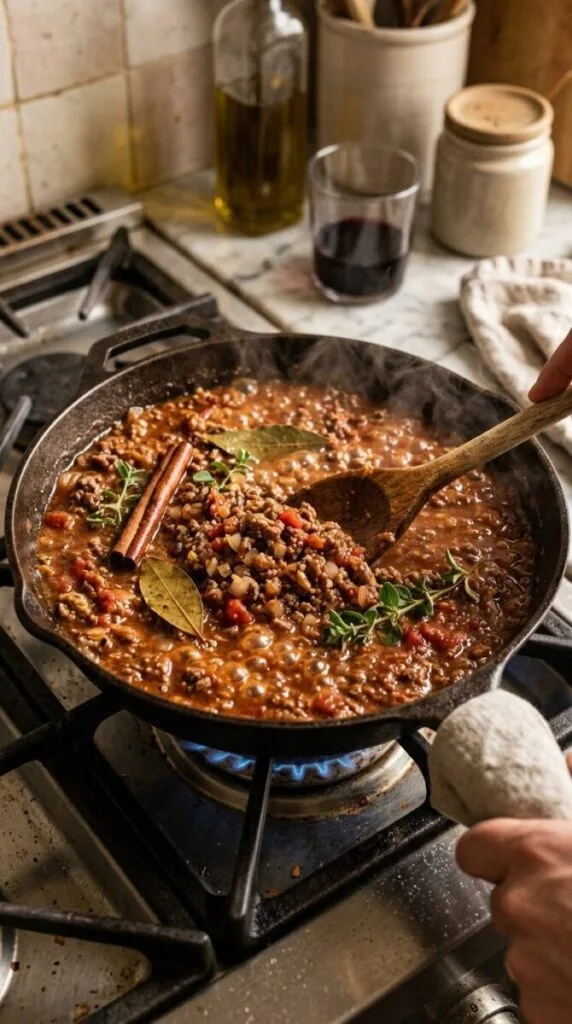
Step 3 — Making the béchamel:
- Melt the butter in a medium saucepan over medium heat. Add the flour all at once and whisk continuously for 2 minutes — this cooks out the raw flour taste; an undercooked roux produces a béchamel that tastes of raw flour even after adding the milk.
- Add the warm milk in a steady stream while whisking constantly — add the first cup slowly to allow the roux to absorb it before adding more. Continue whisking as the sauce thickens, approximately 5 to 7 minutes total, until it is thick enough to coat the back of a spoon and hold a line when a finger is drawn through it.
- Remove from heat. Add the nutmeg, salt, and white pepper and stir to combine.
- Allow to cool for 3 to 4 minutes until just warm rather than hot. Add the beaten eggs while whisking constantly — the sauce must not be hot when the eggs go in, or they will scramble immediately. Whisk until fully incorporated and the béchamel looks smooth and slightly glossy.
- Stir in the grated cheese. The finished béchamel should pour slowly and hold a slightly mounded shape rather than being thin and runny.
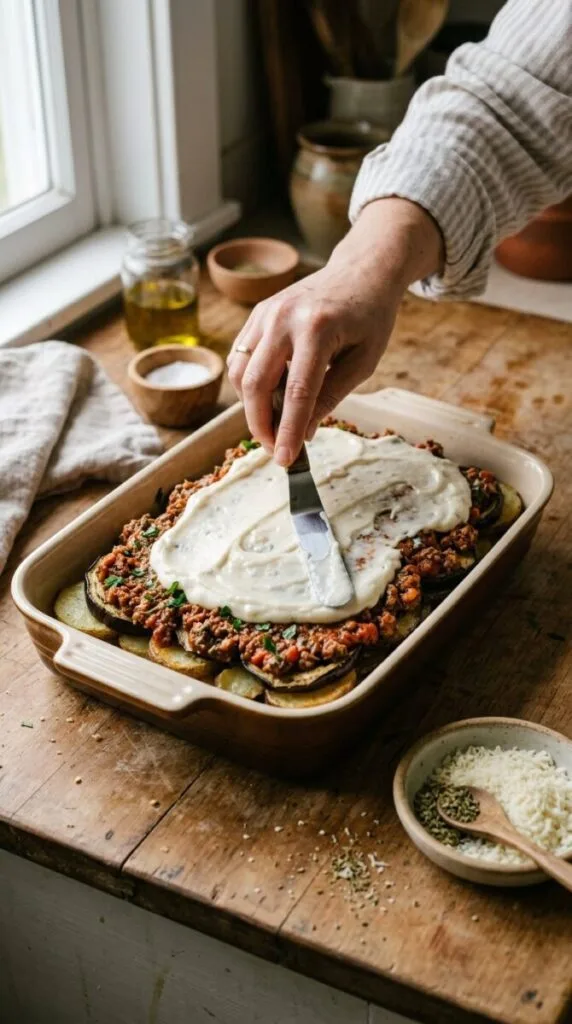
Step 4 — Assembling and baking:
- Lightly oil a 9×13 inch baking dish.
- Layer half the roasted eggplant slices in an overlapping single layer across the bottom of the dish.
- Spread all of the meat sauce evenly over the eggplant in a uniform layer.
- Layer the remaining eggplant slices over the meat sauce.
- Pour the béchamel evenly over the top eggplant layer — spread with a spatula to reach the edges of the dish. The béchamel layer should be approximately 3/4 inch thick across the entire surface.
- Scatter any remaining grated cheese over the béchamel.
- Bake at 375°F for 45 to 50 minutes until the béchamel top is deeply golden, puffed slightly in the center, and a thin knife inserted in the center comes out hot. The top should look like a golden soufflé — pale moussaka is underdone béchamel.
- Rest for at least 20 minutes before cutting — moussaka cut immediately from the oven collapses into layers that slide apart. The resting time allows the béchamel to set from a custard to a sliceable layer that holds its shape when portioned. Moussaka rested for 30 minutes produces clean, distinct, restaurant-quality slices.
Greek moussaka and our Chickpea Beet and Feta Salad with Lemon Garlic Vinaigrette is the Greek dinner combination that needs nothing else on the table — the bright, lemony, earthy salad alongside the rich, warm-spiced moussaka covers every flavour direction at once. The beet and feta provide the cold, fresh counterpoint that the deeply rich moussaka specifically benefits from alongside it.
The Salt-and-Rest Eggplant, the Reduced Sauce, and the Egg-Tempered Béchamel
Salting and resting the eggplant for 30 minutes before roasting removes bitterness and excess moisture — both of which would otherwise affect the finished moussaka. The bitter compounds in eggplant are water-soluble and leave with the drawn moisture; the excess moisture, if not removed, makes the assembled dish wet and prevents the eggplant layers from holding their structure during baking.
Reducing the meat sauce until very thick — significantly thicker than a standard pasta sauce — is the most commonly underestimated step in moussaka assembly. A wet sauce pools between the eggplant layers during the 45-minute bake and makes the dish soupy and structurally unstable. A properly reduced sauce stays in place between the layers, produces distinct, cleanly separated layers when the moussaka is cut, and contributes concentrated flavour rather than diluted tomato liquid to each bite.
Adding the beaten eggs to the béchamel off the heat — after the sauce has cooled to warm rather than hot — is the technique that produces a creamy, custard-like béchamel rather than scrambled eggs dispersed through white sauce. According to Serious Eats, egg proteins begin denaturing (scrambling) at 144°F and are fully coagulated by 158°F — a béchamel that has just come off the heat can be as hot as 200°F, which would instantly scramble the eggs on contact. Cooling to below 140°F before adding the eggs allows them to incorporate smoothly and enrich the sauce rather than cooking into solid curds in it.
What to Serve Alongside
Moussaka is a complete, substantial meal that needs only a simple green salad alongside. The Chickpea Beet and Feta Salad in the blockquote is the strongest accompaniment, but a simple Greek village salad — cucumber, tomato, Kalamata olives, and feta with olive oil and oregano — is the most authentic Greek pairing and comes together in 5 minutes while the moussaka rests.
Crusty bread for the sauce that pools slightly around the moussaka slices is the only additional element worth considering — the spiced meat sauce and béchamel that run into the dish during serving are too good to leave behind.
Variations from the Classic
Vegetarian Moussaka — replace the meat sauce with a lentil and mushroom ragù: sauté 1 cup of finely diced mushrooms until fully cooked, add 1.5 cups of cooked green lentils, the full tomato base (wine, crushed tomatoes, tomato paste), and all the same spices. The lentils provide the body and protein that the meat provides in the classic version, and the warm spice profile — cinnamon, allspice, nutmeg — remains the defining character of the dish regardless of whether the protein is lamb or lentils. This is the most popular moussaka variation for plant-based eaters and produces a result that is genuinely satisfying rather than a compromise.
Vegan Moussaka — use the vegetarian lentil-mushroom sauce above and replace the béchamel with a cashew béchamel: blend 1 cup of soaked raw cashews with 2 cups of unsweetened oat milk until completely smooth, cook with 3 tablespoons of olive oil and 4 tablespoons of flour until thickened, season with nutmeg, salt, and white pepper, and use 2 tablespoons of nutritional yeast in place of the cheese. The cashew béchamel does not bake to the same golden, puffed top as the egg-enriched version but produces a creamy, satisfying topping that makes the vegan version a complete and excellent dish in its own right.
Easy Moussaka (shortcut version) — replace the from-scratch roasted eggplant with pre-sliced eggplant that is salted, microwaved for 3 minutes on high, and patted dry (skipping the 30-minute rest and oven roasting). Use store-bought béchamel sauce warmed and enriched with 2 beaten eggs and grated cheese. Assemble and bake as directed. This shortcut reduces the total active time to approximately 45 minutes — the result is good but noticeably less developed than the from-scratch version; the eggplant is softer and less caramelised, and the béchamel is thinner and less custard-like. Worth making when time is limited; the full version is worth making when it isn’t.
Moussaka with Potatoes — add a layer of thinly sliced (1/4-inch), par-boiled potato rounds beneath the first eggplant layer. The potato layer is used in some regional Greek and Turkish versions and produces a heartier, more substantial moussaka that feeds more people from the same quantity of other ingredients. Par-boil the potato slices for 5 minutes until just tender but not fully cooked before layering — they will finish cooking during the 45-minute bake.
Nutritional Information
| Nutrient | Amount Per Serving (based on 10 servings) |
|---|---|
| Calories | 465 kcal |
| Protein | 24 g |
| Carbohydrates | 22 g |
| Fats | 30 g |
These values are estimates for the full recipe divided by 10 servings. Moussaka is a rich, indulgent dish and the values reflect that honestly — the fat content comes primarily from the lamb, the olive oil used for roasting the eggplant, and the butter in the béchamel. The vegetarian lentil version reduces to approximately 310 calories and 14 grams of protein per serving with significantly less fat from the removed meat and the potential replacement of butter with olive oil in the béchamel.
Storing and Reheating — And Why Day-Two Moussaka Is Better
Store covered in the fridge for up to 4 days — moussaka is genuinely better on day two and three than on day one. The béchamel firms completely during refrigeration to a sliceable, cohesive layer, the meat sauce deepens as the spices steep further, and the eggplant layers integrate with the surrounding sauce in a way that only time produces. Leftover moussaka slices more cleanly, tastes more developed, and reheats more evenly than freshly baked moussaka.
Reheat individual portions in a 350°F oven for 20 minutes covered with foil, then uncovered for 5 minutes — the oven reheats the béchamel from the outside in and produces a warm, creamy interior that the microwave (which produces a hot exterior and cold interior on the same reheating timeline) cannot match. The microwave works at 60 percent power for 3 minutes if the oven isn’t an option.
Moussaka freezes well — cool completely, portion into individual servings, wrap tightly, and freeze for up to 3 months. Thaw overnight in the fridge and reheat as above. The frozen version is marginally softer in texture than the fresh refrigerated version but fully flavoured and satisfying.
Mistakes That Produce Watery or Collapsed Moussaka
Not reducing the meat sauce sufficiently produces a wet, soupy assembled dish where the liquid from the sauce pools between the eggplant layers during baking and the moussaka collapses when cut rather than holding its layered shape. The sauce must look thick and paste-like — more concentrated than any pasta sauce you would normally serve — before it goes into the assembly. When in doubt, cook it 10 more minutes.
Skipping the eggplant salting step produces watery, slightly bitter eggplant that releases its moisture during baking into the meat sauce layer, diluting it and contributing to the same wet, collapsed result as an under-reduced sauce. Thirty minutes of salting and thorough blotting produces noticeably better eggplant in both flavour and structural performance.
Cutting the moussaka immediately from the oven — before the 20-minute rest — produces the kind of moussaka that slides apart on the plate, with the béchamel slipping off the meat sauce layer as a separate entity rather than holding as one cohesive slice. The rest is not optional; it is the step that converts a hot, loose casserole into a set, sliceable dish that holds its layered shape through plating.
Greek Moussaka — Authentic, Rich and Worth Every Step
A traditional Greek casserole with layers of golden roasted eggplant, cinnamon-and-allspice-spiced lamb and tomato sauce, and a thick, creamy béchamel that bakes into a puffed, deeply golden topping.
Why This Recipe Works
Moussaka depends on three properly prepared components. The eggplant is salted, dried, and roasted until silky and golden; the lamb sauce is reduced until thick and deeply flavored; and the béchamel is enriched with eggs and cheese for a creamy, soufflé-like topping.
Removing excess moisture from both the eggplant and meat sauce prevents a watery casserole. Cooling the béchamel before adding the eggs keeps it smooth, while resting the baked moussaka for at least 20 minutes allows the distinct layers to set before slicing.
Ingredients
Prepare the Eggplant
Arrange the eggplant rounds on racks or paper towel-lined baking sheets. Sprinkle both sides with the salt and let them rest for 30 minutes. Moisture should become visible on the surfaces.
Pat both sides of every slice dry with paper towels. The eggplant should look slightly softened and wilted rather than wet.
Preheat the oven to 425°F (220°C). Brush both sides of the eggplant slices with olive oil and arrange them in single layers on two parchment-lined baking sheets.
Roast for 20 to 25 minutes, flipping after approximately 12 minutes. The slices should be golden on both sides and completely tender when pressed. Set aside and reduce the oven temperature to 375°F (190°C).
Make the Meat Sauce
Heat 2 tablespoons olive oil in a large skillet or saucepan over medium-high heat. Add the onion and cook for 6 to 7 minutes, until softened and golden around the edges.
Add the minced garlic and cook for about 60 seconds, stirring continuously, until fragrant but not browned.
Add the lamb or lamb-beef mixture. Cook for 6 to 8 minutes, breaking it into fine crumbles, until no pink remains and the meat has developed browned patches. Drain excess fat, leaving approximately 1 tablespoon in the pan.
Pour in the red wine and cook for 3 to 4 minutes, stirring and scraping the bottom of the pan. Continue until the wine has mostly evaporated and the raw alcohol aroma has disappeared.
Stir in the crushed tomatoes, tomato paste, cinnamon, allspice, nutmeg, oregano, bay leaves, salt, black pepper, and sugar.
Reduce the heat and simmer uncovered for 40 to 45 minutes, stirring occasionally. The finished sauce should be deeply colored and thick like ragù, with almost no loose liquid.
Remove the bay leaves. Taste and adjust the salt, pepper, or spices as needed, then set the sauce aside to cool slightly while making the béchamel.
Make the Béchamel
Melt the butter in a medium saucepan over medium heat. Add the flour all at once and whisk continuously for 2 minutes to cook away the raw flour flavor.
Pour in the first cup of warm milk slowly while whisking constantly. Once smooth, gradually add the remaining milk, continuing to whisk so no lumps form.
Continue cooking and whisking for 5 to 7 minutes, until the sauce coats the back of a spoon and a finger drawn through it leaves a clear line.
Remove the saucepan from the heat. Stir in the nutmeg, salt, and white pepper. Let the sauce cool for several minutes so it is warm rather than piping hot before adding the eggs.
Add the beaten eggs gradually while whisking constantly. The béchamel should remain smooth, glossy, and free of cooked egg pieces.
Stir in the grated Kefalotyri or Parmigiano-Reggiano. The finished béchamel should pour slowly and hold a softly mounded shape rather than running like milk.
Assemble and Bake
Lightly oil a 9-by-13-inch baking dish. Confirm that the oven has been reduced to 375°F (190°C).
Arrange half of the roasted eggplant across the bottom in a slightly overlapping, even layer. Cover as much of the dish as possible without leaving large gaps.
Spread all of the thickened meat sauce evenly over the first eggplant layer, pressing it gently into a uniform layer.
Arrange the remaining roasted eggplant slices over the meat sauce in another overlapping layer.
Pour the béchamel evenly over the eggplant. Spread it gently to the edges with a spatula, aiming for a topping about ¾ inch thick across the surface.
Scatter a little additional grated cheese over the béchamel if desired for extra browning and savory flavor.
Bake for 45 to 50 minutes, until the béchamel is puffed, deeply golden, and browned in spots. A thin knife inserted into the center should come out hot.
Let the moussaka rest for at least 20 minutes; 30 minutes is even better for clean slices. Cut into squares only after the béchamel and meat layers have had time to set.
Key Technique Notes
The 30-minute salt rest draws out moisture. Blot every slice thoroughly before roasting to prevent a watery casserole.
The eggplant should be golden and soft throughout. Pale or resistant centers indicate that it needs more roasting time.
The meat sauce must be thicker than ordinary pasta sauce. Loose tomato liquid will pool between the layers during baking and prevent clean slices.
Warm milk incorporates more easily into the hot roux. Add it gradually while whisking constantly for a smooth béchamel.
Let the béchamel cool until warm, then whisk in the eggs gradually. Adding eggs to very hot sauce can create cooked curds instead of a smooth custard base.
Resting allows the béchamel and sauce to firm enough to hold distinct layers. Moussaka cut immediately from the oven will slide apart.
Helpful Pairing Note
What to Serve Alongside
Combine tomato, cucumber, red onion, Kalamata olives, and feta with olive oil and oregano for a fresh, traditional contrast.
Serve warm bread or pita alongside for collecting the spiced tomato sauce and creamy béchamel left on the plate.
A simple salad of arugula or mixed greens with lemon and olive oil cuts through the richness without competing with the moussaka’s spices.
Serve with green beans roasted with garlic, olive oil, lemon, and oregano for an easy warm vegetable side.
Add cool tzatziki and warm pita wedges as a starter while the moussaka completes its essential resting time.
Pair with a medium-bodied dry red wine that complements the lamb, tomato, cinnamon, and allspice without overwhelming them.
Recipe Variations
Replace the lamb with 1½ cups cooked green lentils and 1 cup finely diced mushrooms. Sauté the mushrooms until dry, then add the lentils, wine, tomatoes, paste, and all the original spices. Reduce until very thick before assembling.
Use the lentil-mushroom filling and prepare a dairy-free sauce with blended soaked cashews, unsweetened oat milk, olive oil, flour, nutmeg, white pepper, and nutritional yeast.
Microwave salted eggplant slices for about 3 minutes, blot them dry, and use prepared béchamel enriched with beaten eggs and grated cheese. The texture will be softer and less caramelized than the traditional version.
Add a bottom layer of ¼-inch potato slices parboiled for approximately 5 minutes. Arrange them beneath the first eggplant layer before adding the meat sauce.
Replace the lamb with ground beef while keeping the cinnamon, allspice, nutmeg, wine, and tomato sauce unchanged. Choose beef with enough fat to keep the filling rich.
Replace one-third of the eggplant with thick zucchini slices. Salt, blot, and roast the zucchini separately until its excess moisture has evaporated.
Nutrition
| Nutrient | Estimated Amount Per Serving |
|---|---|
| Serving Size | ⅒ of the recipe |
| Calories | 465 kcal |
| Protein | 24 g |
| Carbohydrates | 22 g |
| Fat | 30 g |
Values are estimates for one-tenth of the traditional lamb recipe. Exact nutrition varies with the meat, cheese, milk, butter, eggplant, and amount of olive oil used. Bread, salad, and other sides are not included.
Cool leftovers promptly, cover tightly, and refrigerate for up to 4 days. The layers become firmer and the spiced sauce develops further as the moussaka rests.
Prepare and assemble the moussaka up to 24 hours before baking. Cover and refrigerate, then allow additional baking time if it goes into the oven cold.
Cover individual portions with foil and reheat at 350°F for approximately 20 minutes. Uncover for the final 5 minutes to refresh the béchamel surface.
Microwave individual portions at about 60 percent power in 60-second intervals until hot throughout. Lower power promotes more even heating.
Cool completely, portion into airtight freezer-safe containers, and freeze for up to 3 months. Thaw overnight in the refrigerator before reheating for the best texture.
Refrigerated moussaka generally slices more cleanly because the béchamel and meat sauce have fully set. Add a fresh salad or squeeze of lemon when serving leftovers.
The eggplant may not have been salted and dried, or the meat sauce may contain too much liquid. Blot thoroughly and reduce the sauce until thick before assembling.
The slices may be under-roasted or insufficiently salted. Roast until golden and completely soft, with no firm pale center remaining.
Add warm milk gradually while whisking constantly. If lumps remain, pass the sauce through a fine sieve before adding the eggs and cheese.
The béchamel was too hot when the eggs were added. Remove it from the heat, cool until warm, and whisk in the eggs gradually.
Cook the milk and roux until the sauce coats a spoon and holds a clear line. It should pour slowly and remain slightly mounded over the eggplant.
Continue baking until the béchamel is puffed and deeply golden. Broil briefly at the end if necessary, watching continuously to prevent burning.
The moussaka was probably sliced too soon. Rest for at least 20 minutes—and preferably 30—before portioning with a sharp knife.
Allow the wine to reduce fully and simmer the sauce for the complete 40 to 45 minutes. Adjust the salt, cinnamon, allspice, and black pepper before assembly.