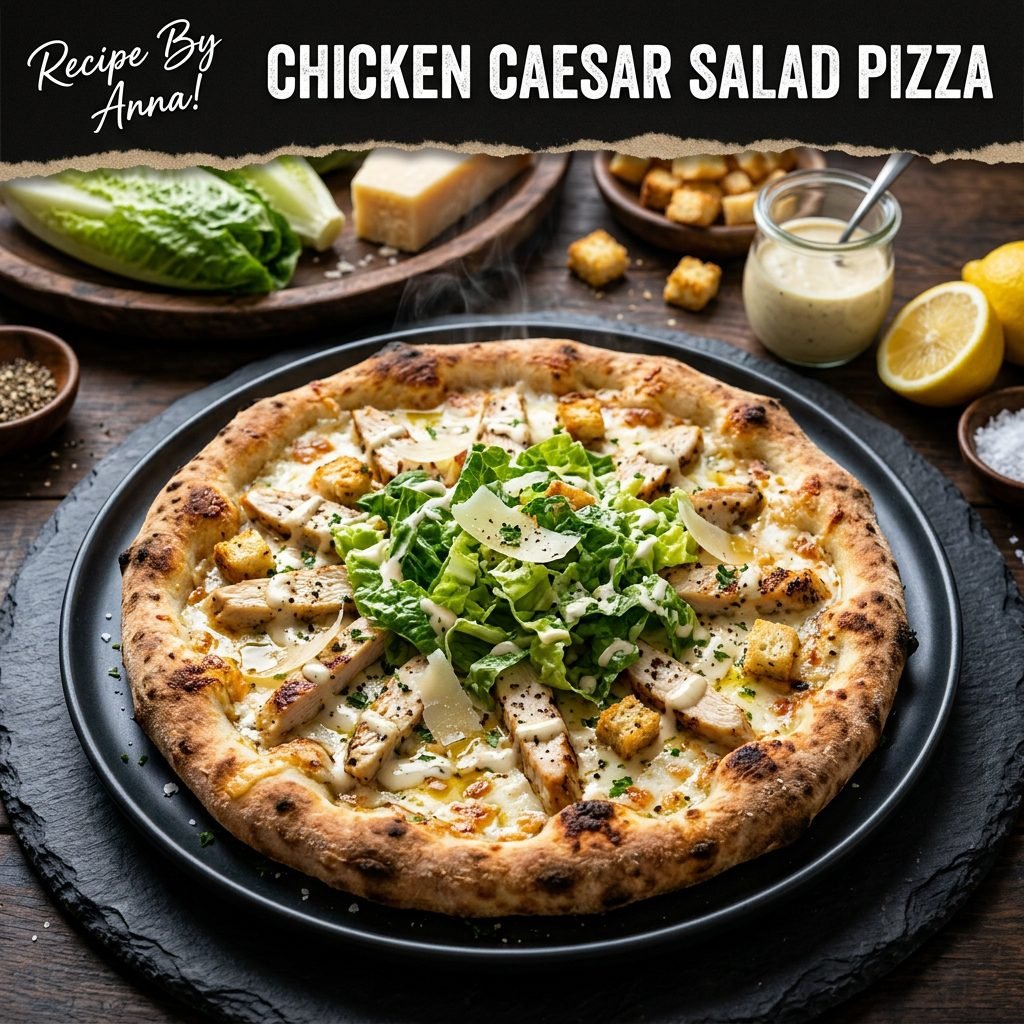
Chicken Caesar Salad Pizza | Family Weeknight Meal
Some recipes are a mash-up, and some are two foods that were secretly waiting for each other. Caesar salad on pizza is the second kind. The pizza half bakes hot and crisp — a real crust, a thin blanket of mozzarella, chicken seared golden and finished in the oven — and the Caesar half never goes near a flame: cold romaine, house dressing, torn croutons, a snowfall of shaved parmesan. At the table, the cold pile goes onto the hot slab, and each wedge comes up carrying a salad on a raft. The contrast isn’t a gimmick; it’s the entire engineering brief. Warm, crisp, creamy, cold, crunchy, in that order, in one bite.
The whole thing runs on what I think of as the cold-hot rule: heat and lettuce are on opposite schedules, and the recipe’s only real job is keeping them from meeting early. The crust bakes to finished — there is no second bake here, no topping that needs the oven after the salad exists. The romaine is washed, dried, and chopped ahead, then dressed in the last sixty seconds before it lands on the crust, because dressing on lettuce is a countdown, not a coat. And the pizza rests five minutes out of the oven first, so what meets the romaine is warm bread, not live steam. Break any leg of that schedule and you get the sad, public version of this dish — wilted greens sliding around on a softening crust — instead of the one that makes people photograph their dinner.
Housekeeping, since this site keeps its shelf honest: there is no Caesar anywhere in the building yet — the dressing shelf belongs to the house Greek, and the flatbread shelf got its pesto entry recently. This post opens the Caesar wing: one pizza that is also a whole dinner, one from-scratch dressing that will end up on every salad in your fridge within the week, and croutons that share the oven with the crust they’re going to ride.
The Cold-Hot Rule
Start with the doctrine, because it decides every step’s timing. Lettuce holds exactly one opinion under heat, and it’s surrender: the cell walls collapse, the water comes out, and a leaf that was crisp at the cutting board is cooked cabbage by the time it reaches a hot surface. So the salad and the pizza are built like two separate recipes that agree to meet at the table — the crust fully baked and briefly rested, the salad fully cold and dressed at the last possible moment, the croutons already crisp and along for the ride. The pizza never waits for the salad. The salad never waits for the oven. The only thing that crosses between them is the temperature you want.
The second half of the rule is drier than it looks: water is the saboteur on both sides of the meal. Wet romaine dilutes the dressing and leaks it down onto the crisp base, steaming it from above; an underbaked crust center drinks that leak and folds like wet cardboard at the first lift. So the lettuce gets dried properly — a salad spinner, and then, honestly, a pass through a clean towel, because spinner-dried is close but towel-dried is dry — and the crust bakes until the center is golden and firm, with no faith placed in carryover cooking that isn’t coming. A Caesar pizza is a texture contract, and both parties sign it before the meeting.
The third leg is the one nobody thinks of, and it’s my favorite trick in the recipe: cut first, dress second. The hot pizza comes out, rests its five minutes, and gets cut into wedges before any salad exists on it — a clean pass of the pizza cutter through naked crust, which it does beautifully, instead of through a pile of romaine, which it does terribly, crushing and dragging and shedding. Then the dressed salad goes over the whole cut pie, the croutons and shaved parmesan go over the salad, and each wedge lifts from beneath with its salad riding on top, cut lines already waiting. It’s the difference between a dish that photographs like a food stylist built it and one that looks like it lost an argument with a rolling blade.
⏱️ 45 MINUTES, ONE OVEN | 🍕 SERVES 4 | 🥗 HOT CRUST, COLD CAESAR
- Prep Time: 20 minutes — dough stretched, dressing whisked, lettuce chopped
- Bake Time: 15-18 minutes at 450°F, croutons on the rack below
- The Meeting: 5-minute rest, then cut, then dress, then pile — about 3 minutes
- Total Time: 45 minutes, with the chicken seared while the oven heats
- Yield: one 12-inch pizza — 4 dinners or 8 wedges as a shared plate
The Dressing Draft
The equipment is ordinary, and one piece of it earns its shelf space twice:
- Sheet pan and parchment — the pizza’s entire life; two pans if the croutons get their own
- Large skillet — for the chicken while the oven preheats
- Salad spinner and a clean towel — the romaine’s two-stage drying; the towel is not optional
- Whisk and a bowl with room to whip — the dressing wants air beaten into it, not stirred in
- Microplane — for the garlic, the parmesan, and the lemon zest all at once
- Pizza cutter — deployed early, on the naked crust, per the rule above
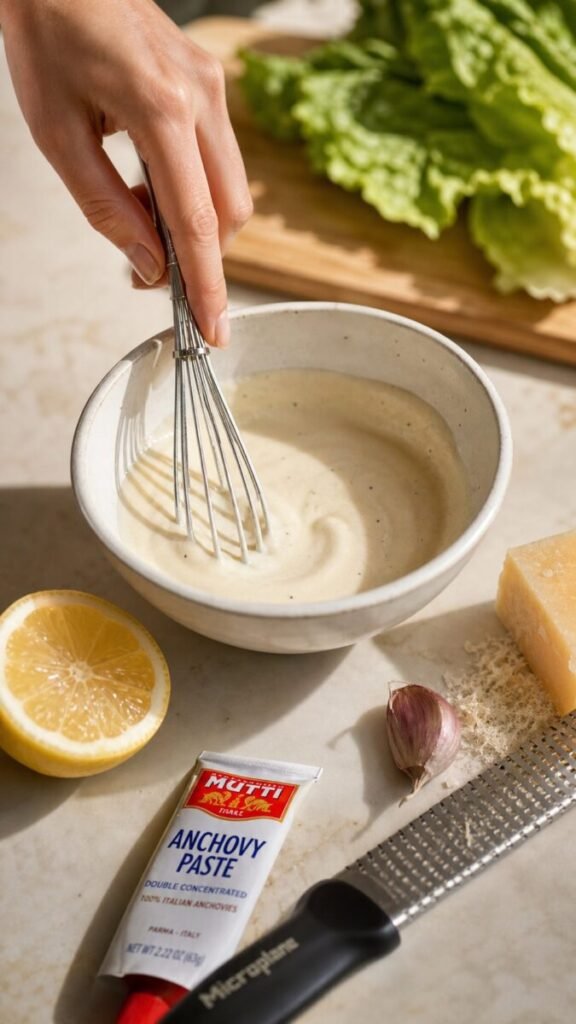
The dressing deserves its own doctrine, because a Caesar lives or dies at the whisk. This house version is built on mayonnaise instead of raw egg yolk — the classic restaurant move is a coddled yolk emulsion, gorgeous and genuinely fussy, and the mayonnaise route gets you the same creamy body with a stable, keepable, no-raw-egg dressing that behaves in a jar all week. From that base, the flavor stack: anchovy paste (the umami floor — it does not taste fishy, it tastes like Caesar), garlic grated to a paste on the microplane (so it dissolves instead of lurking in sharp shards), lemon juice for the acid, a few dashes of Worcestershire for depth, a fistful of grated parmesan, and a serious amount of black pepper — Caesar is one of the rare dressings where the pepper is a main ingredient, not a garnish.
And the reason this section is called a draft: you taste and amend, at least twice, before the dressing is done. Lemon varies in enthusiasm, parmesan in salt, anchovy paste in muscle — the recipe’s measures are a starting parliament, not a law. Taste it on a romaine leaf, not a spoon; the leaf’s water and bitterness are the backdrop it actually performs against. Too flat means lemon or salt; too sharp means more parmesan; too polite means a quarter teaspoon more anchovy. The finished draft should taste slightly too bold on its own and exactly right on lettuce — the difference between those two states is the entire secret of restaurant Caesar.
Ingredients (With Labels)
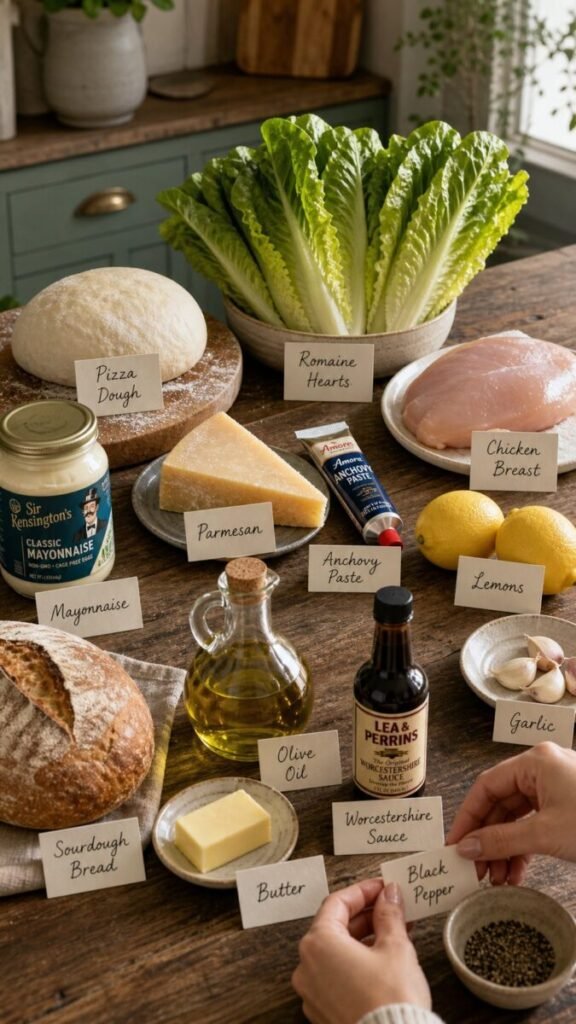
🍞 The Crust and Croutons
- Pizza dough: 1 lb, refrigerated store dough or homemade — brought to room temperature while the oven heats
- Sourdough or baguette: 3 cups torn into rough ¾-inch chunks — sturdier bread makes sturdier croutons
- Butter: 2 tablespoons, melted, for the croutons
- Olive oil: for brushing the crust and the skillet
- Garlic and grated parmesan: 1 clove grated and 2 tablespoons, for the crouton toss
🍗 The Seared
- Boneless skinless chicken breast: 1 lb — one large breast, halved horizontally into thin cutlets
- Salt and black pepper: on the chicken, generously
- A crushed garlic clove: for the skillet’s oil
🧄 The Caesar
- Mayonnaise: ½ cup — good-quality, full-fat; the whole emulsion is built on it
- Anchovy paste: 1½ teaspoons — the flavor floor; see the Questions if you’re squeamish
- Garlic: 1 large clove, grated to a paste
- Lemon: 1 — 3 tablespoons of juice, plus zest if the mood strikes
- Worcestershire sauce: 2 teaspoons
- Grated parmesan: ⅓ cup in the dressing, plus a wedge for shaving over
- Black pepper: ½ teaspoon, coarsely ground — more than feels reasonable, on purpose
🥬 The Romaine
- Romaine hearts: 2 — chopped into bite-size ribbons, spun and toweled dry
- Low-moisture mozzarella: 4 oz, shredded — the thin glue layer under everything
- Lemon wedges: for the table, and more cracked pepper than anyone expects
Step by Step How to Make
- Step 1 — The warm-up. Set the oven to 450°F with the sheet pan inside and pull the dough out of the fridge to lose its chill — cold dough fights the stretch and room-temperature dough cooperates. Season the chicken cutlets and sear them in a film of olive oil with the crushed garlic clove, two minutes a side over medium-high heat, just until golden and just cooked through. They’ll finish nothing later; this sear is their whole career. Set them aside on a cutting board to cool slightly, then slice into strips. While the pan and the dough trade places in your attention, tear the bread into crouton chunks and toss them with the melted butter, grated garlic, parmesan, and a pinch of salt in a bowl.
- Step 2 — The stretch and the blind bake. On a floured counter, press and stretch the dough into a rough 12-inch round — knuckles, not a rolling pin, which crushes the air out of the edge you’re about to puff. Lay it on the hot sheet pan (careful — the pan is a hazard now, and that’s the point of it), brush the top with olive oil, and dock the center a few times with a fork so it doesn’t billow into a dome. Bake 8 minutes, empty but for the oil, until the surface sets matte and the rim starts to color. This is the blind bake: the crust dries and stiffens into a raft before anything wet ever touches it, which is the anti-sog insurance the cold-hot rule runs on.
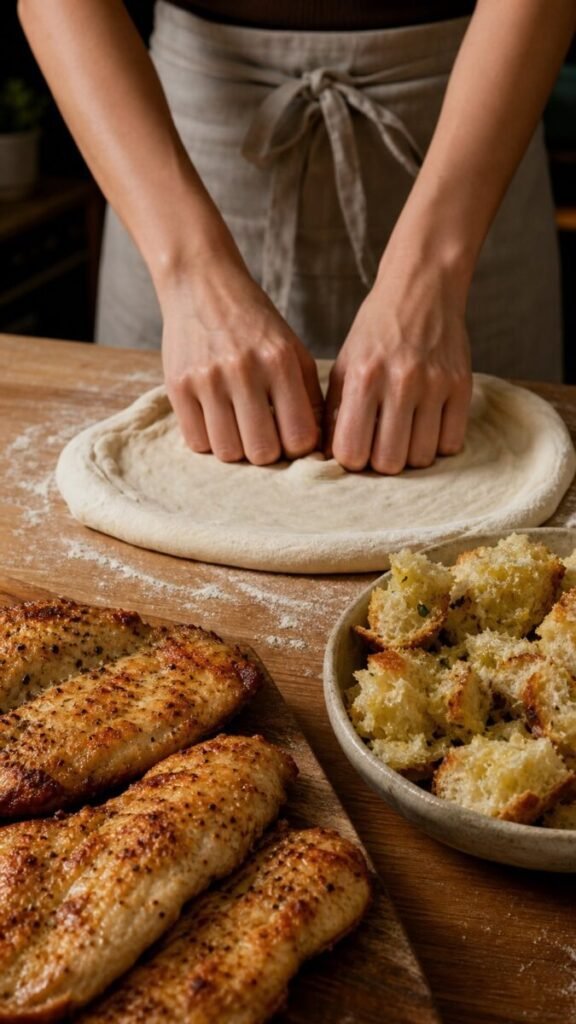
- Step 3 — The topping and the full bake. Pull the blind-baked crust, scatter the mozzarella thinly across it — thin matters, this is glue, not a cheese course — then the sliced chicken, then a first dusting of grated parmesan. Back into the oven for 7 to 8 minutes, with the croutons on a second pan on the rack below, where they toast in the same heat the pizza is using: the two of them come out together, golden crust and golden croutons, one oven, one timetable. The pizza is done when the rim is deep gold and the cheese has bubbled and gone flat in the middle; the croutons are done when they’re crisp at the edges and only barely yielding in the center, because they’ll keep hardening as they cool.
- Step 4 — The draft. While the oven finishes its work, make the dressing: mayonnaise, anchovy paste, grated garlic, lemon juice, Worcestershire, the ⅓ cup of grated parmesan, and the black pepper in the bowl, whisked hard for a full minute until it lightens and turns pale ivory. Then taste it on a romaine leaf, and amend — the draft doctrine from above, at least two rounds, until the dressing tastes slightly too bold alone and exactly right on the leaf. If it’s thicker than heavy cream, loosen it with a teaspoon of water or lemon; it should coat a leaf and cling, not blanket it.
- Step 5 — The cut before the dress. Pizza out, croutons out, oven off. Give the pizza its five minutes of rest — this is when the cheese sets enough to hold a wedge together and the surface drops from live-steam to warmly welcoming, which is the temperature the romaine can safely meet. Then run the pizza cutter across the naked top, twice through the middle and twice across, into eight wedges, while the surface is still bare. The cutter moves through hot bread like it was designed for it, because it was. This is the step people skip and then regret at the table, dragging a blade through a salad and calling it dinner.
- Step 6 — The meeting. Now, and only now, the salad happens: the dried romaine goes into the big bowl, the dressing pours over, and two forks toss it for a fast ten seconds — every ribbon coated, none of it drowning. Pile the salad over the whole cut pizza, right up past the rim, and don’t fuss with making it tidy; a Caesar pizza should look abundant, slightly reckless. Scatter the croutons over the lettuce, shave the parmesan wedge straight over everything in wide, curling ribbons, crack more black pepper across from a height, and put the lemon wedges and the leftover dressing on the table for anyone who wants their wedge wetter. Serve immediately — the cold-hot rule ends here, at the table, exactly where it was always headed.
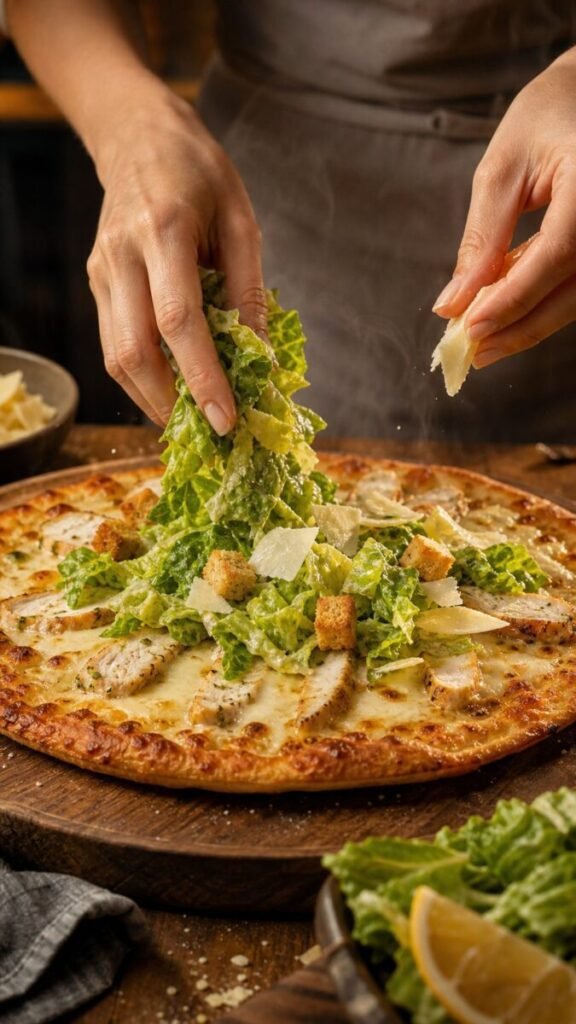
The house Greek dressing is this recipe’s sibling emulsion — a lemon-garlic vinaigrette where the Caesar is a lemon-and-anchovy cream. Make both once and your salads stop needing the store for months.
Anna’s Kitchen Notes
Romaine hearts, not a full head. The outer leaves of a romaine head are darker, tougher, and wetter — great on the grill, wrong in this pile. Hearts are the pale, tight, high-crunch center, and they’re what the squeak test is about: squeeze a heart and it should audibly squeak, the sound of cell walls that still mean business. Two hearts give the right salad-to-pizza ratio for a 12-inch round. Buy a third if your table likes its pizza more salad than bread.
Croutons from bread with a spine. A soft white sandwich loaf makes croutons that eat like packing material. Sourdough, a day-old baguette, or any sturdy country loaf makes croutons with actual structure — crusty edges, a chewy middle that fries crisp in butter. The staler the better, genuinely: fresh bread is moist and steams soft in the oven, while yesterday’s bread is already halfway to crouton before the butter arrives. This is the one recipe in the house where forgetting to eat your bread is a strategic advantage.
The anchovy question, answered without flinching. Anchovy paste is the difference between a dressing that tastes like Caesar and one that tastes like lemon mayonnaise doing its best — I said what I said. It dissolves invisibly into the emulsion and contributes pure savory depth, no fish flavor anywhere in the result. If you are morally opposed, substitute an extra teaspoon of Worcestershire and one more grated garlic clove; the dressing will be good, and you’ll know in your heart it’s a near miss. Keep the tube in the fridge anyway. It lasts months, and it improves more recipes than this one.
Store dough, honestly rated. The refrigerated 1-pound dough from the grocery case is a completely legitimate foundation for this pizza — it stretches well, bakes crisp at 450°F, and costs about two dollars. The bakery’s fresh dough is a modest upgrade; homemade dough is a Saturday project that the toppings here don’t strictly need. What no version of this recipe survives is a thin crust that isn’t baked hard: whatever dough you start with, the blind bake and the full bake together should leave the center of the pie firm enough to hold a salad without bending. When in doubt, give it two more minutes.
The leftover-dressing dividend. This dressing makes more than the pizza needs, on purpose. It keeps a week in a jar in the fridge and improves overnight as the garlic and anchovy settle in — and over that week it will become the house dressing for every lunch salad, the dip for raw vegetables and the parmesan chips, and the spread that makes a leftover-chicken sandwich worth eating. Shake the jar, loosen with a little lemon if it tightens, and treat every jar as the start of the next Caesar pizza.
The Table Around It
This pizza is a full plate on its own — protein, bread, salad, dressing, all four food groups of the American dinner in one wedge — so the company it wants is minimal and cold. A bowl of the roasted Mediterranean vegetables at room temperature is the right neighbor: warm-leaning vegetables that can sit out while the pizza gets cut and dressed. For a bigger table, a mug of the creamy parmesan tomato and cannellini soup beside the wedge turns dinner into a two-course feeling with one oven’s worth of effort already spent.
For the rotation around it: this is the third entry in the house’s hot-bread-with-cold-toppings file, and the different breads keep them distinct — a salad pizza week can be followed by the chicken piccata (same lemon-salt instincts, no oven) and the garlic butter chicken thighs, which share this recipe’s belief that garlic in hot fat is a food group. And when the table wants the bread to be the whole point instead of the base, the buttermilk biscuits carry the meal’s carb budget better than anything else on the shelf.
Same Crust, Other Salads
The Greek build. Swap the Caesar for the house Greek dressing, the romaine for chopped cucumber, tomato, and red onion with oregano, and the mozzarella for a scatter of feta that goes on hot and barely softens. Olives on top, no croutons — the pizza and the salad both change passports, and the cold-hot rule carries over untouched.
The arugula-and-prosciutto build. Baby arugula dressed only in lemon and olive oil, piled on the hot cheese, with prosciutto laid over after the oven — curling and silk-soft on contact. Shaved parmesan, black pepper, done. This is the dinner-party version, and it takes eleven minutes longer than deciding to make it.
The kale build. Chopped lacinato kale massaged with the Caesar dressing for a full minute — kale wants the dressing worked in, not poured on — and given five minutes to soften before it rides the crust. The croutons matter double here, because the greens are sturdy rather than crisp. Kale holds up under a hot crust far longer than romaine ever will, which makes this the right build for a slow, talking dinner.
The antipasto build. Chopped romaine with salami ribbons, pepperoncini, halved cherry tomatoes, and a dressing cut half with red wine vinegar — the pizza goes full Italian deli, and the fridge’s pickle drawer does most of the topping work. This is the clean-out-the-fridge Friday version, and it has never once been worse for the improvisation.
The shrimp swap. Shrimp seared in the same pan where the chicken would have been, two minutes a side with garlic and a pinch of red pepper, laid on the cheese for the last three minutes of the bake. The Caesar’s lemon loves shrimp back — it’s practically a scampi in salad’s clothing — and the pizza goes from weeknight to date night for ninety seconds of extra effort.
The grilled-summer build. The crust grilled outside instead of baked — two minutes a side over real coals, charred blisters and all — with the same cold Caesar meeting it indoors. The smoke under the lettuce is a whole other dish, and the oven never gets warm. July’s version of this recipe, no changes to the cold half of the schedule.
The Pizza Math
| Nutrient | Per Serving (2 wedges of 8) |
|---|---|
| Calories | 520 kcal |
| Protein | 32 g |
| Carbohydrates | 44 g |
| Fats | 24 g |
Estimates as written — a full pound of seared chicken split four ways, real mayonnaise in the dressing, the mozzarella and the croutons counted honestly. Thirty-two grams of protein per serving is dinner-table territory, not side-salad territory, and it’s the number that justifies calling this a pizza you can serve to hungry adults on a weeknight. The money column agrees: store dough, one chicken breast, two romaine hearts, a quarter of the mayonnaise jar, and bread you were going to lose anyway add up to about nine dollars for four dinners — a Caesar that would cost eighteen at the chain restaurant down the road, served at the exact temperature you decided, with the dressing bowl left where you can reach it.
The Last Wedge
Storage, and the honest truth about what this dish becomes tomorrow. The baked pizza — cut or uncut, undressed, no salad ever having touched it — keeps a day wrapped on the counter and re-crisps in a 400°F oven or a dry skillet for six minutes. The dressing keeps a week in its jar. The croutons keep three days in a container that seals, and revive in a 300°F oven for five minutes when they soften. Those are the components, and as components, everything survives beautifully.
Assembled, though, this pizza has no storage life at all, and that’s by design. Dressed romaine on a crust is a sixty-minute food even in the best case — the lettuce weeps, the crust drinks, and the leftover wedge is a soggy memory of dinner by the morning. So portion honestly: cut only what the table will eat, and if there are two wedges left undressed, leave them that way, wrapped, with the salad bowl in the fridge holding its dressing separately. Tomorrow’s lunch is a hot re-crisped wedge, a fresh handful of romaine tossed in thirty seconds, and the jar — the full recipe again, in four minutes flat.
The freezer’s role in all this is dough, not pizza: an extra pound of homemade dough frozen in an oiled bag is a future Caesar pizza waiting for nothing but a thaw and an oven. The crouton bread also freezes beautifully — torn chunks in a bag, straight from freezer to buttered bowl — and the anchovy paste lives in the fridge for months. Stock the parts, and the whole dish is fifteen minutes away on any weeknight that ends in a decision rather than a plan.
Where It Goes Wrong
The wilted pile. Greens gone soft and translucent on top of the pizza — the romaine was dressed too early, or piled onto a crust still steaming, or both. The clock is unforgiving on both ends: five minutes of crust rest, sixty seconds of dressed-lettuce life. If the crowd isn’t at the table yet, keep the salad undressed in the fridge and the pizza warm in a turned-off oven, and marry them only when the seats are full. There is no rescuing wilted Caesar, only preventing it.
The soggy center. The wedge folds and the middle tears under the salad’s weight — the crust underbaked, or the lettuce went on wet, or the mozzarella went on as a thick pad that never fully set. All three fixes live upstream: two extra minutes of bake, a towel pass on the lettuce, a thin glue layer of cheese instead of a mattress. Test the center of the bare baked crust with your fingertip before anything cold lands on it; firm and dry means the raft will hold.
The lemon-mayonnaise problem. The dressing tastes fine and anonymous, like a sandwich spread with ideas — it’s short on anchovy, short on pepper, or short on parmesan, and no amount of lemon fixes what the umami floor should have carried. This is what the draft process is for: taste, amend, taste again, and when in doubt add the anchovy quarter-teaspoon. A Caesar that tastes polite is a Caesar that hasn’t been introduced to itself yet.
The crushed salad. Lettuce dragged and pile-shifted across the pie, the cut lines ragged, the wedges ragged with them — the cutter went through the topping instead of the bare crust. It’s purely cosmetic, and purely preventable: the cut happens before the dress, on the rested naked pizza, in four clean passes. If the salad’s already on and the pie needs cutting anyway, use a chef’s knife with a straight-down press, once per line, never a sawing pass.
The quiet croutons. Soft, pale chunks sinking into the lettuce — they came from soft bread, or got pulled from the oven early, or sat uncovered overnight and lost their nerve. Croutons want sturdy bread, butter not oil, and a bake until the edges are truly golden; they keep hardening for ten minutes after the pan, so pull them a shade before the target. A soft crouton isn’t a failure anyone notices on the plate, which is exactly why it’s worth preventing while nobody’s watching.
The overdressed wedge. Dressing pooling around the crust’s rim, the lettuce glistening wet, the first bites rich to the point of exhaustion — the whole dressing went on at once, when the romaine only needed most of it. Dress in two additions: two-thirds tossed through the leaves, the rest held back for the table, where wedges get re-dressed to individual taste. The leftover dressing isn’t a problem in a jar with a week of utility ahead of it; it’s the head start on the next one.
Caesar Pizza Questions
Is the dressing safe without cooking the egg?
There’s no raw egg in it — that’s the entire reason this house version is built on mayonnaise. Commercial mayonnaise is made with pasteurized eggs, so the dressing is as safe as the jar it came from, stable in the fridge for a week, and safe for the pregnant friends and the immunocompromised relatives who have to interrogate every classic Caesar they’re served. The restaurant version with a coddled raw yolk is wonderful and comes with an asterisk; this one comes with a jar.
Can I use store-bought Caesar dressing?
You can, and the honest rating is: a good bottled Caesar gets you most of the way there, and none of them get you the last quarter, which is the part where the dressing tastes like it was made twenty minutes ago. If the bottle is what tonight allows, buy the refrigerated kind near the produce rather than the shelf-stable aisle, and freshen it with a squeeze of lemon and an extra grind of pepper at the bowl. The pizza half of the recipe doesn’t know the difference; the romaine does.
What about the chicken-crust version I’ve seen online?
That’s a real and popular different dish — canned or ground chicken mixed with egg and parmesan, pressed thin and baked as the crust itself, keto-friendly and startlingly high in protein. I’ve made it, and my honest verdict: it’s a chicken patty wearing pizza’s hat, and the texture never stops reminding you. This recipe is the dough-crust classic — the version where the bread is bread and the chicken is a topping. Different schools, different dinners, and this kitchen picked its lane a long time ago.
Can I make the pizza ahead for guests?
The smart split does almost all of it in advance: dough stretched and blind-baked in the afternoon, croutons toasted and stored sealed, dressing drafted and jarred in the fridge, romaine washed and dried and held crisp in a towel-lined container. Then the final stretch — the topped bake, the rest, the cut, the sixty-second dress — takes twelve minutes while everyone’s finding their seats, and the pizza arrives hot under a cold salad like it was effortless. Because at that point, it genuinely is.
Can I use rotisserie chicken?
Yes — slice it thin and lay it under the mozzarella for the full bake, so it warms through and the edges crisp instead of sitting cold on top of the salad. You lose the sear’s golden crust and the garlic-scented oil, which is a real but survivable loss on a busy night. The version’s quiet advantage: rotisserie chicken is already fully cooked and forgiving, so the oven’s only job is browning the cheese, and the pizza can come out the moment it looks right.
What if I don’t have a pizza cutter?
A sharp chef’s knife does the same job with the same rule — cut the rested, bare crust before the salad goes on, one straight-down press per line, no sawing. A bench scraper works beautifully too, and a pair of kitchen scissors, used from the edge inward, is honestly the most controlled tool of the three for a pizza that’s already dressed — the scissors’ whole design life is cutting without dragging.
Is this a pizza or a salad?
Yes. The legal answer is that it’s a pizza by architecture — dough, oven, cut into wedges — and a salad by weight, since the romaine and the dressing together outweigh everything else on the plate. The practical answer is that it’s dinner in one hand, hot under cold, crisp under creamy, with the fork optional and the napkin mandatory. Every kitchen that’s made it twice stops asking and just puts it in the rotation.
Chicken Caesar Salad Pizza
Ingredients
As an Amazon Associate I earn from qualifying purchases.
Pizza crust & cheese
- 1 lb (454 g) pizza dough, prepared for stretching according to its package
- 4 oz (113 g) shredded low-moisture mozzarella
- 2 teaspoons olive oil, for brushing the crust
- A little all-purpose flour, for shaping
Seared chicken
- 1 lb (454 g) boneless, skinless chicken breast, sliced horizontally into even cutlets about ½ inch thick
- 2 teaspoons olive oil, for the skillet
- 1 clove garlic, crushed
- About ¼ teaspoon fine salt, or to taste
- About ¼ teaspoon black pepper
Garlic-Parmesan croutons
- 3 cups (about 120 g) sourdough or baguette, torn into ¾-inch pieces
- 2 tablespoons unsalted butter, melted
- 1 clove garlic, finely grated
- 2 tablespoons finely grated Parmesan
Caesar dressing
- ½ cup commercial full-fat mayonnaise made with pasteurized eggs
- 1½ teaspoons anchovy paste
- 1 large clove garlic, grated to a paste
- 3 tablespoons fresh lemon juice, plus optional finely grated zest
- 2 teaspoons Worcestershire sauce
- ⅓ cup (about 27 g) finely grated Parmesan
- ½ teaspoon coarsely ground black pepper
- 1–2 teaspoons water, only if needed to thin
Cold salad topping
- 2 romaine hearts, washed, thoroughly dried, and chopped into bite-size pieces
- About 2 tablespoons shaved Parmesan, or to taste
- Extra black pepper and lemon wedges, optional, for serving
Kitchen Tools
- Heavy metal pizza pan or sheet pan, suitable for preheating at 450°F
- Second sheet pan, for the croutons
- Parchment explicitly rated for 450°F, optional; otherwise use a suitable bare metal pan
- Pizza peel or flat transfer tray
- Large skillet and tongs
- Instant-read meat thermometer
- Salad spinner and clean kitchen towel
- Mixing bowls and whisk
- Fine grater and peeler, for Parmesan shavings
- Chef’s knife and cutting boards, keeping raw poultry separate from salad preparation
- Measuring cups and spoons
- Pizza cutter
- Oven mitts and heat-resistant trivet
Directions
- Preheat and sear the chicken. Preheat the oven to 450°F with a suitable heavy metal pizza pan or sheet pan inside. Let the dough become pliable according to its package instructions. Pat the cutlets dry and season with salt and pepper. Heat 2 teaspoons olive oil in the skillet over medium-high heat. Sear the chicken for about 3–4 minutes per side, adjusting for thickness, until the thickest part reaches 165°F. Add the crushed garlic during the final minute so it flavors the oil without burning. Transfer with clean utensils to a clean board, rest briefly, and slice.
- Prepare the salad and Caesar dressing. Wash and thoroughly dry the romaine, using a spinner and a clean towel, then chop and refrigerate. Whisk the mayonnaise, anchovy paste, grated garlic, lemon juice, Worcestershire, ⅓ cup Parmesan, and black pepper until smooth. Add optional lemon zest if desired. Thin with a teaspoon of water at a time only if needed. Taste on a clean romaine leaf and adjust seasoning. Keep the dressing refrigerated and separate from the lettuce until serving.
- Shape and pre-bake the crust. Stretch the dough on a lightly floured surface into a roughly 12-inch round. If it springs back, let it relax briefly before continuing. Transfer using a peel or flat tray onto the preheated pan, with optional parchment rated for 450°F. Do not shape dough directly on hot metal. Brush with 2 teaspoons olive oil and prick the center lightly with a fork, leaving the rim intact. Bake for about 7–9 minutes, until the surface is set and the rim begins to color.
- Finish baking the pizza and toast the croutons. Scatter the mozzarella over the pre-baked crust and distribute the fully cooked chicken evenly on top. Return to the oven for about 7–10 minutes, or until the cheese melts and the crust is golden and cooked through in the center. Meanwhile, toss the torn bread with melted butter, grated garlic, and 2 tablespoons Parmesan. Spread on the second pan and bake alongside the pizza, checking after 4 minutes and turning as needed. Croutons may take about 5–8 minutes at 450°F and can burn quickly; remove them independently when golden. Let them cool before adding to the salad.
- Rest and cut before adding lettuce. Let the baked pizza rest for about 5 minutes, until it is warm rather than releasing strong steam. Transfer to a cutting board and cut into eight wedges with four cuts through the center. Check that the underside is baked and firm before topping; if it is still doughy, return it to the oven first. Keep the lettuce and dressing separate while the crust rests.
- Dress, pile, and serve immediately. Toss the cold romaine with about ⅓ cup dressing, adding a little more only if needed for a light coating. Reserve the remaining dressing. Pile the salad over the cut pizza, then add cooled croutons, Parmesan shavings, and optional extra pepper. Serve at once with lemon wedges. Allow about 45–60 minutes overall, plus any dough tempering required by the package. If saving portions, leave those wedges untopped and refrigerate the chicken-cheese pizza, dressing, and lettuce separately within 2 hours, or 1 hour above 90°F. Use refrigerated pizza and homemade dressing within 3–4 days. Reheat the pizza until the chicken reaches 165°F, rest briefly, then add fresh salad. Never store chicken-and-cheese pizza overnight on the counter.
Nutrition
| Nutrient | Approximate amount per serving |
|---|---|
| Serving size | 2 of 8 wedges, including salad and croutons |
| Calories | 840 kcal |
| Protein | 46 g |
| Carbohydrates | 88 g |
| Total fat | 34 g |
Estimates assume 454 g pizza dough, 454 g raw chicken breast, 113 g mozzarella, 120 g crouton bread, the listed butter and brushing/skillet oil, approximately ⅓ cup prepared dressing used, and the finishing Parmesan. Excludes leftover dressing; using more increases the totals. Dough brands, bread weights, and dressing portions vary substantially. Contains wheat, milk, egg, and fish from anchovy and typically Worcestershire. Commercial mayonnaise avoids adding a raw shell egg, but the prepared dressing still requires refrigeration.