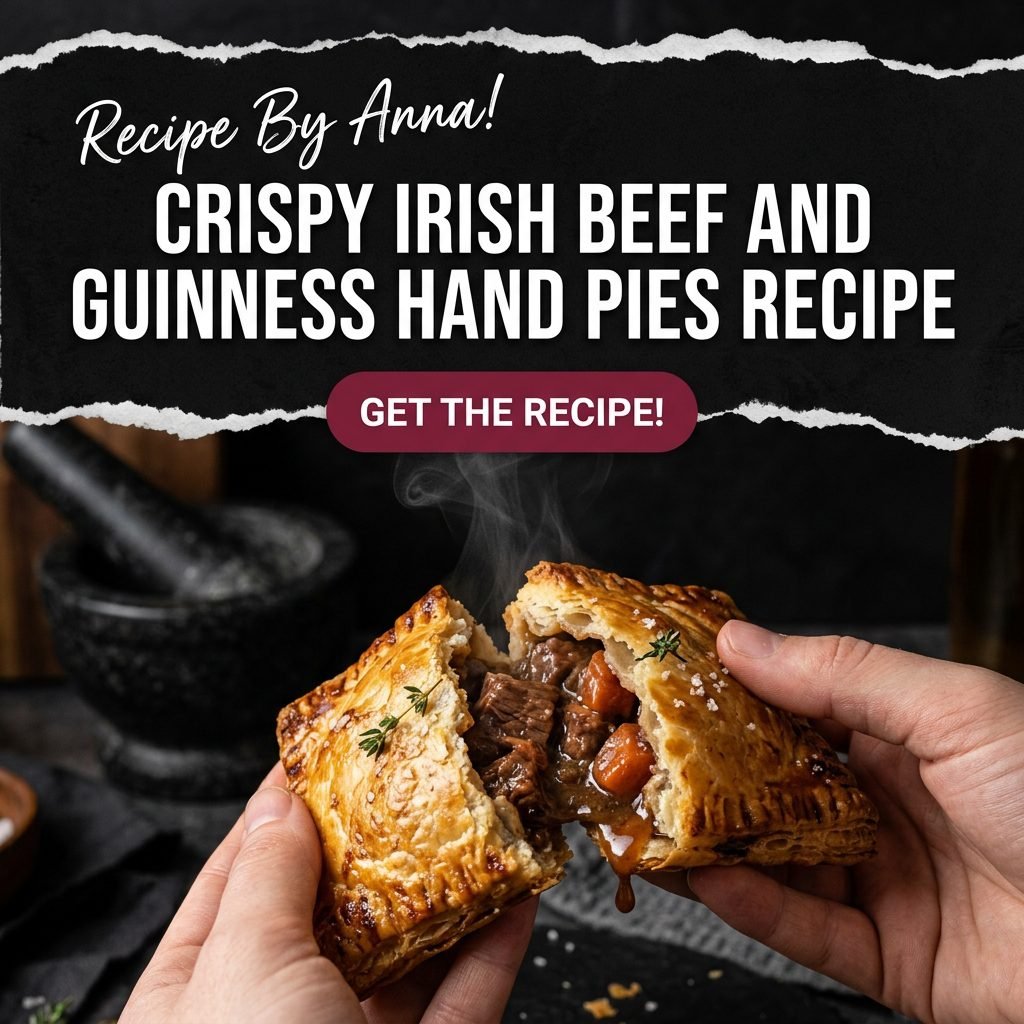
Crispy Irish Beef and Guinness Hand Pies
Beef and Guinness stew is one of Ireland’s great contributions to the idea of dinner — chuck braised until it yields to a spoon, in a dark gravy that tastes like the inside of a pub in January. This recipe takes that stew and does the obvious-in-hindsight thing: wraps it in puff pastry, seals the edges with a fork, and bakes it until the pastry turns into something between a croissant and a cracker. What you get is a stew you can hold in one hand, with no bowl, no spoon, and no possibility of leftovers surviving the evening.
Here’s the sentence that runs the whole recipe, and it’s the one most hand-pie recipes leave out: a hand pie is a stew with a roof. That means the stew inside has to be engineered differently than the stew you’d eat from a bowl — thicker, darker, reduced until it’s closer to a jammy gravy than a soup, because every drop of loose liquid inside a sealed pastry pocket turns to steam in the oven and soaks the roof from underneath. So the filling gets braised long, reduced hard, and then — the step that separates good hand pies from disappointing ones — chilled until it sets into a sliceable, scoopable gel. Cold filling into cold pastry, hot oven, and the result is the crisp-bottomed hand pie that the soggy versions of this dish are always being compared to.
The schedule is the other thing I want to set up front, because it’s the recipe’s best-kept secret: this is a two-day dish by design, and it wants to be. The braise happens on Saturday — two and a half hours, mostly unattended, while you do something better with your afternoon. The filling chills overnight, which both deepens the flavor and sets the gel. Sunday’s job is fifteen minutes of assembly and twenty-five minutes of baking, and dinner comes out looking like you spent the weekend on it, which technically you did, in the way a person asleep on a train is traveling.
One family note: the Irish corner of this site has been growing — the Irish cheddar cabbage hash brown skillet lives over there — and these hand pies are its dinner chapter. If you already know the mini mushroom and Gruyère pot pies, you know this site’s standing position on pastry-wrapped dinner; this is that position, with a stout in it.
The Stew First
The braise is where all the flavor is built, so it gets all the patience. Beef chuck is the cut — it’s marbled with connective tissue that reads as toughness raw and converts, over two hours of gentle wet heat, into gelatin, which is the substance that makes the finished gravy cling and the beef go tender without drying. A lean cut like sirloin has nothing to convert and stays stubbornly chewy long after the flavor has developed; the chuck’s apparent flaw is precisely its value. Brown it properly — dry surface, flour dusting, a genuinely hot pot, and room between the pieces, because beef crowded into a pan steams gray instead of searing brown, and the brown is a flavor, not a look.
Then the Guinness, which is not just “beer in a stew” — it’s a specific tool. Stout gets its character from dark-roasted malt, the same roasting chemistry that gives coffee its bitterness and its faint chocolate edge, and in a braise it behaves less like a beer and more like a wine: acidity that tenderizes and brightens, tannin-like roast bitterness that needs a counterweight. That counterweight is built into the recipe — a couple of teaspoons of brown sugar, the caramelized onions, and optionally a handful of sharp Irish cheddar tucked into each pie, which Irish kitchens have been doing to beef and Guinness for longer than anyone’s been writing it down. And a word on which stout: standard draught Guinness is balanced and gentle; the Extra Stout bottle is a different, much more bitter animal, and if that’s what’s in the pantry, add an extra teaspoon of brown sugar and taste the gravy before you commit.
The last act of the stew is the reduction, and it’s where bowl-stew and pie-stew part ways. Uncovered, at a steady bubble, the liquid cooks down for twenty minutes or so until it’s gravy-thick — it should heap on a spoon and stay heaped, not level off the way a soup does. Every minute of this matters twice: concentrated flavor, and less water to turn to steam inside the pastry tomorrow. When it tastes rich, dark, and just barely sweet under its seriousness, the stew is done, and it goes into a container and then the fridge — where, as it chills, all that converted gelatin sets the filling into something you can cut with a spoon. That set is not an accident. It’s the reason these pies slice clean instead of flooding.
⏱️ A SATURDAY BRAISE + A 25-MINUTE BAKE | 🥧 MAKES 8 HAND PIES | 🍺 THE STEW IS THE RECIPE
- Prep Time: 25 minutes — cubes, lardons, a chop of vegetables
- Braise Time: 2¼ hours covered + 20 minutes reducing, unattended but for a stir or two
- Chill Time: 2 hours minimum; overnight is the plan and the improvement
- Assembly and Bake: 15 minutes plus 20-25 at 400°F
- Yield: 8 hand pies — dinner for 4 at two apiece, or a very good crowd of eight at one
The Cold Fill
Short list, one hero, one rule:
- Heavy Dutch oven or braise-worthy pot with a lid — the stew’s home for two-plus hours, stovetop to oven
- Wooden spoon and a stiff spatula — for the fond-scraping and the sear
- Sheet pan and parchment — the pies’ landing zone; parchment, because egg-washed pastry welds itself to a bare pan out of spite
- 5-inch round cutter, or a bowl and a paring knife — for the pastry circles
- Fork — the crimping tool of record
- Pastry brush — for the two coats of egg wash
- Sharp paring knife — for the vents, which are not decorative
The rule is the section’s name: cold filling into cold pastry. Warm filling is the enemy of puff pastry twice over — it softens the butter layers before the oven can set them, which collapses the rise, and it turns the pastry’s bottom into a sponge before the top has even started to brown. The chilled filling does the opposite: the gelatin-set stew slices and scoops like a firm paté, the pastry stays cold and layered, and the oven’s first minutes go into puffing the crust rather than fighting a warm, wet middle. This is why the overnight chill isn’t a scheduling suggestion — it’s a structural ingredient.
Two smaller decisions live here too. The vents: two short slashes in the top of each pie, deep enough to reach the filling, because a sealed pie is a pressure vessel and steam will find the weakest seam — usually a crimp you were proud of — and open it itself. And the double egg wash: one coat before the oven for adhesion and color, a second light coat at the fifteen-minute mark for the deep, glossy amber that makes a hand pie look like it came from a bakery case. The second coat is thirty seconds of work, and it is the entire difference between gold and merely tan.
Ingredients (With Labels)
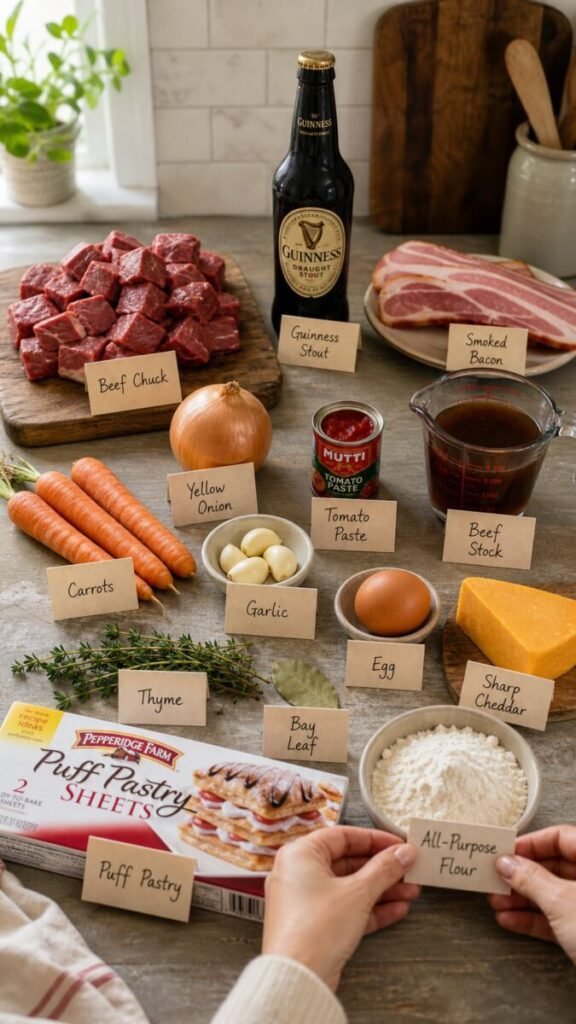
🥩 The Stew
- Beef chuck: 1½ lb, cut into ¾-inch cubes
- Smoked bacon: 3 slices, cut into lardons
- Yellow onion: 1 large, diced
- Carrots: 2, diced small
- Garlic: 3 cloves, minced
- Tomato paste: 1 tablespoon
- All-purpose flour: 3 tablespoons, for dredging, plus 1 tablespoon for the gravy
- Butter and oil: 1 tablespoon each
🍺 The Braise
- Guinness: 12 oz — draught, not Extra Stout, if there’s a choice
- Beef stock: ¾ cup
- Brown sugar: 2 teaspoons — the bitterness counterweight
- Worcestershire sauce: 1 teaspoon
- Thyme: 2 sprigs, or ½ teaspoon dried
- Bay leaf: 1
- Salt and pepper: 1 teaspoon salt and ½ teaspoon pepper in the dredge, more to taste at the end
🥧 The Pastry
- Puff pastry: 2 sheets (one 17 oz box), thawed but cold
- Egg: 1, beaten with 1 teaspoon milk — the double wash
- Sharp Irish cheddar: ¾ cup, grated — optional, and strongly advised
Step by Step How to Make
- Step 1 — The sear. Heat the oven to 325°F. Pat the beef cubes thoroughly dry — wet beef cannot brown, full stop — then toss them with the flour, salt, and pepper. Render the bacon lardons in the Dutch oven over medium heat until crisp, then lift them out leaving the fat behind, add the butter and oil, and raise the heat to medium-high. Sear the beef in two or three batches, undisturbed for two full minutes per side until each face is deeply browned, then transfer to a plate. The brown crust left on the bottom of the pot — the fond — is tomorrow’s flavor; your only job is not to scrub it off yet.
- Step 2 — The braise. Lower the heat to medium, add the onion and carrots with a pinch of salt, and cook six or seven minutes until the onion goes soft and golden at the edges, scraping the fond up with the wooden spoon as you go — the moisture from the vegetables dissolves it, which is why this step exists. Add the garlic and tomato paste and stir one minute, until the paste darkens. Return the beef and bacon, sprinkle the extra tablespoon of flour, and stir for a minute more. Then pour in the Guinness — it will foam and hiss and smell like a bakery in Dublin — scraping the bottom one last time, and add the stock, brown sugar, Worcestershire, thyme, and bay. Bring it to a simmer, cover, and slide it into the oven for 2¼ hours.
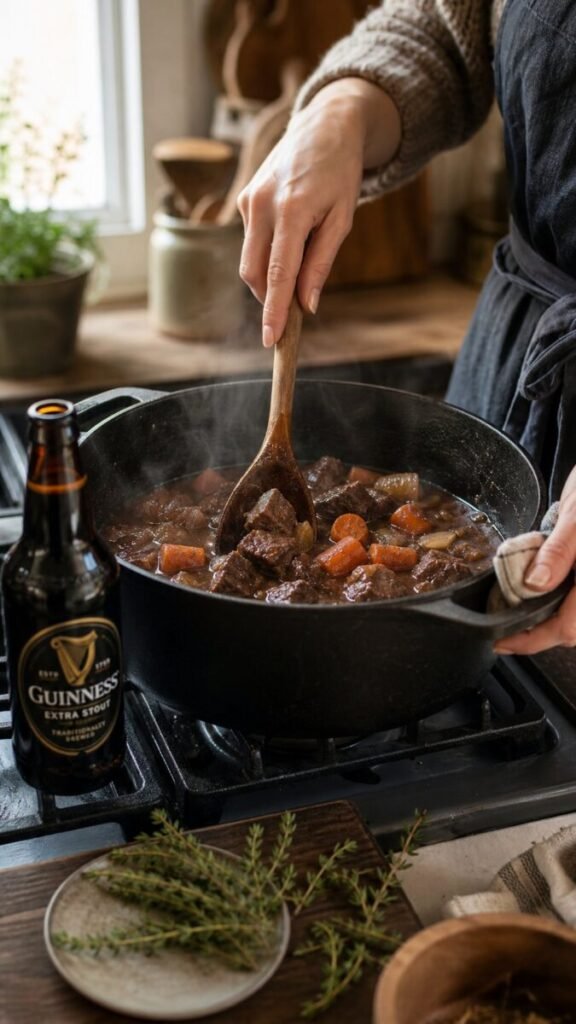
- Step 3 — The reduction. Lift the lid, fish out the thyme stems and bay leaf, and set the pot back on the stovetop over a steady bubble, uncovered, for 20 to 25 minutes, stirring occasionally, while the liquid cooks down. You’re watching for gravy: a spoon lifted should come out coated, and a heap of filling should sit on it without slumping. Taste — dark, rich, faintly sweet under its seriousness, salt adjusted — and remember this is the last moment seasoning is cheap. Cool the filling slightly, then transfer it to a container and refrigerate it, uncovered until cool, then covered. Overnight, it sets into the sliceable gel that makes the assembly a pleasure instead of a flood management exercise.
- Step 4 — Cut the rounds. Day two, or two hours later at the earliest: unfold the puff pastry on a lightly floured counter while it’s still cold — pliable but chilled, the texture of a firm letter. Cut eight 5-inch rounds with the cutter or a bowl-and-knife, re-rolling the trimmings once to get all eight. If the pastry warms and softens as you work, slide the rounds onto a tray and give them ten minutes in the fridge; cold pastry is the entire strategy, and there is no prize for speed. Beat the egg with the milk and have the fork, knife, and cheese within reach — the assembly line is about to run.
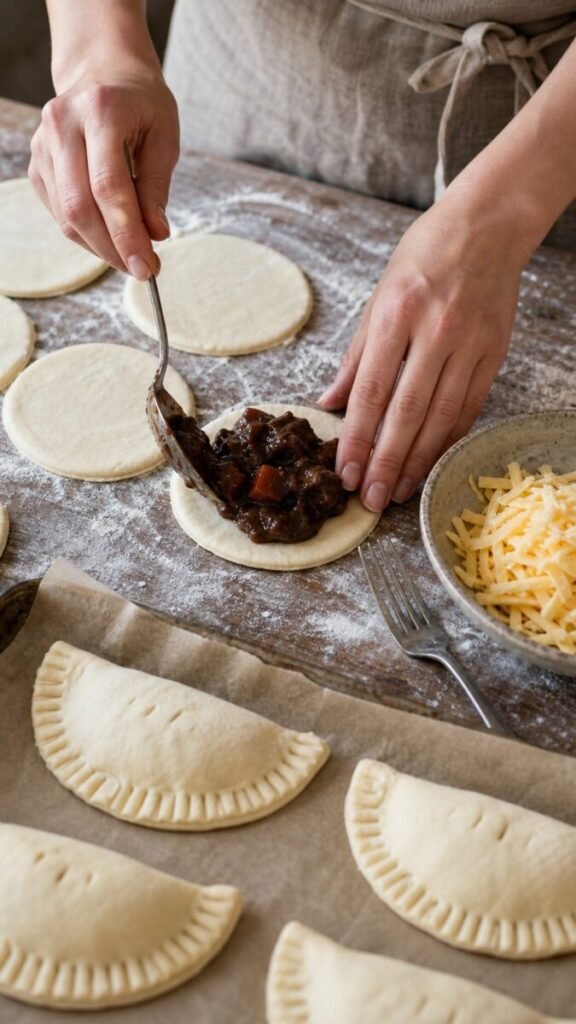
- Step 5 — Fill and seal. Working one round at a time: brush a half-moon of egg wash around the rim, heap two heaping tablespoons of the cold filling slightly off-center, tuck a pinch of the cheddar against the filling if you’re using it — it melts into the gravy and rounds the stout’s edge — and fold the round over into a half-moon. Press the edges closed with your fingers, then crimp all along the seam with the fork, pressing firmly enough to weld: a crimp is a structural seam, not a decoration, and every pleat is a promise. Two short slashes through the top of each pie with the paring knife, down to the filling, and the vents are open for business.
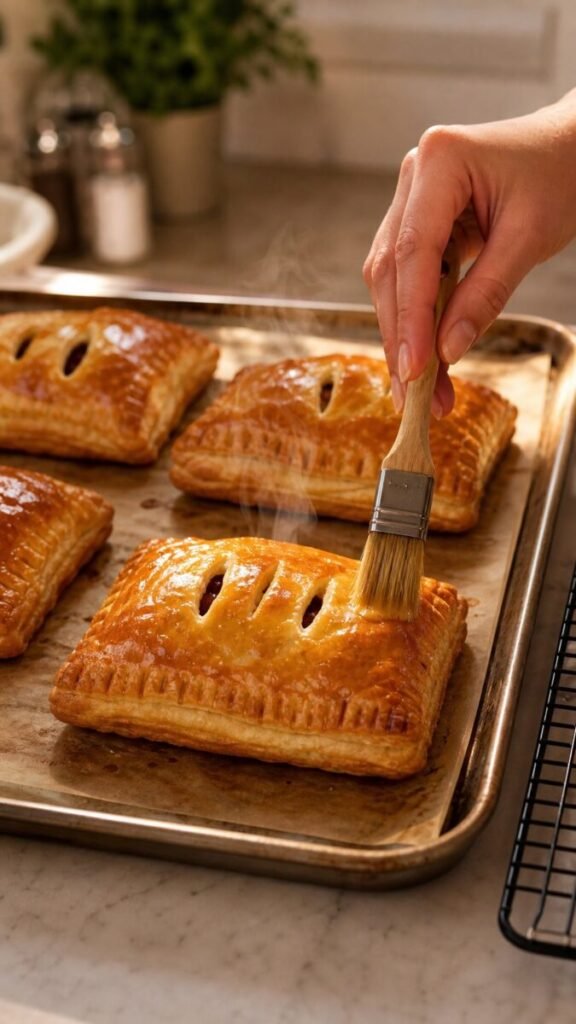
- Step 6 — The bake. Heat the oven to 400°F. Transfer the pies to the parchment-lined sheet pan with an inch of daylight between them, brush them all over with the first coat of egg wash — tops, crimps, edges, no bald spots — and bake 20 to 25 minutes, rotating once, until they’ve puffed tall and gone deep gold. At the fifteen-minute mark, slide the pan out and give them the second light coat; thirty seconds of brushwork, and the finish goes from tan to lacquered amber. Rest them five minutes — the filling inside is molten and serious about it — and then eat the first one over the sink, with both hands, because some traditions don’t need a table.
The mini mushroom and Gruyère pot pies are this recipe’s weekend sibling — same pastry-over-dinner doctrine, no braise required. Between the two, the oven has most of the calendar covered.
Anna’s Kitchen Notes
The two-day schedule is the recipe’s best feature. A braise that has to finish, chill, assemble, and bake in one afternoon is a long afternoon; a braise that happens the day before is a pot in the oven while you live your life, followed by fifteen minutes of assembly the next evening. The overnight chill even improves the flavor — stout gravy, like every stew, tastes deeper on day two — so the convenience and the quality point the same direction for once. Take the win.
Buy all-butter puff pastry if you can find it. The standard supermarket sheets work, and I’ve made these with them plenty of times. But the all-butter versions — several brands make them now, and they’re usually in the freezer case next to the regular ones — puff higher, taste like pastry instead of shortening, and turn a shade of gold that photographs the way this recipe deserves. For a recipe where the pastry is half the point, it’s the one upgrade with a visible return.
The cheddar is optional the way a good chorus is optional. A pinch of sharp Irish cheddar tucked against the filling melts into the stout gravy and rounds off the bitterness — it’s an old Irish trick with beef and Guinness, and it turns the volume of the whole pie up without changing the song. Leave it out and the pies are still excellent, a shade more stern. My table votes cheese, unanimously, every time.
Serve with something sharp and cold. These pies are rich, dark, and serious, and they want a counterpart: whole-grain mustard on the side is the pub move, a sharply dressed green salad is the dinner move, and a spoonful of the Greek dressing from this site’s shelf over bitter greens cuts them beautifully. A pint of the remaining stout is not required, but the recipe does leave four ounces in the can, and I’ve never once seen it go to waste.
Double the braise, freeze the surplus. The stew freezes beautifully for three months on its own, and a thawed tub of it is a future batch of pies — or a bowl of stew over mash, which is the same dinner without the roof. Braise once on a lazy Sunday, eat pies twice in different months, and feel like the most organized person you know. The feeling is the recipe’s second product.
The Irish Table
Two pies apiece with something green and sharp beside them is the full dinner, but the Irish corner of this site sets a fuller table. The Irish cheddar cabbage hash browns are the weekend-brunch counterpart — same cheddar, same cabbage that shows up all over Irish cooking — and the buttermilk biscuits take over the bread basket for any stew night left unbaked.
For the beef nights that aren’t pie nights: the crack burgers are this site’s ground-beef loudspeaker, and the hearty white bean soup with the sausage potato soup beside it covers the whole soup-and-stew season this braise lives in. If you’re building a full pastry-and-dinner repertoire, the puff pastry twists use the same box of dough for the appetizer course — one purchase, two courses, and a freezer that’s working for you.
Same Pastry, Other Fillings
Lamb and pea. The southern-hemisphere cousin: cubed lamb shoulder braised the same way — a lighter stock, a sprig of rosemary — with a handful of frozen peas folded in cold at assembly. Same pastry, same crimp, same bake, and a different dinner entirely, built the same way.
Steak and mushroom. Seared sirloin cubes and sautéed mushrooms bound with a spoonful of the braising gravy, no long braise at all — the quick weeknight version, twenty-five minutes start to finish, and proof that the technique is bigger than the stew.
The chicken curry hand pie. Leftover roast chicken in a quick curried gravy, chilled and filled the same way. This is the direction the hand pie concept travels around the world, and it travels well — the cold-gel filling rule works for any thick, set filling, whatever the spice cabinet is doing.
Mushroom and stout, for the vegetarians. Cremini mushrooms braised in Guinness with the onion and thyme — stout is meatless, so the whole dish stays vegetarian — reduced hard and chilled, with the cheddar mandatory rather than optional. The gap at the table closes, and nobody asks what’s missing.
The Thanksgiving turkey retrofit. Leftover turkey, leftover gravy, a spoonful of leftover stuffing folded in per pie if you have it. December’s best use of November’s leftovers, and the reason I now braise extra on purpose.
Apple and cheddar, the dessert shift. The same pastry and the same crimp around sautéed apples, brown sugar, cinnamon, and a cube of that Irish cheddar — the dessert hand pie this recipe becomes on a Sunday when the beef ran out. The oven runs the same either way; so does the fork.
The Pie Math
| Nutrient | Per Hand Pie (1 of 8) |
|---|---|
| Calories | 480 kcal |
| Protein | 24 g |
| Carbohydrates | 30 g |
| Fats | 27 g |
Estimates as written — full braise, all-butter pastry, the cheddar counted and the second egg-wash coat free. Twenty-four grams of protein per pie is honest dinner arithmetic: real chuck, real cheese, and a pastry built on butter, and two of them with a green salad is a meal that holds a person until breakfast. The money math runs the same direction — the whole batch, Guinness and all-butter pastry included, costs about sixteen dollars, which is two dollars a pie against the eight-plus that a pub charges for a smaller one. The braise is the budget’s friend: chuck is one of the cheapest cuts in the case, and it spends two hours becoming the expensive thing it tastes like.
The Second Bake
Storage and scheduling, exactly as the calendar asks for them. Baked pies keep three days in the fridge, and the reheat is a 350°F oven for eight minutes — the pastry re-crisps almost completely, the filling rewarms through, and day-two pie is a legitimate reason to look forward to Monday lunch. The microwave is not on the list: it softens the pastry into sadness in under a minute, and the whole point of this recipe is the roof.
The freezer is where this recipe quietly wins. Assembled-but-unbaked pies freeze beautifully for two months on a tray, then transfer to a bag — and they bake from frozen, straight onto the parchment, with an extra six to eight minutes and a loose foil tent if the crimps brown before the middle heats. A stash of six in the freezer is the difference between a hard week and a handled one, and it costs one lazy Saturday. Baked pies also freeze, a month, reheated straight from frozen at 350°F for about fifteen minutes — fine, though never quite as crisp as the unbaked route.
And the surplus braise, if you doubled it: three days in the fridge, three months in the freezer, and it becomes whatever the week needs — pies, a bowl over mashed potatoes, a shepherd’s-pie base under a cap of mash. The stew is the engine; the pastry is just one of the vehicles it drives. Plan the braise once and eat it in three formats, which is the most Irish thing I can say about a Sunday.
Where It Goes Wrong
The soggy bottom. The classic, and it always has one of three addresses: the filling went in warm, the filling went in loose, or the pie went unvented. Warm filling melts the butter layers before the oven sets them; loose filling turns its water to steam with nowhere to be; an unvented lid traps that steam against the roof of the pastry. The recipe’s spine — reduce hard, chill fully, vent twice, hot oven — is the prevention, and it’s four habits, not luck.
Burst seams. Overfilling, almost always — the pastry can hold about two heaping tablespoons, and every spoonful beyond it is a wager against your own crimp. The other cause is a lazy seal: egg wash on the rim, fingers first, then the fork pressed with intent. A pie that bursts at the seam still tastes like everything you hoped, but it arrives with an opening statement, and the table notices.
Pale, soft pastry. The egg wash was skipped, done once, or painted only on top. Egg wash is what turns pastry gold and crisp-shiny; without it, puff browns to a matte tan that reads as underdone no matter how long it bakes. Two coats — one before, one at fifteen minutes — and cover the crimps too. The edges are the highest-point flavor real estate on the pie, and they deserve the same paint as the roof.
A bitter, harsh gravy. The stout was Extra Stout, the brown sugar got skipped, or nobody tasted at the reduction. Roast bitterness is the flavor most likely to run away with a Guinness braise, and it’s the easiest to rein in — a teaspoon more sugar, the cheddar in the filling, a longer reduction that concentrates the sweet along with the bitter. Taste before chilling, because day two is calmer but not corrected.
Tough, dry beef. The beef went into the pot wet, the pot wasn’t hot enough to sear, or — the usual — the braise simply stopped early. Chuck needs its full two hours to convert connective tissue to gelatin; at ninety minutes it’s often still tightening, and the window between tough and tender is real. A cube that doesn’t yield to a spoon goes back in for another half hour, and patience is the entire fix.
A gap between lid and filling. Some settling is normal — the filling shrinks slightly as it bakes — but a hollow dome means the filling was too loose going in, and it steamed itself smaller. The reduction and the chill close this gap: a well-set, well-reduced filling barely shrinks at all. If your batch has a history of gaps, reduce the stew five minutes further next time and call it engineering.
Hand Pie Questions
Do I really have to chill the filling overnight?
Two hours is the working minimum; overnight is the plan. The chill does two jobs — it sets the gelatin into a sliceable gel that stays put inside the pastry, and it keeps the butter layers cold so they puff instead of collapsing — and it deepens the flavor as a bonus. Warm filling into pastry is the single most common cause of the soggy bottom, and no oven setting undoes it. If you’re truly pressed, spread the filling on a sheet pan and freeze it for forty-five minutes, stirring once.
Can I use a different beer?
Any stout or porter works — the darker and maltier, the closer to the intent. A regular ale or lager makes a pleasant but much lighter gravy; the dark roast is what the recipe is built around. Non-alcoholic stout exists and braises fine, and if beer’s off the table entirely, beef stock with a teaspoon of instant espresso and a splash of balsamic gets surprisingly close to the dark-roast depth. The recipe is flexible; the color and the sweetness balance are what you’re protecting.
Can I make the stew in a slow cooker?
Yes, with one adjustment: the reduction. Sear the beef and vegetables in a skillet first — that browning doesn’t happen in a slow cooker — then braise on low for 7 to 8 hours, and finish by transferring everything to a pot on the stove and reducing uncovered until it’s gravy-thick. The slow cooker makes excellent stew and terrible pie filling on its own, because it holds liquid rather than losing it. The extra twenty minutes on the stove is what turns the one into the other.
Can I use ground beef instead?
You can, and it becomes a different, faster dish — brown the ground beef with the onion, add the Guinness and simmer twenty minutes hard, reduce, chill, fill. It’s the weeknight version, closer to a pub snack than a braise, and honestly good. What it isn’t is this recipe: the long braise is where the chuck becomes spoon-tender and the gravy gets its body. Both versions have a place in the rotation; just know which one you’re making.
Can I make one big pie instead of eight hand pies?
Absolutely — the filling fits a 9-inch pie dish under a single puff pastry lid, egg-washed and vented, baked at 400°F for 30 to 35 minutes. It’s the traditional presentation, it feeds a table with less assembly, and it gives up exactly one thing: the crisp-to-soft ratio. A hand pie is mostly roof; a big pie is mostly filling. Both are correct, and the stew doesn’t take sides.
How do I make them smaller for a party?
Cut 3½-inch rounds instead of 5, use a single tablespoon of filling, and check the oven at fifteen minutes — minis bake faster and brown faster, so watch the crimps. You’ll get about sixteen party-sized pies from the batch, and they disappear at the pace of the other finger food on this site. Same rule at any size: cold filling, good crimp, two vents.
Why Guinness specifically — is it marketing?
It’s chemistry with a brand name. Guinness is the widely available stout with the gentlest roast balance, which matters in a dish where the beer is a quarter of the liquid and its bitterness is the flavor you’re managing. Another stout works; a heavier one needs more sugar; a lighter beer changes the dish’s whole personality. Use the draught if there’s a choice, save the Extra Stout for drinking, and the recipe will handle the rest.
Beef and Guinness Hand Pies
Ingredients
As an Amazon Associate I earn from qualifying purchases.
Beef stew base
- 1½ lb (680 g) beef chuck, cut into ¾-inch cubes
- 3 slices smoked bacon, cut into small strips
- 1 large yellow onion, diced
- 2 carrots, finely diced
- 3 cloves garlic, minced
- 1 tablespoon tomato paste
- ¼ cup all-purpose flour, divided into 3 tablespoons for dredging and 1 tablespoon for the gravy, plus a little for rolling
- 1 tablespoon unsalted butter
- 1 tablespoon neutral cooking oil
- 1 teaspoon fine salt, plus more to taste
- ½ teaspoon black pepper, plus more to taste
Guinness braise
- 12 fl oz (355 ml) Guinness Draught stout
- ¾ cup low-sodium beef stock, plus a splash if needed during braising
- 2 teaspoons brown sugar
- 1 teaspoon Worcestershire sauce
- 2 sprigs fresh thyme, or ½ teaspoon dried thyme
- 1 bay leaf
Pastry & finish
- 2 sheets puff pastry, about 17–17.3 oz (480–490 g) total, thawed according to the package but still cold
- 1 large egg
- 1 teaspoon milk, for the egg wash
- Up to ¾ cup (about 85 g) grated sharp Irish cheddar, optional; use only what fits without overfilling
Kitchen Tools
- Heavy oven-safe Dutch oven with a lid, including an oven-safe lid knob
- Chef’s knife and cutting board
- Wooden spoon and kitchen tongs
- Shallow food-storage containers, for cooling the filling promptly
- Rolling pin
- 5-inch round cutter, or a similarly sized bowl and paring knife
- Rimmed baking sheet and parchment rated for 400°F
- Pastry brush and fork
- Measuring cups and spoons
- Instant-read food thermometer
- Oven mitts and wire cooling rack
Directions
- Render the bacon and brown the beef. Preheat the oven to 325°F. Pat the beef dry, then toss with 3 tablespoons flour, 1 teaspoon salt, and ½ teaspoon pepper. Cook the bacon in the Dutch oven over medium heat until crisp. Transfer to a plate, leaving the rendered fat in the pot. Add the butter and oil, then brown the beef in 2–3 batches over medium-high heat, allowing space between the pieces. Turn once a brown crust forms and transfer to the plate. Reduce the heat if the flour or pan drippings begin to scorch.
- Build the gravy and braise until tender. Lower the heat to medium. Cook the onion and carrots for 6–7 minutes, stirring and loosening the browned bits. Add the garlic and tomato paste and cook for 1 minute. Stir in the remaining tablespoon flour and cook for another minute. Slowly add the Guinness, scraping the bottom, then add the stock, brown sugar, Worcestershire, thyme, bay leaf, beef, bacon, and any collected juices. Bring to a gentle simmer, cover, and transfer to the oven. Braise for about 2–2¼ hours, checking during cooking and adding a little stock if needed to prevent scorching. Continue until the beef breaks apart easily with a fork; tougher pieces may need another 20–30 minutes.
- Reduce, break up, and chill the filling. Using oven mitts, transfer the pot to the stovetop; the handles remain hot. Remove the bay leaf and thyme stems. Simmer uncovered for about 20–25 minutes, stirring frequently, until the gravy clings to the meat with no loose liquid pooling. Break the tender beef into smaller pieces for easier filling. Taste and adjust seasoning. Divide promptly among shallow containers, ideally no more than 2 inches deep, and refrigerate within 2 hours rather than leaving a deep pot to cool on the counter. Cover loosely while cooling, then seal when cold. Chill until 40°F or below throughout and firm enough to scoop; overnight is recommended, and 2 hours may not be sufficient.
- Cut eight cold pastry rounds. When ready to assemble, preheat the oven to 400°F and line a baking sheet with parchment. On a lightly floured surface, gently roll each cold pastry sheet to roughly 10×10 inches, or just large enough to cut four 5-inch rounds. Stack rather than knead any scraps if a single re-roll is needed. Refrigerate the rounds for 10–15 minutes if they soften. Beat the egg with the milk. Keep the stew refrigerated while working with the pastry.
- Fill modestly, seal, and vent. Place about 2 tablespoons of cold filling on one half of each round, leaving a clear ½-inch border. Add a small pinch of cheddar if using. Increase filling only if the pastry closes easily without stretching. This stew batch makes more filling than eight 5-inch folded pies can hold; reserve the surplus rather than forcing it into the pastry. Brush the sealing border lightly with egg wash, fold over, press out trapped air, and crimp with a fork. Cut two short vents in each top. Arrange on the sheet with space between them and brush the tops lightly with egg wash, avoiding pools on the cut edges. One even coat is sufficient.
- Bake until crisp and hot throughout. Bake for about 20–30 minutes, rotating if needed, until the pastry is golden, the undersides are cooked, and the center of the filling reaches 165°F. Check through a vent with an instant-read thermometer. If the pastry browns before the filling is hot, tent loosely with foil and continue baking. Rest at least 5–10 minutes and check the filling temperature before eating. Allow roughly 3–3½ hours for preparing and cooking the stew, plus thorough chilling, then 45–60 minutes for assembly, baking, and resting. Refrigerate leftover pies and surplus stew promptly and use within 3–4 days of the original braise, or freeze. Reheat leftovers to 165°F.
Nutrition
| Nutrient | Approximate amount per hand pie |
|---|---|
| Serving size | 1 of 8 filled pies, excluding surplus stew |
| Calories | 340–410 kcal |
| Protein | 10–14 g |
| Carbohydrates | 23–28 g |
| Total fat | 23–29 g |
Broad estimates assume approximately 48–55 g pastry, 30–40 g finished stew, a small portion of cheddar, and egg wash per pie. Actual values depend on pastry brand, trimming losses, beef fat, reduction, and the amount of filling used. The full stew batch is not divided among only eight small hand pies. Contains wheat and egg; milk is present in the butter, wash, optional cheddar, and some pastries. Guinness contains barley, and Worcestershire may contain fish. Braising reduces alcohol but does not guarantee its complete removal.