
Hot Pepper Jelly Cheese Bites
Every Southern appetizer shelf has a founding recipe, and mine is this: a block of cream cheese on a plate, a jar of hot pepper jelly poured over the top, a sleeve of crackers leaning against it like a fence post. That’s been party food since before I was born — a jar of pepper jelly was the standard hostess gift, right up there with showing up — and it has outlasted every food trend since, because the pairing is genuinely perfect. Creamy, salty, sweet, and just hot enough to make you reach back. The only problem is the format. The classic needs a knife, a plate, a steady hand, and somewhere to sit down and conduct the whole operation.
These hot pepper jelly cheese bites are the same idea, rebuilt for a room where nobody sits down. Whipped cheddar and cream cheese goes into a little cup of puff pastry, bakes into something molten and golden, and gets capped with warm pepper jelly right at the end. One hand, one bite, no knife, no cracker casualties. And the corners of the pastry climb as they bake, so every bite comes out of the oven looking like a small star holding a jewel — which is more than I can say for most things I make in thirty minutes.
The whole tray is six ingredients and about thirty minutes, and one sheet of pastry turns into twenty-four bites. The rule that matters most — the reason this version works where a lot of baked jelly bites go wrong — is that the jelly never goes in the oven. It goes on after, warm, off the heat. Why that’s true, and what it protects, is the spine of this recipe, so that’s where we start. And if you own a near-empty jar of pepper jelly in the fridge door that you can’t bring yourself to throw away, congratulations: it just found its retirement plan.
The Sweet-Heat Truce
First, why the classic has lasted sixty years, because that’s not nostalgia at work — it’s chemistry that happens to be delicious. Capsaicin, the compound that makes peppers hot, dissolves in fat, not water. So when heat lands in cream cheese, it glides: warm and slow, spread across every creamy bite, instead of scorching the way it can in a thin vinegar sauce. The sugar in the jelly does the other half of the work, resetting your palate between bites so each one tastes as bright as the first. And the salt in the cheese turns both of those up, the same way salt makes a tomato taste more like a tomato. Fat carries the fire, sugar resets the tongue, salt raises the volume. The block-and-cracker version proved all of this decades ago; the only thing we’re changing is the packaging.
Now the rule worth reading twice: the jelly goes on after the oven, never in it. Puff pastry needs a hot oven — 400°F — to climb, because its layers are separated by butter, and the water in that butter has to flash to steam fast enough to blow the layers apart before the fat melts and runs. Pepper jelly is mostly sugar, and sugar starts caramelizing well below the temperature those corners need to turn deep gold. Jelly baked inside a bite gives you dark, bitter edges wrapped around a pale, under-puffed cup — the worst of both worlds in one small star. Its moisture also steams straight down into the pastry, and a soggy bottom is the one thing puff pastry never forgives. So the bites bake naked, the jelly gets warmed in a bowl, and the two meet at the very end: all the gloss, none of the burn.
Two smaller decisions pull real weight here too. The cheese gets whipped — the cream cheese is beaten alone first, until it lightens and turns fluffy, before the cheddar and seasonings join. That air is insulation: it keeps the centers molten and creamy instead of dense and waxy, which is the difference between a bite that flows and a bite that sits on the tongue like a cheese pencil. And full-fat matters, which I don’t say lightly. Low-fat cream cheese replaces fat with water, and water in a 400°F oven does exactly what you’d expect — it weeps, and the filling slumps into a puddle. Same story with the cheddar: shred it off the block, because bagged shreds are dusted with anti-caking starch that fights melting and leaves the filling grainy. Two minutes with a grater buys you smooth.
⏱️ 30 MIN | 🧀 24 BITES | 🌶️ THE JELLY GOES ON AFTER
- Prep Time: 15 minutes
- Bake Time: 13 minutes, plus or minus two
- Rest: 3 minutes — a safety feature, not etiquette
- Total Time: about 30 minutes
- Yield: 24 bites — one sheet of pastry
The Little Lineup
Nothing exotic — the whole setup is small, which is most of the charm:
- Mini muffin tin — 24 cups, or two 12-cup tins. This is the bite-shaper; no liners needed, just a one-second pass of oil spray.
- Pizza cutter or sharp knife — for cutting the pastry sheet into 24 squares. Ten seconds of work.
- Small cookie scoop (teaspoon-size) or two teaspoons — one scoops the filling, one scrapes it level.
- Hand mixer, or a fork and some feelings — the whip is a small batch; a food processor is more machine than the job deserves.
- Small microwave-safe bowl — the jelly’s warming spot. A tiny saucepan on the stove works if you’d rather.
- Small offset spatula or thin fork — for lifting finished bites without beheading them.
- Wire rack — where the three-minute rest happens. Your tongue will write the thank-you note.
Ingredients (With Labels)
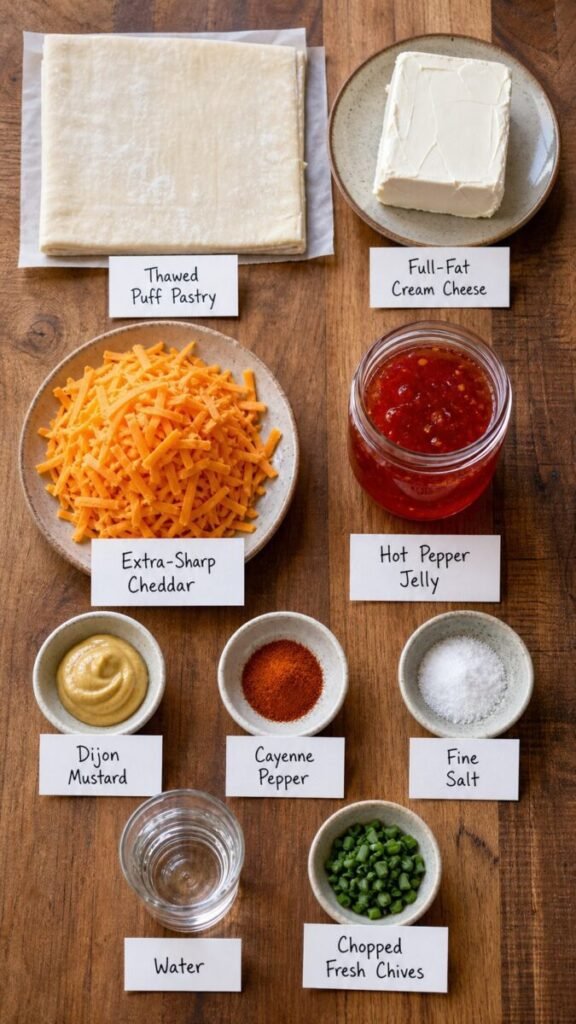
🧀 The Cheese Whip
- Cream cheese: 3 oz full-fat, softened — about 40 minutes on the counter
- Extra-sharp cheddar: ¾ cup, freshly shredded from a 4-oz chunk
- Dijon mustard: 1 teaspoon — the quiet bridge between cheese and jelly
- Cayenne pepper: ¼ teaspoon — the heat dial, turned to your crowd
- Fine salt: 1 small pinch — skip it if your cheddar runs salty
🥐 The Cups
- Puff pastry: 1 sheet from a 17.3-oz box, thawed but still cold
- Oil spray: a one-second pass for the mini muffin tin
🌶️ The Jelly Cap
- Hot pepper jelly: ⅓ cup — red, green, whichever jar needs finishing
- Water: 1 teaspoon, for loosening the jelly into a glaze
- Chives: 1 tablespoon, snipped small
Step by Step How to Make
- Step 1 — Whip the cheese first. Beat the softened cream cheese alone — a hand mixer on medium, or a fork and real determination — for a full minute, until it looks visibly lighter and fluffier. Then add the cheddar, the Dijon, the cayenne, and the pinch of salt, and beat everything together for another 30 seconds. Taste it. It should taste like the best cheese ball you’ve ever met, with a small hum underneath. If the kitchen is warm and the mix softens too much to scoop, ten minutes in the fridge firms it right back up.
- Step 2 — Cut and press the cups. Unroll the pastry sheet — thawed but still cold to the touch; if it feels soft and greasy, it needs the fridge, not you — and cut it into a 4-by-6 grid: twenty-four squares. Press each square into a cup of the oiled mini muffin tin, corners pointing up like a little star. Don’t fuss over the pleats or the corners. The oven is about to do the fluting for you, and this pastry forgives clumsy fingers.
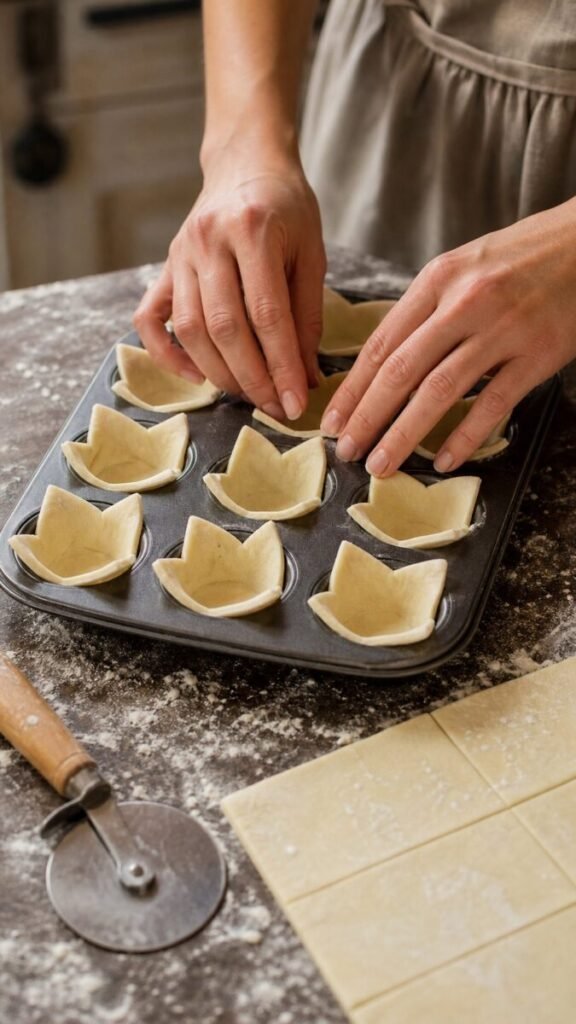
- Step 3 — Fill, mound, don’t second-guess. Two level teaspoons of the cheese whip per cup — a teaspoon-size scoop turns this into a five-minute job — mounded slightly above the rim. It will look like too much. It isn’t: the cheese settles as it melts and the pastry rises around it, so what reads as overkill at the counter comes out of the oven looking deliberate. Any leftover filling keeps; see the second-tray plan below, or the spoon already in your hand.
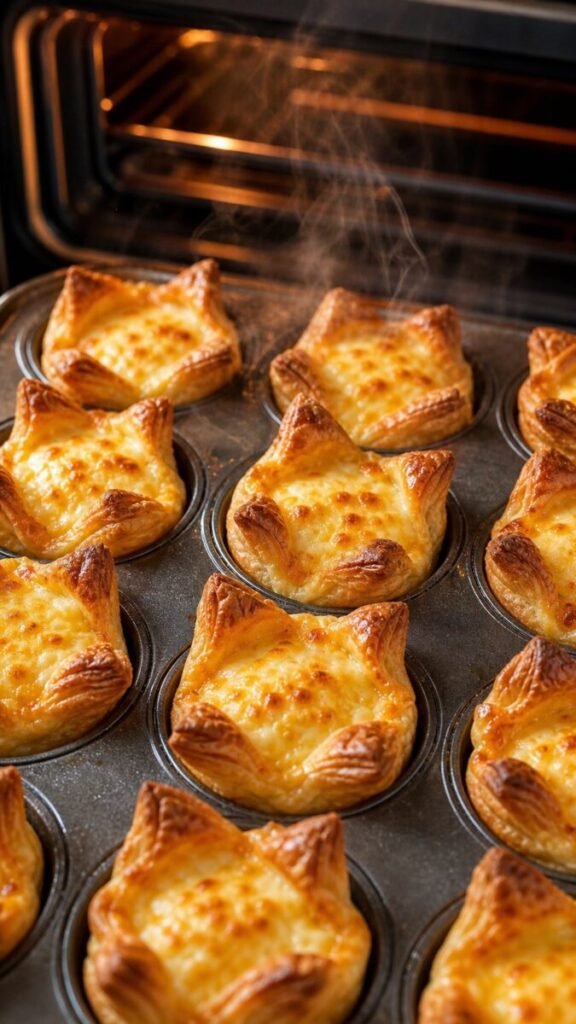
- Step 4 — Bake to deep gold. 400°F, center rack, 13 to 15 minutes, rotating the tin once at the 8-minute mark. They’re done when the corners are deep golden and the filling has slumped and bubbled. Don’t jump early — pale pastry tastes like raw flour, and color is flavor here. The bites will look slightly turbulent coming out of the oven. That’s the look.
- Step 5 — Warm the jelly. While the tin runs out its last minutes, warm the jelly with the teaspoon of water in a small bowl — 25 to 30 seconds in the microwave, then a good stir. You’re looking for a texture that laps off the spoon like warm syrup: loose enough to spoon cleanly, thick enough to stay where it lands. Straight-from-the-fridge jelly is too stiff to behave, and jelly that’s merely room temperature sits on top of a bite like a hat. Warm and loose is the state you want.
- Step 6 — Cap, rest, finish. Half a teaspoon of warm jelly onto each hot bite, centered — it should sit as a glossy cap, not a waterfall — then the snipped chives over everything. Now the three-minute rest, which is not optional etiquette but a safety feature: that molten center is straight-up napalm when it first comes out, and the rest is what drops it from scalding to merely glorious. Lift the bites onto a serving plate with the offset spatula, and take a step back, because the tray now belongs to the room.
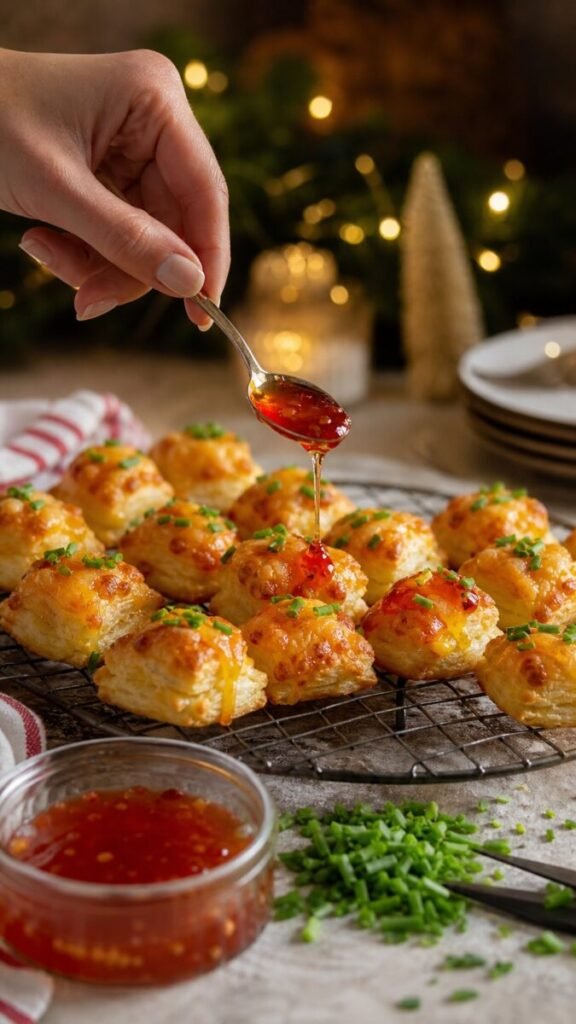
Sweet, salty, and just hot enough to bring you back — these bites are the one-hand update of the pepper-jelly classic, and the cheesy thumbprint appetizers are its shortbread cousin. Same jar of jelly, two different family reunions.
Anna’s Kitchen Notes
The softened test. Press a finger into the cream cheese. It should dent and hold, like butter that’s sat out for an hour — not resist, and not sink. Cold cream cheese whips lumpy no matter how long you beat it, and over-soft cream cheese greases instead of fluffing. The forty-minute counter sit isn’t a suggestion; it’s step one wearing a disguise.
Shred it yourself, this once. A 4-oz chunk of extra-sharp cheddar against a box grater takes about a minute, and it’s the difference between a filling that melts smooth and one that stays faintly grainy no matter how long it bakes. The anti-caking starch on bagged shreds is great for the bag and terrible for this recipe. If the grater and I are both asking nicely, that should settle it.
The jelly jar audit. Every fridge door in the South holds a pepper jelly jar with one-eighth of a jar left, saved for reasons nobody can name. This recipe needs exactly a third of a cup. Run the math, empty a jar or two, and count it as deep-cleaning the fridge door with appetizers. Very few chores pay out like this one.
The quality-control bite. One bite per tray always comes out ugly — a corner that folded, a cap that slid. That one belongs to the cook. It isn’t gluttony, it’s quality assurance, and it’s the most honest part of hosting: you taste the tray so your guests don’t have to review it.
Two tins, two futures. If these are for a party, double the batch into two tins and freeze the second before it bakes — the storage section has the details. The party tray bakes, the future tray waits in the freezer, and future-you gets to accept the compliment casually, as if warm cheese bites materialize on demand.
The Porch Table
These bites lead the board, and the rest of the table should stay one-hand-friendly. The sweet and savory guava dip is the sweet-hot cousin from another coast — creamy, tropical, gone in ten minutes — and the classic party shrimp dip is the cool, creamy counterpoint that keeps the sweet-heat from staging a solo show.
For the heat-lovers, set out the jalapeño cream cheese dip — same cream, more fire — and the frito corn salad brings the crunchy, salty porch energy that everything on this table secretly wants. And if the tray empties early, which it will, the puff pastry twists are the same box of pastry doing a second act — the tidiest kind of shopping there is.
Same Bite, Other Jellies
The Christmas tray. Cap half the bites with red jelly and half with green — green jalapeño jelly is usually a touch milder, and the two-tone tray looks like it was arranged by someone with far more patience than either of us. Same amounts, same warming, same glossy finish.
The Thanksgiving leftover cap. Warm whole-berry cranberry sauce with a pinch of cayenne stirred in stands in for the jelly in the week after Thanksgiving, and it is exactly as good as it sounds like it might be — which is rare in leftover engineering, a field with a humbling success rate.
Apricot with an attitude. Apricot preserves, a squeeze of lemon, and a pinch of cayenne make a respectable pepper jelly on the spot. It’s the make-do version, and nobody at the party will file a complaint.
The blue cheese swap. Trade the cheddar for crumbled blue cheese in the whip and cap with fig jam instead of jelly. The flavor moves from porch to wine bar, and it’s the version I make for the friend who brings actual brie to things and deserves a seat at this table too.
Hot honey instead of jelly. A warm drizzle of hot honey in place of the cap — thinner gloss, same sweet-heat, and the bites suddenly read more game-day than holiday. Good in January, when the tray is wanted but the tinsel isn’t.
The no-bake shortcut, honestly rated. Fully baked mini phyllo shells, the whip spooned in, 8 to 10 minutes at 350°F just to warm through, jelly cap after. You lose the climbing corners and the molten center — phyllo stays crisp while the filling stays soft — and you gain ten minutes and zero lamination anxiety. About eighty-five percent of the experience. Tuesday is allowed.
The Nibble Math
| Nutrient | Per Bite (1 of 24) |
|---|---|
| Calories | 75 kcal |
| Protein | 3 g |
| Carbohydrates | 6 g |
| Fats | 5 g |
Estimates for the bites as written — pastry, cheese whip, jelly cap, and chives. Seventy-five calories apiece puts a full tray of twenty-four around eighteen hundred, which sounds like a lot until you watch a tray disappear in fifteen minutes at a real party and do the sad arithmetic. The fat comes from the pastry’s butter and the cheese, which is the honest kind of fat for a holiday table. And bites are unit food: the official serving is three, and the observed serving is whatever fits on a napkin. I’ve counted. Nobody’s proud.
The Second-Tray Plan
The make-ahead move is the best part of this recipe: fill the cups, then freeze the whole tin before it ever bakes. Once the filled bites are frozen hard — about two hours — transfer them to a freezer bag and they’ll keep beautifully for two months. When the next party materializes, they go into a 400°F oven straight from the freezer — no thawing, which matters, because thawed raw pastry softens, sticks, and loses its climb — with four or five extra minutes on the clock. The cheese whip is unbothered by the freezer; it’s mostly fat and air, and both travel well.
Baked, jelly-capped leftovers keep three days in the fridge and re-crisp on a sheet pan at 350°F for five or six minutes — the pastry comes back remarkably well, the jelly gets glossier, and the center returns to molten. The microwave works if tenderness is the only goal, but it costs you the crisp, and the crisp is the spine of the bite. Fifteen seconds of hesitation about the oven is worth paying.
The whip and the jelly both outlive the party with second careers. Extra whip is the best cracker spread in the fridge and a shameless stuffed-celery situation. Extra pepper jelly belongs on a bagel with cream cheese, glazed onto chicken wings in the last five minutes of roasting, or brushed across a pork chop. And the next near-empty jar you can’t bring yourself to throw away? You know what to do with it now.
Where It Goes Wrong
Slumped, flat cups. Warm pastry. Puff pastry climbs because cold butter flashes to steam inside the layers; if the sheet went in soft — thawed too long on the counter, or worked in a hot kitchen — the butter runs before it steams, the layers merge, and you get little biscuits with no altitude. Thaw in the fridge overnight, work quickly, and if the squares feel soft, chill the whole tin for ten minutes before filling.
Burnt edges around a pale cup. Jelly that went into the oven. This is the recipe’s one hard rule: sugar scorches far below the temperature the pastry needs, so jelly baked in delivers black rims wrapped around an under-puffed cup, plus a steamed, soggy base for good measure. The cap goes on after, warm, off the heat. Every single time.
A weeping, slumped filling. Low-fat cream cheese, most likely — the water standing in for the fat comes out in the oven as a sad puddle. Full-fat is the whole recipe here, and this is not the place to save. Overbaking does it too: the filling only needs to slump and bubble, and minutes past that, it breaks and greases. Pull the tray on schedule.
A grainy filling. Bagged shredded cheese. The starch that keeps shreds from clumping in the bag also keeps them from melting smooth, and no amount of whipping fixes it after the fact. A chunk of cheddar and one minute with a grater is the entire repair.
Pale, careful bites. Pulled too early. Under-baked puff tastes of raw flour, and its color is the timer — deep gold on the corners is the finish line, not a warning sign. If the tops are browning before the corners color, the oven is running hot; drop it 25 degrees and give the tray two more minutes.
Scorched tongues, emergency punch refills. No rest. The filling comes out of the oven just past lava, and the three-minute rest is what stands between your guests and a memorable evening for the wrong reasons. The jelly cap needs those three minutes to settle anyway. Consider it multitasking, Southern-style.
Jelly Questions
Can I use green pepper jelly instead of red?
Absolutely — green jalapeño jelly is the original color and usually a touch milder than most red versions. Around the holidays, the two-tone tray is the move: half red, half green, same amount of jelly, same warming, same glossy cap. It looks like considerably more effort than it is, which is the best kind of holiday decorating.
Can I make these ahead?
Yes, and the make-ahead version is arguably better than the fresh one. Fill the cups, freeze the tin, bag the frozen bites, and bake them from frozen whenever the party lands — 400°F, plus four to five minutes. The cheese whip freezes perfectly. The only step that can’t happen ahead is the jelly cap, which is two minutes of spoon work at the end and honestly the fun part anyway.
Do I need to thaw frozen bites before baking?
No — frozen into a hot oven is the intended path. Thawed raw pastry softens, sticks to the tin, and loses its climb, while frozen pastry hits the 400°F air still cold enough for the butter to steam properly. Add four to five minutes and use the same doneness signal: deep-gold corners, slumped and bubbly centers.
My filling greased out. What happened?
Usually overbaking — minutes past “slumped and bubbled,” the cheese breaks and the fat separates — or an oven running hot, which does the same thing faster. Occasionally it’s low-fat cream cheese, which weeps rather than greases, and the fix for that lives at the store. Pull the tray when the corners are deep gold and the centers have settled; the carryover heat finishes the job in the rest.
Can I use phyllo cups instead of puff pastry?
Yes — it’s the shortcut route. Fifteen mini phyllo cups (they’re sold pre-baked and thaw in minutes), the whip spooned in, 8 to 10 minutes at 350°F to warm everything through, jelly cap after. You trade the climbing corners and the molten center for speed and a crisper shell. For a weeknight, that’s a fair trade; for a party, I’d make the pastry version and let the corners show off.
What if I can’t find hot pepper jelly?
Any red jelly or jam plus a pinch of cayenne and a drop of cider vinegar gets you surprisingly close — pepper jelly is mostly sugar, heat, and a little tang, and that formula is easy to approximate. Warm honey works as the cap too: thinner, but in the same spirit. One shopping note — most stores shelve pepper jelly with the specialty jams rather than the everyday jelly aisle, which is where I have lost twenty minutes of my life more than once.
How spicy are they, honestly?
Mild to medium, by design. Most pepper jelly is sweeter than it is hot, and the cream cheese buffers what heat there is — capsaicin dissolves into the fat, which is the whole truce. The cayenne in the whip is the real dial: a quarter teaspoon reads friendly, a half reads festive. You can hand one to a spice-averse aunt on a cracker of good faith.
Hot Pepper Jelly Cheese Bites
Ingredients
As an Amazon Associate I earn from qualifying purchases.
Cheese filling
- 3 oz (85 g) full-fat block cream cheese, softened but not warm or runny
- ¾ cup (about 85 g / 3 oz) freshly shredded extra-sharp cheddar; grate from a block and measure the amount needed
- 1 teaspoon Dijon mustard
- ¼ teaspoon cayenne pepper, or less to taste
- 1 small pinch fine salt, optional
Pastry cups
- 1 sheet (about 8.65 oz / 245 g) puff pastry, from a 17.3-oz two-sheet box, thawed according to the package but still cold
- Cooking oil spray, for lightly greasing the tin, if permitted by its manufacturer
Pepper jelly finish
- ⅓ cup hot pepper jelly, red or green; you may not need all of it
- Up to 1 teaspoon water, as needed to loosen the jelly
- 1 tablespoon finely snipped chives
Kitchen Tools
- 24-cup mini muffin tin, or two 12-cup mini tins
- Hand mixer or sturdy fork
- Small mixing bowl and silicone spatula
- Cheese grater
- Rolling pin and parchment paper, for rolling without adding flour
- Pizza cutter or sharp knife
- Measuring cups and spoons
- Small microwave-safe bowl, for warming the jelly
- Small pan-safe spatula, for lifting the bites
- Oven mitts and wire cooling rack
Directions
- Preheat and whip the cheese. Preheat the oven to 400°F and lightly grease the mini muffin tin according to its care instructions. Beat the softened cream cheese for about 1 minute until smooth and lighter. Add the cheddar, Dijon, and cayenne, then mix for about 30 seconds until evenly combined. Taste with a clean spoon and add the optional salt only if needed. Pepper jelly heat varies, so reduce the cayenne for a milder filling. Refrigerate briefly if the mixture becomes too soft to portion.
- Roll, cut, and shape the pastry. Unfold the thawed but cold pastry. Roll gently between sheets of parchment to approximately 8×12 inches, then cut into a four-by-six grid to make 24 roughly 2-inch squares. Press one square into each mini muffin cup, leaving the corners pointing upward. Avoid stretching the dough tightly against the sides. If it becomes soft or greasy, refrigerate the shaped cups for 10–15 minutes before baking.
- Divide the filling evenly. Divide the cheese mixture among the 24 cups, starting with about 1 level teaspoon per cup and distributing any remainder evenly. Keep the filling inside the pastry without a large mound above the cup. The small filling batch may not provide 2 teaspoons for every bite; equal portions matter more than a fixed scoop. Leave the jelly off until after baking.
- Bake until the pastry is cooked through. Bake on the center rack, beginning to check at 13 minutes. Allow approximately 15–20 minutes, or longer if needed, until the corners are golden and the pastry sides and bases are cooked rather than pale and doughy. Rotate the tin if your oven browns unevenly. Carefully lift one bite with a pan-safe utensil to check its underside. Do not judge doneness by the melted filling alone. If the tips brown early, loosely shield them with foil while the bases finish baking.
- Warm the pepper jelly gently. Near the end of baking, place the jelly in a microwave-safe bowl. Heat in 10-second bursts, stirring between each, until spoonable. Add up to 1 teaspoon water only if needed; the jelly should remain thick enough to stay on the bites. Avoid boiling it, and handle carefully because hot sugary mixtures can burn. Adding the jelly after baking preserves a glossy topping and helps keep the pastry crisp.
- Top, cool briefly, and serve. Set the tin on a rack. Spoon about ½ teaspoon warm jelly onto each bite, adding a little more only if it fits without overflowing. Sprinkle with chives. Let stand for at least 3–5 minutes, then lift the bites out and check that the centers have cooled enough to eat comfortably. Serve warm. Allow about 35–45 minutes overall, excluding pastry thawing, cheese softening, or extra chilling. Refrigerate leftovers within 2 hours, or within 1 hour above 90°F, and use within 3–4 days. Reheat in a 350°F oven until the centers reach 165°F, watching the jelly so it does not scorch.
Nutrition
| Nutrient | Approximate amount per bite |
|---|---|
| Serving size | 1 bite; ¹⁄₂₄ batch |
| Calories | 85 kcal |
| Protein | 2 g |
| Carbohydrates | 7 g |
| Total fat | 6 g |
Estimates assume a 245 g puff pastry sheet, 85 g full-fat cream cheese, 85 g cheddar, approximately ¼ cup pepper jelly used across the batch, and a light coating of oil spray. Three bites provide approximately 255 calories. Values vary with pastry brand, jelly quantity, and portion size. Contains wheat and milk; check pastry labels for other allergens. For vegetarian needs, choose cheddar made with vegetarian enzymes and pastry without animal-derived shortening.