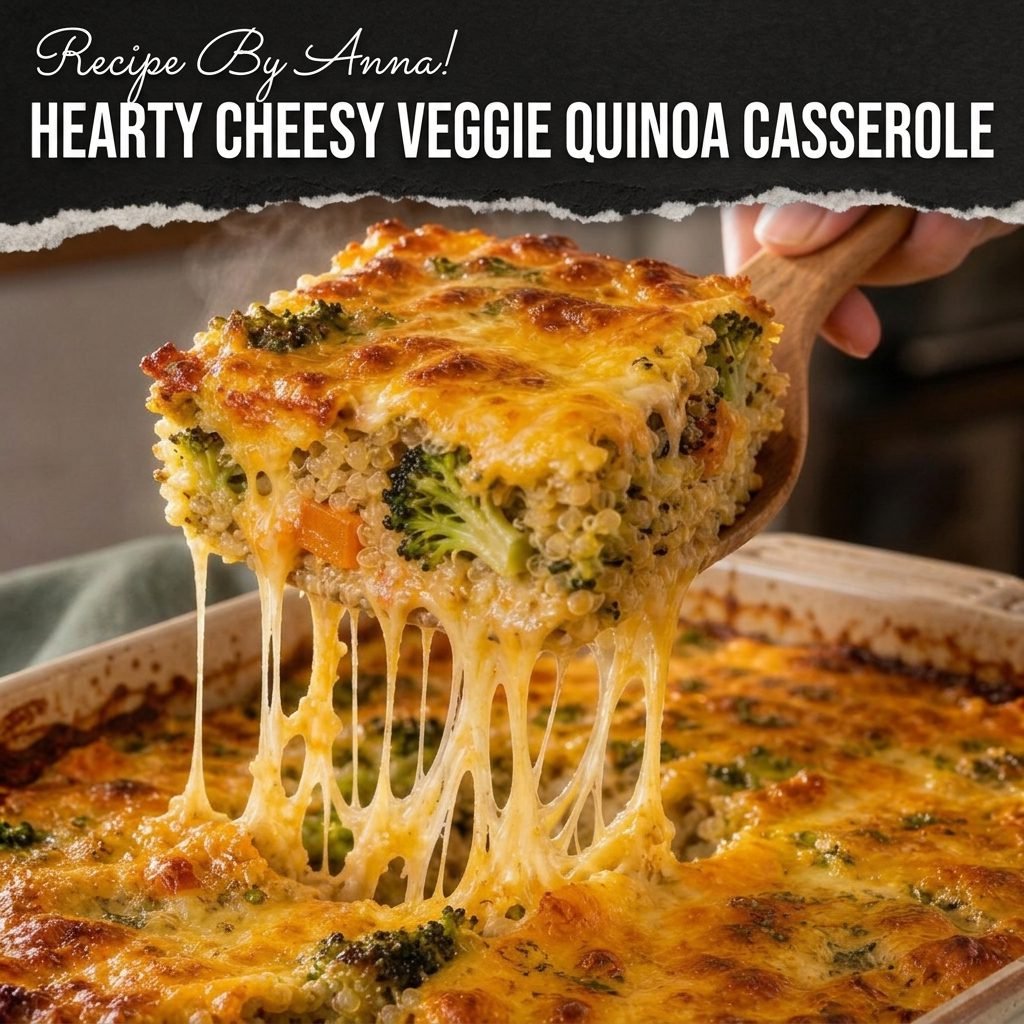
Hearty Cheesy Veggie Quinoa Casserole
This is the casserole I make when the table includes vegetarians, children, and at least one committed carnivore, and I need all three to leave happy. Quinoa cooked in broth until each grain is a plump little cushion, broccoli and carrots and sweet peppers folded through, and the whole thing suspended in an actual cheddar sauce — not cheese stirred into a pot, but a real sauce, built with butter and flour the way a cheese sauce is supposed to be built — under a broiled golden top that crackles when the spoon breaks it. It bakes for twenty minutes, which is really just the mingling phase, because every component is cooked before it meets the dish. The casserole format is doing what casseroles do best: taking good things that are already made and turning them into one dish that’s greater than the parts.
Here’s the thing worth understanding before you cook it, because it’s the difference between this version and the cheesy quinoa casseroles of the internet: most of them bind the dish with eggs and milk, which makes a custard. That’s a legitimate technique — it’s how broccoli-and-rice casseroles have worked for decades — but custard sets firm, and quinoa already has a soft, tender texture that turns to mush under a custard’s seriousness. The other shortcut, cheese and sour cream stirred straight in, goes greasy in the oven as the cheese proteins tighten and push out their fat. This recipe takes the third road, the one the cheese-sauce professionals take: a thin béchamel — butter, flour, milk — with the cheddar melted into it off the heat. The flour’s starch coats the cheese proteins and keeps them from clenching, which is the same trick that keeps fondue smooth and nacho sauce glossy, and it means the casserole comes out creamy on day one and stays creamy when you reheat it on day three. One technique, learned once, and every cheese dish you make from now on behaves better.
The rest of the engineering is water management, the eternal casserole problem. Broccoli gets blanched for exactly two minutes and shocked in cold water, so it arrives bright green and barely bendable — the oven will finish it, and mush is unrecoverable. The peppers and carrots get a quick sauté to drive off their raw edge and a little of their water. And the quinoa cooks one minute shy of done, because it’s about to absorb sauce in a hot oven for twenty minutes, and quinoa that started fully cooked ends up blown out and porridge-like. Every ingredient enters the dish slightly under its best, on the understanding that the bake will take it the rest of the way. That’s not fussiness — that’s the whole reason restaurant vegetables arrive better than yours. They’re never cooked to the end at any single step.
The Quinoa Ratio
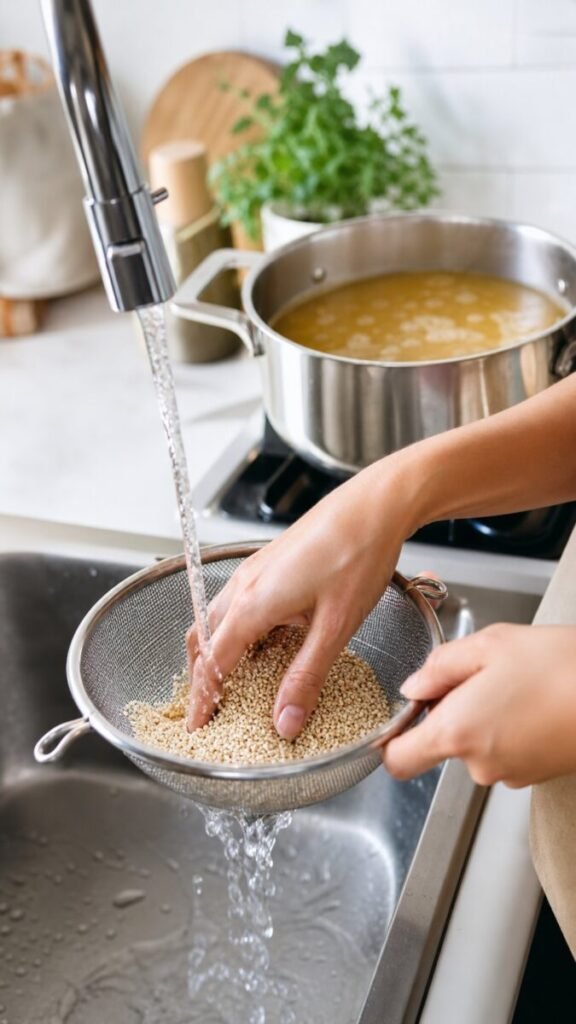
The ratio is the oldest rule in quinoa cooking, and it’s worth knowing rather than following blindly: one part quinoa to two parts liquid, lid on, low simmer, fifteen minutes, and the grain absorbs everything you give it. What this recipe changes is the liquid and the clock. The liquid is vegetable broth instead of water — quinoa is a flavor sponge with no shield of its own, and water gives it nothing to absorb, while broth seasons it from the inside out; this is the single cheapest flavor upgrade in the dish. The clock runs one minute short, fourteen instead of fifteen, because the casserole’s oven time is the quinoa’s final minute. And before any of it, the rinse: quinoa wears a natural coating of saponins, the plant’s bitter insect deterrent, and unwashed quinoa is the reason a lot of people decided they didn’t like quinoa. Thirty seconds in a fine-mesh strainer under running water, rubbing it with your fingers, and the water runs clear and the bitterness is gone.
Then there’s the quantity question, because a casserole’s heartiness lives or dies on the grain-to-sauce ratio. One cup of dry quinoa sounds modest — it becomes three fluffy cups cooked — and against four cups of vegetables and two cups of cheese sauce, it lands exactly right: every spoonful is grain, vegetable, and sauce in balance, nothing dominating. Two cups of dry quinoa, a mistake I made exactly once while feeding a crowd and half-listening to a podcast, gives you a dense, dry brick that no amount of sauce rescues by reheating. The casserole is hearty because everything in it is rich and cohesive, not because it’s packed with starch — the difference between a casserole and a casserole-shaped loaf of bread.
The vegetable arithmetic matters just as much. Broccoli is the backbone — four cups of florets, cut small so they ride on a spoon — and the carrots and peppers are the sweet and colorful supporting cast, one cup each, diced to the same scale. The onion and garlic are the aromatic floor the whole dish stands on. What’s deliberately absent is anything watery: no zucchini, no mushrooms, no tomatoes, all of which would weep into the sauce in the oven and thin it toward soup. Those vegetables have their place in this kitchen — zucchini shows up in a variation below with its own instructions — but the base casserole is built from vegetables that hold their water in the heat, and that’s a choice, not an omission.
⏱️ 30 MIN PREP + 25 MIN BAKE | 🧀 SERVES 6 | 🥦 A COMPLETE VEGETARIAN DINNER
- Prep Time: 30 minutes — quinoa, vegetables, and sauce, largely in parallel
- Bake Time: 20 to 25 minutes, plus an optional two under the broiler
- Rest Time: 10 minutes, which the casserole insists on
- Total Time: about 1 hour, with three things happening at once
- Yield: a 9×13 dish — dinner for 6, leftovers for lunch
The Cheese Bind
The equipment is one of everything, and the sequence matters more than the tools:
- Fine-mesh strainer — for the quinoa rinse; a colander’s holes are too wide and will stage an escape
- Medium saucepan with a lid — the quinoa’s home; the lid is load-bearing
- Large skillet — for the vegetables and then the sauce, in that order, to wash one fewer dish
- Whisk and a wooden spoon — the whisk for the sauce, the spoon for the fold
- Big bowl — where the casserole actually becomes a casserole
- 9×13 baking dish — ceramic or glass, and depth is fine; this isn’t a lofty dish, it’s a dense, golden one
- A pot of salted water, boiling — the broccoli’s two-minute spa visit
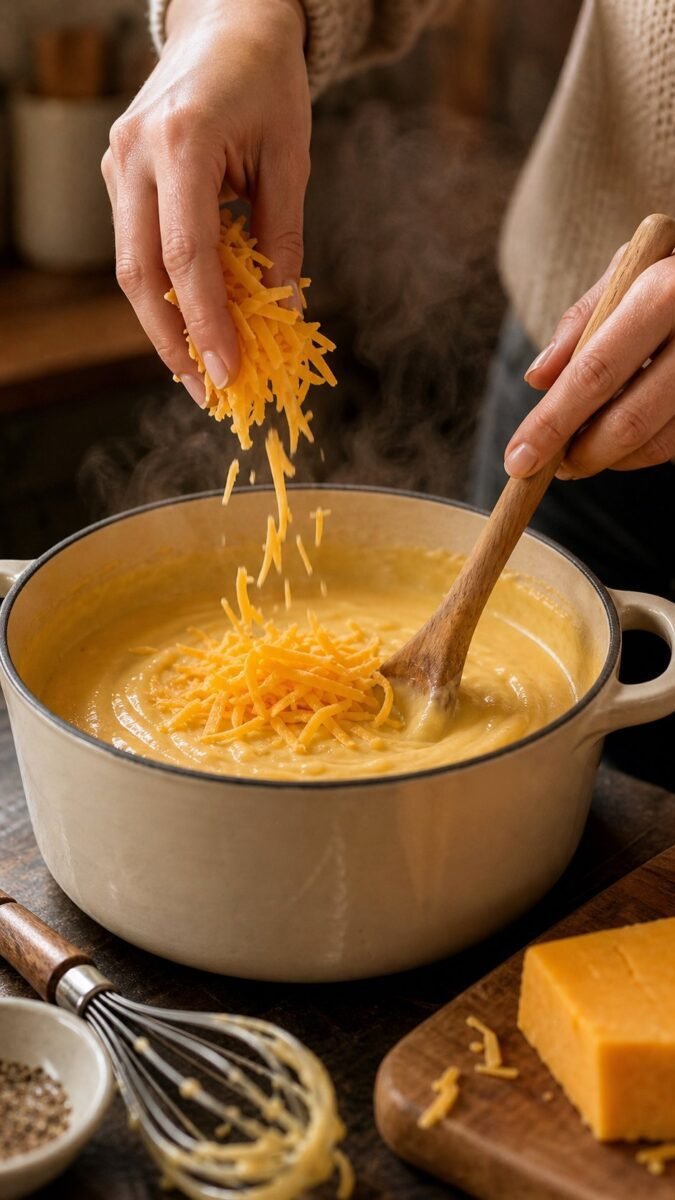
Now the bind itself, which deserves its full explanation because it’s the technique you’ll take to other recipes. Cheese is a fragile emulsion of fat, water, and protein, and when it gets too hot for too long, the proteins tighten and squeeze the fat out — that’s what a broken cheese sauce is, and it’s why day-old mac and cheese reheats into a grainy puddle with an oil slick. The fix is starch. Cook butter and flour into a roux, whisk in milk, and let it thicken to a thin, pourable béchamel; then take it off the heat and stir the cheese in at the end. The gelatinized starch molecules surround and buffer the cheese proteins so they can’t link up and clench, the same physics that keeps a flour-dusted fondue smooth. Sharp cheddar is the flavor engine — buy the block, grate it yourself, because pre-shredded cheese is dusted with anti-caking starch that makes sauces grainy and clingy in all the wrong ways — and a handful of mozzarella goes into the top because it browns and stretches where cheddar just sits there being delicious.
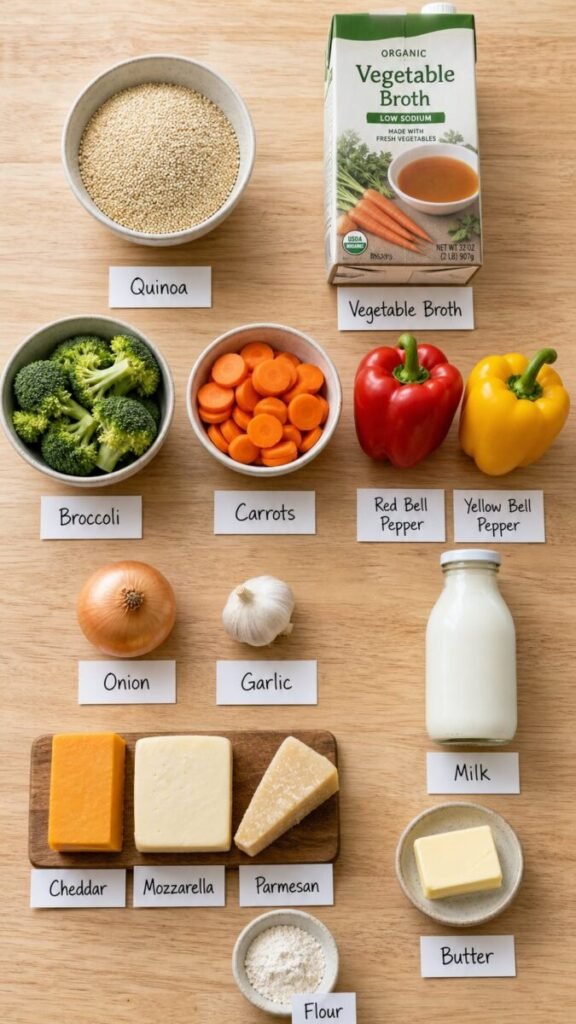
Ingredients (With Labels)
🌾 The Grain
- Quinoa: 1 cup, rinsed — white quinoa for the fluffiest result
- Vegetable broth: 2 cups — the flavor sponge’s seasoning
🥦 The Vegetables
- Broccoli: 4 cups small florets
- Carrots: 1 cup, small dice
- Bell peppers: 1 cup — red and yellow, diced
- Onion: 1 medium, diced
- Garlic: 3 cloves, minced
- Butter and olive oil: 2 tablespoons each, divided
🧀 The Bind
- Flour: 2 tablespoons — the cheese’s bodyguard
- Milk: 2 cups, whole if the week has been good to you
- Sharp cheddar: 2 cups, grated off the block
- Mozzarella: 1 cup, shredded — for the top
- Parmesan: ⅓ cup, grated
- Dijon mustard: 1 teaspoon — the cheese’s best friend
- Smoked paprika: ½ teaspoon, plus a pinch of cayenne
- Salt and black pepper: to taste — taste the sauce before you commit
Step by Step How to Make
- Step 1 — The quinoa. Rinse the quinoa in the fine-mesh strainer under running water for thirty seconds, rubbing it with your fingers, until the water runs clear — that’s the bitterness leaving. Then into the saucepan with the broth, bring to a boil, drop to the lowest simmer, lid on, and cook fourteen minutes. No peeking, no stirring — lifting the lid lets the steam off and the grain cooks unevenly, and stirring makes it gluey. At fourteen minutes, if a grain pressed against the roof of your mouth is tender with a faint bite, it’s right; drain off any last stubborn tablespoon of liquid, fluff with a fork, and spread it on a plate to cool while you work. Cooling matters more than it sounds: quinoa folded into sauce while hot absorbs it greedily and clumps, while warm quinoa folds in evenly.
- Step 2 — The vegetables, two roads. Get the salted water boiling and drop the broccoli in for exactly two minutes — the florets turn an aggressive, gorgeous green — then scoop them straight into a bowl of cold water to stop the cooking, and drain. Those two minutes are the whole plan: raw broccoli won’t soften enough in the casserole’s gentle bake, and three-minute broccoli is already halfway to mush before the oven gets its turn. In the skillet over medium, warm the olive oil, soften the onion and carrots for five minutes, add the peppers for four more, then the garlic for one, and take the pan off the heat. The vegetables should be sweated and glossy, not browned — they’re being pre-cleared for flavor and water loss, not cooked to done.
- Step 3 — The sauce. Back in that same skillet — the vegetables go into the big bowl to wait, and every bit of flavor stuck to the pan is about to be recruited — melt the butter over medium heat, whisk in the flour, and let it cook and bubble for one full minute to lose its raw taste. Pour in the milk in two additions, whisking each smooth, and let it thicken to the consistency of heavy cream, three or four minutes of occasional whisking. Now the sequence that matters: off the heat entirely, wait fifteen seconds, and stir in two-thirds of the cheddar, a handful at a time, each batch melting before the next joins, along with the Dijon, the smoked paprika, the cayenne, and a good grind of pepper. Taste it — it should be assertively seasoned, almost too salty on its own, because it’s about to be diluted by three cups of quinoa and five cups of vegetables, both of which are blank canvases. This is the last moment seasoning is cheap.
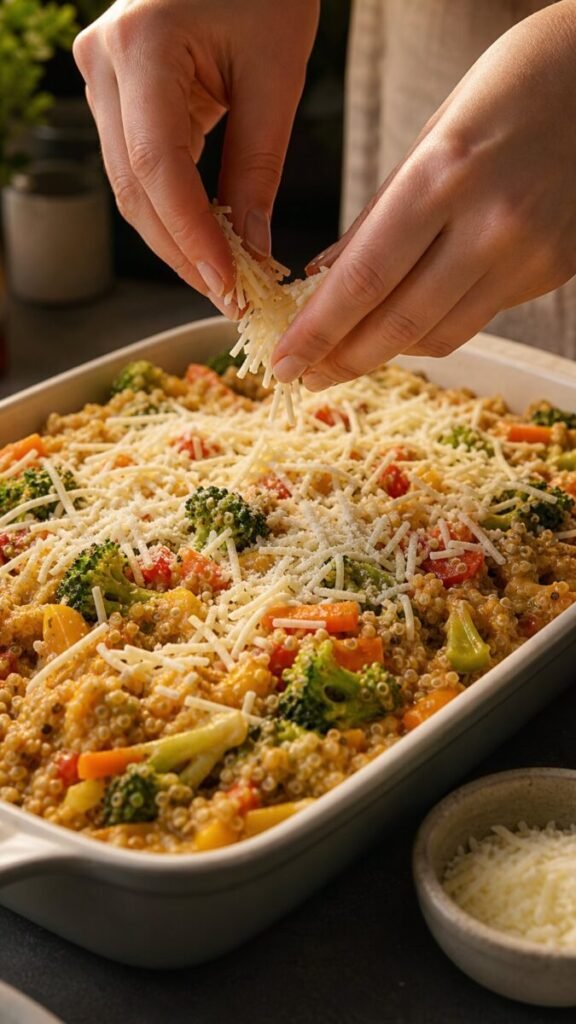
- Step 4 — The assembly. Heat the oven to 375°F. In the big bowl, combine the cooled quinoa, the blanched broccoli, the sautéed vegetables, and the cheese sauce, and fold with the wooden spoon until everything is one golden, speckled mass with no white grain showing anywhere. Scrape it into the baking dish, level the top, then blanket it with the mozzarella, the remaining cheddar, and the parmesan — the double-decker top, stretchy under crisp, is the entire aesthetic of the dish. A quarter cup of panko scattered over makes it crackle; it’s optional, and I make it mandatory in my kitchen by personal decree.
- Step 5 — The bake. Bake 20 to 25 minutes, until the sauce bubbles slowly around the edges and the top has gone molten and freckled gold. If you want the full effect — and you do — run it under the broiler for the last two minutes, door cracked, standing there the entire time, because the distance between “golden and crackling” and “quietly blackened” is about ninety seconds and one glance away. Pull the dish onto a rack and let it rest for ten. This is not a formality: straight from the oven, the casserole is lava — the sauce loose, the pieces sliding — and during the rest the starch in the sauce sets gently and the squares cut clean with the spoon holding them together. The ten minutes also happen to be exactly enough time to dress a salad and call the table.
- Step 6 — The serve. Serve it hot, in generous squares, with something sharp and green beside it — a simple salad with a mustardy vinaigrette is the classic move, because the casserole is rich and the table needs one thing that isn’t. A few flakes of salt over the top and a scatter of chopped parsley if there’s any in the fridge, more for the eyes than the tongue. It’s a complete dinner on its own — grain, vegetable, dairy, done — but it also halves beautifully as a side, which is how it ends up at half my holiday tables, next to whatever bird or roast is carrying the main event. Watch what happens at the table: the vegetarians take seconds immediately, and everyone else follows without announcing it.
Same grain, opposite mood — the healthy quinoa lentil spinach bake is this casserole’s virtuous sibling, and the two of them cover the whole week.
Anna’s Kitchen Notes
Sharp cheddar, and grate it yourself. The cheese is a quarter of this dish by volume and half of it by personality, so buy the sharpest block the store has and grate it on the big holes of a box grater, ten seconds at a time, however long it takes. Pre-shredded cheese is coated in cellulose and potato starch to keep it from clumping in the bag — which is exactly the opposite of what you want in a sauce, where the cheese needs to melt into its neighbors, not stay politely separate. The bagged stuff also costs more per pound, so this is the rare instruction that improves the dish and the receipt.
The Dijon is not negotiable, and nobody will name it. One teaspoon of Dijon in a cheese sauce is the oldest restaurant trick in the book — it sharpens the dairy, deepens the cheddar, and adds a tang that guests consistently misattribute to “just really good cheese.” It does not make the sauce taste like mustard; mustard cooked into dairy is a team player. If you’ve ever made mac and cheese that tasted flat no matter how much cheese you piled in, the missing teaspoon of mustard was almost certainly the whole story.
Make it the night before, bake it the day of. Assembled and covered, the casserole holds 24 hours in the fridge and actually improves — the quinoa drinks a little sauce, the flavors merge, the broccoli settles in — then bakes from cold with ten extra minutes under the foil and five without. This is the dinner-party move: assemble Saturday afternoon, bake Saturday night, and spend the cocktail hour with your guests instead of your whisk. The foil matters for the cold bake — it holds the steam in while the middle catches up to the edges.
Broccoli alternatives, ranked. Cauliflower florets are a one-for-one swap with the same two-minute blanch. Frozen broccoli works in a pinch — thaw it, squeeze it dry in a towel, and skip the blanch — but it arrives softer and stays softer, so the pan loses a little of its structure. Asparagus in spring, cut into thumb-length pieces with the same blanch, is genuinely lovely and makes the dish taste like April. The constant is the pre-cook: whatever green goes in, it enters the dish at barely-tender, because the oven is the finisher and mush is forever.
The cheese pull is real, and it needs mozzarella. Cheddar is the flavor of the dish, but cheddar alone on top browns into a delicious, stubborn mat that doesn’t stretch. The mozzarella layer is what makes the spoon lift with strings — it’s the difference between a casserole people serve themselves politely and one they excavate. Half mozzarella, half cheddar on top, parmesan over all, and every square comes up with the full food-photography effect, no styling required.
The Comfort Table
The casserole brings its own starch and vegetables, so the table wants contrast more than company. The vegetarian zucchini slice is the lighter egg-based cousin for a multi-dish vegetarian spread — serve both and the vegetarians at the table will feel genuinely catered to rather than accommodated.
For the omnivore nights: the ground turkey zucchini casserole is this dish’s meaty twin — same format, different kingdom — and the brown rice and black bean casserole is the same comforting idea pointed southwest. On the quinoa shelf itself, the lentil quinoa patties are the make-ahead lunchbox expression of the same grain, and the autumn glow quinoa bowls are its bright, cold, salad-days counterpart. One pantry, five dinners.
Same Bake, Other Grains
Brown rice, the classic. The same architecture over cooked brown rice — this is, strip the quinoa away, your grandmother’s broccoli cheese and rice casserole, upgraded — with the rice cooked forty minutes instead of fourteen and everything else identical. Heavier, earthier, and famously good the next day.
Farro, the nutty version. Cooked al dente and folded in, farro gives the dish a chew that quinoa can only suggest, and the cheese sauce loves it. This is the version I make for people who claim they don’t like quinoa, and it converts them to the casserole even when it fails to convert them to the grain.
The zucchini summer build. Zucchini finally gets its seat, with rules: grate it, salt it ten minutes, and squeeze it in a towel until it stops yielding — a half-moist zucchini will water down the sauce you worked for. Fold it in raw after the squeeze, skip the blanch, and add the carrots to the skillet instead. July has rarely eaten this well.
The chipotle version. A chopped chipotle in adobo and a half cup of thawed, squeezed-dry corn into the fold, pepper jack standing in for a third of the cheddar — the casserole goes smoky and warm, and wants a squeeze of lime at the table. This is the one my brother-in-law requests by the sound the spoon makes going into the dish.
Chicken, for the mixed table. Two cups of shredded rotisserie chicken folded in at assembly turns it into the one dish that feeds every kind of eater at the table — the sauce and vegetables carry the bird along, and nothing else changes. Add it cold and already seasoned, since it only needs warming through.
The vegan conversion, honestly rated. The quinoa and vegetables are already there; the work is the bind. The creamy cashew cheese sauce stands in for the cheddar sauce — make it thick, fold it through, top with breadcrumbs and nutritional yeast instead of the cheese lid — and the result lands at about eighty percent of the original’s creaminess with a completely different, still-good personality. The rest is the same dish, and the leftovers reheat just as well, which even the dairy version can’t always say about its imitators.
The Casserole Math
| Nutrient | Per Serving (1 of 6) |
|---|---|
| Calories | 480 kcal |
| Protein | 21 g |
| Carbohydrates | 42 g |
| Fats | 24 g |
Estimates as written, full cheese ration and panko included. Twenty-one grams of protein per serving is the number worth pausing on — quinoa is one of the few plant foods carrying a complete amino acid profile, and with the dairy stacked on top, the dish out-proteins plenty of weeknight meats — all from a casserole that reads as comfort food on the plate. The fats are butter, milk, and three cheeses, which is to say they are the dish; this is not the section of the site where we pretend otherwise. For lighter builds, the chicken version redistributes rather than adds, the vegan conversion runs leaner per the cashew math, and the honest everyday trick is what the salad beside it is for: one green plate, one golden one, and the meal balances itself without anyone doing arithmetic at the table.
The Leftover Pan
Storage is where this casserole quietly earns its spot in the rotation, because the starch-stabilized sauce is the whole story. Leftovers keep four days covered in the fridge, and unlike a custard-bound bake — which tightens and weeps by day two — this one reheats creamy, because the flour buffer never let the cheese break in the first place. Reheat squares in a 350°F oven for fifteen minutes, covered loosely with foil, or in a covered skillet on the lowest flame with a spoonful of milk; the microwave at half power is the acceptable single-lunch option. The top won’t re-brown in the microwave, and the pan under the broiler for two minutes will fix that if you care, which you will once you see it.
The freezer takes the assembled dish beautifully: bake it fully, cool it completely, cut nothing, freeze the whole thing solid, then wrap it a second time — three months of standing by. Thaw overnight in the fridge and reheat covered at 350°F for about thirty minutes, and the table gets a baked-that-day casserole for the price of a Monday with no energy left. Individual squares, frozen on a tray and bagged, reheat straight from frozen on evenings when dinner needs to require nothing from you, and this paragraph is the reason the recipe says to make the full dish even for a small table.
Second careers: cold squares, pressed in a panini press or a dry skillet with a weight on top, make a grilled-cheese-adjacent crust on both faces that is objectively better than the original bake — I’ve watched a leftover square outperform the fresh casserole at my own table and I’ve made peace with it. Crumbled and warmed, the casserole tops a baked potato with a completeness no other leftover manages; and a thin layer of it between tortillas is a quesadilla that requires no further ingredients and no apology.
Where It Goes Wrong
A greasy, broken sauce. The cheese went in over heat, or all at once, or it was pre-shredded — some combination of the three doors. Melt the cheese off the heat, a handful at a time, from a block you grated yourself, and the sauce stays one glossy emulsion. If it breaks anyway — and it can, on a stubborn stove — don’t panic: a splash of milk and vigorous whisking off the heat brings most batches back, and a casserole bound for the oven is far more forgiving than a sauce served on its own.
A watery, pooling casserole. Water got in from somewhere: un-blanched or un-shocked broccoli carrying surface moisture, vegetables not sweated, quinoa that kept its full fifteen minutes of liquid, or — the classic — frozen vegetables thawed but never squeezed. Every vegetable enters dry and slightly under, the quinoa enters slightly under, and the dish has no extra water to give. A casserole that comes out loose anyway needed five more minutes in the oven, which evaporates what the assembly couldn’t.
Mush — the texture failure. Everything got cooked to done before the bake, and then the bake cooked it all again. The fix is the under-doctrine at every stage: quinoa at fourteen minutes, broccoli at two, peppers and carrots sweated rather than softened. Each component should feel a minute shy when it goes into the dish, because twenty-five minutes at 375 is the final minute of every one of their lives. Casserole-making is just calendar management for vegetables.
Bland beige disappointment. The sauce wasn’t assertive enough before assembly — the dilution warning in Step 3 exists because quinoa and broccoli are flavor sponges with no opinions, and a sauce seasoned to taste “just right” on its own lands as “polite” in the finished dish. Salt it like you mean it, keep the Dijon, don’t shy the paprika, and use broth, not water, for the quinoa. A finished casserole that still reads flat wants hot sauce and a grind of pepper at the table, and wants more salt in the sauce next time.
A pale, rubbery top. The oven was timid or the dish sat too deep under the cheese without the broiler’s finish. The top wants color — molten, freckled gold, a little crisp at the edges — and the two broiled minutes at the end are how it gets there. Watch it like a hawk for those two minutes, but don’t skip them; the difference between a pallid top and a golden one is entirely the difference between a casserole people serve themselves and one they pass along quickly.
It didn’t set — squares slide apart. Cut before the rest, always. The ten minutes out of the oven is when the sauce’s starch sets and the casserole becomes sliceable, and the dish cut hot is a trough of delicious gravel. If it’s still loose after resting, it needed the five extra minutes in the oven, or the sauce was thin going in — thicken the béchamel to heavy-cream consistency next time, and it sets like a diagram.
Cheese Questions
Can I use a different cheese than cheddar?
Yes, within reason. Gruyère makes the dish Swiss and elegant and stretches beautifully; pepper jack adds a warm hum; smoked gouda goes with the paprika like they were introduced at a party. Keep the total cheese weight the same and keep some mozzarella in the top layer for the pull. What doesn’t work: fresh mozzarella in the sauce (too watery), feta (it never melts, it just sits there being salty), and anything labeled “cheese product,” which behaves like its name.
Why did my sauce get grainy or greasy?
Heat, speed, or the bag. Cheese breaks when its proteins over-tighten and push out fat — so the sauce boils, or the cheese went in over direct heat, or pre-shredded cheese brought its anti-caking starch into a situation it wasn’t built for. The prevention is the whole method: roux first, milk into it, cheese off the heat a handful at a time, from a block. The rescue is a splash of milk and hard whisking off the heat, which pulls most broken sauces back together.
Can I make it ahead and bake later?
That’s one of its best tricks — assemble, cover, refrigerate up to 24 hours, and bake from cold with about ten extra minutes under foil, five without. The flavors improve overnight as the quinoa drinks a touch of sauce and everything settles. The fully baked dish also freezes for three months, squares reheat from frozen, and the whole scheduling system is laid out in the leftover pan section above.
Is quinoa healthy enough to be worth the trouble?
It’s the rare grain that earns its health halo and its texture at the same time — a complete protein with all nine essential amino acids, a good fiber line, and a quick fifteen-minute cook. In this casserole it plays the role rice plays elsewhere, but with a protein count that helps the dish reach twenty-one grams a serving without any meat. Rinse it, cook it in broth, and it stops tasting like health food and starts tasting like dinner.
Can I make it gluten-free?
Easily — the only gluten in the dish is the two tablespoons of flour in the roux and the optional panko. Swap the flour for a gluten-free all-purpose blend or sweet rice flour in the same amount, and use gluten-free breadcrumbs or skip the crackle layer and let the parmesan do the crisping. Quinoa is naturally gluten-free; everything else was already there.
What do I do if my quinoa always comes out bitter?
Rinse it. Then rinse it more than you think you need to. The bitter coating on quinoa is saponin — a natural compound the plant makes to discourage insects — and it’s water-soluble, which makes it the easiest flavor problem in cooking to solve: thirty seconds in a fine-mesh strainer under running water, rubbing the grains, until the water runs clear. If a bag of quinoa stays bitter even after a thorough rinse, the batch was old or badly processed, and no sauce in the world will hide it.
Can I add chicken or another protein?
Two cups of shredded rotisserie chicken folded in at assembly is the standard amendment — no other changes, and the casserole becomes a whole-household dish. Cooked sausage, browned and sliced, and a can of white beans, rinsed, both work the same way. The one rule: the protein goes in already cooked and seasoned, because the bake is only long enough to warm it through and meld, never to cook anything from raw.
Hearty Cheesy Veggie Quinoa Casserole
Ingredients
As an Amazon Associate I earn from qualifying purchases.
Quinoa
- 1 cup dry white quinoa, rinsed
- 2 cups low-sodium vegetable broth, or the liquid quantity specified on the quinoa package
Vegetables
- 4 cups small broccoli florets
- 1 cup finely diced carrots
- 1 cup diced red and yellow bell peppers
- 1 medium onion, diced
- 3 cloves garlic, minced
- 2 tablespoons olive oil
Cheddar sauce & cheese topping
- 2 tablespoons unsalted butter
- 2 tablespoons all-purpose flour
- 2 cups whole milk
- 2 cups grated sharp cheddar, divided: 1⅓ cups for the sauce and ⅔ cup for the topping
- 1 cup shredded low-moisture mozzarella
- ⅓ cup grated vegetarian Parmesan-style cheese
- 1 teaspoon Dijon mustard
- ½ teaspoon smoked paprika
- 1 pinch cayenne pepper
- Salt and black pepper, to taste
Optional finish
- ¼ cup panko breadcrumbs, for the topping
- Chopped fresh parsley, for serving
Kitchen Tools
- Fine-mesh strainer, for rinsing quinoa
- Medium saucepan with lid
- Large skillet, for vegetables and sauce
- Pot and colander, for blanching and draining broccoli
- Large mixing bowl
- Whisk and wooden spoon
- Box grater
- Cutting board and knife
- Measuring cups and spoons
- 9×13-inch baking dish, oven-safe at 375°F; explicitly broiler-safe if using the optional broil
- Instant-read food thermometer
- Oven mitts and heat-resistant trivet
Directions
- Cook the quinoa. Heat the oven to 375°F. Rinse the quinoa thoroughly in a fine-mesh strainer, then combine with the broth in the saucepan. Bring to a boil, reduce to a gentle simmer, and cover. Cook according to the package, beginning to check around 14 minutes. The grains should be tender with a slight bite, not crunchy. Drain any excess liquid, fluff, and set aside briefly while preparing the other components.
- Blanch the broccoli and sauté the vegetables. Blanch the small broccoli florets in boiling water for about 2 minutes, until bright green and just beginning to soften. Cool briefly under cold water, then drain thoroughly and blot away surface moisture. Heat the olive oil in the skillet over medium heat. Cook the onion and finely diced carrots for about 5 minutes, add the peppers for another 4–5 minutes, and stir in the garlic for the final minute. Transfer the sautéed vegetables to the mixing bowl.
- Make the cheddar sauce. In the same skillet, melt the butter over medium heat. Whisk in the flour and cook for 1 minute. Gradually whisk in the milk until smooth, then bring to a gentle simmer, whisking frequently, until lightly thickened, about 4–6 minutes. Remove from the heat. Stir in 1⅓ cups cheddar a handful at a time, followed by the Dijon, smoked paprika, cayenne, and black pepper. Taste and add salt as needed. Choose cheeses made with vegetarian enzymes if serving vegetarians.
- Combine and assemble. Add the quinoa, well-drained broccoli, and cheese sauce to the sautéed vegetables. Fold gently until evenly coated. Transfer to the 9×13-inch baking dish and spread level. Top with the mozzarella, remaining ⅔ cup cheddar, and Parmesan-style cheese. Sprinkle with the optional panko.
- Bake until hot throughout. Bake for about 20–25 minutes, or longer if needed, until the center reaches 165°F and the topping is melted and golden. Timing assumes freshly prepared, still-warm components; a refrigerated casserole will take longer. For extra browning, broil briefly only in a dish explicitly approved for broiler use. Watch continuously and follow your oven’s instructions for rack position and door position. Do not assume oven-safe glass or ceramic is broiler-safe.
- Rest and serve. Place the dish on a heat-resistant trivet and rest for 10 minutes before serving. Divide into six generous portions and finish with parsley if using. Expect a creamy, spoonable casserole rather than guaranteed firm squares. Allow about 60–70 minutes overall when preparing the quinoa, vegetables, and sauce in parallel.
Nutrition
| Nutrient | Approximate amount per serving (⅙ batch) |
|---|---|
| Calories | 520 kcal |
| Protein | 26 g |
| Carbohydrates | 39 g |
| Total fat | 30 g |
| Fiber | 5 g |
Estimated using 170 g dry quinoa, 225 g cheddar, 112 g low-moisture mozzarella, 30 g Parmesan-style cheese, whole milk, the full butter and oil quantities, and optional panko. Actual values vary with brands, ingredient weights, and serving size.