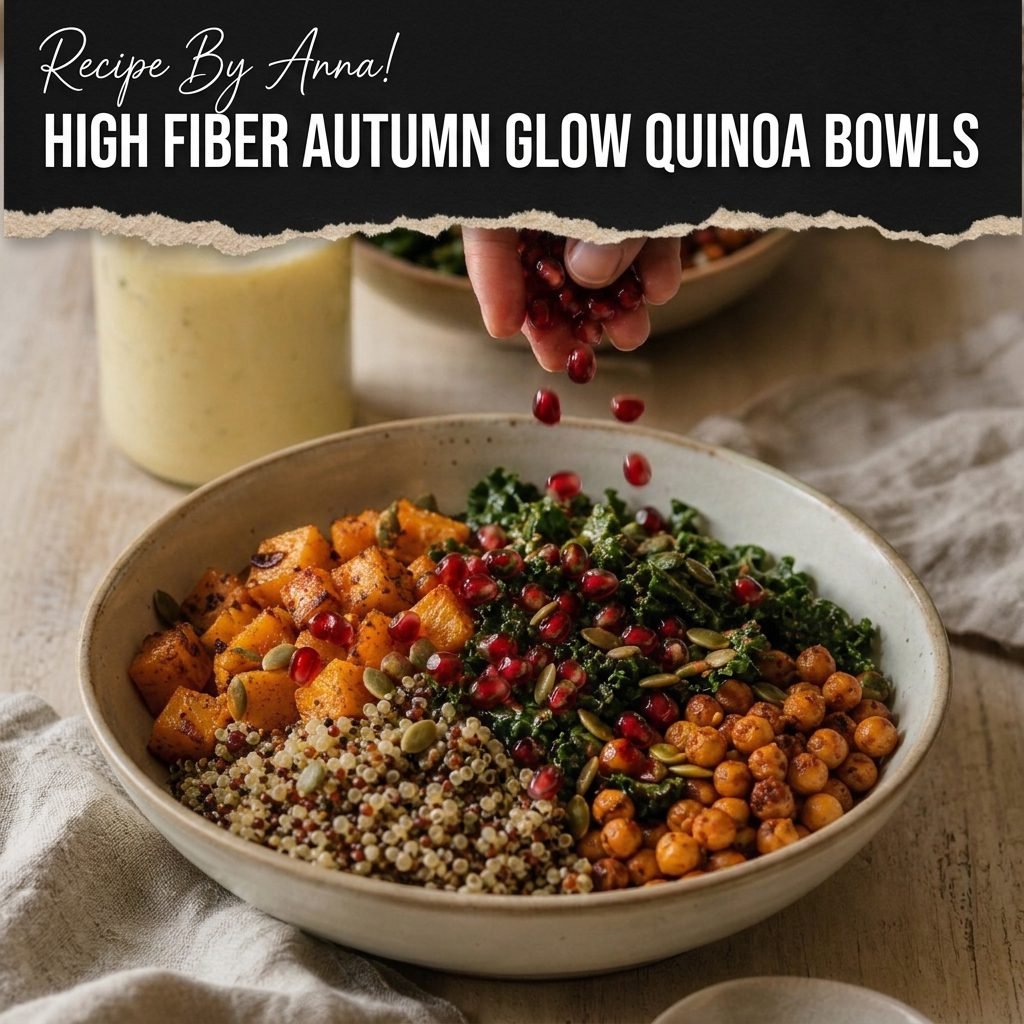
High Fiber Autumn Glow Quinoa Bowls
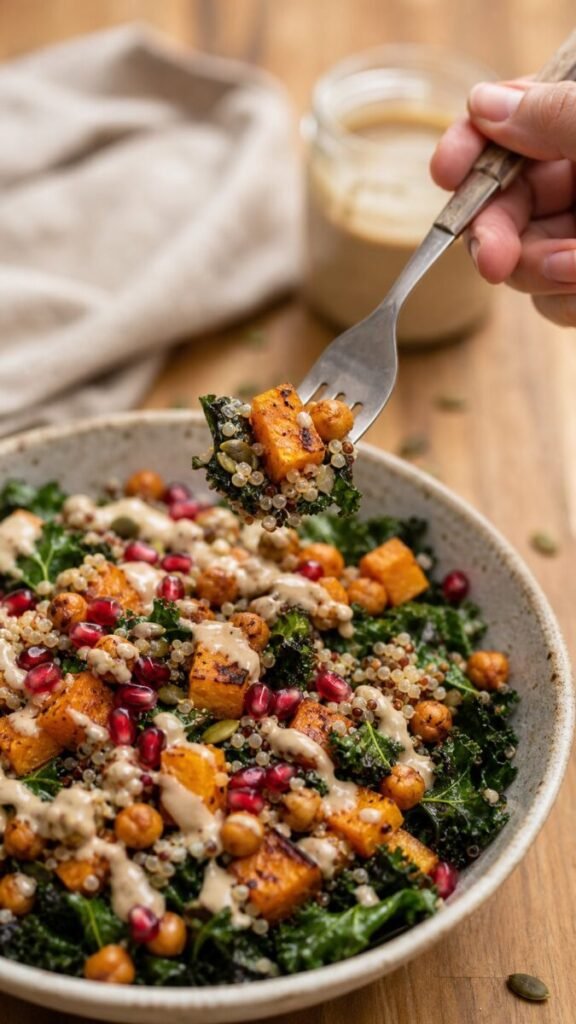
Some Octobers, lunch deserves better than whatever has drifted to the back of the fridge. These high fiber autumn glow quinoa bowls are my standing answer: fluffy quinoa piled with caramelized butternut squash, chickpeas roasted until they rattle in the pan, dark massaged kale, and a scatter of pomegranate seeds that makes the whole bowl look lit from within. Fifty minutes, most of it the oven’s problem, and you get four big bowls that carry you a long way into the work week.
The fiber part isn’t a marketing garnish — it’s the architecture. Quinoa, chickpeas, squash, kale, pumpkin seeds, and pomegranate are all fiber carriers, and together they land somewhere past fifteen grams per bowl, which is roughly half a day’s target in one sitting. The method stays simple on purpose: one sheet pan for the roasted half, one small pot for the quinoa, one jar for the dressing. Nothing complicated, nothing fancy, just a bowl that fills you up and keeps you full past three in the afternoon.
A few honest notes before you start. This is a Sunday-afternoon recipe more than a Tuesday-night one, though the oven does most of the work while you putter. The components keep for days, so it doubles as meal prep. And the pomegranate is the only item that requires a small trick — it’s in my kitchen notes, and it involves a bowl of water and zero stained fingers. Mostly zero.
Why These Bowls Glow
The glow is literal. That orange in the squash is carotenoids, the ruby in the pomegranate is its own set of plant pigments, and the deep green in the kale is a third family entirely — different colors in plants generally mean different compounds, and a bowl with four of them is doing more work than any single-vegetable plate could. Here’s the part I find genuinely neat: several of those compounds are fat-soluble, which means your body absorbs them far better with some fat along for the ride. The tahini and olive oil in the dressing aren’t decoration. They’re the delivery system, which is the best news a dressing has received all year.
The fiber strategy is a relay team. Quinoa brings a gentle, filling kind; chickpeas bring a heavier dose plus protein; squash contributes a soft, soluble sort that turns creamy as it roasts; kale, pomegranate, and pumpkin seeds each add a little more from different directions. A bowl built like this mixes soluble and insoluble fiber without you having to think about either one. And roasting is what makes it all taste like a treat instead of homework — a crispy chickpea is still a chickpea, but it behaves like a snack.
Texture is the last piece of the engineering. Every forkful should be different: a crisp chickpea here, a cold-crunchy pomegranate seed there, creamy squash, soft quinoa, glossy kale in between. That variety is why a built bowl stays interesting to the last bite while a big tossed salad tends to give up on you halfway through. Nothing against salads. But their bowl cousins got the better architecture.
⏱️ 50 MIN | 🧡 15 G FIBER | 🥣 MAKES 4 BIG BOWLS
- Prep Time: 15 minutes
- Roast Time: 30 minutes (oven does the talking)
- Total Time: 50 minutes
- Yield: 4 big bowls
The Assembly Line
Everything here fits in one cabinet, promise:
- Rimmed baking sheet and parchment paper — the squash, chickpeas, and pepitas all share it, each in a single layer.
- Small pot with a lid — for the quinoa.
- Big bowl — for the kale massage, and later for tossing anything that needs tossing.
- Jar with a tight lid — the dressing gets shaken, not whisked. Fewer dishes, better emulsion.
- Fine-mesh strainer — for rinsing the quinoa.
- Chef’s knife and cutting board — the squash is the only real knife work in the recipe.
Ingredients (With Labels)
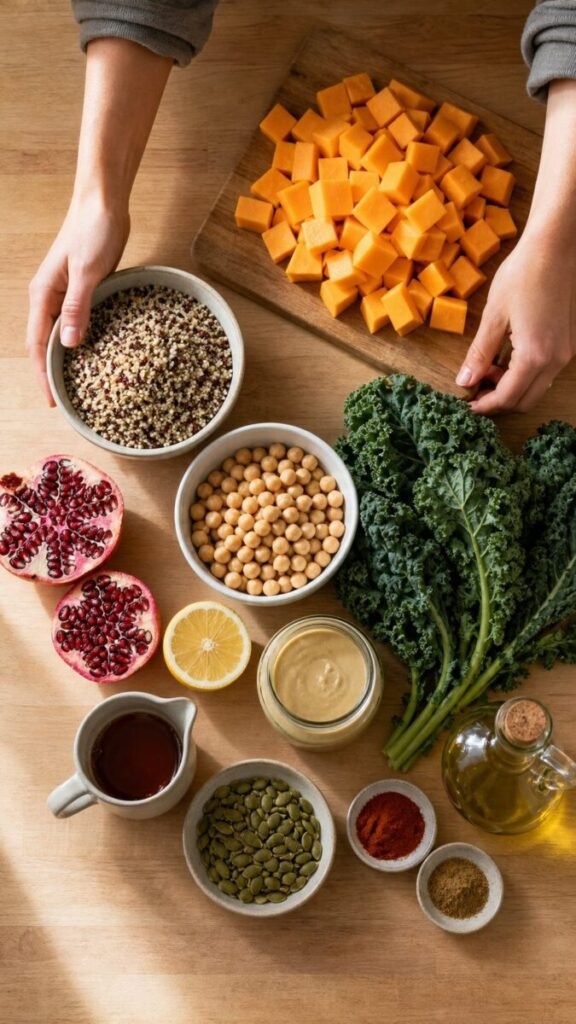
🍚 The Base
- Quinoa: 1 cup dry, rinsed — tricolor for the looks, any kind for the taste
- Water: 1¾ cups, plus a big pinch of salt
🎃 The Roasted Layer
- Butternut squash: 1 lb, peeled and cut into ¾-inch cubes (about 3 cups)
- Chickpeas: 1 can (15 oz), rinsed and patted very dry
- Olive oil: 2 tablespoons
- Smoked paprika: 1 teaspoon
- Ground cumin: 1 teaspoon
- Garlic powder: ½ teaspoon
- Salt: ½ teaspoon
- Pumpkin seeds (pepitas): ⅓ cup, toasted on the pan for the last five minutes
🥬 The Fresh Layer
- Kale: 1 bunch (about 4 cups sliced), stemmed and cut into ribbons — Lacinato or curly, both behave
- Lemon: 1 large, halved — one half for the kale, one half for the dressing
- Pomegranate arils: ¾ cup, from about half a pomegranate
🥣 The Lemon Tahini Drizzle
- Tahini: ¼ cup, stirred in the jar first
- Maple syrup: 1 tablespoon
- Garlic: 1 small clove, grated
- Warm water: 3 to 4 tablespoons, added gradually
- Salt: a small pinch
Step by Step How to Make
- Step 1 — Roast the golden half of the bowl. Heat the oven to 425°F and line the baking sheet with parchment. Pat the chickpeas dry with a kitchen towel, then toss them in the big bowl with the squash, olive oil, smoked paprika, cumin, garlic powder, and the ½ teaspoon of salt until everything is coated in that rusty-red spice mix. Spread it all on the sheet in a single layer — crowded vegetables steam instead of roast, and steamed chickpeas are not what we’re here for. Slide the pan into the oven and set a timer for 25 minutes.
- Step 2 — Quinoa on the back burner. Rinse the quinoa in the fine strainer under running water for a good 30 seconds, swishing it around, until the water runs clear instead of soapy. Combine it with the 1¾ cups of water and a pinch of salt in the small pot, bring to a boil, then clamp on the lid, drop the heat to low, and simmer 15 minutes. Off the heat, still lidded, let it rest 5 minutes before fluffing with a fork. The rest matters — skip it and the bottom layer goes gluey.
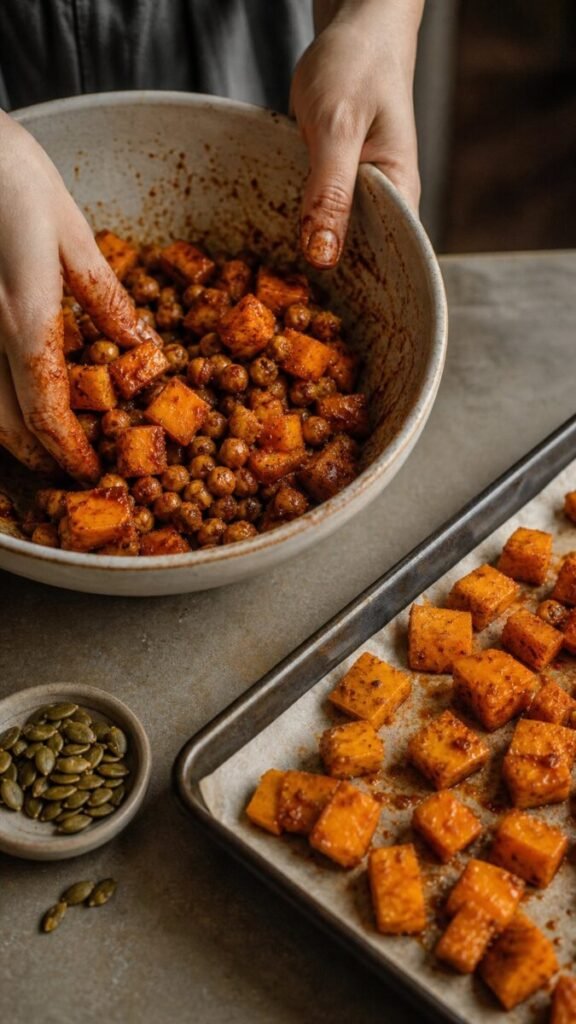
- Step 3 — Toast the pepitas on the same pan. At the 20-minute mark, pull the sheet out briefly and scatter the pumpkin seeds into the warm spots between the squash and chickpeas. Back in the oven for the last 5 minutes, until the squash is caramelized at the edges, the pepitas smell nutty, and the chickpeas rattle when you shake the pan. That rattle is the sound of crisp, and it’s a very good sound.
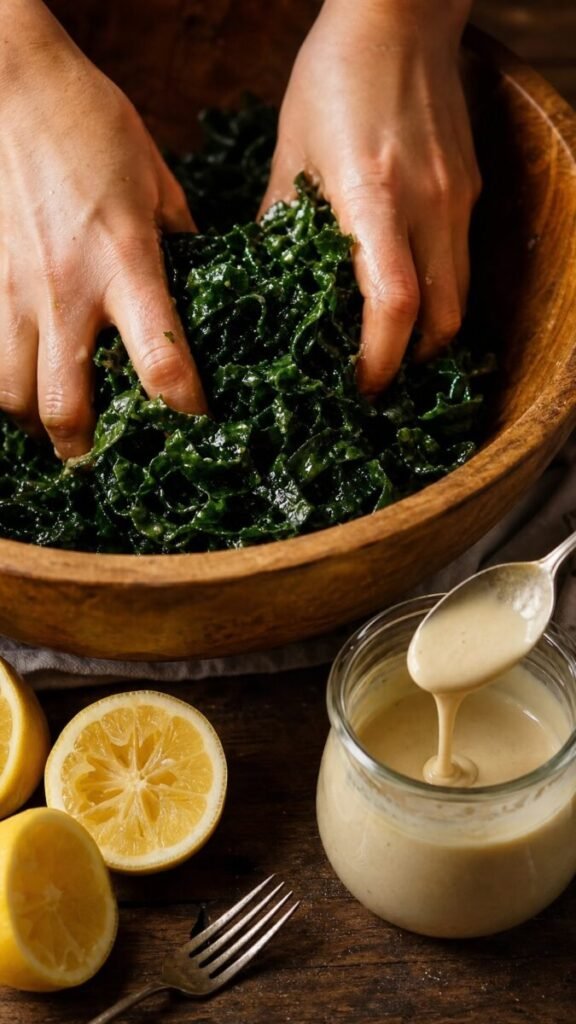
- Step 4 — Shake the dressing. While the pan finishes, combine the tahini, maple syrup, grated garlic, the juice of half the lemon, and a pinch of salt in the jar. Shake it hard. It will tighten into a paste and look like a mistake — keep going. Add the warm water one tablespoon at a time, shaking after each, and around the third spoonful it will relax into something creamy and pourable, like thin salad dressing. That’s your target.
- Step 5 — Massage the kale. Put the kale ribbons in the big bowl, squeeze the other lemon half over them, add a pinch of salt, and rub and squeeze the leaves with your hands for about two minutes. They’ll darken, go glossy, and shrink to roughly half their volume. Taste a piece: it should be tender-chewy instead of tough, like it finally agreed to cooperate.
- Step 6 — Build and dress at the table. Divide the quinoa among four bowls, lay the kale alongside it, then pile on the squash, chickpeas, and toasted pepitas, and finish with the pomegranate arils. Serve the dressing on the side and drizzle per bowl right before eating — the crisp parts hold their texture much longer when the tahini isn’t sitting on them. Warm or room temperature, both are correct. Cold-from-the-fridge is also legal, but give the roasted parts their crisp back in the oven first.
Bowls are a whole genre in this kitchen — our Mediterranean Quinoa Bowl covers the cucumber-and-feta months of summer, and these glow bowls take the shift once the light goes orange. One bowl per season, one very well-fed kitchen.
Anna’s Kitchen Notes
Pat the chickpeas dry like you mean it. Water on a chickpea turns to steam in the oven, and steam is the enemy of crisp. Spread them on a towel, press another towel on top, and give them a real minute of attention before they meet the oil. Those sixty seconds decide between a chickpea that crunches and one that sulks.
Rinse the quinoa even when the bag says pre-rinsed. Quinoa wears a bitter coating called saponin, and bags are famously optimistic about how well it was removed. Thirty seconds under the tap in a fine strainer, swishing, until the water runs clear. It’s the cheapest flavor insurance in the store.
Tahini seizes first, loosens second. When liquid first hits tahini it tightens into a stiff paste, and every first-timer panics at that moment. Don’t. Warm water, one tablespoon at a time, keep shaking or stirring, and it will come back around to creamy. Also stir the tahini in its jar before measuring — it separates as it sits, and the jar’s top half is often mostly oil.
The pomegranate, underwater. Score the fruit around its equator, hold it under water in a big bowl, and pull it apart down there. The arils sink, the pith floats, and your fingers stay clean — mostly. Whoever named pomegranate juice “staining” was not being dramatic. And if all of that sounds like a project, frozen arils are a real product in the freezer aisle and they work beautifully here.
Season every layer lightly, not one layer heavily. Salt goes into the toss for the squash and chickpeas, a pinch into the quinoa water, a pinch on the kale, a pinch in the dressing. A bowl of individually seasoned parts tastes like more than the same salt dumped on top at the end. This is true of bowls, and if I’m honest, of most things.
Beside the Bowl
On its own, one bowl is a complete lunch, and that’s usually the whole plan. When it needs to stretch into dinner, a small cup of soup alongside does the job — our Fast Fall Pumpkin Soup keeps the autumn color scheme running and takes about as much effort as opening the blender.
For a table with more people at it, add a warm second dish with some bite to it. Our Oven Baked Indian Cabbage is the one I reach for — it’s warm and spiced where the bowl is cool and fresh, and the two of them together make a fully rounded meal without either one working very hard.
Bowl Remixes
Fold in feta. A crumbling of feta on top of the finished bowl adds salt and cream, and it teams up with the chickpeas exactly the way it does in our Easy Chickpea Feta Avocado Salad — same crowd, different venue.
The comfort-food detour. Some weeks the fiber has to arrive wearing cheese. When that’s the mood, our Cozy Vegetarian Chili Mac covers the bean count in casserole form, and the glow bowls will still be there next Sunday.
Different grain, same bowl. Farro swaps in for a chewier, nuttier version (about 30 minutes to cook), brown rice adds ten minutes, and millet goes soft and a little rustic. Cook any of them per the package with a pinch of salt, and the assembly doesn’t change by a single step.
The winter remix. Roasted beets and orange segments stand in for the squash and pomegranate, same kale, same dressing. It reads like a completely different bowl, which is handy in January when the produce bins go monochrome.
Sweet potato shortcut. Scrub a couple of sweet potatoes, leave the skin on, cube, and roast exactly the same way. The skin is where a good share of the fiber lives, and skipping the peeling saves the ten most annoying minutes of the whole recipe.
The Fiber Math
| Nutrient | Per Bowl (1 of 4) |
|---|---|
| Calories | 540 kcal |
| Protein | 19 g |
| Carbohydrates | 66 g |
| Fats | 19 g |
And the number the title promised: about 15 grams of fiber per bowl, give or take your pour of dressing. The ledger runs roughly — quinoa 4, chickpeas 5, squash 3, kale 1, pomegranate 2, pepitas and tahini 2. The usual daily target sits between 25 and 38 grams, so one bowl covers nearly half a day in a single meal you’d actually choose. The protein is nothing to shrug at either; between the quinoa, chickpeas, pepitas, and tahini it lands around 19 grams with no meat in sight. All estimates, as always — your toppings and your generosity with them will move the numbers.
The Sunday Prep Plan
Everything here was designed to be made ahead. The quinoa keeps five days in a container in the fridge, the roasted squash, chickpeas, and pepitas keep four or five in their own, and the massaged kale holds a day without complaint. Pomegranate arils last three or four days fresh, or months in the freezer. Four containers, one shelf, lunches handled.
The dressing lives in its jar in the fridge for up to a week — re-shake it and add a splash of warm water if it thickens back up. The one worth knowing: chickpeas go soft in the fridge, and they come back beautifully with five to eight minutes in a 400°F oven. The squash is fine eaten soft from the fridge, honestly better that way in a cold bowl.
For the freezer, cooked quinoa and roasted squash both hold three months; the chickpeas lose some crisp but still work folded in. If Sunday cooking is your thing, make these bowls part of a rotation — our Vegan Thanksgiving Pot Pie for the oven slot and Pumpkin Pie Greek Yogurt jars for the breakfast slot — and the week more or less feeds itself.
Where It Goes Wrong
Soft, sulking chickpeas. They went in wet, the pan was crowded, or the oven wasn’t fully hot yet. Dry them properly, keep everything in one layer, and give the oven its full preheat. Crisp is a commitment, not an accident.
Bitter quinoa. The rinse got skipped. Thirty seconds under running water takes the saponin coating off, and that coating is where all the bitterness lives. Cheapest fix in cooking.
Kale that fights back. The ribs stayed on, or the massage got skipped. Strip the leaves off the center stem, then give them a real two minutes of squeezing — they should come out glossy, dark, and noticeably relaxed, like something that just left a spa.
Dressing like concrete. Cold water added all at once, or tahini measured unstirred from a separated jar. Warm water, gradually, with persistence — and stir the jar before you start. It always comes back; I’ve never once lost a dressing past saving.
A watery bowl bottom. The kale went in still wet from washing, or the dressing was poured on too early. Dry the leaves before slicing them, and keep the drizzle at the table. Puddles at the bottom of a bowl are nobody’s favorite part.
Tastes like a health obligation. Under-salted layers and no acid at the end. Fix it with one more squeeze of lemon over the finished bowl and a pinch of flaky salt, then taste again. Health food that tastes like a punishment gets eaten exactly once — this bowl is built to be craved on purpose.
Quinoa Questions
Can I use a different grain as the base?
Absolutely. Farro is the chewiest and my favorite swap, brown rice is the quiet reliable one, and millet goes soft and cozy. Cook whichever you choose per its package with a pinch of salt, then build the bowl exactly the same way. The assembly doesn’t care what’s underneath it.
Are these bowls served warm or cold?
Warm or room temperature is the sweet spot — the chickpeas are crispest and the quinoa is fluffiest that way. Cold from the fridge works for packed lunches, though the roasted parts lose their edge; a few minutes in a hot oven or a minute in the microwave brings most of it back. The dressing can go on either way.
Is 15 grams of fiber actually a lot?
It is. Daily recommendations land between 25 and 38 grams for most adults, and plenty of us coast along well under that. One bowl at 15 grams covers nearly half a day in one meal. If your current fiber intake is on the low side, work up to bowls like this rather than leaping — your digestive system appreciates a runway, and so does everyone downwind of it.
What can I use instead of tahini?
Thinned-out hummus works well and tastes like a natural extension of the bowl. Sunflower seed butter is the allergy-friendly route. And for a dairy-eating household, Greek yogurt loosened with lemon and a touch of maple makes a tangy, protein-heavy dressing that’s arguably its own argument.
Can I prep these for a whole work week?
Yes — that’s the design. The components keep four to five days, so a Sunday session covers Monday through Friday. Massage the kale the day you’ll eat it or one day ahead at most, and keep the dressing in its jar until the fork is in your hand. Assembled-and-dressed bowls go soggy by day two; assembled-and-dry bowls don’t.
Can I use frozen squash or frozen pomegranate arils?
Both, happily. Frozen squash cubes roast straight from the bag with five to eight extra minutes and slightly softer edges. Frozen arils go on the bowl straight from the freezer — they keep their snappy little crunch and thaw cold, like very tiny sorbet beads doing a job. There’s no shame in either shortcut; my freezer keeps both on standby from November to March.
Golden squash · Ruby pomegranate · Lemon tahini
High Fiber Autumn Glow Quinoa Bowls
Fluffy quinoa, roasted butternut squash and chickpeas, lemon-massaged kale, toasted pepitas, and pomegranate arils finished with a creamy lemon tahini drizzle. Four colorful, satisfying plant-based bowls.
As an Amazon Associate I earn from qualifying purchases. Ingredient and equipment links below are affiliate links.
Equipment
- Large rimmed baking sheet — use two if needed to prevent crowding
- Parchment paper rated for at least 425°F
- Small saucepan with lid
- Large mixing bowl
- Jar with a tight-fitting lid
- Fine-mesh strainer
- Chef’s knife and cutting board
- Clean kitchen towel for drying chickpeas
Ingredients
The quinoa base
The roasted layer
- 1 lb (454 g) peeled, seeded butternut squash, cut into ¾-inch cubes (about 3 cups)
- 1 can (15 oz / 425 g) chickpeas, drained, rinsed, and thoroughly dried
- 2 tablespoons olive oil
- 1 teaspoon smoked paprika
- 1 teaspoon ground cumin
- ½ teaspoon garlic powder
- ½ teaspoon salt
- ⅓ cup raw, shelled pumpkin seeds (pepitas)
The fresh layer
- 1 bunch kale, tough stems removed, washed, dried, and sliced into ribbons (about 4 cups)
- 1 large lemon, halved; use half for the kale and half for the dressing
- 1 small pinch salt, for the kale
- ¾ cup pomegranate arils
Instructions
-
Season and roast the squash and chickpeas
Heat the oven to 425°F (220°C). Line a large rimmed baking sheet with parchment rated for this temperature. Pat the chickpeas thoroughly dry. Toss the squash and chickpeas with the olive oil, smoked paprika, cumin, garlic powder, and ½ teaspoon salt. Spread in a single layer with space between pieces, keeping the chickpeas and squash in separate areas for easier removal if they finish at different times. Roast for 25–30 minutes, turning halfway through. Use two pans if needed to avoid crowding.
-
Cook and fluff the quinoa
Meanwhile, rinse the quinoa in a fine-mesh strainer and drain. Combine with 1¾ cups water and a generous pinch of salt in a small saucepan, or follow your package’s water ratio. Bring to a boil, cover, reduce the heat to low, and simmer for about 15 minutes, until the water is absorbed and the grains are tender. Remove from the heat and leave covered for 5 minutes, then fluff with a fork.
-
Toast the pepitas near the end
When the squash is almost tender, scatter the pepitas into a clear area of the baking sheet for the final 3–5 minutes. Watch closely and remove them as soon as lightly toasted and fragrant. The squash should be fork-tender with browned edges; the chickpeas should be browned and dry on the outside. If the chickpeas need longer, remove the squash and pepitas and continue roasting the chickpeas briefly. Let them cool for a few minutes to firm up; their centers may remain tender.
-
Make the lemon tahini dressing
Combine the tahini, maple syrup, grated garlic, juice of half the lemon, and a small pinch of salt in a jar. Stir or shake to combine. Add warm, not hot, water 1 tablespoon at a time, mixing after each addition until creamy and pourable. Tahini often thickens at first; continue adding water gradually until it loosens. Taste and adjust the seasoning.
-
Massage the kale
Place the dry kale ribbons in a large bowl. Add the juice of the remaining lemon half and a small pinch of salt. Massage with clean hands for about 2 minutes, until the leaves darken, soften, and reduce in volume.
-
Build the bowls
Divide the quinoa and massaged kale among 4 bowls. Add the roasted squash, chickpeas, and toasted pepitas. Scatter the pomegranate arils over the top. Drizzle with the lemon tahini dressing just before eating, or offer it alongside to preserve the roasted ingredients’ texture. Serve warm or at room temperature.
Timing and oven safety: Allow about 50 minutes, with the quinoa, dressing, and kale prepared while the vegetables roast. Extra-crisp chickpeas may need additional roasting time. Keep parchment within the baking sheet’s edges and follow its temperature limit; do not use it under a broiler.
A Note on Fiber
Quinoa, chickpeas, squash, kale, pomegranate, pepitas, and tahini all contribute fiber. The supplied estimate of 15 grams per bowl has not been verified for these quantities, so it is not presented as a measured nutrition value. Actual nutrition depends on ingredient weights, brands, and how much dressing is used.