Manakish Zaatar Flatbread: Crispy Lebanese Breakfast Recipe
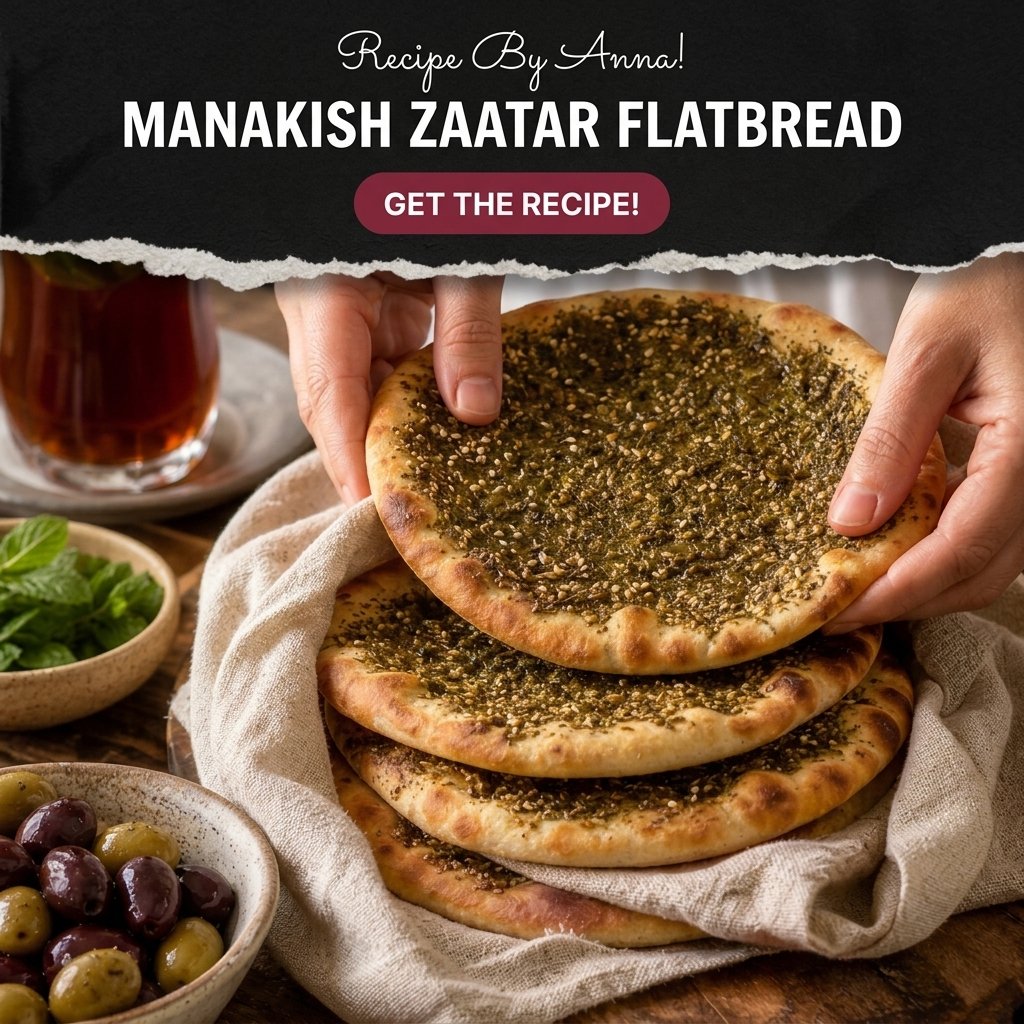
If you’ve ever wandered past a Lebanese bakery in the early morning, you already know the smell: hot bread, toasting herbs, sesame, and olive oil, drifting out the door like an invitation you don’t refuse. That smell is manakish — round flatbreads smeared with zaatar (a blend of dried thyme, sumac, sesame, and salt) mixed into a paste with olive oil, baked fast and hot until the edges blister and crisp. It’s the breakfast of the entire Levant: wrapped in paper, eaten warm, torn and folded around mint leaves, tomato slices, olives, and a little white cheese. It has sustained students, grandmothers, taxi drivers, and entire Saturday mornings for centuries. The za’atar trend may feel new here. Over there, it’s just breakfast.
The homemade version is more achievable than most people expect — it’s a beginner-friendly dough (flour, yeast, water, olive oil, a little patience) and a two-ingredient topping. The oven does the only dramatic part, puffing and blistering the rounds in a hot, fast bake. What comes out is a flatbread with crackly golden edges, a chewy-soft middle, and a savory, herbal, faintly lemony topping that makes toast look like it stopped trying years ago. Fold a piece around a slice of tomato and a mint leaf, take a bite, and you’ll understand why this is one of the world’s great breakfasts — no syrup, no frying, just bread and herbs doing their finest work.
And the full Lebanese breakfast spread around it — mint, cucumber, tomatoes, olives, halloumi or feta, maybe some labneh — turns one tray of flatbread into a morning board that looks generous and feeds exactly that way. It’s naturally vegetarian, it’s made from pantry flour and one hero spice blend, and it comes together in about ninety mostly-hands-off minutes. Make it once and it enters the weekend rotation; make it for guests and you’ll be fielding questions about “that green bread” for the rest of your social life. Fair warning, considered and accepted.
Why This Bread Wins Mornings
Manakish works because every component is doing maximum work with minimum ingredients. The dough is a simple lean dough with a generous glug of olive oil — that oil is what makes the crumb tender and the edges fry-crisp in the oven’s heat, and it’s why the bread stays good even at room temperature. The topping is a study in balance: za’atar brings dried thyme and oregano for herby depth, sumac for a bright lemony tang, sesame for nutty crunch and toasting aroma, and salt to tie it together. Mixed with good olive oil into a paintable paste, it soaks slightly into the dough’s surface while it bakes — flavor fused into bread rather than sitting on top of it. One bite gives you crisp, chew, herb, tang, and toast all at once. That’s a full orchestra from a five-note recipe.
The technique has two keys. First, a hot oven — as hot as yours will honestly go, ideally 450°F to 500°F — set up with a preheated baking steel or an upside-down sheet pan, so the bottom of each round cooks the way it does on a bakery’s stone floor: fast, blistered, and crisp rather than slow and pale. Second, the dimple: before topping, you press your fingertips across the dough to dock it, which keeps the middle from ballooning into a pita dome and gives the zaatar paste little valleys to pool in. The rim stays bare and puffs slightly — that golden handle of plain bread is the baker’s thumbprint and the diner’s favorite edge. Neither step is hard; both are the difference between “flatbread with seasoning” and actual manakish. The details are small, and the details are everything. That’s breakfast in Beirut in one sentence.
⏱️ 1 HR 30 MIN | 🌿 ZAATAR & OLIVE OIL | 🫓 BAKERY-STYLE BLISTER
- Prep Time: 20 minutes (dough and topping)
- Rise Time: 1 hour (the dough’s quiet shift)
- Bake Time: 8 to 10 minutes per tray, hot and fast
- Yield: 8 round manakish
The Bread Kit
Basic baking gear, one hot-and-heavy item:
- Baking steel or pizza stone (optional but mighty) — preheated in the oven, it delivers the blistered bakery bottom. No steel? Flip a heavy sheet pan upside down and preheat that. Bread has never once checked credentials.
- Two rimmed baking sheets and parchment — for shaping and shuttling rounds into the oven.
- Large bowl and clean hands — for mixing and kneading; the dough is soft and pleasant, and hands are the best tool for reading it.
- Tea towel — for covering the dough while it rises and for wrapping the baked manakish, which keeps them soft and foldable.
- Small bowl and spoon — for stirring the zaatar paste.
- Pastry brush or the back of a spoon — for spreading the paste thin and even; the spoon-back is the traditional move and works perfectly.
Ingredients (With Labels)
🫓 The Dough
- All-purpose flour: 4 cups (about 500 g) — bread flour works too, for an extra-chewy bite
- Instant yeast: 2 1/4 teaspoons (one packet)
- Sugar: 1 teaspoon — just enough to wake the yeast up, not enough to taste
- Salt: 1 1/2 teaspoons
- Warm water: 1 1/4 cups (about 100°F — warm like a bath, not like tea)
- Olive oil: 1/4 cup, plus more for the bowl and finishing
🌿 The Zaatar Paste
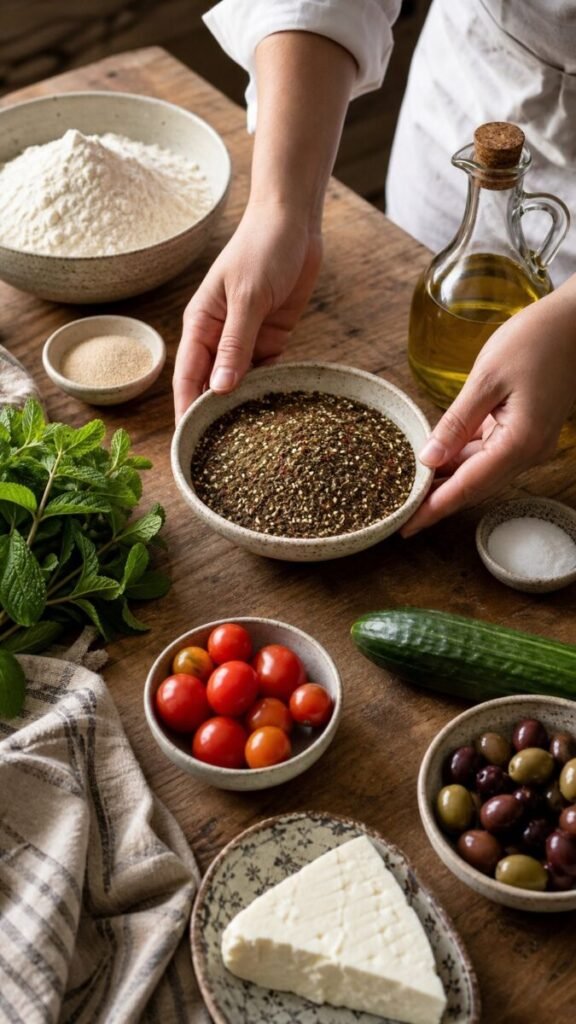
- Zaatar blend: 1/2 cup — the Levantine blend of dried thyme, sumac, sesame seeds, and salt; sold in Middle Eastern groceries and the good spice aisles
- Extra-virgin olive oil: 1/3 cup, or enough to make a spreadable paste — this is the topping’s flavor carrier, so use oil you’d happily dip bread in (you are, effectively, dipping bread in it)
🫒 The Breakfast Board
- Fresh mint: a big bunch — non-negotiable; mint is a vegetable in this breakfast, not a garnish
- Cherry tomatoes and cucumber: sliced, for folding into bites
- Olives: a generous bowl — briny green or wrinkled black, both correct
- White cheese: halloumi, feta, or any squeaky salty white cheese — cubed or in slices
- Labneh or thick yogurt (optional): a small bowl, olive oil drizzled over, for the dunkers
- Hot tea with fresh mint: the traditional co-star of the whole operation
Step by Step How to Make
- Step 1 — Mix the dough. In your big bowl, stir together the flour, yeast, sugar, and salt. Add the warm water and the 1/4 cup olive oil, and mix with your hands or a spoon until a shaggy dough forms — 30 seconds, tops. Cover it with the tea towel and let it rest 10 minutes; this little autolyse break lets the flour hydrate and makes the kneading noticeably easier. The dough is on your side. Let it prove that.
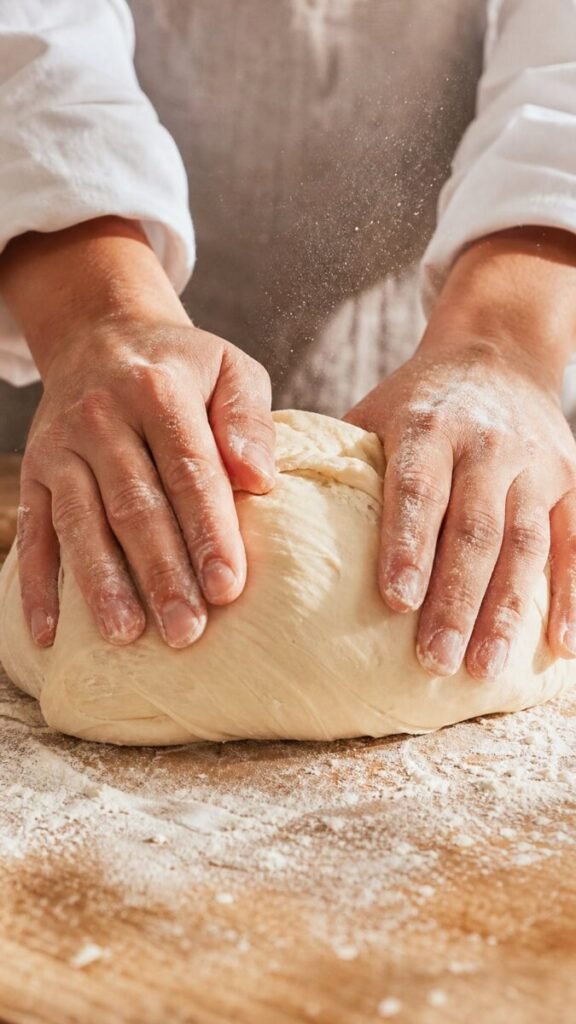
- Step 2 — Knead until smooth. Turn the dough onto a lightly floured counter and knead 5 to 8 minutes, until it’s smooth, supple, and only slightly tacky — it should spring back slowly when poked, like a very relaxed stress ball. Form it into a ball, oil the bowl lightly, roll the dough in the oil, and cover it with the towel. Overly sticky? Add flour a tablespoon at a time. Dry and stiff? A splash of water. Dough-making is a conversation, and this one is friendly.
- Step 3 — Let it rise. Leave the covered bowl somewhere warm for about 1 hour, until the dough has doubled and looks puffed and airy underneath the towel. This is the recipe’s quiet hour — perfect for slicing tomatoes, cubing cheese, washing mint, and setting the breakfast board. The mise en place assembles itself around the rise, which is either good planning or a beautiful accident. I take credit either way.
- Step 4 — Portion and rest. Turn the risen dough out (it will sigh — that’s normal, that’s the yeast exhaling), divide it into 8 equal pieces, and roll each into a tight ball. Cover the balls with the towel and let them rest 10 to 15 minutes. This short rest relaxes the gluten so the rounds actually stretch into circles instead of snapping back into stubborn little polygons.
- Step 5 — Shape, dimple, spread. Preheat the oven to its hottest honest setting — 450°F minimum, 500°F if it goes there — with your steel, stone, or flipped sheet pan inside, getting properly hot. Press and stretch each ball into a round about 5 to 6 inches across and 1/4 to 1/3 inch thick, then dimple the entire surface firmly with your fingertips. Stir the zaatar with the olive oil into a loose paste, and spread a thin, even layer over each round with the back of the spoon, leaving a clean half-inch rim of bare dough. That bare rim is about to become the best part.
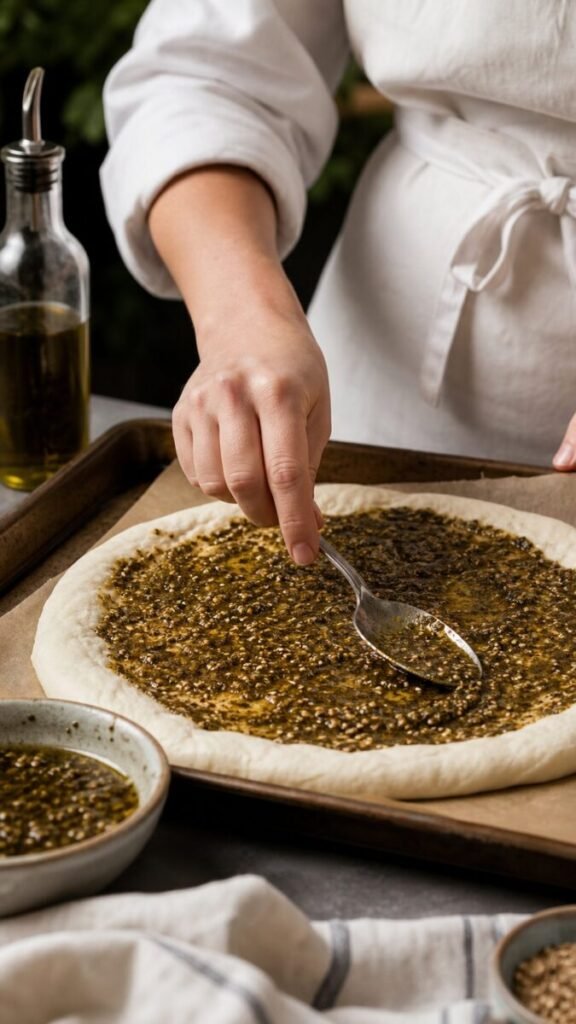
- Step 6 — Bake hot and fast. Slide the topped rounds — parchment and all, two or three at a time — onto the preheated steel or pan. Bake 8 to 10 minutes, until the rims are puffed and golden-brown in spots, the edges are crisp, and the zaatar is bubbling and fragrant. If your oven obliges, a final 60 to 90 seconds under the broiler gives you the bakery-style char on the herbs. Watch it like a hawk with a vested interest — the line between “blistered” and “burned herbs” is thin and crossed quickly.
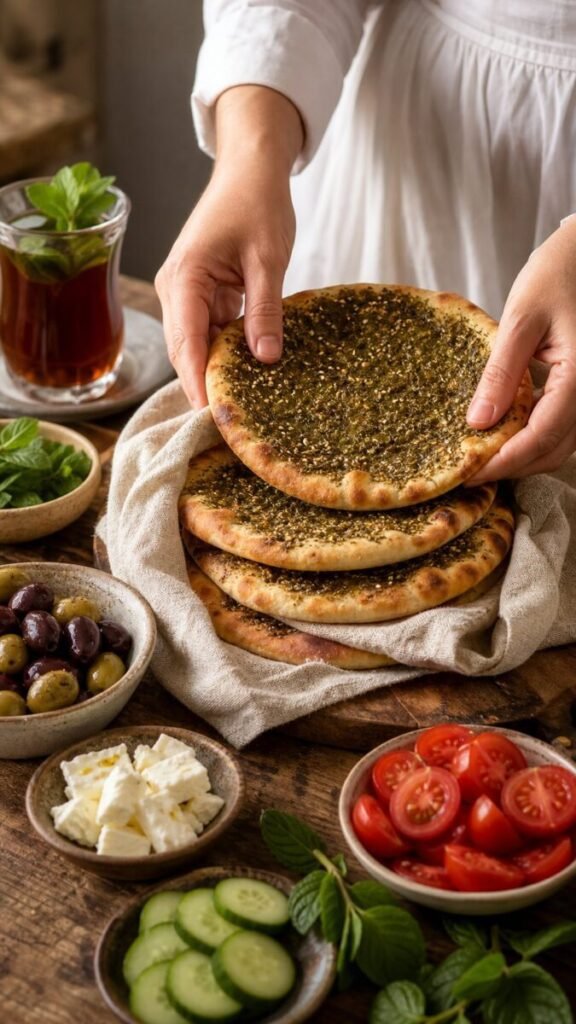
- Step 7 — Wrap, stack, serve warm. Pull the manakish out and brush the rims lightly with olive oil (or a little softened butter, the secret move), then stack them and wrap the stack in a clean towel for a few minutes — the trapped steam softens them into perfect foldability. Unwrap at the table with the breakfast board: mint, tomatoes, cucumber, olives, cheese, tea. Show everyone the fold — a piece of manakish wrapped around a mint leaf and a tomato slice — and let the morning proceed on its own excellent schedule.
Flatbread runs in the family — our Crispy Olive Oil Focaccia is this bread’s Italian cousin: same olive-oil soul, same dimpled top, completely different passport. Bake the manakish for breakfast and the focaccia for dinner, and consider the Mediterranean properly covered.
Dough Sense
Hot oven, patient preheat. The blister and the crisp both come from conductive heat hitting the dough instantly — a steel or stone that’s been preheating for a full 30 minutes. A lukewarm pan bakes pale, bready rounds; a properly hot one makes manakish. Give the oven its half hour. It’s the least glamorous and most important wait of the recipe.
Dimple with conviction. Those fingertip dents aren’t decoration — they keep the middle flat and give the paste somewhere to settle. Press firmly, all over, and don’t be shy about it. An undimpled round puffs into a dome and shoves its topping toward the edges, and then you’re eating herbs off a balloon. Dimple like the recipe depends on it, because it does.
Paste thin, rim bare. A thick layer of zaatar paste turns slick and bitter where it pools; a thin, even layer toasts into the bread. And keep that rim clean — the puffed, bare edge is the textural counterpoint to the herby middle, and the baker’s mark of a real manakish. Half the table will fight over the rims. Let them.
Read the dough, not the clock. Dough rises on its own schedule, decided by your kitchen’s temperature, the flour, and the yeast’s ambitions. An hour is a guide; doubled and puffy is the goal. In a warm kitchen it may be 45 minutes; on a cold morning, 90. The dough will tell you. It always does, once you start listening more than clock-watching.
Wrap, don’t refrigerate-hot. The towel-wrapped stack is a real technique — it keeps the breads soft and foldable instead of turning crisp-board on you as they cool. Serve them within 20 minutes of baking for the full effect. Manakish waits for no one, which is precisely its charm and its discipline.
The Lebanese Breakfast Table
The board is half the tradition. Set out the mint, tomatoes, cucumber, olives, and cheese family-style, and let everyone build their own folded bites — manakish torn, wrapped around mint and tomato, with a piece of cheese and an olive on the side. If you want to widen the spread, our Mediterranean Quinoa Bowl is the lunch-hour cousin of this same flavor world, and Everything Bagel Cucumber Bites bring the sesame-seed family reunion to the table. For the sweet finish, chilled Tiramisu Balls are the no-bake answer while the oven cools. And if breakfast-around-the-world is your new favorite genre, follow this with our Southern Satsuma Breakfast Gumbo the next weekend — Lebanon by way of Louisiana, one Saturday at a time.
Flatbread Riffs
Cheese Manakish (Manakish bil Jibneh) — top the dough with a mix of shredded akkawi or mozzarella and a little feta instead of (or beside) the zaatar, and bake the same way. The cheese version is the other half of every Lebanese bakery counter, and kids vote for it early and often.
Spicy Zaatar with Chili Flakes — add a pinch of Aleppo or crushed red pepper flakes to the paste. Gentle warmth with the sumac — the herbal heat combination that keeps a whole tray disappearing. Serve with a side of our Gochujang Mushrooms if the table runs hot and savory.
Mini Manakish Bites — divide the dough into 16 to 20 golf-ball pieces and make palm-sized minis for a party board. Same bake, about 2 minutes shorter, and they vanish at the speed of appetizers, which is roughly double the speed of breakfast.
Whole Wheat Half-and-Half — swap half the flour for whole wheat for a nuttier, heartier bread; add an extra splash of water, since whole wheat drinks more. Closer to the village-style loaves, and excellent under labneh.
Zaatar Breadsticks — roll the dough into ropes, brush with olive oil, dust heavily with zaatar, and bake until snappy. The snack drawer’s most elegant new resident, and proof this dough has range beyond the round.
Make It a Mediterranean Feast — double the board and serve manakish as the bread course before a big dinner — it opens a table beautifully alongside dishes like our Vegan Paella with Mixed Mushrooms. Same sea, different shores, one very good evening.
The Morning Ledger
| Nutrient | Per Manakish (1 of 8, plain bread and zaatar) |
|---|---|
| Calories | 265 kcal |
| Protein | 6 g |
| Carbohydrates | 36 g |
| Fats | 10 g |
Estimates for the bread and zaatar topping only — the board’s cheese and olives bill separately. The good news is built in: olive oil carries the fat, and it’s the heart-healthy kind the Mediterranean diet built its reputation on. Fold in tomato, cucumber, and mint, and this breakfast quietly assembles half a salad inside a flatbread. Delicious and defensible — my favorite combination on any nutrition label.
Keeping Them Crispy
Manakish is a now food — best within the first 20 minutes, very good within the hour, and that’s not a flaw, that’s the tradition. If you have leftovers, store them wrapped in the towel inside a sealed bag at room temperature for a day. The bread stays soft; the crisp edges soften too, which the wrap-and-fold crowd prefers anyway.
To revive, treat them like pita with ambitions: 3 to 4 minutes in a hot oven or a dry skillet over medium heat brings back the crisp edges and re-fragrances the zaatar. The microwave makes them soft and steamy — acceptable for the fold-style eaters, disappointing for the crisp-seekers. Choose your reheat based on your breakfast philosophy. Both camps are fed either way.
For real storage, freeze the cooled manakish in a sealed bag for up to 2 months, with parchment between them so they don’t fuse into a zaatar tower. Thaw and re-crisp straight from frozen in a 400°F oven for 5 to 6 minutes. Frozen manakish that revive into near-fresh breakfast are a genuinely elite freezer achievement — future Saturday mornings will thank present Saturday you, which is the whole quiet point of a freezer.
Flatbread Flops
Pale, bready rounds. The oven or the steel wasn’t hot enough — this is the number one cause of manakish disappointment. A proper 30-minute preheat at 450°F to 500°F is not optional garnish; it’s the recipe. Pale rounds are still tasty with the board around them, but the blister is the goal, and the blister runs on heat.
Tough, rubbery dough. Usually over-floured during kneading — add flour a tablespoon at a time and stop as soon as the dough stops clinging. Also check the rest in Step 4: a skipped rest makes the gluten fight the shaping, and you’ll wrestle circles out of polygon dough. Tender dough is relaxed dough. So is the baker, ideally.
Dough snapped back, refused to stretch. Not enough rest. Ten to fifteen minutes covered, and the gluten chills out on its own. If it’s still stubborn, give it another five — it’s not defiance, it’s chemistry, and chemistry responds to a short nap.
Bitter, scorched-tasting topping. The zaatar paste went on too thick, or the broiler ran long. Sesame and herbs cross from toasted to bitter fast — thin layer, watch the final minutes, and pull them the moment the edges take on color. Your nose knows the moment; trust it over the timer.
Rounds stuck to the parchment. Cheap parchment sometimes grips at high heat. Slide the rounds onto the hot steel with a quick jiggle of the pan, or dust the parchment with a breath of semolina or flour next batch. A semolina-dusted peel is the baker’s way, and it’s satisfying enough to be worth adopting for its own sake.
Zaatar Questions
What exactly is zaatar?
A blend — and a story. Zaatar is both the name of a wild Middle Eastern thyme and the blend built around it: dried thyme (or a thyme-marjoram-oregano mix), sumac for tang, toasted sesame seeds for crunch, and salt. Every family and every spice merchant has a ratio they’ll defend at length, and no two blends taste identical. Buy a small bag from a Middle Eastern grocery if you can — the freshness of the thyme is the whole game — and see the next question if you’d rather build your own.
Can I make zaatar at home?
Yes, and it takes two minutes: 2 tablespoons dried thyme, 1 tablespoon toasted sesame seeds, 2 teaspoons sumac, and 1/2 teaspoon salt — that’s the backbone. Add marjoram or oregano to the thyme if you have them, and a pinch of dried mint if you’re feeling traditional. Sumac is the one ingredient worth hunting down; its lemony tang is what makes zaatar taste like zaatar. Without it, you’ve made very nice herbed salt, and the bread will know.
Can I use store-bought dough?
Absolutely — one pound of fresh pizza dough from the grocery store makes six honest manakish with zero rise-time waiting. Bring the dough to room temperature, portion, rest, shape, top, and bake exactly as written. The topping and the hot oven carry the authenticity; the dough is a supporting role. This shortcut has rescued many a school morning at my house, with no reported loss of joy.
Can I make the dough the night before?
Yes — mix it, oil the bowl, cover, and refrigerate overnight. The cold slows the rise into a slow, flavor-building ferment (the overnight version honestly tastes a little better), and the dough is ready to portion when you are. Let it sit at room temperature for 30 to 45 minutes first, until it’s soft and pliable again, then proceed. Cold dough straight from the fridge will fight you, and nobody needs that before coffee.
Is there a gluten-free version?
In progress, not perfected — gluten-free doughs don’t stretch and blister the same way, so a GF manakish is closer to a herbed flatbread than a bakery round, though it’s still delicious with the board around it. A good GF pizza dough mix, rolled thin and topped identically, is the best current route. Meanwhile, for a naturally gluten-free Mediterranean plate, the Mediterranean Quinoa Bowl speaks the same flavor language without the flour.
Why is sumac so important here?
Because it’s the brightness. Sumac is a deep-red ground berry with a tart, lemony, almost vinegary zing — the lemon’s land-dwelling cousin, if you will — and it’s what keeps the olive-oil richness of the topping from tasting flat. That same bright-acid move is what makes dishes like our Quick Chicken Piccata sing at dinner. Acid is the cook’s secret handshake, and zaatar has been in on the secret for centuries.
Homemade Dough · Za’atar · Olive Oil · Lebanese Breakfast
Crispy Lebanese Manakish Za’atar & Olive Oil Flatbread
Homemade Lebanese flatbreads with golden edges, chewy centers and a fragrant za’atar–olive oil topping. Serve warm with mint, tomatoes, cucumber, olives and your favorite breakfast accompaniments.
Ingredients
As an Amazon Associate, we earn from qualifying purchases. Ingredient and equipment links below are affiliate links.
For the Dough
- All-purpose flour or bread flour 500 g, about 4 cups
- Instant yeast 2¼ tsp / 7 g
- Sugar 1 tsp
- Fine salt 1½ tsp
- Warm water, about 100°F / 38°C; tap water is fine 1¼ cups / about 296 ml
- Olive oil ¼ cup, plus a little for the bowl
For the Za’atar Topping
- Za’atar blend, with herbs, sumac and sesame ½ cup
- Extra-virgin olive oil ⅓ cup, adjusted for a spreadable paste
- Additional olive oil, optional a light brush on the baked rims
Weigh the flour for consistency; cup measurements vary with how flour is scooped. Za’atar blends differ in salt and sesame content, so taste the paste before adding any extra seasoning.
Optional Breakfast Accompaniments
- Fresh mint 1 bunch
- Cherry tomatoes, halved or sliced as desired
- Cucumber, sliced as desired
- Green or black olives a bowl for the table
- Halloumi or feta, sliced or cubed as desired
- Labneh or thick plain yogurt a small bowl
- Tea with fresh mint optional, to accompany
Equipment
- Baking steel, pizza stone or heavy baking sheet rated for the baking temperature
- Rimmed baking sheets 2, for shaping or baking
- Pizza peel, optional for transferring to a hot surface
- Parchment paper, optional only within its labeled heat limit
- Large mixing bowl for the dough
- Clean tea towel for covering dough
- Small bowl and spoon for the za’atar paste
- Pastry brush, optional for finishing the rims
How to Make It
- Mix and briefly rest the dough Stir together the flour, instant yeast, sugar and salt in a large bowl. Add the warm water and ¼ cup olive oil. Mix until a shaggy dough forms, then cover and rest for 10 minutes to let the flour hydrate.
- Knead until smooth Knead on a lightly floured surface for 5–8 minutes, until smooth, supple and slightly tacky. Add only a little flour if it is unmanageably sticky, or a small splash of water if stiff. Shape into a ball and place in a lightly oiled bowl, turning once to coat.
- Let rise and preheat the baking surface Cover and let rise in a warm spot for about 1 hour, until roughly doubled. During the final 30 minutes of rising, preheat the oven to 450°F (230°C) with a baking steel, stone or heavy inverted sheet pan inside, following the equipment manufacturer’s instructions. A stone may need a longer preheat.
- Divide and relax the dough Turn the risen dough onto the work surface. Divide into eight equal portions and shape into balls. Cover and rest for 10–15 minutes so they stretch easily without springing back.
- Mix the za’atar paste Stir the za’atar with ⅓ cup extra-virgin olive oil to make a spreadable paste. Adjust with a little more oil only if needed. Stir again before topping each batch so the herbs and sesame stay evenly distributed.
- Shape, dimple and top Press or roll each dough ball into a round about 6 inches across and roughly ¼ inch thick. If the dough resists, cover and rest it for another few minutes. Dimple firmly with your fingertips without tearing through. Divide the topping among the rounds in thin, even layers, leaving a bare ½-inch rim.
- Bake in uncrowded batches Transfer two or three rounds at a time onto the hot baking surface using a lightly floured peel. Alternatively, bake on a lightly oiled baking sheet. Use parchment only if its label permits the oven temperature. Bake for about 8–10 minutes, until the rims are golden, the undersides are cooked and the centers are no longer doughy. Watch the topping closely to prevent scorching.
- Finish warm Remove the baked flatbreads and repeat with the remaining rounds. Brush the rims lightly with optional olive oil. For crisp edges, keep the breads unstacked on a rack and serve promptly. For softer, foldable bread, stack and loosely wrap in a clean towel for a few minutes. Bring to the table with the optional breakfast accompaniments.
Allow approximately 1 hour 45 minutes to 2 hours 15 minutes for the full batch, depending on rise speed, shaping time and oven capacity. The original 90-minute estimate does not fully account for both short rests and multiple batches. The first breads may be ready earlier.
Do not exceed the temperature rating of parchment, pans or baking surfaces. At 500°F (260°C), ordinary parchment is often unsuitable. Broiling is not required, and parchment must never be placed under a broiler.
The flatbread itself is plant-based when made with a suitable za’atar blend and olive oil. Dairy accompaniments are optional; choose cheeses made without animal rennet for a vegetarian board. Standard za’atar commonly contains sesame, and the dough contains wheat.
Nutrition
| Nutrient | Source estimate per flatbread (1 of 8) |
|---|---|
| Calories | 265 kcal |
| Protein | 6 g |
| Carbohydrates | 36 g |
| Fat | 10 g |
Figures supplied with the original recipe, not independently calculated. They appear low for 500 grams of flour plus the full dough and topping oils divided into eight portions. Recalculate using the actual za’atar blend and oil quantities before publishing verified nutrition. Breakfast accompaniments are excluded; nutrition microdata is omitted pending verification.