

Fast Mediterranean Vegetable Galette | Simple Veggie Dinner
A galette is a free-form tart — no tart pan required, no blind baking, no perfect edges demanded. You roll the pastry into a rough circle, pile the filling in the center, fold the edges up and over, and bake it. What comes out is something that looks like it was made by someone who has been baking for decades and has long since stopped worrying about straight lines. Which is to say: it looks rustic and confident and intentional, and the imperfect folds are part of what makes it beautiful rather than a sign that something went wrong.
The Mediterranean filling here — roasted zucchini, cherry tomatoes, roasted red peppers, olives, and feta, seasoned with olive oil, garlic, and herbs — is the combination that makes this galette taste specifically of a warm Mediterranean summer even when it is being made in November. The vegetables roast slightly in the oven and release their juices into the pastry edges, producing the particular quality that makes the bottom of a galette one of the most satisfying bites in baking: a pastry that is simultaneously flaky on top and slightly flavour-soaked on the bottom.
This is the vegetarian showpiece recipe for any occasion where the food is expected to be impressive and the cook is expected to appear relaxed. The galette delivers on both requirements. The imperfect edges are doing that work.
What Makes a Galette Different From a Tart
A tart baked in a tart pan has precise edges, a uniform height on the sides, and the structural consistency that comes from the pan holding everything in shape throughout the bake. A galette has none of that — the pastry holds its own shape through the cold butter in the dough (which produces flakiness and structure in the heat of the oven before it melts fully) and the weight of the filling pressing it down. The result is something more organic and more interesting than a tart pan produces, with thick, folded pastry edges that have a different texture from the flat base — more biscuity, more browned, with more butter flavour concentrated in the folds.
The other advantage of the galette format is forgiveness. An imperfect fold becomes a rustic detail. A crack in the pastry becomes character. A slightly uneven distribution of filling becomes the visual complexity that makes the finished galette look considered rather than manufactured. This is the recipe to make when imperfection is aesthetic rather than failure — which, in the galette category, is always.
- Pastry Chill Time: 30 minutes minimum
- Prep Time: 20 minutes
- Cook Time: 40 to 45 minutes
- Total Time: 1 hour 35 minutes (including chill time)
- Yield: 6 servings
What You Need
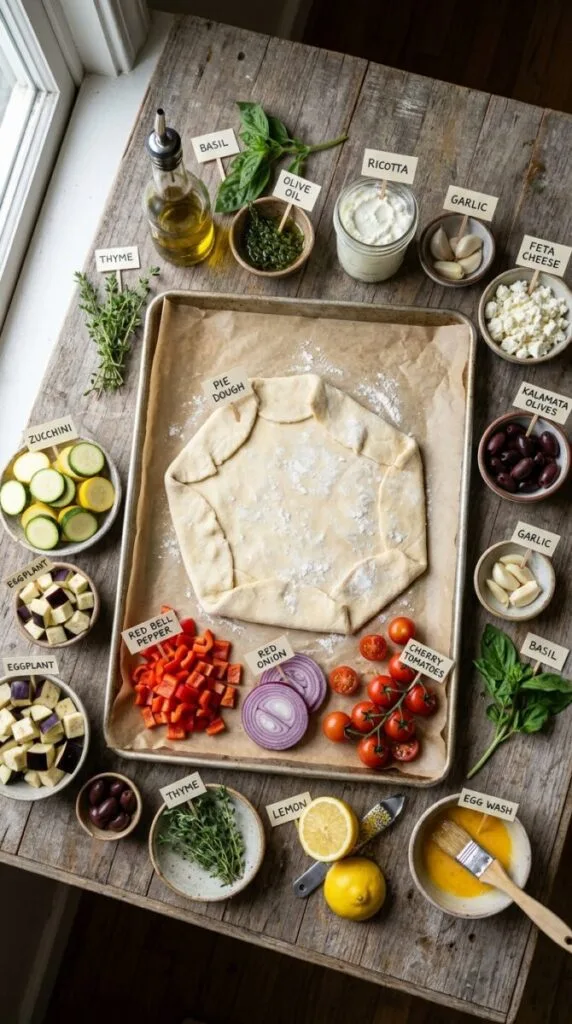
For the galette pastry:
- All-purpose flour: 1 1/4 cups (155g)
- Fine sea salt: 1/4 teaspoon
- Cold unsalted butter, cubed: 1/2 cup (115g) — the butter must be very cold; cold butter produces steam pockets during baking that create the layers of flakiness; room temperature butter produces a crumbly, mealy pastry without flake
- Ice cold water: 3 to 4 tablespoons — added one tablespoon at a time until the dough just comes together
- Apple cider vinegar: 1/2 teaspoon — added to the ice water; inhibits gluten development slightly and produces a more tender pastry
Or, the shortcut: one sheet of store-bought refrigerated pie dough, unrolled. Works beautifully. No judgment extended.
For the filling:
- Zucchini, sliced into 1/4-inch rounds: 1 medium
- Cherry tomatoes, halved: 1 cup
- Roasted red peppers (jarred), drained and sliced: 1/2 cup
- Kalamata olives, halved: 1/3 cup
- Feta cheese, crumbled: 3/4 cup (about 100g)
- Garlic cloves, thinly sliced: 3
- Fresh thyme leaves: 1 tablespoon
- Dried oregano: 1 teaspoon
- Chilli flakes: 1/4 teaspoon
- Extra-virgin olive oil: 3 tablespoons, divided
- Fine sea salt: 3/4 teaspoon
- Black pepper: 1/2 teaspoon
For the base layer:
- Dijon mustard: 1 tablespoon — spread directly on the pastry before the filling goes on; adds a sharp, tangy layer that prevents the pastry base from tasting bland underneath the filling
- Or: good-quality pesto: 2 tablespoons — an excellent alternative to the mustard; the basil and Parmesan in the pesto connect to the Mediterranean filling more directly
For the egg wash:
- 1 egg beaten with 1 tablespoon of milk — brushed on the folded pastry edges before baking for the golden colour and slight sheen that makes the finished galette look bakery-made
For finishing:
- Fresh basil leaves, torn
- Extra olive oil drizzle
- Flaky sea salt
- Lemon zest over the top at serving
🍽️ Equipment I Need for Mediterranean Vegetable Galette
Six simple tools for a flaky free-form crust, dry vegetables, and a beautiful shingled top.

Nordic Ware Natural Aluminum Commercial Baker’s Half Sheet
The rimmed half sheet gives the galette room to spread while catching any bubbling vegetable juices. Line it with parchment for an easy lift.

Pyrex 4.5-Quart Sculpted Glass Mixing Bowl
A large bowl handles the dough first, then the seasoned vegetable toss—fewer dishes, plenty of elbow room.

Farberware Classic Wood Rolling Pin, 18-Inch
A smooth rolling pin gives the forgiving dough an even round; a wine bottle can stand in when needed.

OXO Good Grips Silicone Basting & Pastry Brush
Silicone bristles spread egg wash neatly over the folded crust without clumping or leaving loose fibers.

OXO Good Grips Chef’s Mandoline Slicer 2.0
An adjustable mandoline creates thin, matching zucchini and tomato slices for a gorgeous shingled top.

OXO Good Grips Stainless Steel Colander
The colander drains salted zucchini and tomatoes while paper towels remove the moisture that makes crusts soggy.
How to Make It
Make the pastry (or unwrap the store-bought):
- Combine the flour and salt in a large bowl. Add the cold butter cubes and work with fingertips — press each cube flat, then break and rub until the mixture looks like coarse crumbs with some pea-sized and hazelnut-sized butter pieces still visible. The butter pieces are what create flakiness; work quickly so the butter stays cold.
- Mix the apple cider vinegar into the ice water. Add 3 tablespoons to the flour mixture and mix with a fork until the dough begins to come together — add the 4th tablespoon only if needed. The dough should hold together when squeezed but look shaggy rather than smooth. Do not overwork.
- Shape into a disk, wrap in plastic wrap, and refrigerate for at least 30 minutes. The rest allows the gluten to relax (making rolling easier) and the butter to firm back up (producing more flakiness in the final bake).
Prepare the filling:
- Toss the zucchini rounds with 1 tablespoon of olive oil, 1/4 teaspoon of salt, and a crack of pepper. Arrange on a small baking sheet and roast at 400°F for 15 minutes until slightly softened and beginning to colour at the edges. This pre-roasting step removes some of the zucchini’s moisture and prevents the galette base from becoming soggy from vegetable steam during the main bake. Allow to cool slightly.
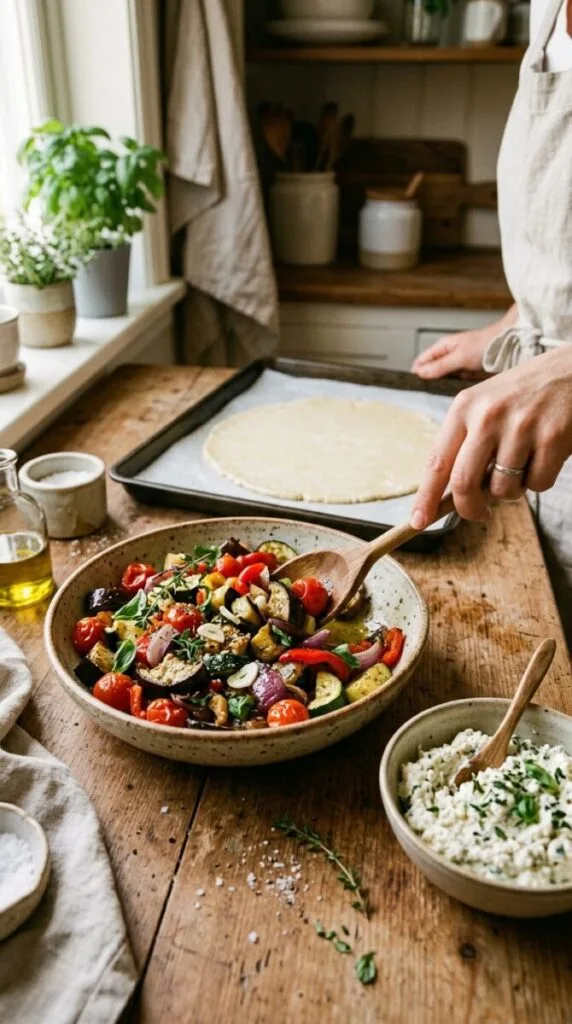
- In a bowl, combine the cherry tomatoes, roasted red peppers, olives, garlic slices, thyme, oregano, chilli flakes, remaining 2 tablespoons of olive oil, and remaining salt and pepper. Toss to coat. Add the cooled roasted zucchini and the crumbled feta. Toss gently.
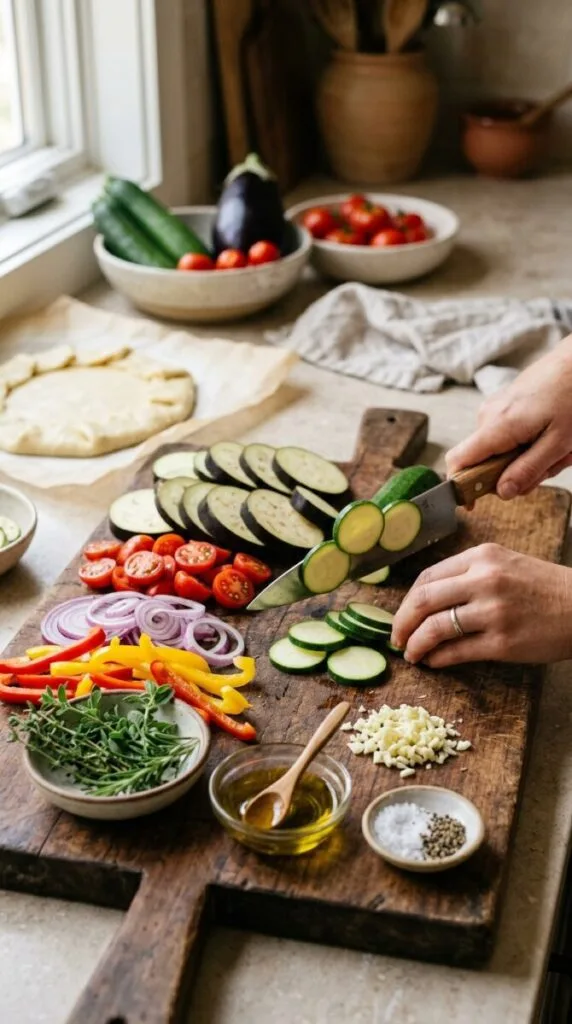
Assemble and bake:
- Preheat the oven to 400°F (200°C). Line a large baking sheet with parchment paper.
- On a lightly floured surface, roll the chilled pastry into a rough circle approximately 12 to 13 inches in diameter. It does not need to be a perfect circle — irregular edges add to the galette’s rustic character. Transfer to the prepared baking sheet.
- Spread the Dijon mustard or pesto over the center of the pastry, leaving a 2-inch border all around the edge.
- Arrange the filling over the mustard or pesto layer in the center of the pastry. The filling should be piled generously rather than laid flat — this is a galette, not a thin-crust pizza, and the filling should look abundant and slightly mounded.
- Fold the pastry border up and over the edge of the filling, pleating it as you go to create the characteristic galette edge. The pleats do not need to be uniform; they should look natural and slightly improvised. Press each pleat gently so it holds its shape during baking.
- Brush the folded pastry edges generously with the egg wash. The egg wash only goes on the pastry, not the filling.
- Bake at 400°F for 38 to 42 minutes until the pastry is deeply golden brown and the filling is bubbling slightly at the edges where the vegetable juices have reduced against the pastry border. The base of the galette should feel firm and sound hollow when tapped — a soft, yielding base means the pastry is still slightly underdone.
- Allow to cool for 10 minutes on the baking sheet before transferring to a serving board. Scatter fresh basil leaves over the top, add a drizzle of good olive oil, a pinch of flaky sea salt, and the lemon zest. Serve warm or at room temperature.
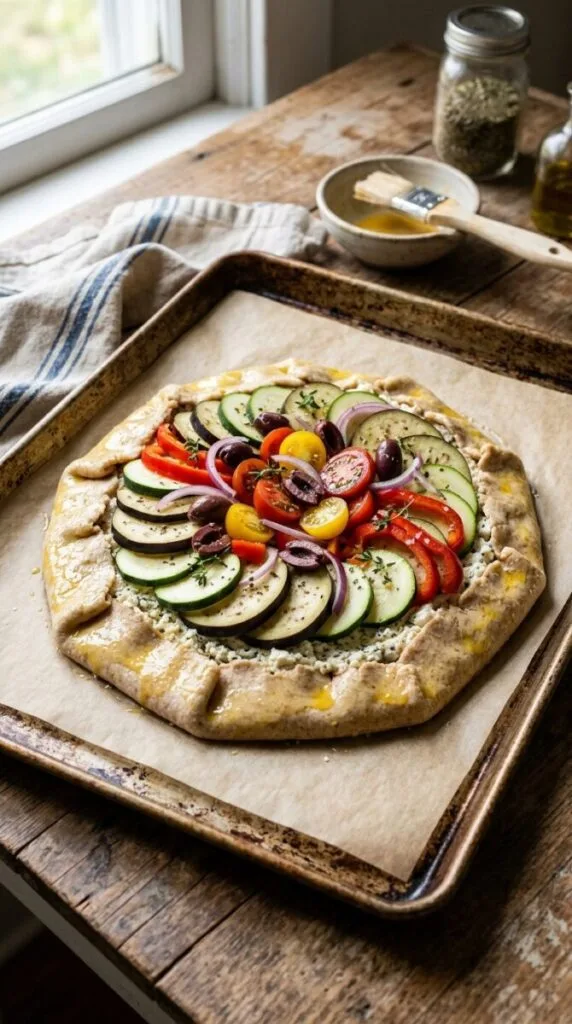
Mediterranean vegetable galette alongside our Chickpea Feta Avocado Salad is the vegetarian dinner spread that makes any table feel like a restaurant produced it — the rustic golden galette as the centrepiece, the bright, lemony chickpea salad as the accompaniment, both in the Mediterranean flavour direction, and together covering every texture and temperature the table needs. The galette warm from the oven. The salad cold from the fridge. The combination is not planned so much as inevitable.
Cold Butter, the Pre-Roasted Zucchini, and the Egg Wash Edge
Cold butter in pastry is not merely a technique preference — it is the structural requirement that produces flakiness. Flakiness in pastry comes from steam: cold butter pieces in the dough resist melting until the oven heat reaches them, at which point the water in the butter converts to steam and creates the puffed, separated layers that flaky pastry is defined by. Room temperature butter, by contrast, is incorporated fully into the dough during mixing rather than remaining as discrete pieces, and melts immediately when the pastry enters the oven — producing no steam pockets, no layers, and a crumbly, mealy texture rather than a flaky one. The butter must be cold. Work quickly. Return to the fridge if the dough starts to feel greasy at any point during shaping.
Pre-roasting the zucchini specifically — rather than adding it raw to the filling — removes approximately 30 percent of its water content before the galette goes into the oven. Zucchini is approximately 95 percent water, and a galette filled with raw zucchini releases that moisture during baking as steam that condenses on the underside of the pastry and prevents it from crisping. The 15-minute pre-roast produces zucchini that is slightly softened and dehydrated — it still has texture and flavour but dramatically less moisture. The bottom of the galette stays crisp. This is the most important preparation step in the recipe and the one most easily skipped on first attempt. Skip it once and you will not skip it again.
The egg wash on the pastry edges — and only the pastry edges, not the filling — produces the specific golden-brown, slightly glossy, bakery-finished appearance that makes the galette look professionally made rather than home-baked in the most obvious sense. Egg wash contains protein that Maillard-browns at oven temperature and fat that produces the sheen. A pastry edge without egg wash is pale, slightly dull, and noticeably less golden than a washed one. The wash is a 30-second step that changes the visual quality of the finished galette significantly.
What to Serve Alongside
As a vegetarian main, a simple dressed green salad is the ideal companion — the cold, acidic salad against the warm, buttery, vegetable-packed galette provides the contrast the rich pastry benefits from. Something with a mustard vinaigrette specifically connects to the Dijon base layer in the galette and makes the combination feel considered.
For a more substantial spread, our Black Bean and Lentil Soup alongside the galette is the combination that turns a light lunch into a complete, hearty dinner — the rich, spiced soup alongside the flaky, vegetable-filled galette covers every food group and every temperature direction without either dish overwhelming the other.
Variations That Keep the Spirit
Mushroom and Goat Cheese Galette: Replace the Mediterranean filling with 1.5 lbs of mixed mushrooms, sautéed until golden (the same hot-pan browning technique from the White Bean Mushroom Skillet and the Garlic Mushroom Rice Casserole), seasoned with thyme, garlic, and a splash of white wine. Spread 4 oz of softened goat cheese on the Dijon base before the mushrooms go on. The mushroom and goat cheese galette is the most autumnal and most dinner-party-appropriate variation — earthy, creamy, deeply savoury, and specifically elegant.
Tomato Galette: For peak summer, skip the other vegetables entirely and fill the galette exclusively with heirloom tomatoes — sliced thick, seasoned generously, layered in concentric overlapping rings over the Dijon or pesto base. Top with Parmesan, Gruyère, or goat cheese, fresh basil, and a drizzle of olive oil. The tomato galette is the most seasonal, most ingredient-dependent, and most beautiful version — it requires genuinely excellent ripe tomatoes and rewards the simplicity of excellent ingredients by letting them speak for themselves.
Butternut Squash and Sage Galette: Roast 2 cups of thin butternut squash slices at 400°F for 20 minutes until tender and beginning to caramelise. Layer over a base of ricotta (1/2 cup, seasoned with salt, pepper, and nutmeg) and top with fried sage leaves, toasted walnuts, and a drizzle of honey. The autumn galette is the most specifically seasonal version and the one that photographs most dramatically — the orange squash against the golden pastry is a colour combination that makes the finished galette look like it belongs on a magazine cover.
Add Eggs: Create 2 to 3 small wells in the filling after the first 25 minutes of baking. Crack an egg into each well and return to the oven for 8 to 10 minutes until the whites are set but the yolk is still runny. The egg galette is the brunch format — the runny yolk breaking into the vegetable filling and the pastry base is one of the most satisfying things that happens at a weekend brunch table.
Nutritional Information
| Nutrient | Amount Per Serving (based on 6 servings) |
|---|---|
| Calories | 375 kcal |
| Protein | 9 g |
| Carbohydrates | 32 g |
| Fats | 24 g |
375 calories per serving reflects the butter pastry, the olive oil in the filling, and the feta together. The 24 grams of fat come primarily from the pastry’s butter content and the olive oil — the fat that produces the flakiness and the richness that makes this worth eating. The protein comes from the feta and the eggs in the pastry. With the pesto base rather than Dijon, the calorie count increases by approximately 20 calories per serving from the additional olive oil in commercial pesto. The egg variation adds approximately 80 calories and 6 grams of protein per serving.
Make-Ahead and Storing
The pastry disk can be made up to 2 days ahead and stored wrapped in the fridge — it can also be frozen for up to 1 month (thaw overnight in the fridge before rolling). The vegetable filling can be prepared and seasoned up to 24 hours ahead and stored covered in the fridge. With both components ready, the day-of assembly and bake takes 45 minutes rather than the full recipe time.
The baked galette keeps in the fridge for up to 2 days. Reheat at 325°F for 12 to 15 minutes to restore the pastry’s crispness — the microwave softens the pastry into something more like pie dough than flaky tart shell. The oven reheat is worth the extra time for the texture it restores. At room temperature, the galette is also good cold — the pastry has a pleasant butteriness at room temperature that the chilled version (straight from the fridge) does not quite have.
The Mistakes Worth Knowing
Not pre-roasting the zucchini produces a galette with a soggy bottom from the steam the raw zucchini releases during baking — the moisture migrates downward through the filling and pools against the pastry base, preventing it from crisping. The 15-minute pre-roast is non-negotiable for a galette with zucchini or any other high-moisture vegetable (courgette, tomatoes if using in quantity, spinach). It can be done while the pastry chills, which means it adds no net time to the recipe.
Overworking the pastry dough develops gluten and produces a tough, dense pastry rather than the flaky, tender one the recipe should make. The dough should look shaggy and slightly rough when it comes together — smooth dough is overworked dough. Stop mixing when the dough holds together when squeezed. The raggedness bakes out. The toughness, once developed, does not.
Not pressing the pastry pleats firmly enough produces edges that unfold during baking, releasing the filling out onto the baking sheet. Press each pleat firmly against the ones adjacent to it as you fold — a slight pressing motion, not a pinching that would tear the pastry. Pleats that are pressed flat against each other hold through the full bake; loose pleats do not.
Mediterranean Vegetable Galette
A rustic, golden free-form tart layered with Dijon mustard or pesto and piled with roasted zucchini, cherry tomatoes, roasted red peppers, Kalamata olives, garlic, herbs, and crumbled feta inside flaky pleated pastry edges.
Ingredients
- For the Galette Pastry (or 1 Store-Bought Pie Dough Sheet)
- All-Purpose Flour 1¼ cups / 155g
- Fine Sea Salt ¼ tsp
- Cold Unsalted Butter, cubed ½ cup / 115g
- Ice Cold Water 3–4 tbsp
- Apple Cider Vinegar ½ tsp
- Shortcut: Refrigerated Pie Dough Sheet 1 sheet, unrolled
- For the Mediterranean Filling
- Zucchini, sliced into ¼-inch rounds 1 medium
- Cherry Tomatoes, halved 1 cup
- Roasted Red Peppers (jarred), drained & sliced ½ cup
- Kalamata Olives, halved ⅓ cup
- Feta Cheese, crumbled ¾ cup / 100g
- Garlic Cloves, thinly sliced 3 cloves
- Fresh Thyme Leaves 1 tbsp
- Dried Oregano 1 tsp
- Chilli Flakes ¼ tsp
- Extra-Virgin Olive Oil, divided 3 tbsp
- Fine Sea Salt ¾ tsp
- Black Pepper ½ tsp
- Base Layer, Egg Wash & Finishing
- Dijon Mustard (or 2 tbsp Basil Pesto) 1 tbsp
- Alternative Base: Good-Quality Pesto 2 tbsp
- Egg Wash (1 Egg beaten + 1 tbsp Milk) For edges
- Fresh Basil Leaves, torn For finishing
- Flaky Sea Salt & Extra Olive Oil Drizzle To finish
- Fresh Lemon Zest Over top at serving
As an Amazon Associate, we may earn from qualifying purchases. Click ingredient names to shop on Amazon.
How to Make It
- Cut cold butter into flour Combine the flour and ¼ teaspoon salt in a large bowl. Add the cold butter cubes and work quickly with your fingertips until the mixture resembles coarse crumbs with pea-sized and hazelnut-sized butter pieces still visible.
- Hydrate and chill pastry Mix the apple cider vinegar into the ice water. Add 3 tablespoons to the flour mixture and toss with a fork until a shaggy dough holds together when squeezed (add the 4th tablespoon only if needed). Shape into a disk, wrap in plastic wrap, and refrigerate for at least 30 minutes.
- Pre-roast the zucchini Toss the zucchini rounds with 1 tablespoon olive oil, ¼ teaspoon salt, and a crack of pepper. Arrange on a baking sheet and roast at 400°F for 15 minutes until slightly softened and beginning to color at the edges. Let cool slightly.
- Combine the Mediterranean filling In a bowl, toss the halved cherry tomatoes, sliced roasted red peppers, olives, garlic slices, thyme, oregano, chilli flakes, remaining 2 tablespoons olive oil, and remaining salt and pepper. Gently fold in the cooled roasted zucchini and crumbled feta.
- Roll dough and spread base layer Preheat oven to 400°F (200°C) and line a large baking sheet with parchment paper. On a lightly floured surface, roll the chilled pastry into a rough 12 to 13-inch circle, transfer to the baking sheet, and spread the Dijon mustard or pesto over the center, leaving a 2-inch border all around.
- Pile filling and fold pleats Pile the vegetable and feta filling generously over the mustard or pesto layer. Fold the 2-inch pastry border up and over the edge of the filling, pleating naturally as you go and pressing each pleat gently so it holds its shape.
- Brush with egg wash and bake Brush the folded pastry edges generously with the beaten egg wash. Bake at 400°F for 38 to 42 minutes until the pastry is deeply golden brown, the base feels firm, and the filling is bubbling at the edges.
- Cool, garnish, and serve Cool for 10 minutes on the baking sheet before transferring to a serving board. Scatter torn fresh basil leaves over the top, finish with a drizzle of olive oil, flaky sea salt, and fresh lemon zest, and serve warm or at room temperature.
Nutritional Information
| Nutrient | Amount Per Serving (based on 6 servings) |
|---|---|
| Calories | 375 kcal |
| Protein | 9 g |
| Carbohydrates | 32 g |
| Fats | 24 g |
Values are estimates based on 6 servings with the Dijon base. Using a pesto base adds ~20 kcal per serving.