

Caramelized Onion & Gruyère Tart Salad (Quick & Decadent)
There is a specific kind of lunch that feels genuinely civilised — the kind that requires a plate, a glass of something cold, and the sense that this is a meal worth sitting down for. This Caramelized Onion and Gruyère Tart is that lunch. It is also, quietly, one of the most impressive things you can produce from four main ingredients: onions, eggs, cream, and Gruyère cheese in a buttery pastry shell.
The caramelized onions are the reason this tart is worth the effort of making. Raw onions roasted into a custard produce a sharply onion-flavoured tart that is fine but not particularly memorable. Onions that have been cooked over low heat for 45 minutes until they are deep brown, jammy, and sweet with their natural sugars produce something entirely different — a filling that tastes rich and deeply savoury rather than just eggy, and that gives the tart a complexity that makes people ask what is in it.
The answer is always “just onions, but properly cooked.” Which is the most satisfying answer in the kitchen.
Why Caramelized Onions Take 40 Minutes and Why It Is Worth It
True caramelized onions — the ones that are deeply brown, sweet, jammy, and almost paste-like in consistency — take 40 to 45 minutes of low, patient cooking. This is not a cheat that can be rushed. Onions cooked over high heat in 10 minutes produce browned edges with raw, sharp centres; onions cooked over low to medium heat for 40 minutes produce a uniform, deep golden-brown caramel throughout every strand. The difference in flavour is so significant that a tart made with properly caramelized onions and a tart made with “quickly browned” onions are essentially different recipes.
The caramelizing happens because onions contain natural sugars that break down through Maillard browning and caramelization reactions at sustained heat over time — reactions that require both temperature and duration. High heat produces the temperature but not the duration; the outsides brown before the internal sugars have time to develop. The 40-minute low-and-slow method is the one that produces the full sweetness and depth.
Make the caramelized onions the night before if you want the day-of assembly to be faster. They keep in the fridge for up to a week and can be used in everything from sandwiches to pasta to this tart.
- Caramelized Onion Time: 40 to 45 minutes
- Pastry Prep and Blind Bake: 45 minutes (including chill time)
- Filling and Final Bake: 35 to 40 minutes
- Total Active Time: 30 minutes
- Yield: one 9-inch tart, serves 6
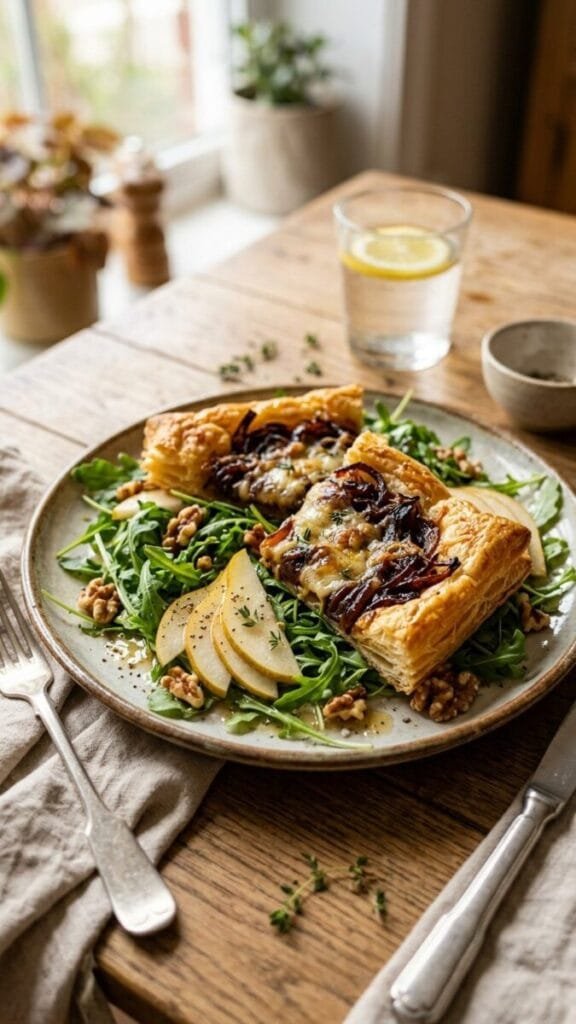
🍽️ Equipment I Need
One good skillet and a tart pan — bistro cooking at home:
- Large Heavy Skillet or Dutch Oven — wide and heavy for even caramelizing without burning. Stainless steel or cast iron both give beautiful color. The Cuisinart MultiClad Pro Triple Ply 12-Inch Skillet has the surface area onions need to brown rather than stew, and the Cuisinart 5-Quart Enameled Cast Iron Covered Casserole holds steady low heat for the long, slow route. Either one builds the fond that makes the onions taste deep instead of merely sweet.
- 9-inch Tart Pan with Removable Bottom (or Pie Dish) — makes that pretty fluted edge and easy slicing. The Wilton Excelle Elite 9-Inch Tart and Quiche Pan lifts its bottom right out, so the tart comes free with the flutes intact instead of crumbling against the sides. Prefer glass? The Pyrex C-209 9.5-Inch Fluted Rim Pie Plate has the same decorative edge and shows off the custard as it sets. Puff pastry works in a sheet pan too for a rustic free-form tart — the Nordic Ware Naturals Half Sheet handles that easily.
- Rolling Pin — for rolling puff pastry or shortcrust into an even circle, if using. This HELFERX Beech Wood Rolling Pin has nylon bearings in the handles, so it rolls smooth and even without you pressing harder in the middle than at the edges.
- Mixing Bowls (2) — one for the custard, one for tossing the little salad at the end. The Pyrex 3-Piece Glass Mixing Bowl Set gives you both sizes in one nesting stack, and glass won’t take on the Dijon or onion smell.
- Whisk — for whisking eggs, cream, and Dijon into a silky custard. The OXO Good Grips 11-Inch Balloon Whisk has the wide loop that pulls air in and breaks up the egg strands, which is what keeps a custard smooth instead of streaky.
What You Need
For the shortcrust pastry:
- All-purpose flour: 1 1/4 cups (155g)
- Unsalted butter, cold and cubed: 1/2 cup (115g)
- Fine sea salt: 1/4 teaspoon
- Ice cold water: 3 to 4 tablespoons — added one tablespoon at a time
- Egg yolk: 1 — adds richness and helps the pastry brown more evenly
Or, if life is short and you have no objections: one sheet of store-bought refrigerated pie pastry. It works. No judgment.
For the caramelized onions:
- Yellow onions: 4 large (approximately 2 lbs / 900g) — they will cook down to approximately 1 cup of caramelized onions; this is correct and expected
- Unsalted butter: 2 tablespoons
- Olive oil: 1 tablespoon
- Fresh thyme: 4 sprigs
- Fine sea salt: 1 teaspoon
- White wine or dry sherry: 2 tablespoons — added in the last 5 minutes to deglaze the pan and add depth
- Sugar: 1 teaspoon — helps the caramelization along; optional but effective
For the custard filling:
- Large eggs: 3
- Heavy cream: 1 cup (240ml)
- Whole milk: 1/4 cup (60ml)
- Gruyère cheese, freshly grated: 1 1/4 cups (125g) — Gruyère specifically; its nutty, slightly sweet flavour and its excellent melting properties make it the traditional choice for this style of French tart, and nothing else quite replicates both qualities simultaneously
- Dijon mustard: 1 teaspoon — spread inside the tart shell before the filling goes in; adds a sharp, slightly pungent layer that lifts the richness of the custard
- Fresh nutmeg, grated: a small pinch
- Fine sea salt: 1/2 teaspoon
- White pepper: 1/4 teaspoon
For the simple green salad:
- Mixed salad greens — peppery (rocket/arugula) or bitter (frisée or endive) works best against the rich tart
- A simple Dijon vinaigrette: 1 tablespoon Dijon, 2 tablespoons white wine vinegar, 4 tablespoons olive oil, salt and pepper, whisked together
- Optional: shaved Parmesan, toasted walnuts, or a few sliced radishes
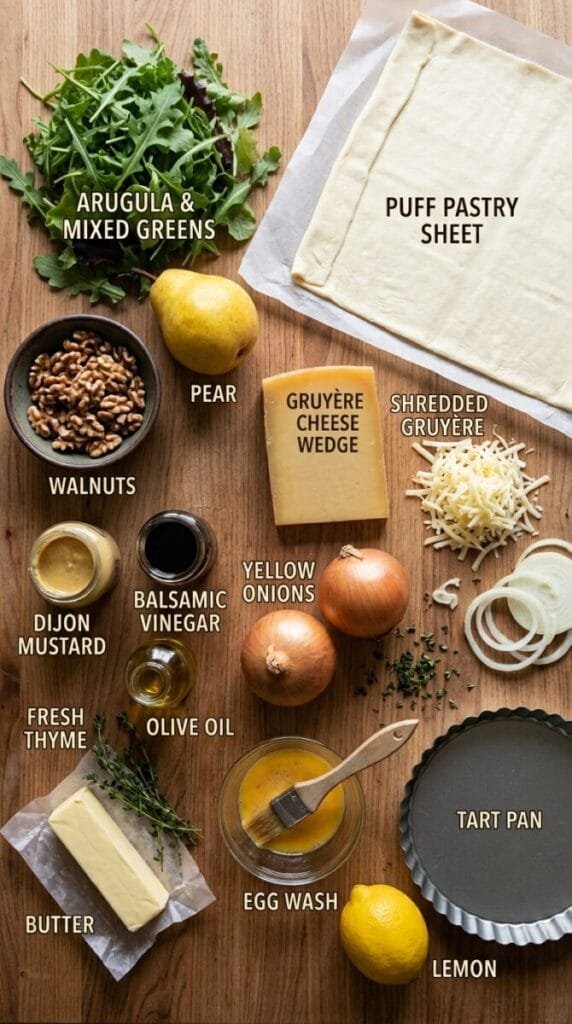
How to Make It
Caramelizing the onions (do this first, or the night before):
- Slice the onions thinly — halved and then sliced into thin half-moons.
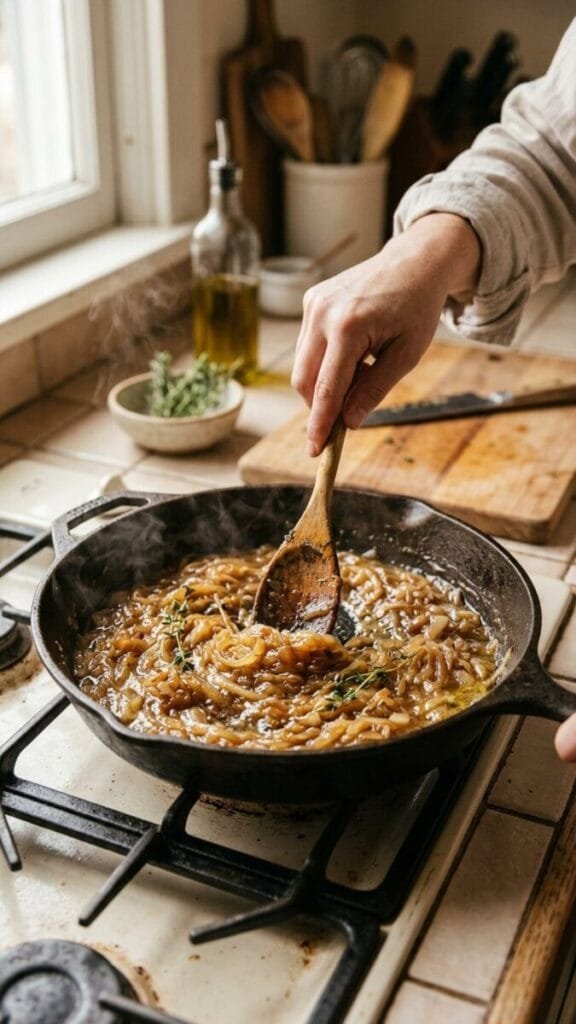
- Heat the butter and olive oil together in a wide, heavy-bottomed skillet over medium-low heat. Add the onions, thyme sprigs, and salt. Stir to coat.
- Cook over medium-low heat, stirring every 5 to 7 minutes, for 40 to 45 minutes. The onions will soften, release their liquid, and then gradually darken from pale yellow to deep golden brown. If they seem to be browning too fast at any point, reduce the heat slightly and add a tablespoon of water to slow the process.
- In the last 5 minutes, add the sugar (if using) and the white wine or sherry. Stir and cook until the liquid has evaporated. The onions should look deeply brown, jammy, and fragrant. Remove the thyme sprigs and set aside to cool.
Making and blind baking the pastry:
- Combine the flour and salt in a bowl. Add the cold butter cubes and rub with fingertips until the mixture looks like coarse crumbs with some pea-sized butter pieces remaining.
- Add the egg yolk and 3 tablespoons of ice cold water. Mix with a fork until the dough just comes together — add the 4th tablespoon of water only if needed. Do not overwork.
- Shape into a disk, wrap, and refrigerate for 20 minutes.
- Preheat the oven to 375°F (190°C). Roll the pastry to approximately 12 inches in diameter and transfer to a 9-inch tart pan with a removable bottom. Press into the edges and trim the excess. Refrigerate for 10 minutes.
- Line the pastry with parchment and fill with pie weights or dried beans. Blind bake for 15 minutes. Remove the weights and bake for another 8 to 10 minutes until the base looks dry and is beginning to turn faintly golden. The blind bake prevents the “soggy bottom” problem.
- Brush the inside of the blind-baked shell with the Dijon mustard while it is still warm. Allow to cool slightly.
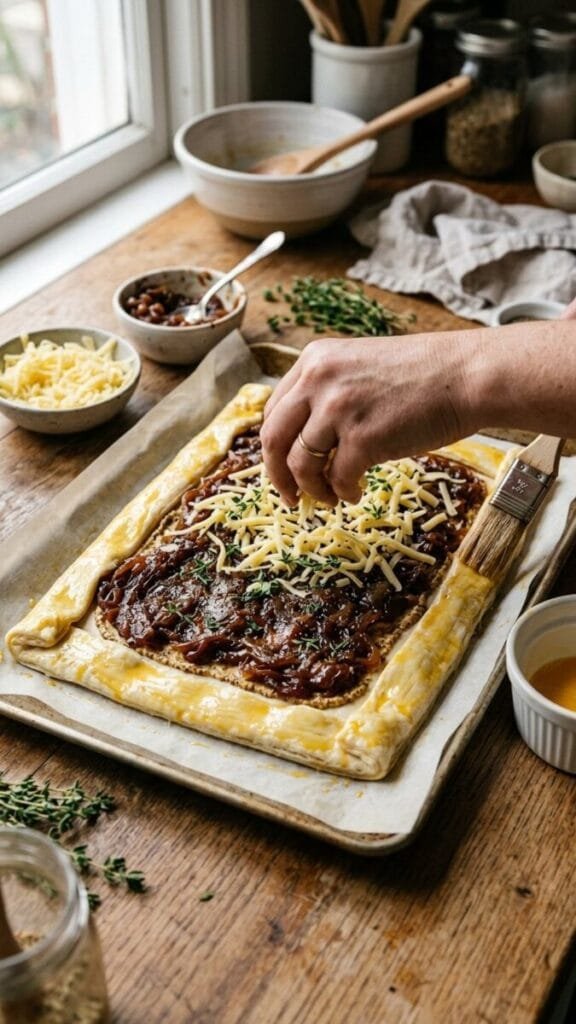
Assembling and baking the tart:
- Whisk the eggs, cream, milk, nutmeg, salt, and white pepper together in a bowl until smooth. Stir in 3/4 cup of the Gruyère.
- Spread the caramelized onions evenly over the mustard-brushed tart shell.
- Pour the custard over the onions slowly, allowing it to settle between the onion strands. The tart shell should be about 3/4 full.
- Scatter the remaining 1/2 cup of Gruyère over the top.
- Bake at 375°F for 30 to 35 minutes until the custard is just set — it should have a very slight wobble in the center, like a just-set crème brûlée. A completely firm custard is overbaked. The wobble sets to a creamy, tender custard as it cools.
- Cool in the pan for 15 to 20 minutes before removing the outer ring. The tart is best served just warm or at room temperature — never piping hot, as the custard needs time to set completely.
Caramelized onion and Gruyère tart alongside our Chickpea Beet and Feta Salad with Lemon Garlic Vinaigrette is the lunch combination that belongs at any gathering where you want to feed people something genuinely impressive without appearing to have tried too hard. The earthy beets, tangy feta, and lemon vinaigrette provide exactly the brightness and acidity that the rich, creamy tart needs alongside it.
The Blind Bake, the Dijon Brush, and the Just-Set Wobble
Blind baking the pastry before adding the filling is the step that prevents the bottom of the tart from being pale and undercooked under the weight of the custard. A raw pastry shell placed in the oven with custard on top takes so long to cook through that the custard has usually overbaked by the time the pastry is done. Blind baking first produces a partially cooked pastry that finishes in the same time as the custard, producing a fully cooked, golden base and a creamy, just-set custard simultaneously.
The Dijon mustard brushed inside the warm blind-baked shell is the step that most people skip and most professional pastry cooks do not — it adds a layer of sharp, slightly pungent flavour between the pastry and the custard that lifts the richness of the egg and cream filling and connects to the Gruyère’s nutty character. It is invisible in the finished tart but its presence is evident in every bite that tastes more complex than you expected.
The slight wobble in the center at the end of baking — the standard instruction for French custard tarts — means the eggs are set enough to hold their structure as the tart cools but not so set that the texture has crossed from silky and custardy to rubbery and dense. A completely firm custard in the oven becomes slightly rubbery as it cools; a slightly wobbly custard in the oven sets to a silky, tender, sliceable texture at room temperature. Take it out at the wobble.
What to Serve Alongside
A sharp, dressed green salad is the only accompaniment this tart needs — the cold, acidic salad against the warm, rich tart is the classic French bistro combination and it is classic because it works perfectly. Arugula or frisée with a strong Dijon vinaigrette is the most natural pairing.
A simple tomato salad dressed with olive oil and flaky salt and a handful of fresh basil works equally well and is faster — sliced ripe tomatoes, good olive oil, salt, done. The acidity of the tomato cuts through the richness of the custard in the same way the vinaigrette does but with considerably less effort.
Variations That Use the Same Technique
Leek and Gruyère Tart: Replace the caramelized onions with 3 large leeks (white and light green parts only), thinly sliced and cooked in butter for 20 minutes until soft, sweet, and slightly translucent. The leek version is milder and more delicate than the onion version — particularly good in spring when leeks are in season and the flavour feels lighter and more appropriate than the deeply sweet winter onion.
Mushroom and Gruyère Tart: Replace the caramelized onions with 1.5 lbs of mixed mushrooms, sautéed until deeply golden and all their moisture has evaporated (use the same technique as the Garlic Mushroom Rice Casserole — high heat, wide pan, no crowding, patience). The mushroom version is the most savoury, most umami-forward direction and suits anyone who finds the sweetness of the caramelized onion slightly too dessert-adjacent for a savoury tart.
Tomato and Goat Cheese Tart: Skip the custard entirely. Spread a mixture of goat cheese, herbes de Provence, and a drizzle of olive oil inside the blind-baked shell. Arrange overlapping slices of ripe tomato over the goat cheese. Drizzle with more olive oil, season with flaky salt and pepper, and bake at 375°F for 25 minutes until the pastry edges are golden and the tomatoes are slightly blistered. This is the summer version — simple, fresh, and genuinely stunning on a warm day when tomatoes are at their best.
Individual Tartlets: Use a muffin tin rather than a 9-inch tart pan and cut the pastry into rounds to line each cup. Reduce the bake time for the custard filling to 18 to 20 minutes. Individual tartlets are the dinner party format — elegant, pre-portioned, and visually striking as a starter or part of a sharing spread. They also make the most beautiful take-to-work lunch in individual containers.
Nutritional Information
| Nutrient | Amount Per Slice (based on 6 slices, tart only) |
|---|---|
| Calories | 445 kcal |
| Protein | 14 g |
| Carbohydrates | 28 g |
| Fats | 31 g |
This is an indulgent tart and the values reflect that honestly — the fat comes from the butter in the pastry, the cream in the custard, and the Gruyère on top. The 14 grams of protein per slice comes from the combination of eggs and Gruyère. Served with a simple green salad (minimal additional calories), the complete lunch comes to approximately 500 calories — a generous, satisfying meal that earns its calorie content in satisfaction and elegance.
Storing and Keeping This
Store the cooled tart loosely covered in the fridge for up to 3 days. The pastry softens somewhat during refrigeration but the custard stays silky and the flavour of the caramelized onions deepens overnight — day-two tart is genuinely excellent.
Reheat individual slices at 325°F in the oven for 10 to 12 minutes until warmed through — or eat at room temperature, which is equally good and requires no reheating. The microwave softens the pastry completely; the oven re-crisps it slightly. For a lunch tart that you want to eat at work, room temperature is the answer and the pastry is perfectly pleasant at that temperature.
The tart does not freeze well — the custard separates slightly on thawing and the pastry becomes soggy. Make and eat within 3 days. The caramelized onions, however, freeze beautifully for up to 3 months — make a large batch, freeze in portions, and have instant tart-ready caramelized onions whenever you want them.
The One Mistake That Is Easy to Make
Pouring the custard into the tart shell while it is still on the oven rack rather than pulling the tart out and filling it on the bench produces an inevitable spill — custard inside a tart shell is heavy and moves easily, and carrying a full liquid tart to the oven from the bench is a high-risk manoeuvre. Instead: place the pastry shell in the oven on its rack, pull the rack out slightly, and pour the custard into the shell from a jug while it is resting on the pulled-out rack. Then push the rack back in. No carrying. No spilling. This is the professional pastry kitchen approach and it is specifically why professional pastry kitchens do not have custard on the oven floor.
Caramelized Onion and Gruyère Tart
A buttery French-style tart filled with deeply caramelized onions, Gruyère cheese, egg custard, Dijon, thyme, and served with a simple green salad.
Ingredients
How to Make
Slice onions into thin half-moons. Heat butter and olive oil in a wide skillet over medium-low heat. Add onions, thyme, and salt. Cook 40 to 45 minutes, stirring every 5 to 7 minutes, until deeply golden, jammy, and sweet.
In the last 5 minutes, add sugar if using and white wine or sherry. Cook until liquid evaporates. Remove thyme sprigs and cool.
Combine flour and salt. Rub in cold butter until coarse crumbs form. Add egg yolk and 3 tablespoons ice water. Mix until dough just comes together, adding the final tablespoon water only if needed.
Shape dough into a disk, wrap, and refrigerate for 20 minutes.
Preheat oven to 375°F / 190°C. Roll pastry to about 12 inches and fit into a 9-inch tart pan. Chill 10 minutes. Line with parchment, fill with weights, and bake 15 minutes. Remove weights and bake 8 to 10 minutes more, until dry and faintly golden.
Brush the inside of the warm blind-baked shell with Dijon mustard. Let cool slightly.
Whisk eggs, cream, milk, nutmeg, salt, and white pepper until smooth. Stir in ¾ cup Gruyère.
Spread caramelized onions evenly in the tart shell. Pour custard over the onions slowly. Scatter remaining ½ cup Gruyère over the top.
Bake at 375°F for 30 to 35 minutes, until custard is just set with a slight wobble in the center.
Cool in the pan for 15 to 20 minutes before removing the outer ring. Serve just warm or at room temperature with salad.
Whisk Dijon, white wine vinegar, olive oil, salt, and pepper. Toss with salad greens just before serving.
Nutrition
| Nutrient | Amount Per Slice |
|---|---|
| Calories | 445 kcal |
| Protein | 14 g |
| Carbohydrates | 28 g |
| Fat | 31 g |
Values are estimates based on 6 slices of tart only, not including salad.