Crispy Rice Paper Scallion Pancakes
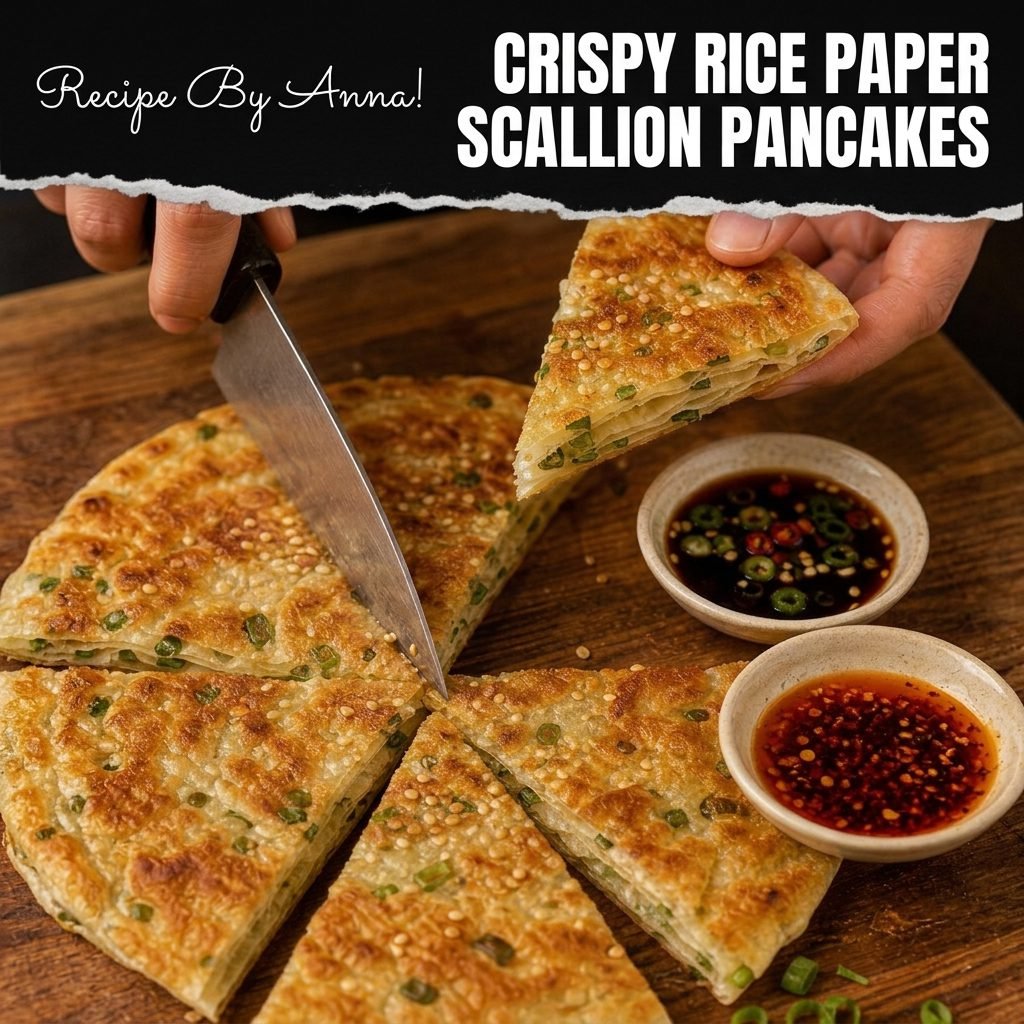
A classic scallion pancake is a beautiful, laminated-dough project — roll, rest, coil, rest, roll again — and I love it on the weekends I plan around it. These crispy rice paper scallion pancakes are what I make the other days: the same golden, shatter-crisp, scallion-flecked idea, built from rice paper rounds instead of dough. A quick dip in water makes the sheets sticky, scallions get sprinkled between the layers, the whole stack presses into one pancake, and a hot pan with a real spoonful of oil does the rest. Thirty minutes, no dough, no rolling pin, and — since rice paper is just rice — no gluten at all.
The idea swept around the internet over the past couple of years as the great rice paper hack, and it earned its popularity honestly: the layers of rice paper mimic the flaky layers of the original, the edges blister and puff like something deep-fried even though it’s just pan-fried, and the whole thing is close enough to the real pancake that purists grumble mostly on principle. My version uses the layered-stack method, with seasoned scallions between every sheet and a thin egg wash on the outside for the deep gold color rice paper can’t manage alone.
A few honest notes before you start. This is a gluten-free recipe only if your soy sauce is — regular soy sauce contains wheat, so tamari is the swap, and check the rice paper label for a certified GF mark if it matters to you. Cold water for dipping, not warm; the details are in the notes and they’re the difference between stack and shreds. And eat these hot — the first-minute crunch is the whole personality of the dish, and it’s worth organizing the table so everyone’s seated when the pan is ready. The sauce takes ninety seconds to stir together; make it first and thank yourself later.
Why Rice Paper Works Here
Rice paper is already what dough becomes after you’ve made it — a pure sheet of rice starch. A two-second dip in cold water reactivates that starch and turns the sheet from brittle paper into a tacky, stretchy wrapper, which is exactly how it behaves in summer rolls. Stack five of those damp sheets with scallions between them and press, and the starch glues the layers into one pancake with scallion strata inside — a free, instant version of the layering that takes a wheat dough an hour of rolling and resting. The scallions do double duty as flavor and as spacers: they keep the layers from fully fusing, so the edges stay distinct and crisp instead of melding into one solid sheet.
The frying is where rice paper outperforms expectations. Rice starch blisters and puffs in hot oil the same way it does when you fry a whole rice paper sheet — the surface bubbles, the edges turn lacy, and the layers separate slightly into crisp shelves. A tablespoon of real oil in a properly hot pan is not the place to economize: it’s a shallow fry, not a sauté, and the oil is what turns the stack into something that audibly cracks when you cut it. The thin egg wash on both sides is the browning agent — rice paper alone fries pale and blond, and the egg’s proteins take on the deep gold that makes the pancake look like its wheaty ancestor.
The seasoning lives between the layers, not on top. Scallions tossed with sesame oil, salt, white pepper, and — when I’m feeling it — a whisper of five-spice get pressed into the middle of the stack, so every bite carries them instead of picking them up as a topping. It’s the same inside-out logic as the original recipe’s oil-flour paste spread on the dough, except the pancake does the work in one move. Dipping sauce at the table for salt, acid, and heat, and the snack is complete on every axis.
⏱️ 30 MIN | 🥢 NO DOUGH, NO ROLLING PIN | 🍃 NATURALLY GLUTEN-FREE
- Prep Time: 15 minutes
- Fry Time: 12 minutes (3 pancakes)
- Total Time: 30 minutes
- Yield: 3 pancakes — 18 wedges, about 6 snack servings
The Pancake Lineup
Everything is already in your kitchen:
- Shallow dish of cold water — wide enough to fit a rice paper round. A pie plate is perfect.
- Large plate or plastic cutting board — the stacking and pressing station. Dry, not damp.
- Nonstick skillet — 10 to 12 inches; rice paper starts sticky and forgives only nonstick.
- Pastry brush — for the thin egg wash on both sides.
- Spatula — thin-edged, for peeling the stack off the plate and flipping in the pan.
- Sharp knife or pizza cutter — wedges, cut straight off the board.
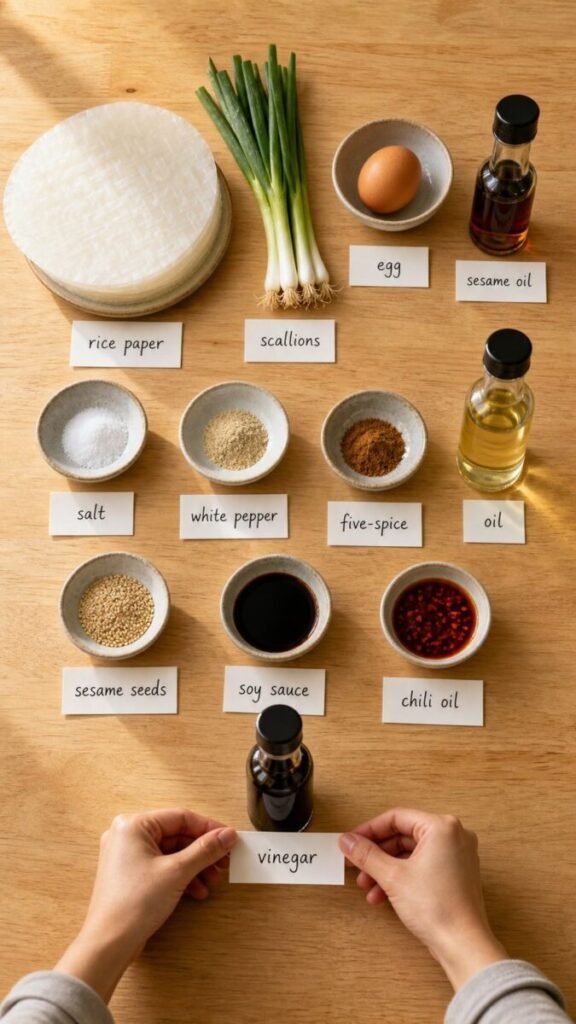
Ingredients (With Labels)
🥞 The Pancake Stack
- Rice paper rounds: 15 sheets (8½ to 9 inches) — three stacks of five; thicker brands tear less
- Scallions: 6 to 8, thinly sliced, whites and greens kept in one pile
- Toasted sesame oil: 2 teaspoons, for the scallions
- Salt: ¾ teaspoon, divided across the scallion layers
- White pepper: ¼ teaspoon
- Five-spice powder: ¼ teaspoon, optional but lovely
🍳 The Crisp Coat
- Egg: 1 large, beaten with a pinch of salt
- Neutral oil: 3 tablespoons for frying — avocado, canola, grapeseed
- Toasted sesame seeds: 1 tablespoon, for the tops
🥣 The Dipping Sauce
- Soy sauce: 3 tablespoons — tamari for gluten-free
- Black vinegar or rice vinegar: 1 tablespoon
- Chili oil: 1 to 2 teaspoons, with its crunchy bits
- Sugar: ½ teaspoon
- Extra scallion rings: a small handful, stirred in
Step by Step How to Make
- Step 1 — Season the scallions. Stir the sliced scallions with the sesame oil, the salt, white pepper, and five-spice in a small bowl until every ring glistens. Give them a minute to sit while you set up — the salt pulls a little moisture and the seasoning clings instead of falling as dry dust. Stir the dipping sauce together in a second small bowl and set it at the table; from here on, your hands are pancake hands.
- Step 2 — Build the first stack. Fill the shallow dish with cold water. Dip one rice paper round for a slow count of two — a dip, not a soak — shake off the excess, and lay it flat on the dry plate. Sprinkle a generous tablespoon of the scallion mix over it, leaving a border at the edge. Dip the next sheet, lay it on top, press gently to fuse, sprinkle again. Repeat — sheet, scallions, sheet, scallions — until the fifth sheet goes on top clean. You should see scallions pressed between translucent layers like a green-streaked window. Press the whole stack firmly with your palms for five seconds to marry the layers.
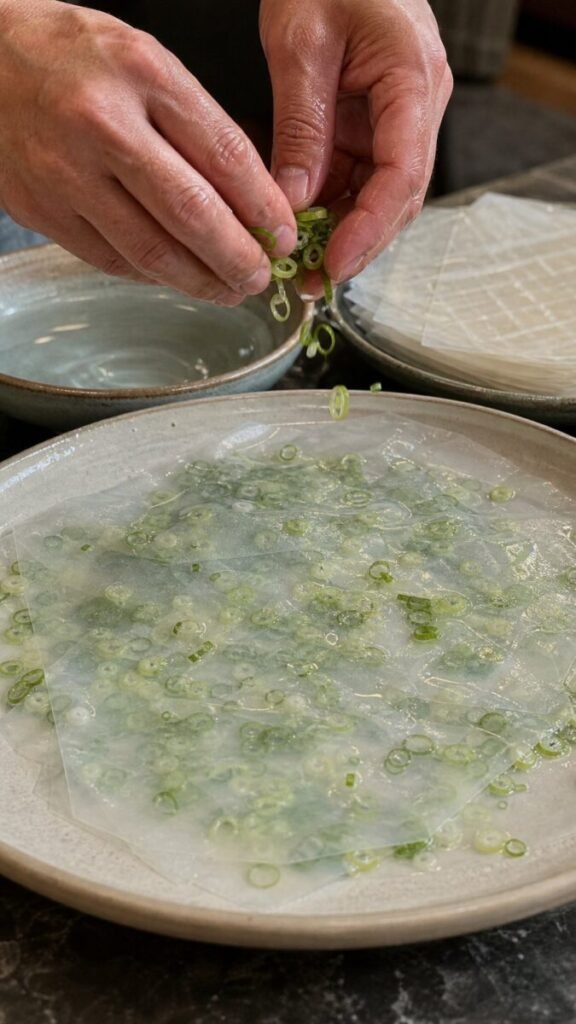
- Step 3 — Egg wash and heat. Brush the top of the stack with a thin layer of beaten egg. Heat the skillet over medium-high with a tablespoon of oil until it shimmers and thins out across the pan. Now the one move that requires nerve: peel the stack off the plate from one edge, flip it egg-side down into the hot oil, and quickly brush the now-upward side with egg. Thirty seconds of courage, and the pan takes over.
- Step 4 — Fry to blisters. Press the pancake gently with the spatula as it cooks — a light, sliding press keeps the layers flat and the blistering even. Fry 2 to 3 minutes until the underside is deep gold and puffed in spots, then flip and do the same on the second side. The edges will turn lacy and you’ll hear a faint crackle — that sound is the entire reason this recipe exists. Slide the finished pancake onto the cutting board and sprinkle sesame seeds over the hot surface so they stick.
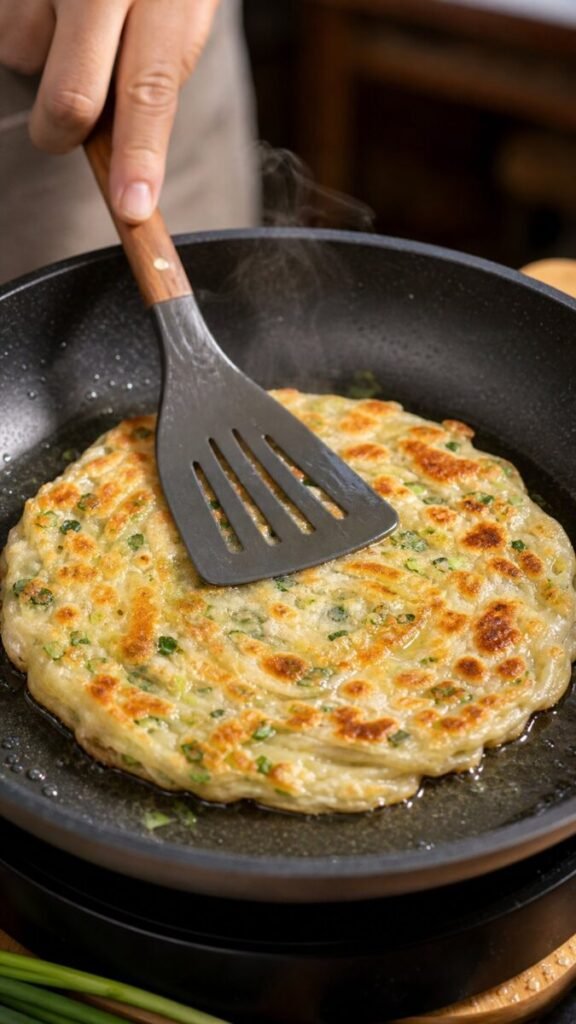
- Step 5 — Repeat the stacks. Build and fry the second and third pancakes the same way, adding a fresh tablespoon of oil to the pan between each. The stacks take about three minutes each now that you know the move, and the frying runs on autopilot. If the first pancake has to wait, tent it loosely with foil — never cover tightly, because trapped steam is the enemy of everything you just built.
- Step 6 — Wedges and the sauce. Cut each pancake into six wedges while hot — you’ll hear the crack — pile them sesame-side up, and serve with the dipping sauce and extra scallion rings. The correct technique is a wedge dunked for exactly as long as your patience allows, eaten immediately, followed by a small pause of appreciation and then no further pauses. The crunch clock is running from the moment the knife goes through.
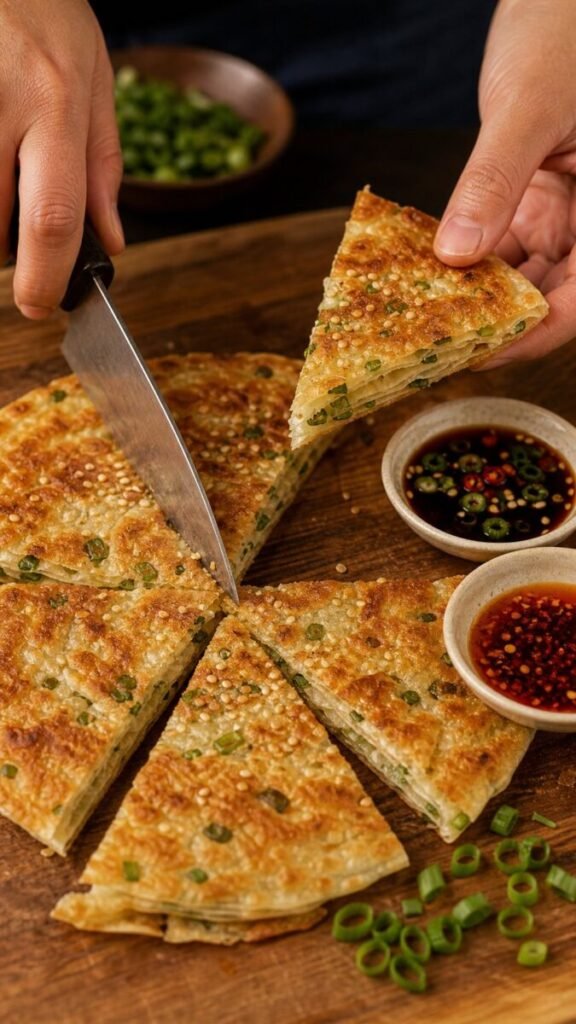
Rice paper is the hardest worker in my snack drawer — these pancakes share the shift with our Crispy Rice Paper Crab Rangoons, and between the two of them, one package covers half the snack table.
Anna’s Kitchen Notes
Cold water, every time. Warm water softens rice paper too fast — the sheet goes from brittle to tearing in the same second, and you find out only when it rips in your hands. Cold water gives you a window of control: two seconds of dip, a tacky-but-handleable sheet, time to position it. This is the single biggest difference between a tidy stacking session and a confetti situation.
Brand matters more than usual. The ultra-thin cheap rice papers are fine for summer rolls and treacherous here — they tear during stacking and fuse unevenly. A mid-weight brand (Three Ladies and its siblings) takes the dip, the press, and the peel without drama. Buy the slightly better bag for this one; it costs a dollar more and removes the only genuinely frustrating failure mode.
Stack on bone-dry plates. Any puddle under the first sheet turns the bottom of your pancake into glue that bonds to the plate forever. Dry plate, dip and shake each sheet, and if water pools at the edges as you stack, blot with the corner of a towel. When it’s time to move the stack, peel from one edge with confidence — a hesitant peel stretches the top layer, a quick one releases it whole.
The egg wash is thin on purpose. You’re painting, not battering. A thick egg layer turns into scrambled-egg sheets at the edges and softens the crisp. Brush, flip, brush — if you can see egg pooling, your layer is too thick and the pastry brush should apologize.
The stack can wait; the fry can’t. You can build all three stacks up to an hour ahead, separated by parchment on a tray, loosely covered with a barely damp towel so the outer sheets stay flexible. Then fry all three back-to-back as people arrive, because these are ten-minute-crisp food and the ten minutes belong to the eaters, not the counter. Hosting math: stacks before the doorbell, frying after it.
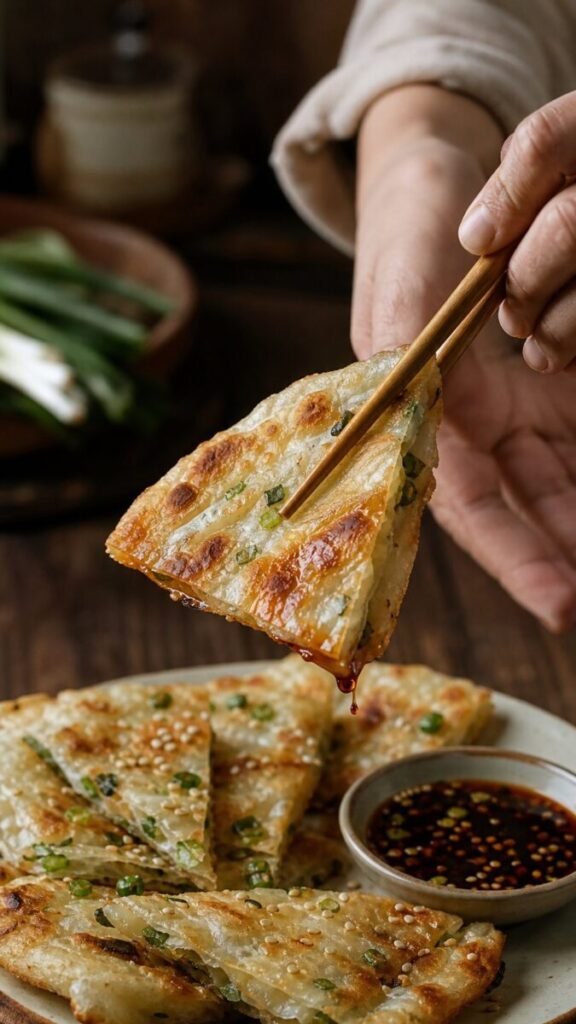
The Dipping Ritual
The soy-chili sauce in the recipe is the house default, but the pancake is a dipping vehicle first — offer options. Straight Thai Peanut Sauce makes the snack considerably more filling, and a spoonful of chili crisp straight from the jar is the zero-effort upgrade that regulars at my table reach for before the soy sauce even lands.
Round the snack into a spread: Easy Gochujang Mushrooms bring sweet-spicy bite, Garlic Bok Choy Stir-Fry keeps a green on the table, and a bowl of our Potsticker Noodle Bowl turns the whole evening into a proper noodle-soup-and-pancake night. For the sweet finish that stays in the same sesame neighborhood, Black Sesame Glutinous Rice Cakes close the meal like a quiet little dessert ceremony.
Pancake Variations
Sesame-shichimi dust. Skip the five-spice in the scallion mix and instead dust each scallion layer with a pinch of shichimi togarashi. Warmer, citrusy heat, and the pancake comes out tasting like a Tokyo convenience store’s best shelf.
Cheese pull version. A small handful of shredded mozzarella scattered with the scallions in the middle layers — the cheese melts into the strata and pulls with every wedge. Not traditional, not apologetic, first to vanish at every gathering I’ve served it at.
Kimchi pancakes. Finely chopped, well-drained kimchi in place of half the scallions, with a drop of its juice in the dipping sauce. Sour, spicy, loud — this is the version my spice-forward friends request by name.
The air fryer route. Stack and egg-wash as written, brush both sides lightly with oil instead of pan-frying, and air fry at 380°F for 8 to 10 minutes, flipping once. Slightly less blistered, considerably less oil, still crackly. The oven, honestly, can’t be trusted with these — the slow heat dries them into armor.
Breakfast pancakes. A layer of crisp bacon bits with the scallions, dipped in maple syrup instead of soy sauce. My family calls this fusion and calls it delicious, and the traditionalists have stopped filing objections.
Wedge Math
| Nutrient | Per Serving (3 of 18 wedges, with sauce) |
|---|---|
| Calories | 180 kcal |
| Protein | 4 g |
| Carbohydrates | 19 g |
| Fats | 9 g |
Estimates for the pancakes as written, sauce included. Rice paper is a light base — the sheets are mostly air and rice starch — so the calories come mostly from the frying oil and the egg wash, and the numbers stay firmly in snack territory. Rice paper has no fat and almost no protein of its own, which is the honest trade for its crisp; the sesame oil and seeds carry the good fats. All estimates as always, and the dipping sauce is a self-reported activity: pour responsibly.
Keeping the Crisp
These pancakes are at their peak for the first ten minutes and honestly good for about an hour. Leftover wedges keep a day in the fridge, uncovered or loosely wrapped — and they re-crisp surprisingly well: 5 minutes in a 400°F oven or 3 minutes in the air fryer at 380°F brings back most of the crackle. The microwave is the one thing I’ll forbid; it turns crisp rice paper into a sad, chewy plate in thirty seconds, and the texture never comes home.
Uncooked stacks, as covered in my notes, hold about an hour under a barely damp towel — that’s the make-ahead window. Beyond that, the outer sheets dry and crack when you peel them, so build-to-fry is the rhythm. Freezing isn’t the move here: thawed rice paper stacks go cloudy and stubborn, and the crisp never fully returns. This is a now-food, which on snack night is exactly what the table wants anyway.
The dipping sauce, on the other hand, keeps a week in the fridge in a sealed jar and improves as the scallions steep in it — I often mix a double batch on purpose and find myself spooning it over eggs and rice all week. Every part of this recipe wants to be eaten fresh except the one part that gets better with age. Plan around that one.
Where It Goes Wrong
Sheets tore during stacking. Warm water, too long a dip, or featherweight rice paper. Cold water, two-second dips, and a mid-weight brand — with those three fixed, tearing basically stops happening. A small tear mid-stack is cosmetic: lay the next sheet over it and carry on.
Pancake welded to the plate. A damp plate or a puddle under the first sheet. Dry the plate completely, shake each sheet hard before laying it, and blot edge puddles. Peel from one edge in one committed motion — hesitation stretches and tears.
Pale, blond pancakes. The egg wash got skipped or skimped — rice paper alone won’t brown. Paint both sides, thin but complete, and the gold arrives on schedule. A pale pancake still tastes fine and looks like it gave up, which is worse.
Chewy instead of crackly. The pan wasn’t hot enough, the oil was stingy, or the stack went in waterlogged. The oil should shimmer and the pancake should sizzle on contact — a quiet pan means a chewy pancake. One real tablespoon of oil per pancake is the recipe’s one indulgence and it is not negotiable.
Steam-soggy middles. The stack was soaked rather than dipped, or the finished pancakes were covered tightly. Dip, don’t soak; tent with foil, never seal. Rice paper holds onto excess water and releases it as steam in the pan, and steam is crisp’s natural enemy.
Scallions spilled out the edges. Overloaded layers. A generous tablespoon per layer with a border at the rim is the load limit — the border sheets fuse to each other and seal the filling in. Every scallion you try to smuggle past the border ends up loose in the frying oil.
Scallion Questions
Why rice paper instead of regular dough?
Speed and access. A traditional scallion pancake needs a laminated dough — rolled, coiled, rested, re-rolled — which is a lovely hour-long project and a terrible Tuesday. Rice paper arrives as ready-made starch sheets: dip, stack, press, fry, and you’re eating crackly, layered pancakes in thirty minutes, gluten-free as a bonus. It’s a stunt that happens to be a genuinely good snack, which is the best kind of stunt.
Are these gluten-free?
The pancakes themselves are — rice paper is made from rice starch and nothing else. The two things to check: your rice paper label for a certified gluten-free mark (some brands share facilities with wheat products), and your soy sauce, which usually contains wheat — swap in tamari or a certified GF soy sauce. Make those two checks and the whole plate, sauce included, is safely gluten-free.
What brand of rice paper should I buy?
Any mid-weight round — thick enough to handle, thin enough to fry crisp. Three Ladies is the reliable standard, and most Asian grocery brands in the same weight class perform the same. What to avoid is the paper-thin cheapest option, which is fine for fresh rolls and treacherous for stacking. If you can see through the stack and it still peels in one piece, you bought correctly.
Can I make them in the air fryer?
Yes — brush the stacked, egg-washed pancake with oil on both sides and air fry at 380°F for 8 to 10 minutes, flipping once. You trade a little of the blister and lacy edge for a lighter finish, and the crackle survives. Start checking at 7 minutes; rice paper goes from golden to rigid quickly at the end.
Can I stack them ahead for a party?
Up to about an hour, separated by parchment, loosely covered with a barely damp towel so the outer sheets stay pliable. Fry in the last ten minutes before eating — these are crisp-on-arrival food, and the frying is the easy part worth doing last. The sauce, meanwhile, can be made days ahead and improves for it.
Why did my pancake taste gummy in the middle?
Water. Either the sheets soaked too long or the stack sat wet before frying, and the extra moisture gelatinized into gumminess instead of frying off into crisp. Two-second dips, a firm shake, a dry plate, and a hot pan — the four habits that keep every layer crisp to the middle.
Can I use other fillings?
Anything small, dry-ish, and flavorful: chopped kimchi (well drained), crumbled cooked bacon, shredded cheese, sesame-shichimi dust, tiny shrimp. The rules are the same as for the scallions — a thin, even layer with a border at the edge, and nothing wet enough to soak the sheets. Wet fillings steam the layers apart from the inside.
Scallion layers · Golden sesame · Chili dipping sauce
Crispy Rice Paper Scallion Pancakes
Rice paper layered with sesame-seasoned scallions, lightly brushed with egg, and pan-fried until golden at the edges. A no-dough shortcut with crisp outer layers, a chewy center, and a tangy chili dipping sauce.
As an Amazon Associate I earn from qualifying purchases. Ingredient and equipment links below are affiliate links.
Equipment
- Wide shallow dish for cold water
- Smooth plastic cutting board or large flat plate for stacking
- Nonstick skillet with a cooking surface wide enough for the rice paper
- Pastry brush
- Wide, thin-edged spatula
- Small mixing bowls
- Pizza cutter or sharp knife
- Wire rack for briefly holding cooked pancakes
Ingredients
The layered pancakes
- 15 round rice paper sheets, 8½–9 inches; 5 sheets per pancake
- 6–8 scallions, thinly sliced, whites and greens
- 2 teaspoons toasted sesame oil
- ¾ teaspoon salt
- ¼ teaspoon white pepper
- ¼ teaspoon five-spice powder (optional)
The golden coating
- 1 large egg, beaten
- 1 pinch salt, for the egg
- 3 tablespoons neutral cooking oil, divided: 1 tablespoon per pancake
- 1 tablespoon toasted sesame seeds
The dipping sauce
- 3 tablespoons soy sauce or certified gluten-free tamari
- 1 tablespoon black vinegar or rice vinegar
- 1–2 teaspoons chili oil with chili bits, to taste
- ½ teaspoon sugar
- 1 small handful extra scallion rings
Gluten-free only with label checks: Rice paper often contains rice and tapioca starch, not just rice. Check the wrappers, tamari, spices, chili oil, and vinegar. Many black vinegars contain wheat or barley; use labeled gluten-free rice vinegar when needed. This recipe contains egg and sesame.
Texture expectations: Five damp rice paper layers can stay chewy in the center even when the outside is crisp. This is a quick rice-paper snack inspired by scallion pancakes, not an identical substitute for laminated wheat dough.
Instructions
-
Mix the sauce and season the scallions
Stir together the soy sauce or tamari, vinegar, chili oil, sugar, and extra scallion rings. Set aside. In another bowl, toss the sliced scallions with the sesame oil, ¾ teaspoon salt, white pepper, and optional five-spice. Divide the seasoned scallions into 3 portions. Beat the egg with its pinch of salt in a separate bowl.
-
Build one five-sheet pancake
Fill a shallow dish with cold water. Briefly dip one rice paper sheet, about 1–2 seconds, then let excess water drip away. Lay it on a clean, smooth stacking surface without puddles underneath. The sheet will continue softening after dipping. Scatter one-quarter of a scallion portion over it, leaving a narrow border. Repeat with 3 more dipped sheets and scallion layers, then finish with a fifth sheet without scallions on top. Press gently to join the layers, blotting any pooled water around the edges.
-
Brush with egg and transfer carefully
Brush the top lightly with beaten egg, without puddles. Heat 1 tablespoon neutral oil in a suitable nonstick skillet over medium to medium-high heat, following the pan manufacturer’s heat limits. The oil should shimmer, not smoke. Loosen the pancake with a wide spatula, support it as you lift, and lower it carefully into the pan egg-side down, away from your body. Do not drop a wet stack into hot oil. Brush the upper side thinly with egg.
-
Pan-fry both sides
Cook for about 2–3 minutes per side, turning with the spatula, until the outside is golden and blistered and the egg coating is fully set on both sides. Press lightly where needed to encourage even pan contact. Reduce the heat if the egg browns before the wrapper has time to crisp. Transfer to a clean board for immediate cutting or to a wire rack for a brief hold, then scatter with sesame seeds.
-
Repeat without stacking the cooked pancakes
Build and fry the remaining 2 pancakes in the same way, using 5 sheets, one scallion portion, and 1 tablespoon oil for each. Divide the remaining egg wash and sesame seeds between them. Keep cooked pancakes in a single layer on the rack rather than stacking or covering tightly, which traps steam. Discard any leftover raw egg wash.
-
Cut into wedges and dip
Cut each pancake into 6 wedges with a sharp knife or pizza cutter on a clean cutting board. Serve promptly with the prepared dipping sauce. For the crispest results, serve each pancake as it finishes rather than waiting for all three.
Timing and handling: Three pancakes cooked for 2–3 minutes per side require 12–18 minutes of frying, plus stacking and pan heating. Allow about 30–35 minutes. Rice paper brands hydrate differently, so use a brief dip as a starting point rather than soaking until completely limp.