

DIY Greek Yogurt Ice Cream — Easy, Healthy No-Churn Homemade
This DIY Greek Yogurt Ice Cream is the no-churn homemade ice cream that genuinely earns the “healthy” label — creamy, scoopable, and deeply satisfying as a frozen dessert, made from full-fat Greek yogurt, a small amount of whipped cream for texture, and whatever flavouring you choose, with no ice cream maker required and no ingredients beyond what is likely already in the kitchen.
Homemade frozen yogurt and Greek yogurt ice cream occupy slightly different territory — traditional froyo is typically low-fat and quite tart, while Greek yogurt ice cream made with full-fat yogurt and enough sweetener is richer, creamier, and genuinely closer to ice cream than most grocery-store frozen yogurt options. The protein content from the Greek yogurt (approximately 12 to 15 grams per serving) makes this the most protein-dense frozen dessert in this collection, and the lower fat content compared to traditional ice cream makes it the dessert that fits comfortably into a week of reasonable eating.
The base recipe produces a vanilla Greek yogurt ice cream that is the foundation for six specific flavour directions — strawberry, chocolate, mango, blueberry lemon, honey walnut, and peach — all made from the same method with specific additions for each flavour.
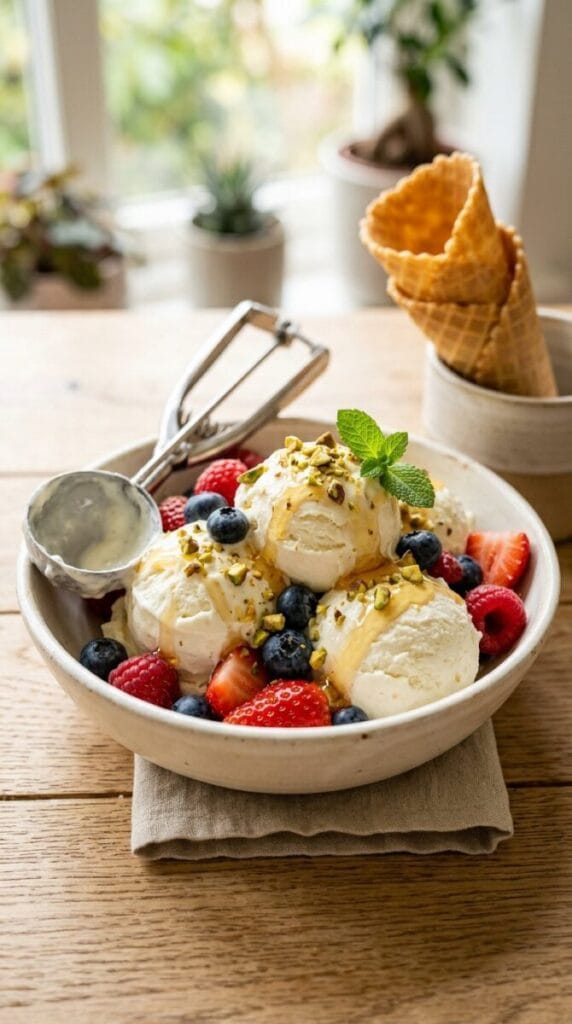
Why No-Churn Greek Yogurt Ice Cream Works Without a Machine
Traditional ice cream requires an ice cream maker because the churning process incorporates air into the freezing mixture and prevents large ice crystals from forming — the continuous movement keeps the ice crystals small and produces a smooth, creamy texture. Without churning, a mixture of cream and milk freezes into a solid block of large ice crystals that is icy and hard rather than smooth and scoopable.
Greek yogurt changes this dynamic — its protein content stabilises the water in the mixture as it freezes, and the lactic acid in the yogurt disrupts ice crystal formation at the molecular level, producing smaller ice crystals than an equivalent dairy mixture without the yogurt component. Folding in whipped heavy cream before freezing adds the air incorporation that the churning step would normally provide, and together these two elements produce a frozen dessert with a smooth, creamy texture that is genuinely scoopable directly from the freezer rather than requiring thawing before serving.
- Prep Time: 15 minutes
- Freeze Time: 6 hours minimum, overnight preferred
- Total Time: 15 minutes active, 6 to 8 hours total
- Yield: approximately 1 quart, serves 6 to 8
The Base Recipe — Vanilla Greek Yogurt Ice Cream
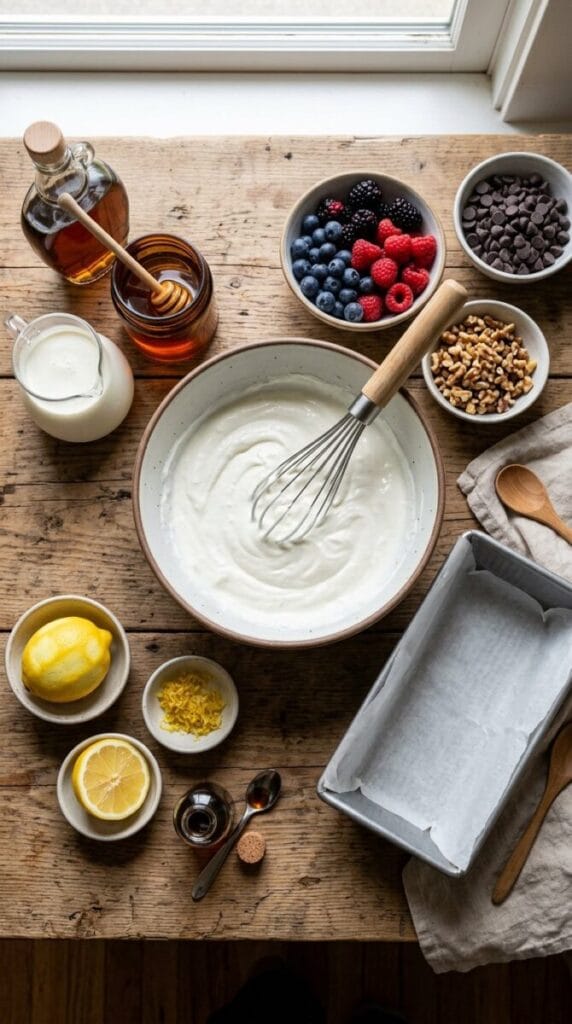
Ingredients:
- Full-fat plain Greek yogurt, cold: 2 cups (480g) — the fat content is structural for the creamy texture; low-fat yogurt produces an icier, less smooth result
- Heavy whipping cream, cold: 1 cup (240ml)
- Honey or maple syrup: 1/3 cup (110g) — liquid sweeteners incorporate more evenly into cold yogurt than granulated sugar; granulated sugar doesn’t fully dissolve in cold dairy and produces a slightly gritty texture
- Pure vanilla extract: 1 1/2 teaspoons
- Vanilla bean paste or seeds from 1 vanilla bean: 1/2 teaspoon (optional — adds visible vanilla specks and intensifies the vanilla flavour)
- Fine sea salt: 1/4 teaspoon — amplifies sweetness and vanilla flavour significantly, even in an ice cream context
Method:
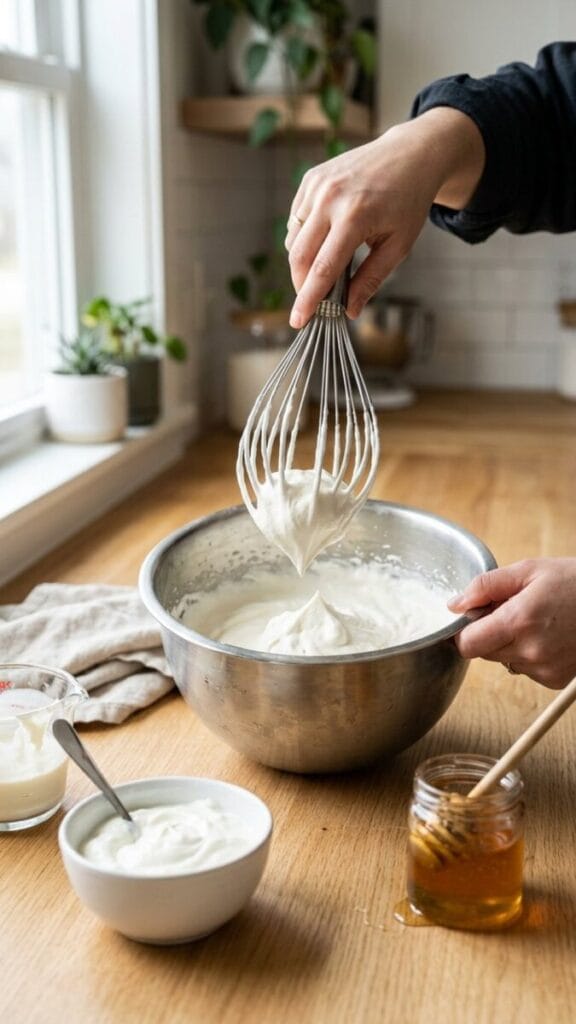
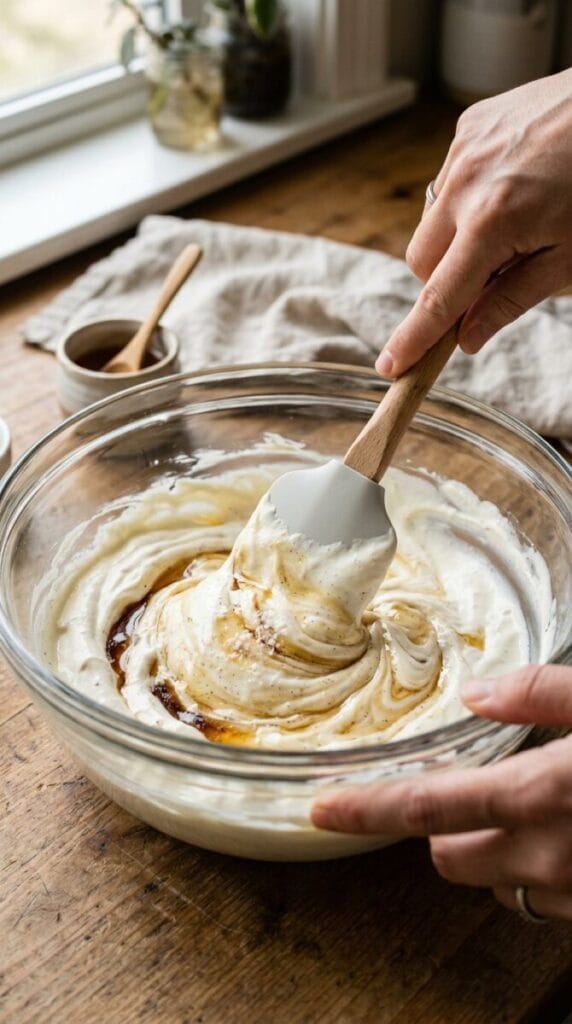
- Whisk the cold Greek yogurt, honey, vanilla extract, vanilla paste if using, and salt together in a large bowl until completely smooth and the honey is fully incorporated — whisk for a full 60 seconds to ensure the honey doesn’t settle at the bottom.
- In a separate cold bowl with cold beaters, whip the cold heavy cream to stiff peaks — the cream should hold a firm peak when the beater is lifted and not slump. Cold equipment speeds this up significantly; refrigerate the bowl and beaters for 10 minutes before whipping if the kitchen is warm.
- Add one large spoonful of the whipped cream to the yogurt mixture and stir vigorously to lighten it — this tempering step makes the subsequent folding easier and prevents the cream from deflating.
- Fold the remaining whipped cream into the yogurt mixture in two additions, using large sweeping strokes from the bottom of the bowl upward, stopping the moment the cream is fully incorporated with no white streaks remaining. The finished mixture should look voluminous and slightly airy rather than dense.
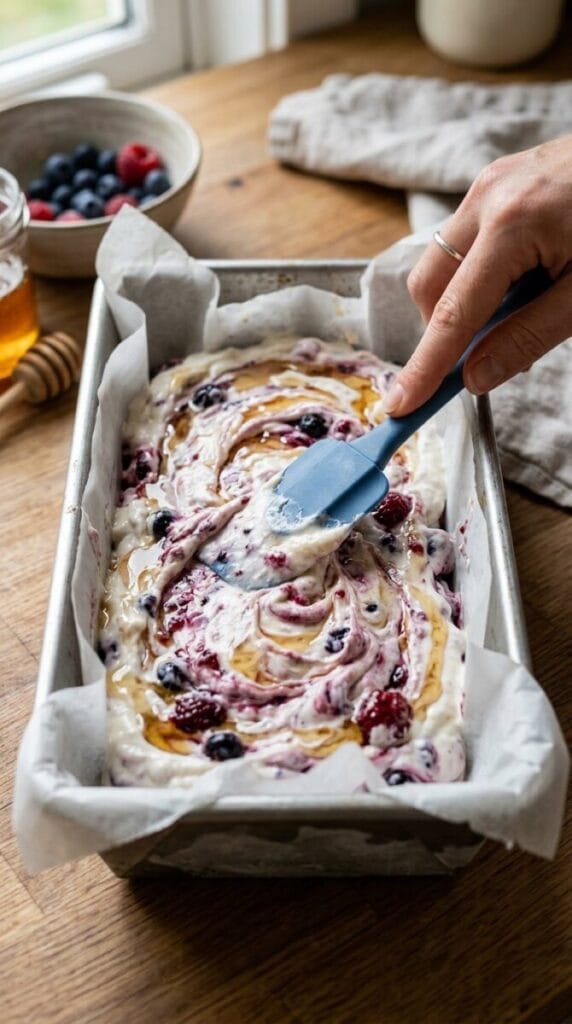
- Pour into a freezer-safe container — a loaf pan, a rectangular storage container, or any flat-bottomed container with a lid works well. Smooth the surface and press plastic wrap directly against the surface to prevent ice crystals from forming on the exposed top layer.
- Freeze for at least 6 hours, overnight preferred — the longer freeze produces a more firmly set ice cream that holds a scoop shape cleanly. At 6 hours the texture is still slightly soft and mousse-like; at 8 to 12 hours it is properly firm and scoopable.
- Remove from the freezer 5 to 8 minutes before scooping — Greek yogurt ice cream is slightly firmer than commercial ice cream directly from the freezer and benefits from a brief counter rest before serving.
This Greek yogurt ice cream served alongside our Peach Crisp or our Peach Crumble is the complete summer dessert combination — the cold, slightly tangy frozen yogurt against the hot, jammy peach filling is one of the most satisfying contrasts in warm-weather eating, and the Greek yogurt’s tang specifically complements the sweetness of the peach better than plain vanilla ice cream does.
The Whipped Cream and Protein Science Behind the Texture
The whipped cream in this recipe serves the same purpose that churning serves in a machine-made ice cream — it introduces air into the mixture before freezing. The air cells remain distributed through the frozen product and prevent the texture from compressing into a dense, hard block. Without the whipped cream, the yogurt mixture freezes solid and requires significant thawing before it can be scooped.
The yogurt’s role in producing small ice crystals is specifically why Greek yogurt makes a better no-churn ice cream base than regular yogurt or milk — Greek yogurt’s high protein concentration (casein and whey proteins) form a loose network within the freezing liquid that physically obstructs ice crystal growth. The lactic acid also lowers the freezing point of the mixture slightly, meaning the Greek yogurt mixture never completely solidifies into the monolithic ice block that an equivalent amount of water-based liquid would produce in the same freezing time. According to Serious Eats, casein proteins in dairy products interact with ice crystals during freezing and coat the crystal surfaces, preventing them from growing larger by fusion — smaller crystals produce the smooth, creamy mouthfeel associated with high-quality ice cream, while larger crystals produce the icy, gritty texture of low-quality or improperly stored frozen desserts.
Six Greek Yogurt Ice Cream Flavours From the Same Base
Strawberry Greek Yogurt Ice Cream — blend 1 cup of fresh or frozen strawberries with 1 tablespoon of honey until smooth, then stir the purée directly into the yogurt mixture before folding in the whipped cream. For visible strawberry pieces alongside the purée, fold in 1/2 cup of fresh diced strawberries at the end. The strawberry version has a beautiful pale pink colour and a fresh, bright fruit flavour that is more intensely strawberry than any commercial strawberry frozen yogurt.
Chocolate Greek Yogurt Ice Cream — whisk 3 tablespoons of Dutch-process cocoa powder and 1 tablespoon of extra honey into the yogurt base before folding in the cream. For a richer chocolate version, melt 2 oz of dark chocolate (70%), cool to room temperature, and stir into the yogurt mixture before the cream goes in. Fold in 1/3 cup of mini chocolate chips at the end. The chocolate version is the closest to a conventional chocolate ice cream in richness and depth.
Mango Greek Yogurt Ice Cream — blend 1 1/2 cups of fresh or frozen mango until completely smooth and stir the mango purée into the yogurt base in place of half the Greek yogurt (use 1 cup of yogurt + 3/4 cup of mango purée + remaining ingredients). The mango replaces part of the yogurt rather than being added to it — this produces a more intensely mango-flavoured ice cream than simply adding purée to the full yogurt quantity. The colour is a brilliant deep yellow and the flavour is tropical and sweet.
Blueberry Lemon Greek Yogurt Ice Cream — simmer 1 cup of fresh or frozen blueberries with 2 tablespoons of honey and 1 tablespoon of lemon juice for 5 minutes until broken down and slightly thickened. Cool completely and swirl through the yogurt mixture after the cream has been folded in — do not fully mix in, allow the blueberry to remain as visible swirls rather than fully incorporated. Add 1 teaspoon of lemon zest to the yogurt base. The blueberry swirl and lemon zest combination produces the most visually beautiful variation with deep purple ribbons through pale lemon cream.
Honey Walnut Greek Yogurt Ice Cream — increase the honey to 1/2 cup in the base recipe and fold in 1/2 cup of roughly chopped toasted walnuts at the very end. The walnut pieces freeze well and stay crunchy, providing textural contrast against the creamy frozen yogurt. Drizzle extra honey over each scoop at serving. This is the most straightforwardly Greek variation — the flavour combination of yogurt, honey, and walnuts is the dessert that has been eaten in Greece for centuries in its fresh form.
Peach Greek Yogurt Ice Cream — blend 1 cup of peeled, diced fresh or frozen peaches with 1 tablespoon of honey until mostly smooth with some small pieces remaining. Cool completely and stir into the yogurt base before folding in the cream. Add 1/4 teaspoon of ground cinnamon and 1/4 teaspoon of ground ginger to the yogurt base. The peach version pairs perfectly with both the Peach Crisp and Peach Crumble already in this collection — the same fruit, different temperatures, same table.
Nutritional Information
| Nutrient | Amount Per Serving (base vanilla, 1/2 cup / ~115g, based on 8 servings) |
|---|---|
| Calories | 185 kcal |
| Protein | 7 g |
| Carbohydrates | 17 g |
| Fats | 10 g |
These values are estimates for the base vanilla recipe divided by 8 half-cup servings. For comparison, a half-cup serving of commercial vanilla ice cream is typically 135 to 145 calories with 2 to 3 grams of protein — the Greek yogurt version is slightly higher in calories per half cup (due to the density of full-fat yogurt and cream) but significantly higher in protein. The chocolate variation adds approximately 20 calories per serving from the cocoa powder. The mango variation reduces the calorie count to approximately 165 per serving by replacing half the yogurt with lower-fat mango purée.
Storing and Keeping This at Its Best
Store in the freezer for up to 3 weeks — Greek yogurt ice cream is best within the first two weeks, after which larger ice crystals begin forming as the protein network stabilises and the ice cream develops a slightly icier texture than its first-week best. Press plastic wrap directly against the surface of the ice cream before sealing the container to prevent freezer burn and the formation of ice crystals on the exposed surface.
If the ice cream is stored for more than a week and develops any icy texture, allow it to thaw in the fridge for 20 minutes and then re-blend briefly — this breaks down the larger crystals that have formed and restores some of the original creamy texture before refreezing. Not a perfect fix, but genuinely effective.
Remove from the freezer 5 to 8 minutes before serving every time — Greek yogurt ice cream is slightly harder than commercial ice cream due to its lower fat content and benefits from this brief counter rest. Using a warm, dry scoop (run under hot water and dried before each scoop) also produces cleaner, rounder scoops than a cold scoop dragged through firm ice cream.
Where This Can Go Wrong
Using low-fat or non-fat Greek yogurt produces an icy, less creamy result — the fat content in full-fat Greek yogurt is part of the structure that produces smooth texture, and low-fat yogurt has more free water that freezes into larger crystals. Full-fat (5 percent fat or higher) Greek yogurt is the minimum fat content that produces a genuinely creamy result.
Adding the honey to the yogurt without whisking thoroughly produces a base where the honey sinks to the bottom of the mixture and doesn’t distribute evenly — honey in cold dairy is more viscous than honey at room temperature and requires real whisking effort to incorporate fully. If the honey still looks streaky after 30 seconds of whisking, gently warm it for 10 seconds in the microwave until it is slightly looser and easier to incorporate.
Not folding the whipped cream gently enough deflates the air that was incorporated during whipping and produces a denser, less creamy frozen result than the recipe should provide — the whipped cream’s air is the element that prevents the mixture from freezing into a dense block, and vigorous stirring rather than gentle folding collapses those air cells before they can do their work. Fold gently, stop at the first sign of full incorporation, and trust that the slight unevenness still visible will resolve itself as the mixture settles before freezing.
DIY Greek Yogurt Ice Cream
A creamy no-churn Greek yogurt ice cream made with full-fat Greek yogurt, whipped cream, honey, vanilla, and sea salt. Make the vanilla base or turn it into strawberry, chocolate, mango, blueberry lemon, honey walnut, or peach.
Why This Recipe Works
This no-churn Greek yogurt ice cream works because full-fat Greek yogurt provides protein, tang, and body, while whipped cream adds air before freezing. Together they create a frozen dessert that is creamy and scoopable without an ice cream machine.
Liquid sweetener is used instead of granulated sugar because honey or maple syrup incorporates smoothly into cold yogurt and helps avoid a gritty texture.
Ingredients
Instructions
Whisk cold Greek yogurt, honey or maple syrup, vanilla extract, vanilla bean paste if using, and salt in a large bowl for a full 60 seconds, until completely smooth and evenly sweetened.
In a separate cold bowl with cold beaters, whip the heavy cream to stiff peaks. The cream should hold a firm peak when the beater is lifted.
Add one large spoonful of whipped cream to the yogurt mixture and stir it in more vigorously. This loosens the base and makes folding easier.
Fold the remaining whipped cream into the yogurt mixture in two additions, using broad strokes from the bottom of the bowl upward. Stop once no white streaks remain.
Pour the mixture into a freezer-safe container, loaf pan, or flat-bottomed storage container. Smooth the top.
Press plastic wrap directly against the surface of the ice cream to reduce surface ice crystals, then cover with a lid or foil.
Freeze for at least 6 hours, preferably overnight. At 6 hours it will be softer and mousse-like; after 8 to 12 hours it will be firmer and more scoopable.
Let sit at room temperature for 5 to 8 minutes before scooping. Use a warm, dry scoop for cleaner, rounder scoops.
Key Technique Notes
Full-fat yogurt gives the creamiest texture. Low-fat or non-fat yogurt contains more free water and freezes icier.
Honey can sink in cold dairy. Whisk for a full minute so the base is evenly sweetened.
The whipped cream replaces the air incorporation of an ice cream machine, keeping the frozen texture lighter.
Direct surface contact helps prevent freezer burn and icy crystals from forming on top.
Six Flavor Variations
Blend 1 cup strawberries with 1 tablespoon honey and stir into the yogurt base before folding in cream. Fold in ½ cup diced strawberries at the end if desired.
Whisk 3 tablespoons Dutch-process cocoa powder and 1 extra tablespoon honey into the yogurt base. For richer chocolate, add 2 oz melted and cooled dark chocolate.
Use 1 cup Greek yogurt plus ¾ cup mango purée instead of the full 2 cups yogurt. This gives a stronger mango flavor and bright tropical color.
Simmer 1 cup blueberries with 2 tablespoons honey and 1 tablespoon lemon juice for 5 minutes. Cool, then swirl through the finished base. Add 1 teaspoon lemon zest to the yogurt.
Increase honey to ½ cup and fold in ½ cup chopped toasted walnuts at the end. Drizzle extra honey over scoops when serving.
Blend 1 cup peeled peaches with 1 tablespoon honey until mostly smooth. Stir into the yogurt base with ¼ teaspoon cinnamon and ¼ teaspoon ginger.
Helpful Pairing Note
Nutrition
| Nutrient | Amount Per Serving |
|---|---|
| Calories | 185 kcal |
| Protein | 7 g |
| Carbohydrates | 17 g |
| Fat | 10 g |
Values are estimates for the base vanilla recipe, based on 8 half-cup servings. Flavor additions may change the numbers slightly.
Store tightly covered in the freezer for up to 3 weeks. Best texture is within the first 2 weeks.
Press plastic wrap directly onto the surface before sealing the container.
Let sit at room temperature for 5 to 8 minutes. Greek yogurt ice cream is firmer than commercial ice cream.
Let thaw slightly in the fridge, briefly re-blend, then refreeze to improve texture.
Low-fat or non-fat Greek yogurt was likely used. Full-fat yogurt is essential for a creamy frozen texture.
The honey was not fully whisked into the cold yogurt. Whisk longer or warm the honey briefly before mixing.
The whipped cream may have been stirred too aggressively and deflated. Fold gently and stop once combined.
Let it rest for several minutes at room temperature and use a warm, dry scoop.



Some truly nice stuff on this site, I like it.