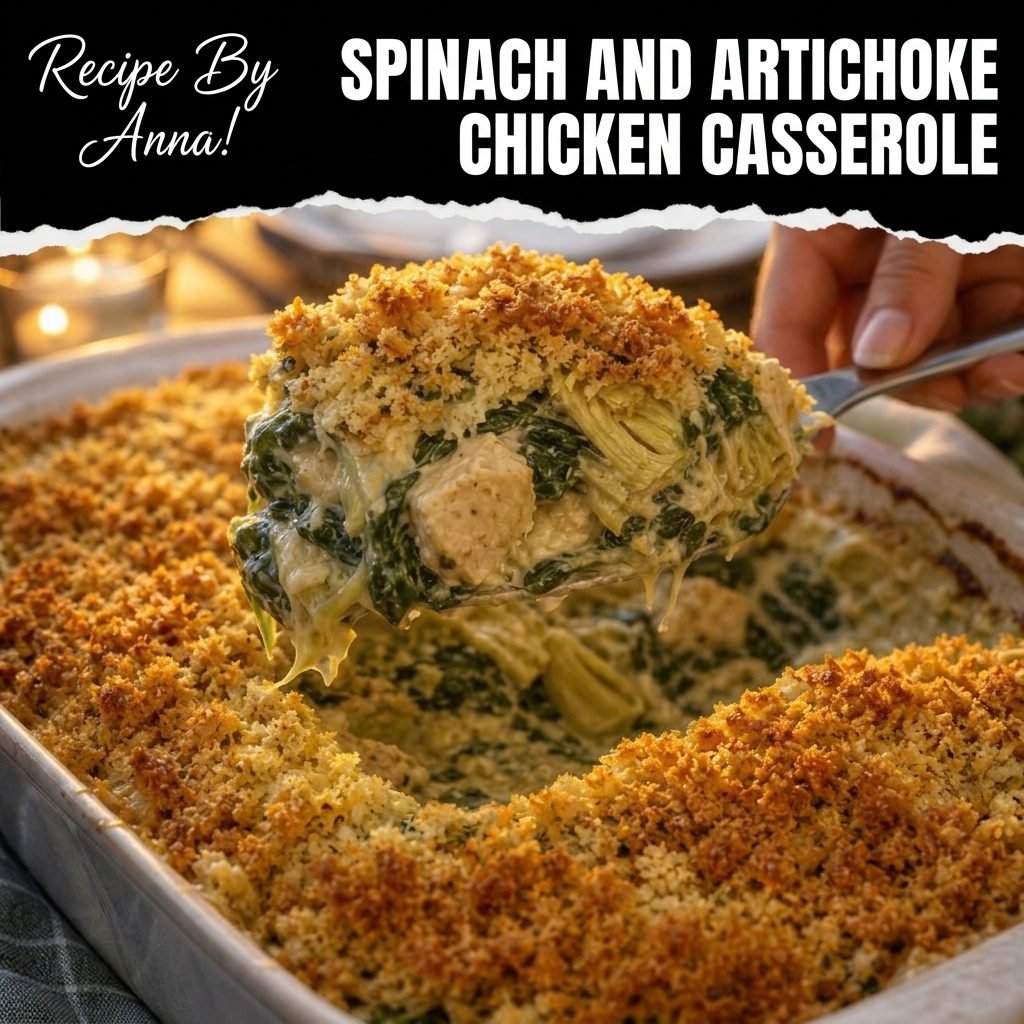
Spinach and Artichoke Chicken Casserole
Spinach-artichoke dip is the most beloved thing anyone has ever eaten standing up. It shows up at parties in a bowl with bread around it, and it disappears, and nobody ever asks it to do more. This casserole is what happens when that dip gets itself a real job: same flavors, promoted to the center of the weeknight plate. Chicken seared golden and folded through, spinach and artichokes in honest quantity, a cream cheese and yogurt sauce that bakes into something scoopable, and a panko-and-parmesan lid that toasts up in the oven’s last stretch so every serving has crunch without a single extra pan. One dish, forty-five minutes, and a dinner that tastes like the appetizer table finally paid rent.
The trick is that a casserole and a dip want opposite things from the same ingredients. A dip can be loose — you’re dragging bread through it, and nobody’s judging its posture. A casserole has to stand: it gets scooped, plated, and eaten with a fork, so the filling has to set enough to hold its shape on the plate instead of running out to the edges. That single difference drives every decision in this recipe. The spinach arrives wet and gets wrung until it isn’t. The artichokes arrive wearing brine and get patted dry. The sauce is built on cream cheese — which firms as it bakes and then sets as it rests — instead of the mayo-and-sour-cream blends that stay pourable forever. And the casserole rests ten minutes out of the oven before the first scoop, because those ten minutes are when a bubbling pan turns into a dinner that keeps its edges.
Shelf notes, since this site keeps them: there’s no artichoke anywhere in the building yet — this post opens that shelf — and the casserole family here (the quinoa bake, the seafood bake, the chilaquiles) are all different flavor countries. This one is its own country too: cream cheese, lemon, parmesan, and the two vegetables that have spent decades learning to work together in a bread bowl.
The Dip, Grown Up
Start with the water, because water is the whole engineering problem, and this filling has two of it arriving disguised as vegetables. Frozen spinach thaws into a dark, dense block that releases a startling amount of green liquid — wring it in a clean towel, hard, then re-wrap and wring again, and keep going until the towel stops darkening. That liquid is flavorless and heavy, and it’s the difference between a casserole and a casserole-shaped puddle. Jarred artichoke hearts are the second leak: they come swimming in brine, which is delicious and also pure water weight. Drain them, then pat them dry with a paper towel until they stop gleaming, and halve anything bigger than a bite. Two vegetables, two towels, four minutes — and the filling’s structure is saved before the oven is even hot.
Then the sauce, which is where the grown-up part lives. The party-bowl original runs on mayonnaise and sour cream, which are lovely and which never set — a dip’s loose, glossy run is an asset in a bowl and a liability in a baking dish. This version builds on softened cream cheese loosened with Greek yogurt, a splash of chicken broth, and lemon juice. Cream cheese does the thing the party version can’t: it melts into everything during the bake and then firms as it cools, so the casserole arrives at the table with body. The yogurt brings the tang sour cream would have, with none of the looseness, and the lemon keeps the whole cream-cheese richness from reading heavy. Parmesan goes in for salt and depth; garlic goes into the skillet’s drippings first, because garlic that starts in chicken fat and ends in cream has lived a fuller life than garlic that started in a bowl.
And the chicken, which is the promotion itself. Cubed breast, patted dry and seared hard in the skillet before anything else — the golden crust and the pan drippings are the flavor foundation the sauce is about to be built on, and a version made with raw cubes stirred into cream cheese skips straight past all of it. The seared cubes finish cooking gently inside the sauce during the bake, where the cream cheese shields them from drying out, which is the rare oven dish where the meat gets more tender as it waits. The dip never had it this good. That’s the point of the promotion.
⏱️ 45 MINUTES, ONE DISH | 🥘 FEEDS 6 | 🧀 DIP FLAVOR, DINNER PORTIONS
- Prep Time: 15 minutes — the sear, the wring, the pats
- Bake Time: 25-30 minutes at 375°F, panko lid browning on top
- The Rest: 10 minutes before the first scoop — the set happens here
- Total Time: 45 minutes, skillet to table
- Yield: one 9×13 dish — 6 dinner servings
The Stand Test
Equipment is minimal, and the two towels matter more than any machine:
- Heavy skillet — the sear and the sauce both happen here; the drippings are an ingredient
- Two clean kitchen towels and a paper towel — one for the spinach’s wringing, one for drying the artichokes, the paper towel for the chicken cubes
- 9×13 baking dish — glass or ceramic; shallow wins over deep, because a wide pan evaporates where a deep one steams
- Big bowl and a sturdy spoon — the fold happens here before the dish
- Instant-read thermometer — optional here and genuinely useful; the casserole is done at 165°F in the center, and color lies
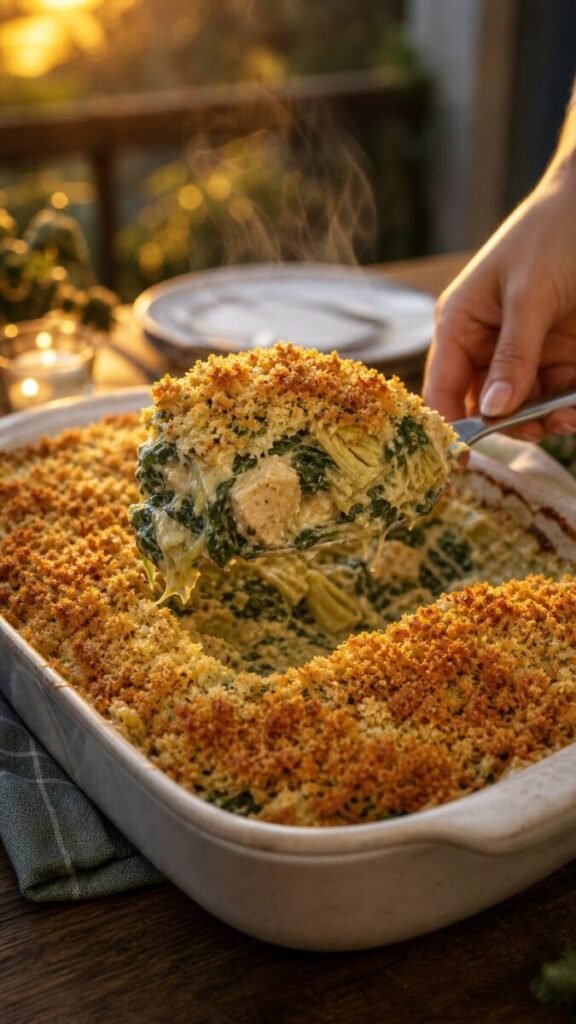
The section’s namesake is the standard the whole recipe answers to, so let’s define it plainly: done means a scoop holds its edge. When the casserole comes out, you rest it, you scoop it, and the serving should sit on the plate as a soft-edged square that keeps its shape while you eat — creamy inside, but standing. A scoop that spreads out into a puddle within a minute means one of the three leaks got through: wet spinach, wet artichokes, or a sauce that never got its cream cheese footing. The test takes one scoop and ten seconds, and it’s the difference between a dinner and a very warm soup with excellent croutons on top.
One scheduling note that isn’t equipment but belongs here: soften the cream cheese before you start, on the counter, for real — a cold block resists the whisk and leaves lumps that never fully dissolve, and a warm one folds in like it’s been waiting for this. Thirty minutes on the counter while the oven heats and the chicken sears costs nothing. If the block got forgotten, a 20-second half-power turn in the microwave fixes it, with the caveat that it melts fast and melted-then-cooled cream cheese behaves worse than softened, so stop the second it gives.
Ingredients (With Labels)
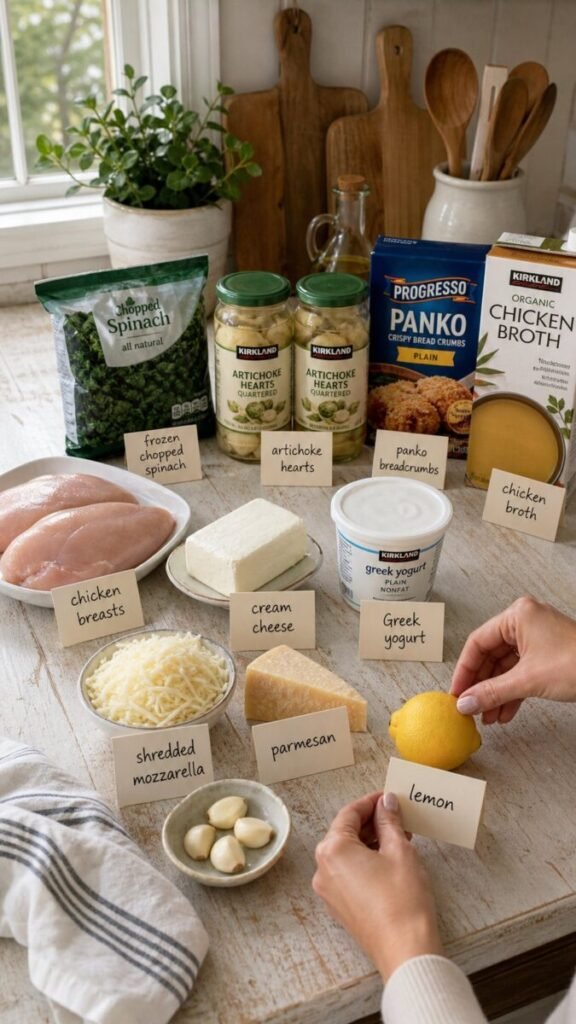
🍗 The Cubes
- Boneless skinless chicken breasts: 1½ lb, cut into 1-inch cubes and patted dry
- Salt and black pepper: ¾ teaspoon and ½ teaspoon, on the cubes
- Olive oil: 1 tablespoon, for the sear
🥬 The Spinach
- Frozen chopped spinach: 10 oz, thawed — and wrung until the towel stops darkening
🫙 The Artichokes
- Artichoke hearts in brine: two 12-oz jars or one 14-oz can — drained, patted dry, big ones halved
🧀 The Binder
- Cream cheese: 8 oz block, softened — the part that sets
- Greek yogurt: ½ cup — whole milk; the tang without the pour
- Chicken broth: ⅓ cup, loosens the sauce into folding range
- Parmesan: ½ cup grated, plus more for the lid
- Garlic: 3 cloves — one into the sear, two into the sauce
- Lemon: 1 tablespoon of juice — the brightness that keeps cream cheese honest
- Mozzarella: 1½ cups shredded, low-moisture — half folded in, half under the lid
🍞 The Crumb
- Panko: ⅓ cup, tossed with 2 tablespoons of grated parmesan and a drizzle of olive oil — the lid
Step by Step How to Make
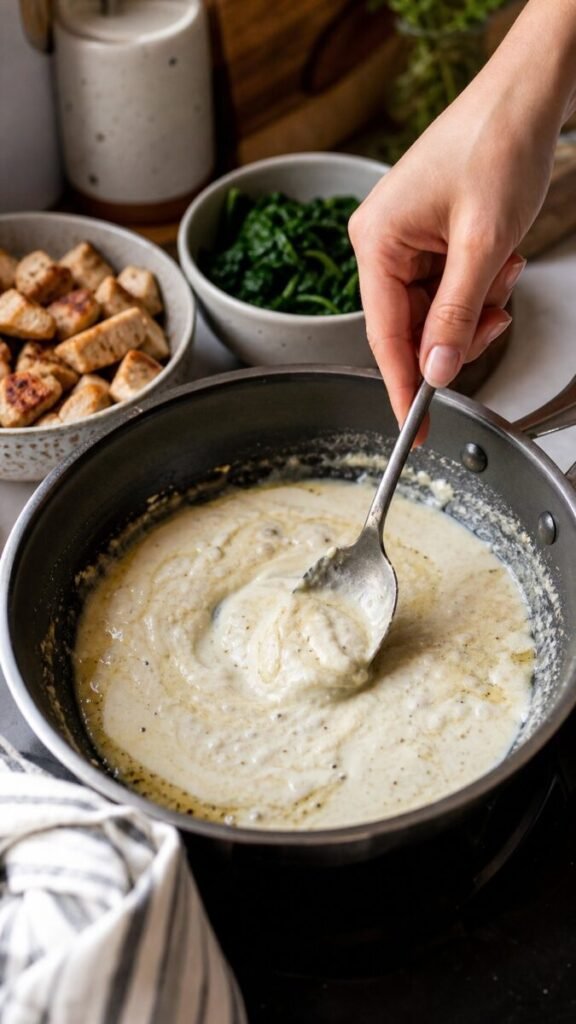
- Step 1 — The sear. Heat the oven to 375°F. Pat the chicken cubes dry — wet cubes steam gray, dry cubes brown — season them, and sear them in the olive oil over medium-high heat, in two batches if the pan crowds, leaving each batch undisturbed long enough to take real color on a face before turning. Six to eight minutes total; they don’t need to cook through, only to brown, because the oven will finish them gently inside the sauce. Lift the cubes out onto a plate and drop one sliced garlic clove into the drippings for thirty seconds, just until it smells like the next half hour. The pan now holds the entire flavor foundation, and the sauce is about to be built directly on top of it.
- Step 2 — The drying room. While the chicken waits, the vegetables get their towels. The thawed spinach goes into the first kitchen towel, twisted hard over the sink, re-wrapped, and twisted again — keep going until the towel stops darkening, which takes more turns than feels necessary and exactly as many as it takes. The artichokes get drained, then pressed between folds of the paper towel like they just came in from the rain, and any heart bigger than a comfortable bite gets halved. This is four minutes of unglamorous work, and it is the entire difference between a casserole that stands and one that doesn’t.
- Step 3 — The sauce. Lower the skillet’s heat to medium and add the softened cream cheese, the yogurt, the broth, the lemon juice, and the remaining two grated garlic cloves to the drippings, stirring and smushing with the sturdy spoon until the cream cheese melts into a single glossy sauce that smells like garlic and chicken and dinner. This takes three or four minutes and one patient wrist — the sauce will look loose and slightly broken at first, then come together as it warms. Stir in the ½ cup of parmesan and taste it: it should be a shade too salty and too tangy, because the spinach and the chicken are about to dilute it, and a sauce that starts bold lands balanced.
- Step 4 — The fold and the dish. Off the heat, the filling comes together in one motion: the seared cubes, the wrung spinach, the patted artichokes, and ¾ cup of the mozzarella go into the skillet, and everything gets folded over itself until the sauce is distributed and no pocket of plain chicken hides at the bottom. Scrape it all into the 9×13 dish and spread it level — level matters, because a bumpy filling browns unevenly and puddles in the dips — and scatter the remaining mozzarella across the top in an even blanket.
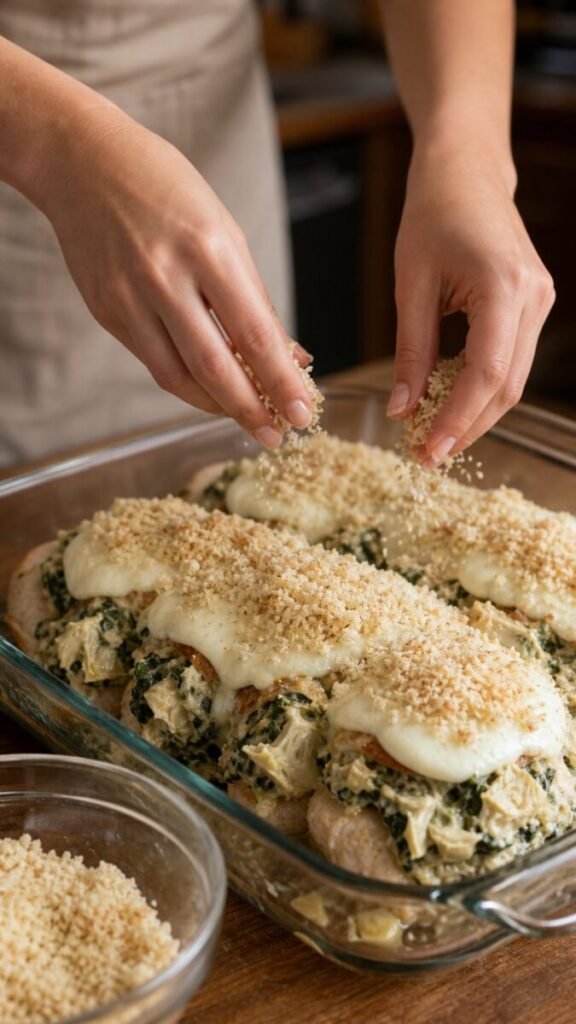
- Step 5 — The lid and the bake. Toss the panko with its parmesan and a drizzle of olive oil until it looks like wet sand, then scatter it across the mozzarella — this is the lid, and it’s the crunch the original dip had to borrow from a bread bowl, built in. Into the 375°F oven for 25 to 30 minutes, until the sauce bubbles in the corners, the mozzarella has melted flat, and the panko has gone from pale to deep gold. Start checking at minute 20: panko moves from golden to dark quickly, and a dark lid is a bitter lid. If the filling is bubbling but the crumb is still pale, two minutes under the broiler finishes it — attended, because panko and a broiler have a short and stormy relationship.
- Step 6 — The rest and the scoop. Out of the oven, and the hard part begins: leave it alone for ten minutes. The casserole is loose and bubbling at the oven door, and the rest is when the cream cheese sets and the whole dish finds its footing — the same physics that sets a cheesecake, working on a weeknight timeline. Then scoop deep, lift, and plate: the serving should hold its edge, creamy within, crumb on top. Serve it beside warm focaccia for dragging, or over rice for the full dinner treatment, and claim the corner scoop yourself — the corner has the most lid, and the person who made the casserole has earned the corner.
The creamy parmesan tomato and cannellini soup shares this recipe’s core instinct — cream, parmesan, and patience ending in something that eats like comfort. One holds a spoon; the other holds a scoop. A kitchen that makes both is a kitchen with a plan.
Anna’s Kitchen Notes
Brine-packed artichokes, not the marinated ones. The jars shelved with the pickles hold artichoke hearts in salted brine — clean-tasting, ready for anything, and what this recipe wants. The marinated ones by the olives arrive pre-dressed in oil and herbs, which sounds like a bonus and behaves like a competing sauce: their oil separates out in the bake and their seasoning argues with the lemon. If marinated is all the store had, drain them well, blot them firmly, and skip the olive oil drizzle in the lid — the artichokes are bringing their own.
The rotisserie shortcut, honestly rated. The dump-and-bake school — shredded rotisserie stirred into the cold sauce, straight to the oven — is real, fast, and completely legitimate on a hard weeknight. What it gives up is the sear and the drippings, which are the flavor this version is built on; the sauce lands a step blander and the chicken reads as warm rather than browned. The patch: drop the garlic into a slick of olive oil for thirty seconds before it goes into the bowl, and add an extra pinch of salt and an extra squeeze of lemon to the sauce. You’ll land most of the way there, and the casserole will still set and still stand — the architecture doesn’t care how the chicken got cooked.
Fresh spinach instead of frozen. Two-and-a-half cups of fresh, chopped, wilted for a minute in the still-warm skillet after the sear, then wrung in the towel like its frozen cousin — the fresh version tastes a shade greener and costs the recipe its pantry-keeper status. Frozen is the honest default here: it’s already blanched, it’s always in the freezer, and after the wringing nobody at the table has ever known the difference. The spinach’s job in this dish is color, body, and the green flecks — not a flavor the lemon and parmesan haven’t already claimed.
Assemble it in the morning, bake it at night. The whole dish, lid and all, goes into the fridge covered for up to 24 hours, and the flavors improve for the wait — the artichokes and garlic settle into the sauce like they’ve been marinating, which is exactly what they’ve been doing. Bake straight from the fridge, adding ten minutes and starting your crumb-watching at minute 30 instead of 20. This is the weeknight lane with the least standing between a working day and a casserole: the morning version takes twelve minutes of assembly, and the evening version takes nothing but an oven timer.
Doubling for a crowd: two pans, never one deep one. The recipe doubles cleanly into two 9×13s, side by side on the middle rack with a swap at the halfway mark. What it doesn’t survive is doubling into one deeper dish — the center of a thick casserole takes ages to reach temperature while the edges over-bake, the lid browns long before the sauce bubbles, and the stand test fails in the middle of the pan where it counts. Shallow is the whole geometry of the dish. Two dishes also means one for tonight and one for the freezer, and a second pan in the freezer is the cheapest insurance a busy week can buy.
The Casserole Table
A casserole this rich wants one bread, one sharp thing, and one blank canvas. The bread is focaccia, warm from the oven and torn — its olive-oil crust was built for exactly this dragging, and the pan scrapings at the end of the meal are its natural conclusion. The sharp thing is a blunt Greek salad with the house dressing, whose vinegar cuts cleanly through the cream cheese between bites. And the blank canvas is rice: a scoop of this over a bed of white rice turns the casserole from a side-flirting main into a complete plate, stretching six servings toward eight — the veggie rice bake covers the same instinct on a lighter night.
For the weeknight rotation: garlic butter chicken thighs are this recipe’s no-casserole sibling — the same garlic-forward, pan-built instincts in thirty minutes of skillet — and buttermilk biscuits swapped in for the focaccia turn the table Southern for a night, split and used as the scoop vehicle with zero ceremony. Any bread that toasts will do the focaccia’s job, but the ones already proven on this site do it best.
Same Sauce, Other Vegetables
The broccoli-and-white-cheddar version. Broccoli florets briefly blanched and thoroughly dried, and sharp white cheddar in place of half the mozzarella — the casserole goes full comfort-food classic, and the lemon stays, because lemon and cheddar are quietly great friends. Same binder, same lid, same stand test.
The mushroom version. A pound of mushrooms, browned hard in the sear pan after the chicken comes out and added with their flavor concentrated — swap gruyère for the mozzarella and the dish lands somewhere between this casserole and a tart. The mushrooms’ water is the third leak in this version: brown them until the pan goes silent before they join the fold.
The sun-dried tomato version. A half cup of oil-packed sun-dried tomatoes, blotted and sliced, and a teaspoon of Italian seasoning into the sauce — the casserole moves a peninsula south, and the mozzarella under the panko lid does its best impression of a much fancier dish. Basil torn over the top after the bake, in the last minute, where its oils land on hot crumb and perfume everything.
The shrimp version. Shrimp instead of chicken — raw, peeled, folded in without pre-searing, baked just until they curl and turn opaque in the sauce’s gentle heat, about fifteen minutes. The lemon and the shrimp have an obvious arrangement, the casserole comes out lighter and faster, and the stand test runs exactly as written. Pull it the moment the shrimp are done; shrimp waits for no casserole.
The demotion. Bake the same filling in a smaller, deeper dish, skip the chicken, serve it hot with cubes of focaccia around it — and the recipe walks back into the party it came from, job forgotten. Every version of this filling is a functioning dip, which is either a bonus recipe or proof that the original never needed the promotion. I’ve made both arguments at the same table.
The stuffed-pepper route. The filling spooned into halved bell peppers, topped with the panko lid, baked at 375°F for 25 minutes until the peppers soften at their edges. All casserole, no casserole dish — the pepper becomes the serving vessel, the carb column drops to the lid alone, and the presentation does things for a dinner party that a 9×13 quietly cannot.
The Bake Math
| Nutrient | Per Serving (1 scoop of 6) |
|---|---|
| Calories | 410 kcal |
| Protein | 38 g |
| Carbohydrates | 12 g |
| Fats | 24 g |
Estimates as written — full-fat cream cheese, real yogurt, both cheeses and the panko lid counted to the last crumb. Thirty-eight grams of protein with twelve grams of carbohydrate is a ratio most dinners can’t quote from memory, and it’s the quiet argument for serving the dip’s flavors over chicken instead of bread. Over rice, add the rice’s column and the plate balances itself. The money math is friendlier still: a pound and a half of chicken, one block of cream cheese, a jar and a half of artichokes, and the cheese drawer’s contribution put six standing scoops on the table for about fourteen dollars — the party-size tub of the original dip costs more than that and has never once fed anyone dinner.
The Second Night
Storage, and a casserole that reheats better than most of its family. The fridge keeps it four days covered, and the flavors genuinely deepen overnight — the artichokes and garlic keep settling into the cream cheese, and day two’s scoop tastes rounder than day one’s. Reheat covered in foil at 350°F for 15 to 20 minutes, until the center is hot and the corners bubble again; the lid softens in the fridge, and five minutes uncovered at the end re-crisps it. The microwave takes a single serving to hot in about two minutes, with the texture going softer and the lid going quiet — a desk-lunch trade that’s worth making anyway.
The stand test loosens slightly on the reheat, because cream cheese softens fully before it sets again — the scoops will hold, more gently, and taste no less like themselves. What the reheat does not need is more liquid: the casserole juices as it warms and comes back to its own consistency, and a splash of broth added on reflex turns day two into soup. Only loosen if the pan is genuinely thick past scoopability, and then a spoonful, not a pour.
The freezer takes the assembled, unbaked dish for two months, wrapped tight with the lid off — freeze it naked, thaw overnight in the fridge, add the panko lid fresh before baking, because a frozen-then-thawed crumb loses its crunch and the lid is five minutes of work. Baked leftovers freeze acceptably but not impressively; the sauce separates a shade on the thaw and the texture goes from standing to leaning. The unbaked dish is the freezer’s real business, and a second pan in there is a future Tuesday already solved.
Where It Goes Wrong
The puddle. A scoop that spreads across the plate inside a minute — one of the three leaks got through. Wet spinach is the usual suspect, then un-patted artichokes, then a sauce that was built with sour cream instead of the cream cheese-and-yogurt pair. There’s no rescuing a baked puddle, only serving it over rice and calling it a sauce, which works honestly well and nobody has to know the plan changed. The stand test next time starts at the towels.
The gray cubes. Chicken that went into the skillet wet, in a crowded pan, or with too much fussing — steamed instead of seared, and the whole casserole tastes one step flatter for it. Dry the cubes, sear in two batches if needed, and leave them alone long enough to take color: the drippings that come off a golden sear are the sauce’s foundation, and gray chicken leaves the pan with nothing to build on.
The bland first bite. Everything present, nothing arriving — the sauce was tasted before the filling folded in and never amended. The sauce on its own should be a shade too salty and too tangy, because two pounds of vegetables and a pound and a half of chicken are about to dilute it; a sauce that tastes perfect in the skillet lands shy in the dish. Taste again after the fold, and adjust then. The other usual culprit: artichokes rinsed to death. A quick drain keeps their brine, which is flavor; a long rinse under the tap sends it down the drain.
The dark lid. Panko the color of old bronze and the taste of regret — the oven ran hot, the crumb was checked late, or the broiler did its worst, which is fast. Start watching at minute 20, pull the dish when the panko is deep gold, and remember the lid keeps browning on the hot pan for a minute after it’s out. If the worst happens, the salvage is honest: scrape the dark crumb off, re-sprinkle a fresh handful of panko, and give it five minutes back in the oven — the second lid is often better than the first.
The oil slick. A shimmer of oil across the top after the bake — marinated artichokes happened, or the mozzarella was over-broiled past its melting range into splitting. Blot the slick gently with a paper towel before the rest; the casserole underneath is fine, and next time the brine-packed jar goes in the basket. An occasional faint slick from the cheese is normal and folds back in on the scoop — it’s the persistent pond that means an ingredient brought too much of its own oil.
The scoop that never set. Everything looks done, the lid is golden, and the filling pours anyway — the rest got skipped, or shortened to two impatient minutes. The ten minutes out of the oven is when the cream cheese goes from melted to set, and a pan scooped at the oven door is a pan scooped mid-transformation. It’s still dinner, and it’s still good, but give the next pan its ten — the stand test has a schedule, and the schedule is the whole point of the last paragraph of any casserole recipe, including this one.
Spinach Artichoke Questions
Can I use fresh spinach instead of frozen?
Yes — about two and a half cups chopped, wilted for a minute in the still-warm sear pan, and wrung in the towel exactly like the frozen block. Fresh tastes marginally greener and costs the dish its freezer-pantry status; after the wringing and the bake, the difference is small enough that I buy whichever the store has that week.
Can I use rotisserie chicken and skip the sear?
Yes — the dump-and-bake lane, covered honestly in the Notes. Fold three cups of shredded rotisserie into the cold sauce, bake as written, and expect a casserole that’s very good rather than built: no drippings, no golden crust, a flatter sauce. The garlic-in-oil patch and an extra lemon squeeze close most of the gap. On the nights that need this version, the version is right.
Can I make it ahead?
Assemble and refrigerate, lid off, up to 24 hours — bake from cold with ten minutes added and the crumb-watch starting at minute 30. The flavors improve overnight; the artichokes and garlic settle into the sauce like a marinade that finally got its chance. The fully baked casserole also reheats well the next day, covered in foil, so the make-ahead lane runs in both directions.
Can I make it gluten-free?
The filling already is — chicken, vegetables, cream cheese, yogurt, cheese, no flour anywhere in the build. Swap the panko lid for gluten-free crumbs, or skip the crumb entirely and use a parmesan-only lid, which browns into a thin, crisp sheet with none of the crunch but all of the salt. The stand test doesn’t involve the lid; the casserole stands either way.
Why Greek yogurt instead of sour cream?
Two reasons, one of them flavor and one of them physics. Yogurt’s tang does sour cream’s job in the taste, and its thicker body helps the sauce set rather than stay pourable — sour cream loosens a sauce, yogurt tightens one, and this casserole is trying to stand. If sour cream is what’s in the fridge, use it and accept a slightly softer scoop. The yogurt traditions of this site were built on exactly this kind of double duty.
Can I bake rice right into it?
I wouldn’t — the sauce is engineered to set, not to simmer, and raw rice needs bubbling liquid for the better part of an hour, which overcooks everything else in the dish. Bake the rice separately and serve the casserole over it: same plate, same comfort, and both halves cooked the way they wanted to be. The rice absorbs the sauce as it should, at the table, one bowl at a time.
How do I know it’s done?
Three signals, in order of reliability: the corners bubble, the center reads 165°F on a thermometer, and the lid is deep gold. Bubbles and color tell you the outside is ready; only the thermometer tells you the middle is. If you don’t own one, the fallback is a scoop from the center of the pan after the rest — the sauce should be steaming and thick enough that the spinach and chicken stay put where you left them. Underdone goes back in for five covered; the dish forgives that easily. The stand test is the final word, as always.
Spinach and Artichoke Chicken Casserole
Ingredients
As an Amazon Associate I earn from qualifying purchases.
Chicken
- 1½ lb (680 g) boneless skinless chicken breasts, cut into 1-inch cubes
- ¾ teaspoon fine salt, or less if using salty broth and cheeses
- ½ teaspoon black pepper
- 1 tablespoon olive oil, for searing
Vegetables
- 10 oz (283 g) frozen chopped spinach, thawed and squeezed very dry
- 1 can (14 oz / 397 g before draining) artichoke hearts in brine, drained, patted dry, and chopped into bite-size pieces; approximately 8–9 oz drained
Creamy sauce
- 8 oz (226 g) full-fat block cream cheese, softened
- ½ cup (120 g) plain whole-milk Greek yogurt
- ⅓ cup low-sodium chicken broth
- ½ cup (about 45 g) finely grated Parmesan
- 3 cloves garlic, finely minced
- 1 tablespoon fresh lemon juice
- 1½ cups (170 g) shredded low-moisture mozzarella, divided
Crunchy topping
- ⅓ cup panko breadcrumbs
- 2 tablespoons finely grated Parmesan
- 2 teaspoons olive oil, plus a little for greasing the dish
Kitchen Tools
- 9×13-inch baking dish, rated for 375°F
- Large heavy skillet, for the chicken and sauce
- Large mixing bowl and small topping bowl
- Clean kitchen towel, for squeezing spinach
- Paper towels, using separate sheets for vegetables and raw chicken
- Colander, for draining artichokes
- Chef’s knife and cutting boards
- Measuring cups and spoons
- Heat-resistant spatula or sturdy spoon
- Instant-read thermometer, for checking the chicken and casserole center
- Aluminum foil, if the topping browns before the center is hot
Directions
- Heat the oven and dry the vegetables. Heat the oven to 375°F and lightly grease a 9×13-inch baking dish. Thaw the spinach, following any package cooking instructions, and cool enough to handle. Squeeze firmly in a clean towel until very little liquid comes out, then break up the clumps. Drain the artichokes, pat thoroughly dry, and cut into bite-size pieces. Use one 14-ounce can for this version; two 12-ounce jars are not an equivalent quantity. If substituting jars, match the drained weight rather than the number of containers.
- Brown and fully cook the chicken. Pat the chicken dry with paper towels and season with the salt and pepper. Heat 1 tablespoon olive oil in the skillet over medium-high heat. Cook the chicken in uncrowded batches, letting the first side brown before turning. Allow approximately 6–8 minutes per batch, or longer as needed, until several of the largest pieces register 165°F in their centers. Transfer with a clean utensil to a clean plate. Fully cooking the chicken here avoids holding partially cooked poultry while assembling the casserole. Wash hands and sanitize surfaces that touched raw chicken.
- Build a smooth, gently heated sauce. Reduce the heat to medium-low. Add all three minced garlic cloves to the skillet and stir for about 30 seconds without letting them brown. Add the broth, scrape up the browned chicken bits, and bring to a brief simmer. Reduce the heat to low and stir in the softened cream cheese until smooth. Remove from the heat, then gradually stir in the Greek yogurt, lemon juice, and ½ cup Parmesan. Avoid boiling after adding the yogurt, which can separate under high heat.
- Fold together and add the topping. In the large bowl, combine the cooked chicken, spinach, artichokes, sauce, and ¾ cup mozzarella. Fold until evenly coated, then spread into the baking dish. Scatter the remaining ¾ cup mozzarella over the surface. In the small bowl, toss the panko with 2 tablespoons Parmesan and 2 teaspoons olive oil, then sprinkle evenly over the cheese.
- Bake until the center reaches 165°F. Bake on the middle rack for approximately 25–30 minutes, checking the topping after 20 minutes. The center of the casserole must reach 165°F; bubbling edges and golden crumbs alone do not confirm doneness. If the topping browns too quickly, tent loosely with foil and continue baking until the center is hot enough. A lightly golden topping is fine—broiling is not necessary, and ordinary glass baking dishes must not go under a broiler.
- Rest, then portion into six servings. Rest for 10 minutes before scooping. Expect a creamy, cohesive filling rather than firm, sliceable squares; moisture levels and cheese brands affect how much it thickens. Allow approximately 55–70 minutes overall, excluding spinach thawing and cream-cheese softening, with additional time if needed for chicken batches. Refrigerate leftovers in shallow containers within 2 hours, or 1 hour above 90°F, use within 3–4 days, and reheat to 165°F. For advance assembly, use fully cooked chicken, chill promptly, and add the crumbs just before baking. Follow the baking-dish manufacturer’s guidance to avoid refrigerator-to-hot-oven thermal shock.
Nutrition
| Nutrient | Approximate amount per serving |
|---|---|
| Serving size | ⅙ of the casserole |
| Calories | 480 kcal |
| Protein | 42 g |
| Carbohydrates | 13 g |
| Total fat | 29 g |
| Fiber | 3 g |
Estimates use 680 g raw chicken breast, full-fat cream cheese, whole-milk Greek yogurt, 170 g mozzarella, approximately 56 g Parmesan total, one drained 14-ounce can of artichokes, and the listed oil and panko. Brands and drained weights change the totals. Extra greasing oil and side dishes are not included. Contains milk and wheat. For a gluten-free version, use certified gluten-free panko and check broth and other packaged ingredients.