Best Roasted Sweet Potato & Beetroot Salad (Healthy)
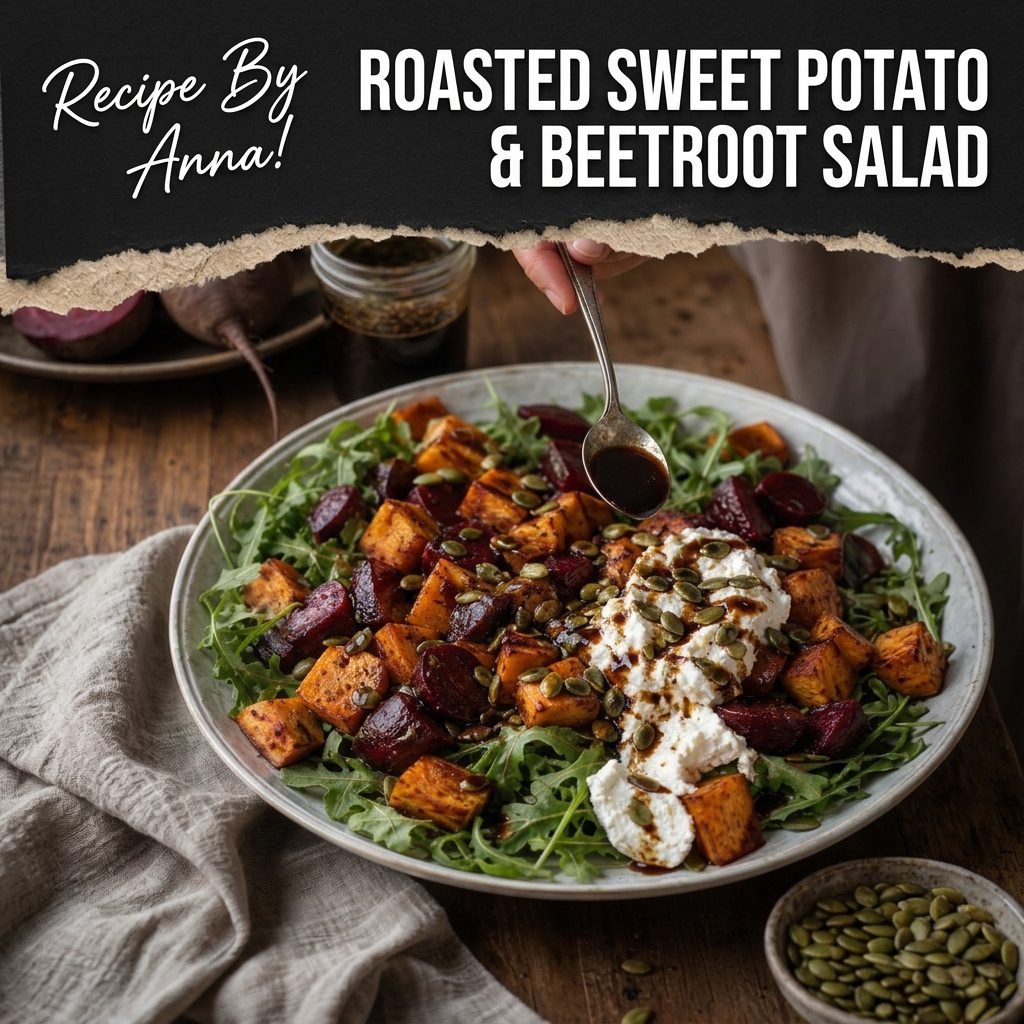
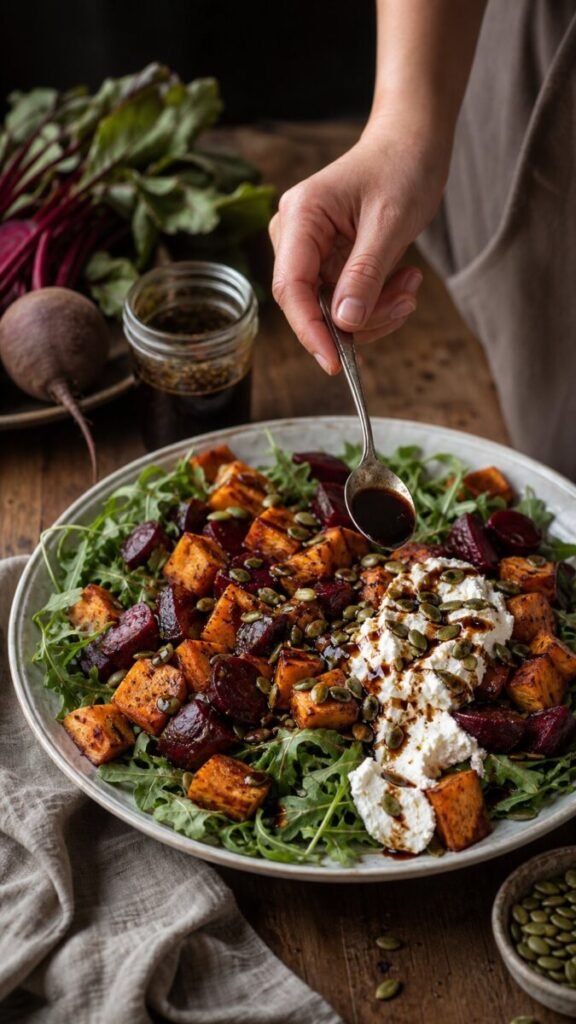
Roasted sweet potato and beetroot is the salad I make when the holidays are over but the weather hasn’t gotten the memo — jewel-toned, warm, substantial enough to be dinner, and pretty enough that people always ask what’s in it. Caramelized orange sweet potato cubes and deep, earthy beet wedges pile over peppery arugula with creamy goat cheese, toasted pepitas, and a glossy balsamic-honey drizzle. It’s the color scheme of a farmers’ market in November, and it eats like a main course wearing a salad’s clothes.
Here’s the thing almost every version of this salad gets wrong: the two roots get roasted on the same pan, and they shouldn’t even be in the same conversation. Beets and sweet potatoes want different things from an oven — beets want long, moist, gentle heat and turn everything on the pan pink; sweet potatoes want dry heat, space, and time enough to build crisp brown edges. Roast them together and you get pale sweet potatoes blushing pink, beets that are still firm when the potatoes are already soft, or both. So this recipe separates them from the start: the beets steam-roast whole in their own foil packet while the sweet potatoes crisp on a second pan, and — because the oven’s already on — a little ramekin of balsamic and honey sits on the rack beside them and reduces into glaze for free. The oven does three jobs, and you do about fifteen minutes of actual work.
A few honest notes before you start. The beets need the head start — they go in 25 minutes before the sweet potatoes, so the timetable is the recipe, and I’ve written it as one. Roast the beets whole and unpeeled; the skin holds the juice in, the color in, and slips off like a jacket once they’re tender. And this is a warm-ish salad, best served within an hour of the oven — the goat cheese softens against the warm vegetables just slightly, the arugula wilts at the edges instead of into submission, and the balsamic drizzle needs no introduction. It also holds at room temperature like a champ, which makes it the potluck dish that arrives looking exactly like it left.
Why Beets Get Their Own Packet
Let’s be specific about the separation, because it’s the whole engineering of this salad. A raw beet is a dense, 87-percent-water root that takes 50 minutes or more to become tender, and its pigment — betalain, the thing that stains cutting boards, dish towels, and every neighboring vegetable a cheerful pink — is fully water-soluble. That’s the case for the foil packet: whole scrubbed beets, a drizzle of oil, a pinch of salt, wrapped tight and roasted. Inside the packet the beets steam in their own moisture, which keeps them juicy and concentrates their sweetness; the skin holds most of the pigment in; and the stain stays contained instead of painting your sweet potatoes rose. When they’re fork-tender, the skins slide off under running water in about ten seconds each, and you cut them into wedges that have never leaked on anything.
The sweet potatoes, meanwhile, get the opposite treatment on purpose. Cubed, tossed in oil, and spread on their own parchment-lined pan with real space between the pieces, they roast in dry heat at 425°F — the temperature where surface moisture flashes off and the edges caramelize instead of steaming. Crowd the pan and they’ll steam each other into sog; give them room and every cube gets a browned edge and a custardy middle. The two pans even teach the lesson side by side: wet heat for the dense, slow root; dry heat for the quick, sugary one. Same oven, two philosophies, and the salad needs both to taste like more than the sum of its parts.
And then the free third job. Balsamic vinegar plus honey, in a small oven-safe dish on the rack beside the vegetables, reduces over the last twenty minutes into a syrupy glaze with almost no attention — the oven’s ambient heat evaporates the water and leaves the sweetness and the acid behind, concentrated. On the stovetop the same reduction takes 10 minutes of watching and stirring; in the oven it takes zero. That glaze is what ties the salad’s two personalities together — sweet potato loves sweet-and-sour, beets love sweet-and-sour, and goat cheese was arguably invented to be drizzled with it. The ramekin comes out when the beets do, and dinner’s finishing sauce made itself while you were setting the table.
⏱️ 1 HR 10 MIN | 🥗 THREE JOBS, ONE OVEN | 💗 THE STAIN STAYS IN THE PACKET
- Prep Time: 15 minutes
- Oven Time: 55 minutes, staggered — beets first, potatoes join at 25
- Assembly: 10 minutes
- Total Time: 1 hour 10 minutes
- Yield: 4 lunch-size bowls or 6 sides
The Roast Rack
Two pans, one packet, no gadgets:
- Aluminum foil — one big sheet per beet session, double-thick if your foil runs flimsy.
- Two sheet pans with parchment — one for the beet packet, one for the sweet potato cubes. They can share the oven, never the pan.
- Small oven-safe dish or ramekin — for the balsamic reduction, the oven’s third job.
- Large bowl — for tossing the sweet potatoes with oil, and later for the salad itself.
- Sharp knife and cutting board — cube the potatoes, wedge the cooled beets.
- Big platter — this is a wide, layered salad, and it deserves the stage.
- Dry skillet — three minutes for the pepitas, while the beets cool.
Ingredients (With Labels)
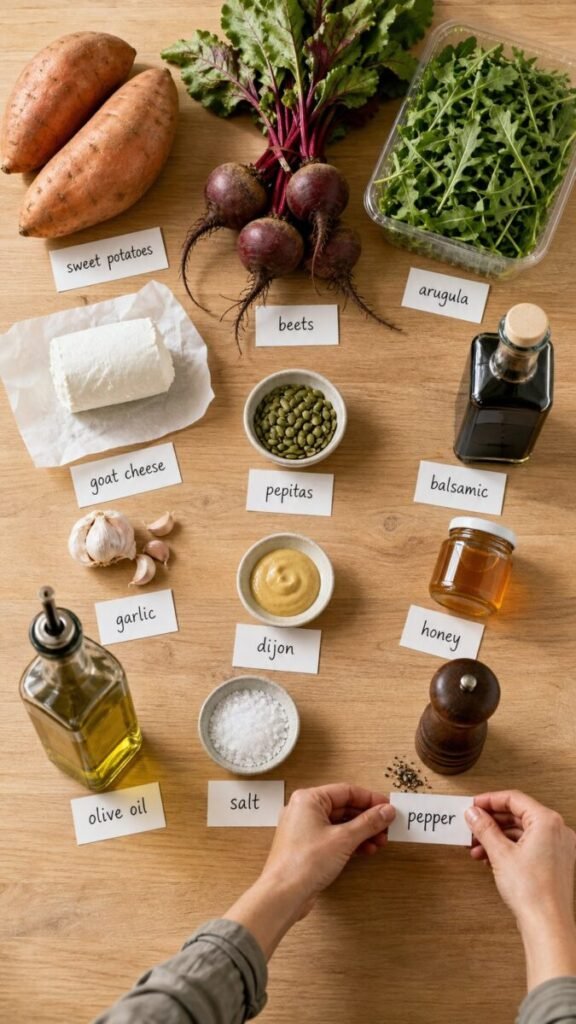
🍠 The Two Roots
- Beets: 3 medium, scrubbed, tops trimmed to an inch
- Olive oil: 1 teaspoon for the packet, plus 2 tablespoons for the potatoes
- Salt: ½ teaspoon total for roasting
- Sweet potatoes: 2 large, peeled and cut into ¾-inch cubes
- Smoked paprika: ½ teaspoon — the quiet depth note
🥬 The Bed and the Toppings
- Arugula: 5 oz, any tough stems picked out
- Goat cheese: 4 oz log, crumbled or swooshed
- Pepitas: ⅓ cup, toasted
- Flaky salt: for the finish
🍯 The Oven-Reduced Drizzle
- Balsamic vinegar: ⅓ cup
- Honey: 2 tablespoons
- Dijon mustard: 1 teaspoon
- Garlic: 1 small clove, grated
- Olive oil: 2 tablespoons, stirred in at the end
Step by Step How to Make
- Step 1 — Start the beets. Heat the oven to 425°F. Set each scrubbed beet on its own square of foil with a few drops of oil and a pinch of salt, wrap it into a sealed packet, and put the packets directly on an oven rack or on a pan below — somewhere they can sit undisturbed for the long haul. They’ll roast 50 to 55 minutes total, and they don’t need attention, so let them be. This is the head start that makes the whole staggered timetable work.
- Step 2 — Potatoes join at minute 25. While the beets steam in their packets, toss the sweet potato cubes with 2 tablespoons of oil, the salt, and the smoked paprika. At the 25-minute mark, slide the parchment pan onto a second rack, spreading the cubes out with real space between them. On the same rack — or beside them — set the small dish with the balsamic and honey stirred together. Now the oven is doing all three jobs: steaming beets, crisping potatoes, reducing glaze.
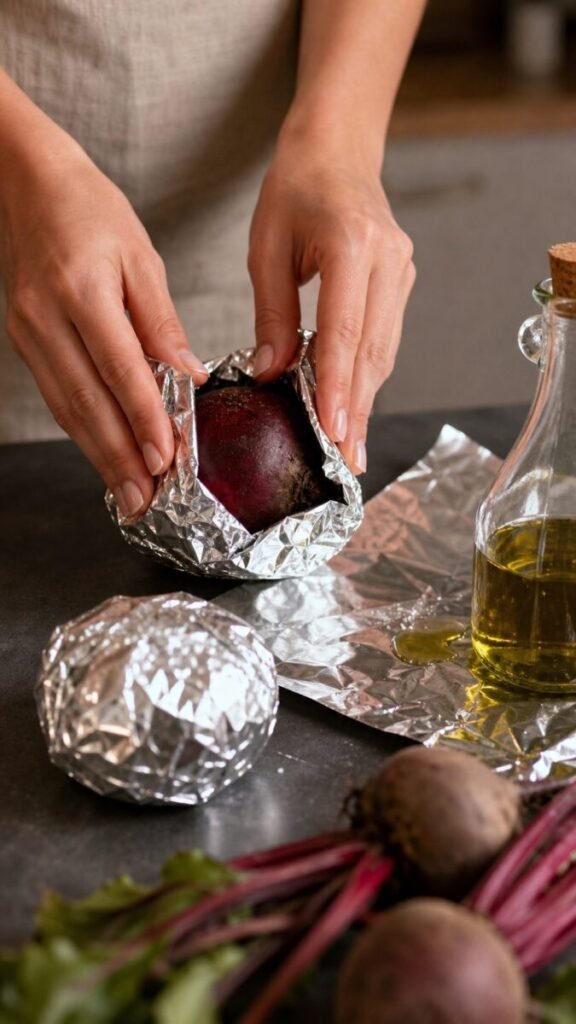
- Step 3 — Check both at minute 50. The sweet potatoes are likely done before the beets are: look for browned, crisp edges and a fork that slides through the center of a cube — 25 to 30 minutes is the usual window, and if they’re ready, pull them and let the pan rest. The beets are ready when a fork or paring knife meets no resistance through to the center. The balsamic, meanwhile, should be reduced to a syrup that coats a spoon — thick, dark, and about half its original volume.
- Step 4 — Slip the jackets. Let the beets cool just until you can hold them — five minutes — then rub each one under cool running water and watch the skin slide off whole, no peeler required. Cut each beet into wedges about the same heft as the potato cubes. Keep the beets and potatoes in separate bowls until the very end; the salad is layered, not stirred, and the sweet potatoes stay golden because of it.
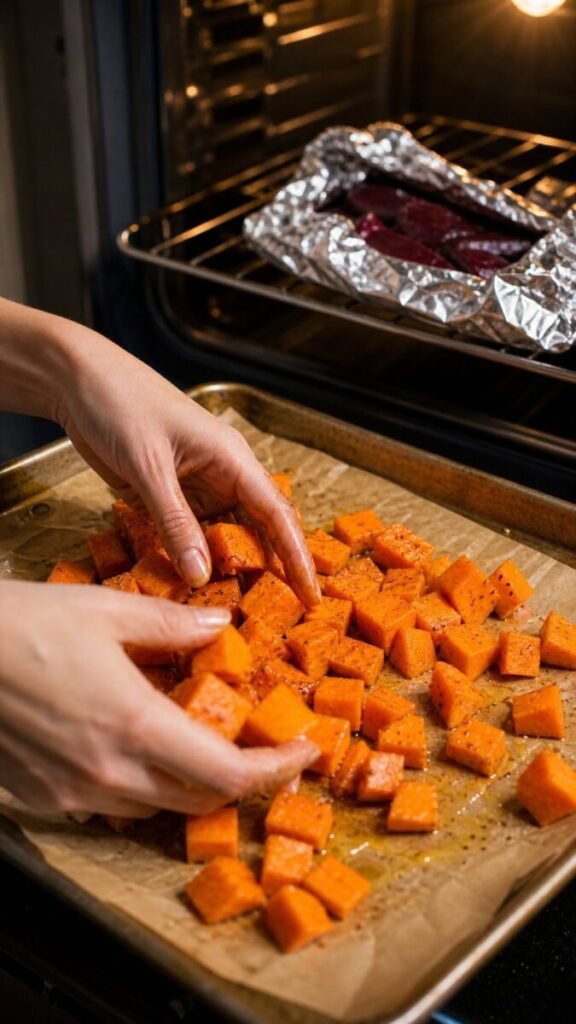
- Step 5 — Toast the pepitas, finish the glaze. While the beets cool, toast the pepitas in a dry skillet over medium heat for 3 minutes, shaking the pan, until they smell like a bakery and the first ones start to pop. Stir the Dijon, grated garlic, and the 2 tablespoons of olive oil into the reduced balsamic — the warm syrup takes them in smoothly, and the mustard holds it all from separating. Taste: it should be sweet, tart, and a little sharper than you want, because the cheese and potatoes will mellow it.
- Step 6 — Layer, don’t stir. On the big platter: arugula first, then the warm sweet potatoes, then the beet wedges scattered like you mean them, keeping the two colors mostly apart — this salad’s whole look is the orange against the deep red, and stirring turns it into a painting of a fight. Crumble the goat cheese over everything, scatter the pepitas, finish with flaky salt, and drizzle the glaze in ribbons from a height. Serve warm or within the hour. The goat cheese will soften slightly where it touches the warm vegetables, and that, frankly, is the point of it.
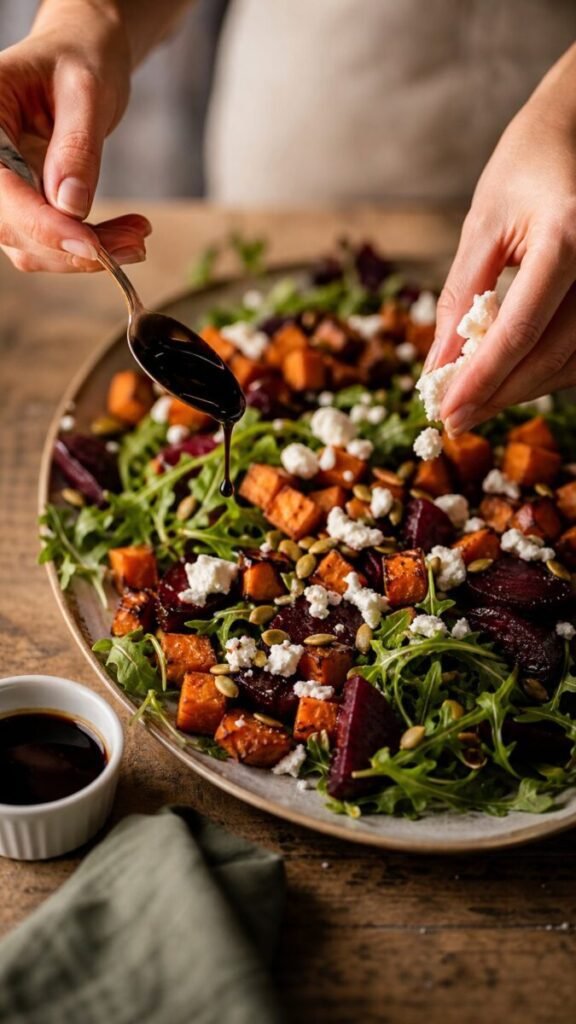
Every beet that enters this kitchen has two possible careers — this warm, layered platter, or the cold, no-cook route in our Chickpea Beet Feta Salad. One for winter, one for summer, and between them the beet question stays answered.
Anna’s Kitchen Notes
Buy beets with the tops on, cook them the day you get them — or don’t. Fresh beet greens are the freshness gauge, same as radish tops, and they’re also a free side dish: sauteed with garlic, they’re spinach’s earthier cousin. But the bulbs themselves keep for weeks in the crisper, so don’t panic if the greens fade — the beet beneath is in no hurry. My usual move is two bunches: one for this salad, one for the curry pot later in the week.
The pink problem, handled honestly. Beets stain because betalain pigment is water-soluble, and it gets everywhere the moment you cut into a raw beet. This recipe sidesteps it: whole beets, roasted in foil, peeled under running water after. The pink goes down the drain instead of into your cutting board, your towel, and your sweet potatoes. If you do end up with magenta fingers anyway, lemon juice and salt, rubbed together and rinsed, fades most of it — or you can simply wear your stained hands with pride for a day, like I do, as evidence of a good week’s cooking.
Golden beets exist, and they’re the diplomatic option. If pink-bleeding worries you at all, swap in golden or chioggia beets — same packet method, same timing, zero stain, and the salad goes sunset-colored instead of jewel-toned. Red beets give you the classic look; golden beets give you peace of mind. I make it both ways depending on which look the table needs, and nobody has ever guessed they’re eating the “careful” version.
Smoked paprika is doing quiet work. Sweet potato and sweet balsamic could drift toward dessert without something savory holding the floor. Half a teaspoon of smoked paprika on the potatoes adds a low, smoky note that keeps the whole platter on the dinner side of the line, and nobody can ever name what it is — they just say the salad tastes “somehow more serious” than it looks. That’s the paprika. It’s fine to let them wonder.
Goat cheese: crumbled or swooshed. Crumbled over the top is the potluck-proof route — it holds its shape and distributes fairly. The swoosh — goat cheese whipped with a splash of milk and spread across the platter with the back of a spoon before the vegetables go on — is the dinner-party route, and every warm cube lands on a little bed of it. Same cheese, same flavor, two entirely different evenings. I’ve stopped pretending the swoosh doesn’t take an extra ninety seconds, because it does, and it’s worth every one of them.
Plates It Loves
This salad walks the line between side and main, so plan around it accordingly. As a side, it belongs next to anything roasted or simple — roast chicken, a plain grilled steak, or a frittata for a lunch plate. As a main, add protein and it’s dinner: white beans folded in, or the platter served with good bread and the cheese doubled.
On the winter-salad shelf, it keeps company with the Roast Pumpkin & Lentil Salad — the other warm, roasted, sweet-vegetable platter — and the Hearty Potato Bowl with Roasted Chickpeas, which carries the same sturdy, crunchy energy in bowl form. And when the dressing jar runs empty, the Greek Salad Dressing is the sharp, herby understudy this platter takes to surprisingly well.
Other Roots, Other Nights
The carrot exchange. Two large carrots, peeled and cut on the bias, roast right alongside the sweet potatoes — same pan, same timing, same oil — and the salad goes even more golden. This is the version I make in the hungry weeks between winter and spring, when the beets at the market all look like they’ve been through something.
The butternut swap. Cubed butternut squash for the sweet potatoes, one-for-one, same 425°F, same crisp-edge ambitions. The salad turns softer and sweeter, the smoked paprika becomes even more necessary, and the goat cheese feels right at home. Squash and goat cheese is one of the oldest partnerships on the winter board for a reason.
The grain bed. Lay the whole platter over cooked farro, quinoa, or the roasted chickpea bowl treatment — the warm vegetables and the glaze fall into the grains, and a side dish quietly becomes a meal for six. Leftover grains plus leftover salad is also, without exaggeration, the best desk lunch of the whole winter rotation.
The citrus weeks. Deep winter wants brightness: add segments of one orange with the beets and swap the balsamic drizzle for lemon and honey. The orange against the beet is a classic for a reason — it’s the same sweet-acid job the glaze does, in a sunnier key, and the platter photographs like February never happened.
The vegan plate. Skip the goat cheese and add whipped white beans instead — cannellini blitzed with lemon, garlic, and oil, swooshed where the cheese would go. The creamy layer survives the swap completely, the protein goes up, and the platter loses nothing but the dairy. The honey in the glaze can go to maple syrup without complaint.
The Root Ledger
| Nutrient | Per Bowl (1 of 4) |
|---|---|
| Calories | 380 kcal |
| Protein | 10 g |
| Carbohydrates | 41 g |
| Fats | 21 g |
Estimates for the platter as written — arugula, both roots, the cheese, the pepitas, and a generous hand with the glaze. Ten grams of protein comes mostly from the goat cheese and pepitas, which is side-dish territory; add white beans or serve it over grains and it crosses into a real main. The fats are olive oil, pepitas, and goat cheese, which is to say the kind your cardiologist describes as “the good news part of the visit.” As always, estimates — the glaze is the variable, and nobody has ever stopped at one drizzle, including me, including tonight.
Tomorrow’s Platter
This is the rare roasted salad that genuinely holds: the components store separately for four days — potatoes in one container, beet wedges in another (always another), arugula in its bag, glaze in its jar — and assemble in two minutes per bowl all week. The beets actually improve on day two, deeper and sweeter, and the potatoes hold their edges better than you’d expect if you reheat them briefly, 8 minutes at 400°F on a pan, though cold-from-the-fridge cubes over arugula is a legitimate lunch too. The glaze keeps two weeks in the fridge and thickens as it chills — ten seconds in the microwave brings it back to a pour.
What doesn’t wait is the assembled platter with goat cheese on it: by the next morning the arugula has wilted and the pink has begun its migration into the cheese. It’s still tasty, in the way leftover parties are tasty, but it’s a different dish, and it knows it. So the rule from the farro jars applies here too: store in layers, assemble at the last minute, and never dress the greens until the bowl is about to be eaten.
For make-ahead hosting, the split is clean: beets roasted and wedged up to two days ahead, glaze up to a week, pepitas toasted and holding in a jar, potatoes roasted an hour before serving so they arrive warm. When the guests sit down, your remaining work is one platter, one swoosh, and two ribbons of glaze — about ninety seconds, which is exactly as long as you want to be working while everyone else is already eating the bread.
Where It Goes Wrong
Everything on the platter is pink. Raw or cut beets shared a pan — or a bowl — with everything else. The betalain pigment is water-soluble and it travels; once beets and sweet potatoes touch during any moist cooking, the color bleeds. The fix is built into the recipe: whole beets, sealed packet, separate bowls, layered platter. Pink is the beet’s job; it doesn’t need a second one.
Beets still crunchy at the hour mark. They were big, the packet leaked steam, or the foil was tented loose. Medium beets run 50 minutes; a beet the size of a softball needs 75, and there’s no arguing with physics. Check at 50 with a paring knife — it should slide through like the beet isn’t even trying. If it resists, rewrap and give it ten more; sweet patience is cheaper than a bad salad.
Sweet potatoes pale and soggy. The pan was crowded, the cubes were small, or the oven ran cool. Sweet potatoes need dry heat, real space, and 425°F to brown — squeeze a full recipe onto a half-sheet and they steam each other into sadness. Two pans beat one proud pan, every time, and the oven already has the second rack warm.
Burnt potato edges, raw centers. The cubes were cut unevenly, or the paprika scorched on the hottest corner of the pan. Cut to a consistent three-quarter inch, and remember that dark pans run hot — rotate the pan once, halfway, if yours bakes aggressively. The goal is browned edges, not black ones; the line between them is about five minutes, and it’s worth standing near.
A glaze that’s thin vinegar. The ramekin came out early, or the oven was packed cool. The reduction needs its full 20 minutes and a low-sided dish — a deep ramekin holds too much surface tension and barely reduces. You want syrup that clings to a spoon and moves slowly. Thirty seconds in the microwave at a time, watched, finishes an underdone one on the counter while everything else rests.
A salad that tastes flat despite perfect vegetables. Under-salted beets, skipped flaky salt at the end, or a glaze that wasn’t tasted. Root vegetables are sweet and earthy, and they lean on salt for the other half of their flavor; the seasoning has three checkpoints — the packet, the potatoes, and the platter — and each one matters. Miss one and the salad will taste like a good idea; hit all three and it tastes like dinner.
Beet Questions
Can I use pre-cooked or vacuum-packed beets?
You can — good ones exist, and they’re honest weeknight savings. Skip the packet, cut them into wedges, toss with a little oil, and give them 10 minutes in the 425°F oven alongside the potatoes so they caramelize at the edges instead of tasting straight from the packet. The salad loses a little of the “roasted all afternoon” depth, and nobody at a weeknight table has ever mentioned it.
Can I roast the beets and sweet potatoes on one pan after all?
You can, with consequences you’ve now read about: pink potatoes, uneven cooking, and a pan you’ll scrub with feelings. If oven space forces it, cube the beets small (half-inch), keep them on their own half of the parchment with a foil wall between, and expect the beets to finish about five minutes after the potatoes. The separate-packet method exists precisely so you don’t have to negotiate — but the one-pan truce is available in an emergency.
How do I stop my hands staining when I peel them?
Peel them under cool running water — the slip-the-jacket method in Step 4 — and most of the pigment rides off down the drain. Disposable gloves are the full solution, and I keep a box by the sink for beet week. If your hands do go pink, lemon juice and coarse salt, rubbed and rinsed, fades it in a wash or two. Wearing it for a day is also a recognized option, and a badge of sorts.
Can I serve this cold?
Yes, and it becomes a different, equally good salad — fully chilled, over the arugula, with the glaze thinned with a drop of water so it pours. The warm version is the one with the softening goat cheese and the fragrant steam; the cold one is the packed-lunch hero. What it can’t do is sit at room temperature overnight with everything already assembled, which is where the texture goes to retire.
What if I can’t find goat cheese?
Feta is the obvious stand-in — saltier, firmer, and already a beet professional — and blue cheese takes the salad somewhere louder and wonderful. A torn ball of fresh mozzarella makes it mildest. Whatever the cheese, the rule holds: add it at the end, keep it in pieces or swooshes, and let the warm vegetables do the softening. The glaze will carry any of them.
Can I make the glaze without the oven step?
Of course — simmer the balsamic and honey in a small saucepan over medium-low for 8 to 10 minutes, swirling, until it coats a spoon; then stir in the Dijon, garlic, and oil off the heat. The oven method exists because the oven was already on and empty space is a terrible thing to waste. The stovetop version is identical in about the time it takes to toast the pepitas, which you’re doing anyway.
Is this salad keto-friendly?
It isn’t, as written — both roots are carbohydrate-heavy, and a beet is a sugar-storage device wearing a nice jacket. The closest low-carb cousin using the same method: swap the sweet potato for cubed celery root or radishes and keep everything else. The beets themselves are moderate; it’s the potatoes doing the heavy lifting, and they’re not sorry.
Roast separately · Layer gently · Serve warm
Roasted Sweet Potato & Beetroot Salad
Caramelized sweet potato cubes and tender roasted beet wedges layered over peppery arugula with creamy goat cheese and toasted pepitas. A balsamic-honey drizzle brings the earthy, sweet, and tangy flavors together.
As an Amazon Associate I earn from qualifying purchases.
Ingredients
The two roots
- 3 medium beets, scrubbed, tops trimmed to about 1 inch
- 2 large sweet potatoes, peeled and cut into even ¾-inch cubes
- 1 teaspoon plus 2 tablespoons olive oil — 1 teaspoon for the beets and 2 tablespoons for the sweet potatoes
- ½ teaspoon salt, divided between the vegetables
- ½ teaspoon smoked paprika
The greens & toppings
- 5 oz arugula, washed and thoroughly dried, tough stems removed
- 4 oz soft goat cheese, crumbled; choose vegetarian enzymes
- ⅓ cup pepitas, toasted
- Flaky salt, to taste
The balsamic-honey drizzle
- ⅓ cup balsamic vinegar
- 2 tablespoons honey
- 1 teaspoon Dijon mustard
- 1 small clove garlic, finely grated
- 2 tablespoons extra-virgin olive oil, stirred in after reducing
The roast rack
- Aluminum foil, for individual beet packets
- 2 rimmed sheet pans, plus another if needed to avoid crowding
- Parchment paper, rated for at least 425°F
- Small, shallow oven-safe dish, rated for 425°F, with room for the glaze to bubble
- Large mixing bowl
- Sharp knife and cutting board
- Wide serving platter
- Small skillet, for the pepitas
- Oven mitts and a dry, heat-resistant trivet
Separate pans, distinct colors: keep the beet packets on a rimmed pan to catch leaks. Give the sweet potatoes their own uncrowded pan, then keep the cooked vegetables separate until plating. Cooked beets can still stain anything they touch.
Use tenderness, not just the timer: beet size can change the roasting time considerably. Medium beets often need 50–75 minutes; larger ones may take longer. The sweet potatoes can come out first.
How to make it
-
Give the beets a head start
Heat the oven to 425°F. Place each scrubbed, unpeeled beet on a square of foil. Divide 1 teaspoon olive oil and a little of the measured roasting salt among the beets. Wrap tightly, set the packets on a rimmed sheet pan, and roast. Start checking for tenderness after about 50 minutes; allow 50–75 minutes or longer as needed.
-
Add the sweet potatoes after 25 minutes
Toss the sweet potato cubes with 2 tablespoons olive oil, the remaining roasting salt, and the smoked paprika. Spread in a single layer on a separate sheet pan lined with parchment rated for 425°F, leaving space between pieces. Put them in the oven when the beets have roasted for 25 minutes. Roast the sweet potatoes for 25–30 minutes, turning halfway through, until tender with browned edges. Allow longer if needed.
-
Reduce the balsamic while the vegetables roast
Stir the balsamic vinegar and honey together in a small, shallow oven-safe dish with plenty of room for bubbling. Place it securely on the beet pan beside the packets when the sweet potatoes go in. Check after 10 minutes, then every few minutes, stirring carefully. It may take roughly 15–25 minutes or longer depending on the dish and vinegar. Remove when lightly syrupy and reduced by roughly one-third to one-half; it will thicken further as it cools. Do not leave it unchecked or wait until it becomes thick and sticky in the oven.
-
Check the roots and peel the beets
Remove the sweet potatoes when tender and browned. Carefully open a beet packet away from your face to release steam and test the center with a paring knife. If it resists, reseal and roast in 10-minute increments. Once tender, unwrap and let cool until safe to handle. Rub off the skins with a paper towel or under a little cool running water, then pat dry and cut into wedges. Keep them separate from the sweet potatoes.
-
Toast the pepitas and finish the drizzle
While the beets cool, toast the pepitas in a dry skillet over medium heat for about 2–4 minutes, stirring often, until fragrant and lightly golden. Transfer to a plate immediately. Let the balsamic reduction cool until warm rather than bubbling, then whisk in the Dijon, grated garlic, and 2 tablespoons olive oil. Taste and adjust. If it has become too thick to drizzle, whisk in warm water a teaspoon at a time.
-
Layer the platter without tossing
Let the vegetables cool from piping hot to warm. Spread the dry arugula over a wide platter, then arrange the sweet potatoes and beet wedges on top without stirring them together. Crumble over the goat cheese and scatter with toasted pepitas. Drizzle with the balsamic dressing and add flaky salt to taste. Serve promptly so the greens retain some bite and the cheese softens gently against the warm vegetables.
Hot-dish and food safety: the glaze dish and beet packets stay very hot; use oven mitts and a dry trivet, and avoid sudden temperature changes with glass or ceramic bakeware. Refrigerate leftovers within 2 hours, or 1 hour above 90°F. This salad contains dairy and mustard; choose goat cheese made with vegetarian enzymes for a vegetarian platter.