
Fast Ham and Cheese Muffins | Kids’ Lunchbox Favorite
Savoury muffins are the breakfast category that most people do not know they are missing until they make them once, and then cannot imagine going back to a breakfast that requires any active cooking on a weekday morning. Ham and cheese muffins are the version that converts the most people the fastest — because the combination of salty diced ham, sharp melted cheddar, and a slightly herb-flecked, savoury muffin crumb is so specifically satisfying for breakfast that it covers every flavour direction a weekday morning requires before anyone has had to cook anything at all.
Make them on Sunday. Eat them all week. Reheat for 30 seconds in the microwave. Walk out the door. This is the entire protocol.
They are also, as a bonus, the thing to bring to a brunch where you want to contribute something impressive that did not take an impressive amount of effort. Nobody at the brunch table needs to know these took 35 minutes. The golden domed tops and the smell of cheese baked into a warm muffin does most of the impression work independently.
Why Savoury Muffins Are Better Meal Prep Than Most Alternatives
The ideal meal prep breakfast is one that is protein-rich, portable, reheatable without texture degradation, and satisfying enough to last until lunch. Ham and cheese muffins check every requirement. The ham provides protein and the salty, savoury flavour that makes breakfast feel like a meal rather than a snack. The cheese provides fat and the specific richness that makes the muffin filling rather than just sustaining. The muffin base provides enough carbohydrate to make the whole thing feel complete. And the whole thing reheats in 30 seconds in a microwave and tastes genuinely good rather than compromised by the reheating — which is the standard most meal prep breakfasts fail to meet.
The format also means zero active cooking on the morning itself. The muffin is the cooking. Everything else is eating.
- Prep Time: 10 minutes
- Cook Time: 22 to 25 minutes
- Total Time: 35 minutes
- Yield: 12 muffins

What You Need
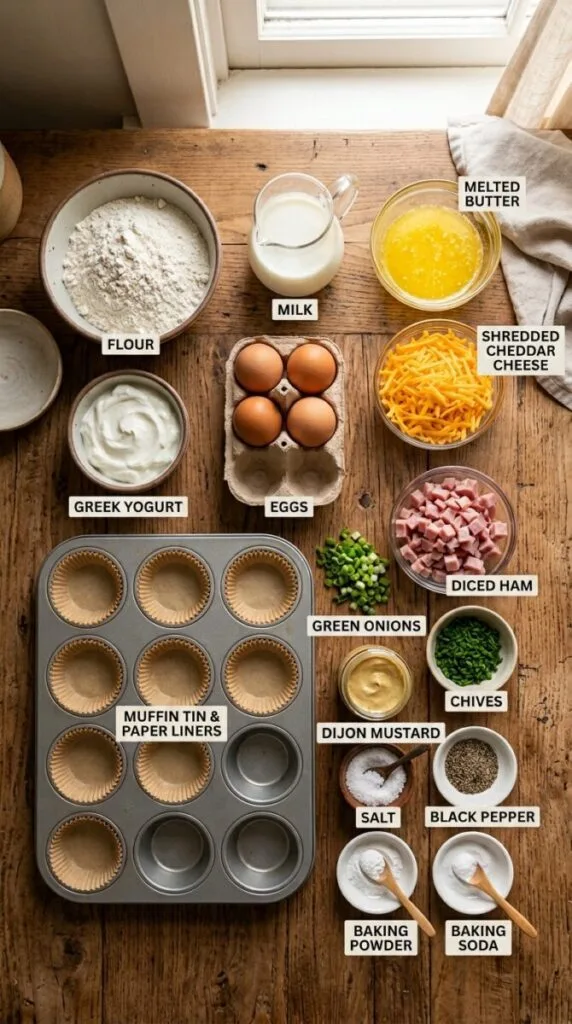
- All-purpose flour: 2 cups (250g)
- Baking powder: 1 tablespoon — a full tablespoon produces a domed, well-risen muffin; less than this and the muffins will be flat and dense
- Fine sea salt: 3/4 teaspoon — the ham and cheese both carry salt, so the base batter needs less than a standard sweet muffin
- Black pepper: 1/2 teaspoon — present throughout every bite; savoury muffins need pepper in the batter, not just on top
- Smoked paprika: 1/2 teaspoon — adds colour and a gentle smoky note that connects to the ham
- Garlic powder: 1/4 teaspoon
- Dried mustard powder: 1/4 teaspoon — the background sharpness that makes the cheese flavour taste more like cheese
- Large eggs: 2
- Whole milk: 1 cup (240ml)
- Sour cream or plain Greek yogurt: 1/4 cup (60g) — adds moisture, slight tanginess, and a tender crumb; the same principle as the Greek yogurt in the Peanut Butter Blondies and the Cottage Cheese Pancakes: dairy protein improves the texture of anything it bakes into
- Neutral oil or melted butter: 1/3 cup (75ml) — melted butter produces a richer, slightly more flavoured muffin; neutral oil produces a slightly moister one; both work
- Diced cooked ham: 1 1/4 cups (approximately 200g) — deli ham, leftover baked ham, or canned ham all work; dice into 1/4-inch pieces so there is ham in every bite rather than a few large chunks distributed unevenly
- Sharp cheddar, freshly grated: 1 1/2 cups (150g), divided — 1 cup folded into the batter, 1/2 cup reserved for the tops; grate it yourself; pre-shredded cheese coated in anti-caking starch does not melt the same way into the batter and produces a slightly grainy crumb
- Green onions, thinly sliced: 3 — folded into the batter; adds freshness and a mild onion flavour that cuts through the richness of the cheese and ham
- Fresh or dried thyme: 1 teaspoon — the herb that connects the savoury components without overpowering them
🍽️ Equipment I Need for Ham and Cheese Muffins
Basic baking gear, nothing fancy: 6 kitchen workhorses for light folding, even portioning, and golden cheese tops.

USA Pan Bakeware 12-Well Muffin Pan
Heavy gauge aluminized steel with fluted wells conducts heat gently, baking tall, golden savory muffins without scorching delicate cheese edges.

If You Care FSC Certified Parchment Baking Cups (Large)
Greaseproof unbleached parchment releases caramelized, bubbly cheddar effortlessly without tearing or leaving sticky crumbs behind.

Pyrex Essentials 3-Piece Glass Mixing Bowls Set
Sturdy tempered glass bowls keep dry and wet ingredients separated until the final fold, ensuring a textbook two-bowl muffin method.

OXO Good Grips Silicone Everyday Spatula
Flexible beveled silicone blade folds diced ham and sharp cheddar smoothly into the batter without overworking gluten strands.

OXO Good Grips Large Cookie & Muffin Scoop (3 Tbsp)
Spring-action sweeper glides cleanly through chunky batter, filling all twelve muffin cups with identical volume and zero messy drippings.

Checkered Chef Stainless Steel Cooling Racks (2-Pack)
Elevated tight crosswire grid circulates 360° air around warm muffins, letting internal steam dissipate so bottoms stay firm and golden.
How to Make Them
- Preheat the oven to 375°F (190°C). Line a 12-cup muffin tin with paper liners or grease each cup generously with butter or cooking spray. Savoury muffins with cheese stick more than sweet muffins — be thorough with the greasing if not using liners.
- In a large bowl, whisk together the flour, baking powder, salt, pepper, smoked paprika, garlic powder, and mustard powder until evenly combined.
- In a separate bowl, whisk the eggs, milk, sour cream (or Greek yogurt), and oil (or melted butter) together until smooth.
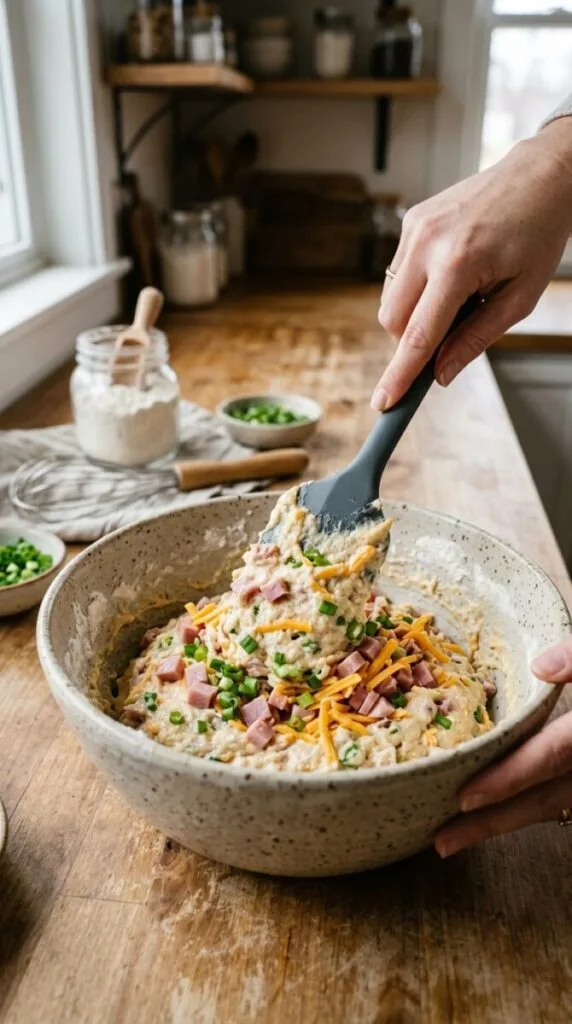
- Pour the wet ingredients into the dry ingredients and fold with a spatula until just combined — 10 to 12 folds, stopping as soon as no dry flour streaks remain. The batter will look slightly lumpy. This is correct. Overmixed muffin batter develops gluten and produces tough, tunnelled muffins with peaked tops rather than the domed, tender muffins the recipe should make. Mix less than you think you need to. The lumps bake out.
- Fold in 1 cup of the grated cheddar, the diced ham, green onions, and thyme with 3 to 4 more folds. Distribute evenly but do not overmix.
- Divide the batter evenly between the 12 muffin cups — fill each cup approximately 3/4 full. Scatter the reserved 1/2 cup of cheddar over the top of each muffin, pressing it gently so it adheres to the surface rather than sliding off during baking.
- Bake at 375°F for 22 to 25 minutes until the tops are golden brown, the cheese on top is melted and beginning to bubble at the edges, and a toothpick inserted in the center comes out clean. The tops should look domed and slightly cracked — the crack on a muffin top is the sign of a properly leavened, properly baked muffin rather than a flat or tunnelled one.
- Cool in the tin for 5 minutes before transferring to a wire rack. The muffins need the 5-minute rest for the structure to set — too hot, and they will squash slightly when removed from the tin. After 5 minutes they should release cleanly.

Ham and cheese muffins made on Sunday alongside our Cottage Cheese Pancakes batch-cooked and frozen in stacks is the weekend meal prep session that covers every weekday breakfast for the entire week — the muffins grab-and-go from the fridge, the cottage cheese pancakes reheat from the freezer in 90 seconds, and not a single weekday morning requires any active cooking between now and Friday. This is the system.
The Fold-Don’t-Stir Rule and the Reserved Cheese Topping
The fold-not-stir instruction for muffin batter is the single most important technique note in any muffin recipe, because it is the most commonly ignored one. Stirring muffin batter — using a spoon or spatula in a circular motion with full rotation — works the flour into the liquid and develops gluten strands in exactly the same way that kneading bread dough does, just less efficiently. The result is a batter with developing gluten that bakes into a tough, dense, slightly rubbery crumb with a peaked rather than domed top and long internal tunnels where gas bubbles could not escape through the stiffening structure. Folding — using the spatula in an under-and-over motion, rotating the bowl, minimal strokes — incorporates the wet and dry ingredients without working the gluten. The difference is visible in the finished muffin and significant in the texture.
The reserved cheese on top is not just a visual detail — the cheese on the surface of the muffin melts and caramelises against the dry oven air during baking, producing a slightly browned, slightly crispy cheese crust that makes the top of each muffin the best bite. If the cheese goes entirely into the batter, the muffins taste consistently cheesy throughout but have no textural interest on the surface. The split — cheese in the batter for flavour, cheese on top for texture — produces a muffin where every bite is cheesy but the first bite, the top, is the most satisfying one.
What to Serve These With
As a standalone breakfast, one or two ham and cheese muffins with a piece of fruit is the complete weekday morning meal that requires nothing else. As a brunch item, they work on a board alongside sliced fruit, a simple salad, and something sweet — the savoury muffin as the anchor, the sweet element for anyone who wants to balance the savoury.
For a weekend brunch spread, these alongside our Cheddar Bacon Dutch Baby cover both the individual take-and-eat format and the dramatic shared-skillet format at the same table — two entirely different presentations of the same cheddar-and-savoury-breakfast direction, which makes the brunch feel more composed and more considered than two entirely unrelated dishes would.
Variations That Are All Useful
Bacon and Gruyère: Replace the ham with 6 strips of crispy bacon, crumbled, and the cheddar with Gruyère. The bacon and Gruyère version is richer, nuttier, and more specifically French in character — particularly good for a brunch where the occasion is slightly more special than an ordinary weekend morning. The Gruyère melts into the batter more smoothly than cheddar and produces a slightly more elegant finished muffin.
Sun-Dried Tomato and Feta: Replace the ham with 1/3 cup of chopped oil-packed sun-dried tomatoes and the cheddar with crumbled feta. Add 1 tablespoon of dried oregano and 1/4 teaspoon of red pepper flakes. The Mediterranean version is the completely meat-free direction — the sun-dried tomatoes provide the salt and savouriness that the ham would have contributed, and the feta provides the sharp, salty dairy note. These are the muffins to make for a mixed meat-and-vegetarian table.
Jalapeño Cheddar: Add 2 finely diced pickled jalapeños (or 1 fresh jalapeño, seeds removed for mild heat) to the batter alongside the ham and cheese. Replace 1/4 teaspoon of the smoked paprika with chipotle powder. The jalapeño cheddar version is the most popular variation for anyone who wants a little heat with their breakfast and is the one most likely to be specifically requested by name at every subsequent gathering.
Spinach and Feta: Skip the ham entirely. Add 1 cup of finely chopped fresh baby spinach (squeezed dry if it seems particularly wet) and 3/4 cup of crumbled feta instead of the cheddar. Add the zest of 1 lemon and 2 tablespoons of fresh dill to the batter. The spinach and feta version is the lightest, most summery direction — closer in character to a Greek börek than a ham and cheese muffin, and genuinely excellent for anyone who wants a vegetarian breakfast muffin that tastes specifically of something rather than generically of “baked vegetable.”
Everything Bagel Muffins: Keep the ham and cheddar base. Replace the thyme with 1 tablespoon of everything bagel seasoning folded into the batter. Top each muffin with more everything bagel seasoning instead of (or in addition to) the cheese. The everything bagel muffin is the most crowd-pleasing variation for a breakfast gathering — the sesame-garlic-onion-salt combination on a muffin is the flavour that makes people ask “what is in these?” and then eat three.
Nutritional Information
| Nutrient | Amount Per Muffin (based on 12 muffins) |
|---|---|
| Calories | 245 kcal |
| Protein | 12 g |
| Carbohydrates | 22 g |
| Fats | 12 g |
12 grams of protein per muffin from the ham, eggs, and cheese makes these genuinely competitive with the Greek yogurt and cottage cheese-based breakfast recipes in the collection for protein content — which is unusual for a baked good that doubles as a meal-prep item. At 245 calories per muffin, two muffins and a piece of fruit is a 550-calorie breakfast that provides 24 grams of protein, which is a breakfast that will actually last until lunch rather than requiring a mid-morning snack to bridge the gap.
Storing and Reheating — The Meal Prep Details
Store in an airtight container at room temperature for up to 2 days, or in the fridge for up to 5 days. Refrigerated muffins are slightly denser and firmer than room-temperature ones from the cold firming the fat in the batter — 20 seconds in the microwave restores them to their original soft, moist texture. The cheese on top re-melts during reheating and the muffin tastes essentially freshly baked.
Freeze completely cooled muffins individually wrapped in plastic wrap for up to 3 months. Reheat from frozen in the microwave for 60 to 75 seconds. The frozen and reheated version is genuinely very good — the muffin structure survives freezing and thawing without becoming gummy or crumbly, which makes these one of the better freezer meal-prep items in the breakfast category. A batch of 12 muffins frozen individually means 12 separate weekday breakfasts that each require less than 90 seconds of active morning effort.
The reheating protocol: wrap the muffin in a damp paper towel before microwaving. The damp paper towel creates a small steam environment around the muffin during reheating that prevents the exterior from drying out and produces a uniformly soft, moist muffin rather than a muffin with a slightly tough outer edge and a soft center. This applies to muffins from the fridge and from the freezer equally. The damp paper towel is the detail that makes reheated muffins taste baked rather than microwaved.
The Only Mistakes Worth Mentioning
Overmixing the batter is the mistake that produces tough, peaked, tunnelled muffins — the visual signals are a top that comes to a point rather than a dome, and visible large holes in the crumb when the muffin is broken open. The fix is simply to mix less: fold until the flour just disappears, stop, and trust that the lumpy batter will bake into a smooth crumb. Count the folds if you need to. Ten to twelve folds for the wet-into-dry combination. Three to four more for the ham and cheese. No more.
Not greasing the muffin tin properly (or skipping liners) when using cheese in the batter produces muffins that stick so firmly to the tin that they tear rather than releasing cleanly. The melted cheese that contacts the tin surface bonds to it during baking. Liners are the easiest solution. If not using liners, grease every surface thoroughly including the flat area between cups where overflow might reach.
Using pre-shredded cheese in both the batter and on top produces a slightly grainy crumb inside (from the anti-caking starch preventing clean melting into the batter) and a cheese topping that does not caramelise as beautifully as freshly grated cheese does. Two minutes of grating. Meaningfully better result. Worth it.
Ham and Cheese Savoury Muffins
Fluffy savoury breakfast muffins with diced ham, sharp cheddar, green onions, thyme, sour cream or Greek yogurt, and a golden cheese topping.
Ingredients
How to Make
Preheat oven to 375°F / 190°C. Line a 12-cup muffin tin with paper liners or grease each cup very well.
In a large bowl, whisk flour, baking powder, salt, black pepper, smoked paprika, garlic powder, and mustard powder until evenly combined.
In a separate bowl, whisk eggs, milk, sour cream or Greek yogurt, and oil or melted butter until smooth.
Pour wet ingredients into dry ingredients and fold gently with a spatula until just combined, about 10 to 12 folds. The batter should be slightly lumpy.
Fold in 1 cup cheddar, diced ham, green onions, and thyme with 3 to 4 more folds.
Divide batter evenly between the 12 muffin cups, filling each about ¾ full.
Scatter the reserved ½ cup cheddar over the tops, pressing gently so it adheres.
Bake for 22 to 25 minutes, until the tops are golden, domed, and a toothpick inserted in the center comes out clean.
Cool in the muffin tin for 5 minutes, then transfer to a wire rack. Serve warm or store for meal prep.
Nutrition
| Nutrient | Amount Per Muffin |
|---|---|
| Calories | 245 kcal |
| Protein | 12 g |
| Carbohydrates | 22 g |
| Fat | 12 g |
Values are estimates based on 12 muffins.