Sweet Potato and Bacon Skewers Recipe
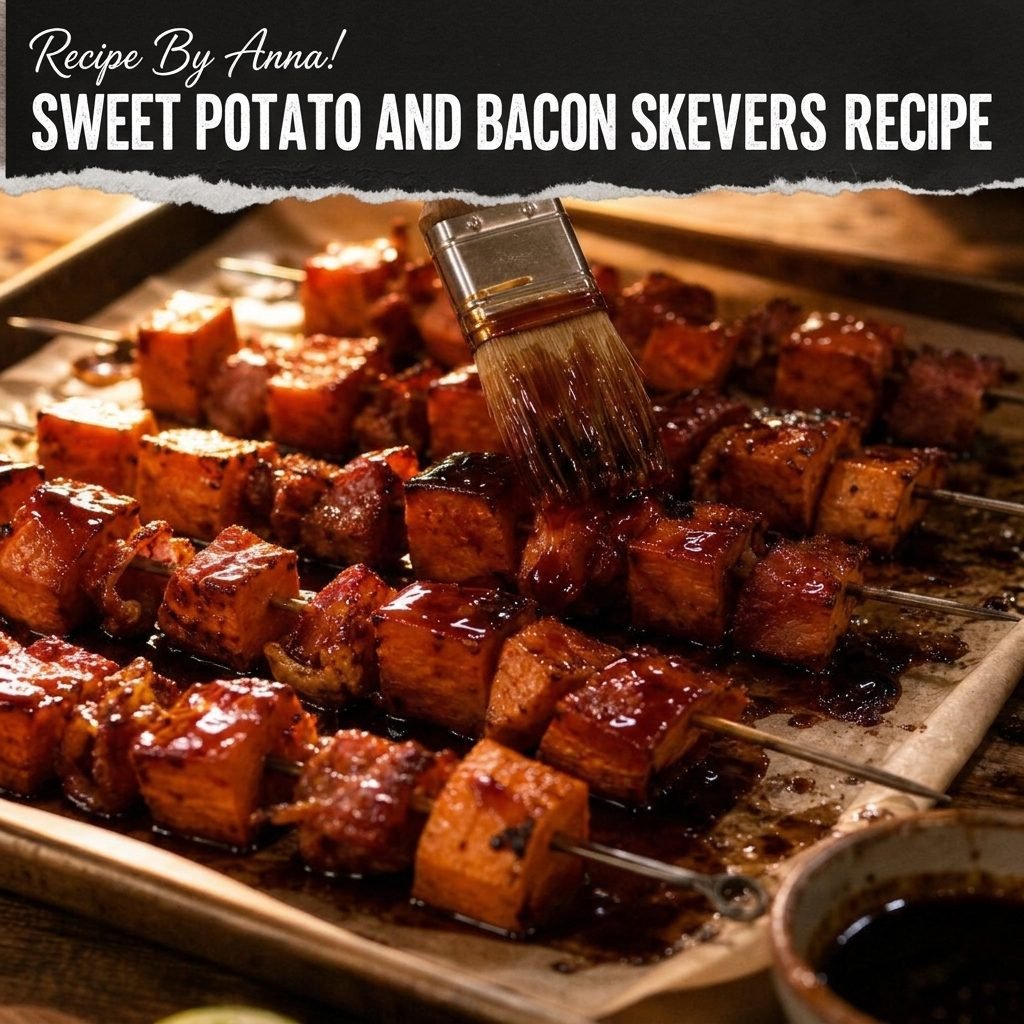
Sweet potato and bacon skewers are the appetizer I make when I want people to stand around the kitchen saying things like “wait, what IS this?” in a good way. Cubes of sweet potato and folds of bacon, threaded on skewers, glazed with maple and chipotle, and baked until the potatoes caramelize and the bacon goes crisp at its ruffled edges. It’s sweet, smoky, salty, sticky, and finger food by design — you pick up a skewer, you slide bites off with your teeth, and then you find yourself explaining to the tray that you were only going to have one.
The recipe solves one real problem, and it’s the reason some bacon-potato attempts end in disappointment: the two ingredients keep different schedules. Sweet potato cubes need a good 25 minutes to turn tender and caramelized; bacon on a skewer, away from direct pan contact, cooks slower than you’d hope and then, suddenly, all at once. The fix is a five-minute parboil of the potatoes before they ever meet the skewer — it starts them down the road to tenderness so everything arrives at done at the same moment. It’s the same logic a good host uses at a party: introduce the guests before dinner so nobody spends the meal catching up.
A few honest notes before you start. Use regular-cut bacon, not thick-cut — thick bacon stays chewy in the time the potatoes need, and chewy bacon on a skewer is a texture pretending to be a choice. Soak wooden skewers for 30 minutes if that’s what you have; metal ones need nothing. And these are best served warm, within twenty minutes of the oven, when the glaze is still tacky and the bacon still snaps. The good news for party planning: you can parboil and glaze a day ahead, so the last half hour is just threading and baking.
Why These Skewers Work
The parboil is the whole engineering story. Raw sweet potato cubes going straight onto a skewer with bacon are racing in opposite directions — the potato needs long, slow heat to soften and sweeten, while the bacon’s goal is to render its fat and crisp before anything dries out. A five-minute boil in salted water gives the potatoes a head start: their edges are already yielding, their starches are beginning to swell, and now they only need the oven’s time to finish and caramelize. Bacon and potato, for once, are on the same clock.
The glaze does more than coat. Maple syrup and brown sugar bring sugars that caramelize in the oven’s dry heat, building the sticky, burnished edges that make these skewers taste candied without being dessert. Chipotle powder is the counterweight — smoky and warmly spicy rather than sharp — and a small pinch of cinnamon bridges the maple and the pepper so the glaze tastes like one idea instead of three. Half the glaze goes on before baking so it can bake on; the other half gets brushed on at the end so it stays glossy and fresh. Two coats, two jobs.
Threading matters more than it looks. Leaving a finger-width of space between each piece isn’t neatness — it’s heat management. Packed-tight skewers steam in their own trapped moisture and the bacon stays flabby; spaced pieces let the hot oven air wrap around every surface, which is how bacon crisps on a skewer at all. Potato, folded bacon, potato, folded bacon, with the occasional red onion fold for sharp bites between the sweet ones. The pattern is simple, and the space between is the recipe.
⏱️ 50 MIN | 🍠 SWEET, SMOKY, STICKY | 🥓 MAKES 12 SKEWERS
- Prep Time: 20 minutes
- Parboil Time: 5 to 6 minutes
- Bake Time: 22 to 25 minutes
- Total Time: 50 minutes
- Yield: 12 skewers — 4 servings of 3, or a party platter
Skewer Gear
Short list, one soak:
- 12 skewers — metal need nothing; wooden or bamboo soak in water for 30 minutes so they don’t scorch.
- Large pot — for the potato parboil.
- Rimmed baking sheet and parchment — the glaze drips and caramelizes; parchment saves you from the pan’s ambitions.
- Large bowl — for tossing the potatoes in glaze.
- Basting brush — for the second coat at the end.
- Tongs — for turning skewers mid-bake without glueing your fingers to bacon.
- Chef’s knife and cutting board — the cubes are the only real knife work.
Ingredients (With Labels)
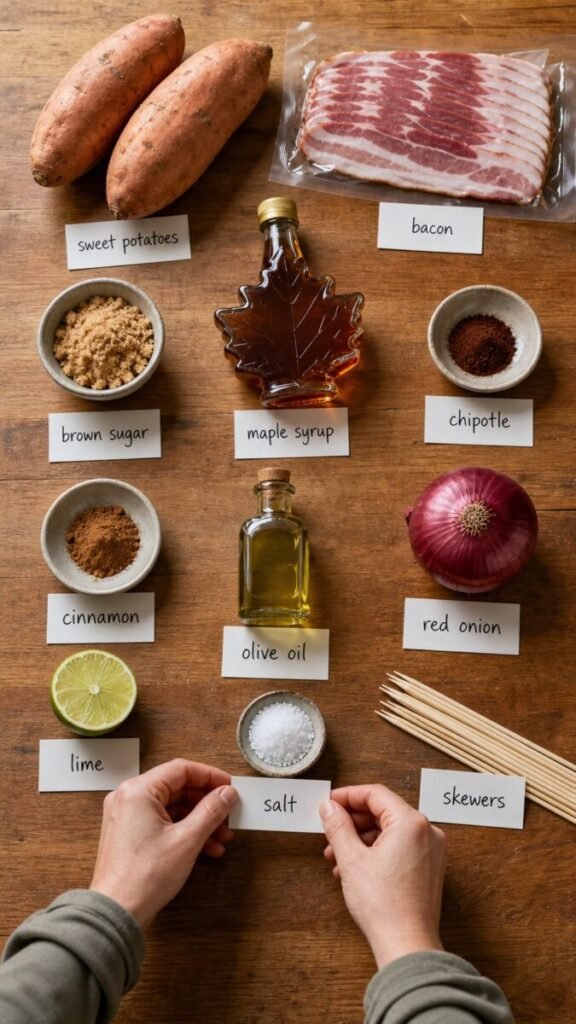
🍠 The Skewer Crew
- Sweet potatoes: 2 lb, peeled and cut into 1¼-inch cubes — roughly 3 medium potatoes
- Bacon: 12 oz, regular-cut — about 12 slices, each halved crosswise
- Red onion: 1 small, cut into wedges and separated into folds
🍁 The Maple-Chipotle Glaze
- Maple syrup: ⅓ cup
- Brown sugar: 2 tablespoons, packed
- Olive oil: 1 tablespoon
- Chipotle powder: 1 teaspoon — smoked paprika plus a pinch of cayenne if that’s the jar you have
- Cinnamon: ½ teaspoon, the quiet bridge of the glaze
- Salt: ½ teaspoon
🍋 At the Platter
- Lime: 1 half, for squeezing over the finished skewers
- Flaky salt: a small pinch over the whole tray
Step by Step How to Make
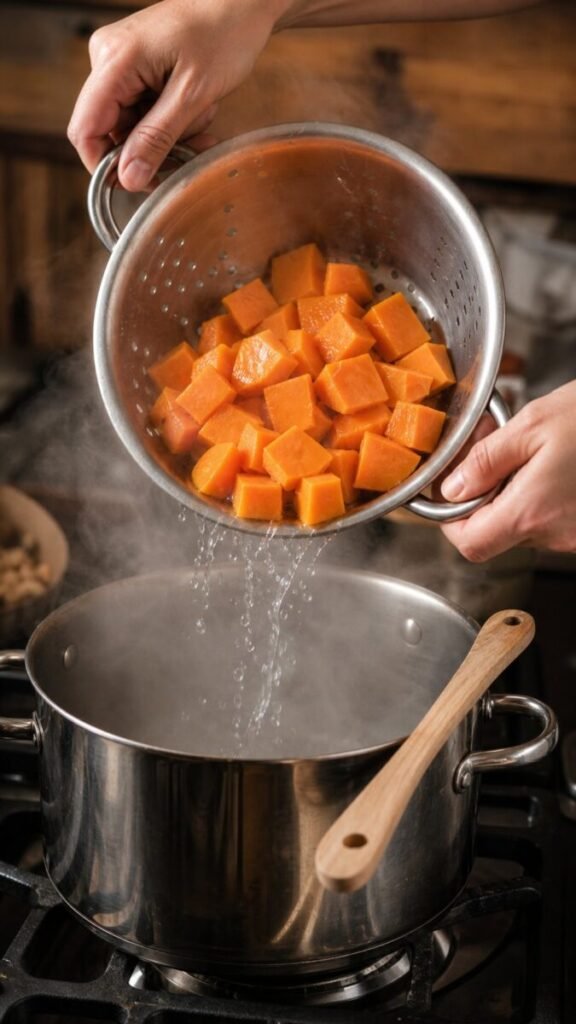
- Step 1 — Parboil the potatoes. Bring a large pot of salted water to a boil and drop in the sweet potato cubes. Cook 5 to 6 minutes — they should yield to a fork at the edges but stay firm at the center, because they have an oven’s worth of cooking left. Drain thoroughly and let them steam off in the colander for a couple of minutes. Wet potatoes water down the glaze, and the glaze deserves better.
- Step 2 — Glaze once. Heat the oven to 400°F. In the big bowl, whisk the maple syrup, brown sugar, olive oil, chipotle, cinnamon, and salt until smooth. Scoop out and reserve about a third of the glaze in a small bowl — that’s the finishing coat. Add the drained potatoes to the big bowl and toss gently until every cube shines. Leave the bacon out of the glaze for now; it’ll pick up plenty in the oven.
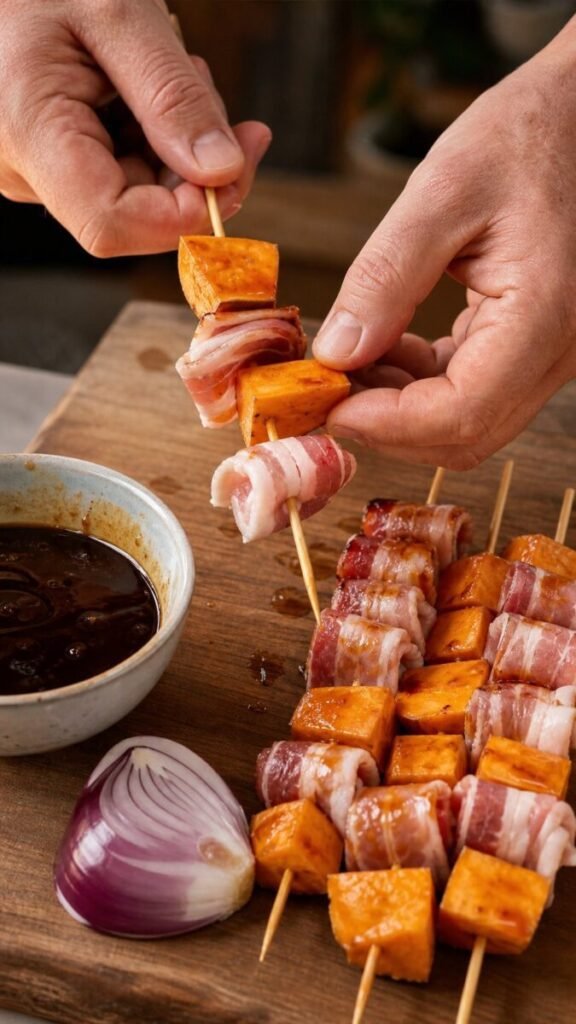
- Step 3 — Thread with breathing room. Take a skewer and build the pattern: potato, folded half-slice of bacon, potato, bacon, and so on, tucking a fold of red onion in every third or fourth slot. Two rules hold the whole step together — fold the bacon so it ruffles rather than lies flat, and leave a finger-width gap between pieces. Ruffled bacon crisps; flat bacon steams. Spaced pieces cook; crowded ones sulk.
- Step 4 — Bake and turn. Lay the skewers on the parchment-lined sheet with a little space between them and slide into the oven. Bake 12 minutes, then turn each skewer with the tongs and bake 10 to 12 minutes more, until the potato edges are dark and caramelized and the bacon is browned and crisp at its ruffles. If the bacon looks close but not there, give the tray 1 to 2 minutes under the broiler — watch it like a hawk, because the glaze goes from caramelized to carbonized in about that long.
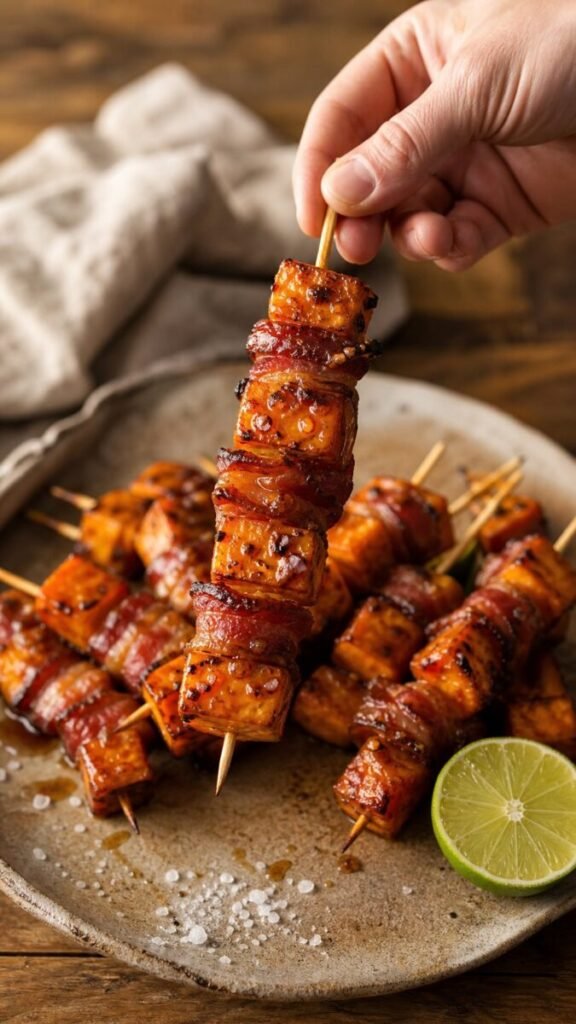
- Step 5 — The second coat. Move the skewers to a serving platter and brush them with the reserved glaze while they’re still hot, so it settles in and stays glossy. Squeeze the lime half over the whole tray and scatter a pinch of flaky salt. The lime is not decoration — a hit of acid is what keeps a sweet glaze tasting bright instead of heavy, and it takes four seconds.
- Step 6 — Serve warm, two minutes ago. These are at their absolute peak right out of the oven, when the glaze is tacky, the bacon snaps, and the potato centers are creamy. Put the platter out with the skewers fanned in one direction — it reads as abundant, and it keeps the glaze from ending up on the table instead of the potatoes. Napkins nearby. You know your people.
Sweet potato shows up all over this kitchen, but these skewers are its party outfit — on weeknights it wears the comfortable stuff, like our Sweet Potato & Black Bean Enchiladas. Same vegetable, same warmth, considerably more glaze.
Anna’s Kitchen Notes
Regular-cut bacon, and here’s why. Thick-cut bacon is wonderful in most jobs, but on a skewer it’s still chewy when the potatoes are already done — it simply can’t render and crisp in the time this recipe has. Regular-cut gets there in the same 22 minutes the potatoes need. Save the thick stuff for Sunday breakfast, where it has all morning.
The potato cube size is a contract. 1¼ inches sounds fussy until you bake one tray of mixed sizes and watch the small cubes turn to candy while the big ones stay stubborn. Even cubes are even skewers, and even skewers are the ones that come back empty. If your potatoes are long and thin, cut the cylinders into coins and then quarters — close enough counts, as long as it’s uniform.
Do the parboil and glaze a day ahead. Cube and parboil the potatoes, toss them in the first coat of glaze, and refrigerate the covered bowl overnight — the glaze soaks in while you sleep. On party day, all that’s left is threading and baking, which turns a 50-minute recipe into a 30-minute one and makes you look suspiciously relaxed for someone hosting. I’ve stopped correcting people’s suspicions.
The broiler is a tool, not a default. One to two minutes at the end can push the bacon from “almost” to “exactly right,” but the glaze’s sugars are sitting right at the edge of burned the whole time, and a broiler does not send a warning shot. Stay at the oven, door cracked, hand on the switch. I have paid for this lesson in smoke-detector beeps so you don’t have to.
Double the batch on two sheets. Twelve skewers is a tasting portion for a real party — double everything and bake two sheets, switching their shelf positions at the turn. Don’t crowd one sheet, and don’t stack skewers on top of each other; the air needs to reach every ruffle of bacon for the crisp to happen. Two trays, two shelves, one switch halfway. That’s the entire scaling math.
The Table Around Them
These skewers are the flashy centerpiece, so give them support staff with different strengths. Something creamy and cool for contrast — a bowl of our Slam Dunk Dip with its sour-cream-and-sriracha tang works beautifully alongside the maple heat. Something warm and cheesy next door, like Longhorn Stuffed Mushrooms, covers the guests who claim they “don’t love sweet things with meat” — they’ll come around by their third skewer, but let them have their journey.
For a bigger spread, add a platter of Pigs in a Blanket so the bacon-and-pastry crowd has its own corner, and the party cheeseball for the cracker people. On holiday tables, the skewers slot in next to the Sweet Potato Lasagna — one sweet potato dish is a side, two is a theme, and themes are what people remember.
Skewer Reruns
Pineapple in the rotation. Trade the red onion for pineapple chunks and the whole skewer goes tropical — the pineapple caramelizes alongside the potato and the bacon finds its classic Hawaiian teammate. Same glaze, same timing, zero new skills.
Thanksgiving-mode glaze. Swap the chipotle for ½ teaspoon of smoked paprika and add a pinch of ground sage to the glaze. Suddenly they’re autumn-holiday skewers that sit happily next to turkey, and you’ve made the one appetizer that doesn’t require oven space on the big day… wait, they do. Make them the day before and re-crisp; see the storage section.
The grill version. Medium heat, oiled grates, 12 to 15 minutes with a quarter-turn every few minutes, glaze reserved for after — grilled bacon fat plus charcoal smoke is a genuine upgrade if the weather is cooperating. The parboil matters even more on the grill; it’s the only way the potatoes finish before the bacon burns. Close the lid between turns.
Marshmallow coda. For the guests who think these are already basically dessert, press a mini marshmallow between the last two cubes of a few skewers for the final two minutes of baking. It toasts, melts slightly, and makes those skewers the first to vanish. My kids have made this the law.
Not-sweet-at-all version. Drop the maple and brown sugar, and toss the parboiled potatoes in olive oil, rosemary, garlic powder, salt, and pepper instead — a completely savory skewer that goes equally well with the bacon. The technique doesn’t change one bit; only the mood does.
The Count on the Stick
| Nutrient | Per Serving (3 of 12 skewers) |
|---|---|
| Calories | 310 kcal |
| Protein | 9 g |
| Carbohydrates | 34 g |
| Fats | 15 g |
Estimates for the skewers as written, glaze included. The sweetness comes with real nutrition attached — sweet potatoes bring fiber, potassium, and all that orange carotenoid color, which makes this one of the few sticky party foods that can look a salad in the eye. The bacon and the glaze do what bacon and sugar do, and I report the numbers without judging anyone. Serving these as a side for six instead of an appetizer for four? Halve the per-person count and the math forgives you.
Storing the Sticks
Leftover skewers keep two days in a covered container in the fridge, and they re-crisp surprisingly well: 8 to 10 minutes in a 400°F oven brings the bacon’s snap back and re-warms the glaze. The microwave is the enemy here — it turns the bacon to rubber and the glaze to regret, and I say that as someone who has tried to shortcut her way around it more than once.
For real make-ahead, freeze the threaded, unglazed skewers solid on the sheet, then bag them for up to a month. Bake from frozen at 400°F for about 30 minutes, glaze and all — add the finishing coat after. This is how a tray of these shows up at a party I’m not cooking at: freezer to oven to platter, and I arrive carrying nothing but a lime.
One warning from the front lines: the glaze caramelizes onto pans with real ambition, so parchment on the baking sheet isn’t optional — scrubbing fossilized maple off a bare sheet pan is nobody’s favorite November activity, and I’ve done enough of it for both of us.
Where It Goes Wrong
Chewy, flabby bacon. Thick-cut bacon, flat-threaded bacon, or skewers packed too tight to let the air circulate. Use regular-cut, fold the slices so they ruffle, and keep finger-width gaps. The bacon’s whole job is surface area; give it some.
Hard potato centers. The parboil got skipped or shortened. Raw potatoes threaded with bacon are a schedule conflict the oven can’t resolve in 25 minutes — five minutes in boiling water first is the peace treaty. If it’s already happened, lower the heat 25 degrees and give the tray ten more minutes, shielded with foil if the bacon is browning.
Burnt glaze, perfect everything else. The sugars in maple and brown sugar catch fast, especially under the broiler and on pan spots directly over the element. Rotate the sheet at the turn, keep the broiler to two watched minutes, and remember that deep amber is the destination — dark brown missed its exit.
Skewers scorched to charcoal at the tips. Wooden skewers skipped their soak. Thirty minutes in water is the difference between skewers and kindling. Metal skips the bath entirely, and a strip of foil laid under the exposed ends works when the soak got forgotten.
Glaze slid off, potatoes went dry. The potatoes went onto the skewers wet, or the glaze was brushed on cold. Dry the parboiled cubes, warm the glaze slightly if it’s thick from the fridge, and coat while the potatoes are still warm enough to drink it in.
They stuck to the parchment. Caramelized sugar is essentially glue with a flattering name. Slide a thin spatula under each skewer the minute they’re out of the oven — wait ten minutes and you’ll be performing surgery. Parchment still beats a bare pan by a mile; it’s the difference between a mess and a memory.
Skewer Questions
Can I grill these instead of using the oven?
Yes, and they’re excellent grilled — medium heat, oiled grates, 12 to 15 minutes with a quarter-turn every few minutes. The parboil becomes even more important, since the grill’s direct heat browns bacon fast while potatoes catch up. Save the glaze for after the grill, not before, or the sugars will scorch over the flames.
Can I make them ahead for a party?
Two ways. Best: parboil and glaze the potatoes a day ahead, then thread and bake on party day — the final work is 30 minutes. Also possible: bake fully, refrigerate, and re-crisp at 400°F for 8 to 10 minutes before serving. They’re very good reheated and never quite as glorious as fresh, so if timing allows, day-of baking wins.
Can I use canned sweet potatoes?
Please don’t — they’re already cooked to softness and will fall apart on the skewer and turn to mush under the glaze. This recipe wants firm, raw cubes that parboil for five minutes and hold their shape through the bake. Fresh sweet potatoes are one of the few places I won’t budge on a shortcut.
What if I don’t have chipotle powder?
Smoked paprika plus a small pinch of cayenne gets you the same smoky warmth with adjustable heat. Plain chili powder works too, a little muddier but perfectly friendly. The glaze is forgiving — it’s maple doing the heavy lifting, and the spice is the accent, not the architecture.
How do I keep the bacon from spinning when people bite off a piece?
Thread the bacon folds so the skewer passes through the bacon twice — fold the half-slice into a loose “S” and run the point through both layers. Double-threaded bacon holds its position, single-threaded bacon spins like a lazy Susan. This is the kind of detail nobody notices until it’s missing.
Can I do a whole sheet of these without skewers?
You can — toss the parboiled potatoes and bacon pieces in glaze and roast everything on one sheet pan, stirring twice, and you’ll get what my family calls “deconstructed skewers.” Same flavor, none of the fun, considerably less dishes-to-photograph. It’s the Tuesday version of a Saturday recipe, and some weeks that’s exactly the version you need.
Maple glaze · Smoky chipotle · Crisp bacon edges
Sweet Potato and Bacon Skewers
Tender sweet potato cubes, loosely folded bacon, and red onion roasted with a maple-chipotle glaze. A final brush of maple and a squeeze of lime bring sweet, smoky, salty bites together.
As an Amazon Associate I earn from qualifying purchases. Ingredient and equipment links below are affiliate links.
Equipment
- 12 metal skewers or bamboo skewers, long enough to leave gaps between ingredients
- Large pot and colander
- Large rimmed baking sheet — use two if needed
- Parchment paper rated for 400°F
- Large mixing bowl and small bowl
- Basting brush
- Tongs
- Chef’s knife and cutting board
Ingredients
The skewer ingredients
- 2 lb (907 g) sweet potatoes, peeled and cut into even 1¼-inch cubes
- 12 oz (340 g) regular-cut bacon, about 12 slices, halved crosswise
- 1 small red onion, cut into wedges and separated into layers
- Salt, for the parboiling water
The bright finish
- ½ lime, for squeezing
- 1 small pinch flaky salt, to taste
The maple-chipotle glaze
- ⅓ cup maple syrup
- 2 tablespoons packed brown sugar
- 1 tablespoon olive oil
- 1 teaspoon chipotle powder
- ½ teaspoon ground cinnamon
- ½ teaspoon salt
Choose thin bacon: Regular-cut bacon cooks more readily than thick-cut bacon in this recipe. Keep its folds loose and shallow; tightly stacked layers can stay undercooked even when the exposed edges are crisp.
Instructions
-
Prepare the skewers and parboil the potatoes
If using bamboo skewers, soak them in water for 30 minutes, beginning before the other prep. Heat the oven to 400°F (200°C). Bring a large pot of salted water to a boil. Add the sweet potato cubes and cook for 5–6 minutes, until the edges begin to soften but the centers remain firm. Drain thoroughly and let the surface moisture steam off. Cool just enough to handle safely.
-
Mix and divide the glaze
Stir together the maple syrup, brown sugar, olive oil, chipotle powder, cinnamon, and ½ teaspoon salt. Before handling the bacon, transfer one-third of the glaze to a separate clean bowl for finishing. Toss the drained potatoes gently with the remaining two-thirds. Keep the reserved glaze and finishing brush away from raw bacon and any utensils used on it.
-
Thread with room for hot air
Divide the potato cubes, bacon, and onion among 12 skewers. Alternate potato pieces with loosely folded half-slices of bacon and occasional onion layers. Aim for about 2 half-slices of bacon per skewer, adjusting for your package’s slice count. Pass the skewer through the bacon folds twice to help secure them, without compressing the folds into a thick bundle. Leave small gaps between ingredients and do not force excess pieces onto a skewer.
-
Bake and turn
Arrange on a parchment-lined rimmed baking sheet with space between skewers. Use a second sheet if needed. Bake for 12 minutes, then carefully turn with tongs. Bake another 10–13 minutes, checking that the potato centers are tender and the bacon is fully cooked through its folds, not just browned at the exposed edges. Follow the bacon package’s cooking guidance and extend the baking time as needed. If the glaze darkens too quickly, loosely shield with foil and continue baking until everything is cooked.
-
Brush with the clean finishing glaze
Using clean utensils, move the cooked skewers to a clean serving platter. Brush with the reserved, uncontaminated glaze while still warm. Squeeze the lime half over the skewers and taste before adding a small pinch of flaky salt.
-
Cool briefly and serve warm
Let the hot glaze and skewers cool for a few minutes before serving. Metal skewers can remain very hot; offer a fork to slide bites onto a plate rather than eating directly from the sharp point. Serve warm while the bacon edges are crisp and the glaze is glossy.
Oven safety: Do not broil these skewers on parchment. The regular oven method avoids that fire risk and gives the bacon folds time to cook. Soaking bamboo reduces scorching but does not make it fireproof; shield exposed ends with foil if they darken.
Timing: Allow about 50–60 minutes, including parboiling, draining, threading, and baking. Start the bamboo soak early so it overlaps prep. Bacon thickness, fold size, and pan crowding can require additional cooking time.