

Flavorful Maple Bacon Breakfast Casserole
This is the breakfast I make when people are coming over and I refuse to spend the morning at the stove. The night before, a dish of cubed bread gets layered with bacon, cheddar, gruyère, and scallions, drowned in an egg-and-milk custard, and put in the fridge to soak. Overnight, while everyone sleeps, the bread drinks the custard — every cube turning into a soft, savory piece of French toast that never met sweetness it couldn’t handle — and in the morning the whole thing bakes into a puffed, golden slab that you cut into eight squares and serve with warm maple syrup at the table. Sweet, salty, smoky, custardy, and ready for a crowd with fifteen minutes of morning effort. It’s the casserole version of the best breakfast plate you’ve ever had: bacon, eggs, toast, and syrup, all in one architectural form.
Let me be precise about what this dish is, because “breakfast casserole” is a big tent. This is the savory strata — bread soaked in egg custard, the format Italian cooks call a strata and every American brunch table calls a breakfast casserole — with maple doing three deliberate jobs rather than getting sloshed on top as an afterthought. Job one: the bacon is candied — brushed with maple in its last minutes in the oven, so it comes out glossy, amber-edged, and sweet-smoky, and it goes on top where it stays crisp instead of sinking into the custard and giving up. Job two: one spoonful of maple goes into the custard itself, where you don’t taste maple so much as you taste roundness — the eggs taste richer, the cheese tastes sharper, and nobody can name why. Job three: warm maple at the table, for the people who want their square to taste like the pancake side of breakfast. Three jobs, one bottle, and a dish that tastes composed instead of sweet.
The technique worth learning here is the custard clock — the relationship between bread, custard, and time — because it’s what separates a silky strata from a soggy one. The bread must be a day old, or briefly toasted, because fresh bread is a closed sponge: it resists the custard, then collapses into gummy layers. Day-old bread has dried out just enough that its structure opens up and it drinks. The soak must be real — a minimum of one hour, overnight is better — because the custard needs time to migrate all the way to the center of each cube; pour it and bake it immediately and you get dry pockets in the middle of a wet dish. And the bake must be gentle and then rested, because egg custard sets between 160°F and 180°F, and pushing past that turns silk into rubber. Every rule in the recipe is one of those three clocks: soak, set, rest. Get them right once and you own every strata, sweet or savory, for the rest of your cooking life.
The Custard Clock
The custard itself is arithmetic: eight eggs to two and a half cups of dairy, which lands the ratio at just about one egg per quarter-cup of liquid — the zone where custard sets tender rather than weepy or rubbery. The dairy is whole milk with a splash of cream if the morning feels like an occasion, though half-and-half in place of both is the classic move and works beautifully. Into the custard go the seasonings that make a strata taste finished rather than like soaked bread: Dijon and dry mustard (they do different things — Dijon rounds, dry mustard sharpens), salt, black pepper, and a whisper of nutmeg, the oldest egg-friendly spice there is. And the maple spoonful, whose job was described above and whose presence nobody will identify — they’ll just say the eggs taste better than eggs.
The bread doctrine deserves its own paragraph, because it’s the most counterintuitive rule in the dish: day-old bread is not a compromise, it’s the requirement. Bread fresh from the oven is full of moisture and its starch is sealed; custard beads off it and the loaf compresses under soaking. Twenty-four hours of sitting (or ten minutes in a 300°F oven) dries the surface and sets the crumb into an open, drinkable structure. This is why strata was invented, historically — it’s a leftover-bread dish, a way to make yesterday’s loaf carry today’s breakfast — and the modern habit of buying fresh brioche for it is the culinary equivalent of buying a dog and barking yourself. Use a sturdy white loaf, sourdough, or brioche; each is addressed properly in the notes.
Then the assembly order, which matters more than it looks. Bread cubes go in first, then the bacon and two-thirds of the cheese and the scallions get scattered through the layers — not stirred — so every square gets seams of flavor rather than a uniform beige. The custard pours over everything, and then the whole dish gets pressed down firmly with a spatula and weighted with a sheet of parchment and whatever’s handy, because the top layer of bread needs to be submerged to drink; dry floaters are the number-one cause of the pale, dry patch that afflicts badly built stratas. The reserved bacon and last third of cheese go on tomorrow, just before the bake — the bacon because it’s candied and deserves to stay crisp, the cheese because a top layer of gruyère browns into something the middle can’t.
⏱️ 25 MIN + AN OVERNIGHT SOAK | 🥓 SERVES 8 | 🍁 THREE JOBS FOR THE MAPLE
- Prep Time: 25 minutes the night before — most of it the bacon
- Soak Time: overnight in the fridge, 8 to 24 hours, doing the real work
- Bake Time: 45 to 50 minutes, covered then uncovered
- Rest Time: 15 minutes, while the custard finishes setting
- Yield: a 9×13 dish — 8 generous squares
The Bacon Ledger
The kit is modest, and one sheet pan does the heavy lifting:
- 9×13 baking dish — glass or ceramic; the 8-square yield assumes it
- Sheet pan and parchment — the bacon’s oven home, where it bakes flat and even instead of curling in a skillet
- Pastry brush — for the maple glaze on the bacon; the back of a spoon works in a pinch
- Big bowl and a whisk — the custard’s studio
- Large glass measuring cup — pour the custard evenly rather than sloshing it from a bowl
- Spatula, plus a sheet of parchment and a small weight — for pressing the top layer under the custard; a second small dish or a couple of buttered ramekins make fine weights
- Foil — the bake starts covered, and the foil is the browning controller
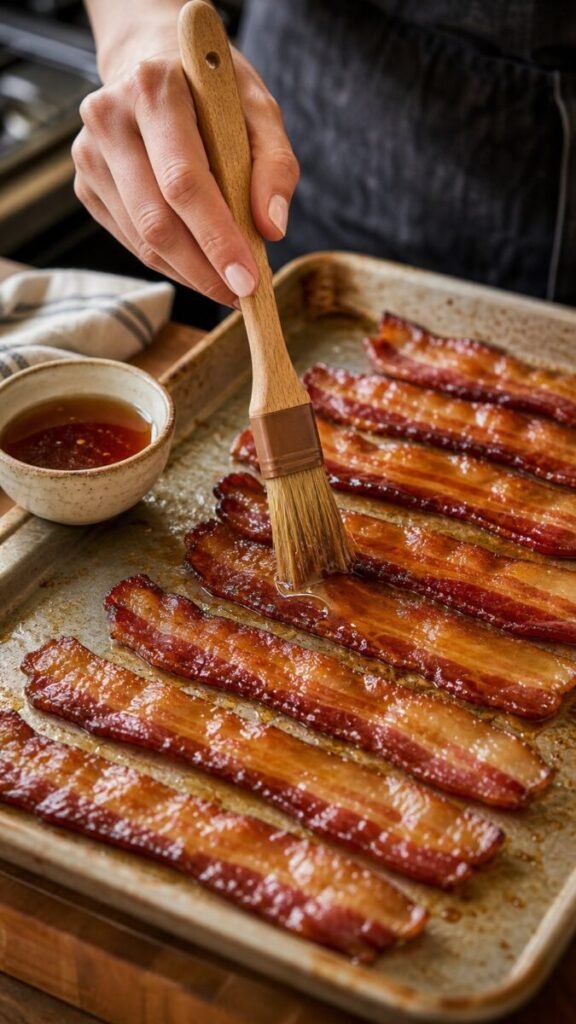
Now the bacon ledger proper, because the bacon decision is the recipe’s biggest flavor lever after the maple. Buy thick-cut. Regular bacon is engineered to crisp into shattering strips on a plate, where its thinness is a feature; in a casserole it needs to hold some chew through a fifty-minute bake, and thin bacon just dissolves into salty confetti. Thick-cut keeps a meaty bite. Cook it in the oven — 400°F, fifteen to eighteen minutes on parchment, flat and unstirred, no spatter on the stovetop — and in the last three minutes, brush it with maple. The syrup hits the hot fat and caramelizes into a thin candy shell, and what you’ve made is candied bacon by way of a two-minute afterthought. Half gets crumbled into the strata; the other half stays in long shards for the top, where its crunch against the custard is the textural point of the whole dish.
Ingredients (With Labels)
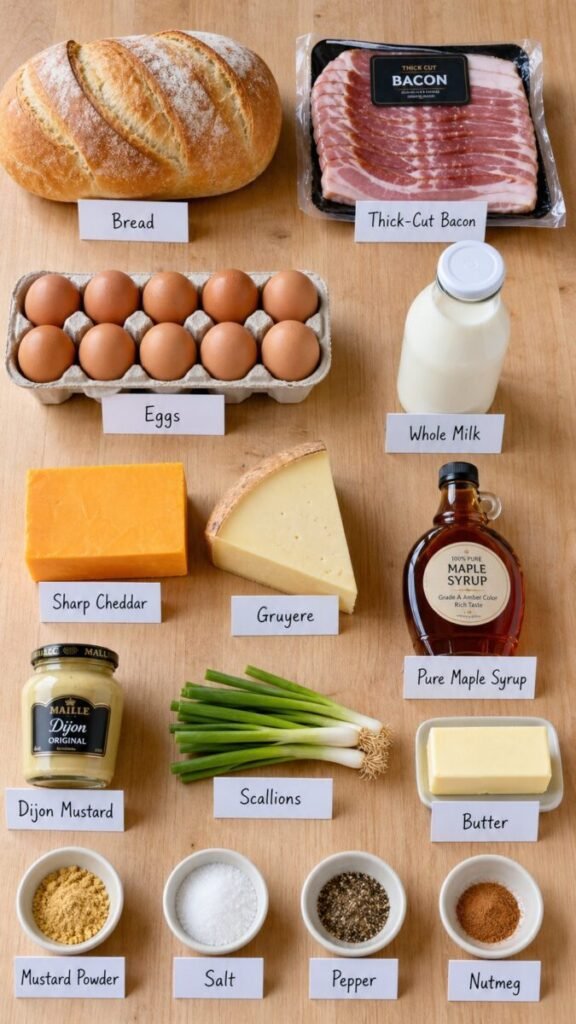
🥓 The Bacon
- Thick-cut bacon: 1 lb — 12 to 14 slices
- Pure maple syrup: ⅓ cup total, divided across three jobs — see below
🍞 The Bread and the Custard
- Sturdy white bread or sourdough: 8 cups in 1-inch cubes — a day old
- Eggs: 8 large
- Whole milk: 2½ cups — or 2 cups milk plus ½ cup cream
🧀 The Cheese and the Fold-Ins
- Sharp cheddar: 1½ cups, grated
- Gruyère: 1 cup, grated — the browning top; swap more cheddar in a pinch
- Scallions: 4, sliced — plus more for the finish
- Dijon mustard: 1 tablespoon
- Dry mustard: ½ teaspoon
- Salt and black pepper: ¾ teaspoon and ½ teaspoon
- Nutmeg: ⅛ teaspoon — a whisper, no more
- Butter: 1 tablespoon, for the dish and the finish
Step by Step How to Make
- Step 1 — The candied bacon. Heat the oven to 400°F and lay the bacon on a parchment-lined sheet pan without overlapping. Bake 12 minutes, until the fat is rendered and the strips are bubbling but not yet crisp — they’ll firm up as they cool, so pull them just shy of done. Pull the pan, brush every strip lightly with a third of the maple, and back in for 3 minutes, until the syrup is caramelized and the edges are dark amber. Cool on the parchment — candied bacon goes from flexible to crisp in about five minutes at room temperature, a transformation that never stops being satisfying. Roughly chop half into crumbles; leave the other half in shard-sized pieces. If you eat one or two shards at the counter, the ledger balances itself — that’s the cook’s cut, and it’s factored in.
- Step 2 — The bread. Drop the oven to 350°F for later, or just turn it off — you’ll reheat it tomorrow. Cut the bread into one-inch cubes, crusts on, and pile them on a sheet pan. If the bread is genuinely day-old and dry to the squeeze, proceed; if it’s fresh, toast the cubes in the 300°F oven for ten minutes, stirring once, until the surfaces feel dry but the insides are still soft. Eight cups of cubes goes into the buttered baking dish, and the bacon crumbles, two-thirds of both cheeses, and most of the scallions get scattered through the layers — seams of flavor, not a stirred mush.
- Step 3 — The custard. In the big bowl, whisk the eight eggs thoroughly — thirty real seconds, until uniform and slightly foamy, because streaky eggs make streaky custard. Whisk in the milk, the second third of the maple syrup, the Dijon, the dry mustard, salt, pepper, and the nutmeg whisper. Pour it slowly and evenly over the whole dish, making sure every region gets its share, and then press the bread down firmly with the spatula — every cube should be moistened and the top layer pushed toward the liquid. If the top layer still floats proud of the custard, weigh it down: a sheet of parchment laid directly on the surface, with a small dish set on top, keeps the drinking honest for the first hour in the fridge. Cover the whole dish with foil or a lid, and into the refrigerator it goes.
- Step 4 — The overnight soak. Now the fridge works and you don’t. Eight hours is the working minimum for the custard to migrate to the center of every cube; anything from eight to twenty-four is the sweet spot, which is why this dish and Saturday were made for each other — assemble Friday night, bake whenever the house wakes up. The soak is also flavor marriage: the mustard and the maple and the nutmeg have all night to get acquainted with the bread and the bacon fat, and a strata baked from an overnight soak tastes rounder than one baked from an hour’s, every time. If you simply don’t have the time, the one-hour minimum soak works — press the bread well and expect a slightly less unified dish — but overnight is the recipe as intended.

- Step 5 — The bake. In the morning, pull the dish out while the oven preheats to 350°F — a cold dish going into a hot oven is a thermal shock the custard doesn’t deserve. Scatter the reserved bacon shards and the last of the gruyère over the top, cover with foil, and bake 30 minutes. Then uncover and bake 15 to 20 more, until the top is puffed and browned and the edges bubble. The doneness test is the wobble, not the clock: nudge the dish, and the center should move like set jello — one soft shudder — not like liquid. A knife inserted off-center should come out clean-ish, with custard clinging in moist bits rather than running wet. If it’s still sloshing, give it five more minutes; custard sets in its own time, and the oven will not be insulted.
- Step 6 — The rest and the table. Rest the dish fifteen minutes before cutting — this is when the last of the setting happens, and squares cut from a rested strata hold their shape while squares cut hot slump into a puddle of deliciousness that’s harder to serve. While it rests, warm the last of the maple with the butter in a small pan until they’re one glossy sauce — thirty seconds — and put it in a pitcher for the table. Then cut the eight squares, top each plate with a scatter of scallions, and let people maple their own — some want a light stripe, some want the full pancake experience, and the pitcher settles it democratically. Coffee, obviously. And the cook, who did the work last night, gets to sit down.

Sweet and savory on one brunch table — this strata and the McGriddle breakfast bake are the two halves of the maple-bacon argument, and I always make both.
Anna’s Kitchen Notes
The bread is the whole texture conversation. A sturdy white loaf or sourdough is the tested base — sourdough’s tang plays beautifully against the maple, and its sturdy crumb drinks without dissolving. Brioche makes a richer, more tender, more dessert-adjacent strata that’s lovely for holiday mornings; it also soaks faster, so check it at the early end of the bake. Whatever the loaf, day-old is the requirement, and the ten-minute toast is the fix for fresh — a strata built on fresh, untoasted bread is how good intentions turn to gummy layers.
Gruyère earns its slot. Cheddar alone is delicious and a little one-note; gruyère brings the nutty melt that browns into the crackly top, and the two together taste like a decision rather than a default. All cheddar works fine; all gruyère is expensive and slightly too elegant for bacon. The one-to-one-and-a-half ratio in the recipe is where my tests landed, and I’ve run this test more times than any casserole deserves, purely for science, with leftovers.
The freezer is the second act. Assembled but unbaked, the strata freezes beautifully for a month: assemble through Step 4, freeze solid wrapped in foil and plastic, then thaw overnight in the fridge and bake as directed, adding five covered minutes for the cold start. Fully baked leftovers also freeze as individual squares, reheated straight from frozen at 350°F for about twenty minutes while you shower. A breakfast that reheats itself while you dress is the closest thing cooking has to a time machine.
The wobble is the only clock that matters. Ovens vary, dishes vary, and custard sets on its own schedule — so bake to the wobble, not the number. Pulled at the soft-shudder stage and rested, the strata finishes setting on the counter and serves silky; baked to “definitely done,” it carries into rubber before the plates are warm. When in doubt, pull early: an under-set center tightens in the rest, but an over-set one never comes back. That’s the custard clock, and it runs every egg dish in the house.
Scale it without thinking. The recipe is a 9×13 for eight, and it halves into an 8×8 for four with every ingredient halved and about five minutes off the bake. Doubling means two dishes, not one bigger one — custard deeper than about two and a half inches in the dish sets unevenly, with rubbery edges around a wet middle. Two dishes, rotated and swapped halfway, feed sixteen and cost you the same fifteen minutes of morning.
The Brunch Table
A brunch spread wants a second egg dish and something sweet, and the site’s breakfast shelf covers both. The eggs benedict casserole is this strata’s elegant sibling — same format, hollandaise ambitions — and the pancake sausage casserole is the all-sweet counterpart for the table’s pancake faction. Between the three casseroles, a brunch for twelve builds itself.
To finish the table: the fluffy banana pancakes are the griddle classic if someone insists on flipping something, the 3-ingredient cottage cheese pancakes are the protein-forward version for the gym contingent, and the air fryer carrot bacon is the crisp, clever side for anyone who wants more bacon on the plate — there’s always someone, and now they’re covered. And for a genuinely Southern brunch swing, the satsuma breakfast gumbo is the conversation piece that makes the whole table feel like an event.
Same Pan, Other Breakfasts
The sausage version. A pound of breakfast sausage, browned and crumbled, stands in for the bacon one-for-one — skip the candying, add a quarter teaspoon of sage to the custard, and the strata goes full diner. Half bacon, half sausage is the crowd-pleasing mixed grill, and the mapled bacon on top of sausage-in-the-middle is my family’s official holiday configuration.
Ham and gruyère. Diced leftover ham and all gruyère, with the Dijon bumped to a tablespoon and a half — this is the croque-monsieur of stratas, and the January-after-Easter version when the fridge is full of ham. The maple on top stays; ham and maple are old, close friends.
The spicy build. Pepper jack for the cheddar, a diced jalapeño scattered with the scallions, and a pinch of cayenne in the custard — sweet, salty, and warm all at once, and the maple cools it just enough to keep the whole table in play. This is the version for the brunch where nobody has anywhere else to be.
Mushroom and spinach, the meatless Monday of stratas. A half pound of mushrooms browned hard and a box of squeezed-dry thawed spinach, feta instead of gruyère — the strata goes vegetarian without losing its architecture, and the maple spoonful in the custard stays, because vegetables benefit from roundness too. Serve the maple on the side for this one; the table will split on it.
The French toast conversion, honestly rated. Brioche, challah custard with cinnamon and vanilla, the candied bacon and toasted pecans on top, and all the maple at the table — this is the sweet family of the dish, and it’s genuinely excellent. It’s also a different recipe wearing the same technique, the way a dessert is a different recipe wearing the same custard. Make it when the table wants sweet; make the savory one when the table wants breakfast. The overnight soak doctrine is the inheritance either way.
Ramekins for the fancy table. The same assembly in six to eight buttered ramekins bakes in twenty-five minutes flat, unmolds like a dream, and turns the casserole into individual towers for a seated brunch. Soak the same, wobble-test the same, and accept the compliment when someone assumes you catered.
The Brunch Math
| Nutrient | Per Serving (1 of 8) |
|---|---|
| Calories | 430 kcal |
| Protein | 23 g |
| Carbohydrates | 28 g |
| Fats | 25 g |
Estimates as written, full cheese and candied bacon ration included, table maple counted at a modest drizzle — pour it like pancake night and the number moves, and worth it. Twenty-three grams of protein per square is the quiet headline: eight eggs, a pound of bacon, and two cheeses add up to a breakfast that carries people to lunch without a snack stop, which is the entire reason casseroles beat danish for hosting. The fat line is bacon, dairy, and butter doing what they were hired for; this is a weekend dish and never pretended otherwise. For lighter builds, the mushroom-spinach version runs leaner, halving into the 8×8 does portion control automatically, and a green salad beside the square — yes, at breakfast, and yes, it works — balances the plate the way the pickle balances a deli sandwich.
The Overnight Rest
The storage story is the recipe’s whole personality: it’s designed to be made ahead. Assembled, the strata keeps 24 hours in the fridge (that’s the soak window anyway) and a full 48 if life intervenes — the bread just keeps drinking, and a 48-hour strata is slightly softer and slightly more unified than a 24-hour one, not worse. Baked leftovers keep four days covered in the fridge and reheat like a dream: a square in a 350°F oven for ten to twelve minutes comes back with the top re-crisped and the custard re-softened, and the microwave at half power is the acceptable fast lane for one, thirty to forty seconds, no shame before coffee.
The freezer takes both forms. Assembled-unbaked for a month, thaw overnight, bake with five extra covered minutes. Baked squares, frozen individually on a tray then bagged, are the weekday breakfast the household will find on its own — they reheat from frozen in a 350°F oven in about twenty minutes, which is exactly one shower. The one thing not to freeze is the candied bacon intended for the top: it loses its crunch in the thaw, so candy the bacon fresh for a from-frozen bake, or accept a softer shard and carry on.
Second careers, briefly: leftover squares, sliced thick and toasted in a buttered skillet until the faces crisp, are objectively better than the original bake — the strata’s own version of fried bread, and my favorite weekday breakfast on this entire site. Cubes of it warmed with a fried egg on top is the full-English shorthand; and any custard you over-poured into a ramekin becomes a small baked egg custard for the cook’s breakfast tomorrow, which is not a leftover so much as a bonus track.
Where It Goes Wrong
A wet, weeping middle. The custard ratio drifted (too much milk for the eggs), the bread was too fresh to drink properly, or the bake came out early — the wobble was liquid and got served anyway. The fixes are arithmetic and patience: eight eggs to two and a half cups dairy, day-old bread, and bake to the soft shudder, then rest. A wet-middle square is still tasty — call it “spoonable” — but the dish built right cuts clean, and now you know which clock misbehaved.
Rubbery, squeaky eggs. The opposite failure: baked past the set point, custard that tightened into firm curds that leak a little whey. Egg protein goes from silk to rubber in a narrow window around 180°F, and a strata forgotten under the broiler crosses it quietly. Bake covered first, uncover late, wobble-test early, and pull at the shudder — the carryover rest finishes the center without the oven’s help. Rubber is permanent; patience is free.
Dry, pale floaters on top. The top layer of bread never met the custard — it wasn’t pressed down, or it bobbed above the liquid line all night and baked dry. The parchment-and-weight trick in Step 3 exists for exactly this. Assemble so every cube is at least dampened, press firmly before the fridge, and if the custard doesn’t quite reach the top, add a splash of milk the next morning until it does. A damp top is the difference between a unified slab and a casserole wearing a dry hat.
Soggy, lost bacon. All the bacon went inside, where fifty minutes of custard converted its crisp to chew — or worse, thin bacon was used and it dissolved entirely. The split is the fix: candied thick-cut crumbles inside for flavor, shards on top for crunch, and the top layer going on just before the bake so it stays glassy. If the top bacon softens under the cheese anyway, three minutes under the broiler at the end brings the crackle back — watch it the whole three minutes.
A bland beige slab. The seasonings were shy and the soak muted them — custard dishes need more salt than seems right because the bread is a blank canvas drinking at full capacity. The Dijon and dry mustard are not optional flavorings; they’re the reason the eggs taste like a restaurant’s. Salt the custard assertively, keep the nutmeg whisper, and taste the custard before it goes on the bread — it should be pleasantly over-seasoned on the tongue, because the bread is about to dilute it by a third.
A burnt top, a raw middle. The foil came off too early, or the dish sat too high in a hot oven. The covered-then-uncovered schedule is the browning controller: foil for the first thirty minutes holds steam and lets the middle set, and the uncovered stretch only browns what’s already built. If the top browns before the wobble sets, tent the foil back on and give the center the time it asked for. The broiler is a finisher, not a shortcut, and it runs on attention.
Bacon Questions
Can I make this the same morning, without the overnight soak?
Yes, with expectations: give it at least one full hour of soaking with a good press on the bread, and know that the result is slightly less unified — the custard hasn’t migrated all the way to the center of every cube. It’s a good dish; the overnight version is the great one. If morning-only is the reality, toast the bread cubes thoroughly before assembly so they drink faster, and cut the dish a little shallower in a 9×13 so the custard travels less distance.
Do I have to candy the bacon?
No, and the casserole works with plain cooked bacon folded through — but you’d be skipping the recipe’s signature move for the sake of three minutes. The maple-brushed finish is what makes the top layer taste like the best part of a pancake breakfast, and it’s the difference between bacon casserole and maple bacon casserole. The brush, the syrup, the three extra minutes: it’s the smallest big upgrade in the dish.
What bread should I use?
Sturdy white or sourdough, a day old — the full doctrine is in the notes above. Sourdough brings tang that plays against the maple; brioche brings richness and turns the dish toward the sweet side; plain sandwich bread works in a pinch but tends toward softness, so toast it well. Whatever you choose, the day-old rule is the one that matters: dry bread drinks custard, fresh bread resists it and goes gummy.
Can I assemble it and freeze instead of refrigerate?
Yes — through Step 4, wrapped airtight, for up to a month. Thaw it overnight in the fridge first (a frozen-solid strata straight into the oven bakes unevenly no matter how long you give it), then add the bacon shards and cheese and bake as directed with five extra covered minutes. Candied bacon for the top is better made fresh, since the freeze-thaw softens its crunch.
Why is my strata watery or weeping?
Three usual suspects: the dairy-to-egg ratio drifted rich (measure the milk, count the eggs), the bread was too fresh to absorb its share, or the dish was cut hot before the rest set the custard. The recipe’s arithmetic — eight eggs, two and a half cups dairy, eight cups day-old bread — plus the fifteen-minute rest handles all three. A weeping square still tastes fine; a rested one looks like the recipe photo, and both get eaten.
Can I make it without maple syrup?
You can — it becomes a classic bacon-cheddar strata, still excellent — but you lose the dish’s personality. Honey stands in for the custard spoonful and the candied finish with a different accent, or brown the butter for the table sauce and skip sweetness altogether. Real maple is the tested version, and a third of a cup across eight servings is a modest line item for what it does.
How do I know when it’s done?
The wobble test, always: nudge the dish, and the center should move like set jello — one soft shudder — with the edges puffed, the top browned, and a knife off-center coming out with moist crumbs rather than running custard. Pull it at the shudder and rest fifteen minutes; the carryover finishes the set. When in doubt, early — custard tightens as it cools, and rubber never loosens.
Flavorful Maple Bacon Breakfast Casserole
Ingredients
As an Amazon Associate I earn from qualifying purchases.
Maple bacon
- 1 lb thick-cut bacon
- ⅓ cup pure maple syrup, divided: 2 tablespoons for the bacon, 1 tablespoon for the custard, and the remaining 2 tablespoons plus 1 teaspoon for serving
Bread & custard
- 8 cups 1-inch cubes of day-old sturdy white bread or sourdough
- 8 large eggs
- 2½ cups whole milk, or 2 cups milk plus ½ cup heavy cream
- 1 tablespoon Dijon mustard
- ½ teaspoon dry mustard
- ½–¾ teaspoon salt, using less for particularly salty bacon or cheese
- ½ teaspoon black pepper
- ⅛ teaspoon nutmeg
Cheese, scallions & butter
- 1½ cups grated sharp cheddar, divided: 1 cup inside and ½ cup on top
- 1 cup grated Gruyère, divided: ⅔ cup inside and ⅓ cup on top
- 4 scallions, sliced, plus more for finishing if desired
- 1 tablespoon unsalted butter, divided: 1 teaspoon for the dish and 2 teaspoons for the serving syrup
Kitchen Tools
- 9×13-inch metal baking pan, or a baking dish used according to its manufacturer’s temperature-change instructions
- Rimmed sheet pan, plus a second if needed to avoid overlapping bacon
- Parchment paper, rated for at least 400°F
- Pastry brush
- Large mixing bowl and whisk
- Large liquid measuring jug
- Measuring cups and spoons
- Cutting board and bread knife
- Box grater
- Spatula and foil
- Instant-read food thermometer
- Small saucepan and serving pitcher
Directions
- Cook and glaze the bacon. Heat the oven to 400°F. Arrange the bacon in a single layer on a parchment-lined rimmed sheet pan, using two pans if necessary. Bake until nearly done, beginning to check at 15 minutes; thick-cut bacon may take 20–25 minutes or longer overall. Brush lightly with the measured 2 tablespoons maple syrup during the final 2–3 minutes and finish cooking the bacon fully. Watch closely so the syrup does not scorch. Cool briefly, then chop half for the filling and break the remainder into topping pieces. Refrigerate the topping bacon promptly in a separate covered container.
- Prepare the bread and layer the filling. If the bread is fresh or very soft, spread the cubes on a sheet pan and dry them in a 300°F oven for about 10–15 minutes, stirring once, then cool. Grease the baking pan with 1 teaspoon butter. Layer in the bread, chopped filling bacon, 1 cup cheddar, ⅔ cup Gruyère, and the sliced scallions. Cover and refrigerate the remaining cheeses separately for topping the casserole the next day.
- Whisk the custard and soak overnight. Whisk the eggs until uniform, then whisk in the milk, 1 tablespoon maple syrup, Dijon, dry mustard, salt, pepper, and nutmeg. Do not taste the raw custard. Pour evenly over the bread and press gently with a spatula until all the cubes are moistened. Cover and refrigerate at 40°F or below for 8–24 hours. Press the top down again after the first 30 minutes if needed. Do not leave the casserole on the counter to soak or add extra milk simply to submerge the bread.
- Begin the covered bake. Heat the oven to 350°F. Remove any wrapping used during soaking, scatter the reserved ½ cup cheddar and ⅓ cup Gruyère over the casserole, and cover with foil. Bake for 30 minutes. Use bakeware approved for the temperature transition; a short rest on the counter does not guarantee that refrigerated glass or ceramic can safely enter a hot oven.
- Uncover and bake until the center is safely set. Remove the foil and continue baking for about 20–35 minutes, or until the center reaches at least 160°F and no liquid custard remains. Add the reserved cooked bacon pieces during the final 5–10 minutes so their maple coating does not spend the entire bake exposed to heat. If the top browns too quickly, tent loosely with foil. Use the thermometer in the center, not just near an edge; a wobble or knife test alone cannot verify safe doneness. Do not remove an undercooked center expecting the rest to finish cooking it.
- Rest, warm the syrup, and serve. Rest the casserole for 15 minutes before cutting. Meanwhile, gently warm the remaining 2 tablespoons plus 1 teaspoon maple syrup with the remaining 2 teaspoons butter, stirring to combine. Cut the casserole into eight portions, finish with extra scallions if desired, and pass the warm syrup separately. Allow about 65–80 minutes for the morning bake and rest, in addition to oven preheating.
Nutrition
| Nutrient | Approximate amount per serving (⅛ batch) |
|---|---|
| Calories | 520 kcal |
| Protein | 29 g |
| Carbohydrates | 35 g |
| Total fat | 29 g |
Estimated using approximately 400 g bread, 170 g cheddar, 110 g Gruyère, whole milk, and about 180 g cooked, drained bacon from the 1 lb raw package. Includes the full ⅓ cup maple syrup and 1 tablespoon butter. Bread density, bacon cooking yield, brands, and syrup left unserved can substantially change the values.